The Darent Valley
CTG MasterClass
Course Bringing order to Chaos
Mark Waterstone
Consultant Obstetrician
Why this course?
• Provide physiological basis for CTG interpretation
• Offer tools and solutions to improve fetal outcomes
• Illustrate with case studies
• Suggest interface language to communicate with
others
Timetable
• Introduction - fetal monitoring in the wider context
• Physiology and pathophysiology
• The four features
• Acid-base analysis
• Use of ultrasound
• Required documentation (NICE & CNST)
• NICE or FIGO?
• CTGs: Stories they could tell …
• Case studies
The Aim of Obstetrics
Healthy mum
Healthy babe(s)
[happy family]
NOT a vaginal
delivery at any cost
Obstetrics is not science
but art
based on science
“The major correctable error for avoidance of intra-
partum related deaths was the interpretation of
EFM traces”
Mary MacIntosh
J Roy Soc Med 2001 94:14-16
Fetal “monitoring”
Antepartum
– Nuchal / combined testing
– Anomaly scans
– Fetal activity (objective / subjective)
– Ultrasound:
• Growth
• Dopplers
• Liquor Volume
• Biophysical Profile
– CTG (non-stress test)
Fetal Movement
• A sudden change in fetal movements
should always be followed by CTG
• Second presentation should have
CTG + USS (within 48 hours)
Fetal monitoring
Intrapartum
– Auscultation
• Intermittent (Pinard / electronic)
– CTG
• Continuous (EFM – electronic fetal monitoring)

• +/- FBS (fetal blood sample)
• +/- FSS (fetal scalp stimulation)
– STAN
• Fetal ECG
– Liquor
• quantity and quality (meconium/blood)
Intermittent Auscultation
Duration: for at least 60 seconds
during and at least 30 seconds after a contraction
for 3 contractions if the FHR is not always in the normal range
Baseline (as a single counted number in bpm)
presence or absence of accelerations and decelerations.
Interval: Every 15 minutes in the active phase of the first stage of labour.
Every 5 minutes in the second stage of labour.
Uterine contractions: Before and during FHR auscultation, in order to detect at least
two contractions.
Fetal movements: at the same time as evaluation of contractions
Maternal heart rate: At the time of FHR auscultation.
FIGO 2015
Fetal heart rate:
external probes susceptible to recording
maternal rate (esp second stage)
Internal probes more invasive
Uterine activity:
External pressure transducer susceptible to
maternal interference
Continuous CTG
Continuous CTG
• Never subjected to randomised controlled trials
• PPV 40-60 %
• NPV 99 %
• Associated with a reduction in neonatal
seizures, but …
• No significant differences in cerebral palsy,
infant mortality, etc
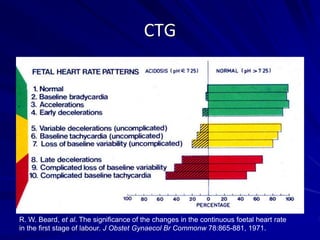
CTG
R. W. Beard, et al. The significance of the changes in the continuous foetal heart rate
in the first stage of labour. J Obstet Gynaecol Br Commonw 78:865-881, 1971.
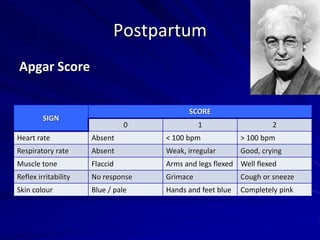
Postpartum
Apgar Score
SIGN
SCORE
0 1 2
Heart rate Absent < 100 bpm > 100 bpm
Respiratory rate Absent Weak, irregular Good, crying
Muscle tone Flaccid Arms and legs flexed Well flexed
Reflex irritability No response Grimace Cough or sneeze
Skin colour Blue / pale Hands and feet blue Completely pink
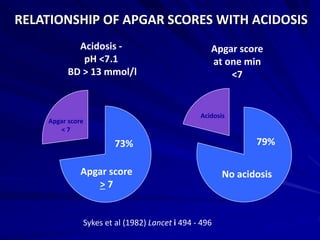
Acidosis -
pH <7.1
BD > 13 mmol/l
RELATIONSHIP OF APGAR SCORES WITH ACIDOSIS
Apgar score
< 7
Apgar score
> 7
Acidosis
No acidosis
Apgar score
at one min
<7
Sykes et al (1982) Lancet i 494 - 496
73% 79%
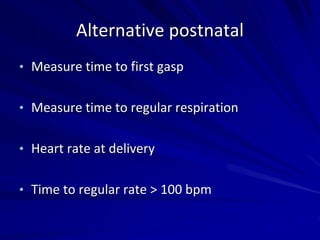
Alternative postnatal
• Measure time to first gasp
• Measure time to regular respiration
• Heart rate at delivery
• Time to regular rate > 100 bpm
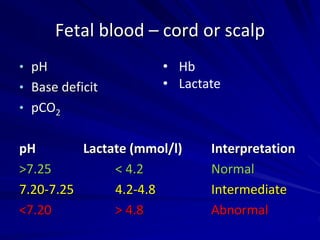
Fetal blood – cord or scalp
• pH
• Base deficit
• pCO2
pH Lactate (mmol/l) Interpretation
>7.25 < 4.2 Normal
7.20-7.25 4.2-4.8 Intermediate
<7.20 > 4.8 Abnormal
• Hb
• Lactate
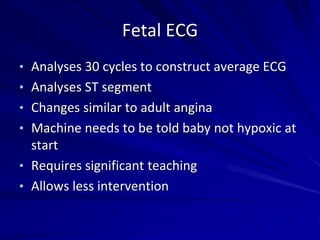
Fetal ECG
• Analyses 30 cycles to construct average ECG
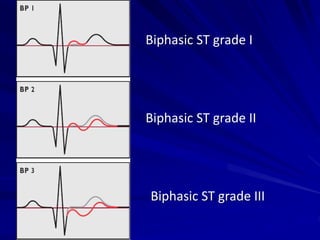
• Analyses ST segment
• Changes similar to adult angina
• Machine needs to be told baby not hypoxic at
start
• Requires significant teaching
• Allows less intervention
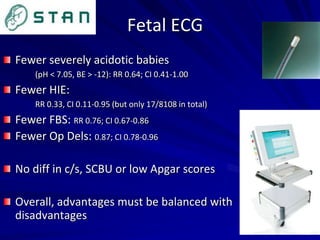
Fetal ECG
Fewer severely acidotic babies
(pH < 7.05, BE > -12): RR 0.64; CI 0.41-1.00
Fewer HIE:
RR 0.33, CI 0.11-0.95 (but only 17/8108 in total)
Fewer FBS: RR 0.76; CI 0.67-0.86
Fewer Op Dels: 0.87; CI 0.78-0.96
No diff in c/s, SCBU or low Apgar scores
Overall, advantages must be balanced with
disadvantages
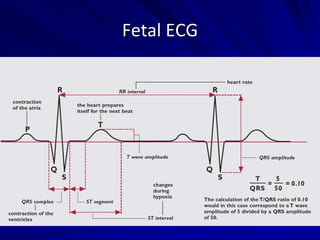
Fetal ECG
Biphasic ST grade I
Biphasic ST grade II
Biphasic ST grade III
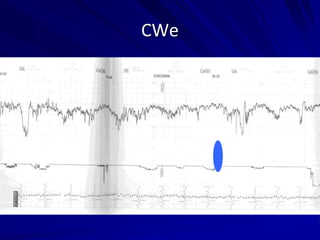
CWe
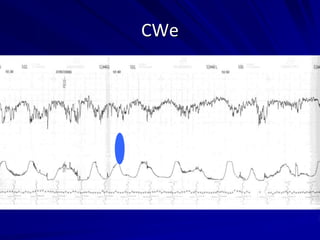
CWe
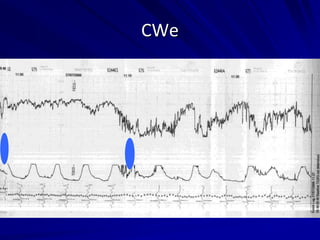
CWe
The Darent Valley
CTG MasterClass
Course
Bringing order to Chaos
Physiology / Pathophysiology of
fetal heart rate regulation
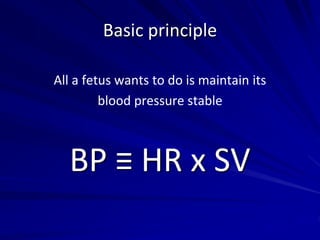
Basic principle
All a fetus wants to do is maintain its
blood pressure stable
BP ≡ HR x SV
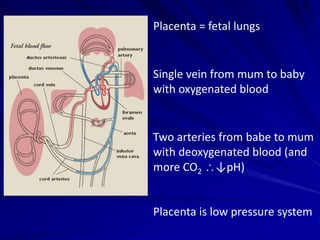
Placenta = fetal lungs
Single vein from mum to baby
with oxygenated blood
Two arteries from babe to mum
with deoxygenated blood (and
more CO2 ↓pH)
Placenta is low pressure system
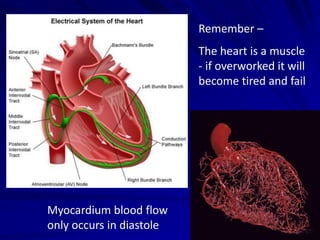
Remember –
The heart is a muscle
- if overworked it will
become tired and fail
Myocardium blood flow
only occurs in diastole
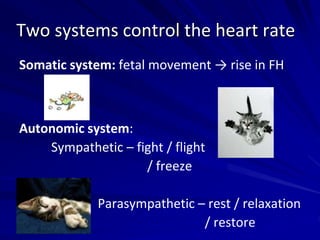
Somatic system: fetal movement → rise in FH
Autonomic system:
Sympathetic – fight / flight
/ freeze
Parasympathetic – rest / relaxation
/ restore
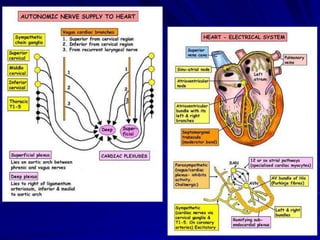
Two systems control the heart rate
Control of Fetal Heart Rate
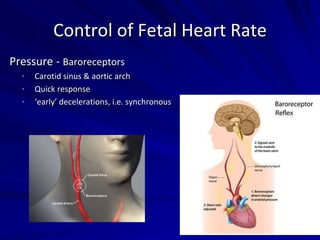
Pressure - Baroreceptors
• Carotid sinus & aortic arch
• Quick response
• ‘early’ decelerations, i.e. synchronous
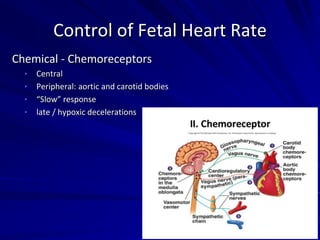
Chemical - Chemoreceptors
• Central
• Peripheral: aortic and carotid bodies
• “Slow” response
• late / hypoxic decelerations
Control of Fetal Heart Rate
• Stress - maternal
– Adrenaline
– Cortisol
• Others
– Drugs
• pethidine, methyl dopa etc…
– pyrexia
• Stress – Fetal
– Adrenaline
– Cortisol
Labour is stressful
the baseline rate will
always increase
before
hypoxic changes appear
e.g. Non-physiological decelerations or reduction in variability
The Four Features
• Baseline Rate
– Reduces with increasing gestation because of increasing
parasympathetic influence
• Baseline Variability (‘bandwidth’)
– Battle of sympathetic with parasympathetic
• Accelerations
– Increase of 15 by 15.
– “If you have to count it, it ain’t there” Waterstone 2009
• Decelerations
– Decrease of 15 by 15, but not if variability reduced
Baseline Rate
• Mean level of the most horizontal and less oscillatory segments
• Normal range 110-160 bpm (NICE: 100-160)
• Reduces with advancing gestation with greater parasympathetic
influence
• Rises with maternal pyrexia (usually 1 hour before ↑ temp)
• First sign of hypoxic stress is increase in baseline = normal
physiologic response
• Will not reduce unless intra-uterine environment improves (e.g.
reduce contractions, change position, ↑ BP)
Variability
• The range of rate above and below the baseline (‘bandwidth’)
over 1 minute
• Normal range 5-25 bpm
• Single most important feature indicating fetal well being
• Physiological cycling (sleep/wake pattern) indicates good health,
even with reduced variability
• Beware reduction during labour
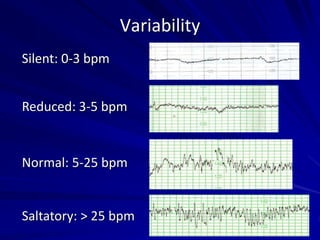
Variability
Silent: 0-3 bpm
Reduced: 3-5 bpm
Normal: 5-25 bpm
Saltatory: > 25 bpm
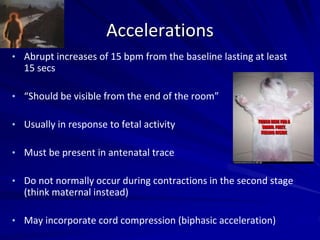
Accelerations
• Abrupt increases of 15 bpm from the baseline lasting at least
15 secs
• “Should be visible from the end of the room”
• Usually in response to fetal activity
• Must be present in antenatal trace
• Do not normally occur during contractions in the second stage
(think maternal instead)
• May incorporate cord compression (biphasic acceleration)
Decelerations
• Reduction in the baseline of 15 bpm lasting at least 15 seconds
• With a tired myocardium the decelerations may be shallow
(<15 bpm) and are more sinister – usually associated with
reduced variability
• May be a physiological response by the fetus to its environment
• Head compression – early (synchronous)
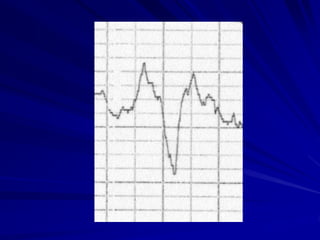
• Cord compression – classic appearance with shouldering
but….
do not forget contractions
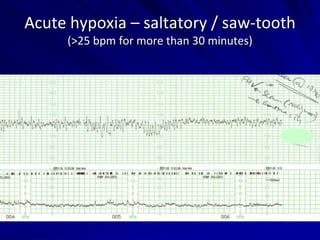
Acute hypoxia – saltatory / saw-tooth
(>25 bpm for more than 30 minutes)
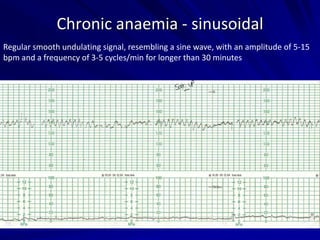
Chronic anaemia - sinusoidal
Regular smooth undulating signal, resembling a sine wave, with an amplitude of 5-15
bpm and a frequency of 3-5 cycles/min for longer than 30 minutes
Types of deceleration
• Early
– Synchronous with and mirroring the contraction
– Mediated by baroreceptors
– Caused by head compression
– Not associated with hypoxia
Types of deceleration
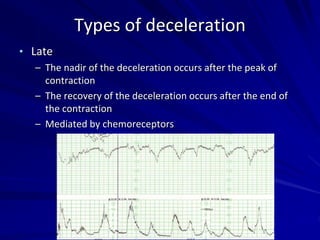
• Late
– The nadir of the deceleration occurs after the peak of
contraction
– The recovery of the deceleration occurs after the end of
the contraction
– Mediated by chemoreceptors
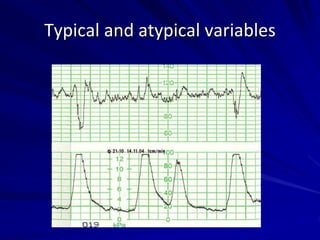
Variable decelerations
Standard teaching
• Typical
• Atypical
CTG MasterClass
• Typical
• Atypical
• Others
– unnamed as yet
– usually / almost always in
labour therefore:
LABOUR VARIABLES
Basic principle
All a fetus wants to do is maintain its
blood pressure stable
BP ≡ HR x SV
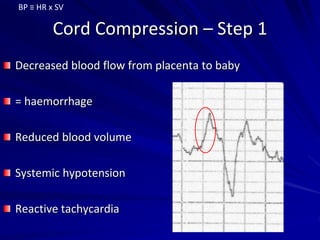
Cord Compression – Step 1
Decreased blood flow from placenta to baby
= haemorrhage
Reduced blood volume
Systemic hypotension
Reactive tachycardia
BP ≡ HR x SV
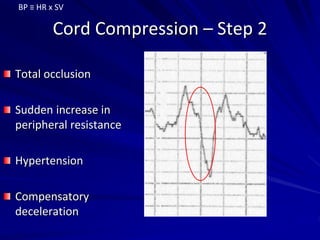
Cord Compression – Step 2
Total occlusion
Sudden increase in
peripheral resistance
Hypertension
Compensatory
deceleration
BP ≡ HR x SV
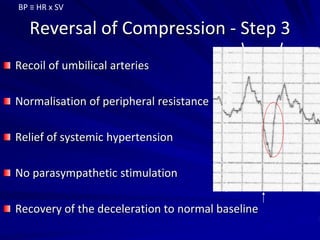
Reversal of Compression - Step 3
Recoil of umbilical arteries
Normalisation of peripheral resistance
Relief of systemic hypertension
No parasympathetic stimulation
Recovery of the deceleration to normal baseline
BP ≡ HR x SV
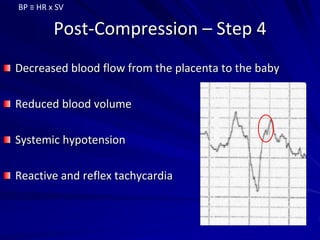
Post-Compression – Step 4
Decreased blood flow from the placenta to the baby
Reduced blood volume
Systemic hypotension
Reactive and reflex tachycardia
BP ≡ HR x SV
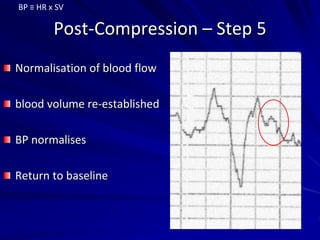
Post-Compression – Step 5
Normalisation of blood flow
blood volume re-established
BP normalises
Return to baseline
BP ≡ HR x SV
Typical and atypical variables
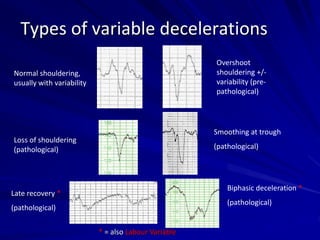
Types of variable decelerations
Normal shouldering,
usually with variability
Loss of shouldering
(pathological)
Late recovery *
(pathological)
Overshoot
shouldering +/-
variability (pre-
pathological)
Smoothing at trough
(pathological)
Biphasic deceleration *
(pathological)
* = also Labour Variable
The Darent Valley
CTG MasterClass
Course Bringing order to Chaos
Fetal acid-base status
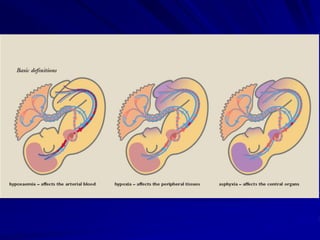
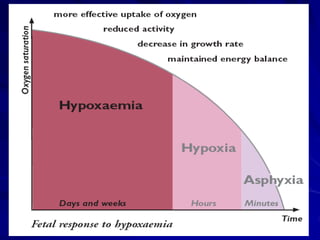
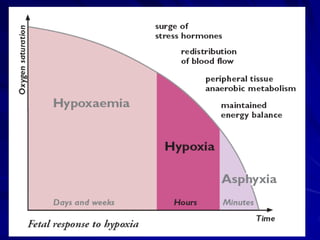
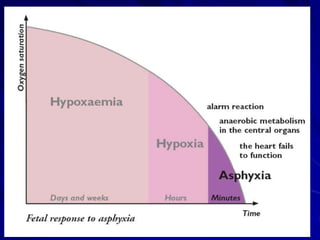
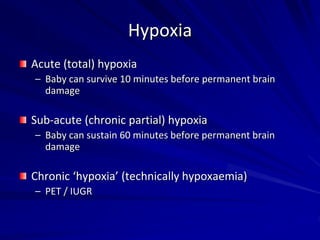
Hypoxia
Acute (total) hypoxia
– Baby can survive 10 minutes before permanent brain
damage
Sub-acute (chronic partial) hypoxia
– Baby can sustain 60 minutes before permanent brain
damage
Chronic ‘hypoxia’ (technically hypoxaemia)
– PET / IUGR
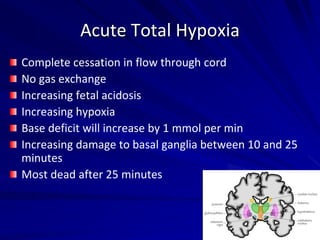
Acute Total Hypoxia
Complete cessation in flow through cord
No gas exchange
Increasing fetal acidosis
Increasing hypoxia
Base deficit will increase by 1 mmol per min
Increasing damage to basal ganglia between 10 and 25
minutes
Most dead after 25 minutes
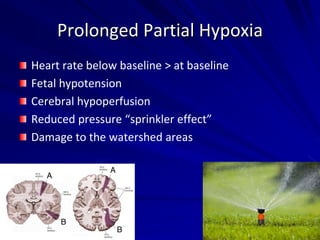
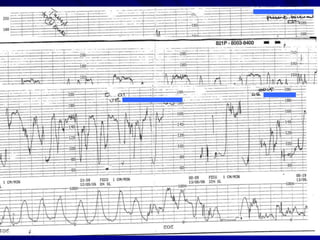
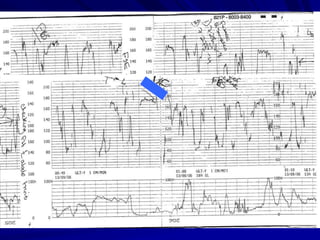
Prolonged Partial Hypoxia
Heart rate below baseline > at baseline
Fetal hypotension
Cerebral hypoperfusion
Reduced pressure “sprinkler effect”
Damage to the watershed areas
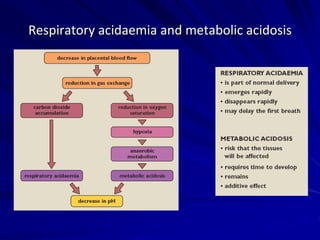
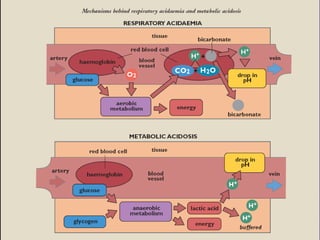
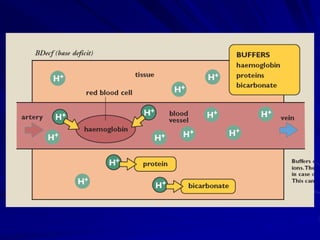
Respiratory acidaemia and metabolic acidosis
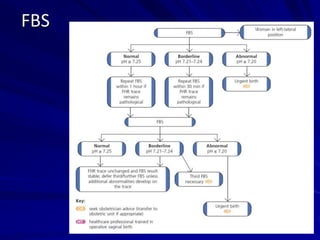
FBS
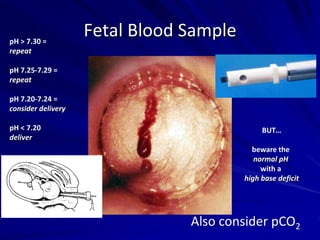
Fetal Blood SamplepH > 7.30 =
repeat
pH 7.25-7.29 =
repeat
pH 7.20-7.24 =
consider delivery
pH < 7.20
deliver
BUT…
beware the
normal pH
with a
high base deficit
Also consider pCO2
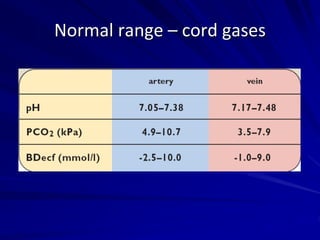
Normal range – cord gases
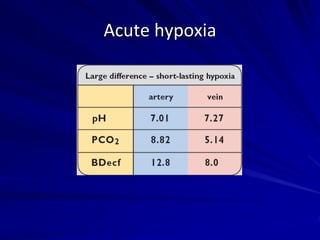
Acute hypoxia
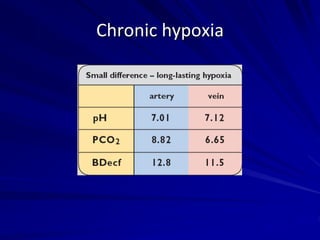
Chronic hypoxia
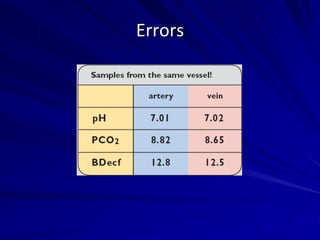
Errors
Cord Bloods
• Essential to differentiate between
– Acute hypoxia
– Chronic hypoxia
– Acute on chronic hypoxia
• Requires both venous and arterial samples
with pH and base deficit
• Arterial pH ALWAYS lower than venous
The Darent Valley
CTG MasterClass
Course Bringing order to Chaos
markwaterstone@obstetricexpert.co.uk
Use of Ultrasound in
Fetal Monitoring
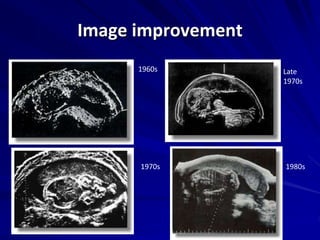
Image improvement
1980s1970s
Late
1970s
1960s
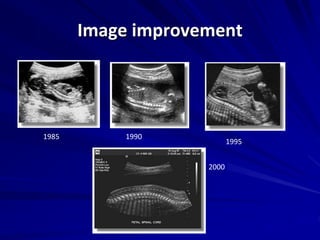
Image improvement
1985
2000
1990
1995
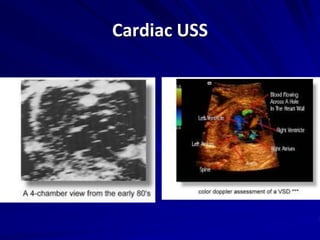
Cardiac USS
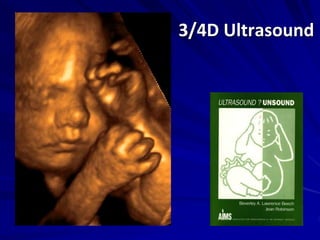
3/4D Ultrasound
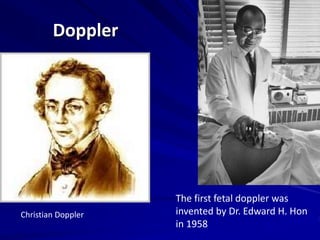
Doppler
Christian Doppler
The first fetal doppler was
invented by Dr. Edward H. Hon
in 1958
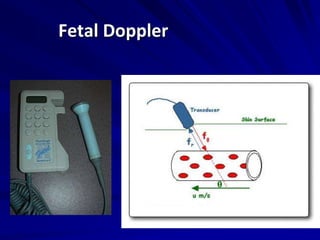
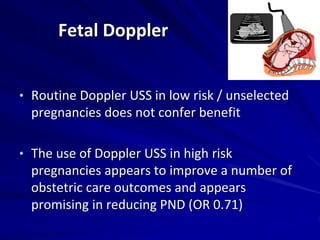
Fetal Doppler
Fetal Doppler
• Routine Doppler USS in low risk / unselected
pregnancies does not confer benefit
• The use of Doppler USS in high risk
pregnancies appears to improve a number of
obstetric care outcomes and appears
promising in reducing PND (OR 0.71)
High-Risk Doppler
• Fewer IOL (OR 0.83; 0.74-0.93)
• Fewer TCIs (OR 0.56; 0.43-0.72)
but no difference in …
• Fetal “distress” in labour (OR 0.81; 0.59-1.13)
• Caesarean delivery (OR 0.94; 0.82-1.06)
An early stage in fetal adaptation
to hypoxaemia
• Central redistribution of blood flow (brain-
sparing reflex)
• Increased blood flow to protect the brain,
heart and adrenals
• Reduced flow to the peripheral and placental
circulations
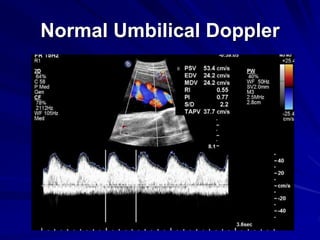
Normal Umbilical Doppler
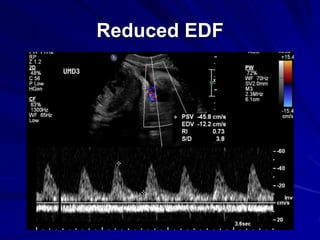
Reduced EDF
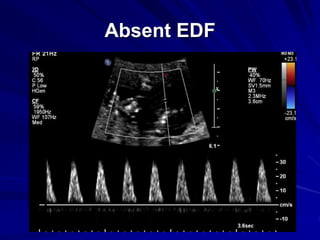
Absent EDF
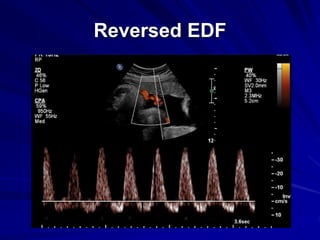
Reversed EDF
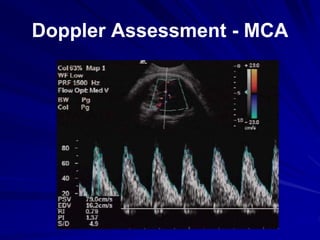
Doppler Assessment - MCA
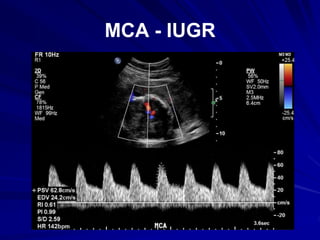
MCA - IUGR
Doppler wave form of early stage of fetal
hypoxaemia
• Increased end-diastolic flow (EDF) in the
middle cerebral artery
– ↓MCA pulsatility index (PI) / resistance index (RI)
• Decreased end-diastolic flow in the umbilical
artery
– ↑umbilical artery RI
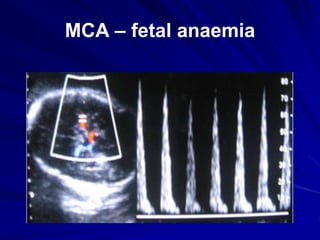
MCA – fetal anaemia
Reference for Dopplers
https://iame.com/online/multi_vessel_dopple
r/content.php
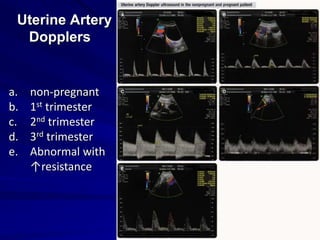
Uterine Artery
Dopplers
a. non-pregnant
b. 1st trimester
c. 2nd trimester
d. 3rd trimester
e. Abnormal with
↑resistance
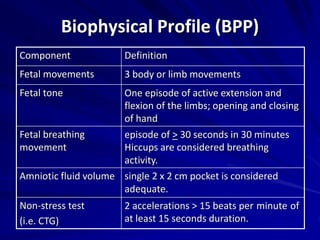
Biophysical Profile (BPP)
Component Definition
Fetal movements 3 body or limb movements
Fetal tone One episode of active extension and
flexion of the limbs; opening and closing
of hand
Fetal breathing
movement
episode of > 30 seconds in 30 minutes
Hiccups are considered breathing
activity.
Amniotic fluid volume single 2 x 2 cm pocket is considered
adequate.
Non-stress test
(i.e. CTG)
2 accelerations > 15 beats per minute of
at least 15 seconds duration.
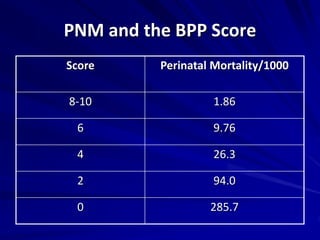
PNM and the BPP Score
Score Perinatal Mortality/1000
8-10 1.86
6 9.76
4 26.3
2 94.0
0 285.7
BPP - Cochrane
• Not enough evidence to support use in high-risk
pregnancies
• Associated with significantly increased use of
induction and caesarean section
• Recommended by NICE for monitoring of twins
in late pregnancy
USS - Summary
USS has a central place in fetal monitoring
Caution regarding predictions
Cannot be used in isolation
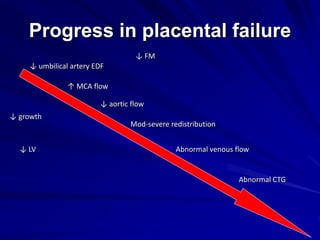
Progress in placental failure
↓ umbilical artery EDF
↑ MCA flow
↓ aortic flow
Mod-severe redistribution
↓ growth
Abnormal venous flow
↓ FM
↓ LV
Abnormal CTG
The Darent Valley
CTG MasterClass
Course
Bringing order to Chaos
markwaterstone@obstetricexpert.co.uk
NICE / CNST
NICE provides......
... the alphabet blocks from which words are made
It is not the words themselves
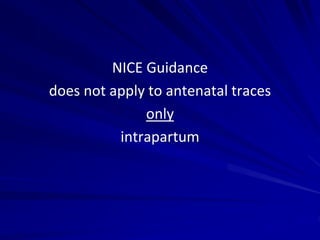
NICE Guidance
does not apply to antenatal traces
only
intrapartum
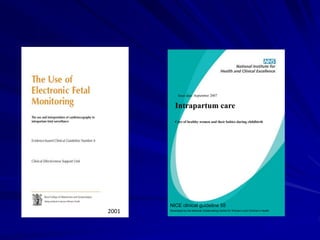
Issue date: September 2007
NICE clinical guideline 55
Developed by the National Collaborating Centre for Women’s and Children’s Health
Intrapartum care
Care of healthy women and their babies during childbirth
2001
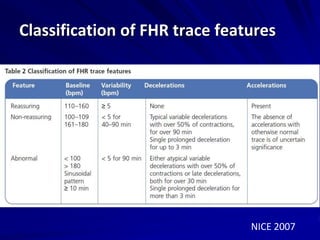
Classification of FHR trace features
NICE 2007
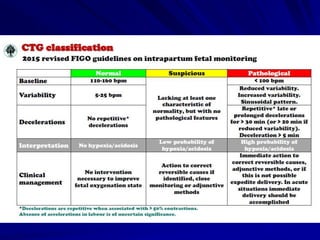
FIGO Classification
FIGO 2015
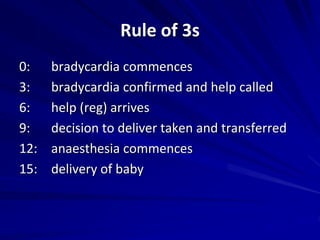
Rule of 3s
0: bradycardia commences
3: bradycardia confirmed and help called
6: help (reg) arrives
9: decision to deliver taken and transferred
12: anaesthesia commences
15: delivery of baby
Hinshaw K (1996) ALSO course manual
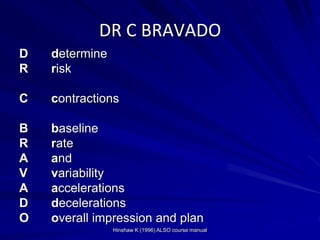
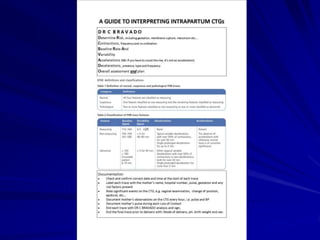
DR C BRAVADO
D determine
R risk
C contractions
B baseline
R rate
A and
V variability
A accelerations
D decelerations
O overall impression and plan
<25
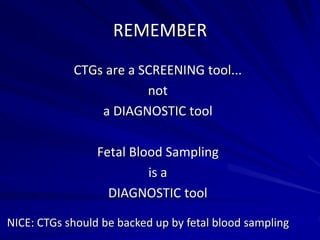
REMEMBER
CTGs are a SCREENING tool...
not
a DIAGNOSTIC tool
Fetal Blood Sampling
is a
DIAGNOSTIC tool
NICE: CTGs should be backed up by fetal blood sampling
Not so NICE…
• No mention of contractions
• Does not allow for shallow decelerations
• No upper limit for variability
• Does not take into account changes in CTG within
the normal range
• Does lead to ‘jobsworths’ waiting for 90 minutes
before reporting a flat trace as pathological
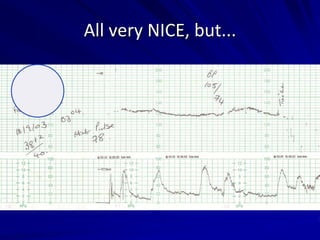
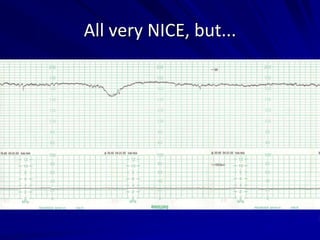
All very NICE, but...
Need to retain common sense
And remember ...
It’s only a guidance
CNST Standard 2 – Criterion 1
Care of women in labour
• Observations to be carried out on admission
and in 1st, 2nd and 3rd stages as per NICE
• Documentation of observations as per NICE
CNST Standard 2 – Criterion 3
Continuous EFM
• Date and time checks on CTG machines as per NICE
• Minimum data on tracing:
– Name & hospital number
– Date & time
– Any intrapartum event, recorded at time of event, signed
and timed
– Any review documented on trace as well as notes
– End of trace documentation as per NICE
• Hourly systematic assessment of trace as per NICE
THANK YOU

The DVH MasterClass Course - one day 2016

  • 1.
    The Darent Valley CTGMasterClass Course Bringing order to Chaos Mark Waterstone Consultant Obstetrician
  • 3.
    Why this course? •Provide physiological basis for CTG interpretation • Offer tools and solutions to improve fetal outcomes • Illustrate with case studies • Suggest interface language to communicate with others
  • 4.
    Timetable • Introduction -fetal monitoring in the wider context • Physiology and pathophysiology • The four features • Acid-base analysis • Use of ultrasound • Required documentation (NICE & CNST) • NICE or FIGO? • CTGs: Stories they could tell … • Case studies
  • 5.
    The Aim ofObstetrics Healthy mum Healthy babe(s) [happy family] NOT a vaginal delivery at any cost
  • 6.
    Obstetrics is notscience but art based on science
  • 7.
    “The major correctableerror for avoidance of intra- partum related deaths was the interpretation of EFM traces” Mary MacIntosh J Roy Soc Med 2001 94:14-16
  • 8.
    Fetal “monitoring” Antepartum – Nuchal/ combined testing – Anomaly scans – Fetal activity (objective / subjective) – Ultrasound: • Growth • Dopplers • Liquor Volume • Biophysical Profile – CTG (non-stress test)
  • 9.
    Fetal Movement • Asudden change in fetal movements should always be followed by CTG • Second presentation should have CTG + USS (within 48 hours)
  • 10.
    Fetal monitoring Intrapartum – Auscultation •Intermittent (Pinard / electronic) – CTG • Continuous (EFM – electronic fetal monitoring) • +/- FBS (fetal blood sample) • +/- FSS (fetal scalp stimulation) – STAN • Fetal ECG – Liquor • quantity and quality (meconium/blood)
  • 11.
    Intermittent Auscultation Duration: forat least 60 seconds during and at least 30 seconds after a contraction for 3 contractions if the FHR is not always in the normal range Baseline (as a single counted number in bpm) presence or absence of accelerations and decelerations. Interval: Every 15 minutes in the active phase of the first stage of labour. Every 5 minutes in the second stage of labour. Uterine contractions: Before and during FHR auscultation, in order to detect at least two contractions. Fetal movements: at the same time as evaluation of contractions Maternal heart rate: At the time of FHR auscultation. FIGO 2015
  • 12.
    Fetal heart rate: externalprobes susceptible to recording maternal rate (esp second stage) Internal probes more invasive Uterine activity: External pressure transducer susceptible to maternal interference Continuous CTG
  • 13.
    Continuous CTG • Neversubjected to randomised controlled trials • PPV 40-60 % • NPV 99 % • Associated with a reduction in neonatal seizures, but … • No significant differences in cerebral palsy, infant mortality, etc
  • 14.
    CTG R. W. Beard,et al. The significance of the changes in the continuous foetal heart rate in the first stage of labour. J Obstet Gynaecol Br Commonw 78:865-881, 1971.
  • 15.
    Postpartum Apgar Score SIGN SCORE 0 12 Heart rate Absent < 100 bpm > 100 bpm Respiratory rate Absent Weak, irregular Good, crying Muscle tone Flaccid Arms and legs flexed Well flexed Reflex irritability No response Grimace Cough or sneeze Skin colour Blue / pale Hands and feet blue Completely pink
  • 16.
    Acidosis - pH <7.1 BD> 13 mmol/l RELATIONSHIP OF APGAR SCORES WITH ACIDOSIS Apgar score < 7 Apgar score > 7 Acidosis No acidosis Apgar score at one min <7 Sykes et al (1982) Lancet i 494 - 496 73% 79%
  • 17.
    Alternative postnatal • Measuretime to first gasp • Measure time to regular respiration • Heart rate at delivery • Time to regular rate > 100 bpm
  • 18.
    Fetal blood –cord or scalp • pH • Base deficit • pCO2 pH Lactate (mmol/l) Interpretation >7.25 < 4.2 Normal 7.20-7.25 4.2-4.8 Intermediate <7.20 > 4.8 Abnormal • Hb • Lactate
  • 19.
    Fetal ECG • Analyses30 cycles to construct average ECG • Analyses ST segment • Changes similar to adult angina • Machine needs to be told baby not hypoxic at start • Requires significant teaching • Allows less intervention
  • 20.
    Fetal ECG Fewer severelyacidotic babies (pH < 7.05, BE > -12): RR 0.64; CI 0.41-1.00 Fewer HIE: RR 0.33, CI 0.11-0.95 (but only 17/8108 in total) Fewer FBS: RR 0.76; CI 0.67-0.86 Fewer Op Dels: 0.87; CI 0.78-0.96 No diff in c/s, SCBU or low Apgar scores Overall, advantages must be balanced with disadvantages
  • 21.
  • 22.
    Biphasic ST gradeI Biphasic ST grade II Biphasic ST grade III
  • 23.
  • 24.
  • 25.
  • 27.
    The Darent Valley CTGMasterClass Course Bringing order to Chaos Physiology / Pathophysiology of fetal heart rate regulation
  • 28.
    Basic principle All afetus wants to do is maintain its blood pressure stable BP ≡ HR x SV
  • 29.
    Placenta = fetallungs Single vein from mum to baby with oxygenated blood Two arteries from babe to mum with deoxygenated blood (and more CO2 ↓pH) Placenta is low pressure system
  • 30.
    Remember – The heartis a muscle - if overworked it will become tired and fail Myocardium blood flow only occurs in diastole
  • 31.
    Somatic system: fetalmovement → rise in FH Autonomic system: Sympathetic – fight / flight / freeze Parasympathetic – rest / relaxation / restore Two systems control the heart rate
  • 33.
    Control of FetalHeart Rate Pressure - Baroreceptors • Carotid sinus & aortic arch • Quick response • ‘early’ decelerations, i.e. synchronous
  • 34.
    Chemical - Chemoreceptors •Central • Peripheral: aortic and carotid bodies • “Slow” response • late / hypoxic decelerations Control of Fetal Heart Rate
  • 35.
    Control of FetalHeart Rate • Stress - maternal – Adrenaline – Cortisol • Others – Drugs • pethidine, methyl dopa etc… – pyrexia • Stress – Fetal – Adrenaline – Cortisol
  • 36.
    Labour is stressful thebaseline rate will always increase before hypoxic changes appear e.g. Non-physiological decelerations or reduction in variability
  • 37.
    The Four Features •Baseline Rate – Reduces with increasing gestation because of increasing parasympathetic influence • Baseline Variability (‘bandwidth’) – Battle of sympathetic with parasympathetic • Accelerations – Increase of 15 by 15. – “If you have to count it, it ain’t there” Waterstone 2009 • Decelerations – Decrease of 15 by 15, but not if variability reduced
  • 38.
    Baseline Rate • Meanlevel of the most horizontal and less oscillatory segments • Normal range 110-160 bpm (NICE: 100-160) • Reduces with advancing gestation with greater parasympathetic influence • Rises with maternal pyrexia (usually 1 hour before ↑ temp) • First sign of hypoxic stress is increase in baseline = normal physiologic response • Will not reduce unless intra-uterine environment improves (e.g. reduce contractions, change position, ↑ BP)
  • 39.
    Variability • The rangeof rate above and below the baseline (‘bandwidth’) over 1 minute • Normal range 5-25 bpm • Single most important feature indicating fetal well being • Physiological cycling (sleep/wake pattern) indicates good health, even with reduced variability • Beware reduction during labour
  • 40.
    Variability Silent: 0-3 bpm Reduced:3-5 bpm Normal: 5-25 bpm Saltatory: > 25 bpm
  • 41.
    Accelerations • Abrupt increasesof 15 bpm from the baseline lasting at least 15 secs • “Should be visible from the end of the room” • Usually in response to fetal activity • Must be present in antenatal trace • Do not normally occur during contractions in the second stage (think maternal instead) • May incorporate cord compression (biphasic acceleration)
  • 42.
    Decelerations • Reduction inthe baseline of 15 bpm lasting at least 15 seconds • With a tired myocardium the decelerations may be shallow (<15 bpm) and are more sinister – usually associated with reduced variability • May be a physiological response by the fetus to its environment • Head compression – early (synchronous) • Cord compression – classic appearance with shouldering
  • 43.
  • 44.
    Acute hypoxia –saltatory / saw-tooth (>25 bpm for more than 30 minutes)
  • 45.
    Chronic anaemia -sinusoidal Regular smooth undulating signal, resembling a sine wave, with an amplitude of 5-15 bpm and a frequency of 3-5 cycles/min for longer than 30 minutes
  • 47.
    Types of deceleration •Early – Synchronous with and mirroring the contraction – Mediated by baroreceptors – Caused by head compression – Not associated with hypoxia
  • 48.
    Types of deceleration •Late – The nadir of the deceleration occurs after the peak of contraction – The recovery of the deceleration occurs after the end of the contraction – Mediated by chemoreceptors
  • 49.
    Variable decelerations Standard teaching •Typical • Atypical CTG MasterClass • Typical • Atypical • Others – unnamed as yet – usually / almost always in labour therefore: LABOUR VARIABLES
  • 50.
    Basic principle All afetus wants to do is maintain its blood pressure stable BP ≡ HR x SV
  • 52.
    Cord Compression –Step 1 Decreased blood flow from placenta to baby = haemorrhage Reduced blood volume Systemic hypotension Reactive tachycardia BP ≡ HR x SV
  • 53.
    Cord Compression –Step 2 Total occlusion Sudden increase in peripheral resistance Hypertension Compensatory deceleration BP ≡ HR x SV
  • 54.
    Reversal of Compression- Step 3 Recoil of umbilical arteries Normalisation of peripheral resistance Relief of systemic hypertension No parasympathetic stimulation Recovery of the deceleration to normal baseline BP ≡ HR x SV
  • 55.
    Post-Compression – Step4 Decreased blood flow from the placenta to the baby Reduced blood volume Systemic hypotension Reactive and reflex tachycardia BP ≡ HR x SV
  • 56.
    Post-Compression – Step5 Normalisation of blood flow blood volume re-established BP normalises Return to baseline BP ≡ HR x SV
  • 57.
  • 58.
    Types of variabledecelerations Normal shouldering, usually with variability Loss of shouldering (pathological) Late recovery * (pathological) Overshoot shouldering +/- variability (pre- pathological) Smoothing at trough (pathological) Biphasic deceleration * (pathological) * = also Labour Variable
  • 60.
    The Darent Valley CTGMasterClass Course Bringing order to Chaos Fetal acid-base status
  • 65.
    Hypoxia Acute (total) hypoxia –Baby can survive 10 minutes before permanent brain damage Sub-acute (chronic partial) hypoxia – Baby can sustain 60 minutes before permanent brain damage Chronic ‘hypoxia’ (technically hypoxaemia) – PET / IUGR
  • 66.
    Acute Total Hypoxia Completecessation in flow through cord No gas exchange Increasing fetal acidosis Increasing hypoxia Base deficit will increase by 1 mmol per min Increasing damage to basal ganglia between 10 and 25 minutes Most dead after 25 minutes
  • 67.
    Prolonged Partial Hypoxia Heartrate below baseline > at baseline Fetal hypotension Cerebral hypoperfusion Reduced pressure “sprinkler effect” Damage to the watershed areas
  • 70.
    Respiratory acidaemia andmetabolic acidosis
  • 73.
  • 74.
    Fetal Blood SamplepH> 7.30 = repeat pH 7.25-7.29 = repeat pH 7.20-7.24 = consider delivery pH < 7.20 deliver BUT… beware the normal pH with a high base deficit Also consider pCO2
  • 75.
    Normal range –cord gases
  • 76.
  • 77.
  • 78.
  • 79.
    Cord Bloods • Essentialto differentiate between – Acute hypoxia – Chronic hypoxia – Acute on chronic hypoxia • Requires both venous and arterial samples with pH and base deficit • Arterial pH ALWAYS lower than venous
  • 81.
    The Darent Valley CTGMasterClass Course Bringing order to Chaos markwaterstone@obstetricexpert.co.uk Use of Ultrasound in Fetal Monitoring
  • 82.
  • 83.
  • 84.
  • 85.
  • 86.
    Doppler Christian Doppler The firstfetal doppler was invented by Dr. Edward H. Hon in 1958
  • 87.
  • 88.
    Fetal Doppler • RoutineDoppler USS in low risk / unselected pregnancies does not confer benefit • The use of Doppler USS in high risk pregnancies appears to improve a number of obstetric care outcomes and appears promising in reducing PND (OR 0.71)
  • 89.
    High-Risk Doppler • FewerIOL (OR 0.83; 0.74-0.93) • Fewer TCIs (OR 0.56; 0.43-0.72) but no difference in … • Fetal “distress” in labour (OR 0.81; 0.59-1.13) • Caesarean delivery (OR 0.94; 0.82-1.06)
  • 90.
    An early stagein fetal adaptation to hypoxaemia • Central redistribution of blood flow (brain- sparing reflex) • Increased blood flow to protect the brain, heart and adrenals • Reduced flow to the peripheral and placental circulations
  • 91.
  • 92.
  • 93.
  • 94.
  • 95.
  • 96.
  • 97.
    Doppler wave formof early stage of fetal hypoxaemia • Increased end-diastolic flow (EDF) in the middle cerebral artery – ↓MCA pulsatility index (PI) / resistance index (RI) • Decreased end-diastolic flow in the umbilical artery – ↑umbilical artery RI
  • 98.
  • 99.
  • 100.
    Uterine Artery Dopplers a. non-pregnant b.1st trimester c. 2nd trimester d. 3rd trimester e. Abnormal with ↑resistance
  • 101.
    Biophysical Profile (BPP) ComponentDefinition Fetal movements 3 body or limb movements Fetal tone One episode of active extension and flexion of the limbs; opening and closing of hand Fetal breathing movement episode of > 30 seconds in 30 minutes Hiccups are considered breathing activity. Amniotic fluid volume single 2 x 2 cm pocket is considered adequate. Non-stress test (i.e. CTG) 2 accelerations > 15 beats per minute of at least 15 seconds duration.
  • 102.
    PNM and theBPP Score Score Perinatal Mortality/1000 8-10 1.86 6 9.76 4 26.3 2 94.0 0 285.7
  • 103.
    BPP - Cochrane •Not enough evidence to support use in high-risk pregnancies • Associated with significantly increased use of induction and caesarean section • Recommended by NICE for monitoring of twins in late pregnancy
  • 104.
    USS - Summary USShas a central place in fetal monitoring Caution regarding predictions Cannot be used in isolation
  • 105.
    Progress in placentalfailure ↓ umbilical artery EDF ↑ MCA flow ↓ aortic flow Mod-severe redistribution ↓ growth Abnormal venous flow ↓ FM ↓ LV Abnormal CTG
  • 107.
    The Darent Valley CTGMasterClass Course Bringing order to Chaos markwaterstone@obstetricexpert.co.uk NICE / CNST
  • 108.
    NICE provides...... ... thealphabet blocks from which words are made It is not the words themselves
  • 109.
    NICE Guidance does notapply to antenatal traces only intrapartum
  • 110.
    Issue date: September2007 NICE clinical guideline 55 Developed by the National Collaborating Centre for Women’s and Children’s Health Intrapartum care Care of healthy women and their babies during childbirth 2001
  • 112.
    Classification of FHRtrace features NICE 2007
  • 113.
  • 115.
    Rule of 3s 0:bradycardia commences 3: bradycardia confirmed and help called 6: help (reg) arrives 9: decision to deliver taken and transferred 12: anaesthesia commences 15: delivery of baby
  • 116.
    Hinshaw K (1996)ALSO course manual DR C BRAVADO D determine R risk C contractions B baseline R rate A and V variability A accelerations D decelerations O overall impression and plan
  • 117.
  • 119.
    REMEMBER CTGs are aSCREENING tool... not a DIAGNOSTIC tool Fetal Blood Sampling is a DIAGNOSTIC tool NICE: CTGs should be backed up by fetal blood sampling
  • 120.
    Not so NICE… •No mention of contractions • Does not allow for shallow decelerations • No upper limit for variability • Does not take into account changes in CTG within the normal range • Does lead to ‘jobsworths’ waiting for 90 minutes before reporting a flat trace as pathological
  • 121.
  • 122.
  • 124.
    Need to retaincommon sense And remember ... It’s only a guidance
  • 126.
    CNST Standard 2– Criterion 1 Care of women in labour • Observations to be carried out on admission and in 1st, 2nd and 3rd stages as per NICE • Documentation of observations as per NICE
  • 127.
    CNST Standard 2– Criterion 3 Continuous EFM • Date and time checks on CTG machines as per NICE • Minimum data on tracing: – Name & hospital number – Date & time – Any intrapartum event, recorded at time of event, signed and timed – Any review documented on trace as well as notes – End of trace documentation as per NICE • Hourly systematic assessment of trace as per NICE
  • 128.