CTG INTERPRETATION
Dr. Qurrat ul Ain
Preparation
Determine indication for fetal monitoring
Discuss fetal monitoring with the woman and obtain permission to
commence
Perform abdominal examination to determine lie and presentation
Give the woman the opportunity to empty her bladder
The woman should be in an upright or lateral position (not supine)
Check the accurate date and time has been set on the CTG machine
Maternal heart rate must be recorded on the CTG at commencement of
the CTG in order to differentiate between maternal and fetal heart rate
Cont…
• CTG paper speed at 1cm/min
• Sensitivity displays at 20 beats per minute/cm
• Set FHR range display at 50 – 210 bpm
• Ensure date and time are correct on commencement of
CTG
• Check that date and time settings on CTG tracings are
regularly validated
• Label CTGs with the mother’s name, date, time
commenced and hospital record number
CTG RECOMMENDATIONS
In addition, medical expert consensus recommends:
• Midwives should not undertake continuous CTG
monitoring in the absence of medical supervision
• On commencement of CTG monitoring, women should
be advised, in general terms, how to read their tracing
• Where central monitoring is in use, the woman should
be able to recognise the significance of the alarm/light
if it activates, so that staff can be summoned if they do
not react to the alarm
Consider
• Intrapartum / antepartum trace.
• Stage of labour
• Gestation
• Fetal presentation?Malpresentation.
• Any augmentation
• IOL Medications
INTERPRETATION OF FEATURES
OF CTG
Features Baseline rate
(Beats/min)
Baseline Rate
Variability
Baseline
variability
Deceleration
Decelerations
Acceleration
Accelerations
Reassuring 110-160 Over 5 None Present
Non-
reassuring
100-109
161-180
Under 5
for 40-90 min
Early
Typical
variable
Absence
of unknown
significance
Abnormal Under 100
Over 180
Under 5
for over 90
min
Late
Atypical
variable
Absence
of unknown
significance
Overall impression & plan of
action
CATEGORY DEFINITION ACTION
Normal Rate, variability, and
deceleration all
reassuring
None
Suspicious One non reassuring
feature
Conservative
measures
Pathological Two non-reassuring
OR
One abnormal feature
Fetal scalp
sampling or
deliver the baby
Baseline Rate
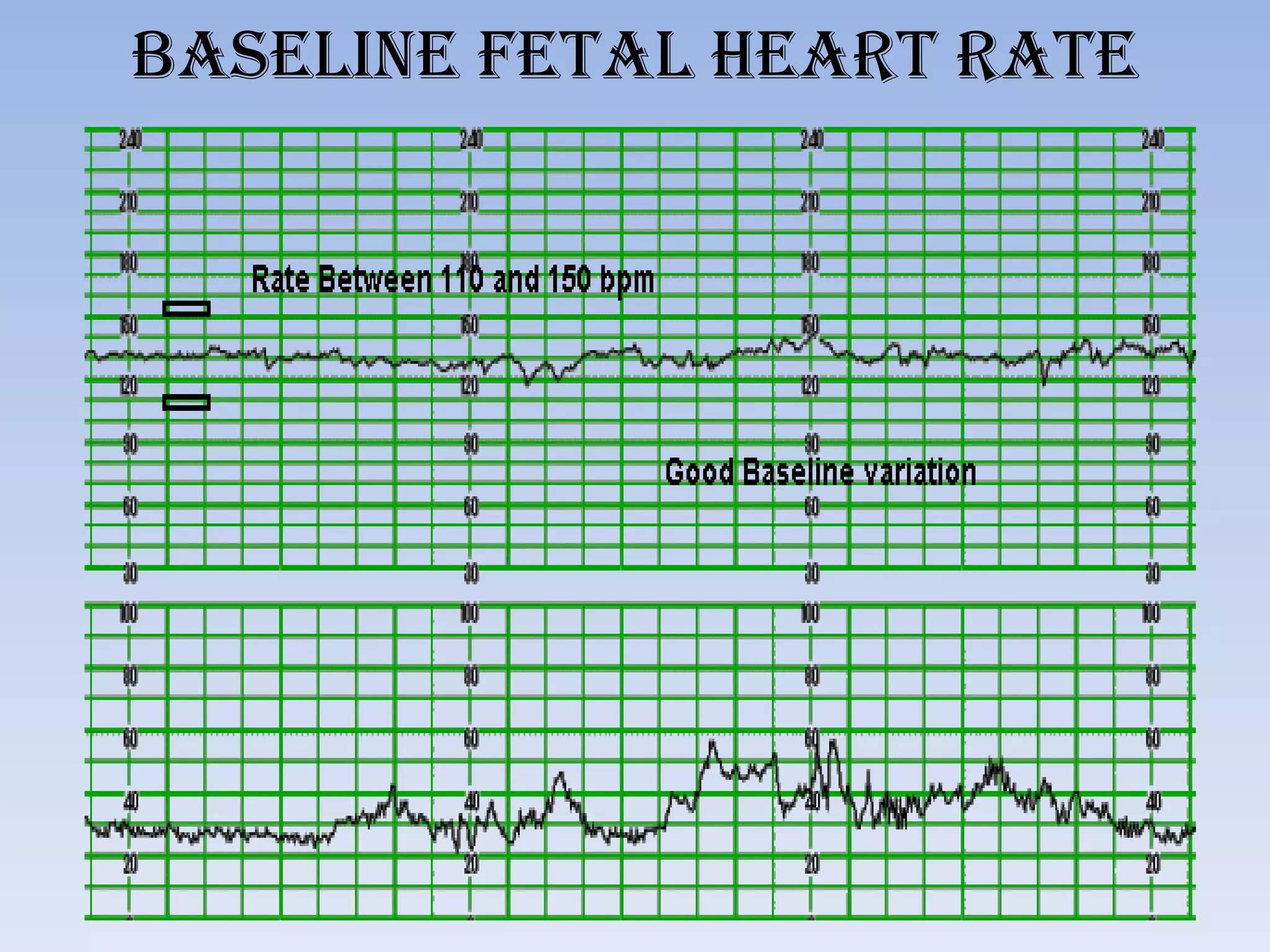
• The baseline FHR should be determined over 5 to 10 minutes and
expressed in bpm
• Normal 110 – 160 bpm
• Bradycardia <110 bpm
• Tachycardia >160 bpm
• The mean of the FHR when this is stable, excluding accelerations
and decelerations.
• The minimum baseline duration must be at least 2 minutes.
• If minimum baseline duration is < 2 minutes then the baseline is
indeterminate.
Baseline Fetal Heart Rate
Fatal Bradycardia
Fetal Tachycardia
Fetal Tachycardia
Fetal tachycardia with possible onset of decreased variability during
the second stage of labor. Fetal heart rate is 170 to 180 bpm. Mild
variable decelerations are present.
Fetal Tachycardia
Fetal tachycardia that is due to fetal tachyarrhythmia associated with congenital
anomalies, in this case, ventricular septal defect. Fetal heart rate is 180 bpm.
Notice the "spike" pattern of the fetal heart rate.
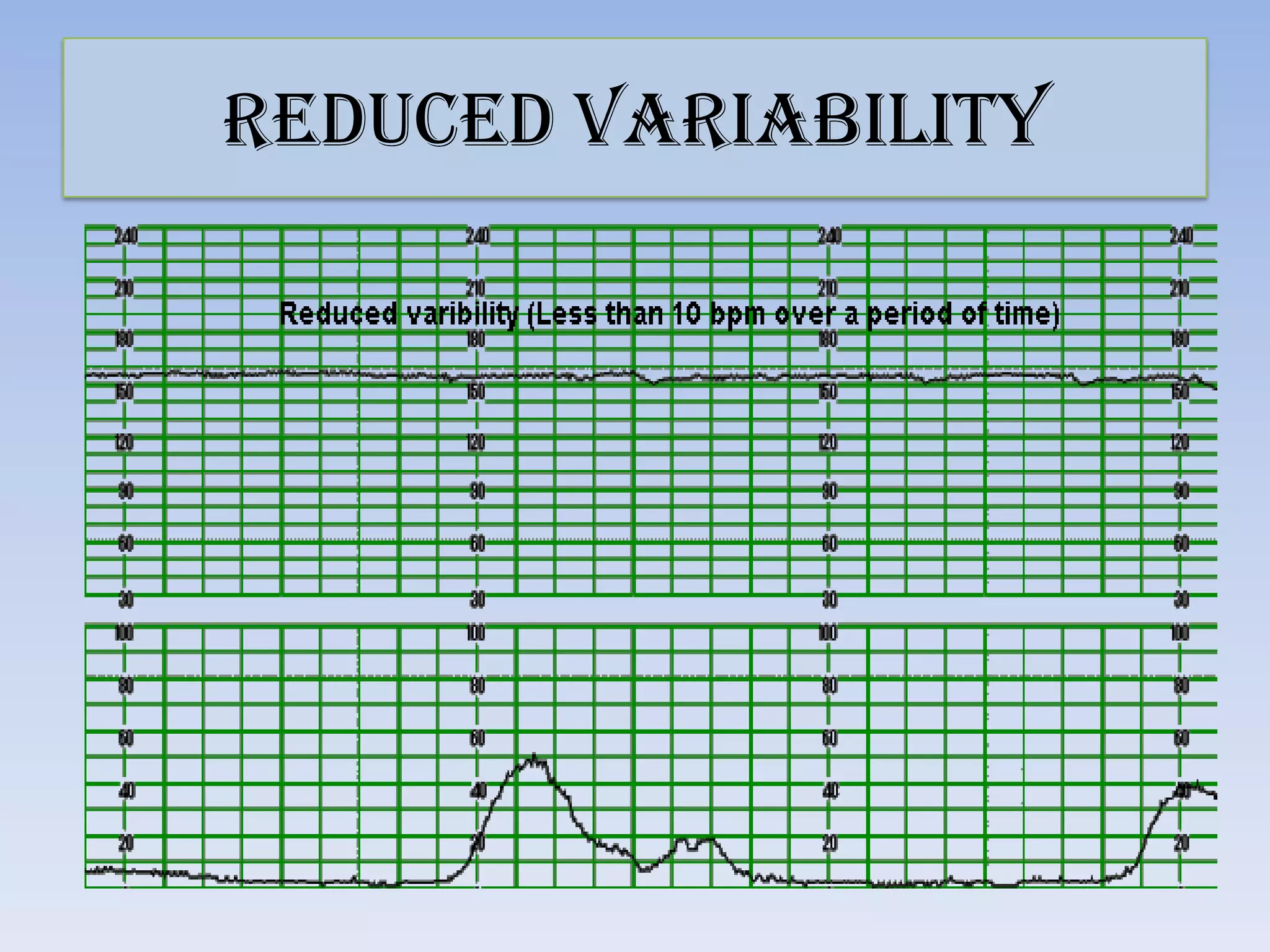
Baseline variability
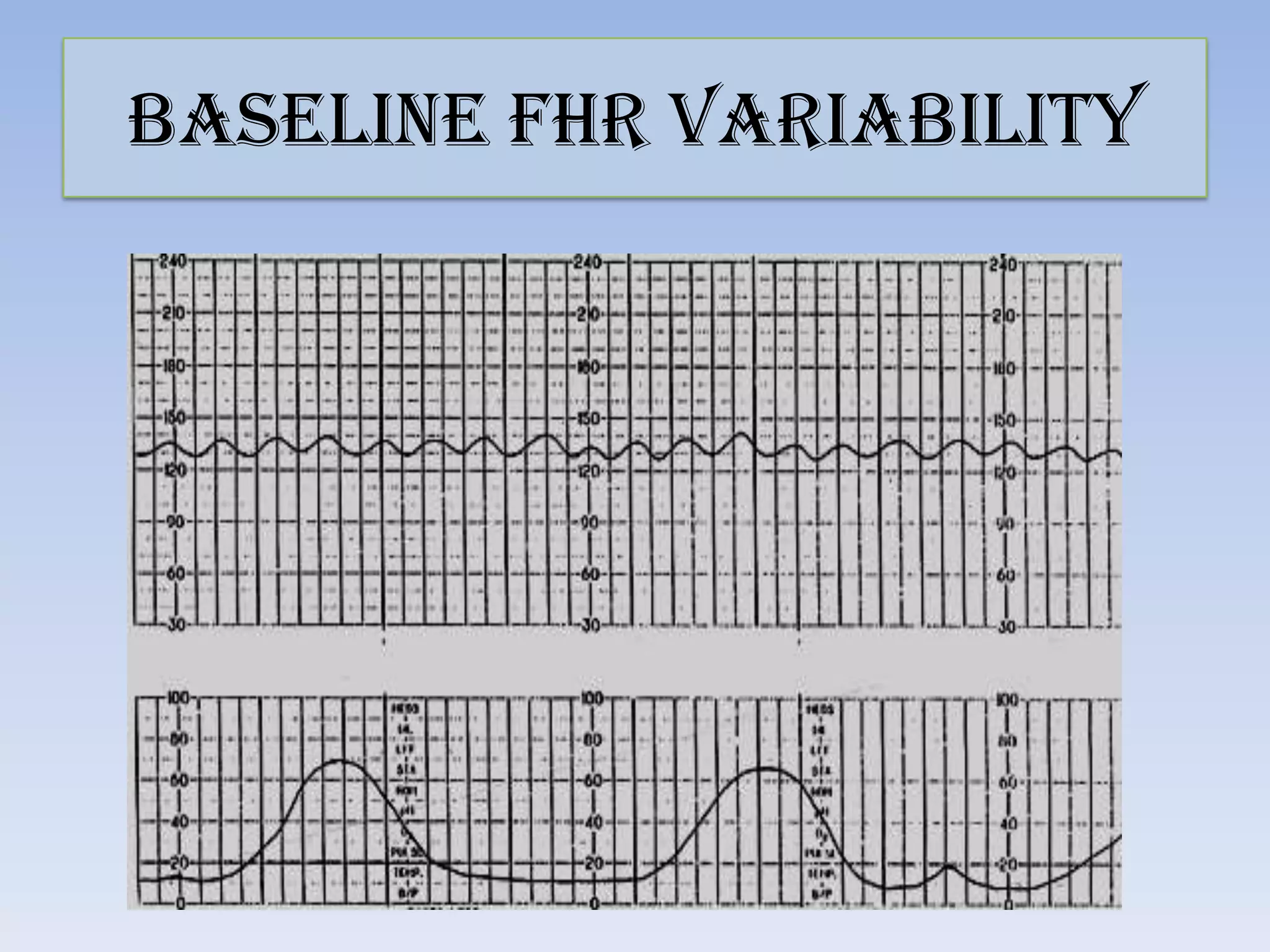
• Fluctuations in the fetal heart rate of more than 2 cycles
per minute. No distinction is made between short-term
variability (or beat-to-beat variability) and long-term
variability
• Grades of fluctuation are based on amplitude range
Absent variability …. Amplitude range undetectable
• Normal 5 – 25 bpm (moderate)
• Increased > 25 bpm (marked)
• Reduced 3 – 5 bpm (minimal)
• Absent < 3 bpm
Baseline FHR Variability
Reduced variability
Reduced variability
Sleeping pattern
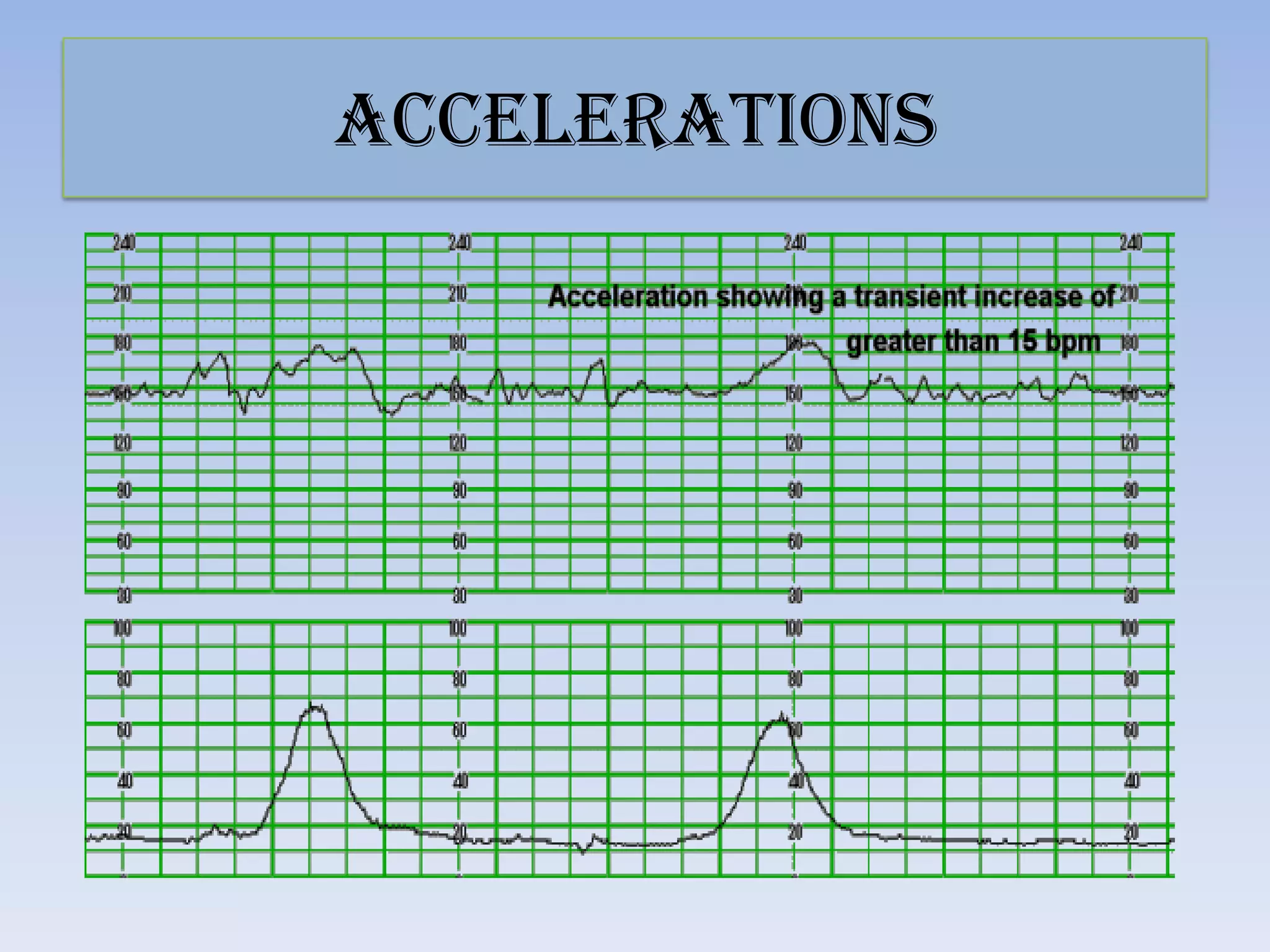
Accelerations
• Transient increases in FHR of 15 bpm or more above the
baseline and lasting 15seconds or more
• The significance of no accelerations on an otherwise
normal FHR recording is not known
• The duration of the acceleration is defined as the time
from the initial change in heart rate from the baseline to
the time of return to the FHR to baseline.
Adequate accelerations
• <32 weeks' : >10 BPM above baseline for >10 seconds
• >32 weeks' : >15 BPM above baseline for > 15 seconds
accelerations
decelerations
Transient episodes of slowing of FHR
below the baseline of more than 15 bpm
lasting at least 15 seconds
• Episodic patterns are those not associated with
uterine contractions
• Periodic patterns are those associated with uterine
contractions.
decelerations
• Quantitated by the depth of the nadir in BPM
below the baseline. The duration is quantitated
in minutes and seconds from the beginning to
the end of the deceleration.
The type of the deceleration is distinguished
on the basis of its waveform.
Decelerations
Periodic patterns
– Early Decelerations
• uniform, repetitive decrease of FHR with slow onset early
in the contraction and slow return to baseline by the end of
the contraction
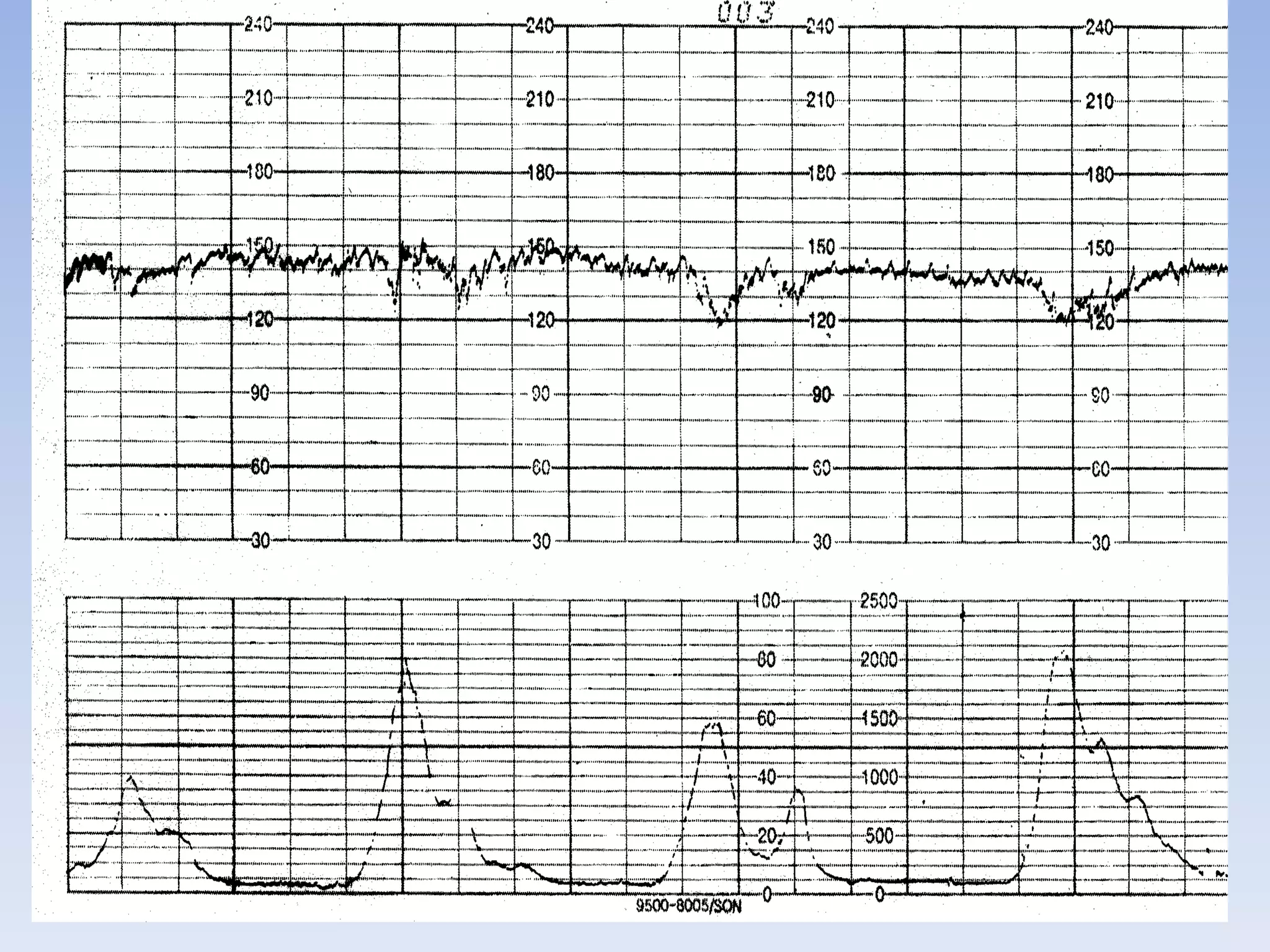
– Late Decelerations
• Uniform, repetitive decreasing of FHR with, usually, slow
onset mid to end of the contraction and nadir more than 20
seconds after the peak of the contraction and ending after
the contraction
• In the presence of a non-accelerative trace with baseline
variability < 5 bpm, the definition would include
decelerations < 15 bpm
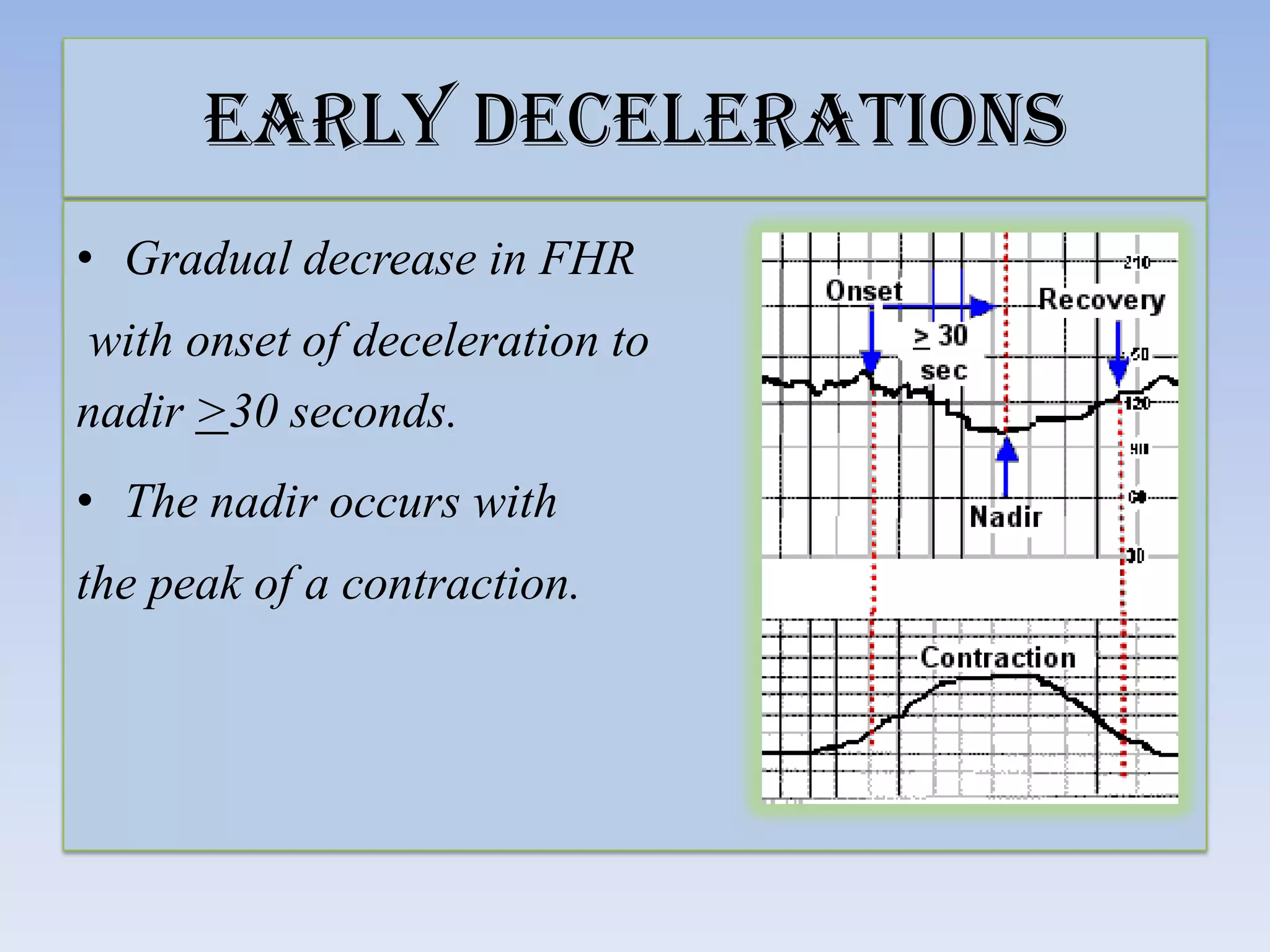
Early decelerations
• Gradual decrease in FHR
with onset of deceleration to
nadir >30 seconds.
• The nadir occurs with
the peak of a contraction.
LATE DECELERATIONS
• Uniform, repetitive, decreasing of FHR with,
usually, slow onset mid to end of the contraction,
nadir more than 20 seconds after the peak of the
contraction and ending after the contraction
• In the presence of a non-accelerative trace with
baseline variability < 5 bpm, the definition would
include decelerations < 15 bpm
Late Deceleration
Gradual decrease in FHR
with onset of deceleration
to nadir >30 seconds.
Onset of the deceleration
occurs after the beginning
of the contraction,
and the nadir of the
fetal heart occurs after
the peak of the contraction.
Late Deceleration
preservation of beat-to beat variability
Late deceleration related to bigeminal contractions. B-to-B variability is preserved.
Note the prolonged contraction pattern with elevated uterine tone between the peaks of
the contractions, causing hyperstimulation and uteroplacental insufficiency
Late Deceleration
no variability
Late deceleration with loss of variability. This is an ominous pattern, and
immediate delivery is indicated.
Variable decelerations
• Intermittent periodic slowing of FHR with
rapid onset and recovery.
• The time relationship with contractions is
variable but they most commonly occur in
association with contractions
• Vagal in origin, medical experts suggest
variable decelerations result from stimuli such
as cord or head compression
Variable decelerations
• Abrupt decrease in FHR of
> 15 bpm measured from the most
recently determined baseline rate.
• The onset of deceleration
to nadir is less than 30 seconds.
• The deceleration lasts > 15 sec
and less than 2 minutes.
• A shoulder, if present, is not
included as part of the
deceleration.
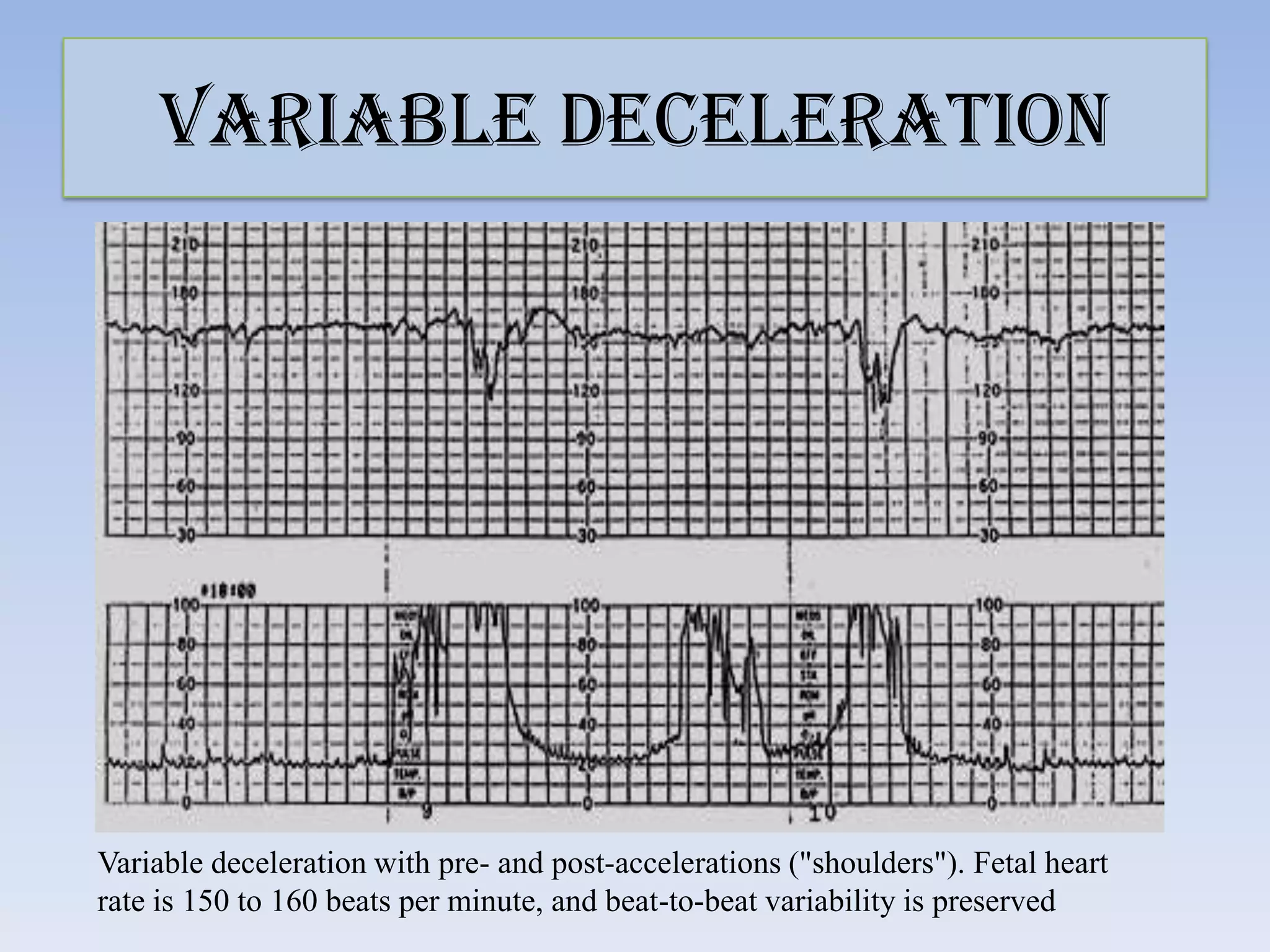
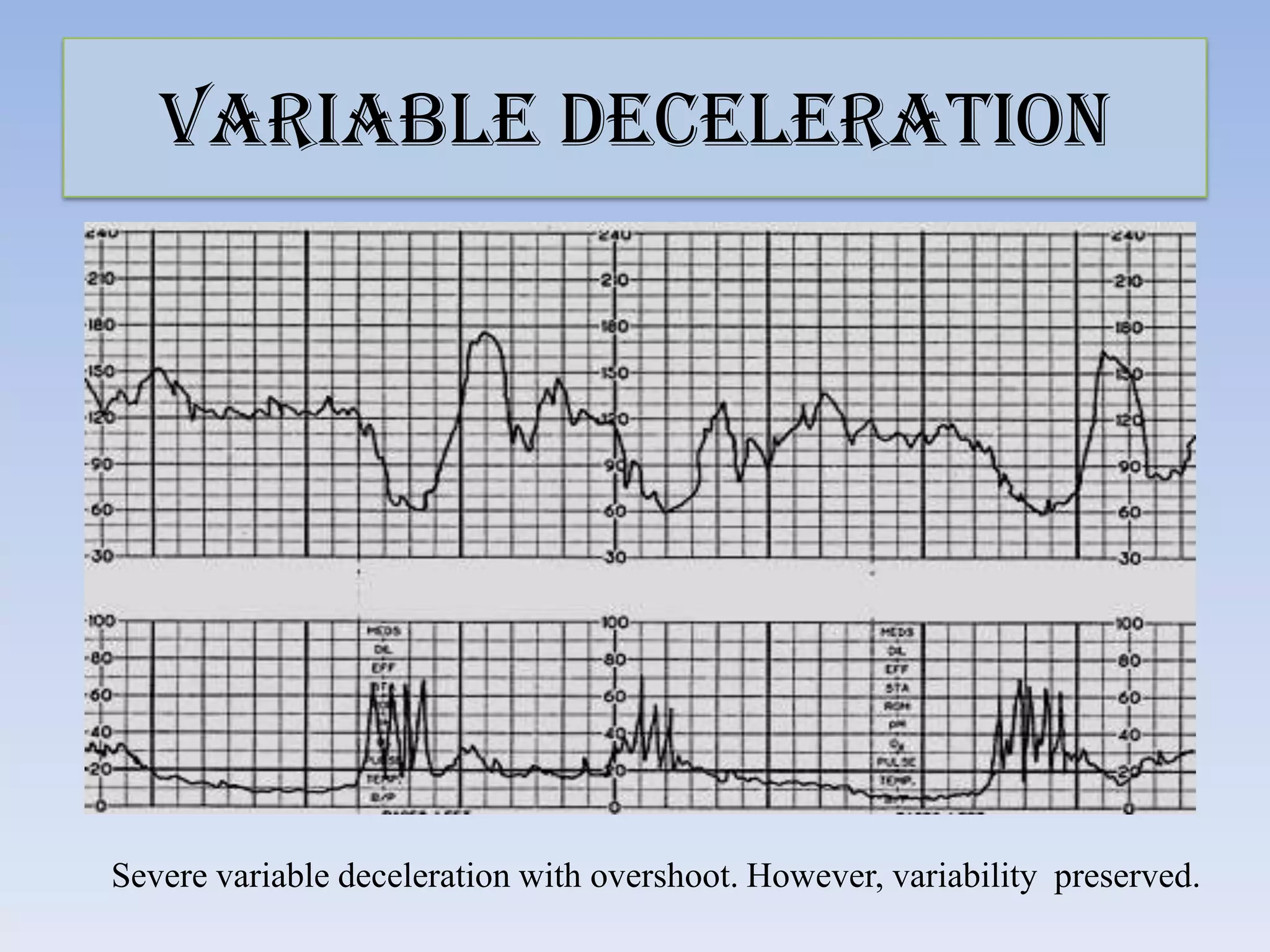
variable Deceleration
Variable deceleration with pre- and post-accelerations ("shoulders"). Fetal heart
rate is 150 to 160 beats per minute, and beat-to-beat variability is preserved
Complicated Variable
decelerations
• Rising baseline rate or fetal tachycardia
• Reducing baseline variability
• Slow return to baseline FHR after the end of the
contraction
• Large amplitude (by 60 bpm or to 60 bpm) and / or
long duration (60 secs)
• Loss of pre and post deceleration shouldering
(abrupt brief increases in FHR baseline)
• Presence of post deceleration smooth overshoots
(temporary increase in FHR above baseline)
variable Deceleration
Severe variable deceleration with overshoot. However, variability preserved.
Prolonged decelerations
• Decrease of FHR below the baseline of more
than 15 bpm for longer than 90 seconds but
less than 5 minutes
Prolonged deceleration
•
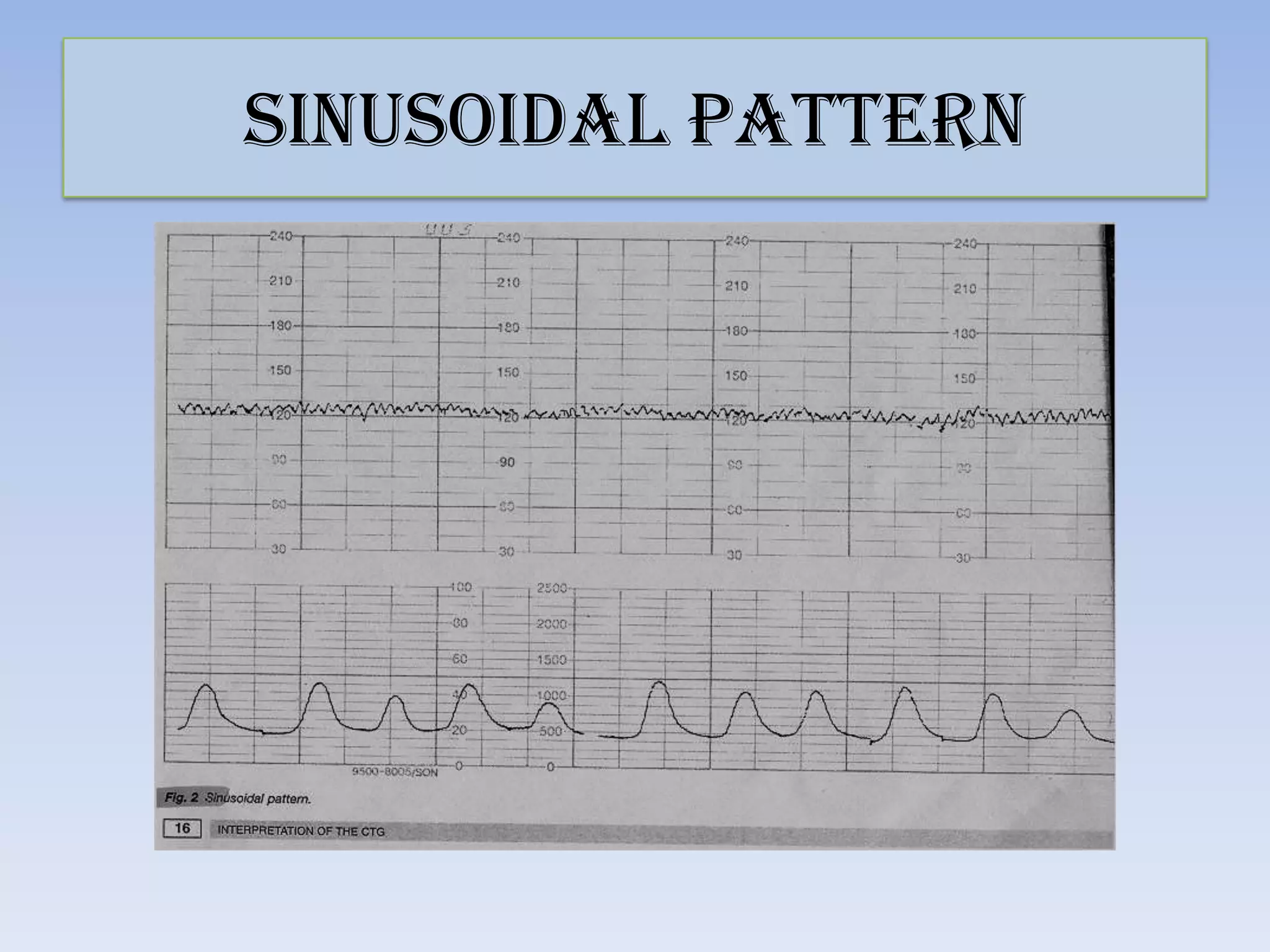
Sinusoidal pattern
Saltatory pattern
Thank you
There are no internationally agreed practice
recommendations. However, various
authorities such as ACOG, RCOG, NICE and
RANZCOG have published guidelines.
RANZCOG (2006) recommends:
The AMD-5600 Curved Array Probe for the
SmartProbe UltrasoundTM is used for all
obstetrical and abdominal scanning applications.
The 3.5 MHz probe has the familiar look and feel
of big system probes.
Specifications
•Frequency: 3.5MHz
•Elements: 128
•Pitch (mm): 0.520
•Elevation Width (mm): 15.0
•Geometric Focus (mm): 90
•Azimuth Radius (mm): 65.0
•Azimuth Length (mm): 66.6
List Price : $14,000

CTG

  • 1.
  • 2.
    Preparation Determine indication forfetal monitoring Discuss fetal monitoring with the woman and obtain permission to commence Perform abdominal examination to determine lie and presentation Give the woman the opportunity to empty her bladder The woman should be in an upright or lateral position (not supine) Check the accurate date and time has been set on the CTG machine Maternal heart rate must be recorded on the CTG at commencement of the CTG in order to differentiate between maternal and fetal heart rate
  • 3.
    Cont… • CTG paperspeed at 1cm/min • Sensitivity displays at 20 beats per minute/cm • Set FHR range display at 50 – 210 bpm • Ensure date and time are correct on commencement of CTG • Check that date and time settings on CTG tracings are regularly validated • Label CTGs with the mother’s name, date, time commenced and hospital record number
  • 4.
    CTG RECOMMENDATIONS In addition,medical expert consensus recommends: • Midwives should not undertake continuous CTG monitoring in the absence of medical supervision • On commencement of CTG monitoring, women should be advised, in general terms, how to read their tracing • Where central monitoring is in use, the woman should be able to recognise the significance of the alarm/light if it activates, so that staff can be summoned if they do not react to the alarm
  • 5.
    Consider • Intrapartum /antepartum trace. • Stage of labour • Gestation • Fetal presentation?Malpresentation. • Any augmentation • IOL Medications
  • 6.
    INTERPRETATION OF FEATURES OFCTG Features Baseline rate (Beats/min) Baseline Rate Variability Baseline variability Deceleration Decelerations Acceleration Accelerations Reassuring 110-160 Over 5 None Present Non- reassuring 100-109 161-180 Under 5 for 40-90 min Early Typical variable Absence of unknown significance Abnormal Under 100 Over 180 Under 5 for over 90 min Late Atypical variable Absence of unknown significance
  • 7.
    Overall impression &plan of action CATEGORY DEFINITION ACTION Normal Rate, variability, and deceleration all reassuring None Suspicious One non reassuring feature Conservative measures Pathological Two non-reassuring OR One abnormal feature Fetal scalp sampling or deliver the baby
  • 8.
    Baseline Rate • Thebaseline FHR should be determined over 5 to 10 minutes and expressed in bpm • Normal 110 – 160 bpm • Bradycardia <110 bpm • Tachycardia >160 bpm • The mean of the FHR when this is stable, excluding accelerations and decelerations. • The minimum baseline duration must be at least 2 minutes. • If minimum baseline duration is < 2 minutes then the baseline is indeterminate.
  • 9.
  • 10.
  • 11.
  • 12.
    Fetal Tachycardia Fetal tachycardiawith possible onset of decreased variability during the second stage of labor. Fetal heart rate is 170 to 180 bpm. Mild variable decelerations are present.
  • 13.
    Fetal Tachycardia Fetal tachycardiathat is due to fetal tachyarrhythmia associated with congenital anomalies, in this case, ventricular septal defect. Fetal heart rate is 180 bpm. Notice the "spike" pattern of the fetal heart rate.
  • 14.
    Baseline variability • Fluctuationsin the fetal heart rate of more than 2 cycles per minute. No distinction is made between short-term variability (or beat-to-beat variability) and long-term variability • Grades of fluctuation are based on amplitude range Absent variability …. Amplitude range undetectable • Normal 5 – 25 bpm (moderate) • Increased > 25 bpm (marked) • Reduced 3 – 5 bpm (minimal) • Absent < 3 bpm
  • 15.
  • 16.
  • 17.
  • 18.
  • 19.
    Accelerations • Transient increasesin FHR of 15 bpm or more above the baseline and lasting 15seconds or more • The significance of no accelerations on an otherwise normal FHR recording is not known • The duration of the acceleration is defined as the time from the initial change in heart rate from the baseline to the time of return to the FHR to baseline. Adequate accelerations • <32 weeks' : >10 BPM above baseline for >10 seconds • >32 weeks' : >15 BPM above baseline for > 15 seconds
  • 20.
  • 21.
    decelerations Transient episodes ofslowing of FHR below the baseline of more than 15 bpm lasting at least 15 seconds • Episodic patterns are those not associated with uterine contractions • Periodic patterns are those associated with uterine contractions.
  • 22.
    decelerations • Quantitated bythe depth of the nadir in BPM below the baseline. The duration is quantitated in minutes and seconds from the beginning to the end of the deceleration. The type of the deceleration is distinguished on the basis of its waveform.
  • 23.
    Decelerations Periodic patterns – EarlyDecelerations • uniform, repetitive decrease of FHR with slow onset early in the contraction and slow return to baseline by the end of the contraction – Late Decelerations • Uniform, repetitive decreasing of FHR with, usually, slow onset mid to end of the contraction and nadir more than 20 seconds after the peak of the contraction and ending after the contraction • In the presence of a non-accelerative trace with baseline variability < 5 bpm, the definition would include decelerations < 15 bpm
  • 24.
    Early decelerations • Gradualdecrease in FHR with onset of deceleration to nadir >30 seconds. • The nadir occurs with the peak of a contraction.
  • 27.
    LATE DECELERATIONS • Uniform,repetitive, decreasing of FHR with, usually, slow onset mid to end of the contraction, nadir more than 20 seconds after the peak of the contraction and ending after the contraction • In the presence of a non-accelerative trace with baseline variability < 5 bpm, the definition would include decelerations < 15 bpm
  • 28.
    Late Deceleration Gradual decreasein FHR with onset of deceleration to nadir >30 seconds. Onset of the deceleration occurs after the beginning of the contraction, and the nadir of the fetal heart occurs after the peak of the contraction.
  • 30.
    Late Deceleration preservation ofbeat-to beat variability Late deceleration related to bigeminal contractions. B-to-B variability is preserved. Note the prolonged contraction pattern with elevated uterine tone between the peaks of the contractions, causing hyperstimulation and uteroplacental insufficiency
  • 31.
    Late Deceleration no variability Latedeceleration with loss of variability. This is an ominous pattern, and immediate delivery is indicated.
  • 32.
    Variable decelerations Variable decelerations •Intermittent periodic slowing of FHR with rapid onset and recovery. • The time relationship with contractions is variable but they most commonly occur in association with contractions • Vagal in origin, medical experts suggest variable decelerations result from stimuli such as cord or head compression
  • 33.
    Variable decelerations • Abruptdecrease in FHR of > 15 bpm measured from the most recently determined baseline rate. • The onset of deceleration to nadir is less than 30 seconds. • The deceleration lasts > 15 sec and less than 2 minutes. • A shoulder, if present, is not included as part of the deceleration.
  • 34.
    variable Deceleration Variable decelerationwith pre- and post-accelerations ("shoulders"). Fetal heart rate is 150 to 160 beats per minute, and beat-to-beat variability is preserved
  • 35.
    Complicated Variable decelerations • Risingbaseline rate or fetal tachycardia • Reducing baseline variability • Slow return to baseline FHR after the end of the contraction • Large amplitude (by 60 bpm or to 60 bpm) and / or long duration (60 secs) • Loss of pre and post deceleration shouldering (abrupt brief increases in FHR baseline) • Presence of post deceleration smooth overshoots (temporary increase in FHR above baseline)
  • 36.
    variable Deceleration Severe variabledeceleration with overshoot. However, variability preserved.
  • 37.
    Prolonged decelerations • Decreaseof FHR below the baseline of more than 15 bpm for longer than 90 seconds but less than 5 minutes
  • 38.
  • 39.
  • 40.
  • 41.
  • 42.
    There are nointernationally agreed practice recommendations. However, various authorities such as ACOG, RCOG, NICE and RANZCOG have published guidelines. RANZCOG (2006) recommends:
  • 43.
    The AMD-5600 CurvedArray Probe for the SmartProbe UltrasoundTM is used for all obstetrical and abdominal scanning applications. The 3.5 MHz probe has the familiar look and feel of big system probes. Specifications •Frequency: 3.5MHz •Elements: 128 •Pitch (mm): 0.520 •Elevation Width (mm): 15.0 •Geometric Focus (mm): 90 •Azimuth Radius (mm): 65.0 •Azimuth Length (mm): 66.6 List Price : $14,000