CARDIOTOCOGRAPHY
By
Osama M Warda , MD
Professor of Obstetrics & Gynecology
Mansoura University- EGYPT
BACKGROUND
Cardiotocography (CTG) is a test used in pregnancy to
monitor both the fetal heart pattern as well as the
uterine contractions.
It should only used in the 3rd trimester when fetal neural
reflexes are present.
Its purpose is to monitor fetal well-being & allows early
detection of fetal distress antenatal or intra-partum.
An abnormal CTG indicates the need for further invasive
investigation & ultimately may lead to emergency CS
O Warda 2
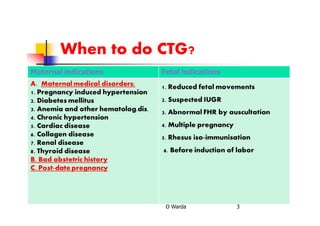
When to do CTG?
O Warda 3
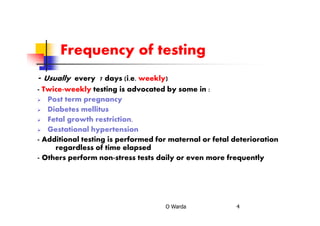
Frequency of testing
- Usually every 7 days (i.e. weekly)
- Twice-weekly testing is advocated by some in :
Post term pregnancy
Diabetes mellitus
Fetal growth restriction,
Gestational hypertension
- Additional testing is performed for maternal or fetal deterioration
regardless of time elapsed
- Others perform non-stress tests daily or even more frequently
O Warda 4
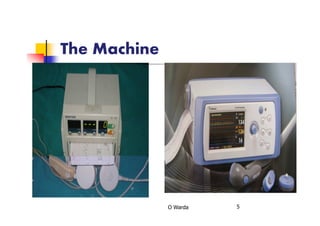
The Machine
O Warda 5
O Warda 6
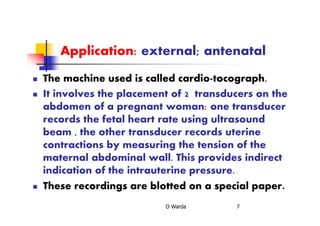
Application: external; antenatal
The machine used is called cardio-tocograph.
It involves the placement of 2 transducers on the
abdomen of a pregnant woman: one transducer
records the fetal heart rate using ultrasound
beam , the other transducer records uterine
contractions by measuring the tension of the
maternal abdominal wall. This provides indirect
indication of the intrauterine pressure.
These recordings are blotted on a special paper.
O Warda 7
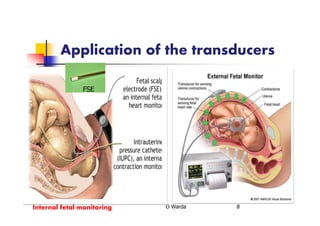
Application of the transducers
O Warda 8Internal fetal monitoring
FSE
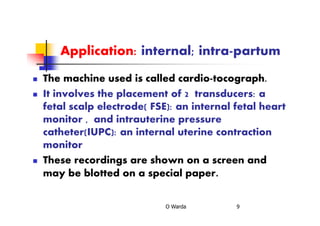
Application: internal; intra-partum
The machine used is called cardio-tocograph.
It involves the placement of 2 transducers: a
fetal scalp electrode( FSE): an internal fetal heart
monitor , and intrauterine pressure
catheter(IUPC): an internal uterine contraction
monitor
These recordings are shown on a screen and
may be blotted on a special paper.
O Warda 9
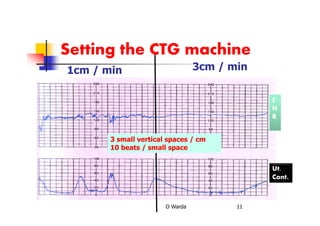
Setting the CTG machine
Horizontal Scale
Paper speed is set to 1,2,or 3 cm /minute.
Vertical Scale:
Sensitivity displays are set to 20 or 30 beats per
minute (bpm) /cm.
FHR range displays of 30–240 bpm .
Uterine Activity: Internal 0-100 mmHg
External 0-100 relative units
O Warda 10
Setting the CTG machine
O Warda 11
3cm / min1cm / min
3 small vertical spaces / cm
10 beats / small space
F
H
R
Ut.
Cont.
Setting the CTG machine
Fetal heart rate is commonly recorded
with paper speed at 1 cm/ min compared
with 3 cm/min chart recorder.
3 cm: is the more accurate for abnormalities
1cm: less paper but less accurate : Used
for screening
O Warda 12
ACOUSTIC STIMULATION TESTS
Provoking acceleration of FHR.
The acoustic stimulator is positioned on the
maternal abdomen and a stimulus of 1 to 2 sec .
It may be repeated up to three times.
It shortened the average time for non-stress
testing from 24 to 15 minutes.
O Warda 13
Interpretation of CTG
To interpret a CTG you need a structured
method of assessing its various characteristics.
The most popular method can be remembered
using the acronym DR C BRAVADO
- DR=Define Risk . - C= Contractions
- Bra= Baseline Rate - V=Variability
- A= Accelerations - D= Decelerations
- O= Overall impression
O Warda 14
Define Risk
You first need to assess if this pregnancy
is high or low risk
This is important as it gives more context
to the CTG reading ;e.g. If the pregnancy is
high risk, your threshold for intervening
may be lowered.
O Warda 15
DR C BRAVADO
Define Risk
High-risk pregnancies:
O Warda 16
DR C BRAVADO
Contraction
Record the number of contractions present in a 10
minute period - e.g. 3 in 10
Each big square is equal to 1 minute, so you look
how many contractions occurred in 10 squares
Individual contractions are seen as peaks on the part
of the CTG monitoring uterine activity
You should assess contractions for the following:
Duration – how long do the contractions last?
Intensity – how strong are the contractions? (assessed using palpation)
O Warda 17
DR C BRAVADO
O Warda 18
In this example there are 2-3 contractions in a 10 minute period - e.g. 3 in 10
Contraction DR C BRAVADO
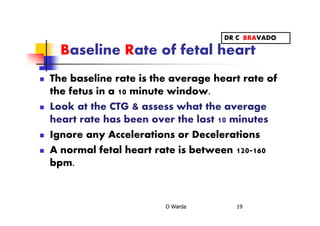
Baseline Rate of fetal heart
The baseline rate is the average heart rate of
the fetus in a 10 minute window.
Look at the CTG & assess what the average
heart rate has been over the last 10 minutes
Ignore any Accelerations or Decelerations
A normal fetal heart rate is between 120-160
bpm.
O Warda 19
DR C BRAVADO
Baseline Rate of fetal heart
O Warda 20
DR C BRAVADO
Baseline Rate of fetal heart
O Warda 21
DR C BRAVADO
If the causes of tachy-or-bradycardia cannot be identified and
corrected, immediate delivery is recommended
Variability
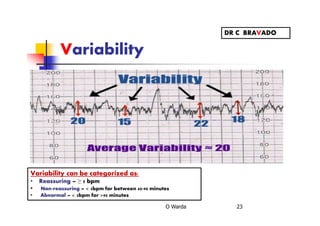
Baseline variability refers to the variation of fetal heart rate from
one beat to the next.
Variability occurs as a result of the interaction between the
nervous system, chemoreceptors, barorecptors & cardiac
responsiveness.
Therefore it is a good indicator of how healthy the fetus is at that
time.
This is because a healthy fetus will constantly be adapting it’s
heart rate to respond to changes in it’s environment.
Normal variability is between 10-25 bpm
To calculate variability you look at how much the peaks & troughs
of the heart rate deviate from the baseline rate (in bpm)
O Warda 22
DR C BRAVADO
Variability
O Warda 23
DR C BRAVADO
Variability can be categorized as:
• Reassuring – ≥ 5 bpm
• Non-reassuring – < 5bpm for between 40-90 minutes
• Abnormal – < 5bpm for >90 minutes
Variability
O Warda 24
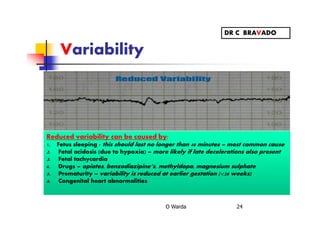
Reduced variability can be caused by:
1. Fetus sleeping - this should last no longer than 40 minutes – most common cause
2. Fetal acidosis (due to hypoxia) – more likely if late decelerations also present
3. Fetal tachycardia
4. Drugs – opiates, benzodiazipine’s, methyldopa, magnesium sulphate
5. Prematurity – variability is reduced at earlier gestation (<28 weeks)
6. Congenital heart abnormalities
DR C BRAVADO
Accelerations
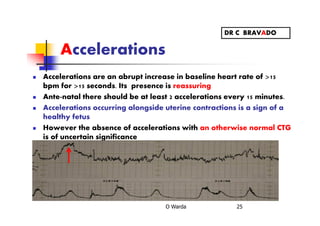
Accelerations are an abrupt increase in baseline heart rate of >15
bpm for >15 seconds. Its presence is reassuring
Ante-natal there should be at least 2 accelerations every 15 minutes.
Accelerations occurring alongside uterine contractions is a sign of a
healthy fetus
However the absence of accelerations with an otherwise normal CTG
is of uncertain significance
O Warda 25
DR C BRAVADO
Decelerations
Decelerations are an abrupt decrease in baseline heart
rate of >15 bpm for >15 seconds
There are a number of different types of decelerations,
each with varying significance
1. Early decelerations
2. Variable decelerations
3. Late decelerations
4. Prolonged decelerations
5. Sinusoidal pattern
O Warda 26
DR C BRAVADO
Decelerations
1. Early deceleration
Early decelerations start when uterine contraction begins & recover when
uterine contraction stops
This is due to increased fetal intracranial pressure causing increased vagal
tone
It therefore quickly resolves once the uterine contraction ends & intracranial
pressure reduces
This type of deceleration is therefore considered to be physiological .
O Warda 27
DR C BRAVADO
Decelerations
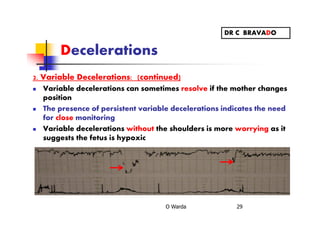
2. Variable Decelerations:
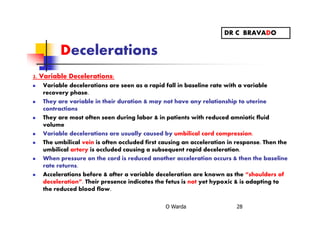
Variable decelerations are seen as a rapid fall in baseline rate with a variable
recovery phase.
They are variable in their duration & may not have any relationship to uterine
contractions
They are most often seen during labor & in patients with reduced amniotic fluid
volume
Variable decelerations are usually caused by umbilical cord compression.
The umbilical vein is often occluded first causing an acceleration in response. Then the
umbilical artery is occluded causing a subsequent rapid deceleration.
When pressure on the cord is reduced another acceleration occurs & then the baseline
rate returns.
Accelerations before & after a variable deceleration are known as the “shoulders of
deceleration”. Their presence indicates the fetus is not yet hypoxic & is adapting to
the reduced blood flow.
O Warda 28
DR C BRAVADO
Decelerations
2. Variable Decelerations: (continued)
Variable decelerations can sometimes resolve if the mother changes
position
The presence of persistent variable decelerations indicates the need
for close monitoring
Variable decelerations without the shoulders is more worrying as it
suggests the fetus is hypoxic
O Warda 29
DR C BRAVADO
Decelerations
3. Late deceleration
Late decelerations begin at the peak of uterine contraction & recover after the
contraction ends.
This type of deceleration indicates there is insufficient blood flow through the uterus
& placenta. As a result blood flow to the fetus is significantly reduced causing fetal
hypoxia & acidosis
Reduced utero-placental blood flow can be caused by:
Maternal hypotension
Pre-eclampsia
Uterine hyper-stimulation
NOTE: The presence of late decelerations is
taken seriously & fetal blood sampling for pH
is indicated, If fetal blood pH is acidotic it
indicates significant foetal hypoxia & the
need for emergency C-section
O Warda 30
DR C BRAVADO
Decelerations
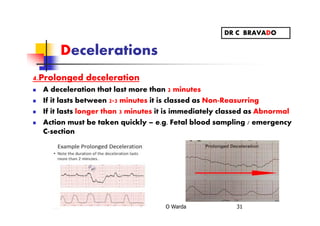
4.Prolonged deceleration
A deceleration that last more than 2 minutes
If it lasts between 2-3 minutes it is classed as Non-Reasurring
If it lasts longer than 3 minutes it is immediately classed as Abnormal
Action must be taken quickly – e.g. Fetal blood sampling / emergency
C-section
O Warda 31
DR C BRAVADO
O Warda 32
Decelerations
5. Sinusoidal Pattern
This type of pattern is rare, however if present it is very serious
It is associated with high rates of fetal morbidity & mortality
It is described as:
A smooth, regular, wave-like pattern
Frequency of around 2-5 cycles a minute
Stable baseline rate around 120-160 bpm
No beat to beat variability
A sinusoidal pattern indicates:
Severe fetal hypoxia
Severe fetal anaemia
Fetal/Maternal Hemorrhage
Immediate C-section is indicated
for this kind of pattern. Outcome is usually poor
O Warda 33
DR C BRAVADO
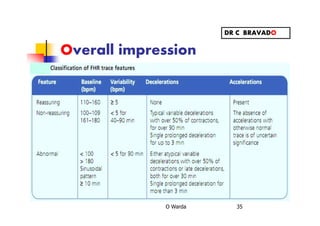
Overall impression
- Once you have assessed all aspects of the CTG you need to give your
overall impression. The overall impression can be described as either:
Reassuring
Suspicious
Pathological
-The overall impression is determined by how many of the CTG features were
either reassuring, non-reassuring or abnormal. The NICE guideline
demonstrates how to decide which category a CTG falls into:
1- Normal CTG= All four features are classified as reassuring.
2-Suspicious CTG= One feature is classified as non-reassuring while the
remaining features are reassuring
3- Pathological CTG= ≥ 2 features non-reassuring, or ≥ 1 feature
classified as abnormal
O Warda 34
DR C BRAVADO
Overall impression
O Warda 35
DR C BRAVADO
INTRAPARTUM FETAL MONITORING
Monitoring uncomplicated pregnancy:
- For a woman who is healthy and has had an otherwise
uncomplicated pregnancy, intermittent auscultation should be
offered and recommended in labor to monitor fetal well-being
using Doppler or Pinard.
- In the active stages of labor, intermittent auscultation should occur
after a contraction, for a minimum of 60 seconds, and at least:
- Every 15 minutes in the first stage
- Every 5 minutes in the second stage
- The maternal pulse should be palpated if FHR abnormality
detected to differentiate the 2 heart rates.
O Warda 36
NICE 2007
INTRAPARTUM FETAL MONITORING
Continuous EFM In Low-risk Women:
Indications:
1. Significant or light Meconium-stained liquor
2. Abnormal FHR detected by intermittent auscultation
(< 110 bpm; or > 160 bpm, or any decelerations after a
contraction.
3. Maternal pyrexia (defined as 38.0 °C once or 37.5 °C on
two occasions 2 hours apart)
4. Fresh bleeding developing in labor
5. Oxytocin use for augmentation
6. The woman’s request. O Warda 37
NICE 9- 2007
INTRAPARTUM FETAL MONITORING
Continuous EFM In Low-risk Women:
Evaluation :
There was a borderline evidence that continuous EFM
were more likely to have an instrumental birth
compared with the auscultation group although there
was no evidence of differences in:
Augmentation
Perinatal mortality
Other neonatal morbidities
O Warda 38
NICE 9- 2007
O Warda 39

Cardiotocography (CTG) warda

  • 1.
    CARDIOTOCOGRAPHY By Osama M Warda, MD Professor of Obstetrics & Gynecology Mansoura University- EGYPT
  • 2.
    BACKGROUND Cardiotocography (CTG) isa test used in pregnancy to monitor both the fetal heart pattern as well as the uterine contractions. It should only used in the 3rd trimester when fetal neural reflexes are present. Its purpose is to monitor fetal well-being & allows early detection of fetal distress antenatal or intra-partum. An abnormal CTG indicates the need for further invasive investigation & ultimately may lead to emergency CS O Warda 2
  • 3.
    When to doCTG? O Warda 3
  • 4.
    Frequency of testing -Usually every 7 days (i.e. weekly) - Twice-weekly testing is advocated by some in : Post term pregnancy Diabetes mellitus Fetal growth restriction, Gestational hypertension - Additional testing is performed for maternal or fetal deterioration regardless of time elapsed - Others perform non-stress tests daily or even more frequently O Warda 4
  • 5.
  • 6.
  • 7.
    Application: external; antenatal Themachine used is called cardio-tocograph. It involves the placement of 2 transducers on the abdomen of a pregnant woman: one transducer records the fetal heart rate using ultrasound beam , the other transducer records uterine contractions by measuring the tension of the maternal abdominal wall. This provides indirect indication of the intrauterine pressure. These recordings are blotted on a special paper. O Warda 7
  • 8.
    Application of thetransducers O Warda 8Internal fetal monitoring FSE
  • 9.
    Application: internal; intra-partum Themachine used is called cardio-tocograph. It involves the placement of 2 transducers: a fetal scalp electrode( FSE): an internal fetal heart monitor , and intrauterine pressure catheter(IUPC): an internal uterine contraction monitor These recordings are shown on a screen and may be blotted on a special paper. O Warda 9
  • 10.
    Setting the CTGmachine Horizontal Scale Paper speed is set to 1,2,or 3 cm /minute. Vertical Scale: Sensitivity displays are set to 20 or 30 beats per minute (bpm) /cm. FHR range displays of 30–240 bpm . Uterine Activity: Internal 0-100 mmHg External 0-100 relative units O Warda 10
  • 11.
    Setting the CTGmachine O Warda 11 3cm / min1cm / min 3 small vertical spaces / cm 10 beats / small space F H R Ut. Cont.
  • 12.
    Setting the CTGmachine Fetal heart rate is commonly recorded with paper speed at 1 cm/ min compared with 3 cm/min chart recorder. 3 cm: is the more accurate for abnormalities 1cm: less paper but less accurate : Used for screening O Warda 12
  • 13.
    ACOUSTIC STIMULATION TESTS Provokingacceleration of FHR. The acoustic stimulator is positioned on the maternal abdomen and a stimulus of 1 to 2 sec . It may be repeated up to three times. It shortened the average time for non-stress testing from 24 to 15 minutes. O Warda 13
  • 14.
    Interpretation of CTG Tointerpret a CTG you need a structured method of assessing its various characteristics. The most popular method can be remembered using the acronym DR C BRAVADO - DR=Define Risk . - C= Contractions - Bra= Baseline Rate - V=Variability - A= Accelerations - D= Decelerations - O= Overall impression O Warda 14
  • 15.
    Define Risk You firstneed to assess if this pregnancy is high or low risk This is important as it gives more context to the CTG reading ;e.g. If the pregnancy is high risk, your threshold for intervening may be lowered. O Warda 15 DR C BRAVADO
  • 16.
  • 17.
    Contraction Record the numberof contractions present in a 10 minute period - e.g. 3 in 10 Each big square is equal to 1 minute, so you look how many contractions occurred in 10 squares Individual contractions are seen as peaks on the part of the CTG monitoring uterine activity You should assess contractions for the following: Duration – how long do the contractions last? Intensity – how strong are the contractions? (assessed using palpation) O Warda 17 DR C BRAVADO
  • 18.
    O Warda 18 Inthis example there are 2-3 contractions in a 10 minute period - e.g. 3 in 10 Contraction DR C BRAVADO
  • 19.
    Baseline Rate offetal heart The baseline rate is the average heart rate of the fetus in a 10 minute window. Look at the CTG & assess what the average heart rate has been over the last 10 minutes Ignore any Accelerations or Decelerations A normal fetal heart rate is between 120-160 bpm. O Warda 19 DR C BRAVADO
  • 20.
    Baseline Rate offetal heart O Warda 20 DR C BRAVADO
  • 21.
    Baseline Rate offetal heart O Warda 21 DR C BRAVADO If the causes of tachy-or-bradycardia cannot be identified and corrected, immediate delivery is recommended
  • 22.
    Variability Baseline variability refersto the variation of fetal heart rate from one beat to the next. Variability occurs as a result of the interaction between the nervous system, chemoreceptors, barorecptors & cardiac responsiveness. Therefore it is a good indicator of how healthy the fetus is at that time. This is because a healthy fetus will constantly be adapting it’s heart rate to respond to changes in it’s environment. Normal variability is between 10-25 bpm To calculate variability you look at how much the peaks & troughs of the heart rate deviate from the baseline rate (in bpm) O Warda 22 DR C BRAVADO
  • 23.
    Variability O Warda 23 DRC BRAVADO Variability can be categorized as: • Reassuring – ≥ 5 bpm • Non-reassuring – < 5bpm for between 40-90 minutes • Abnormal – < 5bpm for >90 minutes
  • 24.
    Variability O Warda 24 Reducedvariability can be caused by: 1. Fetus sleeping - this should last no longer than 40 minutes – most common cause 2. Fetal acidosis (due to hypoxia) – more likely if late decelerations also present 3. Fetal tachycardia 4. Drugs – opiates, benzodiazipine’s, methyldopa, magnesium sulphate 5. Prematurity – variability is reduced at earlier gestation (<28 weeks) 6. Congenital heart abnormalities DR C BRAVADO
  • 25.
    Accelerations Accelerations are anabrupt increase in baseline heart rate of >15 bpm for >15 seconds. Its presence is reassuring Ante-natal there should be at least 2 accelerations every 15 minutes. Accelerations occurring alongside uterine contractions is a sign of a healthy fetus However the absence of accelerations with an otherwise normal CTG is of uncertain significance O Warda 25 DR C BRAVADO
  • 26.
    Decelerations Decelerations are anabrupt decrease in baseline heart rate of >15 bpm for >15 seconds There are a number of different types of decelerations, each with varying significance 1. Early decelerations 2. Variable decelerations 3. Late decelerations 4. Prolonged decelerations 5. Sinusoidal pattern O Warda 26 DR C BRAVADO
  • 27.
    Decelerations 1. Early deceleration Earlydecelerations start when uterine contraction begins & recover when uterine contraction stops This is due to increased fetal intracranial pressure causing increased vagal tone It therefore quickly resolves once the uterine contraction ends & intracranial pressure reduces This type of deceleration is therefore considered to be physiological . O Warda 27 DR C BRAVADO
  • 28.
    Decelerations 2. Variable Decelerations: Variabledecelerations are seen as a rapid fall in baseline rate with a variable recovery phase. They are variable in their duration & may not have any relationship to uterine contractions They are most often seen during labor & in patients with reduced amniotic fluid volume Variable decelerations are usually caused by umbilical cord compression. The umbilical vein is often occluded first causing an acceleration in response. Then the umbilical artery is occluded causing a subsequent rapid deceleration. When pressure on the cord is reduced another acceleration occurs & then the baseline rate returns. Accelerations before & after a variable deceleration are known as the “shoulders of deceleration”. Their presence indicates the fetus is not yet hypoxic & is adapting to the reduced blood flow. O Warda 28 DR C BRAVADO
  • 29.
    Decelerations 2. Variable Decelerations:(continued) Variable decelerations can sometimes resolve if the mother changes position The presence of persistent variable decelerations indicates the need for close monitoring Variable decelerations without the shoulders is more worrying as it suggests the fetus is hypoxic O Warda 29 DR C BRAVADO
  • 30.
    Decelerations 3. Late deceleration Latedecelerations begin at the peak of uterine contraction & recover after the contraction ends. This type of deceleration indicates there is insufficient blood flow through the uterus & placenta. As a result blood flow to the fetus is significantly reduced causing fetal hypoxia & acidosis Reduced utero-placental blood flow can be caused by: Maternal hypotension Pre-eclampsia Uterine hyper-stimulation NOTE: The presence of late decelerations is taken seriously & fetal blood sampling for pH is indicated, If fetal blood pH is acidotic it indicates significant foetal hypoxia & the need for emergency C-section O Warda 30 DR C BRAVADO
  • 31.
    Decelerations 4.Prolonged deceleration A decelerationthat last more than 2 minutes If it lasts between 2-3 minutes it is classed as Non-Reasurring If it lasts longer than 3 minutes it is immediately classed as Abnormal Action must be taken quickly – e.g. Fetal blood sampling / emergency C-section O Warda 31 DR C BRAVADO
  • 32.
  • 33.
    Decelerations 5. Sinusoidal Pattern Thistype of pattern is rare, however if present it is very serious It is associated with high rates of fetal morbidity & mortality It is described as: A smooth, regular, wave-like pattern Frequency of around 2-5 cycles a minute Stable baseline rate around 120-160 bpm No beat to beat variability A sinusoidal pattern indicates: Severe fetal hypoxia Severe fetal anaemia Fetal/Maternal Hemorrhage Immediate C-section is indicated for this kind of pattern. Outcome is usually poor O Warda 33 DR C BRAVADO
  • 34.
    Overall impression - Onceyou have assessed all aspects of the CTG you need to give your overall impression. The overall impression can be described as either: Reassuring Suspicious Pathological -The overall impression is determined by how many of the CTG features were either reassuring, non-reassuring or abnormal. The NICE guideline demonstrates how to decide which category a CTG falls into: 1- Normal CTG= All four features are classified as reassuring. 2-Suspicious CTG= One feature is classified as non-reassuring while the remaining features are reassuring 3- Pathological CTG= ≥ 2 features non-reassuring, or ≥ 1 feature classified as abnormal O Warda 34 DR C BRAVADO
  • 35.
  • 36.
    INTRAPARTUM FETAL MONITORING Monitoringuncomplicated pregnancy: - For a woman who is healthy and has had an otherwise uncomplicated pregnancy, intermittent auscultation should be offered and recommended in labor to monitor fetal well-being using Doppler or Pinard. - In the active stages of labor, intermittent auscultation should occur after a contraction, for a minimum of 60 seconds, and at least: - Every 15 minutes in the first stage - Every 5 minutes in the second stage - The maternal pulse should be palpated if FHR abnormality detected to differentiate the 2 heart rates. O Warda 36 NICE 2007
  • 37.
    INTRAPARTUM FETAL MONITORING ContinuousEFM In Low-risk Women: Indications: 1. Significant or light Meconium-stained liquor 2. Abnormal FHR detected by intermittent auscultation (< 110 bpm; or > 160 bpm, or any decelerations after a contraction. 3. Maternal pyrexia (defined as 38.0 °C once or 37.5 °C on two occasions 2 hours apart) 4. Fresh bleeding developing in labor 5. Oxytocin use for augmentation 6. The woman’s request. O Warda 37 NICE 9- 2007
  • 38.
    INTRAPARTUM FETAL MONITORING ContinuousEFM In Low-risk Women: Evaluation : There was a borderline evidence that continuous EFM were more likely to have an instrumental birth compared with the auscultation group although there was no evidence of differences in: Augmentation Perinatal mortality Other neonatal morbidities O Warda 38 NICE 9- 2007
  • 39.