CTG
Interpretation and management
Aboubakr Elnashar: Benha University Hospital, EgyptAboubakr Elnashar
INTERPRETATION
 Steps
1. Evaluate tracing.
Do you have enough of a continuous strip for
interpretation
2. Identify
 FHR baseline
 BBV
absent, minimal, moderate or marked
 Accelerations or
 Decelerations.
Aboubakr Elnashar
3. Evaluate contractions
regularity, rate, intensity, duration of
contractions.
4. Correlate accelerations and decelerations with
uterine contractions and identify the pattern.
5. Determine whether the FHR recording is
reassuring, non reassuring or ominous.
6. Document interpretation of
FHR
clinical conclusion
plan of care.
Aboubakr Elnashar
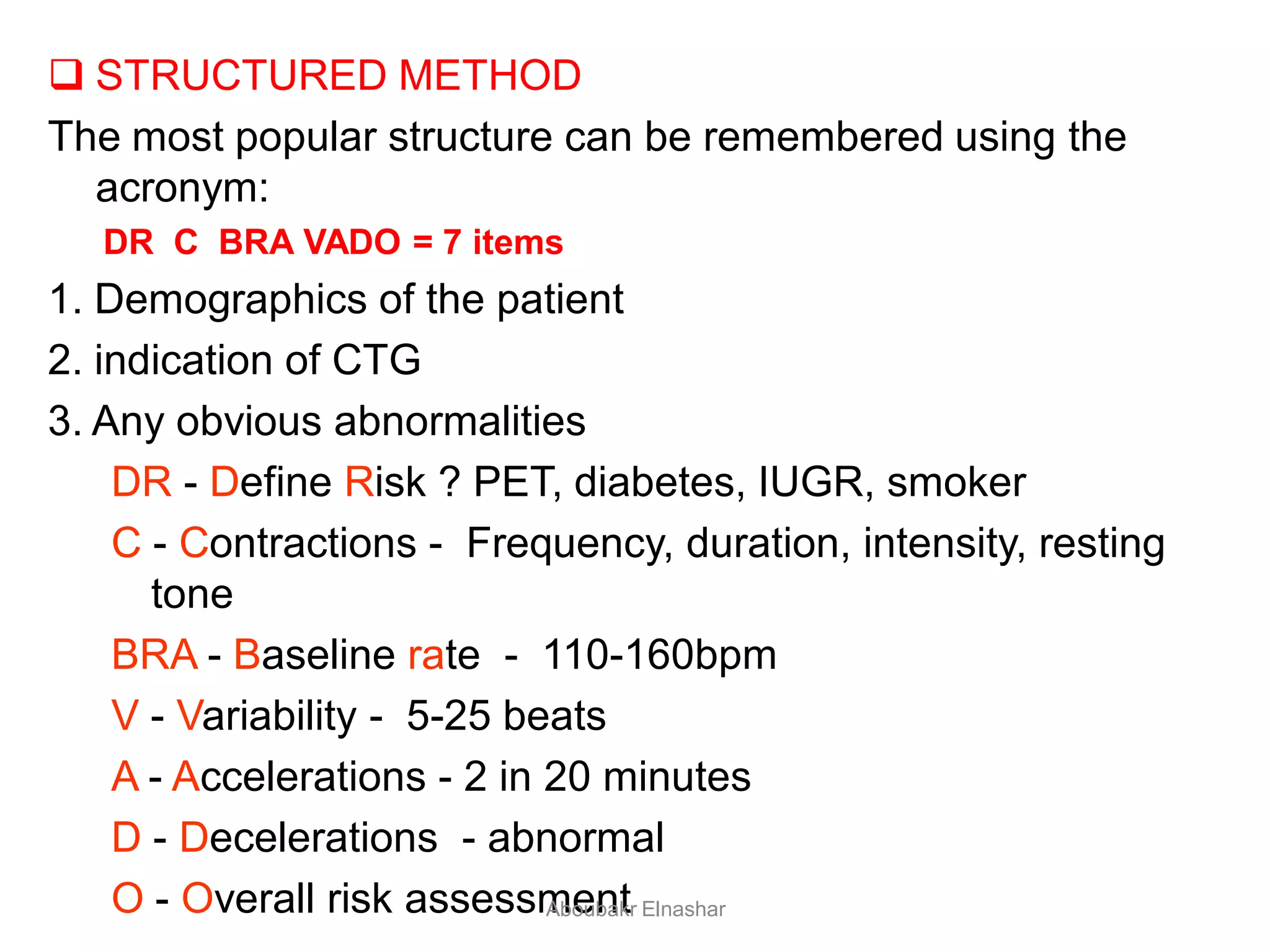
 STRUCTURED METHOD
The most popular structure can be remembered using the
acronym:
DR C BRA VADO = 7 items
1. Demographics of the patient
2. indication of CTG
3. Any obvious abnormalities
DR - Define Risk ? PET, diabetes, IUGR, smoker
C - Contractions - Frequency, duration, intensity, resting
tone
BRA - Baseline rate - 110-160bpm
V - Variability - 5-25 beats
A - Accelerations - 2 in 20 minutes
D - Decelerations - abnormal
O - Overall risk assessmentAboubakr Elnashar
 Define Risk
• You first need to assess if this pregnancy is high or low risk
• This is important as it gives more context to the CTG
reading. e.g. If the pregnancy is high risk, your threshold for
intervening may be lowered
• Maternal medical illness
Gestational diabetes
Hypertension
Asthma.
• Obstetric complications
Multiple gestation
Post-date gestation
Previous cesarean section
Intrauterine growth restriction
Premature rupture of the membranes
Congenital malformations
Oxytocin induction/augmentation of labor
Pre-eclampsia. Aboubakr Elnashar
O – Overall assessment
Once you have assessed all aspects of the CTG
you need to give your overall impression
Aboubakr Elnashar
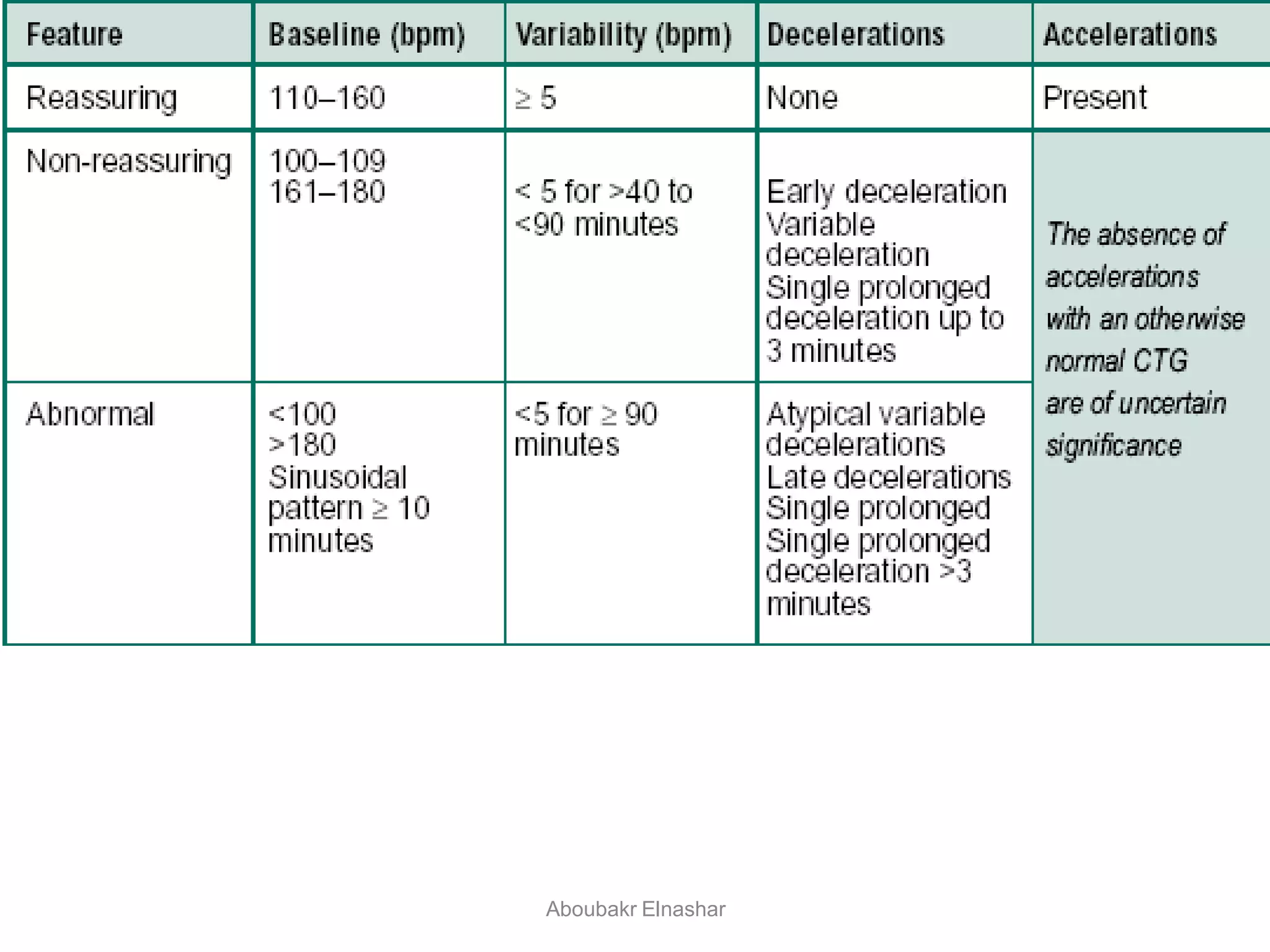
Categorization of FHR traces
Aboubakr Elnashar
Aboubakr Elnashar
Aboubakr Elnashar
Aboubakr Elnashar
II. MANAGEMENT
FIGO Fetal HR Pattern Classification
Normal means fetal health
• Suspicious means
- continue observation
- additional tests
• Pathological means
- additional test
- intervention
1. Normal/Reassuring
risk of fetal hypoxia in spontaneous labour is low:
Manage normally.
Aboubakr Elnashar
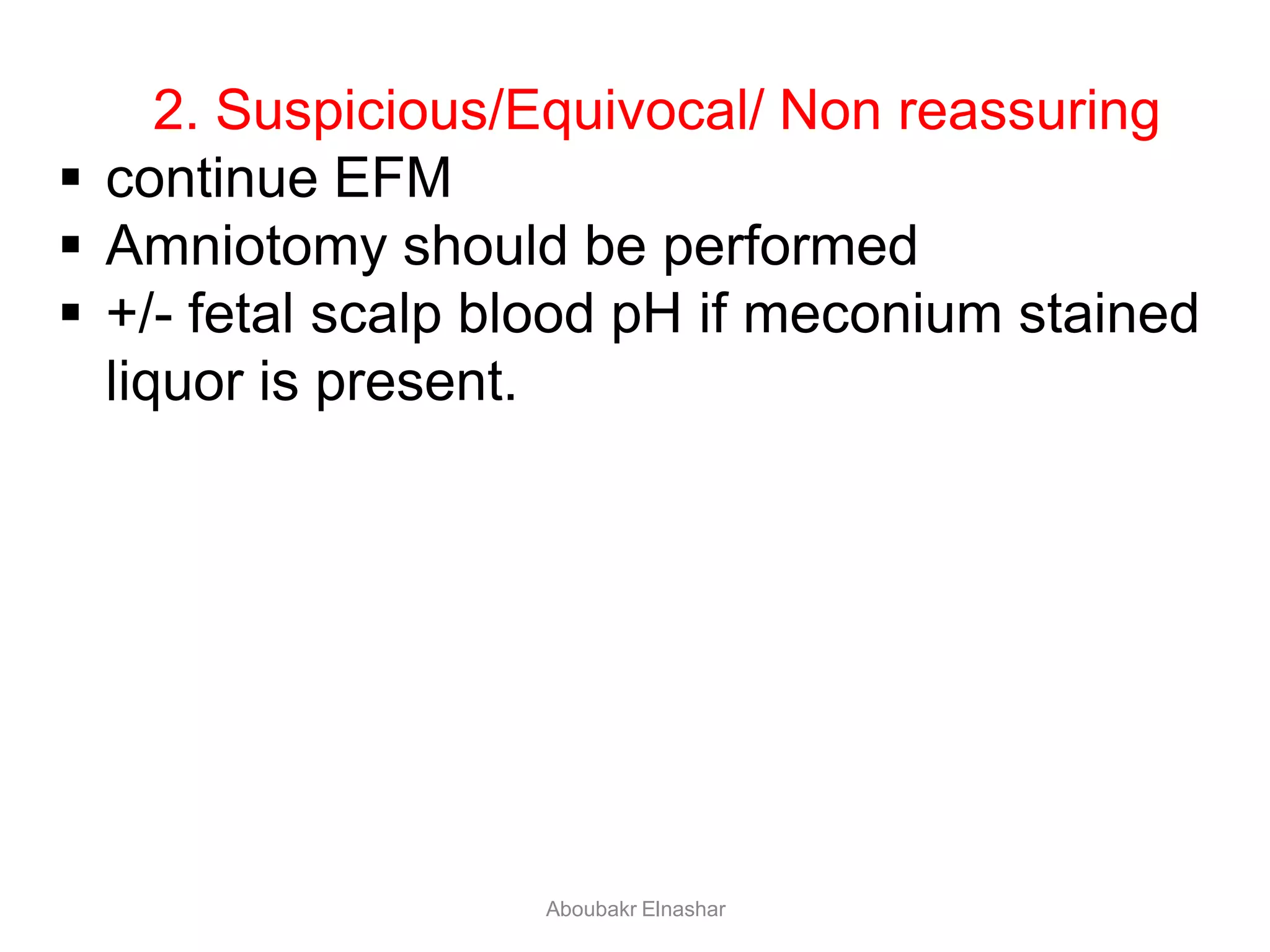
2. Suspicious/Equivocal/ Non reassuring
 continue EFM
 Amniotomy should be performed
 +/- fetal scalp blood pH if meconium stained
liquor is present.
Aboubakr Elnashar
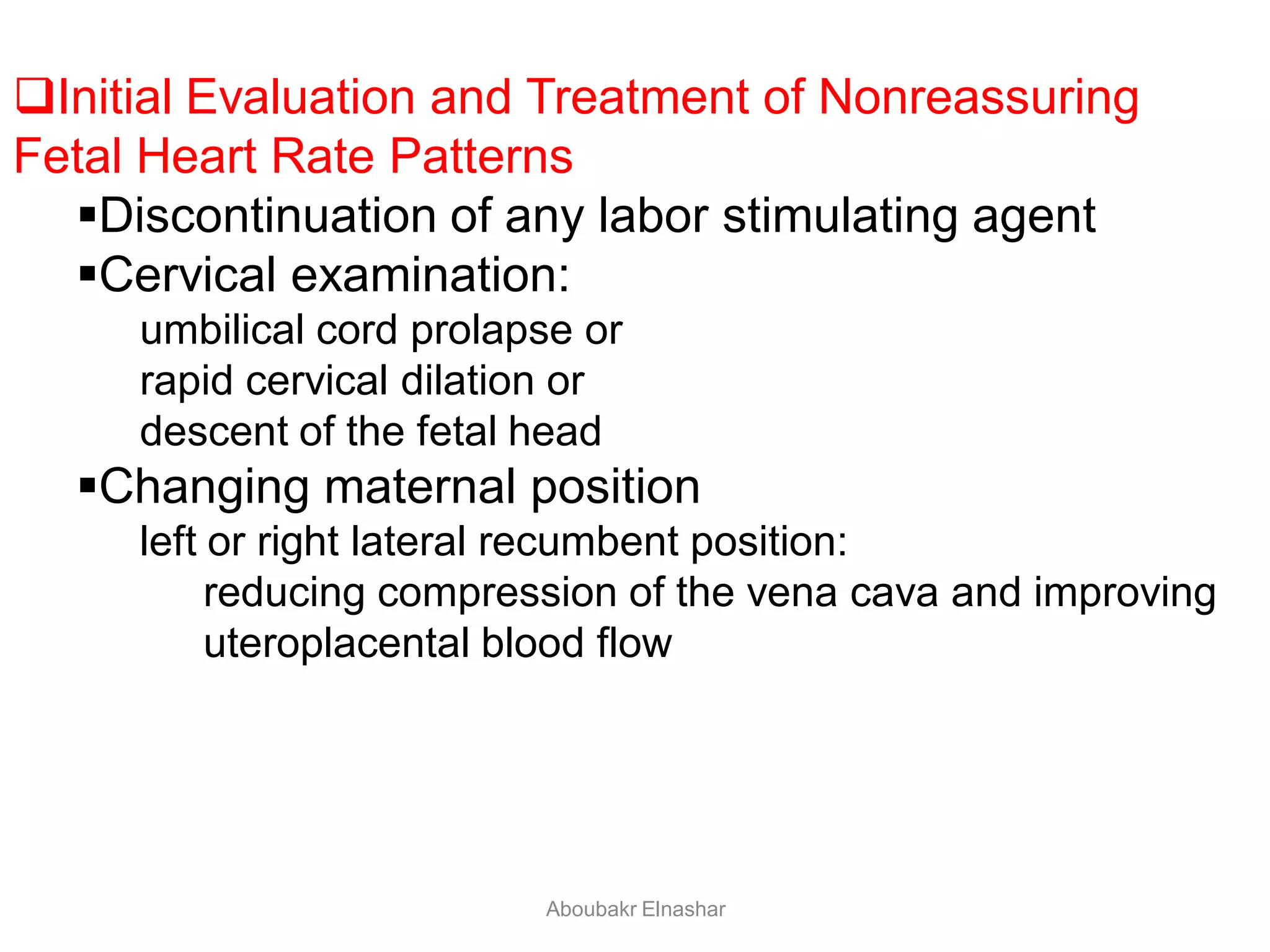
Initial Evaluation and Treatment of Nonreassuring
Fetal Heart Rate Patterns
Discontinuation of any labor stimulating agent
Cervical examination:
umbilical cord prolapse or
rapid cervical dilation or
descent of the fetal head
Changing maternal position
left or right lateral recumbent position:
reducing compression of the vena cava and improving
uteroplacental blood flow
Aboubakr Elnashar
Monitoring BP
for evidence of hypotension, especially in those with
regional anesthesia
if present: treatment with ephedrine or phenylephrine
may be warranted
Assessment of patient for uterine hyperstimulation
 by evaluating uterine contraction frequency and
duration
In the presence of abnormal FHR patterns and
uterine hypercontractility not secondary to oxytocin
infusion: tocolysis
 subcutaneous terbutaline 0.25 milligrams
Aboubakr Elnashar
In cases of suspected or confirmed acute fetal
compromise:
delivery should be accomplished as soon as
possible, accounting for the severity of the FHR
abnormality and relevant maternal factors
The accepted standard has been that ideally this
should be accomplished within 30 minutes.
Aboubakr Elnashar
Maternal facial oxygen therapy
Prolonged use of maternal facial oxygen therapy
may be harmful to the fetus and should be avoided.
There is no research evidence evaluating the
benefits or risks associated with the short-term use
of maternal facial oxygen therapy in cases of
suspected fetal compromise .•C
Aboubakr Elnashar
3. Abnormal/Pathological
Amniotomy
Fetal scalp blood pH if meconium stained
liquor to determine subsequent management
or
Deliver if clinically indicated.
Deliver if fetal scalp pH required but not
obtainable i.e. if cervix not sufficiently dilated
or equipment not available.
Aboubakr Elnashar
III. SPECIAL SITUATIONS
Second Stage of Labour
Signs of hypoxia:
• Tachycardia
• ↓ variability between and during decelerations
• Late decelerations
• Failure to return to baseline (or > 100 bpm)
after decelerations
• Prolonged bradycardia
* Delay of 20 min → asphyxiated infant
Aboubakr Elnashar
Placental abruption
• Uterine irritability shown by frequent
contractions of low amplitude
• FHR trace:
initially tachycardia
± decelerations
no accelerations
↓ variability.
Bradycardia is a late and danger sign of
severe asphyxia
Aboubakr Elnashar
Fetal abnormality
• CNS abnormality: →
↓ baseline variability
low baseline rate
• Discrepancy between CTG (abnormal) and
biophysical profile (within normal) suggest
chromosomal abnormalities, especially if bony
measurements are reduced/slight IUGR
Aboubakr Elnashar
Heart block
• Persistent bradycardia / double counting
• No respond to stimulation
Dying fetus
• Acute/subacute insult : decelerations /
tachycardia / lack of accelerations → ↓
variability → bradycardia
Aboubakr Elnashar
Thank you
Aboubakr Elnashar
CTG
PATTERN
CAUSE CLINICAL MANAGEMENT
Declaration
Early
2nd Stage NONE
Late Uterine
hypercontractily
Stop oxytocin
Consider terbutaline sc
Oxygen @ 8-10 l/min
Left lateral decubitus
Variable Cord
compression
Consider amnioinfusion
(mild/mod v.d.)
Tachycardia Maternal fever,
tachycardia,
dehydration
Infection screen
Hydrate: crystalloids
Stop tocolysis if pulse>120
SUSPICIOUS CTG
Aboubakr Elnashar
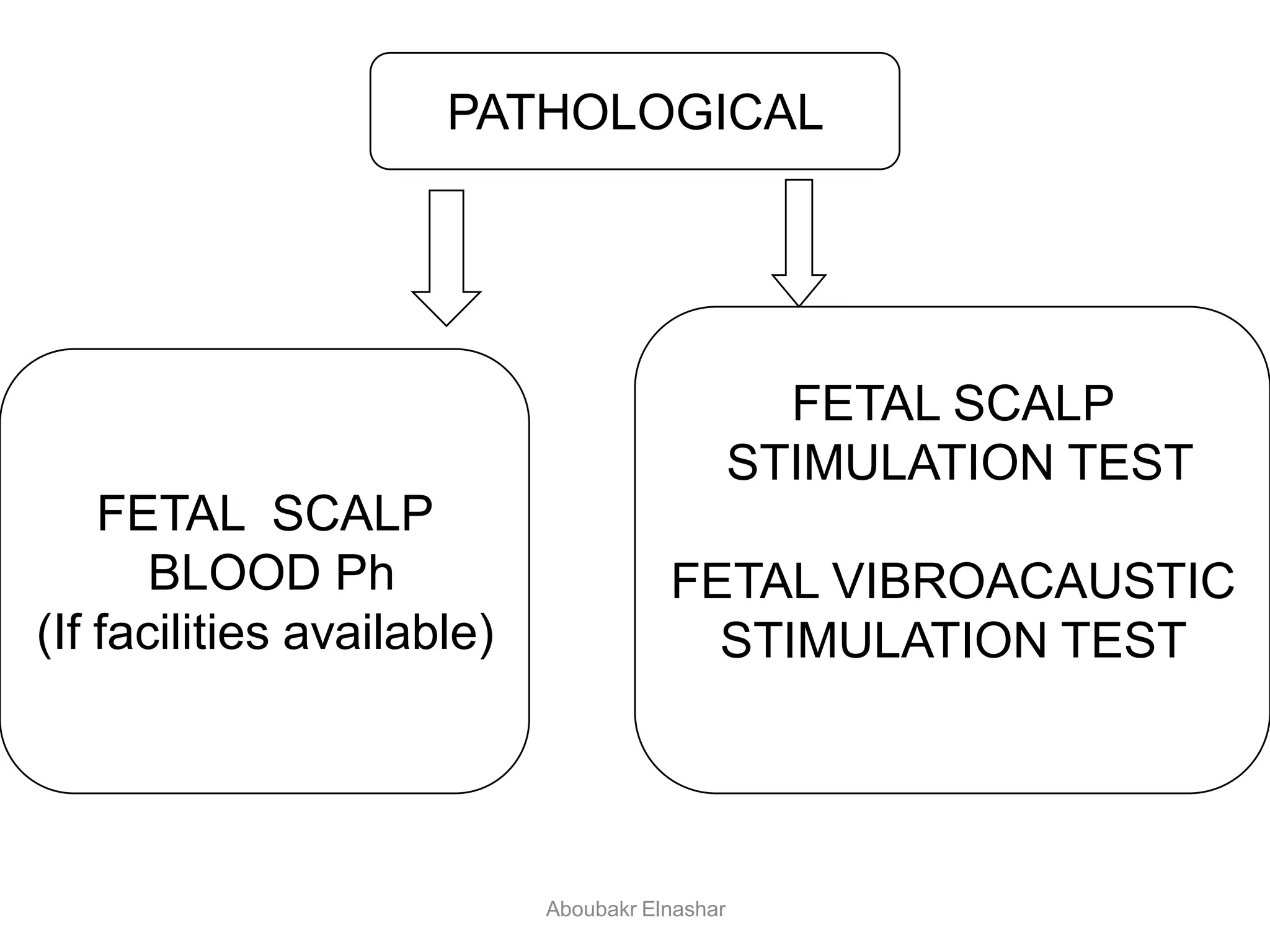
PATHOLOGICAL
FETAL SCALP
BLOOD Ph
(If facilities available)
FETAL SCALP
STIMULATION TEST
FETAL VIBROACAUSTIC
STIMULATION TEST
Aboubakr Elnashar
PATHOLOGICAL
FETAL SCALP
BLOOD Ph
(If facilities available)
FETAL SCALP
STIMULATION TEST
FETAL VIBROACAUSTIC
STIMULATION TEST
Aboubakr Elnashar
Category Definition
Normal All four reassuring
Suspicious 1 non-reassuring
Rest reassuring
Pathological 2 or more non-reassuring
1 or more abnormal
Aboubakr Elnashar
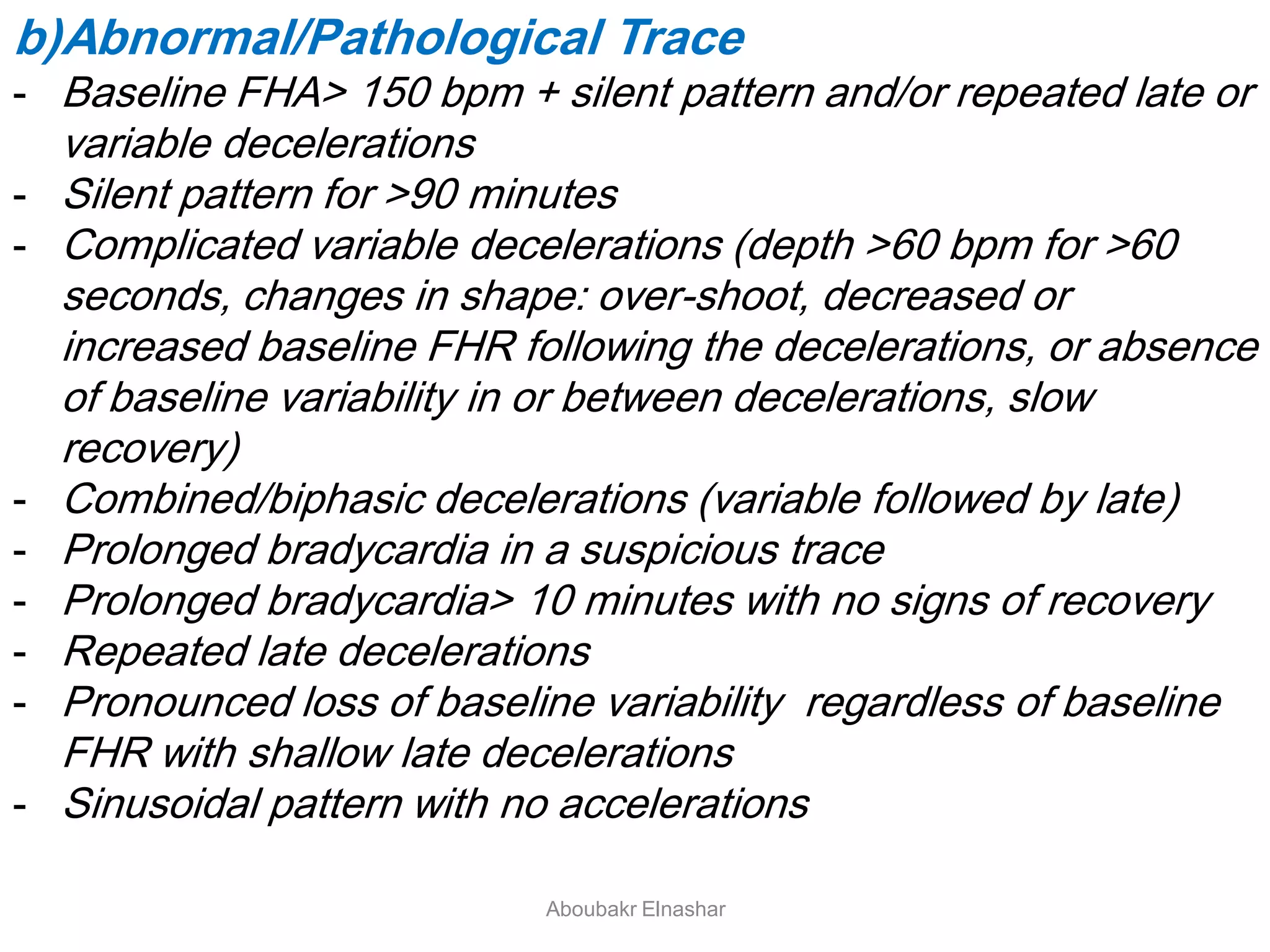
b)Abnormal/Pathological Trace
- Baseline FHA> 150 bpm + silent pattern and/or repeated late or
variable decelerations
- Silent pattern for >90 minutes
- Complicated variable decelerations (depth >60 bpm for >60
seconds, changes in shape: over-shoot, decreased or
increased baseline FHR following the decelerations, or absence
of baseline variability in or between decelerations, slow
recovery)
- Combined/biphasic decelerations (variable followed by late)
- Prolonged bradycardia in a suspicious trace
- Prolonged bradycardia> 10 minutes with no signs of recovery
- Repeated late decelerations
- Pronounced loss of baseline variability regardless of baseline
FHR with shallow late decelerations
- Sinusoidal pattern with no accelerations
Aboubakr Elnashar
Aboubakr Elnashar
a)Normal/Reassuring Trace
- At least two accelerations (> 15 beats per minute
for >15 seconds) in 20 minutes
- Baseline heart rate: 110-150 bpm
- Baseline variability: 5-25 bpm
- Early decelerations (in late first stage of labour)
Aboubakr Elnashar
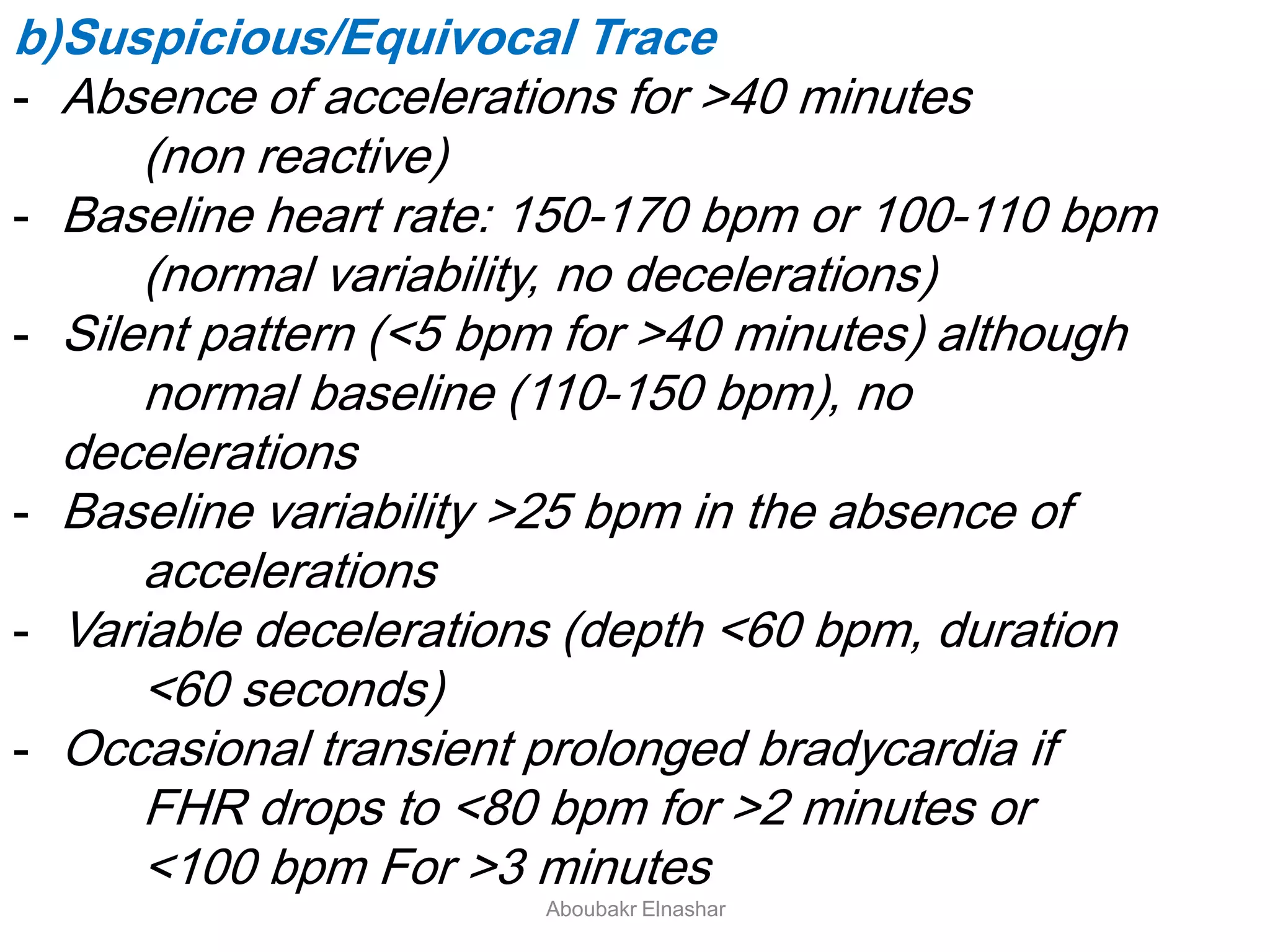
b)Suspicious/Equivocal Trace
- Absence of accelerations for >40 minutes
(non reactive)
- Baseline heart rate: 150-170 bpm or 100-110 bpm
(normal variability, no decelerations)
- Silent pattern (<5 bpm for >40 minutes) although
normal baseline (110-150 bpm), no
decelerations
- Baseline variability >25 bpm in the absence of
accelerations
- Variable decelerations (depth <60 bpm, duration
<60 seconds)
- Occasional transient prolonged bradycardia if
FHR drops to <80 bpm for >2 minutes or
<100 bpm For >3 minutes
Aboubakr Elnashar

CTG: Interpretation and management

  • 1.
    CTG Interpretation and management AboubakrElnashar: Benha University Hospital, EgyptAboubakr Elnashar
  • 2.
    INTERPRETATION  Steps 1. Evaluatetracing. Do you have enough of a continuous strip for interpretation 2. Identify  FHR baseline  BBV absent, minimal, moderate or marked  Accelerations or  Decelerations. Aboubakr Elnashar
  • 3.
    3. Evaluate contractions regularity,rate, intensity, duration of contractions. 4. Correlate accelerations and decelerations with uterine contractions and identify the pattern. 5. Determine whether the FHR recording is reassuring, non reassuring or ominous. 6. Document interpretation of FHR clinical conclusion plan of care. Aboubakr Elnashar
  • 4.
     STRUCTURED METHOD Themost popular structure can be remembered using the acronym: DR C BRA VADO = 7 items 1. Demographics of the patient 2. indication of CTG 3. Any obvious abnormalities DR - Define Risk ? PET, diabetes, IUGR, smoker C - Contractions - Frequency, duration, intensity, resting tone BRA - Baseline rate - 110-160bpm V - Variability - 5-25 beats A - Accelerations - 2 in 20 minutes D - Decelerations - abnormal O - Overall risk assessmentAboubakr Elnashar
  • 5.
     Define Risk •You first need to assess if this pregnancy is high or low risk • This is important as it gives more context to the CTG reading. e.g. If the pregnancy is high risk, your threshold for intervening may be lowered • Maternal medical illness Gestational diabetes Hypertension Asthma. • Obstetric complications Multiple gestation Post-date gestation Previous cesarean section Intrauterine growth restriction Premature rupture of the membranes Congenital malformations Oxytocin induction/augmentation of labor Pre-eclampsia. Aboubakr Elnashar
  • 6.
    O – Overallassessment Once you have assessed all aspects of the CTG you need to give your overall impression Aboubakr Elnashar
  • 7.
    Categorization of FHRtraces Aboubakr Elnashar
  • 8.
  • 9.
  • 10.
  • 11.
    II. MANAGEMENT FIGO FetalHR Pattern Classification Normal means fetal health • Suspicious means - continue observation - additional tests • Pathological means - additional test - intervention 1. Normal/Reassuring risk of fetal hypoxia in spontaneous labour is low: Manage normally. Aboubakr Elnashar
  • 12.
    2. Suspicious/Equivocal/ Nonreassuring  continue EFM  Amniotomy should be performed  +/- fetal scalp blood pH if meconium stained liquor is present. Aboubakr Elnashar
  • 13.
    Initial Evaluation andTreatment of Nonreassuring Fetal Heart Rate Patterns Discontinuation of any labor stimulating agent Cervical examination: umbilical cord prolapse or rapid cervical dilation or descent of the fetal head Changing maternal position left or right lateral recumbent position: reducing compression of the vena cava and improving uteroplacental blood flow Aboubakr Elnashar
  • 14.
    Monitoring BP for evidenceof hypotension, especially in those with regional anesthesia if present: treatment with ephedrine or phenylephrine may be warranted Assessment of patient for uterine hyperstimulation  by evaluating uterine contraction frequency and duration In the presence of abnormal FHR patterns and uterine hypercontractility not secondary to oxytocin infusion: tocolysis  subcutaneous terbutaline 0.25 milligrams Aboubakr Elnashar
  • 15.
    In cases ofsuspected or confirmed acute fetal compromise: delivery should be accomplished as soon as possible, accounting for the severity of the FHR abnormality and relevant maternal factors The accepted standard has been that ideally this should be accomplished within 30 minutes. Aboubakr Elnashar
  • 16.
    Maternal facial oxygentherapy Prolonged use of maternal facial oxygen therapy may be harmful to the fetus and should be avoided. There is no research evidence evaluating the benefits or risks associated with the short-term use of maternal facial oxygen therapy in cases of suspected fetal compromise .•C Aboubakr Elnashar
  • 17.
    3. Abnormal/Pathological Amniotomy Fetal scalpblood pH if meconium stained liquor to determine subsequent management or Deliver if clinically indicated. Deliver if fetal scalp pH required but not obtainable i.e. if cervix not sufficiently dilated or equipment not available. Aboubakr Elnashar
  • 18.
    III. SPECIAL SITUATIONS SecondStage of Labour Signs of hypoxia: • Tachycardia • ↓ variability between and during decelerations • Late decelerations • Failure to return to baseline (or > 100 bpm) after decelerations • Prolonged bradycardia * Delay of 20 min → asphyxiated infant Aboubakr Elnashar
  • 19.
    Placental abruption • Uterineirritability shown by frequent contractions of low amplitude • FHR trace: initially tachycardia ± decelerations no accelerations ↓ variability. Bradycardia is a late and danger sign of severe asphyxia Aboubakr Elnashar
  • 20.
    Fetal abnormality • CNSabnormality: → ↓ baseline variability low baseline rate • Discrepancy between CTG (abnormal) and biophysical profile (within normal) suggest chromosomal abnormalities, especially if bony measurements are reduced/slight IUGR Aboubakr Elnashar
  • 21.
    Heart block • Persistentbradycardia / double counting • No respond to stimulation Dying fetus • Acute/subacute insult : decelerations / tachycardia / lack of accelerations → ↓ variability → bradycardia Aboubakr Elnashar
  • 22.
  • 23.
    CTG PATTERN CAUSE CLINICAL MANAGEMENT Declaration Early 2ndStage NONE Late Uterine hypercontractily Stop oxytocin Consider terbutaline sc Oxygen @ 8-10 l/min Left lateral decubitus Variable Cord compression Consider amnioinfusion (mild/mod v.d.) Tachycardia Maternal fever, tachycardia, dehydration Infection screen Hydrate: crystalloids Stop tocolysis if pulse>120 SUSPICIOUS CTG Aboubakr Elnashar
  • 24.
    PATHOLOGICAL FETAL SCALP BLOOD Ph (Iffacilities available) FETAL SCALP STIMULATION TEST FETAL VIBROACAUSTIC STIMULATION TEST Aboubakr Elnashar
  • 25.
    PATHOLOGICAL FETAL SCALP BLOOD Ph (Iffacilities available) FETAL SCALP STIMULATION TEST FETAL VIBROACAUSTIC STIMULATION TEST Aboubakr Elnashar
  • 26.
    Category Definition Normal Allfour reassuring Suspicious 1 non-reassuring Rest reassuring Pathological 2 or more non-reassuring 1 or more abnormal Aboubakr Elnashar
  • 27.
    b)Abnormal/Pathological Trace - BaselineFHA> 150 bpm + silent pattern and/or repeated late or variable decelerations - Silent pattern for >90 minutes - Complicated variable decelerations (depth >60 bpm for >60 seconds, changes in shape: over-shoot, decreased or increased baseline FHR following the decelerations, or absence of baseline variability in or between decelerations, slow recovery) - Combined/biphasic decelerations (variable followed by late) - Prolonged bradycardia in a suspicious trace - Prolonged bradycardia> 10 minutes with no signs of recovery - Repeated late decelerations - Pronounced loss of baseline variability regardless of baseline FHR with shallow late decelerations - Sinusoidal pattern with no accelerations Aboubakr Elnashar
  • 28.
  • 29.
    a)Normal/Reassuring Trace - Atleast two accelerations (> 15 beats per minute for >15 seconds) in 20 minutes - Baseline heart rate: 110-150 bpm - Baseline variability: 5-25 bpm - Early decelerations (in late first stage of labour) Aboubakr Elnashar
  • 30.
    b)Suspicious/Equivocal Trace - Absenceof accelerations for >40 minutes (non reactive) - Baseline heart rate: 150-170 bpm or 100-110 bpm (normal variability, no decelerations) - Silent pattern (<5 bpm for >40 minutes) although normal baseline (110-150 bpm), no decelerations - Baseline variability >25 bpm in the absence of accelerations - Variable decelerations (depth <60 bpm, duration <60 seconds) - Occasional transient prolonged bradycardia if FHR drops to <80 bpm for >2 minutes or <100 bpm For >3 minutes Aboubakr Elnashar