SEMINAR ON
Common Technical Document (CTD)
and Electronic CTD (eCTD)
Presented by:
Preeti P Kulkarni
M.Pharm 1st Sem
Dept. Of Pharmaceutics
Introduction
• CTD is a complete, predictable, consistent and well organised
format for regulatory submissions.
• CTD is a joint effort of 3 major regulatory authorities;
–European Medicine Agency ( EMA, Europe, EU)
–US Food and Drug Administration (FDA,USA)
–Ministry of Health, Labour and Welfare (MHLW, Japan)
• It was agreed on November 2000, SanDiego, USA;
• It is a Standard format for regulatory submissions like IND,
AND, ANDA and BLA and DMFs.
• It is maintained by the ICH.
Need for CTD
• All regulatory authorities had their own guidelines to
submit regulatory dossiers to get marketing approval of
the drug.
• Approval process was slow and time-consuming.
• 3 ICH regions (US, Europe and Japan) collaborated and
developed CTD format for regulatory submissions.
• It has been adopted by several other countries including
Australia, Canada and Switzerland (2004).
• In 2009: CDSCO adopted CTD format.
WHAT IS CTD?
• Application format.
• The CTD is a set of specifications for a dossier for the
registration of medicines.
• CTD is an internationally agreed “well structured
common format” for the organization of the technical
requirements that is to be submitted to the regulatory
authority as an application for the registration of
pharmaceuticals for human use in all three ICH regions
(U.S.A., Europe and Japan).
Overview
• CTD is a joint effort of 3 major regulatory authorities.
1. European Medicine Agency (EMEA, Europe ,EU)
2. US-Food and Drug Administration (FDA)
3.Ministry of Health, Labour and Welfare (MHLW, Japan)
• It is the agreement to assemble all the Quality, Safety and
Efficacy information in a common format (called CTD- Common
Technical Document).
• It is not the “Global Dossier”.
• CTD is maintained by the ICH.
Objective of CTD
• The objective is to increase international
harmonization of technical requirements to
ensure that safe, effective, and high quality
medicines are developed and registered in the
most efficient and cost effective manner.
SIGNIFICANCE OF CTD
• Avoid generating and compiling different registration
dossiers.
• Common format will reduce the time and resources.
• Facilitates simultaneous submission in three regions
• Facilitates exchange of information among regulatory
authorities
• Faster availability of new medicines.
CTD format
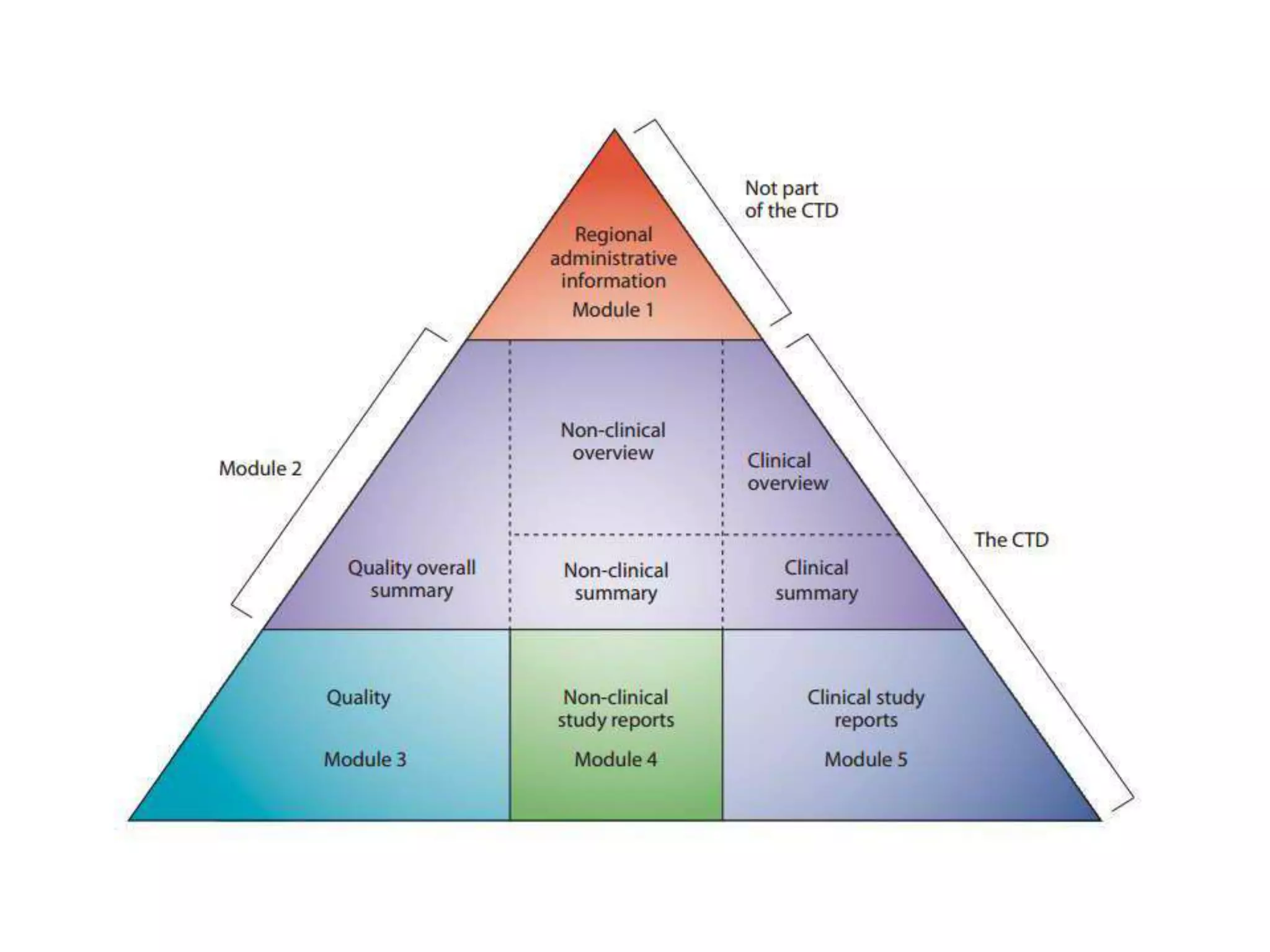
• The CTD is organized into 5 modules.
• Module1: General information: Administrative and
prescribing information
• Module2: CTD summaries-A Quality, non clinical and
clinical summary and non clinical and clinical overviews
• Module3: Quality
• Module4: Non clinical study reports (pharmacology and
toxicology)
• Module5: Clinical study reports (safety and efficacy)
Module 1: General information (Administrative
Information and Prescribing Information)
• Contains documents specific to each region.
• Documents includes; application form, summary of product
characteristics ,patent certification, labelling text,
environmental risk assessment ,description of
pharmacovigilance(PV )system, and risk management plan
(RMP)
• This module is not apart of CTD
• Content and format of this module may vary as per relevant
regulatory authorities
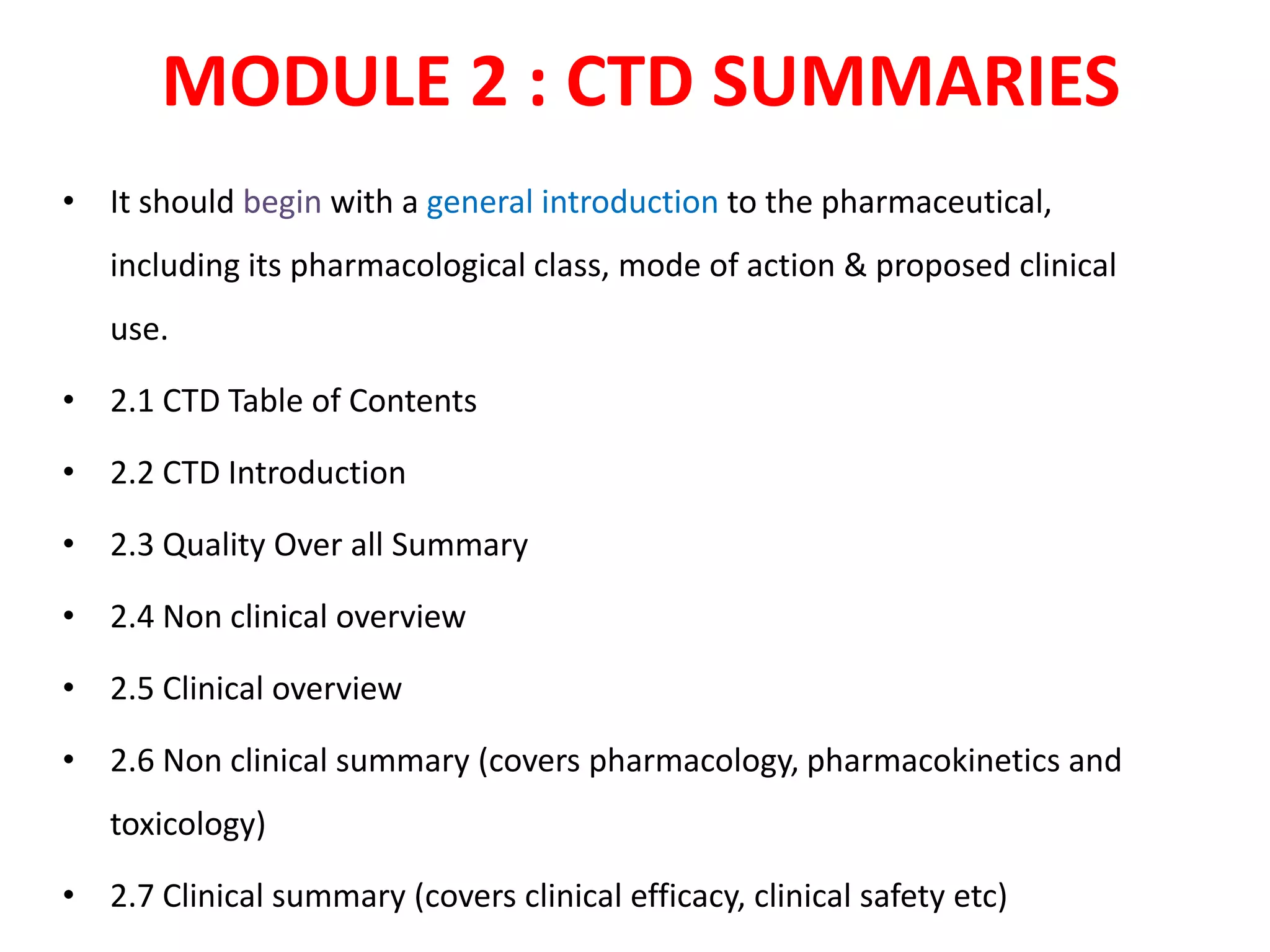
MODULE 2 : CTD SUMMARIES
• It should begin with a general introduction to the pharmaceutical,
including its pharmacological class, mode of action & proposed clinical
use.
• 2.1 CTD Table of Contents
• 2.2 CTD Introduction
• 2.3 Quality Over all Summary
• 2.4 Non clinical overview
• 2.5 Clinical overview
• 2.6 Non clinical summary (covers pharmacology, pharmacokinetics and
toxicology)
• 2.7 Clinical summary (covers clinical efficacy, clinical safety etc)
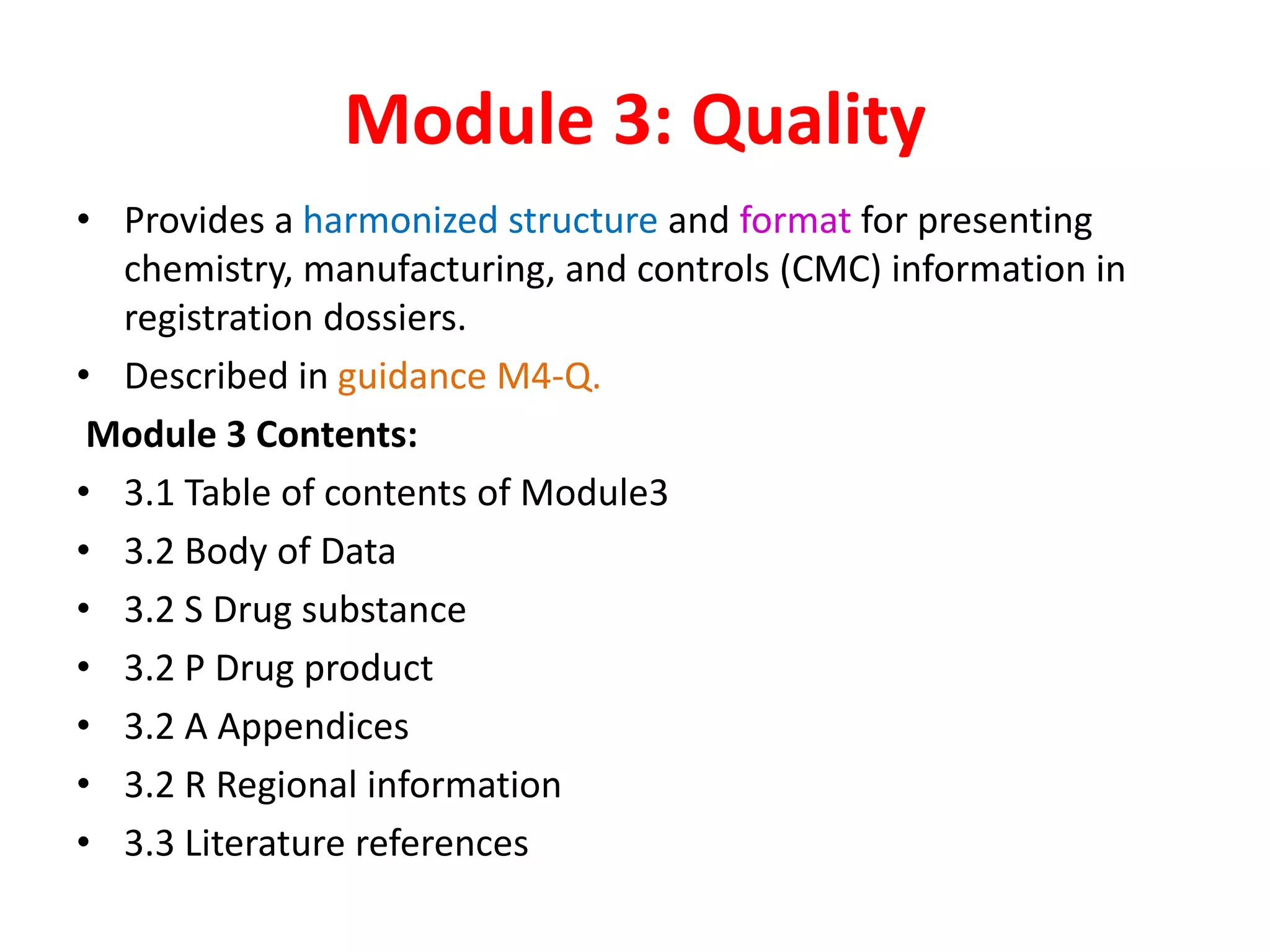
Module 3: Quality
• Provides a harmonized structure and format for presenting
chemistry, manufacturing, and controls (CMC) information in
registration dossiers.
• Described in guidance M4-Q.
Module 3 Contents:
• 3.1 Table of contents of Module3
• 3.2 Body of Data
• 3.2 S Drug substance
• 3.2 P Drug product
• 3.2 A Appendices
• 3.2 R Regional information
• 3.3 Literature references
Module 4: Non-Clinical Study Report
• Module 4 includes non-clinical study reports.
• Reports must be presented in order described in guidance
M4-S.
• Non-clinical study reports include reports related to
pharmacology, pharmacokinetics, toxicology.
• 4.1 Table of content of Module4
• 4.2 Study reports
• 4.2.1 Pharmacology
• 4.2.2 Pharmacokinetics
• 4.2.3 Toxicology
• 4.3 Literature References
Module 5: Clinical Study Report
• It explains studies on human and related information.
• Clinical (human study) reports must be presented in order described in the
guidance M4-E.
• 5.1 Table of content of Module 5
• 5.2 Tabular listing of clinical studies
• 5.3 Clinical study reports
• 5.3.1 Reports of biopharmaceutical study [BA-BE]
• 5.3.2 Reports of PK [biomaterial] study
• 5.3.3 Reports of PK studies
• 5.3.4 Reports of PD studies
• 5.3.5 Reports of Efficacy and safety studies
• 5.3.6 Reports of Post marketing experience
• 5.3.7 Case Report forms & Individual patient listings
e CTD
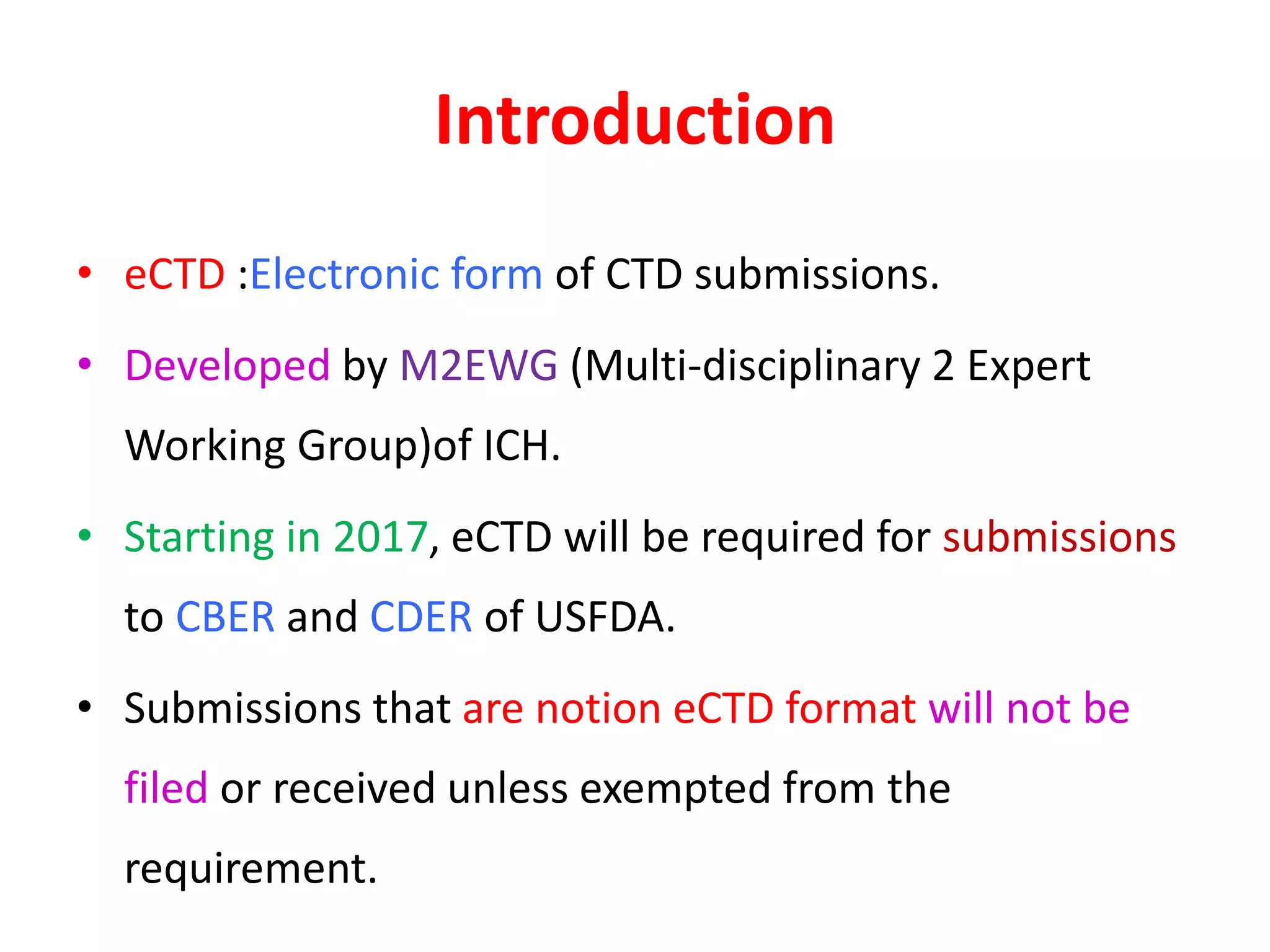
Introduction
• eCTD :Electronic form of CTD submissions.
• Developed by M2EWG (Multi-disciplinary 2 Expert
Working Group)of ICH.
• Starting in 2017, eCTD will be required for submissions
to CBER and CDER of USFDA.
• Submissions that are notion eCTD format will not be
filed or received unless exempted from the
requirement.
• eCTD highly recommended by USFDA for NDAs,
and DMFs, filing.
• From 2010 EU also make compulsory eCTD to all
procedure.
• eCTD composed of 2 types of specification
1.Content specification–As defined by ICH
2.Technical specification-Electronic softwares
• CTD- Table of content [pdf] [paper]
• eCTD -XML Backbone
ADVANTAGES
• Improve the submission and review process
• Increase accuracy of the submission
• Highly organized electronic table of contents
• More efficient use of resources
• Immediate Access to complete and up‐to‐date information
• Ease of navigation during review using hyperlinks and bookmarks
• Facilitated evaluation and better visibility of the process
• Reduced workload for assessment of reports
• Reduced the time for filing submissions
• Reduce time to market
Comparing paper CTD and eCTD
e CTD Characteristics
Structure
• All Modules 1 to 5 have granularity options
• PDF documents linked via XML backbone
• Increased document granularity.
• Transparency of entire submission
• Ease of navigation and review
eCTD SUBMISSION CHECKLIST
• eCTD Software
• Software training and support from the supplier
• Compiling and eCTD
• eCTD hyper-linking
• QC of eCTD
• Submit eCTD on CD/DVD or Use electronic
gateway
CTD and eCTD Seminar.pptx

CTD and eCTD Seminar.pptx

  • 1.
    SEMINAR ON Common TechnicalDocument (CTD) and Electronic CTD (eCTD) Presented by: Preeti P Kulkarni M.Pharm 1st Sem Dept. Of Pharmaceutics
  • 2.
    Introduction • CTD isa complete, predictable, consistent and well organised format for regulatory submissions. • CTD is a joint effort of 3 major regulatory authorities; –European Medicine Agency ( EMA, Europe, EU) –US Food and Drug Administration (FDA,USA) –Ministry of Health, Labour and Welfare (MHLW, Japan) • It was agreed on November 2000, SanDiego, USA; • It is a Standard format for regulatory submissions like IND, AND, ANDA and BLA and DMFs. • It is maintained by the ICH.
  • 3.
    Need for CTD •All regulatory authorities had their own guidelines to submit regulatory dossiers to get marketing approval of the drug. • Approval process was slow and time-consuming. • 3 ICH regions (US, Europe and Japan) collaborated and developed CTD format for regulatory submissions. • It has been adopted by several other countries including Australia, Canada and Switzerland (2004). • In 2009: CDSCO adopted CTD format.
  • 4.
    WHAT IS CTD? •Application format. • The CTD is a set of specifications for a dossier for the registration of medicines. • CTD is an internationally agreed “well structured common format” for the organization of the technical requirements that is to be submitted to the regulatory authority as an application for the registration of pharmaceuticals for human use in all three ICH regions (U.S.A., Europe and Japan).
  • 5.
    Overview • CTD isa joint effort of 3 major regulatory authorities. 1. European Medicine Agency (EMEA, Europe ,EU) 2. US-Food and Drug Administration (FDA) 3.Ministry of Health, Labour and Welfare (MHLW, Japan) • It is the agreement to assemble all the Quality, Safety and Efficacy information in a common format (called CTD- Common Technical Document). • It is not the “Global Dossier”. • CTD is maintained by the ICH.
  • 6.
    Objective of CTD •The objective is to increase international harmonization of technical requirements to ensure that safe, effective, and high quality medicines are developed and registered in the most efficient and cost effective manner.
  • 7.
    SIGNIFICANCE OF CTD •Avoid generating and compiling different registration dossiers. • Common format will reduce the time and resources. • Facilitates simultaneous submission in three regions • Facilitates exchange of information among regulatory authorities • Faster availability of new medicines.
  • 8.
    CTD format • TheCTD is organized into 5 modules. • Module1: General information: Administrative and prescribing information • Module2: CTD summaries-A Quality, non clinical and clinical summary and non clinical and clinical overviews • Module3: Quality • Module4: Non clinical study reports (pharmacology and toxicology) • Module5: Clinical study reports (safety and efficacy)
  • 10.
    Module 1: Generalinformation (Administrative Information and Prescribing Information) • Contains documents specific to each region. • Documents includes; application form, summary of product characteristics ,patent certification, labelling text, environmental risk assessment ,description of pharmacovigilance(PV )system, and risk management plan (RMP) • This module is not apart of CTD • Content and format of this module may vary as per relevant regulatory authorities
  • 11.
    MODULE 2 :CTD SUMMARIES • It should begin with a general introduction to the pharmaceutical, including its pharmacological class, mode of action & proposed clinical use. • 2.1 CTD Table of Contents • 2.2 CTD Introduction • 2.3 Quality Over all Summary • 2.4 Non clinical overview • 2.5 Clinical overview • 2.6 Non clinical summary (covers pharmacology, pharmacokinetics and toxicology) • 2.7 Clinical summary (covers clinical efficacy, clinical safety etc)
  • 12.
    Module 3: Quality •Provides a harmonized structure and format for presenting chemistry, manufacturing, and controls (CMC) information in registration dossiers. • Described in guidance M4-Q. Module 3 Contents: • 3.1 Table of contents of Module3 • 3.2 Body of Data • 3.2 S Drug substance • 3.2 P Drug product • 3.2 A Appendices • 3.2 R Regional information • 3.3 Literature references
  • 13.
    Module 4: Non-ClinicalStudy Report • Module 4 includes non-clinical study reports. • Reports must be presented in order described in guidance M4-S. • Non-clinical study reports include reports related to pharmacology, pharmacokinetics, toxicology. • 4.1 Table of content of Module4 • 4.2 Study reports • 4.2.1 Pharmacology • 4.2.2 Pharmacokinetics • 4.2.3 Toxicology • 4.3 Literature References
  • 14.
    Module 5: ClinicalStudy Report • It explains studies on human and related information. • Clinical (human study) reports must be presented in order described in the guidance M4-E. • 5.1 Table of content of Module 5 • 5.2 Tabular listing of clinical studies • 5.3 Clinical study reports • 5.3.1 Reports of biopharmaceutical study [BA-BE] • 5.3.2 Reports of PK [biomaterial] study • 5.3.3 Reports of PK studies • 5.3.4 Reports of PD studies • 5.3.5 Reports of Efficacy and safety studies • 5.3.6 Reports of Post marketing experience • 5.3.7 Case Report forms & Individual patient listings
  • 15.
  • 16.
    Introduction • eCTD :Electronicform of CTD submissions. • Developed by M2EWG (Multi-disciplinary 2 Expert Working Group)of ICH. • Starting in 2017, eCTD will be required for submissions to CBER and CDER of USFDA. • Submissions that are notion eCTD format will not be filed or received unless exempted from the requirement.
  • 17.
    • eCTD highlyrecommended by USFDA for NDAs, and DMFs, filing. • From 2010 EU also make compulsory eCTD to all procedure. • eCTD composed of 2 types of specification 1.Content specification–As defined by ICH 2.Technical specification-Electronic softwares • CTD- Table of content [pdf] [paper] • eCTD -XML Backbone
  • 18.
    ADVANTAGES • Improve thesubmission and review process • Increase accuracy of the submission • Highly organized electronic table of contents • More efficient use of resources • Immediate Access to complete and up‐to‐date information • Ease of navigation during review using hyperlinks and bookmarks • Facilitated evaluation and better visibility of the process • Reduced workload for assessment of reports • Reduced the time for filing submissions • Reduce time to market
  • 19.
  • 20.
    e CTD Characteristics Structure •All Modules 1 to 5 have granularity options • PDF documents linked via XML backbone • Increased document granularity. • Transparency of entire submission • Ease of navigation and review
  • 21.
    eCTD SUBMISSION CHECKLIST •eCTD Software • Software training and support from the supplier • Compiling and eCTD • eCTD hyper-linking • QC of eCTD • Submit eCTD on CD/DVD or Use electronic gateway