Presented by Md. Zakaria Faruki
Asst. Manager, Quality Assurance
OPL
Training on
Electronic Common Technical
Document (eCTD)
The ICH
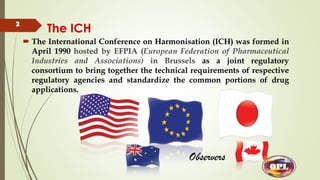
 The International Conference on Harmonisation (ICH) was formed in
April 1990 hosted by EFPIA (European Federation of Pharmaceutical
Industries and Associations) in Brussels as a joint regulatory
consortium to bring together the technical requirements of respective
regulatory agencies and standardize the common portions of drug
applications.
Observers
OPL
Common Technical Document (CTD)
Representatives of the regulatory agencies and industry
associations of EU, Japan and the US.
OPL
eSubmissions History
 Began in late 80’s but insufficient IT capabilities
 1995 – FDA used PDF files with hyperlinks
 1997 – CTD topic of ICH4
 2001 – first eCTD guideline
 2003 – CTD mandatory in EU and first eCTDs submitted
 2006 – lifecycle management a challenge
 In 2007,eCTDs represented 10% of total submissions to CDER.
 2008 – only electronic submissions accepted (either eCTD or non-eCTD)
 2009 – strongly recommend only eCTD format electronic submissions to be
accepted. Paper and other electronic formats to be exception in the EMEA
 It is expected that by the end of 2012, eCTD submissions may represent 40 or 50%
of total submissions to CDER (Center for Drug Evaluation and Research).
OPL
What does eCTD consist of?
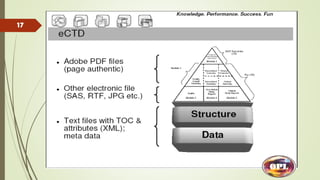
 Folder or tree structure
 XML backbone file is Table of Contents
 Additional information (Document type definition – rule book
for tags and attributes)
 Regional information and files
OPL
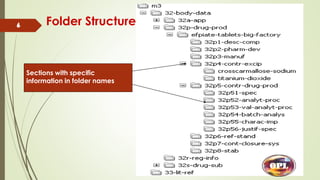
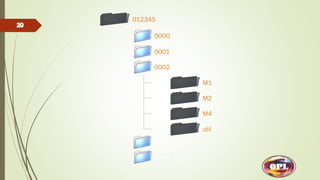
Folder Structure
Sections with specific
information in folder names
OPL
Preparing documents
Templates should be used where possible
Documents to be:
 technically correct
 have the right granularity
 conform to external regulations/guidelines
 consistent with internal standards and styles – naming
conventions, etc.
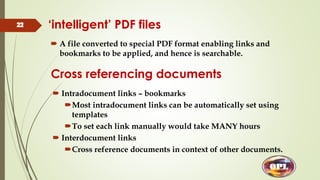
 ‘intelligent’ PDF files
OPL
Concept of Reuse
 Submit a document once, never submit again.
Concept of Granularity
 Authoring in smaller pieces (granules), allows for greater
flexibility and reuse in the context of submissions.
 If documents are formatted according to ICH granularity and
content needs to change, only those documents that contain new
content will need to be replaced (or appended) and submitted
not the entire section or study report.
OPL
What is XML?
 Extensible Markup Language (XML) is an electronic
document and data exchange standard.
XML vs. HTML?
 XML describes and focuses on data. It is information
wrapped in tags that requires another piece of software to
send, receive or display it. The tags are not predefined. XML
is a complement to HTML.
 HTML displays data and focuses on the appearance of data.
Tags are predefined.
OPL
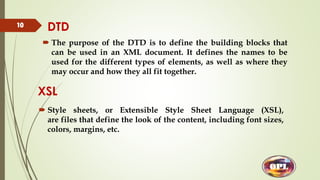
DTD
 The purpose of the DTD is to define the building blocks that
can be used in an XML document. It defines the names to be
used for the different types of elements, as well as where they
may occur and how they all fit together.
XSL
 Style sheets, or Extensible Style Sheet Language (XSL),
are files that define the look of the content, including font sizes,
colors, margins, etc.
OPL
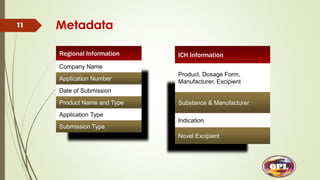
Metadata
Regional Information
Company Name
Application Number
Date of Submission
Product Name and Type
Application Type
Submission Type
ICH Information
Product, Dosage Form,
Manufacturer, Excipient
Substance & Manufacturer
Indication
Novel Excipient
OPL
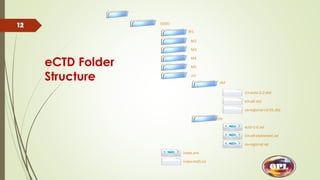
012345
util
style
ich-ectd-3-2.dtd
dtd
0000
M1
M2
M3
M4
M5
ich-stf.dtd
us-regional-v2-01.dtd
ectd-1-0.xsl
ich-stf-stylesheet.xsl
us-regional.xsl
index.xml
index-md5.txt
eCTD Folder
Structure
OPL
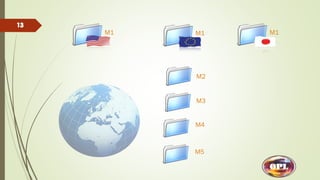
M1M1 M1
M2
M3
M4
M5
OPL
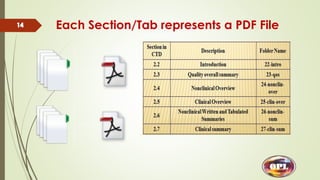
Each Section/Tab represents a PDF File
OPL
X
M
L
OPL
OPL
OPL
eCTD Software Vendors
1) Extedo / IABG Life Sciences-:
eCTDmanager is an off-the-shelf submission management system of highest quality
and functionality. It provides the eCTD functions of building, viewing, validating and
publishing (electronic and paper) and enables the easy-to-use compilation of
compliant electronic dossiers based on CTD, eCTD and other dossier structures.
2) eCTD Xpress:
eCTD XPress is ISI’s latest web-based solution for creating, managing eCTD lifecycles,
and reviewing eCTD submissions. The application satisfies both regulatory agencies’
and industry sponsors’ requirements for reviewing, compiling, publishing and
archiving of multi-region eCTD submissions. eCTDXPress allows users to separate
technology from content, which improves productivity and time-to-market.
3) Submission Accelerator for eCTD:
It is a complimentary module for CoreDossier® -- automates the assembly and
publishing of compliant eCTD dossiers, including the XML backbones for regional
content.
OPL
012345
0000
M1
M2
M3
M4
M5
util
index.xml
Index-md5.txt OPL
0000
0001
0002
012345
M1
M2
M4
util
0003
0004
OPL
Granularity
 Defines how the completed document is broken down,
tagged and stored for reuse
 Determines smallest piece of information that is reusable
 Changing granularity during lifecycle is difficult, therefore
must be planned at the beginning.
 FDA Guidance
Each document should be provided as a separate file
OPL
‘intelligent’ PDF files
 A file converted to special PDF format enabling links and
bookmarks to be applied, and hence is searchable.
Cross referencing documents
 Intradocument links – bookmarks
Most intradocument links can be automatically set using
templates
To set each link manually would take MANY hours
 Interdocument links
Cross reference documents in context of other documents.
OPL
Cross referencing submissions
 Inter submission links
Cross references of submissions in context of other
submissions, e.g. variations.
Time frames
 Once all documents are written, checked and formatted
setting bookmarks and links take from 2 to 12 weeks.
OPL
Eye openers
 Global application
 Life cycle history easily accessible
 Ease of compilation and review once system is up and running
 Intersubmission checks made possible by both applicant and
reviewer
 Authenticity of documentation easy to verify.
bombshell
 Extensive software programme needed to support the system
 Software programme used in EU costs €20,000 per USER
 Extensive IT support needed by applicant and regulator.
OPL
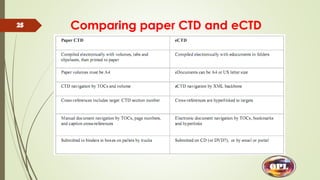
Comparing paper CTD and eCTD
OPL
Conclusion
 Great idea but need intermediate steps to get there
CTD format to be adopted immediately
NeeS in interim
 Essential to join electronic bandwagon
 To explore the stages of developing an eCTD strategy and
approach.
OPL
Strategy & Approach
Save a Tree!!
• NCE is approx 240,000 pages, Paper for this would be 672 kg, Equivalent to ONE
average tree.
•An entire tree is required to submit a single copy of the application form one
applicant to one health authority
OPL
OPL

Electronic Common Technical Document (eCTD)

  • 1.
    Presented by Md.Zakaria Faruki Asst. Manager, Quality Assurance OPL Training on Electronic Common Technical Document (eCTD)
  • 2.
    The ICH  TheInternational Conference on Harmonisation (ICH) was formed in April 1990 hosted by EFPIA (European Federation of Pharmaceutical Industries and Associations) in Brussels as a joint regulatory consortium to bring together the technical requirements of respective regulatory agencies and standardize the common portions of drug applications. Observers OPL
  • 3.
    Common Technical Document(CTD) Representatives of the regulatory agencies and industry associations of EU, Japan and the US. OPL
  • 4.
    eSubmissions History  Beganin late 80’s but insufficient IT capabilities  1995 – FDA used PDF files with hyperlinks  1997 – CTD topic of ICH4  2001 – first eCTD guideline  2003 – CTD mandatory in EU and first eCTDs submitted  2006 – lifecycle management a challenge  In 2007,eCTDs represented 10% of total submissions to CDER.  2008 – only electronic submissions accepted (either eCTD or non-eCTD)  2009 – strongly recommend only eCTD format electronic submissions to be accepted. Paper and other electronic formats to be exception in the EMEA  It is expected that by the end of 2012, eCTD submissions may represent 40 or 50% of total submissions to CDER (Center for Drug Evaluation and Research). OPL
  • 5.
    What does eCTDconsist of?  Folder or tree structure  XML backbone file is Table of Contents  Additional information (Document type definition – rule book for tags and attributes)  Regional information and files OPL
  • 6.
    Folder Structure Sections withspecific information in folder names OPL
  • 7.
    Preparing documents Templates shouldbe used where possible Documents to be:  technically correct  have the right granularity  conform to external regulations/guidelines  consistent with internal standards and styles – naming conventions, etc.  ‘intelligent’ PDF files OPL
  • 8.
    Concept of Reuse Submit a document once, never submit again. Concept of Granularity  Authoring in smaller pieces (granules), allows for greater flexibility and reuse in the context of submissions.  If documents are formatted according to ICH granularity and content needs to change, only those documents that contain new content will need to be replaced (or appended) and submitted not the entire section or study report. OPL
  • 9.
    What is XML? Extensible Markup Language (XML) is an electronic document and data exchange standard. XML vs. HTML?  XML describes and focuses on data. It is information wrapped in tags that requires another piece of software to send, receive or display it. The tags are not predefined. XML is a complement to HTML.  HTML displays data and focuses on the appearance of data. Tags are predefined. OPL
  • 10.
    DTD  The purposeof the DTD is to define the building blocks that can be used in an XML document. It defines the names to be used for the different types of elements, as well as where they may occur and how they all fit together. XSL  Style sheets, or Extensible Style Sheet Language (XSL), are files that define the look of the content, including font sizes, colors, margins, etc. OPL
  • 11.
    Metadata Regional Information Company Name ApplicationNumber Date of Submission Product Name and Type Application Type Submission Type ICH Information Product, Dosage Form, Manufacturer, Excipient Substance & Manufacturer Indication Novel Excipient OPL
  • 12.
  • 13.
  • 14.
  • 15.
  • 16.
  • 17.
  • 18.
    eCTD Software Vendors 1)Extedo / IABG Life Sciences-: eCTDmanager is an off-the-shelf submission management system of highest quality and functionality. It provides the eCTD functions of building, viewing, validating and publishing (electronic and paper) and enables the easy-to-use compilation of compliant electronic dossiers based on CTD, eCTD and other dossier structures. 2) eCTD Xpress: eCTD XPress is ISI’s latest web-based solution for creating, managing eCTD lifecycles, and reviewing eCTD submissions. The application satisfies both regulatory agencies’ and industry sponsors’ requirements for reviewing, compiling, publishing and archiving of multi-region eCTD submissions. eCTDXPress allows users to separate technology from content, which improves productivity and time-to-market. 3) Submission Accelerator for eCTD: It is a complimentary module for CoreDossier® -- automates the assembly and publishing of compliant eCTD dossiers, including the XML backbones for regional content. OPL
  • 19.
  • 20.
  • 21.
    Granularity  Defines howthe completed document is broken down, tagged and stored for reuse  Determines smallest piece of information that is reusable  Changing granularity during lifecycle is difficult, therefore must be planned at the beginning.  FDA Guidance Each document should be provided as a separate file OPL
  • 22.
    ‘intelligent’ PDF files A file converted to special PDF format enabling links and bookmarks to be applied, and hence is searchable. Cross referencing documents  Intradocument links – bookmarks Most intradocument links can be automatically set using templates To set each link manually would take MANY hours  Interdocument links Cross reference documents in context of other documents. OPL
  • 23.
    Cross referencing submissions Inter submission links Cross references of submissions in context of other submissions, e.g. variations. Time frames  Once all documents are written, checked and formatted setting bookmarks and links take from 2 to 12 weeks. OPL
  • 24.
    Eye openers  Globalapplication  Life cycle history easily accessible  Ease of compilation and review once system is up and running  Intersubmission checks made possible by both applicant and reviewer  Authenticity of documentation easy to verify. bombshell  Extensive software programme needed to support the system  Software programme used in EU costs €20,000 per USER  Extensive IT support needed by applicant and regulator. OPL
  • 25.
    Comparing paper CTDand eCTD OPL
  • 26.
    Conclusion  Great ideabut need intermediate steps to get there CTD format to be adopted immediately NeeS in interim  Essential to join electronic bandwagon  To explore the stages of developing an eCTD strategy and approach. OPL
  • 27.
    Strategy & Approach Savea Tree!! • NCE is approx 240,000 pages, Paper for this would be 672 kg, Equivalent to ONE average tree. •An entire tree is required to submit a single copy of the application form one applicant to one health authority OPL
  • 28.