Introduction to CTD
(Common Technical Document)
Prepared By: Ayesha Khursheed
Table of Contents:
 Introduction
 Need of CTD
 Origin of CTD
 Overview of CTD
 Modules of CTD
 Significance of CTD
 Impact of CTD
 References
CTD (Common Technical Document)
 CTD is a joint effort of 3 major regulatory authorities.
 1. European Medicine Agency (EMEA, Europe, EU)
 2. US-Food and Drug Administration (FDA)
 3. Ministry of Health, Labour and Welfare (MHLW, Japan)
Canada and Switzerland has also adopted CTD.
Need of CTD
 Prior to implementation of CTD three major regulatory
authorities EU, USA and Japan has their own set of guidelines
and procedures for the submission of the regulatory dossiers to
get the marketing approval of the drug.
 Some countries in EU also had their internal guidelines and
formats which making the dossier submission in different
countries a very time consuming and repetitive process.
 Keeping in view all the complication, the representatives from
these authorities designed a common set of guidelines, format and
contents for the drug registration in all the three regions under the
same umbrella of ICH.
Origin of CTD
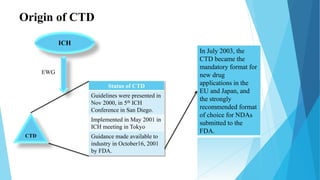
ICH
EWG
CTD
Status of CTD
Guidelines were presented in
Nov 2000, in 5th ICH
Conference in San Diego.
Implemented in May 2001 in
ICH meeting in Tokyo
Guidance made available to
industry in October16, 2001
by FDA.
In July 2003, the
CTD became the
mandatory format for
new drug
applications in the
EU and Japan, and
the strongly
recommended format
of choice for NDAs
submitted to the
FDA.
Overview of CTD:
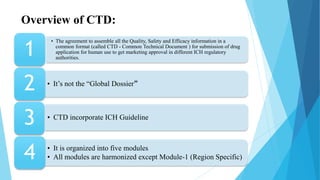
• The agreement to assemble all the Quality, Safety and Efficacy information in a
common format (called CTD - Common Technical Document ) for submission of drug
application for human use to get marketing approval in different ICH regulatory
authorities.
1
• It’s not the “Global Dossier”
2
• CTD incorporate ICH Guideline
3
• It is organized into five modules
• All modules are harmonized except Module-1 (Region Specific)4
The CTD format consists of 5 modules
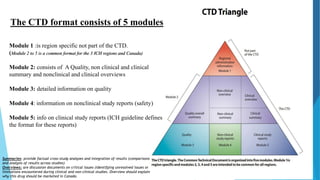
Module 1 :is region specific not part of the CTD.
(Module 2 to 5 is a common format for the 3 ICH regions and Canada)
Module 2: consists of A Quality, non clinical and clinical
summary and nonclinical and clinical overviews
Module 3: detailed information on quality
Module 4: information on nonclinical study reports (safety)
Module 5: info on clinical study reports (ICH guideline defines
the format for these reports)
Summaries: provide factual cross-study analyses and integration of results (comparisons
and analysis of results across studies)
Overviews: are discussion documents on critical issues (identifying unresolved issues or
limitations encountered during clinical and non-clinical studies. Overview should explain
why this drug should be marketed in Canada.
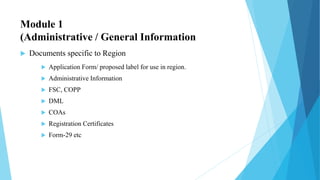
Module 1
(Administrative / General Information
 Documents specific to Region
 Application Form/ proposed label for use in region.
 Administrative Information
 FSC, COPP
 DML
 COAs
 Registration Certificates
 Form-29 etc
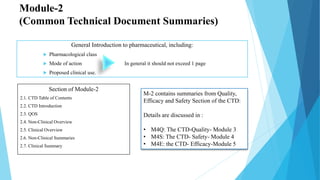
Module-2
(Common Technical Document Summaries)
General Introduction to pharmaceutical, including:
 Pharmacological class
 Mode of action In general it should not exceed 1 page
 Proposed clinical use.
Section of Module-2
2.1. CTD Table of Contents
2.2. CTD Introduction
2.3. QOS
2.4. Non-Clinical Overview
2.5. Clinical Overview
2.6. Non-Clinical Summaries
2.7. Clinical Summary
M-2 contains summaries from Quality,
Efficacy and Safety Section of the CTD:
Details are discussed in :
• M4Q: The CTD-Quality- Module 3
• M4S: The CTD- Safety- Module 4
• M4E: the CTD- Efficacy-Module 5
Module 3
Quality
 This Section of CTD provide a harmonized structure and
format for presenting CMC ( Chemistry, Manufacturing,
Controls) information of the dossier
 Module 3 Contents:
 3.1: Module 3 table of contents
 3.2: Body of Data
 3.3: Literature References
Module 3
Cont...
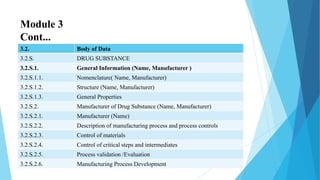
3.2. Body of Data
3.2.S. DRUG SUBSTANCE
3.2.S.1. General Information (Name, Manufacturer )
3.2.S.1.1. Nomenclature( Name, Manufacturer)
3.2.S.1.2. Structure (Name, Manufacturer)
3.2.S.1.3. General Properties
3.2.S.2. Manufacturer of Drug Substance (Name, Manufacturer)
3.2.S.2.1. Manufacturer (Name)
3.2.S.2.2. Description of manufacturing process and process controls
3.2.S.2.3. Control of materials
3.2.S.2.4. Control of critical steps and intermediates
3.2.S.2.5. Process validation /Evaluation
3.2.S.2.6. Manufacturing Process Development
Cont...
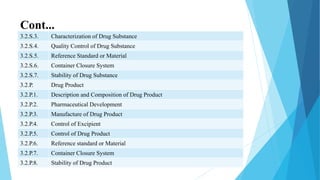
3.2.S.3. Characterization of Drug Substance
3.2.S.4. Quality Control of Drug Substance
3.2.S.5. Reference Standard or Material
3.2.S.6. Container Closure System
3.2.S.7. Stability of Drug Substance
3.2.P. Drug Product
3.2.P.1. Description and Composition of Drug Product
3.2.P.2. Pharmaceutical Development
3.2.P.3. Manufacture of Drug Product
3.2.P.4. Control of Excipient
3.2.P.5. Control of Drug Product
3.2.P.6. Reference standard or Material
3.2.P.7. Container Closure System
3.2.P.8. Stability of Drug Product
Module 4
Non-Clinical Study Report
 Contains Non-Clinical Study reports.
 Presented in the order described in M4-S ICH Guidance for
industry.
 Literature References
Module 5
Clinical Study Report
 It explains clinical study reports
 Studies on human and related information
 Presented in the order described in M4-E ICH Guidance for
industry.
 Literature References
Significance of CTD
 More “reviewable” applications
 Complete, well-organized submissions
 More predictable format
 More consistent reviews
 Easier analysis across applications
 Easier exchange of information
 Facilitates electronic submissions
Impact of CTD
 The ICH CTD represents one of the most ambitious and
successful international harmonization activities undertaken
 It will significantly reduce time and resources needed by industry
to compile applications for global registration.
References:
 http://www.ich.org/products/ctd.html
 http://www.slideshare.net/drsukant/common-technical-document
 https://en.wikipedia.org/wiki/CTD
 http://www.ema.europa.eu/docs/en_GB/document_library/Presentation/2009/10/WC50
0004211.pdf
Thank you

Introduction to ctd (common technical document)

  • 1.
    Introduction to CTD (CommonTechnical Document) Prepared By: Ayesha Khursheed
  • 2.
    Table of Contents: Introduction  Need of CTD  Origin of CTD  Overview of CTD  Modules of CTD  Significance of CTD  Impact of CTD  References
  • 3.
    CTD (Common TechnicalDocument)  CTD is a joint effort of 3 major regulatory authorities.  1. European Medicine Agency (EMEA, Europe, EU)  2. US-Food and Drug Administration (FDA)  3. Ministry of Health, Labour and Welfare (MHLW, Japan) Canada and Switzerland has also adopted CTD.
  • 4.
    Need of CTD Prior to implementation of CTD three major regulatory authorities EU, USA and Japan has their own set of guidelines and procedures for the submission of the regulatory dossiers to get the marketing approval of the drug.  Some countries in EU also had their internal guidelines and formats which making the dossier submission in different countries a very time consuming and repetitive process.  Keeping in view all the complication, the representatives from these authorities designed a common set of guidelines, format and contents for the drug registration in all the three regions under the same umbrella of ICH.
  • 5.
    Origin of CTD ICH EWG CTD Statusof CTD Guidelines were presented in Nov 2000, in 5th ICH Conference in San Diego. Implemented in May 2001 in ICH meeting in Tokyo Guidance made available to industry in October16, 2001 by FDA. In July 2003, the CTD became the mandatory format for new drug applications in the EU and Japan, and the strongly recommended format of choice for NDAs submitted to the FDA.
  • 6.
    Overview of CTD: •The agreement to assemble all the Quality, Safety and Efficacy information in a common format (called CTD - Common Technical Document ) for submission of drug application for human use to get marketing approval in different ICH regulatory authorities. 1 • It’s not the “Global Dossier” 2 • CTD incorporate ICH Guideline 3 • It is organized into five modules • All modules are harmonized except Module-1 (Region Specific)4
  • 7.
    The CTD formatconsists of 5 modules Module 1 :is region specific not part of the CTD. (Module 2 to 5 is a common format for the 3 ICH regions and Canada) Module 2: consists of A Quality, non clinical and clinical summary and nonclinical and clinical overviews Module 3: detailed information on quality Module 4: information on nonclinical study reports (safety) Module 5: info on clinical study reports (ICH guideline defines the format for these reports) Summaries: provide factual cross-study analyses and integration of results (comparisons and analysis of results across studies) Overviews: are discussion documents on critical issues (identifying unresolved issues or limitations encountered during clinical and non-clinical studies. Overview should explain why this drug should be marketed in Canada.
  • 8.
    Module 1 (Administrative /General Information  Documents specific to Region  Application Form/ proposed label for use in region.  Administrative Information  FSC, COPP  DML  COAs  Registration Certificates  Form-29 etc
  • 9.
    Module-2 (Common Technical DocumentSummaries) General Introduction to pharmaceutical, including:  Pharmacological class  Mode of action In general it should not exceed 1 page  Proposed clinical use. Section of Module-2 2.1. CTD Table of Contents 2.2. CTD Introduction 2.3. QOS 2.4. Non-Clinical Overview 2.5. Clinical Overview 2.6. Non-Clinical Summaries 2.7. Clinical Summary M-2 contains summaries from Quality, Efficacy and Safety Section of the CTD: Details are discussed in : • M4Q: The CTD-Quality- Module 3 • M4S: The CTD- Safety- Module 4 • M4E: the CTD- Efficacy-Module 5
  • 10.
    Module 3 Quality  ThisSection of CTD provide a harmonized structure and format for presenting CMC ( Chemistry, Manufacturing, Controls) information of the dossier  Module 3 Contents:  3.1: Module 3 table of contents  3.2: Body of Data  3.3: Literature References
  • 11.
    Module 3 Cont... 3.2. Bodyof Data 3.2.S. DRUG SUBSTANCE 3.2.S.1. General Information (Name, Manufacturer ) 3.2.S.1.1. Nomenclature( Name, Manufacturer) 3.2.S.1.2. Structure (Name, Manufacturer) 3.2.S.1.3. General Properties 3.2.S.2. Manufacturer of Drug Substance (Name, Manufacturer) 3.2.S.2.1. Manufacturer (Name) 3.2.S.2.2. Description of manufacturing process and process controls 3.2.S.2.3. Control of materials 3.2.S.2.4. Control of critical steps and intermediates 3.2.S.2.5. Process validation /Evaluation 3.2.S.2.6. Manufacturing Process Development
  • 12.
    Cont... 3.2.S.3. Characterization ofDrug Substance 3.2.S.4. Quality Control of Drug Substance 3.2.S.5. Reference Standard or Material 3.2.S.6. Container Closure System 3.2.S.7. Stability of Drug Substance 3.2.P. Drug Product 3.2.P.1. Description and Composition of Drug Product 3.2.P.2. Pharmaceutical Development 3.2.P.3. Manufacture of Drug Product 3.2.P.4. Control of Excipient 3.2.P.5. Control of Drug Product 3.2.P.6. Reference standard or Material 3.2.P.7. Container Closure System 3.2.P.8. Stability of Drug Product
  • 13.
    Module 4 Non-Clinical StudyReport  Contains Non-Clinical Study reports.  Presented in the order described in M4-S ICH Guidance for industry.  Literature References
  • 14.
    Module 5 Clinical StudyReport  It explains clinical study reports  Studies on human and related information  Presented in the order described in M4-E ICH Guidance for industry.  Literature References
  • 15.
    Significance of CTD More “reviewable” applications  Complete, well-organized submissions  More predictable format  More consistent reviews  Easier analysis across applications  Easier exchange of information  Facilitates electronic submissions
  • 16.
    Impact of CTD The ICH CTD represents one of the most ambitious and successful international harmonization activities undertaken  It will significantly reduce time and resources needed by industry to compile applications for global registration.
  • 17.
    References:  http://www.ich.org/products/ctd.html  http://www.slideshare.net/drsukant/common-technical-document https://en.wikipedia.org/wiki/CTD  http://www.ema.europa.eu/docs/en_GB/document_library/Presentation/2009/10/WC50 0004211.pdf
  • 18.