CTD, eCTD Dossier
PRESENTED BY
RIZWAN AHMAD
M.PHARM 1ST YR [1ST SEM]
PHARMACEUTICS
SUPERVISER
DR. AARTI BELGAMWAR
Institute of pharmaceutical education and research Boregaon (MEGHE),wardha -442001
2021-2022
Will discuss about:-
 What is CTD
 Evolution of CTD
 Why CTD
 Preparing and organizing the CTD
 ICH- eCTD
 Benefits
 References
What is CTD?
 Application format.
 The CTD is a set of specification for a dossier for the registration of
medicines (TGA) Therapeutic goods administration.
 CTD is an internationally agreed well structured common format for
the organization of the technical requirements that is to be submitted to
regulatory authority as an application for the registration of
pharmaceuticals for human use in all three ICH regions (USA,
EUROPE and JAPAN)
Evolution of CTD
 CTD is a joint effort of 3 regulatory agencies:
1. European medicines agency (EMEA, Europe)
2. Food and drug administration (FDA, USA)
3. Ministry of health labour and welfare (MHLW, JAPAN)
CTD is maintained by ICH through EWG.(Expert Working Group)
In July 2003 the CTD became the mandatory format for new drug application in the
EU and Japan and the strongly recommended format of choice for NDA submitted to
the FDA.
It has been adopted by several other countries including Australia, Canada and
Switzerland (2004).
Evolution of CTD
 In ICH region:
• 1995: concept of CTD proposed by industry.
• November 2000: ICH CTD guideline finalized.
• September 2002: guideline re-edited with numbering & section header changes.
• Prior to July 2003: voluntary submission phase in 3 ICH region.
• July 1, 2003: Mandatory requirement in three ICH regions.
• In India
• 2009: CDSCO adopted CTD format for technical requirements for registration of biological
products.
• October 28 2010: CDSCO give guideline for import/Manufacture and marketing approval
of new drug for human use (i.e. NDA) & ask for comments and suggestion within 60 days.
Why CTD
 To provide a harmonized common format/template for the submission of
the technical requirements to the regulatory authorities (FDA) that is
acceptable in all ICH regions.
 Reduce the time and resources used to compile applications.
• It will ease the preparation of electronic submissions.
• To facilitate simultaneous submission in three regions.
• To facilitate exchange of regulatory information.
• Faster availability of new medicines.
Objectives of CTD
 The primary objective of the CTD is to avoid duplicative animal and human
testing and to reach a common understanding of the technical requirements to
support the registration process in the three ICH regions.
 These objectives are achieved through harmonized guidelines and result in a
more economical use of human, animal and material resources as well as the
elimination of unnecessary delays in the global development and availability of
new drug medicines while maintaining safeguards on quality safety, efficacy and
regulatory obligations to protect public health.
 With the development of the common technical document the ICH hopes to
accomplish many of its objectives.
Preparing & organization of CTD
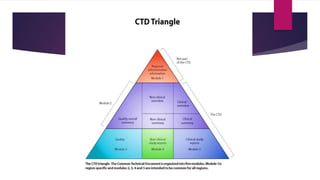
It Is Organized Into:- 5 MODULES
 Module 1: General Information.
 Module 2: CTD Summaries
 Module 3: Quality
 Module 4: Non-clinical Study Report
 Module 5: Clinical Study Reports
Module 1.
 Administrative information and prescribing information.
 Documents specific to the each regions.
 Eg . Application forms
proposed label for use in the region.
Module 1.
 Administrative information.
 Coordinates related to the applications.
(Name, Address, Telephone, Fax, E-mail)of Applicant Of Drug Product ,
Manufacturer Of Drug Substance , Responsible Officials ,Others Manufacturer
Involving In Production Process, Authorized Agent In India.
 General information on drug product.
(Brief Description Of Drug ,Nonproprietary Name, Composition, Dose, Route
Of Admtn, Etc.)
 Domestic price of drug, sample of drug product and promotional materials.
 Regulatory status in other countries.
Module 2.
 It should begin with a general introduction to the pharmaceuticals,
including it's pharmacological class, mode of action & proposed clinical
use. In general, the information should not exceed one page.
 Module-2 should contain 7 sections in the following order:
 1) CTD table of contents.
 2) CTD introduction.
 3) Quality & overall summery.
 4) Non-clinical overview.
 5) Clinical overview.
 6) Non-clinical written & tabulated summaries.
 7) Clinical summary.
 The individual organization of these summaries is described in three
separate documents.
 a) M4Q The CTD Quality.
 b) M4S The CTD Safety.
 c) M4E The CTD Efficacy.
 The Quality section of the CTD provides a harmonized structure and
format for presenting CMC (Chemistry, Manufacturing, Controls)
information in a registration dossier.
 The table of contents include sections on Drug substances & Drug
products.
 1. Clinical overview: A short document that provides a critical
assessment of the clinical data.
 2. Clinical summary: A longer document that focuses on data
summarization and integration.
Module 3.
 Module 3 presents the chemistry, manufacturing, and controls reports for
the product included in the registration dossier. Full details of what
should be included in Module 3 are provided in the ICH M4Q guideline.5
Sections on both drug substance and drug product are included in this
module. The main headings in this section (that must not be altered) are
as follows:
 3.1 Table of contents of Module 3
 3.2 Body of data
 3.2.S Drug Substance
 3.2.P+ Drug Product
 3.3 Literature references used in Module 3
{ ICH M4Q:-Common technical document for
the registration of pharmaceuticals for human
use }
Module 4.
 Module 4 presents the non-clinical reports included in the dossier. The
structure and content of Module 4 is specified in the ICH M4S
guidelines.7 The main headings in this section (that must not be altered)
are as follows:
 4.1 Table of contents of Module 4
 4.2 Study reports
 4.2.1 Pharmacology
 4.2.2 Pharmacokinetics
 4.2.3 Toxicology
 4.3 Literature references used in Module 4.
Module 5.
 The human study reports and related information should be presented in
the order described in Guideline M4E
 5:0 Clinical Study Reports
 5.1 Table of Contents of Module 5
 5.2 Tabular Listing of All Clinical Studies
 5.3 Clinical Study Reports
 5.4 Literature Reference
e-CTD
 The eCTD is the electronic equivalent to the CTD.
 Why electronic?
• Improve the submission and review process
• Increase accuracy of the submission
• Decrease total costs
 This specification has been developed by the ICH M2 Expert Working
group and maintained by the eCTD Implementation Working group in
accordance with the ICH Process
e-CTD Changes
 XML (Extensible Markup Language) based eCTD backbone replaces PDF Tables of
Content (index xml file). The purpose of this file is two‐fold:
• Manage meta‐data for the entire submission
• Constitute a comprehensive table of contents and provide corresponding navigation aid
 Increase document granularity in accordance with ICH eCTD agreements.
 Life Cycle Management:
• Composed at least of an initial submission
• Incremental updates
• Only what was changed needs to be re‐submitted.
e-CTD Implementation
• ICH‐eCTD is an internationally driven standard designed to reduce cost in
the administration, assessment and archiving of applications for marketing
authorization of medicinal products for human use, to reduce the use of
paper and streamline the assessment process making the system more
efficient.
• Unlike CTD the eCTD is not mandatory in Europe (highly recommended).
• NCAs are progressively adapting their infrastructure, processes and
legislation to be able to receive and handle paperless applications for
marketing authorization by 2009.
e-CTD Specification
• eCTD is a message specification for the transfer of files and metadata
from industry to regulatory.
• The eCTD Specification describes many optional folders and file names.
• What is the minimum set of required folders and files for a technically
acceptable eCTD?
Benefits of eCTD
• Improved handling and archiving of submissions
• Better information management
• Support of Life Cycle Management
• Immediate Access to complete and up‐to‐date information
• Search functionality for assessors and increased tracking ability
• Facilitated evaluation and better visibility of the process
• Reduced workload and reuse of information for assessment reports
• Controlled communication with external experts
• Better use of resources
• Simplified business process
• Better communication with industry
CTD : Regulatory sources
 Notice to Applicants, Eudralex Vol. 2B : Structure is defined here
• http://ec.europa.eu/enterprise/pharmaceuticals/eudralex/vol‐2/b/CTD_
06‐2006.pdf
• Http://www.fda.gov/cder/regulatory/ersr/eCTD.htm
 Q&A
• http://www.ICH.org/LOB/media/MEDIA620.pdf
 ICH Updates
• http://www.ICH.org
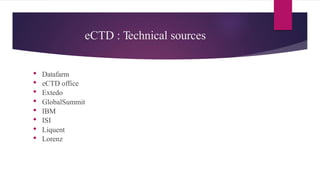
eCTD : Technical sources
• Datafarm
• eCTD office
• Extedo
• GlobalSummit
• IBM
• ISI
• Liquent
• Lorenz
THANK YOU