Basics of CT Scan
CT (CAT) scanning

—is a noninvasive medical test that helps physicians
 diagnose and treat medical conditions.

- combines special x-ray equipment with
  sophisticated computers to produce multiple
  images or pictures of the inside of the body.

- These cross-sectional images of the area being
  studied can then be examined on a computer
  monitor, printed or transferred to a CD.
Some common uses of the procedure
• one of the best and fastest tools for examining
  the chest, abdomen and pelvis
• it provides detailed, cross-sectional views of
  all types of tissue.
• used to examine patients with severe injuries
  from incidents such as a motor vehicle
  accident.
• performed on patients with acute symptoms
  such as abdominal pain or difficulty breathing.
• often the best method for detecting many different
  cancers, including lung, liver, kidney and pancreatic cancer,
  since the image allows a physician to confirm the presence
  of a tumor and measure its size, precise location and the
  extent of the tumor's involvement with other nearby
  tissue.
• an examination that plays a significant role in the
  detection, diagnosis and treatment of vascular diseases
  that can lead to stroke, kidney failure or even death.
• CT is commonly used to assess for pulmonary embolism (a
  blood clot in the lung vessels) as well as for abdominal
  aortic aneurysms (AAA).
• invaluable in diagnosing and treating spinal problems and
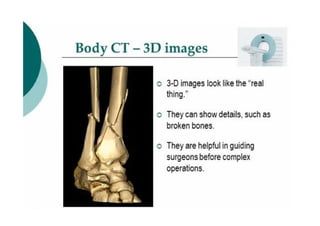
  injuries to the hands, feet and other skeletal structures
  because it can clearly show even very small bones as well
  as surrounding tissues such as muscle and blood vessels.
For children
CT imaging is more often used to evaluate:

•   lymphoma
•   neuroblastoma
•   kidney tumors
•   congenital malformations of the heart, kidneys and
    blood vessels
•   cystic fibrosis
•   complications of acute appendicitis
•   complications of pneumonia
•   inflammatory bowel disease
•   severe injuries
Physicians often use the CT
             examination to:
• quickly identify injuries to the lungs, heart and vessels,
  liver, spleen, kidneys, bowel or other internal organs in
  cases of trauma.
• guide biopsies and other procedures such as abscess
  drainages and minimally invasive tumor treatments.
• plan for and assess the results of surgery, such as organ
  transplants or gastric bypass.
• stage, plan and properly administer radiation
  treatments for tumors as well as monitor response to
  chemotherapy.
• measure bone mineral density for the detection of
  osteoporosis.
Equipment
• The CT scanner is typically a large, box-like machine
  with a hole, or short tunnel, in the center.

• The Patient will lie on a narrow examination table that
  slides into and out of this tunnel.

• Rotating around patient, the x-ray tube and electronic
  x-ray detectors are located opposite each other in a
  ring, called a gantry.

• The computer workstation that processes the imaging
  information is located in a separate control room,
  where the technologist operates the scanner and
  monitors your examination.
How does the procedure work?
• In many ways CT scanning works very much like
  other x-ray examinations.
• X-rays are a form of radiation—like light or radio
  waves—that can be directed at the body. Different
  body parts absorb the x-rays in varying degrees.
• In a conventional x-ray exam, a small amount of
  radiation is aimed at and passes through the body,
  recording an image on photographic film or a special
  image recording plate.
• Bones appear white on the x-ray; soft tissue, such as
  organs like the heart or liver, shows up in shades of
  gray and air appears black.
• With CT scanning, numerous x-ray beams and a set
  of electronic x-ray detectors rotate around patient,
  measuring the amount of radiation being absorbed
  throughout your body.

• At the same time, the examination table is moving
  through the scanner, so that the x-ray beam follows
  a spiral path.

• A special computer program processes this large
  volume of data to create two-dimensional cross-
  sectional images of your body, which are then
  displayed on a monitor.

• This technique is called helical or spiral CT.
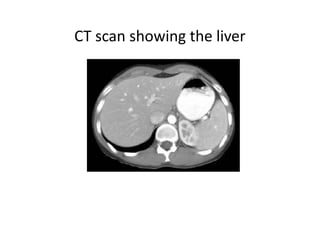
CT scan showing the liver
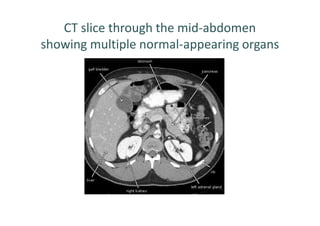
CT slice through the mid-abdomen
showing multiple normal-appearing organs
• CT imaging is sometimes compared to looking
  into a loaf of bread by cutting the loaf into thin
  slices.
• When the image slices are reassembled by
  computer software, the result is a very detailed
  multidimensional view of the body's interior.
• Refinements in detector technology allow new
  CT scanners to obtain multiple slices in a single
  rotation.
• These scanners, called multislice CT or
  multidetector CT, allow thinner slices to be
  obtained in a shorter period of time, resulting in
  more detail and additional view capabilities.
How is the CAT scan performed?
• The technologist begins by positioning patient on
  the CT examination table, usually lying flat on
  back or less commonly, on one side or on
  stomach.
• Straps and pillows may be used to help you
  maintain the correct position and to hold still
  during the exam.
• Depending on the part of the body being
  scanned, patient may be asked to keep hands
  over head.
                                                  .mp4
• If contrast material is used, it will be swallowed,
  injected through an intravenous line (IV) or
  administered by enema, depending on the type
  of examination.
• Next, the table will move quickly through the
  scanner to determine the correct starting
  position for the scans.
• Then, the table will move slowly through the
  machine as the actual CT scanning is performed.
• Depending on the type of CT scan, the machine
  may make several passes.
• Patient may be asked to hold breath during the
  scanning.
• Any motion, whether breathing or body
  movements, can lead to artifacts on the images.
• This is similar to the blurring seen on a
  photograph taken of a moving object.
• When the examination is completed, you will be
  asked to wait until the technologist verifies that
  the images are of high enough quality for
  accurate interpretation.
• The CT examination is usually completed within
  30 minutes. The portion requiring intravenous
  contrast injection usually lasts only 10 to 30
  seconds.
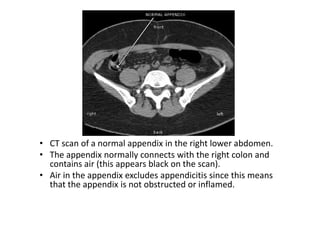
• CT scan of a normal appendix in the right lower abdomen.
• The appendix normally connects with the right colon and
  contains air (this appears black on the scan).
• Air in the appendix excludes appendicitis since this means
  that the appendix is not obstructed or inflamed.
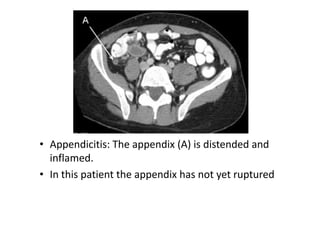
• Appendicitis: The appendix (A) is distended and
  inflamed.
• In this patient the appendix has not yet ruptured
Benefits vs. Risks
Benefits:
• CT scanning is painless, noninvasive and accurate.
• A major advantage of CT is its ability to image bone,
  soft tissue and blood vessels all at the same time.
• Unlike conventional x-rays, CT scanning provides
  very detailed images of many types of tissue as well
  as the lungs, bones, and blood vessels.
• CT examinations are fast and simple; in emergency
  cases, they can reveal internal injuries and bleeding
  quickly enough to help save lives.
• CT has been shown to be a cost-effective imaging
  tool for a wide range of clinical problems.
• CT is less sensitive to patient movement than MRI.
Benefits:
• CT can be performed if you have an implanted medical
  device of any kind, unlike MRI.
• CT imaging provides real-time imaging, making it a good
  tool for guiding minimally invasive procedures such as
  needle biopsies and needle aspirations of many areas of
  the body, particularly the lungs, abdomen, pelvis and
  bones.
• A diagnosis determined by CT scanning may eliminate the
  need for exploratory surgery and surgical biopsy.
• No radiation remains in a patient's body after a CT
  examination.
• X-rays used in CT scans usually have no immediate side
  effects.
Risks
• There is no conclusive evidence that radiation
  at amounts delivered by a CT scan causes
  cancer.
• Large population studies have shown a slight
  increase in cancer from larger amounts of
  radiation, such as from radiation therapy.
• Thus, there is always concern that this risk
  may also apply to the lower amounts of
  radiation delivered by a CT exam.
Risks
• The effective radiation dose for this procedure
  varies.
• CT scanning is, in general, not recommended for
  pregnant women unless medically necessary
  because of potential risk to the baby.
• Manufacturers of intravenous contrast indicate
  mothers should not breastfeed their babies for
  24-48 hours after contrast medium is given.
• The risk of serious allergic reaction to contrast
  materials that contain iodine is extremely rare,
  and radiology departments are well-equipped to
  deal with them.
Limitations of CT Scanning of the Body
• Soft-tissue details in areas such as the brain, internal
  pelvic organs, and joints (such as knees and
  shoulders) can often be better evaluated with
  magnetic resonance imaging (MRI).
• In pregnant women, while CT can be performed
  safely, other imaging exams not involving radiation,
  such as ultrasound or MRI, is preferred if they are
  likely to be as good as CT in diagnosing your
  condition.
• A person who is very large may not fit into the
  opening of a conventional CT scanner or may be
  over the weight limit—usually 450 pounds—for the
  moving table.

Basics of CT Scan

  • 1.
  • 3.
    CT (CAT) scanning —isa noninvasive medical test that helps physicians diagnose and treat medical conditions. - combines special x-ray equipment with sophisticated computers to produce multiple images or pictures of the inside of the body. - These cross-sectional images of the area being studied can then be examined on a computer monitor, printed or transferred to a CD.
  • 5.
    Some common usesof the procedure • one of the best and fastest tools for examining the chest, abdomen and pelvis • it provides detailed, cross-sectional views of all types of tissue. • used to examine patients with severe injuries from incidents such as a motor vehicle accident. • performed on patients with acute symptoms such as abdominal pain or difficulty breathing.
  • 6.
    • often thebest method for detecting many different cancers, including lung, liver, kidney and pancreatic cancer, since the image allows a physician to confirm the presence of a tumor and measure its size, precise location and the extent of the tumor's involvement with other nearby tissue. • an examination that plays a significant role in the detection, diagnosis and treatment of vascular diseases that can lead to stroke, kidney failure or even death. • CT is commonly used to assess for pulmonary embolism (a blood clot in the lung vessels) as well as for abdominal aortic aneurysms (AAA). • invaluable in diagnosing and treating spinal problems and injuries to the hands, feet and other skeletal structures because it can clearly show even very small bones as well as surrounding tissues such as muscle and blood vessels.
  • 7.
    For children CT imagingis more often used to evaluate: • lymphoma • neuroblastoma • kidney tumors • congenital malformations of the heart, kidneys and blood vessels • cystic fibrosis • complications of acute appendicitis • complications of pneumonia • inflammatory bowel disease • severe injuries
  • 8.
    Physicians often usethe CT examination to: • quickly identify injuries to the lungs, heart and vessels, liver, spleen, kidneys, bowel or other internal organs in cases of trauma. • guide biopsies and other procedures such as abscess drainages and minimally invasive tumor treatments. • plan for and assess the results of surgery, such as organ transplants or gastric bypass. • stage, plan and properly administer radiation treatments for tumors as well as monitor response to chemotherapy. • measure bone mineral density for the detection of osteoporosis.
  • 11.
    Equipment • The CTscanner is typically a large, box-like machine with a hole, or short tunnel, in the center. • The Patient will lie on a narrow examination table that slides into and out of this tunnel. • Rotating around patient, the x-ray tube and electronic x-ray detectors are located opposite each other in a ring, called a gantry. • The computer workstation that processes the imaging information is located in a separate control room, where the technologist operates the scanner and monitors your examination.
  • 15.
    How does theprocedure work? • In many ways CT scanning works very much like other x-ray examinations. • X-rays are a form of radiation—like light or radio waves—that can be directed at the body. Different body parts absorb the x-rays in varying degrees. • In a conventional x-ray exam, a small amount of radiation is aimed at and passes through the body, recording an image on photographic film or a special image recording plate. • Bones appear white on the x-ray; soft tissue, such as organs like the heart or liver, shows up in shades of gray and air appears black.
  • 16.
    • With CTscanning, numerous x-ray beams and a set of electronic x-ray detectors rotate around patient, measuring the amount of radiation being absorbed throughout your body. • At the same time, the examination table is moving through the scanner, so that the x-ray beam follows a spiral path. • A special computer program processes this large volume of data to create two-dimensional cross- sectional images of your body, which are then displayed on a monitor. • This technique is called helical or spiral CT.
  • 17.
    CT scan showingthe liver
  • 18.
    CT slice throughthe mid-abdomen showing multiple normal-appearing organs
  • 19.
    • CT imagingis sometimes compared to looking into a loaf of bread by cutting the loaf into thin slices. • When the image slices are reassembled by computer software, the result is a very detailed multidimensional view of the body's interior. • Refinements in detector technology allow new CT scanners to obtain multiple slices in a single rotation. • These scanners, called multislice CT or multidetector CT, allow thinner slices to be obtained in a shorter period of time, resulting in more detail and additional view capabilities.
  • 20.
    How is theCAT scan performed? • The technologist begins by positioning patient on the CT examination table, usually lying flat on back or less commonly, on one side or on stomach. • Straps and pillows may be used to help you maintain the correct position and to hold still during the exam. • Depending on the part of the body being scanned, patient may be asked to keep hands over head. .mp4
  • 21.
    • If contrastmaterial is used, it will be swallowed, injected through an intravenous line (IV) or administered by enema, depending on the type of examination. • Next, the table will move quickly through the scanner to determine the correct starting position for the scans. • Then, the table will move slowly through the machine as the actual CT scanning is performed. • Depending on the type of CT scan, the machine may make several passes. • Patient may be asked to hold breath during the scanning.
  • 22.
    • Any motion,whether breathing or body movements, can lead to artifacts on the images. • This is similar to the blurring seen on a photograph taken of a moving object. • When the examination is completed, you will be asked to wait until the technologist verifies that the images are of high enough quality for accurate interpretation. • The CT examination is usually completed within 30 minutes. The portion requiring intravenous contrast injection usually lasts only 10 to 30 seconds.
  • 23.
    • CT scanof a normal appendix in the right lower abdomen. • The appendix normally connects with the right colon and contains air (this appears black on the scan). • Air in the appendix excludes appendicitis since this means that the appendix is not obstructed or inflamed.
  • 24.
    • Appendicitis: Theappendix (A) is distended and inflamed. • In this patient the appendix has not yet ruptured
  • 27.
    Benefits vs. Risks Benefits: •CT scanning is painless, noninvasive and accurate. • A major advantage of CT is its ability to image bone, soft tissue and blood vessels all at the same time. • Unlike conventional x-rays, CT scanning provides very detailed images of many types of tissue as well as the lungs, bones, and blood vessels. • CT examinations are fast and simple; in emergency cases, they can reveal internal injuries and bleeding quickly enough to help save lives. • CT has been shown to be a cost-effective imaging tool for a wide range of clinical problems. • CT is less sensitive to patient movement than MRI.
  • 28.
    Benefits: • CT canbe performed if you have an implanted medical device of any kind, unlike MRI. • CT imaging provides real-time imaging, making it a good tool for guiding minimally invasive procedures such as needle biopsies and needle aspirations of many areas of the body, particularly the lungs, abdomen, pelvis and bones. • A diagnosis determined by CT scanning may eliminate the need for exploratory surgery and surgical biopsy. • No radiation remains in a patient's body after a CT examination. • X-rays used in CT scans usually have no immediate side effects.
  • 29.
    Risks • There isno conclusive evidence that radiation at amounts delivered by a CT scan causes cancer. • Large population studies have shown a slight increase in cancer from larger amounts of radiation, such as from radiation therapy. • Thus, there is always concern that this risk may also apply to the lower amounts of radiation delivered by a CT exam.
  • 30.
    Risks • The effectiveradiation dose for this procedure varies. • CT scanning is, in general, not recommended for pregnant women unless medically necessary because of potential risk to the baby. • Manufacturers of intravenous contrast indicate mothers should not breastfeed their babies for 24-48 hours after contrast medium is given. • The risk of serious allergic reaction to contrast materials that contain iodine is extremely rare, and radiology departments are well-equipped to deal with them.
  • 31.
    Limitations of CTScanning of the Body • Soft-tissue details in areas such as the brain, internal pelvic organs, and joints (such as knees and shoulders) can often be better evaluated with magnetic resonance imaging (MRI). • In pregnant women, while CT can be performed safely, other imaging exams not involving radiation, such as ultrasound or MRI, is preferred if they are likely to be as good as CT in diagnosing your condition. • A person who is very large may not fit into the opening of a conventional CT scanner or may be over the weight limit—usually 450 pounds—for the moving table.