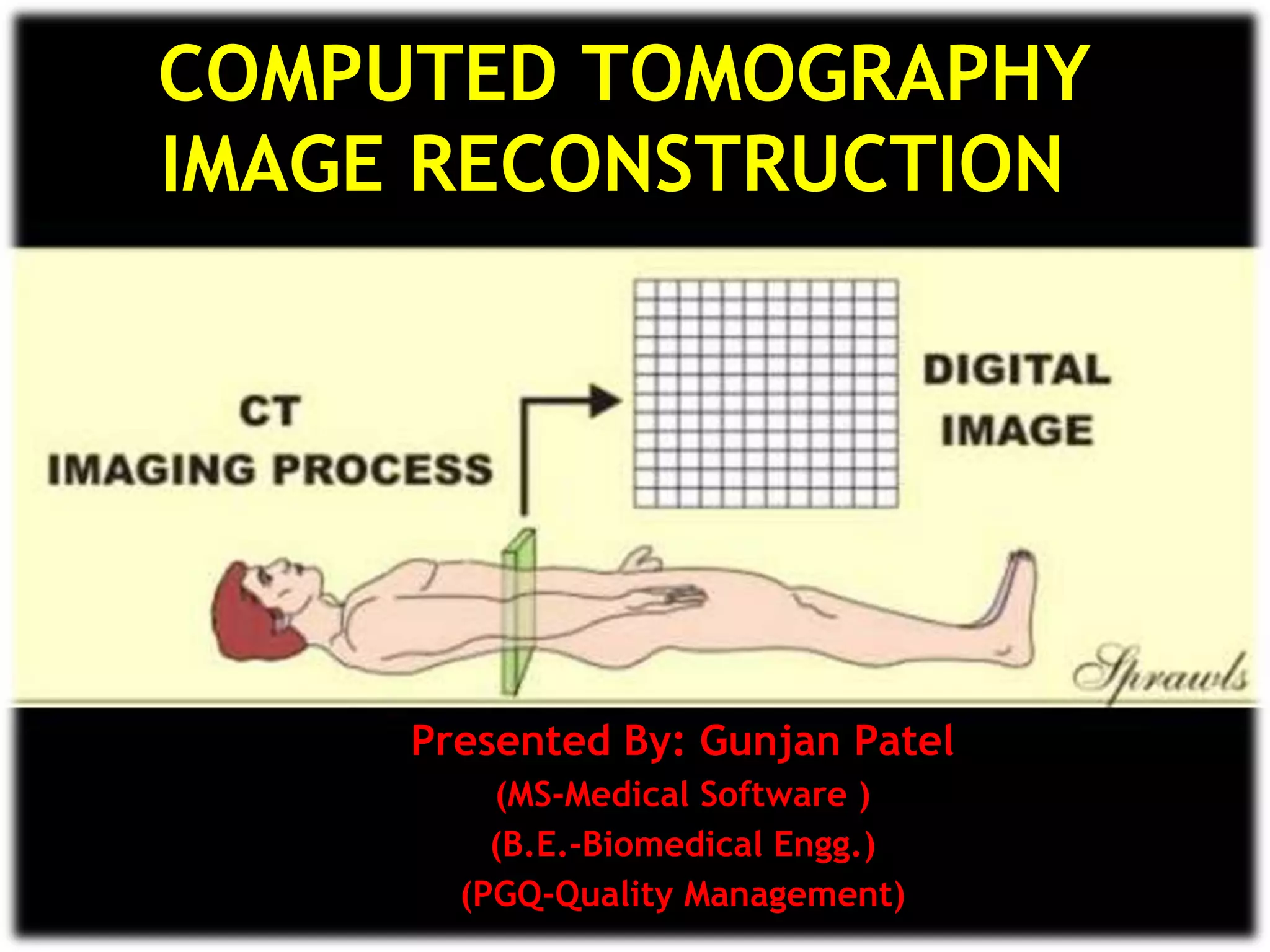
COMPUTED TOMOGRAPHY IMAGE RECONSTRUCTION  Presented By: Gunjan Patel (MS-Medical Software ) (B.E.-Biomedical Engg.) (PGQ-Quality Management)
History of Image Reconstruction 1917 Radon  has developed mathematical solution to the  problems of image reconstruction  from of a  set of projection . Utilization in solving problems in astronomy and optics. 1961  finally these techniques were used in  medical field .
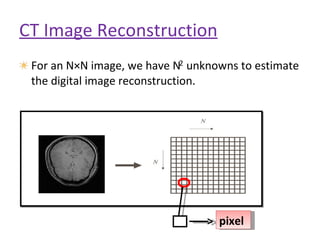
CT Image Reconstruction For an N×N image, we have N  unknowns to estimate the digital image reconstruction. 2 pixel
IMAGE RECONSTRUCTION
BACK PROJECTION METHOD The oldest method Not used in commercial ct scanners Method is analogous  to a graphic reconstruction Processing part is simple and direct Each projection can not contribute originally formal of profile Some produces images are ‘Starred’ and ‘blurring’ that makes unsuitable for medical diagnosis  A sinogram is a special x-ray procedure that is done with contrast media (x-ray dye) to visualize any abnormal opening (sinus) in the body
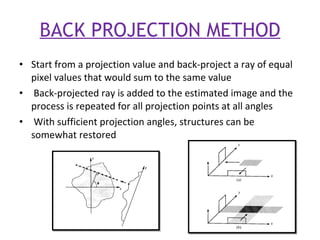
BACK PROJECTION METHOD Start from a projection value and back-project a ray of equal pixel values that would sum to the same value Back-projected ray is added to the estimated image and the process is repeated for all projection points at all angles  With sufficient projection angles, structures can be somewhat restored
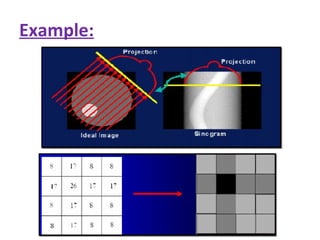
Example:
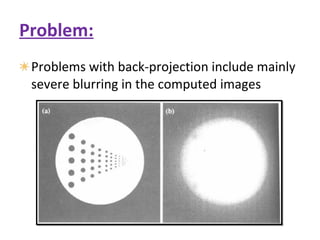
Problem: Problems with back-projection include mainly severe blurring in the computed images
Iterative  reconstruction Successive approximation method  Iterative least squares techniques Algebraic reconstruction Hounsfield used this technique in his  First EMI BRAIN SCANNER Iterative methods are not use in today commercial scanners
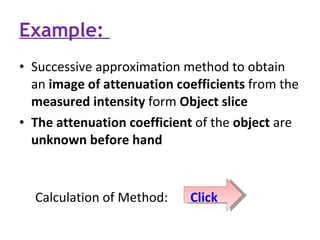
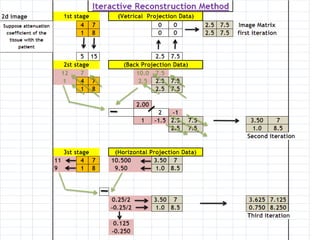
Example:  Successive approximation method to obtain an  image of attenuation coefficients  from the  measured intensity  form  Object slice The attenuation coefficient  of the  object  are  unknown before hand Calculation of Method:    Click
 
Analytical methods Current Commercial scanner uses  this method A mathematical technique known as  convolution or filtering  Technique employs a  spatial filter for   remove blurring artifacts. 2 types of method Filtered back projection Fourier filtering
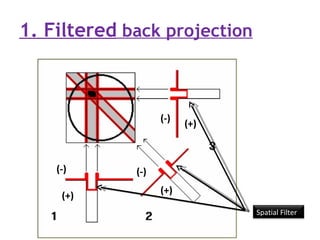
1. Filtered  back projection (-) (-) (-) (+) (+) (+) Spatial Filter
1. Filtered  back projection This technique  elimination the unwanted cusp  like tails of the projection. The projection data are  convoluted  with suitable processing function before  back projection The filter function has  negative side lobes surrounding a positive core , so that in summing the  filtered back projection  -  positive and negative contribution that cancel outside  the central core    The constructed image resemble  Original object
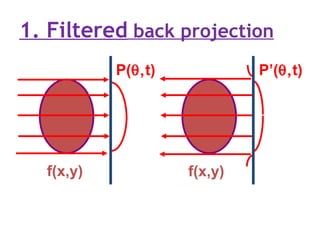
1. Filtered  back projection f(x,y) f(x,y) P(  t) P’(  t)
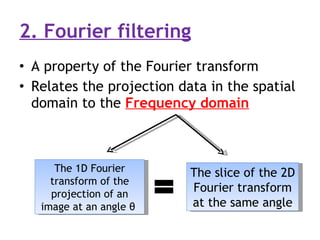
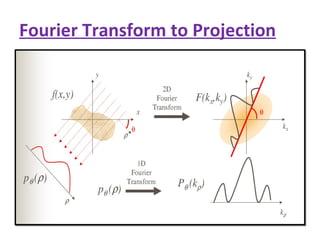
2. Fourier filtering A property of the Fourier transform Relates the projection data in the spatial domain to the  Frequency domain The 1D Fourier transform of the projection of an image at an angle θ  The slice of the 2D Fourier transform at the same angle
Fourier Transform to Projection
Fourier Slice Theorem Ky Kx  F(Kx,Ky) F[P(  t)] P(  t) f(x,y) t  y x X-rays
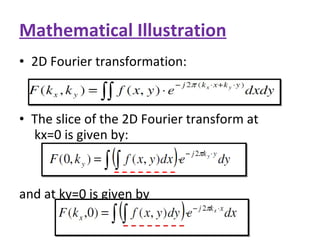
Mathematical Illustration 2D Fourier transformation: The slice of the 2D Fourier transform at  kx=0 is given by: and at ky=0 is given by
From Projections to Image y x Ky Kx F -1 [F(Kx,ky)] f(x,y) P(  t) F(Kx,Ky)
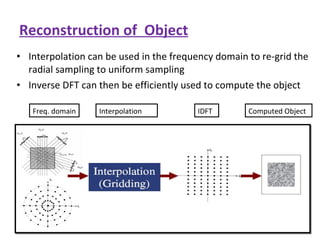
Reconstruction of  Object Interpolation can be used in the frequency domain to re-grid the radial sampling to uniform sampling Inverse DFT can then be efficiently used to compute the object Freq. domain Interpolation IDFT Computed Object
References http://www.slideshare.net/NYCCT1199/ct-reconstruction-methods http://en.wikipedia.org/wiki/Iterative_reconstruction Handbook of Biomedical Instrumentation-R.S.Khandpur
Queries !!!
 

CT Scan Image reconstruction

  • 1.
    COMPUTED TOMOGRAPHY IMAGERECONSTRUCTION Presented By: Gunjan Patel (MS-Medical Software ) (B.E.-Biomedical Engg.) (PGQ-Quality Management)
  • 2.
    History of ImageReconstruction 1917 Radon has developed mathematical solution to the problems of image reconstruction from of a set of projection . Utilization in solving problems in astronomy and optics. 1961 finally these techniques were used in medical field .
  • 3.
    CT Image ReconstructionFor an N×N image, we have N unknowns to estimate the digital image reconstruction. 2 pixel
  • 4.
  • 5.
    BACK PROJECTION METHODThe oldest method Not used in commercial ct scanners Method is analogous to a graphic reconstruction Processing part is simple and direct Each projection can not contribute originally formal of profile Some produces images are ‘Starred’ and ‘blurring’ that makes unsuitable for medical diagnosis A sinogram is a special x-ray procedure that is done with contrast media (x-ray dye) to visualize any abnormal opening (sinus) in the body
  • 6.
    BACK PROJECTION METHODStart from a projection value and back-project a ray of equal pixel values that would sum to the same value Back-projected ray is added to the estimated image and the process is repeated for all projection points at all angles With sufficient projection angles, structures can be somewhat restored
  • 7.
  • 8.
    Problem: Problems withback-projection include mainly severe blurring in the computed images
  • 9.
    Iterative reconstructionSuccessive approximation method Iterative least squares techniques Algebraic reconstruction Hounsfield used this technique in his First EMI BRAIN SCANNER Iterative methods are not use in today commercial scanners
  • 10.
    Example: Successiveapproximation method to obtain an image of attenuation coefficients from the measured intensity form Object slice The attenuation coefficient of the object are unknown before hand Calculation of Method: Click
  • 11.
  • 12.
    Analytical methods CurrentCommercial scanner uses this method A mathematical technique known as convolution or filtering Technique employs a spatial filter for remove blurring artifacts. 2 types of method Filtered back projection Fourier filtering
  • 13.
    1. Filtered back projection (-) (-) (-) (+) (+) (+) Spatial Filter
  • 14.
    1. Filtered back projection This technique elimination the unwanted cusp like tails of the projection. The projection data are convoluted with suitable processing function before back projection The filter function has negative side lobes surrounding a positive core , so that in summing the filtered back projection - positive and negative contribution that cancel outside the central core  The constructed image resemble Original object
  • 15.
    1. Filtered back projection f(x,y) f(x,y) P(  t) P’(  t)
  • 16.
    2. Fourier filteringA property of the Fourier transform Relates the projection data in the spatial domain to the Frequency domain The 1D Fourier transform of the projection of an image at an angle θ The slice of the 2D Fourier transform at the same angle
  • 17.
  • 18.
    Fourier Slice TheoremKy Kx  F(Kx,Ky) F[P(  t)] P(  t) f(x,y) t  y x X-rays
  • 19.
    Mathematical Illustration 2DFourier transformation: The slice of the 2D Fourier transform at kx=0 is given by: and at ky=0 is given by
  • 20.
    From Projections toImage y x Ky Kx F -1 [F(Kx,ky)] f(x,y) P(  t) F(Kx,Ky)
  • 21.
    Reconstruction of Object Interpolation can be used in the frequency domain to re-grid the radial sampling to uniform sampling Inverse DFT can then be efficiently used to compute the object Freq. domain Interpolation IDFT Computed Object
  • 22.
  • 23.
  • 24.