SHIVAPRASAD
CT/MRI TECHNOLOGIST
Computed Tomography
History Of CT Scan
Sir Godfrey N. Hounsfield invented the CT scan in
the year 1972 and called computerized axial
transverse scanning.
He presented a cross-sectional image of the head
that revealed the internal structures of the brain in a
manner previously only seen at surgery or autopsy
and for the first time pathologic processes such as
blood clots, tumors, and strokes could be easily seen
noninvasively.
BASIC PRINCIPLE:
The Internal Structures of An Object Can Be
Reconstructed From Multiple Projections Of The
Object.
By assigning different levels to different attenuation
coefficients, an image can be reconstructed with aid
of computer that represent various structures with
diff attenuation properties.
COMPARISION OF CT WITH
CONVIENTIONAL RADIOGRAPHY
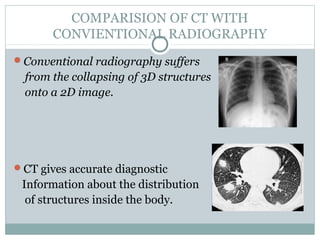
Conventional radiography suffers
from the collapsing of 3D structures
onto a 2D image.
CT gives accurate diagnostic
Information about the distribution
of structures inside the body.
VARIOUS PARAMETERS OF CT
SLICE
MATRIX
PIXEL
VOXEL
CT NUMBER
WINDOWING
WINDOW WIDTH
WINDOW LEVEL
PITCH
SLICE/CUT
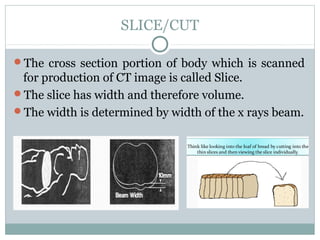
The cross section portion of body which is scanned
for production of CT image is called Slice.
The slice has width and therefore volume.
The width is determined by width of the x rays beam.
MATRIX
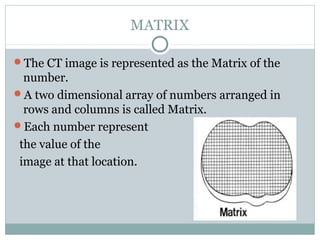
The CT image is represented as the Matrix of the
number.
A two dimensional array of numbers arranged in
rows and columns is called Matrix.
Each number represent
the value of the
image at that location.
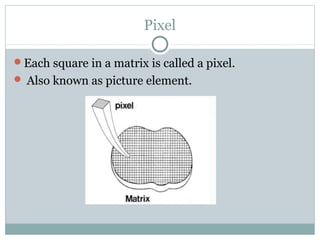
Pixel
Each square in a matrix is called a pixel.
 Also known as picture element.
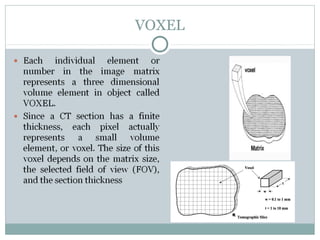
VOXEL
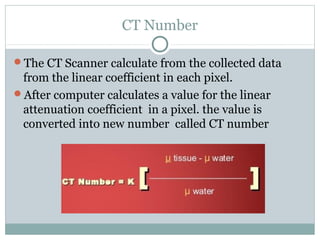
CT Number
The CT Scanner calculate from the collected data
from the linear coefficient in each pixel.
After computer calculates a value for the linear
attenuation coefficient in a pixel. the value is
converted into new number called CT number
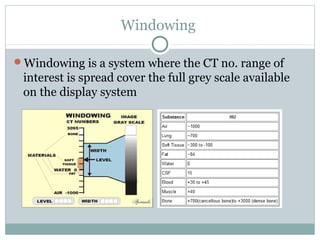
Windowing
Windowing is a system where the CT no. range of
interest is spread cover the full grey scale available
on the display system
WINDOW WIDTH –Means total range of CT no.
values selected for gray scale interpretation. It
corresponds to Contrast of the image.

WINDOW LEVEL– represents the CT no. selected
for the center of the range of the no. displayed on the
image. It corresponds to Brightness of image.
Pitch
The relationship between patient and tube motion is
called Pitch.
It is defined as table movement during each
revolution of x-ray tube divided by collimation
width.
For example: For a 5mm section, if patient moves
10mm during the time it takes for the x-ray tube to
rotate through 360˚, the pitch is 2.
Increasing pitch reduces the scan time and patient
dose.
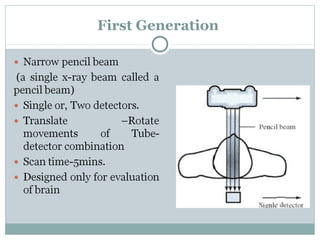
First Generation
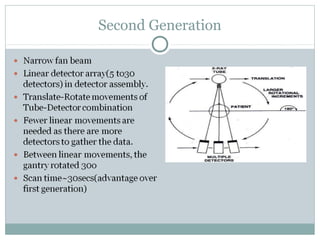
Second Generation
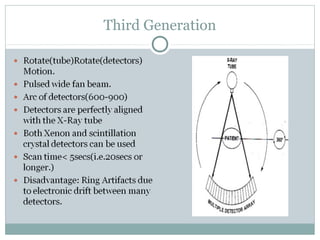
Third Generation
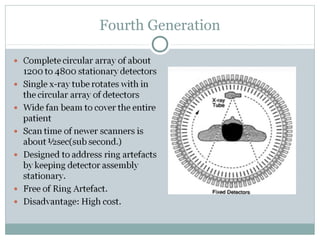
Fourth Generation
Fifth Generation(EBCT)
 Stationary/stationary
Developed specifically for cardiac tomographic
imaging
No conventional x-ray tube; large arc of tungsten
encircles patient and lies directly opposite to the
detector ring
Electron beam steered around the patient to strike
the annular tungsten target
Capable of 50-msec scan times; can produce fast-
frame- rate CT movies of the beating heart
Sixth Generation( Spiral CT)
Seventh generation
Single x ray tube
Cone beam
Multiple of detectors array
Fast 3D images
Disadvantages – Expensive
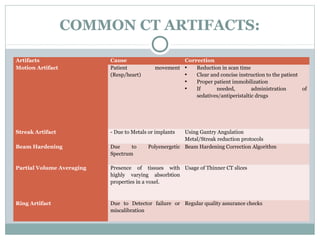
COMMON CT ARTIFACTS:
Artifacts Cause Correction
Motion Artifact Patient movement
(Resp/heart)
 Reduction in scan time
 Clear and concise instruction to the patient
 Proper patient immobilization
 If needed, administration of
sedatives/antiperistaltic drugs
Streak Artifact - Due to Metals or implants Using Gantry Angulation
Metal/Streak reduction protocols
Beam Hardening Due to Polyenergetic
Spectrum
Beam Hardening Correction Algorithm
Partial Volume Averaging Presence of tissues with
highly varying absorbtion
properties in a voxel.
Usage of Thinner CT slices
Ring Artifact Due to Detector failure or
miscalibration
Regular quality assurance checks
CT SCAN BASICS

CT SCAN BASICS

  • 1.
  • 2.
    History Of CTScan Sir Godfrey N. Hounsfield invented the CT scan in the year 1972 and called computerized axial transverse scanning. He presented a cross-sectional image of the head that revealed the internal structures of the brain in a manner previously only seen at surgery or autopsy and for the first time pathologic processes such as blood clots, tumors, and strokes could be easily seen noninvasively.
  • 3.
    BASIC PRINCIPLE: The InternalStructures of An Object Can Be Reconstructed From Multiple Projections Of The Object. By assigning different levels to different attenuation coefficients, an image can be reconstructed with aid of computer that represent various structures with diff attenuation properties.
  • 4.
    COMPARISION OF CTWITH CONVIENTIONAL RADIOGRAPHY Conventional radiography suffers from the collapsing of 3D structures onto a 2D image. CT gives accurate diagnostic Information about the distribution of structures inside the body.
  • 5.
    VARIOUS PARAMETERS OFCT SLICE MATRIX PIXEL VOXEL CT NUMBER WINDOWING WINDOW WIDTH WINDOW LEVEL PITCH
  • 6.
    SLICE/CUT The cross sectionportion of body which is scanned for production of CT image is called Slice. The slice has width and therefore volume. The width is determined by width of the x rays beam.
  • 7.
    MATRIX The CT imageis represented as the Matrix of the number. A two dimensional array of numbers arranged in rows and columns is called Matrix. Each number represent the value of the image at that location.
  • 8.
    Pixel Each square ina matrix is called a pixel.  Also known as picture element.
  • 9.
  • 10.
    CT Number The CTScanner calculate from the collected data from the linear coefficient in each pixel. After computer calculates a value for the linear attenuation coefficient in a pixel. the value is converted into new number called CT number
  • 11.
    Windowing Windowing is asystem where the CT no. range of interest is spread cover the full grey scale available on the display system
  • 12.
    WINDOW WIDTH –Meanstotal range of CT no. values selected for gray scale interpretation. It corresponds to Contrast of the image.  WINDOW LEVEL– represents the CT no. selected for the center of the range of the no. displayed on the image. It corresponds to Brightness of image.
  • 13.
    Pitch The relationship betweenpatient and tube motion is called Pitch. It is defined as table movement during each revolution of x-ray tube divided by collimation width. For example: For a 5mm section, if patient moves 10mm during the time it takes for the x-ray tube to rotate through 360˚, the pitch is 2. Increasing pitch reduces the scan time and patient dose.
  • 14.
  • 15.
  • 16.
  • 17.
  • 18.
    Fifth Generation(EBCT)  Stationary/stationary Developedspecifically for cardiac tomographic imaging No conventional x-ray tube; large arc of tungsten encircles patient and lies directly opposite to the detector ring Electron beam steered around the patient to strike the annular tungsten target Capable of 50-msec scan times; can produce fast- frame- rate CT movies of the beating heart
  • 19.
  • 20.
    Seventh generation Single xray tube Cone beam Multiple of detectors array Fast 3D images Disadvantages – Expensive
  • 21.
    COMMON CT ARTIFACTS: ArtifactsCause Correction Motion Artifact Patient movement (Resp/heart)  Reduction in scan time  Clear and concise instruction to the patient  Proper patient immobilization  If needed, administration of sedatives/antiperistaltic drugs Streak Artifact - Due to Metals or implants Using Gantry Angulation Metal/Streak reduction protocols Beam Hardening Due to Polyenergetic Spectrum Beam Hardening Correction Algorithm Partial Volume Averaging Presence of tissues with highly varying absorbtion properties in a voxel. Usage of Thinner CT slices Ring Artifact Due to Detector failure or miscalibration Regular quality assurance checks