CT-Scan 
M.Zeeshan Khalid(09050610-039) 
Muhammad Saqib (09050610-051)
CT Scan 
History 
 CT-Scan referred as a computerized axial tomography. 
 CT was developed independently by a British engineer named Sir Godfrey 
Hounsfield and Dr. Alan Cormack. 
 CT scanners first began to be installed in 1974. 
 CT scan can help doctors to visualize small nodules or tumors, which they cannot 
see with a plain film X-ray.
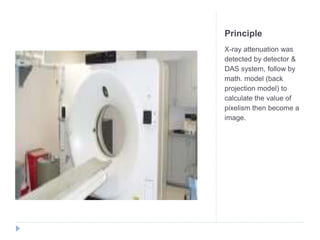
Principle 
X-ray attenuation was 
detected by detector & 
DAS system, follow by 
math. model (back 
projection model) to 
calculate the value of 
pixelism then become a 
image.
Introduction 
 CT scan images allow the doctor to look at the inside of the body 
 CT has become a commonly performed procedure. 
 CT has revolutionized medicine because it allows doctors to see diseases that, in the 
past, could often only be found at surgery or at autopsy. 
 CT and MRI are similar to each other, but provide a much different view of the body 
than an X-ray does. 
 People often have CT scans to further evaluate an abnormality seen on another test 
such as an X-ray or an ultrasound.
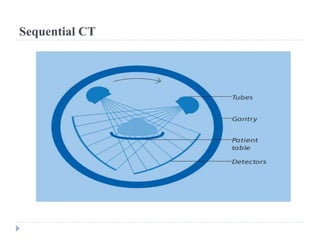
Sequential CT
Spiral CT
Setup of a CT System 
 A CT system comprises several components. 
 These basically include: 
 The scanning unit, i.e. the gantry, with tube 
 and detector system 
 The patient table 
 The image processor for image reconstruction 
 The console
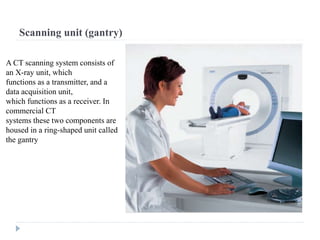
Scanning unit (gantry) 
A CT scanning system consists of 
an X-ray unit, which 
functions as a transmitter, and a 
data acquisition unit, 
which functions as a receiver. In 
commercial CT 
systems these two components are 
housed in a ring-shaped unit called 
the gantry
X-ray components 
Tube 
 Tubes used in modern CT scanners have a power rating of 20–60 kW at voltages of 
80 to 140 kV. 
 Limits are defined by the properties of the anode and the generator. 
 To prevent overloading of the X-ray tube, the power must be reduced for long 
scans.
 Shielding 
 Each CT scanner is equipped with grids, collimators and filters to provide shielding 
against scattered radiation, to define the scan slice and to absorb the low-energy 
portion of the X-ray spectrum. In this way, both the patient and the examiner are 
protected.
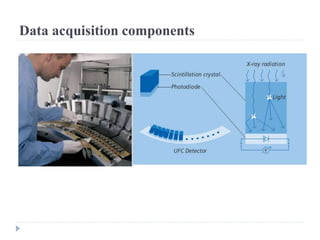
Data acquisition components
cont 
Detector 
 The detector system plays a special role in the interaction of the CT components. It 
converts the incident X-rays of varying intensity to electric signals. These analog 
signals are amplified by downstream electronic components and converted to digital 
pulses. Over time, certain materials have proven very effective in the utilization of 
X-rays.
cont 
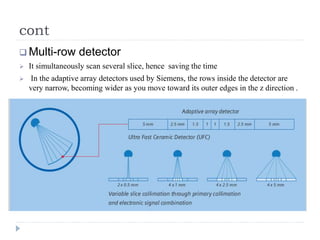
 Multi-row detector 
 It simultaneously scan several slice, hence saving the time 
 In the adaptive array detectors used by Siemens, the rows inside the detector are 
very narrow, becoming wider as you move toward its outer edges in the z direction .
CT in general clinical use 
 The use of spiral CT has significantly shortened scan 
times compared to sequential CT. This is of great 
advantage when examining patients who, due to the 
nature of their illness, are unable to cooperate. 
Motion artifacts caused by different respiratory 
conditions during the acquisition are reduced 
considerably, because in spiral CT the entire volume 
is scanned faster and without gaps. Multiple scans 
due to breathing during the acquisition are no longer 
necessary. The patient dose is therefore reduced
Advantages of spiral CT in clinical use 
 Complete coverage of organs in a single respiratory 
position 
 Short scan times (resulting in fewer motion artifacts 
and a lower contrast medium requirement) 
 Additional diagnostic information due to improved 
 resolution (thinner slices) and 3D visualization in 
routine operation. 
 Special cost-effective applications based on spiral 
CT
CT-Angiography (CTA) 
CTA Image of Vascular system
CT Scan Risks 
 The patient will be exposed to radiation when undergoing a CT scan. However, it is 
a safe level. 
 The biggest potential risk is with a contrast (also called dye) injection that is 
sometimes used in CT scanning. 
 Like any medication, some people can have a serious reaction to the contrast. 
 Any time an injection is done into a vein, there is a risk of the contrast leaking 
outside of the vein under the skin.

CT scan

  • 1.
    CT-Scan M.Zeeshan Khalid(09050610-039) Muhammad Saqib (09050610-051)
  • 2.
    CT Scan History  CT-Scan referred as a computerized axial tomography.  CT was developed independently by a British engineer named Sir Godfrey Hounsfield and Dr. Alan Cormack.  CT scanners first began to be installed in 1974.  CT scan can help doctors to visualize small nodules or tumors, which they cannot see with a plain film X-ray.
  • 3.
    Principle X-ray attenuationwas detected by detector & DAS system, follow by math. model (back projection model) to calculate the value of pixelism then become a image.
  • 4.
    Introduction  CTscan images allow the doctor to look at the inside of the body  CT has become a commonly performed procedure.  CT has revolutionized medicine because it allows doctors to see diseases that, in the past, could often only be found at surgery or at autopsy.  CT and MRI are similar to each other, but provide a much different view of the body than an X-ray does.  People often have CT scans to further evaluate an abnormality seen on another test such as an X-ray or an ultrasound.
  • 5.
  • 6.
  • 7.
    Setup of aCT System  A CT system comprises several components.  These basically include:  The scanning unit, i.e. the gantry, with tube  and detector system  The patient table  The image processor for image reconstruction  The console
  • 8.
    Scanning unit (gantry) A CT scanning system consists of an X-ray unit, which functions as a transmitter, and a data acquisition unit, which functions as a receiver. In commercial CT systems these two components are housed in a ring-shaped unit called the gantry
  • 9.
    X-ray components Tube  Tubes used in modern CT scanners have a power rating of 20–60 kW at voltages of 80 to 140 kV.  Limits are defined by the properties of the anode and the generator.  To prevent overloading of the X-ray tube, the power must be reduced for long scans.
  • 10.
     Shielding Each CT scanner is equipped with grids, collimators and filters to provide shielding against scattered radiation, to define the scan slice and to absorb the low-energy portion of the X-ray spectrum. In this way, both the patient and the examiner are protected.
  • 11.
  • 12.
    cont Detector The detector system plays a special role in the interaction of the CT components. It converts the incident X-rays of varying intensity to electric signals. These analog signals are amplified by downstream electronic components and converted to digital pulses. Over time, certain materials have proven very effective in the utilization of X-rays.
  • 13.
    cont  Multi-rowdetector  It simultaneously scan several slice, hence saving the time  In the adaptive array detectors used by Siemens, the rows inside the detector are very narrow, becoming wider as you move toward its outer edges in the z direction .
  • 14.
    CT in generalclinical use  The use of spiral CT has significantly shortened scan times compared to sequential CT. This is of great advantage when examining patients who, due to the nature of their illness, are unable to cooperate. Motion artifacts caused by different respiratory conditions during the acquisition are reduced considerably, because in spiral CT the entire volume is scanned faster and without gaps. Multiple scans due to breathing during the acquisition are no longer necessary. The patient dose is therefore reduced
  • 15.
    Advantages of spiralCT in clinical use  Complete coverage of organs in a single respiratory position  Short scan times (resulting in fewer motion artifacts and a lower contrast medium requirement)  Additional diagnostic information due to improved  resolution (thinner slices) and 3D visualization in routine operation.  Special cost-effective applications based on spiral CT
  • 16.
    CT-Angiography (CTA) CTAImage of Vascular system
  • 17.
    CT Scan Risks  The patient will be exposed to radiation when undergoing a CT scan. However, it is a safe level.  The biggest potential risk is with a contrast (also called dye) injection that is sometimes used in CT scanning.  Like any medication, some people can have a serious reaction to the contrast.  Any time an injection is done into a vein, there is a risk of the contrast leaking outside of the vein under the skin.