CRM: AN INTRODUCTION
Thursday, 27th May 2010
Before we start
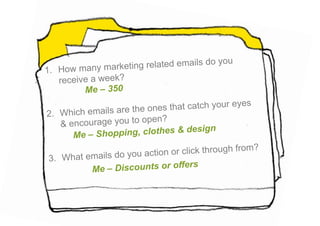
ng related emails do you
1.  How many marketi
    receive a week?
          Me – 350
                                                  es
                    the on es that catch your ey
2. Which emails are
                        pen?
   & encourage you to o
                                      sign
      Me – Shopping, clothes & de

                        ction  or click through from?
3. What emails do you a
                                   ers
          Me – Discounts or off
ils?
                         e  open rate for auto ema
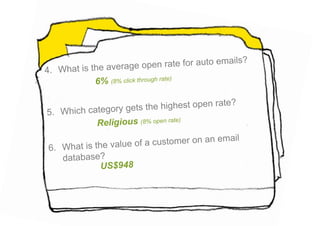
4.  What is the averag
             6% (8% click through rate)

                                         rate?
                    ets the highest open
5. Which category g
           Religious (8% open rate)
                                            ail
                      of a customer on an em
 6. What is the value
    database?
              US$948
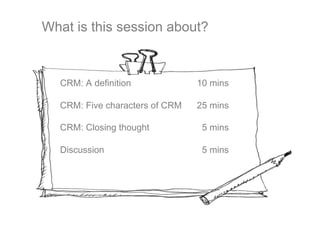
What is this session about?


  CRM: A definition             10 mins

  CRM: Five characters of CRM   25 mins

  CRM: Closing thought           5 mins

  Discussion                     5 mins
CRM: A DEFINITION
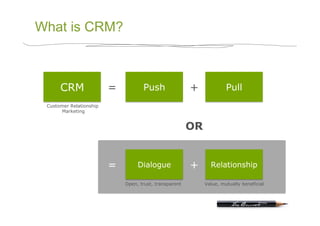
What is CRM?


      CRM                =          Push                +             Pull
 Customer Relationship
       Marketing


                                                        OR


                         =        Dialogue              +      Relationship

                             Open, trust, transparent        Value, mutually beneficial
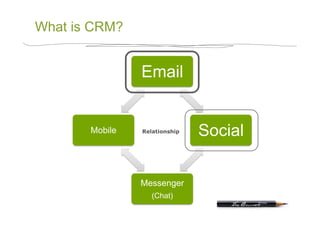
What is CRM?


                Email


       Mobile   Relationship   Social

                Messenger
                   (Chat)
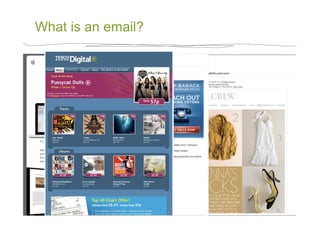
What is an email?
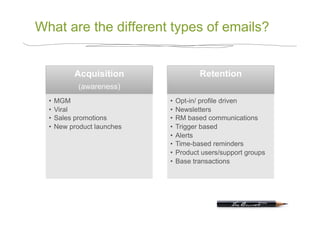
What are the different types of emails?


          Acquisition                Retention
           (awareness)
  •  MGM                    •  Opt-in/ profile driven
  •  Viral                  •  Newsletters
  •  Sales promotions       •  RM based communications
  •  New product launches   •  Trigger based
                            •  Alerts
                            •  Time-based reminders
                            •  Product users/support groups
                            •  Base transactions
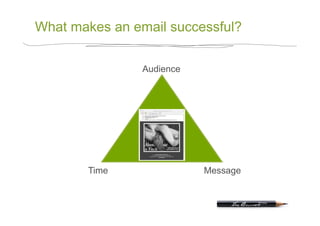
What makes an email successful?

                Audience


       Time                Message
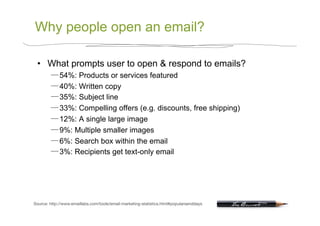
Why people open an email?

 •  What prompts user to open & respond to emails?
             54%: Products or services featured
             40%: Written copy
             35%: Subject line
             33%: Compelling offers (e.g. discounts, free shipping)
             12%: A single large image
             9%: Multiple smaller images
             6%: Search box within the email
             3%: Recipients get text-only email


Source: http://www.emaillabs.com/tools/email-marketing-statistics.html#popularsenddays
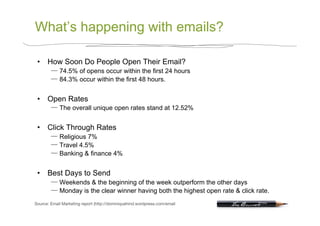
What’s happening with emails?

 •  How Soon Do People Open Their Email?
             74.5% of opens occur within the first 24 hours
             84.3% occur within the first 48 hours.


 •  Open Rates
             The overall unique open rates stand at 12.52%


 •  Click Through Rates
             Religious 7%
             Travel 4.5%
             Banking & finance 4%


 •  Best Days to Send
             Weekends & the beginning of the week outperform the other days
             Monday is the clear winner having both the highest open rate & click rate.
Source: Email Marketing report (http://dominiquehind.wordpress.com/email
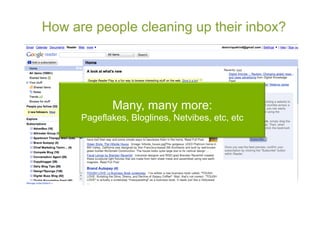
How are people cleaning up their inbox?


             Many, many more:
      Pageflakes, Bloglines, Netvibes, etc, etc
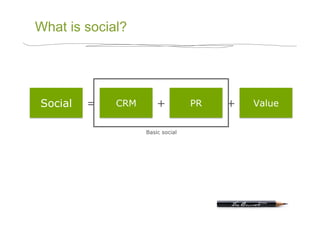
What is social?


Social   =   CRM       +          PR   +   Value


                   Basic social
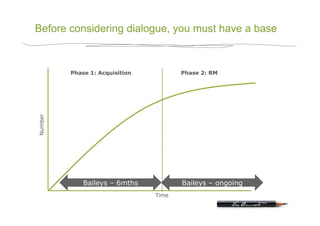
Before considering dialogue, you must have a base


         Phase 1: Acquisition          Phase 2: RM
Number


             Baileys – 6mths           Baileys – ongoing
                                Time
jargon time-out
CRM: FIVE CHARACTERS
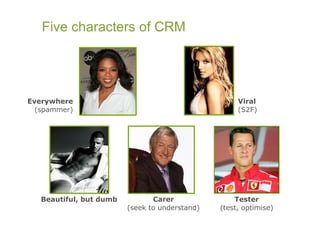
Five characters of CRM


Everywhere                                           Viral
  (spammer)                                          (S2F)


   Beautiful, but dumb          Carer               Tester
                         (seek to understand)   (test, optimise)
1. ‘Everywhere’


          Appear everywhere &
      focus on pushing their agenda
               (spammers)
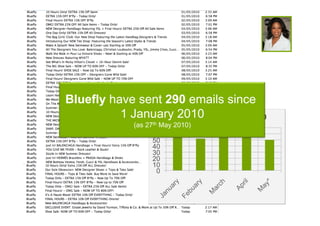
Bluefly have sent 290 emails since
          1 January 2010
            (as 27th May 2010)
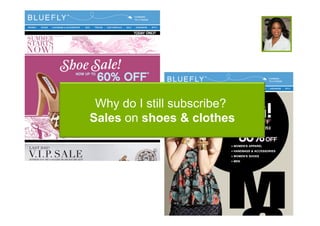
Why do I still subscribe?
Sales on shoes & clothes
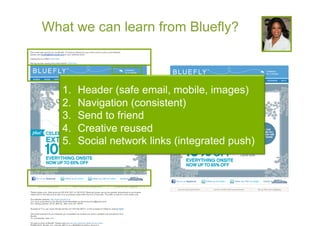
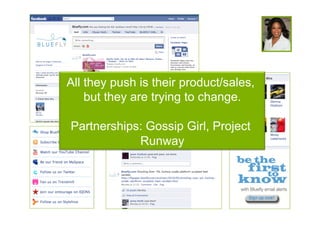
What we can learn from Bluefly?


   1.    Header (safe email, mobile, images)
   2.    Navigation (consistent)
   3.    Send to friend
   4.    Creative reused
   5.    Social network links (integrated push)
All they push is their product/sales,
    but they are trying to change.

Partnerships: Gossip Girl, Project
            Runway
2. ‘Viral’


      Shocks to encourage community
               (send 2 friend)
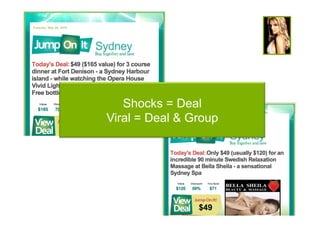
Shocks = Deal
Viral = Deal & Group
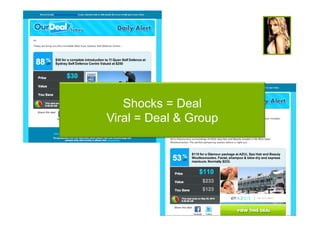
Shocks = Deal
Viral = Deal & Group
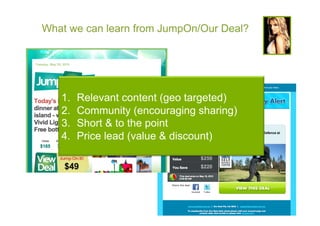
What we can learn from JumpOn/Our Deal?


   1.    Relevant content (geo targeted)
   2.    Community (encouraging sharing)
   3.    Short & to the point
   4.    Price lead (value & discount)
3. ‘Beautiful but dumb’


        Look forward to receiving,
          but they aren’t smart
            (tailored/relevant)
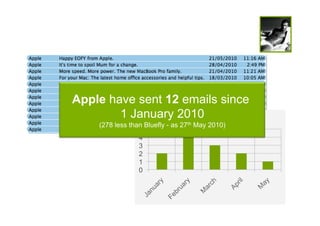
Apple have sent 12 emails since
        1 January 2010
    (278 less than Bluefly - as 27th May 2010)
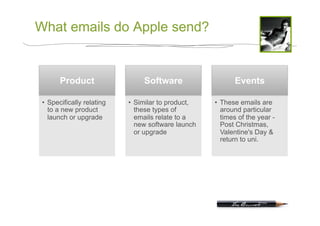
What emails do Apple send?


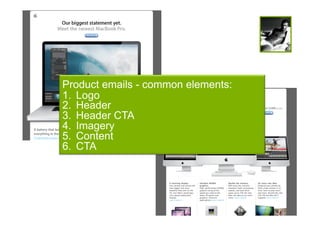
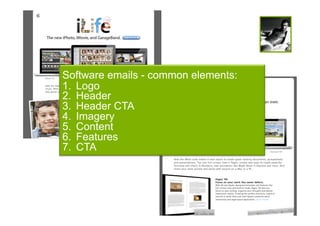
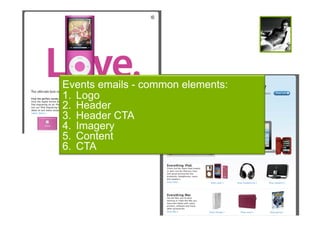
       Product                   Software                   Events

 •  Specifically relating   •  Similar to product,   •  These emails are
    to a new product           these types of           around particular
    launch or upgrade          emails relate to a       times of the year -
                               new software launch      Post Christmas,
                               or upgrade               Valentine's Day &
                                                        return to uni.
Product emails - common elements:
1.  Logo
2.  Header
3.  Header CTA
4.  Imagery
5.  Content
6.  CTA
Software emails - common elements:
1.  Logo
2.  Header
3.  Header CTA
4.  Imagery
5.  Content
6.  Features
7.  CTA
Events emails - common elements:
1.  Logo
2.  Header
3.  Header CTA
4.  Imagery
5.  Content
6.  CTA
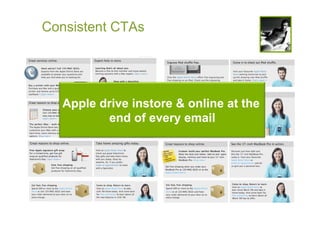
Consistent CTAs


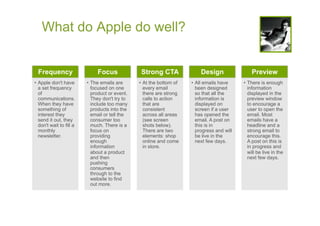
  Apple drive instore & online at the
         end of every email
What do Apple do well?


  Frequency                    Focus              Strong CTA               Design                 Preview
•  Apple don't have       •  The emails are      •  At the bottom of   •  All emails have     •  There is enough
   a set frequency           focused on one         every email           been designed          information
   of                        product or event.      there are strong      so that all the        displayed in the
   communications.           They don't try to      calls to action       information is         preview window
   When they have            include too many       that are              displayed on           to encourage a
   something of              products into the      consistent            screen if a user       user to open the
   interest they             email or tell the      across all areas      has opened the         email. Most
   send it out, they         consumer too           (see screen           email. A post on       emails have a
   don't wait to fill a      much. There is a       shots below).         this is in             headline and a
   monthly                   focus on               There are two         progress and will      strong email to
   newsletter.               providing              elements: shop        be live in the         encourage this.
                             enough                 online and come       next few days.         A post on this is
                             information            in store.                                    in progress and
                             about a product                                                     will be live in the
                             and then                                                            next few days.
                             pushing
                             consumers
                             through to the
                             website to find
                             out more.
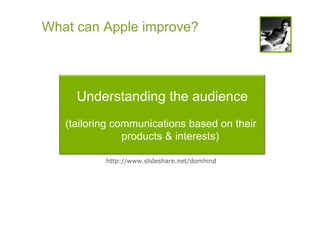
What can Apple improve?


     Understanding the audience
   (tailoring communications based on their
                products & interests)

           http://www.slideshare.net/domhind
4. ‘Carer’


     Ask customers what they want &
          tailor what they provide
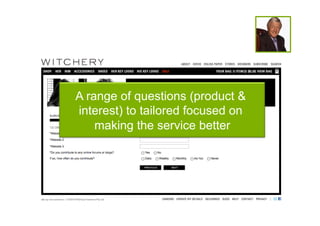
A range of questions (product &
interest) to tailored focused on
    making the service better
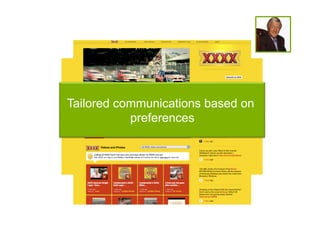
Tailored communications based on
           preferences
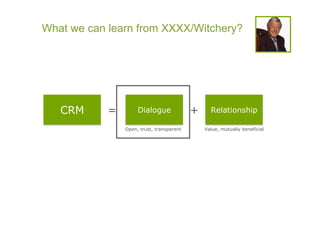
What we can learn from XXXX/Witchery?


   CRM      =        Dialogue              +     Relationship

                Open, trust, transparent       Value, mutually beneficial
5. ‘Tester’


     Constantly test, learn & optimise
            (tweak & refine)
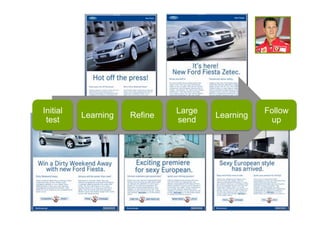
Initial                       Large              Follow
          Learning   Refine           Learning
 test                         send                up
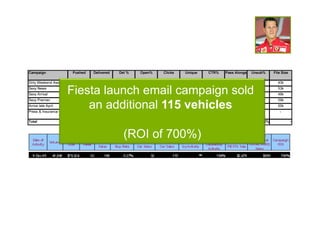
Fiesta launch email campaign sold
    an additional 115 vehicles

         (ROI of 700%)
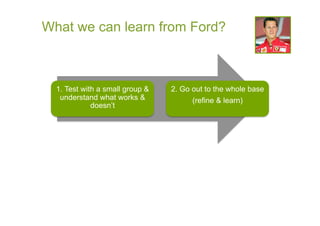
What we can learn from Ford?


  1. Test with a small group &   2. Go out to the whole base
   understand what works &             (refine & learn)
             doesn’t
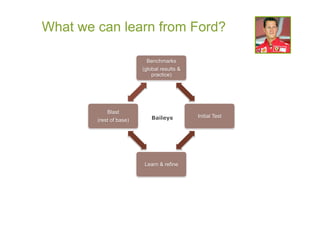
What we can learn from Ford?

                           Benchmarks
                         (global results &
                             practice)


            Blast
                             Baileys         Initial Test
        (rest of base)


                          Learn & refine
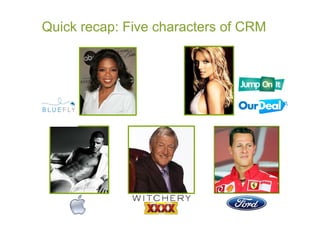
Quick recap: Five characters of CRM
CLOSING REQUEST
Homework – when you are back at work?

•  Set up an email address (eg leoburnettauto@gmail.com)
•  Pick one of your clients:
      Subscribe to their newsletter & all of the competitors
•  Review the emails that are sent to the inbox & package it
   up for your clients.
      Look for opportunities & areas they can improve.
THOUGHTS
DISCUSSION
QUESTIONS
THANK YOU!
http://www.slideshare.net/domhind
http://dominiquehind.wordpress.com
SUPPORTING
INFORMATION
What is a relationship?

•  Things to consider:
      A relationship is two-way communication
      121 has to sit across every brand touch point
      Consumers don’t have relationships with databases
      You can’t control where & why relationships need management
      You can buy attention but not genuine relationships
      Incentives are transactional, we need long-term relationship
      activity
      Social universes are ‘live’ spaces & they need constant
      conversation .
What’s happening with emails?

•  Subject Lines
        Shorter than 35 characters were opened more than emails with subject lines
        longer than 35 characters.
•  Personalization
        Only when the message is personalized, there are more opens and clicks.
        Emails with only the subject line personalized garnered the least amount of
        opens and clicks.
•  Deliverability
        Deliverability continues to increase and bounces continue to decrease. This
        means more messages are reaching recipients’ inbox.
•  Number of Recipients
        Messages delivered to small & medium lists have far greater open & click rates
        than messages delivered to lists containing 1000 or more subscribers.
        A smaller list does not directly affect open and click rates, but mailings to
        smaller lists may be targeted better, contain more relevant content or have
        more recent subscribers.

                       Source: xx
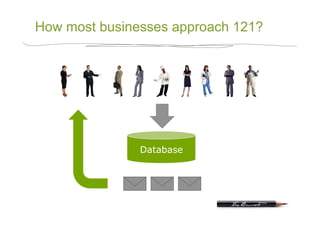
How most businesses approach 121?


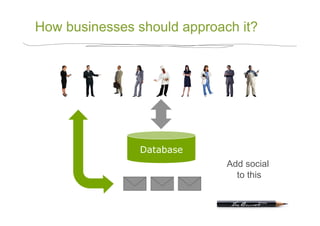
               Database
How businesses should approach it?


                Database
                             Add social
                               to this
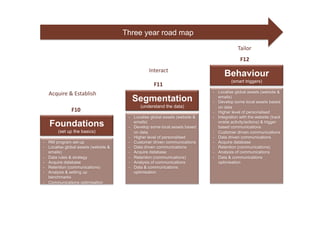
Three year road map
                                                                                             Tailor	
  
                                                                                              F12	
  
                                                  Interact	
  	
  
                                                                                     Behaviour
                                                                                         (smart triggers)
                                                     F11	
  
   Acquire	
  &	
  Establish	
  	
                                             -  Localise global assets (website &
                                         Segmentation                             emails)
                                                                               -  Develop some local assets based
                                              (understand the data)               on data
                 F10	
                                                         -  Higher level of personalised
                                        -  Localise global assets (website &   -  Integration with the website (track
   Foundations                             emails)
                                        -  Develop some local assets based
                                                                                  onsite activity/actions) & trigger
                                                                                  based communications
         (set up the basics)               on data                             -  Customer driven communications
                                        -  Higher level of personalised        -  Data driven communications
-  RM program set-up                    -  Customer driven communications      -  Acquire database
-  Localise global assets (website &    -  Data driven communications          -  Retention (communications)
   emails)                              -  Acquire database                    -  Analysis of communications
-  Data rules & strategy                -  Retention (communications)          -  Data & communications
-  Acquire database                     -  Analysis of communications             optimisation
-  Retention (communications)           -  Data & communications
-  Analysis & setting up                   optimisation
   benchmarks
-  Communications optimisation
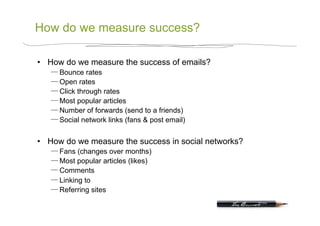
How do we measure success?

•  How do we measure the success of emails?
      Bounce rates
      Open rates
      Click through rates
      Most popular articles
      Number of forwards (send to a friends)
      Social network links (fans & post email)


•  How do we measure the success in social networks?
      Fans (changes over months)
      Most popular articles (likes)
      Comments
      Linking to
      Referring sites

CRM Introduction

  • 1.
  • 2.
  • 3.
    ng related emailsdo you 1.  How many marketi receive a week? Me – 350 es the on es that catch your ey 2. Which emails are pen? & encourage you to o sign Me – Shopping, clothes & de ction or click through from? 3. What emails do you a ers Me – Discounts or off
  • 4.
    ils? e open rate for auto ema 4.  What is the averag 6% (8% click through rate) rate? ets the highest open 5. Which category g Religious (8% open rate) ail of a customer on an em 6. What is the value database? US$948
  • 5.
    What is thissession about? CRM: A definition 10 mins CRM: Five characters of CRM 25 mins CRM: Closing thought 5 mins Discussion 5 mins
  • 6.
  • 7.
    What is CRM? CRM = Push + Pull Customer Relationship Marketing OR = Dialogue + Relationship Open, trust, transparent Value, mutually beneficial
  • 8.
    What is CRM? Email Mobile Relationship Social Messenger (Chat)
  • 9.
    What is anemail?
  • 10.
    What are thedifferent types of emails? Acquisition Retention (awareness) •  MGM •  Opt-in/ profile driven •  Viral •  Newsletters •  Sales promotions •  RM based communications •  New product launches •  Trigger based •  Alerts •  Time-based reminders •  Product users/support groups •  Base transactions
  • 11.
    What makes anemail successful? Audience Time Message
  • 12.
    Why people openan email? •  What prompts user to open & respond to emails?  54%: Products or services featured  40%: Written copy  35%: Subject line  33%: Compelling offers (e.g. discounts, free shipping)  12%: A single large image  9%: Multiple smaller images  6%: Search box within the email  3%: Recipients get text-only email Source: http://www.emaillabs.com/tools/email-marketing-statistics.html#popularsenddays
  • 13.
    What’s happening withemails? •  How Soon Do People Open Their Email?   74.5% of opens occur within the first 24 hours   84.3% occur within the first 48 hours. •  Open Rates   The overall unique open rates stand at 12.52% •  Click Through Rates   Religious 7%   Travel 4.5%   Banking & finance 4% •  Best Days to Send   Weekends & the beginning of the week outperform the other days   Monday is the clear winner having both the highest open rate & click rate. Source: Email Marketing report (http://dominiquehind.wordpress.com/email
  • 14.
    How are peoplecleaning up their inbox? Many, many more: Pageflakes, Bloglines, Netvibes, etc, etc
  • 15.
    What is social? Social = CRM + PR + Value Basic social
  • 16.
    Before considering dialogue,you must have a base Phase 1: Acquisition Phase 2: RM Number Baileys – 6mths Baileys – ongoing Time
  • 17.
  • 18.
  • 19.
    Five characters ofCRM Everywhere Viral (spammer) (S2F) Beautiful, but dumb Carer Tester (seek to understand) (test, optimise)
  • 20.
    1. ‘Everywhere’ Appear everywhere & focus on pushing their agenda (spammers)
  • 21.
    Bluefly have sent290 emails since 1 January 2010 (as 27th May 2010)
  • 22.
    Why do Istill subscribe? Sales on shoes & clothes
  • 23.
    What we canlearn from Bluefly? 1.  Header (safe email, mobile, images) 2.  Navigation (consistent) 3.  Send to friend 4.  Creative reused 5.  Social network links (integrated push)
  • 24.
    All they pushis their product/sales, but they are trying to change. Partnerships: Gossip Girl, Project Runway
  • 25.
    2. ‘Viral’ Shocks to encourage community (send 2 friend)
  • 26.
    Shocks = Deal Viral= Deal & Group
  • 27.
    Shocks = Deal Viral= Deal & Group
  • 28.
    What we canlearn from JumpOn/Our Deal? 1.  Relevant content (geo targeted) 2.  Community (encouraging sharing) 3.  Short & to the point 4.  Price lead (value & discount)
  • 29.
    3. ‘Beautiful butdumb’ Look forward to receiving, but they aren’t smart (tailored/relevant)
  • 30.
    Apple have sent12 emails since 1 January 2010 (278 less than Bluefly - as 27th May 2010)
  • 31.
    What emails doApple send? Product Software Events •  Specifically relating •  Similar to product, •  These emails are to a new product these types of around particular launch or upgrade emails relate to a times of the year - new software launch Post Christmas, or upgrade Valentine's Day & return to uni.
  • 32.
    Product emails -common elements: 1.  Logo 2.  Header 3.  Header CTA 4.  Imagery 5.  Content 6.  CTA
  • 33.
    Software emails -common elements: 1.  Logo 2.  Header 3.  Header CTA 4.  Imagery 5.  Content 6.  Features 7.  CTA
  • 34.
    Events emails -common elements: 1.  Logo 2.  Header 3.  Header CTA 4.  Imagery 5.  Content 6.  CTA
  • 35.
    Consistent CTAs Apple drive instore & online at the end of every email
  • 36.
    What do Appledo well? Frequency Focus Strong CTA Design Preview •  Apple don't have •  The emails are •  At the bottom of •  All emails have •  There is enough a set frequency focused on one every email been designed information of product or event. there are strong so that all the displayed in the communications. They don't try to calls to action information is preview window When they have include too many that are displayed on to encourage a something of products into the consistent screen if a user user to open the interest they email or tell the across all areas has opened the email. Most send it out, they consumer too (see screen email. A post on emails have a don't wait to fill a much. There is a shots below). this is in headline and a monthly focus on There are two progress and will strong email to newsletter. providing elements: shop be live in the encourage this. enough online and come next few days. A post on this is information in store. in progress and about a product will be live in the and then next few days. pushing consumers through to the website to find out more.
  • 37.
    What can Appleimprove? Understanding the audience (tailoring communications based on their products & interests) http://www.slideshare.net/domhind
  • 38.
    4. ‘Carer’ Ask customers what they want & tailor what they provide
  • 39.
    A range ofquestions (product & interest) to tailored focused on making the service better
  • 40.
  • 41.
    What we canlearn from XXXX/Witchery? CRM = Dialogue + Relationship Open, trust, transparent Value, mutually beneficial
  • 42.
    5. ‘Tester’ Constantly test, learn & optimise (tweak & refine)
  • 43.
    Initial Large Follow Learning Refine Learning test send up
  • 44.
    Fiesta launch emailcampaign sold an additional 115 vehicles (ROI of 700%)
  • 45.
    What we canlearn from Ford? 1. Test with a small group & 2. Go out to the whole base understand what works & (refine & learn) doesn’t
  • 46.
    What we canlearn from Ford? Benchmarks (global results & practice) Blast Baileys Initial Test (rest of base) Learn & refine
  • 47.
    Quick recap: Fivecharacters of CRM
  • 48.
  • 49.
    Homework – whenyou are back at work? •  Set up an email address (eg leoburnettauto@gmail.com) •  Pick one of your clients:  Subscribe to their newsletter & all of the competitors •  Review the emails that are sent to the inbox & package it up for your clients.  Look for opportunities & areas they can improve.
  • 50.
  • 51.
  • 52.
  • 53.
    What is arelationship? •  Things to consider:  A relationship is two-way communication  121 has to sit across every brand touch point  Consumers don’t have relationships with databases  You can’t control where & why relationships need management  You can buy attention but not genuine relationships  Incentives are transactional, we need long-term relationship activity  Social universes are ‘live’ spaces & they need constant conversation .
  • 54.
    What’s happening withemails? •  Subject Lines   Shorter than 35 characters were opened more than emails with subject lines longer than 35 characters. •  Personalization   Only when the message is personalized, there are more opens and clicks.   Emails with only the subject line personalized garnered the least amount of opens and clicks. •  Deliverability   Deliverability continues to increase and bounces continue to decrease. This means more messages are reaching recipients’ inbox. •  Number of Recipients   Messages delivered to small & medium lists have far greater open & click rates than messages delivered to lists containing 1000 or more subscribers.   A smaller list does not directly affect open and click rates, but mailings to smaller lists may be targeted better, contain more relevant content or have more recent subscribers. Source: xx
  • 55.
    How most businessesapproach 121? Database
  • 56.
    How businesses shouldapproach it? Database Add social to this
  • 57.
    Three year roadmap Tailor   F12   Interact     Behaviour (smart triggers) F11   Acquire  &  Establish     -  Localise global assets (website & Segmentation emails) -  Develop some local assets based (understand the data) on data F10   -  Higher level of personalised -  Localise global assets (website & -  Integration with the website (track Foundations emails) -  Develop some local assets based onsite activity/actions) & trigger based communications (set up the basics) on data -  Customer driven communications -  Higher level of personalised -  Data driven communications -  RM program set-up -  Customer driven communications -  Acquire database -  Localise global assets (website & -  Data driven communications -  Retention (communications) emails) -  Acquire database -  Analysis of communications -  Data rules & strategy -  Retention (communications) -  Data & communications -  Acquire database -  Analysis of communications optimisation -  Retention (communications) -  Data & communications -  Analysis & setting up optimisation benchmarks -  Communications optimisation
  • 58.
    How do wemeasure success? •  How do we measure the success of emails?  Bounce rates  Open rates  Click through rates  Most popular articles  Number of forwards (send to a friends)  Social network links (fans & post email) •  How do we measure the success in social networks?  Fans (changes over months)  Most popular articles (likes)  Comments  Linking to  Referring sites