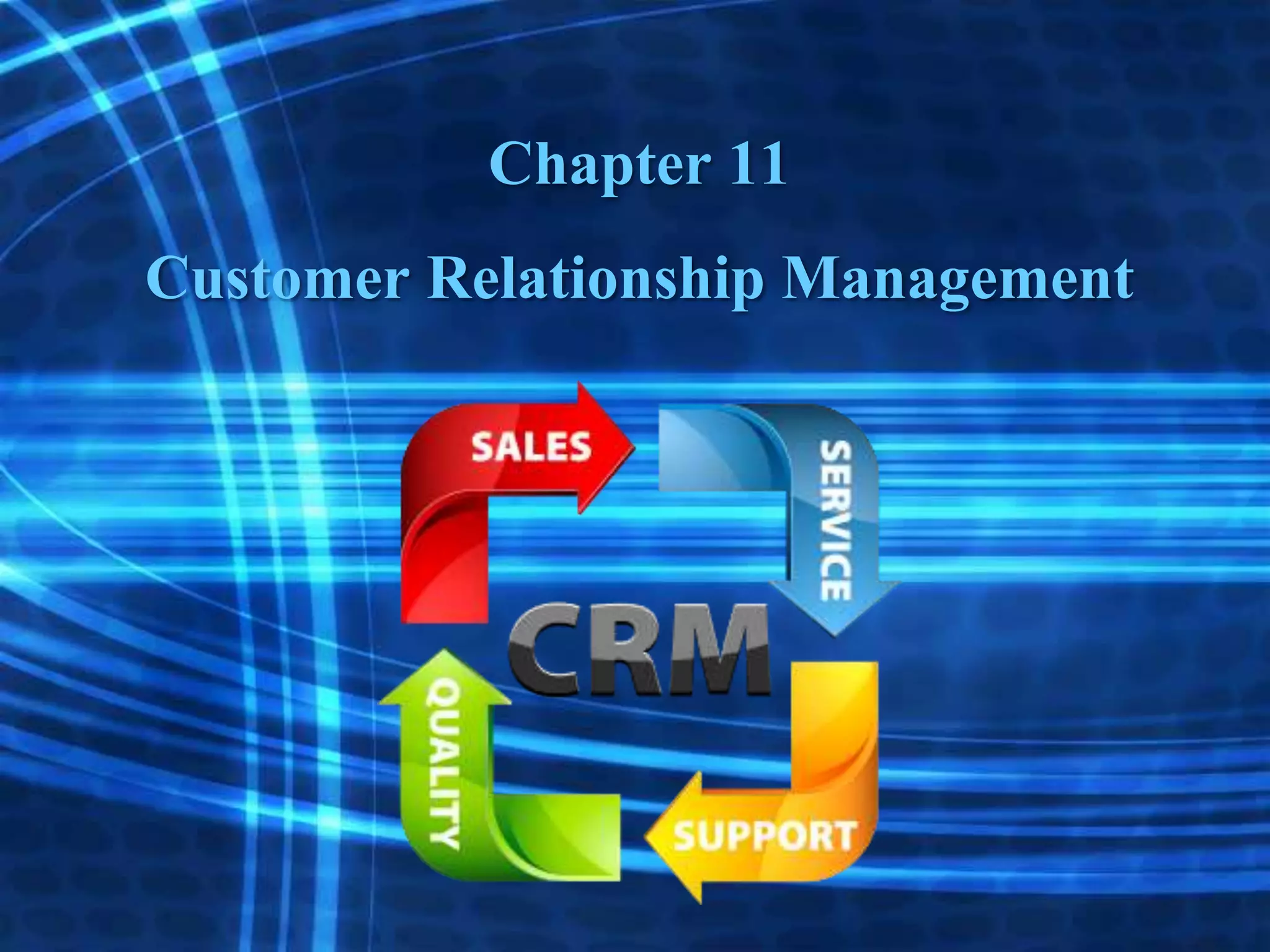
Chapter 11
Customer Relationship Management
Learning Objectives
1. Describe the customer relationship management
process
2. Understand how customer shopping data are
collected
3. Explain the methods used to analyze customer data
and identify target customers
4. Outline how retailers develop their frequent-
shopper programs
5. Explain various ways to implement effective CRM
programs
What is CRM?
• A business philosophy and set of strategies, programs, and
systems that focuses on identifying and building
relationships with a retailer’s valued customers.
• Increases its share of wallet
– the percentage of the customers’ purchases made from
the retailer
CRM Process
• To develop loyalty and repeat-purchase behavior among a
retailer’s best customers.
• Customer Loyalty
– Customers are committed to purchasingmerchandiseand servicesfrom a
certain retailer and will resist activitiesof competitorsattempting to steal
their patronage.
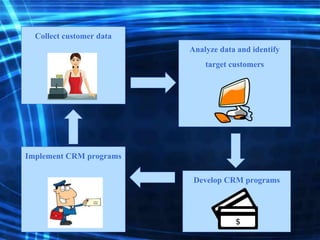
CRM Process Overview
• Step 1:
– Collect customer data
• Step 2:
– Analyze customer data and identifytarget customers
• Step 3:
– Develop CRM through frequent-shopperprograms
• Step 4:
– Implement CRM programs.
Step 1:
Collecting Customer Shopping Data
• Create customer database by including the following:
– Transactions – a completehistory of purchasesmade by the customer
• Date,SKU, price, special promotion response
– Customer contacts – a record of interactionsbetween the customer and the
retailer
• Website, kiosks, blogs or Facebook, returns,phone calls,catalogs, emails
– Customer preference – what the customer likes
• Colors,brands, fabrics,flavors,sizes
– Descriptive information – customer info used in developingmarket segments
• Demographic,psychographic
Step 1:
Collecting Customer Shopping Data
• Identifying information for in-store purchases can be more difficult than
online shopping. Here’s how to overcome:
– Ask for identifying information
• Phone number, email,name, address
– Connect internet and store purchasingdata
• Creditand debit can be linked to info provided with online purchases
– Offer frequent-shopperprograms
• Alsocalled loyalty programs – identifyand provide rewards to customers who patronize
a retailer
• Frequent-shopper cards are perfect for keeping track of this info
Step 1:
Collecting Customer Shopping Data
– Use biometrics
• Measurement of human characteristicssuch as hand geometry,fingerprints,voice or iris
• Helps ensure consistent data collected
• Customerscan receive personalizeddiscounts printed when entering store
• Faster checkout , labor cost reduction, reduces fraud and shoplifting
– Place RFID chips on merchandise
• Can acquire a customers personal informationas wellas product interests
• Uses a global satellitetracking system
– Track customers movement throughout the store
Step 1:
Collecting Customer Shopping Data
Step 1:
Collecting Customer Shopping Data
• A customer’s privacy is normally measured by:
– Control of informationgiven
– Knowledge about why informationis collected
• Online information is collected by cookies.
– Small files of browsing and personal info stored ona customer’scomputer
• Personal info, websites,passwords,money spent, social networking,etc.
Step 1:
Collecting Customer Shopping Data
• Protecting customer privacy is guided by three principles:
– Privacy by design
• Business “default settling”
• Responsibilityof retailer,not customer
• Provide security
• Guidelineson how and when data is used and deleted
– Simplified consumerchoice
• Do Not Track abilityfor consumers
• Abilityfor consumers to view what the retaileris tracking
Step 1:
Collecting Customer Shopping Data
• Protecting customer privacy (con’t)
– Greater transparency
• Improving consumers understanding of data collection
• EU (European Union) has more restrictions on consumer data.
– Consumers own personal info
• Must opt in or opt out of data collection agreement
Step 2:
Analyzing Customer Data
Identifying Target Customers
• One objective for analyzing the customer database is:
– Identifying thecustomers whose loyalty and patronage will significantly add to
the retailer’s bottom line
• Customer lifetimevalue (CLV)– the expected contributionfrom the customer to the
retailer’sprofitsover their entire relationshipwith the retailer.
• RFM analysis – used to determinecustomer segmentsfor promotion or catalog mailings
– (Recency, Frequency, Monetary)
– How recentlythe customer made a purchase
– How frequently purchases are made
– How much money is spent
Step 2:
Analyzing Customer Data
Identifying Target Customers
• Second objective for analyzing the customer database:
– Using analytical methods to improve decisionsmade by managers
• Retailanalytics - Analyzingcustomer data using statisticaltechniques and models
• Data mining – an informationprocessing method that relieson search techniques to
discover new insights into the buying patters of customers,using large databases
– Market basket analysis
– Targeting promotions
– Assortment planning
Step 2:
Analyzing Customer Data
Identifying Target Customers
– Market basket analysis
• Datamining tools determinewhich products appear in the market basket that a customer
purchases during a single shopping trip.
– Computer program counts how many times two products get purchased together
• Determineswhere to place products and which to pair together for promotions
– Targeting promotions
• Can help provide insight into assortmentdecisions and promotions
– Ex: specific brand of conditionerand shampoo will be purchases at same time
– Assortment planning
• High CLV customers’brand preferences willdominate shelves even if it’s not the highest
gross profit item
Step 3:
Developing CRM Programs
• Two objectives of CRM programs are:
– To build a customer database that connectscustomers and their purchases
– To encourage repeat purchasebehavior and loyalty
• Great for building databases but not at building customer relationship.
– Similar at differentretailers
– Costly to maintain
– Difficult to change
Step 3:
Developing CRM Programs
• Ways to make frequent-shopper programs more effective:
– Offer tieredrewards
• Gives incentive
• Must create attainabletiers
– Treat high CLVs as VIPs
• Consumers love to feel special
• Must be promoted in advance
– Incorporate charitable contributions
• Will contribute to effectivenessbut should not be the main focus of the program
Step 3:
Developing CRM Programs
• More ways to make frequent-shopper programs more effective:
– Offer choices
• Betterprices,coupons, points store, presale items
– Reward all transactions
• Even when joining
– Make the program transparentand simple
Step 4:
Implementing CRM Programs
• Customer pyramid
– 80-20 rule
• 80% of sales come from 20% of the customers
• CLVs
– Four segments most retailersuse are:
• Platinum
• Gold
• Iron
• Lead
Step 4:
Implementing CRM Programs
• Customer pyramid
– Platinum
• Top 25% CLVs
• Most profitableand loyal
• Place more value on customer service than price
– Gold
• BottomCLVs
• Less loyal and profitable
• Place more value on price
• Should give incentive to move up to platinum
Step 4:
Implementing CRM Programs• Customer pyramid
– Iron
• Modest purchases
– Ex: low income, price sensitive,competitionloyalty
• Not profitableenough for special treatment
– Lead
• Negativecontribution
• Require high attention
• Oftenreturn items
• Give retailerbad name
• Retailermust pay no attentionto these customers
Step 4:
Implementing CRM Programs
• For retailers to retain their customers, two approaches must be made.
– Personalization
• 1-to-1 retailing– developing retailprograms for small groups or individual customers
• Focus groups
– Community
• Retailbrand community - a group of customers who are bound together by their loyalty
to a retailerand the activitiesthe retailersponsors and undertakes.
• Attractnew customers to retailer
• More reluctantto leave the “family”
Step 4:
Implementing CRM Programs
• Making good customers into best customers is called customer alchemy.
• Ex. Converting iron to gold..
– This is done by add-on selling – offering and selling more products and
servicesto existing customersto increasethe retailer'sshare of wallet with these
customers.
• Customerdatabase comes in handy here
Step 4:
Implementing CRM Programs
• Dealing with unprofitable customers
– Lead segment
– “Gettingthe lead out” is done by:
• Offeringless costlyservices to satisfy their needs
• Chargingcustomers for the services they are abusing
– Ex: returning items excessively
• Exclude them from the retail offerings altogether
Collect customer data
Analyze data and identify
target customers
Develop CRM programs
Implement CRM programs
Summary
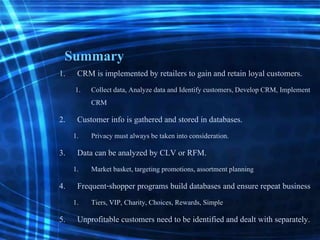
1. CRM is implemented by retailers to gain and retain loyal customers.
1. Collect data, Analyze data and Identify customers, Develop CRM, Implement
CRM
2. Customer info is gathered and stored in databases.
1. Privacy must always be taken into consideration.
3. Data can be analyzed by CLV or RFM.
1. Market basket, targeting promotions,assortment planning
4. Frequent-shopper programs build databases and ensure repeat business
1. Tiers, VIP, Charity, Choices, Rewards, Simple
5. Unprofitable customers need to be identified and dealt with separately.
Key Terms
• Add-on selling
• Biometrics
• Cookies
• Customer database
• Customer lifetime value
(CLV)
• Customer loyalty
• Customer relationship
management (CRM)
• Data mining
• 80-20 Rule
• Frequent-shopper
program
• Loyalty program
• Market basket analysis
• 1-to-1 retailing
• Opt in
• Opt out
• Retail analytics
• Retail brand community
• RFM analysis
• Share of wallet

Chapter 11 crm

  • 1.
  • 2.
    Learning Objectives 1. Describethe customer relationship management process 2. Understand how customer shopping data are collected 3. Explain the methods used to analyze customer data and identify target customers 4. Outline how retailers develop their frequent- shopper programs 5. Explain various ways to implement effective CRM programs
  • 3.
    What is CRM? •A business philosophy and set of strategies, programs, and systems that focuses on identifying and building relationships with a retailer’s valued customers. • Increases its share of wallet – the percentage of the customers’ purchases made from the retailer
  • 4.
    CRM Process • Todevelop loyalty and repeat-purchase behavior among a retailer’s best customers. • Customer Loyalty – Customers are committed to purchasingmerchandiseand servicesfrom a certain retailer and will resist activitiesof competitorsattempting to steal their patronage.
  • 5.
    CRM Process Overview •Step 1: – Collect customer data • Step 2: – Analyze customer data and identifytarget customers • Step 3: – Develop CRM through frequent-shopperprograms • Step 4: – Implement CRM programs.
  • 6.
    Step 1: Collecting CustomerShopping Data • Create customer database by including the following: – Transactions – a completehistory of purchasesmade by the customer • Date,SKU, price, special promotion response – Customer contacts – a record of interactionsbetween the customer and the retailer • Website, kiosks, blogs or Facebook, returns,phone calls,catalogs, emails – Customer preference – what the customer likes • Colors,brands, fabrics,flavors,sizes – Descriptive information – customer info used in developingmarket segments • Demographic,psychographic
  • 7.
    Step 1: Collecting CustomerShopping Data • Identifying information for in-store purchases can be more difficult than online shopping. Here’s how to overcome: – Ask for identifying information • Phone number, email,name, address – Connect internet and store purchasingdata • Creditand debit can be linked to info provided with online purchases – Offer frequent-shopperprograms • Alsocalled loyalty programs – identifyand provide rewards to customers who patronize a retailer • Frequent-shopper cards are perfect for keeping track of this info
  • 8.
    Step 1: Collecting CustomerShopping Data – Use biometrics • Measurement of human characteristicssuch as hand geometry,fingerprints,voice or iris • Helps ensure consistent data collected • Customerscan receive personalizeddiscounts printed when entering store • Faster checkout , labor cost reduction, reduces fraud and shoplifting – Place RFID chips on merchandise • Can acquire a customers personal informationas wellas product interests • Uses a global satellitetracking system – Track customers movement throughout the store
  • 9.
  • 10.
    Step 1: Collecting CustomerShopping Data • A customer’s privacy is normally measured by: – Control of informationgiven – Knowledge about why informationis collected • Online information is collected by cookies. – Small files of browsing and personal info stored ona customer’scomputer • Personal info, websites,passwords,money spent, social networking,etc.
  • 11.
    Step 1: Collecting CustomerShopping Data • Protecting customer privacy is guided by three principles: – Privacy by design • Business “default settling” • Responsibilityof retailer,not customer • Provide security • Guidelineson how and when data is used and deleted – Simplified consumerchoice • Do Not Track abilityfor consumers • Abilityfor consumers to view what the retaileris tracking
  • 12.
    Step 1: Collecting CustomerShopping Data • Protecting customer privacy (con’t) – Greater transparency • Improving consumers understanding of data collection • EU (European Union) has more restrictions on consumer data. – Consumers own personal info • Must opt in or opt out of data collection agreement
  • 13.
    Step 2: Analyzing CustomerData Identifying Target Customers • One objective for analyzing the customer database is: – Identifying thecustomers whose loyalty and patronage will significantly add to the retailer’s bottom line • Customer lifetimevalue (CLV)– the expected contributionfrom the customer to the retailer’sprofitsover their entire relationshipwith the retailer. • RFM analysis – used to determinecustomer segmentsfor promotion or catalog mailings – (Recency, Frequency, Monetary) – How recentlythe customer made a purchase – How frequently purchases are made – How much money is spent
  • 14.
    Step 2: Analyzing CustomerData Identifying Target Customers • Second objective for analyzing the customer database: – Using analytical methods to improve decisionsmade by managers • Retailanalytics - Analyzingcustomer data using statisticaltechniques and models • Data mining – an informationprocessing method that relieson search techniques to discover new insights into the buying patters of customers,using large databases – Market basket analysis – Targeting promotions – Assortment planning
  • 15.
    Step 2: Analyzing CustomerData Identifying Target Customers – Market basket analysis • Datamining tools determinewhich products appear in the market basket that a customer purchases during a single shopping trip. – Computer program counts how many times two products get purchased together • Determineswhere to place products and which to pair together for promotions – Targeting promotions • Can help provide insight into assortmentdecisions and promotions – Ex: specific brand of conditionerand shampoo will be purchases at same time – Assortment planning • High CLV customers’brand preferences willdominate shelves even if it’s not the highest gross profit item
  • 16.
    Step 3: Developing CRMPrograms • Two objectives of CRM programs are: – To build a customer database that connectscustomers and their purchases – To encourage repeat purchasebehavior and loyalty • Great for building databases but not at building customer relationship. – Similar at differentretailers – Costly to maintain – Difficult to change
  • 17.
    Step 3: Developing CRMPrograms • Ways to make frequent-shopper programs more effective: – Offer tieredrewards • Gives incentive • Must create attainabletiers – Treat high CLVs as VIPs • Consumers love to feel special • Must be promoted in advance – Incorporate charitable contributions • Will contribute to effectivenessbut should not be the main focus of the program
  • 18.
    Step 3: Developing CRMPrograms • More ways to make frequent-shopper programs more effective: – Offer choices • Betterprices,coupons, points store, presale items – Reward all transactions • Even when joining – Make the program transparentand simple
  • 19.
    Step 4: Implementing CRMPrograms • Customer pyramid – 80-20 rule • 80% of sales come from 20% of the customers • CLVs – Four segments most retailersuse are: • Platinum • Gold • Iron • Lead
  • 20.
    Step 4: Implementing CRMPrograms • Customer pyramid – Platinum • Top 25% CLVs • Most profitableand loyal • Place more value on customer service than price – Gold • BottomCLVs • Less loyal and profitable • Place more value on price • Should give incentive to move up to platinum
  • 21.
    Step 4: Implementing CRMPrograms• Customer pyramid – Iron • Modest purchases – Ex: low income, price sensitive,competitionloyalty • Not profitableenough for special treatment – Lead • Negativecontribution • Require high attention • Oftenreturn items • Give retailerbad name • Retailermust pay no attentionto these customers
  • 22.
    Step 4: Implementing CRMPrograms • For retailers to retain their customers, two approaches must be made. – Personalization • 1-to-1 retailing– developing retailprograms for small groups or individual customers • Focus groups – Community • Retailbrand community - a group of customers who are bound together by their loyalty to a retailerand the activitiesthe retailersponsors and undertakes. • Attractnew customers to retailer • More reluctantto leave the “family”
  • 23.
    Step 4: Implementing CRMPrograms • Making good customers into best customers is called customer alchemy. • Ex. Converting iron to gold.. – This is done by add-on selling – offering and selling more products and servicesto existing customersto increasethe retailer'sshare of wallet with these customers. • Customerdatabase comes in handy here
  • 24.
    Step 4: Implementing CRMPrograms • Dealing with unprofitable customers – Lead segment – “Gettingthe lead out” is done by: • Offeringless costlyservices to satisfy their needs • Chargingcustomers for the services they are abusing – Ex: returning items excessively • Exclude them from the retail offerings altogether
  • 25.
    Collect customer data Analyzedata and identify target customers Develop CRM programs Implement CRM programs
  • 26.
    Summary 1. CRM isimplemented by retailers to gain and retain loyal customers. 1. Collect data, Analyze data and Identify customers, Develop CRM, Implement CRM 2. Customer info is gathered and stored in databases. 1. Privacy must always be taken into consideration. 3. Data can be analyzed by CLV or RFM. 1. Market basket, targeting promotions,assortment planning 4. Frequent-shopper programs build databases and ensure repeat business 1. Tiers, VIP, Charity, Choices, Rewards, Simple 5. Unprofitable customers need to be identified and dealt with separately.
  • 27.
    Key Terms • Add-onselling • Biometrics • Cookies • Customer database • Customer lifetime value (CLV) • Customer loyalty • Customer relationship management (CRM) • Data mining • 80-20 Rule • Frequent-shopper program • Loyalty program • Market basket analysis • 1-to-1 retailing • Opt in • Opt out • Retail analytics • Retail brand community • RFM analysis • Share of wallet