
C ustomer R elationship M anagement     Praveen Pillai
Abbreviations Day 2, 21 April 2009 10.00  CRM in the Pharmaceutical Industry     Understand the importance of CRM • Explain the determinants of CRM and the key stages in its development   • Discuss the main functions and various models of CRM   • Explain the role of salespeople as relationship developers   • Discuss the management of customer relationships Praveen Pillai,  Director of Business Development,  MD-USA, Premier Medical Services 07/02/10 Praveen Pillai
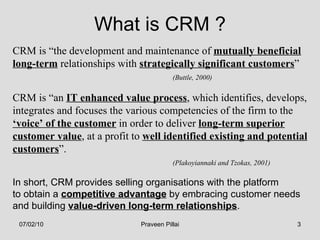
CRM is “the development and maintenance of  mutually beneficial   long-term  relationships with  strategically significant customers ” (Buttle, 2000) CRM is “an  IT enhanced value process , which identifies, develops, integrates and focuses the various competencies of the firm to the ‘ voice’ of the customer  in order to deliver  long-term superior customer value , at a profit to  well identified existing and potential customers ”. (Plakoyiannaki and Tzokas, 2001) In short, CRM provides selling organisations with the platform  to obtain a  competitive advantage  by embracing customer needs  and building  value-driven long-term relationships . What is CRM ? 07/02/10 Praveen Pillai
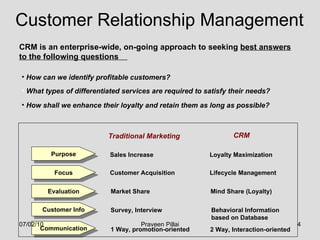
Customer Relationship Management Purpose Traditional Marketing CRM Sales Increase Customer Acquisition Market Share Survey, Interview 1 Way, promotion-oriented Loyalty Maximization Lifecycle Management 2 Way, Interaction-oriented Focus Evaluation Customer Info Communication Mind Share (Loyalty) Behavioral Information  based on Database How can we identify profitable customers? What types of differentiated services are required to satisfy their needs? How shall we enhance their loyalty and retain them as long as possible? CRM is an enterprise-wide, on-going approach to seeking  best answers to the following questions  07/02/10 Praveen Pillai
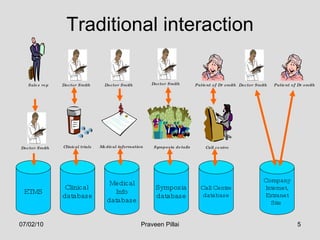
Traditional interaction ETMS Medical information Medical Info database Clinical trials Clinical  database Symposia database Symposia details Call Centre database Call centre Company Internet, Extranet Site  07/02/10 Praveen Pillai Doctor Smith Sales rep Doctor Smith Doctor Smith Doctor Smith Patient of Dr smith Doctor Smith Patient of Dr smith
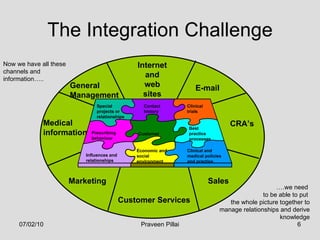
The Integration Challenge Sales Marketing Customer Services Medical information CRA’s General Management E-mail Internet and web sites Now we have all these channels and information….. … .we need  to be able to put  the whole picture together to manage relationships and derive knowledge 07/02/10 Praveen Pillai Customer Influences and relationships Economic and social environment Clinical and medical policies and practice Prescribing behaviour Clinical trials Contact history Special projects or relationships Best practice processes
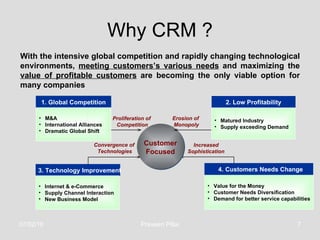
Why CRM ? 1. Global Competition Value for the Money Customer Needs Diversification Demand for better service capabilities 2. Low Profitability 4. Customers Needs Change 3. Technology Improvement Proliferation of  Competition Convergence of  Technologies Erosion of  Monopoly Increased Sophistication Internet & e-Commerce Supply Channel Interaction New Business Model Matured Industry Supply exceeding Demand M&A International Alliances Dramatic Global Shift Customer Focused With the intensive global competition and rapidly changing technological environments,  meeting customers’s various needs  and maximizing the  value of profitable customers  are becoming the only viable option for many companies   07/02/10 Praveen Pillai
Determinants of CRM Trust   The willingness to rely on the ability, integrity, and motivation of  one company to serve the needs of the other company as agreed  upon implicitly and explicitly.  Value The ability of a selling organisation to satisfy the needs of the  customer at a comparatively lower cost or higher benefit than  that offered by competitors and measured in monetary,  temporal, functional and psychological terms. 07/02/10 Praveen Pillai
Determinants of CRM In addition to  trust  and  value , salespeople  must : Understand customer needs and problems; Meet their commitments; Provide superior after sales support; Make sure that the customer is always told the truth (must be honest); and Have a passionate interest in establishing and retaining a long-term relationship (e.g., have long-term perspective).  07/02/10 Praveen Pillai
Functions of Customer Relationship Management Direct functions  (are the basic requirements of a company that are necessary to survive in the competitive marketplace) Profit maximization ;  Volume generation ; and  Safeguard shareholders interest Indirect functions  (are the actions necessary to convince the  customer to participate in various marketing activities). Innovation:  Explore new Market;  Scout (explore / investigate): and  Access. 07/02/10 Praveen Pillai
I dentifying  potential customers and their needs; Approaching  key decision makers in the buying firm; Negotiating and advancing  dialogue and mutual trust; Coordinating  the cooperation between the customers and the company; Encouraging the  inter-organisational  learning process;  Contributing to  constructive resolution  of existing conflicts; and Leading  the customer relationship development team Sales People  are the individuals in any organisation who  act both as relationship builders and as relationship promoters . Role of salespeople as relationship builders 07/02/10 Praveen Pillai
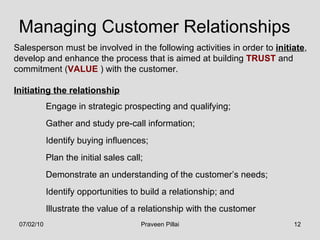
Managing Customer Relationships Salesperson must be involved in the following activities in order to  initiate , develop and enhance the process that is aimed at building  TRUST  and commitment ( VALUE  ) with the customer. Initiating the relationship Engage in strategic prospecting and qualifying; Gather and study pre-call information; Identify buying influences; Plan the initial sales call; Demonstrate an understanding of the customer’s needs; Identify opportunities to build a relationship; and Illustrate the value of a relationship with the customer 07/02/10 Praveen Pillai
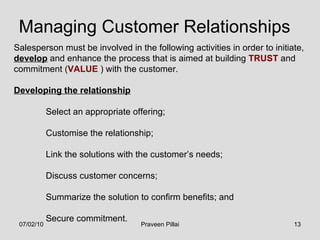
Managing Customer Relationships Salesperson must be involved in the following activities in order to initiate,  develop  and enhance the process that is aimed at building  TRUST  and commitment ( VALUE  ) with the customer. Developing the relationship Select an appropriate offering; Customise the relationship; Link the solutions with the customer’s needs; Discuss customer concerns; Summarize the solution to confirm benefits; and Secure commitment. 07/02/10 Praveen Pillai
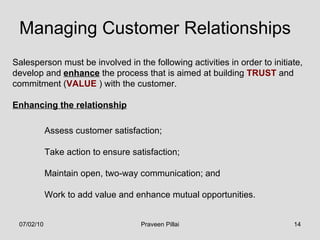
Managing Customer Relationships Salesperson must be involved in the following activities in order to initiate, develop and  enhance  the process that is aimed at building  TRUST  and commitment ( VALUE  ) with the customer. Enhancing the relationship Assess customer satisfaction; Take action to ensure satisfaction; Maintain open, two-way communication; and Work to add value and enhance mutual opportunities. 07/02/10 Praveen Pillai
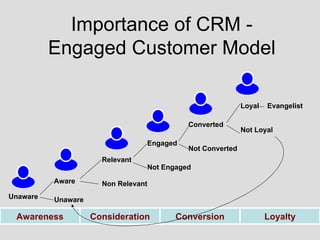
Importance of CRM - Engaged Customer Model Consideration Conversion Unaware Aware Unaware Relevant Non Relevant Converted Not Converted Loyal Not Loyal Engaged Not Engaged Evangelist Awareness Loyalty
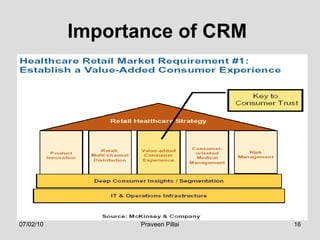
Importance of CRM  07/02/10 Praveen Pillai
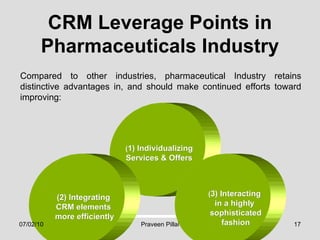
CRM Leverage Points in Pharmaceuticals Industry Compared to other industries, pharmaceutical Industry retains distinctive advantages in, and should make continued efforts toward improving:  ( 1) Individualizing Services & Offers (2) Integrating  CRM elements  more efficiently ( 3) Interacting  in a highly  sophisticated fashion 07/02/10 Praveen Pillai
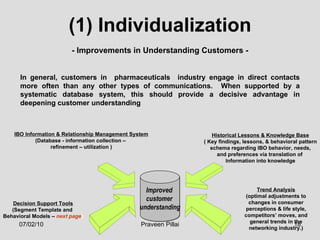
(1) Individualization In general, customers in  pharmaceuticals  industry engage in direct contacts more often than any other types of communications.  When supported by a systematic database system, this should provide a decisive advantage in deepening customer understanding   - Improvements in Understanding Customers - Decision Support Tools (Segment Template and  Behavioral Models  –   next page ) Improved  customer  understanding IBO Information & Relationship Management System (Database - information collection –  refinement – utilization ) Historical Lessons & Knowledge Base ( Key findings, lessons, & behavioral pattern schema regarding IBO behavior, needs, and preferences via translation of  Information into knowledge Trend Analysis (optimal adjustments to changes in consumer perceptions & life style, competitors’ moves, and general trends in the networking industry.) 07/02/10 Praveen Pillai
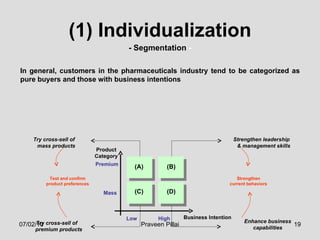
(1) Individualization In general, customers in the pharmaceuticals industry tend to be categorized as pure buyers and those with business intentions  - Segmentation  - Business Intention Product Category High Low Premium Mass (A) (B) (C) (D) Strengthen leadership    & management skills Enhance business capabilities Try cross-sell of    mass products Try cross-sell of    premium products Test and confirm product preferences Strengthen current behaviors 07/02/10 Praveen Pillai
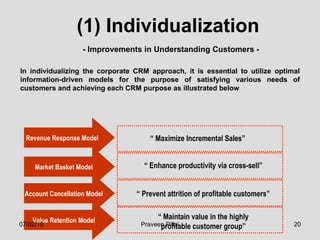
(1) Individualization In individualizing the corporate CRM approach, it is essential to utilize optimal information-driven models for the purpose of satisfying various needs of customers and achieving each CRM purpose as illustrated below  - Improvements in Understanding Customers - Revenue Response Model  Market Basket Model Account Cancellation Model Value Retention Model “  Maximize Incremental Sales” “  Enhance productivity via cross-sell” “  Prevent attrition of profitable customers” “  Maintain value in the highly profitable customer group” 07/02/10 Praveen Pillai
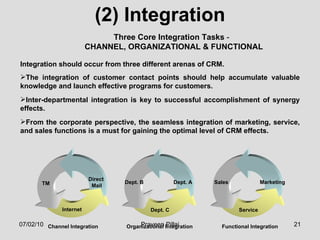
(2) Integration Integration should occur from three different arenas of CRM.  The integration of customer contact points should help accumulate valuable knowledge and launch effective programs for customers.  Inter-departmental integration is key to successful accomplishment of synergy effects.  From the corporate perspective, the seamless integration of marketing, service, and sales functions is a must for gaining the optimal level of CRM effects.  Three Core Integration Tasks  -  CHANNEL, ORGANIZATIONAL & FUNCTIONAL Channel Integration Organizational Integration Functional Integration 07/02/10 Praveen Pillai Direct  Mail TM Internet Dept. A Dept. B Dept. C Marketing Sales Service
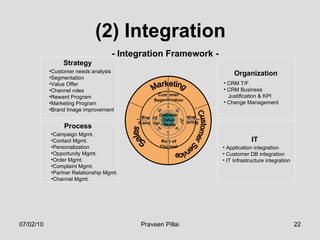
(2) Integration - Integration Framework -  07/02/10 Praveen Pillai Application integration Customer DB integration IT Infrastructure integration Customer needs analysis Segmentation Value Offer Channel roles Reward Program Marketing Program Brand Image improvement Campaign Mgmt. Contact Mgmt. Personalization Opportunity Mgmt. Order Mgmt. Complaint Mgmt. Partner Relationship Mgmt. Channel Mgmt. CRM T/F  CRM Business    Justification & KPI Change Management Value Offering Role of Channel Reward /Campaign Customer Segmentation Customer Value / Needs Marketing Sales Customer Service Strategy Organization IT Process
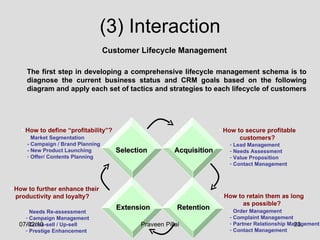
(3) Interaction The first step in developing a comprehensive lifecycle management schema is to diagnose the current business status and CRM goals based on the following diagram and apply each set of tactics and strategies to each lifecycle of customers  Customer Lifecycle Management  Selection Acquisition Extension Retention How to secure profitable customers? How to further enhance their productivity and loyalty? How to retain them as long as possible? How to define “profitability”?  Market Segmentation - Campaign / Brand Planning - New Product Launching Offer/ Contents Planning Lead Management Needs Assessment Value Proposition Contact Management Order Management Complaint Management Partner Relationship Management Contact Management  Needs Re-assessment Campaign Management Cross-sell / Up-sell Prestige Enhancement 07/02/10 Praveen Pillai
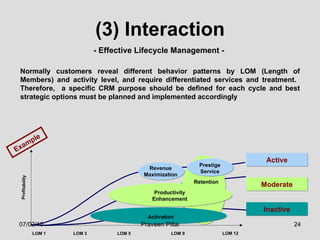
(3) Interaction Normally customers reveal different behavior patterns by LOM (Length of Members) and activity level, and require differentiated services and treatment.  Therefore,  a specific CRM purpose should be defined for each cycle and best strategic options must be planned and implemented accordingly   - Effective Lifecycle Management -   Profitability LOM 1 LOM 3 LOM 5 LOM 12 Activation Productivity Enhancement Revenue Maximization Prestige Service Retention LOM 9 Example Active Moderate Inactive 07/02/10 Praveen Pillai
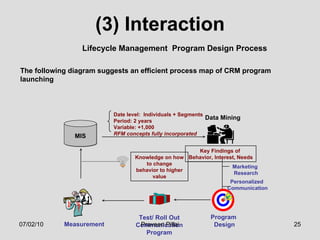
(3) Interaction The following diagram suggests an efficient process map of CRM program launching Lifecycle Management  Program Design Process  Date level:  Individuals + Segments Period: 2 years Variable: +1,000  RFM concepts fully incorporated Data Mining Key Findings of  Behavior, Interest, Needs Program  Design Marketing Research Personalized Communication Test/ Roll Out Communication Program Knowledge on how to change behavior to higher value Measurement MIS 07/02/10 Praveen Pillai
Sample CRM Infrastructure 07/02/10 Praveen Pillai
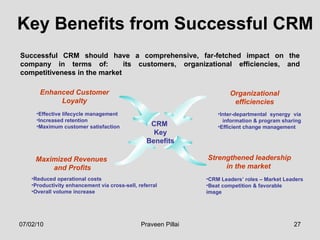
Key Benefits from Successful CRM Successful CRM should have a comprehensive, far-fetched impact on the company in terms of:  its customers, organizational efficiencies, and competitiveness in the market   CRM  Key Benefits Enhanced Customer Loyalty Maximized Revenues  and Profits Strengthened leadership in the market  Organizational efficiencies Effective lifecycle management Increased retention Maximum customer satisfaction   Reduced operational costs Productivity enhancement via cross-sell, referral Overall volume increase Inter-departmental synergy via   information & program sharing Efficient change management CRM Leaders’ roles – Market Leaders Beat competition & favorable image 07/02/10 Praveen Pillai
Long Way To Go Many, Much More To Gain And Many More To Give.  THANK YOU 07/02/10 Praveen Pillai

Customer Relationship Management

  • 1.
    C ustomer Relationship M anagement Praveen Pillai
  • 2.
    Abbreviations Day 2,21 April 2009 10.00  CRM in the Pharmaceutical Industry Understand the importance of CRM • Explain the determinants of CRM and the key stages in its development • Discuss the main functions and various models of CRM • Explain the role of salespeople as relationship developers • Discuss the management of customer relationships Praveen Pillai, Director of Business Development, MD-USA, Premier Medical Services 07/02/10 Praveen Pillai
  • 3.
    CRM is “thedevelopment and maintenance of mutually beneficial long-term relationships with strategically significant customers ” (Buttle, 2000) CRM is “an IT enhanced value process , which identifies, develops, integrates and focuses the various competencies of the firm to the ‘ voice’ of the customer in order to deliver long-term superior customer value , at a profit to well identified existing and potential customers ”. (Plakoyiannaki and Tzokas, 2001) In short, CRM provides selling organisations with the platform to obtain a competitive advantage by embracing customer needs and building value-driven long-term relationships . What is CRM ? 07/02/10 Praveen Pillai
  • 4.
    Customer Relationship ManagementPurpose Traditional Marketing CRM Sales Increase Customer Acquisition Market Share Survey, Interview 1 Way, promotion-oriented Loyalty Maximization Lifecycle Management 2 Way, Interaction-oriented Focus Evaluation Customer Info Communication Mind Share (Loyalty) Behavioral Information based on Database How can we identify profitable customers? What types of differentiated services are required to satisfy their needs? How shall we enhance their loyalty and retain them as long as possible? CRM is an enterprise-wide, on-going approach to seeking best answers to the following questions 07/02/10 Praveen Pillai
  • 5.
    Traditional interaction ETMSMedical information Medical Info database Clinical trials Clinical database Symposia database Symposia details Call Centre database Call centre Company Internet, Extranet Site 07/02/10 Praveen Pillai Doctor Smith Sales rep Doctor Smith Doctor Smith Doctor Smith Patient of Dr smith Doctor Smith Patient of Dr smith
  • 6.
    The Integration ChallengeSales Marketing Customer Services Medical information CRA’s General Management E-mail Internet and web sites Now we have all these channels and information….. … .we need to be able to put the whole picture together to manage relationships and derive knowledge 07/02/10 Praveen Pillai Customer Influences and relationships Economic and social environment Clinical and medical policies and practice Prescribing behaviour Clinical trials Contact history Special projects or relationships Best practice processes
  • 7.
    Why CRM ?1. Global Competition Value for the Money Customer Needs Diversification Demand for better service capabilities 2. Low Profitability 4. Customers Needs Change 3. Technology Improvement Proliferation of Competition Convergence of Technologies Erosion of Monopoly Increased Sophistication Internet & e-Commerce Supply Channel Interaction New Business Model Matured Industry Supply exceeding Demand M&A International Alliances Dramatic Global Shift Customer Focused With the intensive global competition and rapidly changing technological environments, meeting customers’s various needs and maximizing the value of profitable customers are becoming the only viable option for many companies 07/02/10 Praveen Pillai
  • 8.
    Determinants of CRMTrust The willingness to rely on the ability, integrity, and motivation of one company to serve the needs of the other company as agreed upon implicitly and explicitly. Value The ability of a selling organisation to satisfy the needs of the customer at a comparatively lower cost or higher benefit than that offered by competitors and measured in monetary, temporal, functional and psychological terms. 07/02/10 Praveen Pillai
  • 9.
    Determinants of CRMIn addition to trust and value , salespeople must : Understand customer needs and problems; Meet their commitments; Provide superior after sales support; Make sure that the customer is always told the truth (must be honest); and Have a passionate interest in establishing and retaining a long-term relationship (e.g., have long-term perspective). 07/02/10 Praveen Pillai
  • 10.
    Functions of CustomerRelationship Management Direct functions (are the basic requirements of a company that are necessary to survive in the competitive marketplace) Profit maximization ; Volume generation ; and Safeguard shareholders interest Indirect functions (are the actions necessary to convince the customer to participate in various marketing activities). Innovation: Explore new Market; Scout (explore / investigate): and Access. 07/02/10 Praveen Pillai
  • 11.
    I dentifying potential customers and their needs; Approaching key decision makers in the buying firm; Negotiating and advancing dialogue and mutual trust; Coordinating the cooperation between the customers and the company; Encouraging the inter-organisational learning process; Contributing to constructive resolution of existing conflicts; and Leading the customer relationship development team Sales People are the individuals in any organisation who act both as relationship builders and as relationship promoters . Role of salespeople as relationship builders 07/02/10 Praveen Pillai
  • 12.
    Managing Customer RelationshipsSalesperson must be involved in the following activities in order to initiate , develop and enhance the process that is aimed at building TRUST and commitment ( VALUE ) with the customer. Initiating the relationship Engage in strategic prospecting and qualifying; Gather and study pre-call information; Identify buying influences; Plan the initial sales call; Demonstrate an understanding of the customer’s needs; Identify opportunities to build a relationship; and Illustrate the value of a relationship with the customer 07/02/10 Praveen Pillai
  • 13.
    Managing Customer RelationshipsSalesperson must be involved in the following activities in order to initiate, develop and enhance the process that is aimed at building TRUST and commitment ( VALUE ) with the customer. Developing the relationship Select an appropriate offering; Customise the relationship; Link the solutions with the customer’s needs; Discuss customer concerns; Summarize the solution to confirm benefits; and Secure commitment. 07/02/10 Praveen Pillai
  • 14.
    Managing Customer RelationshipsSalesperson must be involved in the following activities in order to initiate, develop and enhance the process that is aimed at building TRUST and commitment ( VALUE ) with the customer. Enhancing the relationship Assess customer satisfaction; Take action to ensure satisfaction; Maintain open, two-way communication; and Work to add value and enhance mutual opportunities. 07/02/10 Praveen Pillai
  • 15.
    Importance of CRM- Engaged Customer Model Consideration Conversion Unaware Aware Unaware Relevant Non Relevant Converted Not Converted Loyal Not Loyal Engaged Not Engaged Evangelist Awareness Loyalty
  • 16.
    Importance of CRM 07/02/10 Praveen Pillai
  • 17.
    CRM Leverage Pointsin Pharmaceuticals Industry Compared to other industries, pharmaceutical Industry retains distinctive advantages in, and should make continued efforts toward improving: ( 1) Individualizing Services & Offers (2) Integrating CRM elements more efficiently ( 3) Interacting in a highly sophisticated fashion 07/02/10 Praveen Pillai
  • 18.
    (1) Individualization Ingeneral, customers in pharmaceuticals industry engage in direct contacts more often than any other types of communications. When supported by a systematic database system, this should provide a decisive advantage in deepening customer understanding - Improvements in Understanding Customers - Decision Support Tools (Segment Template and Behavioral Models – next page ) Improved customer understanding IBO Information & Relationship Management System (Database - information collection – refinement – utilization ) Historical Lessons & Knowledge Base ( Key findings, lessons, & behavioral pattern schema regarding IBO behavior, needs, and preferences via translation of Information into knowledge Trend Analysis (optimal adjustments to changes in consumer perceptions & life style, competitors’ moves, and general trends in the networking industry.) 07/02/10 Praveen Pillai
  • 19.
    (1) Individualization Ingeneral, customers in the pharmaceuticals industry tend to be categorized as pure buyers and those with business intentions - Segmentation - Business Intention Product Category High Low Premium Mass (A) (B) (C) (D) Strengthen leadership & management skills Enhance business capabilities Try cross-sell of mass products Try cross-sell of premium products Test and confirm product preferences Strengthen current behaviors 07/02/10 Praveen Pillai
  • 20.
    (1) Individualization Inindividualizing the corporate CRM approach, it is essential to utilize optimal information-driven models for the purpose of satisfying various needs of customers and achieving each CRM purpose as illustrated below - Improvements in Understanding Customers - Revenue Response Model Market Basket Model Account Cancellation Model Value Retention Model “ Maximize Incremental Sales” “ Enhance productivity via cross-sell” “ Prevent attrition of profitable customers” “ Maintain value in the highly profitable customer group” 07/02/10 Praveen Pillai
  • 21.
    (2) Integration Integrationshould occur from three different arenas of CRM. The integration of customer contact points should help accumulate valuable knowledge and launch effective programs for customers. Inter-departmental integration is key to successful accomplishment of synergy effects. From the corporate perspective, the seamless integration of marketing, service, and sales functions is a must for gaining the optimal level of CRM effects. Three Core Integration Tasks - CHANNEL, ORGANIZATIONAL & FUNCTIONAL Channel Integration Organizational Integration Functional Integration 07/02/10 Praveen Pillai Direct Mail TM Internet Dept. A Dept. B Dept. C Marketing Sales Service
  • 22.
    (2) Integration -Integration Framework - 07/02/10 Praveen Pillai Application integration Customer DB integration IT Infrastructure integration Customer needs analysis Segmentation Value Offer Channel roles Reward Program Marketing Program Brand Image improvement Campaign Mgmt. Contact Mgmt. Personalization Opportunity Mgmt. Order Mgmt. Complaint Mgmt. Partner Relationship Mgmt. Channel Mgmt. CRM T/F CRM Business Justification & KPI Change Management Value Offering Role of Channel Reward /Campaign Customer Segmentation Customer Value / Needs Marketing Sales Customer Service Strategy Organization IT Process
  • 23.
    (3) Interaction Thefirst step in developing a comprehensive lifecycle management schema is to diagnose the current business status and CRM goals based on the following diagram and apply each set of tactics and strategies to each lifecycle of customers Customer Lifecycle Management Selection Acquisition Extension Retention How to secure profitable customers? How to further enhance their productivity and loyalty? How to retain them as long as possible? How to define “profitability”? Market Segmentation - Campaign / Brand Planning - New Product Launching Offer/ Contents Planning Lead Management Needs Assessment Value Proposition Contact Management Order Management Complaint Management Partner Relationship Management Contact Management Needs Re-assessment Campaign Management Cross-sell / Up-sell Prestige Enhancement 07/02/10 Praveen Pillai
  • 24.
    (3) Interaction Normallycustomers reveal different behavior patterns by LOM (Length of Members) and activity level, and require differentiated services and treatment. Therefore, a specific CRM purpose should be defined for each cycle and best strategic options must be planned and implemented accordingly - Effective Lifecycle Management - Profitability LOM 1 LOM 3 LOM 5 LOM 12 Activation Productivity Enhancement Revenue Maximization Prestige Service Retention LOM 9 Example Active Moderate Inactive 07/02/10 Praveen Pillai
  • 25.
    (3) Interaction Thefollowing diagram suggests an efficient process map of CRM program launching Lifecycle Management Program Design Process Date level: Individuals + Segments Period: 2 years Variable: +1,000 RFM concepts fully incorporated Data Mining Key Findings of Behavior, Interest, Needs Program Design Marketing Research Personalized Communication Test/ Roll Out Communication Program Knowledge on how to change behavior to higher value Measurement MIS 07/02/10 Praveen Pillai
  • 26.
    Sample CRM Infrastructure07/02/10 Praveen Pillai
  • 27.
    Key Benefits fromSuccessful CRM Successful CRM should have a comprehensive, far-fetched impact on the company in terms of: its customers, organizational efficiencies, and competitiveness in the market CRM Key Benefits Enhanced Customer Loyalty Maximized Revenues and Profits Strengthened leadership in the market Organizational efficiencies Effective lifecycle management Increased retention Maximum customer satisfaction Reduced operational costs Productivity enhancement via cross-sell, referral Overall volume increase Inter-departmental synergy via information & program sharing Efficient change management CRM Leaders’ roles – Market Leaders Beat competition & favorable image 07/02/10 Praveen Pillai
  • 28.
    Long Way ToGo Many, Much More To Gain And Many More To Give. THANK YOU 07/02/10 Praveen Pillai

Editor's Notes

  • #2 What is the status of CRM in the pharmaceutical industry today? Why does the pharmaceutical industry need CRM? What are the Critical Success Factors for CRM in the pharmaceutical industry 2003-05? What makes a good CRM Manager
  • #6 Are there multiple “Touch Points” of interactions within BMS? ETMS- Sales Rep Clinical trials Medical information Symposiums Call centre Web, email Are you leveraging the information/knowledge gained from these interactions? Is information stored on multiple databases that are disparate from each other? sales marketing and medical may be viewed as separate functions. Customers may get different answers depending on who they talk to This cant be tenable any longer??