CHAPTER 10
Export modes
Global Marketing
Svend Hollensen
Fifth Edition
A decision-oriented approach
Introduction
Exporting is thus typically used in initial entry and
gradually evolves towards foreign-based operations. In some
cases where there are substantial scale economies or a limited
number of buyers in the market worldwide, production may
be concentrated in a single or a limited number of locations,
and the goods then exported to other markets.
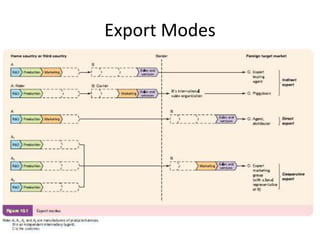
Exporting can be organized in a variety of ways,
depending on the number and type of intermediaries, for the
purposes of simplicity three major types may be identified:
1. Indirect export,
2. Direct export and
3. Cooperative export marketing groups.
Export Modes
Indirect Export Modes
Indirect export occurs when the exporting
manufacturer uses independent organizations
located in the producer’s country
There are five main entry modes of indirect
exporting:
1. export buying agent
2. broker
3. export management company/export house
4. trading company
5. piggyback
Export Buying Agent
(export commission house)
A representative of
foreign buyers who is
located in the exporter’s
home country. The agent
offers services to the
foreign buyers, such as
identifying potential
sellers and negotiating
prices.
Broker
The chief function of a
broker is to bring a buyer
and a seller together.
Thus the broker is a
specialist in performing
the contractual function,
and does not actually
handle the products sold
or bought.
Export Management Company
(export house)
Export houses or export management
companies (EMCs) are specialist companies set
up to act as the ‘export department’ for a range
of non-competing companies (Rosenbloom and
Andras, 2008)
Trading Company
Trading companies play a central role in such diverse
areas as shipping, warehousing, finance, technology transfer,
planning resource development, construction and regional
development (e.g. turnkey projects), insurance, consulting, real
estate and deal-making in general (including facilitating
investment and joint ventures.
These services include the guaranteeing of loans, the
financing of both accounts receivable and payable, the issuing
of promissory notes, major foreign exchange transactions,
equity investment and even direct loans.
Piggyback
In piggybacking the export-inexperienced SME,
the ‘rider’, deals with a larger company (the carrier)
which already operates in certain foreign markets and
is willing to act on behalf of the rider that wishes to
export to those markets.
piggyback marketing provides an easy, low-risk
way for a company to begin export marketing
operations. It is especially well suited to manufacturers
that are either too small to go directly into exports or
do not want to invest heavily in foreign marketing.
Direct Export Modes
The manufacturer sells directly to an importer,
agent or distributor located in the foreign target market.
As exporters grow more confident they may decide
to undertake their own exporting task. This will involve
building up overseas contacts, undertaking marketing
research, handling documentation and transportation,
and designing marketing mix strategies.
Direct export modes include export through
foreign-based agents and distributors (independent
intermediaries).
Distributors (importers)
Distributors buy on their own accounts and
have substantial freedom to choose their own
customers and to set the conditions of sale. For
each country exporters deal with one
distributor, take one credit risk and ship to one
destination In many cases distributors own and
operate wholesale and retail establishments,
warehouses and repair and service facilities.
Agents
Independent company that
sells on to customers on behalf of
the manufacturer (exporter).
Usually it will not see or stock the
product. It profits from a
commission (typically 5–10 per
cent) paid by the manufacturer on
a pre-agreed basis.
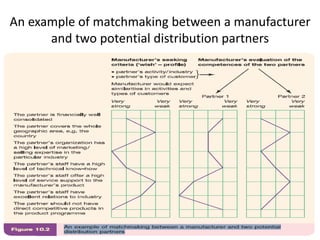
An example of matchmaking between a manufacturer
and two potential distribution partners
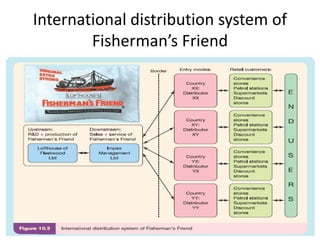
International distribution system of
Fisherman’s Friend
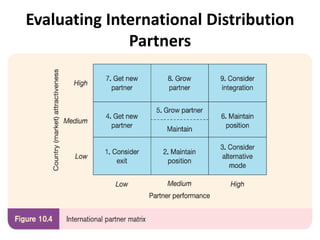
Evaluating International Distribution
Partners
Termination of contracts with
distribution partners
Cancellation clauses in
distribution partner agreements
usually involve rights under
local legislation and it is best
that a contract is scrutinized by
a local lawyer before signature,
ratherthan after a relationship
has ended and a compensation
case is being fought in the
courts.

CHAPTER 10 Export Modes

  • 1.
    CHAPTER 10 Export modes GlobalMarketing Svend Hollensen Fifth Edition A decision-oriented approach
  • 2.
    Introduction Exporting is thustypically used in initial entry and gradually evolves towards foreign-based operations. In some cases where there are substantial scale economies or a limited number of buyers in the market worldwide, production may be concentrated in a single or a limited number of locations, and the goods then exported to other markets. Exporting can be organized in a variety of ways, depending on the number and type of intermediaries, for the purposes of simplicity three major types may be identified: 1. Indirect export, 2. Direct export and 3. Cooperative export marketing groups.
  • 3.
  • 4.
    Indirect Export Modes Indirectexport occurs when the exporting manufacturer uses independent organizations located in the producer’s country There are five main entry modes of indirect exporting: 1. export buying agent 2. broker 3. export management company/export house 4. trading company 5. piggyback
  • 5.
    Export Buying Agent (exportcommission house) A representative of foreign buyers who is located in the exporter’s home country. The agent offers services to the foreign buyers, such as identifying potential sellers and negotiating prices.
  • 6.
    Broker The chief functionof a broker is to bring a buyer and a seller together. Thus the broker is a specialist in performing the contractual function, and does not actually handle the products sold or bought.
  • 7.
    Export Management Company (exporthouse) Export houses or export management companies (EMCs) are specialist companies set up to act as the ‘export department’ for a range of non-competing companies (Rosenbloom and Andras, 2008)
  • 8.
    Trading Company Trading companiesplay a central role in such diverse areas as shipping, warehousing, finance, technology transfer, planning resource development, construction and regional development (e.g. turnkey projects), insurance, consulting, real estate and deal-making in general (including facilitating investment and joint ventures. These services include the guaranteeing of loans, the financing of both accounts receivable and payable, the issuing of promissory notes, major foreign exchange transactions, equity investment and even direct loans.
  • 9.
    Piggyback In piggybacking theexport-inexperienced SME, the ‘rider’, deals with a larger company (the carrier) which already operates in certain foreign markets and is willing to act on behalf of the rider that wishes to export to those markets. piggyback marketing provides an easy, low-risk way for a company to begin export marketing operations. It is especially well suited to manufacturers that are either too small to go directly into exports or do not want to invest heavily in foreign marketing.
  • 10.
    Direct Export Modes Themanufacturer sells directly to an importer, agent or distributor located in the foreign target market. As exporters grow more confident they may decide to undertake their own exporting task. This will involve building up overseas contacts, undertaking marketing research, handling documentation and transportation, and designing marketing mix strategies. Direct export modes include export through foreign-based agents and distributors (independent intermediaries).
  • 11.
    Distributors (importers) Distributors buyon their own accounts and have substantial freedom to choose their own customers and to set the conditions of sale. For each country exporters deal with one distributor, take one credit risk and ship to one destination In many cases distributors own and operate wholesale and retail establishments, warehouses and repair and service facilities.
  • 12.
    Agents Independent company that sellson to customers on behalf of the manufacturer (exporter). Usually it will not see or stock the product. It profits from a commission (typically 5–10 per cent) paid by the manufacturer on a pre-agreed basis.
  • 13.
    An example ofmatchmaking between a manufacturer and two potential distribution partners
  • 14.
    International distribution systemof Fisherman’s Friend
  • 15.
  • 16.
    Termination of contractswith distribution partners Cancellation clauses in distribution partner agreements usually involve rights under local legislation and it is best that a contract is scrutinized by a local lawyer before signature, ratherthan after a relationship has ended and a compensation case is being fought in the courts.