Introduction to email marketing

  Dr Philip Alford (Bournemouth University)
               School of Tourism
Group discussion
•   What email marketing do you currently do?
•   What data do you currently hold about customers?
•   How do you capture customer data?
•   Where do you store it?
•   What do you do with it?
•   What objectives do you set (if any)?
•   How do you analyse campaigns?
•   What technology do you use to enable email
    marketing?
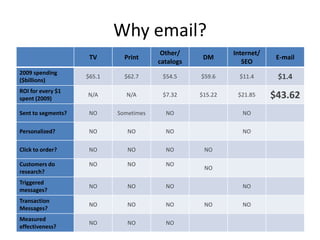
Why email?
                                         Other/             Internet/
                     TV       Print                 DM                   E-mail
                                        catalogs               SEO
2009 spending
($billions)
                    $65.1     $62.7      $54.5     $59.6      $11.4      $1.4
ROI for every $1
spent (2009)
                    N/A       N/A        $7.32     $15.22    $21.85     $43.62
Sent to segments?    NO     Sometimes     NO                   NO

Personalized?        NO        NO         NO                   NO

Click to order?      NO        NO         NO        NO

Customers do         NO        NO         NO
                                                    NO
research?
Triggered
                     NO        NO         NO                   NO
messages?
Transaction
                     NO        NO         NO        NO         NO
Messages?
Measured
                     NO        NO         NO
effectiveness?
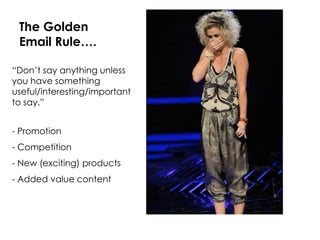
The Golden
 Email Rule….

“Don’t say anything unless
you have something
useful/interesting/important
to say.”


- Promotion
- Competition
- New (exciting) products
- Added value content
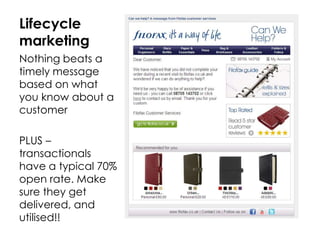
Lifecycle
marketing
Nothing beats a
timely message
based on what
you know about a
customer

PLUS –
transactionals
have a typical 70%
open rate. Make
sure they get
delivered, and
utilised!!
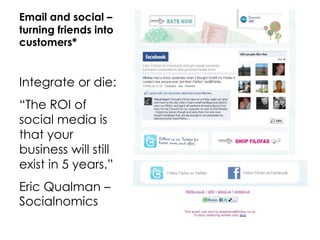
Email and social –
turning friends into
customers*


Integrate or die:
“The ROI of
social media is
that your
business will still
exist in 5 years.”
Eric Qualman –
Socialnomics
Case study - Filofax
• Integrating email and social media
• http://www.youtube.com/watch?v=A-
  iH6wC7QOs
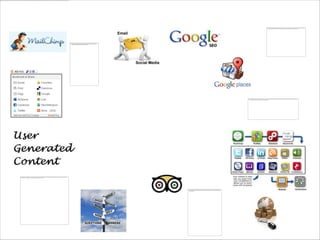
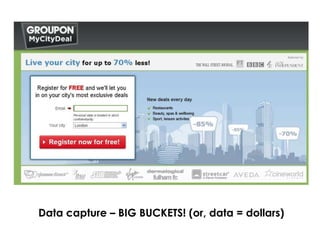
Data capture – BIG BUCKETS! (or, data = dollars)
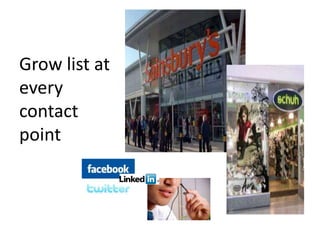
Grow list at
every
contact
point
What are they signing
                        up for?

Incentive for sign up
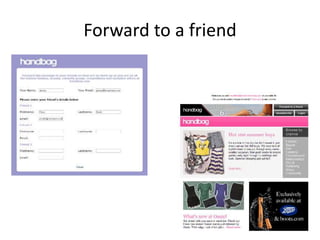
Forward to a friend
• 90% of people have access to email once a day*
  • 44% of people have continuous access to email*
  • An average person receives 365 email per week*
  • Limited number of complaints – Only 1 Civil case in the UK


BUT consumer behaviour is changing:
B2B and B2C recipients are changing their perceptions of and responsiveness to email
marketing- they are becoming more web savvy


Future Implications

• Consumers will become more enlightened and empowered
• Consumers will become more ‘Slippery’
• It will become even easier to report SPAMMERS
• Legislation will become more stringent and more cases will be heard


                                            13
Deliverability
• 87.1 % of email sent in 2009 was SPAM.
• Hotmail sees 8m new IP addresses every
  day. Good? Bad?
• Deliverability myths – message structure
• Deliverability Facts - Reputation is Key.
  – Manage your IP reputation. Volume,
    Frequency, message structure.
Deliverability
• Data Management
 –Remove hard bounces after 1 attempt,
  deal with complaints, manage soft
  bounces, honour unsubscribes
 –Don’t mail to very old lists
 –Validate by sending welcome messages
  or double opt in. Revalidate regularly.
Deliverability
• Volume consistency
  –ISP’s evaluate your volumes every
   24hours
  –Familiarity is key
  –Send regular volumes
  –Send at regular intervals
  –Use same IP
Email campaign Objectives
•   Reinforce your brand
•   Viral marketing
•   Convert prospects to customers
•   Cross sell/up sell
•   Develop loyalty
•   Drive web traffic
•   Subscription renewals
•   Educate & inform
•   Communicate with channels or other business
    partners
Measuring Success
•   Clickthrough’s on embedded URL’s
•   Conversion to purchase
•   Database growth
•   Unsubscribes/bad records/bouncebacks
Creating Value
•   Personalise every message, with a name if possible
•   Ensure your ‘From’ name is recognisable
•   Discounts, special email only offers
•   Keep it brief
•   If you need more detail – entice to a website or microsite
•   Relevant creative
•   Develop follow up messages based on behaviour
•   Make sure your messages fit with your other marketing
    channels
•   Use both Text & HTML
•   Remind the recipients why they are getting this email
•   Include user friendly instructions
•   Keep the subject line brief
The new rules of email marketing

The old way                     The new way
Interruption                    Anticipation
List size                       Active recipients
Subject line                    ‘From’ field
Prospecting for leads           Relationships with customers
                                Lifetime value
Campaign success
                                Recipient control
Maximum frequency of
                                Recipient control (preferences)
        campaigns
                                Email is less expensive than other
Communicate anything you want       mediums
Email is virtually free         Customer Communication
Email marketing                     Management
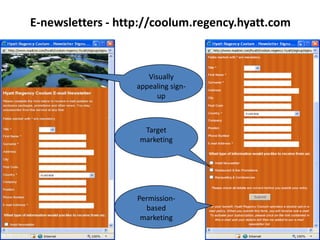
E-newsletters - http://coolum.regency.hyatt.com


                      Visually
                   appealing sign-
                         up


                    Target
                   marketing


                   Permission-
                     based
                    marketing
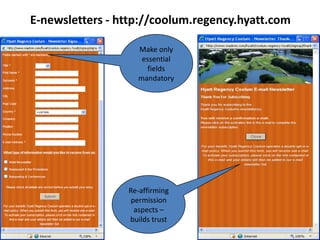
E-newsletters - http://coolum.regency.hyatt.com

                   Make only
                    essential
                      fields
                   mandatory


                 Re-affirming
                  permission
                   aspects –
                 builds trust
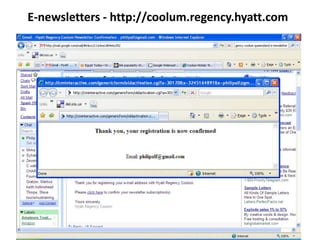
E-newsletters - http://coolum.regency.hyatt.com
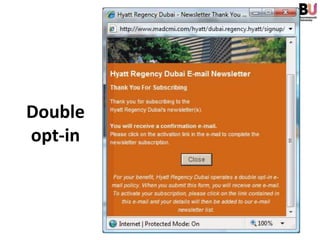
Double
opt-in
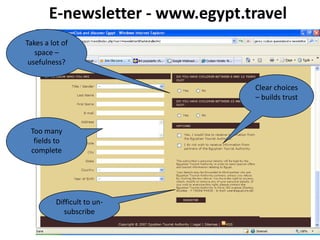
E-newsletter - www.egypt.travel
Takes a lot of
   space –
 usefulness?


                                 Clear choices
                                 – builds trust


 Too many
  fields to
 complete


          Difficult to un-
             subscribe
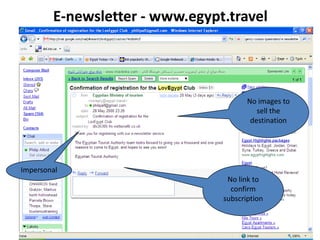
E-newsletter - www.egypt.travel


                                       No images to
                                          sell the
                                        destination


Impersonal
                                 No link to
                                  confirm
                                subscription
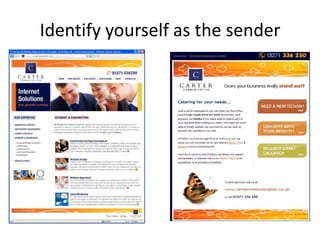
Identify yourself as the sender
The subject line
1. The Subject line: the most important sentence in
   email marketing
2. Max 40 characters and place the most important
   words at the beginning of the sentence.
3. Write as if you are talking to a friend, ask a
   question, don’t broadcast an announcement.
4. Give a clear insight to the content of the email,
   but leave an element of mystery.
5. Should convey something important, timely or
   valuable.
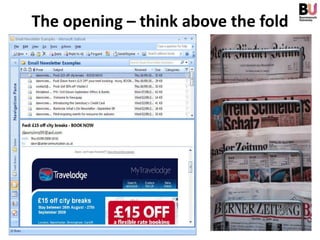
The opening – think above the fold
Relevance
• The more relevant the campaign, the
  better your response rates and
  return on investment.
• ONLY use opt-in lists and segment
  your lists.
• Ensure your email lists are regularly
  cleaned and maintained.
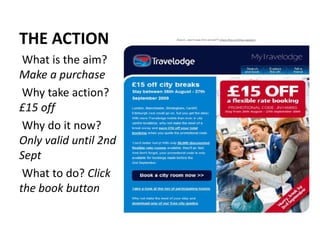
THE ACTION
 What is the aim?
Make a purchase
 Why take action?
£15 off
 Why do it now?
Only valid until 2nd
Sept
 What to do? Click
the book button
Top Ten Tips
1.  Define your goals and stay focussed
2.  Spend time on your Subject Line. Use a grabbing headline or question in
    the subject to get people to open it.
3. Approach copywriting as a customer.
4. Discuss your ideas with your web designer.
5. Build up a library of e-mailers, good and bad.
6. Tailor your content - segment and personalise.
7. Keep your contact regular and ongoing, no less then 1 a month. Always
    focus on helping your audience and you'll have a good response.
8. Get your subscribe process right and use incentives to increase opt-in
    subscribers
9. Statistically Tuesday and Wednesday give best response rates
10. Test, Test, Test!
Contact details


          palford@bournemouth.ac.uk
                Tel: 01202 961646
              Twitter: @philipalford
          Web: www.budigitalhub.co.uk
Facebook: http://www.facebook.com/BUDigitalHub

Email Marketing

  • 1.
    Introduction to emailmarketing Dr Philip Alford (Bournemouth University) School of Tourism
  • 2.
    Group discussion • What email marketing do you currently do? • What data do you currently hold about customers? • How do you capture customer data? • Where do you store it? • What do you do with it? • What objectives do you set (if any)? • How do you analyse campaigns? • What technology do you use to enable email marketing?
  • 3.
    Why email? Other/ Internet/ TV Print DM E-mail catalogs SEO 2009 spending ($billions) $65.1 $62.7 $54.5 $59.6 $11.4 $1.4 ROI for every $1 spent (2009) N/A N/A $7.32 $15.22 $21.85 $43.62 Sent to segments? NO Sometimes NO NO Personalized? NO NO NO NO Click to order? NO NO NO NO Customers do NO NO NO NO research? Triggered NO NO NO NO messages? Transaction NO NO NO NO NO Messages? Measured NO NO NO effectiveness?
  • 5.
    The Golden EmailRule…. “Don’t say anything unless you have something useful/interesting/important to say.” - Promotion - Competition - New (exciting) products - Added value content
  • 6.
    Lifecycle marketing Nothing beats a timelymessage based on what you know about a customer PLUS – transactionals have a typical 70% open rate. Make sure they get delivered, and utilised!!
  • 7.
    Email and social– turning friends into customers* Integrate or die: “The ROI of social media is that your business will still exist in 5 years.” Eric Qualman – Socialnomics
  • 8.
    Case study -Filofax • Integrating email and social media • http://www.youtube.com/watch?v=A- iH6wC7QOs
  • 9.
    Data capture –BIG BUCKETS! (or, data = dollars)
  • 10.
  • 11.
    What are theysigning up for? Incentive for sign up
  • 12.
  • 13.
    • 90% ofpeople have access to email once a day* • 44% of people have continuous access to email* • An average person receives 365 email per week* • Limited number of complaints – Only 1 Civil case in the UK BUT consumer behaviour is changing: B2B and B2C recipients are changing their perceptions of and responsiveness to email marketing- they are becoming more web savvy Future Implications • Consumers will become more enlightened and empowered • Consumers will become more ‘Slippery’ • It will become even easier to report SPAMMERS • Legislation will become more stringent and more cases will be heard 13
  • 14.
    Deliverability • 87.1 %of email sent in 2009 was SPAM. • Hotmail sees 8m new IP addresses every day. Good? Bad? • Deliverability myths – message structure • Deliverability Facts - Reputation is Key. – Manage your IP reputation. Volume, Frequency, message structure.
  • 15.
    Deliverability • Data Management –Remove hard bounces after 1 attempt, deal with complaints, manage soft bounces, honour unsubscribes –Don’t mail to very old lists –Validate by sending welcome messages or double opt in. Revalidate regularly.
  • 16.
    Deliverability • Volume consistency –ISP’s evaluate your volumes every 24hours –Familiarity is key –Send regular volumes –Send at regular intervals –Use same IP
  • 17.
    Email campaign Objectives • Reinforce your brand • Viral marketing • Convert prospects to customers • Cross sell/up sell • Develop loyalty • Drive web traffic • Subscription renewals • Educate & inform • Communicate with channels or other business partners
  • 18.
    Measuring Success • Clickthrough’s on embedded URL’s • Conversion to purchase • Database growth • Unsubscribes/bad records/bouncebacks
  • 19.
    Creating Value • Personalise every message, with a name if possible • Ensure your ‘From’ name is recognisable • Discounts, special email only offers • Keep it brief • If you need more detail – entice to a website or microsite • Relevant creative • Develop follow up messages based on behaviour • Make sure your messages fit with your other marketing channels • Use both Text & HTML • Remind the recipients why they are getting this email • Include user friendly instructions • Keep the subject line brief
  • 20.
    The new rulesof email marketing The old way The new way Interruption Anticipation List size Active recipients Subject line ‘From’ field Prospecting for leads Relationships with customers Lifetime value Campaign success Recipient control Maximum frequency of Recipient control (preferences) campaigns Email is less expensive than other Communicate anything you want mediums Email is virtually free Customer Communication Email marketing Management
  • 21.
    E-newsletters - http://coolum.regency.hyatt.com Visually appealing sign- up Target marketing Permission- based marketing
  • 22.
    E-newsletters - http://coolum.regency.hyatt.com Make only essential fields mandatory Re-affirming permission aspects – builds trust
  • 23.
  • 24.
  • 25.
    E-newsletter - www.egypt.travel Takesa lot of space – usefulness? Clear choices – builds trust Too many fields to complete Difficult to un- subscribe
  • 26.
    E-newsletter - www.egypt.travel No images to sell the destination Impersonal No link to confirm subscription
  • 27.
  • 28.
    The subject line 1.The Subject line: the most important sentence in email marketing 2. Max 40 characters and place the most important words at the beginning of the sentence. 3. Write as if you are talking to a friend, ask a question, don’t broadcast an announcement. 4. Give a clear insight to the content of the email, but leave an element of mystery. 5. Should convey something important, timely or valuable.
  • 29.
    The opening –think above the fold
  • 30.
    Relevance • The morerelevant the campaign, the better your response rates and return on investment. • ONLY use opt-in lists and segment your lists. • Ensure your email lists are regularly cleaned and maintained.
  • 31.
    THE ACTION Whatis the aim? Make a purchase Why take action? £15 off Why do it now? Only valid until 2nd Sept What to do? Click the book button
  • 32.
    Top Ten Tips 1. Define your goals and stay focussed 2. Spend time on your Subject Line. Use a grabbing headline or question in the subject to get people to open it. 3. Approach copywriting as a customer. 4. Discuss your ideas with your web designer. 5. Build up a library of e-mailers, good and bad. 6. Tailor your content - segment and personalise. 7. Keep your contact regular and ongoing, no less then 1 a month. Always focus on helping your audience and you'll have a good response. 8. Get your subscribe process right and use incentives to increase opt-in subscribers 9. Statistically Tuesday and Wednesday give best response rates 10. Test, Test, Test!
  • 33.
    Contact details palford@bournemouth.ac.uk Tel: 01202 961646 Twitter: @philipalford Web: www.budigitalhub.co.uk Facebook: http://www.facebook.com/BUDigitalHub

Editor's Notes

  • #5 Awareness: Linking: showfeatured products screenshot from a New Mind website