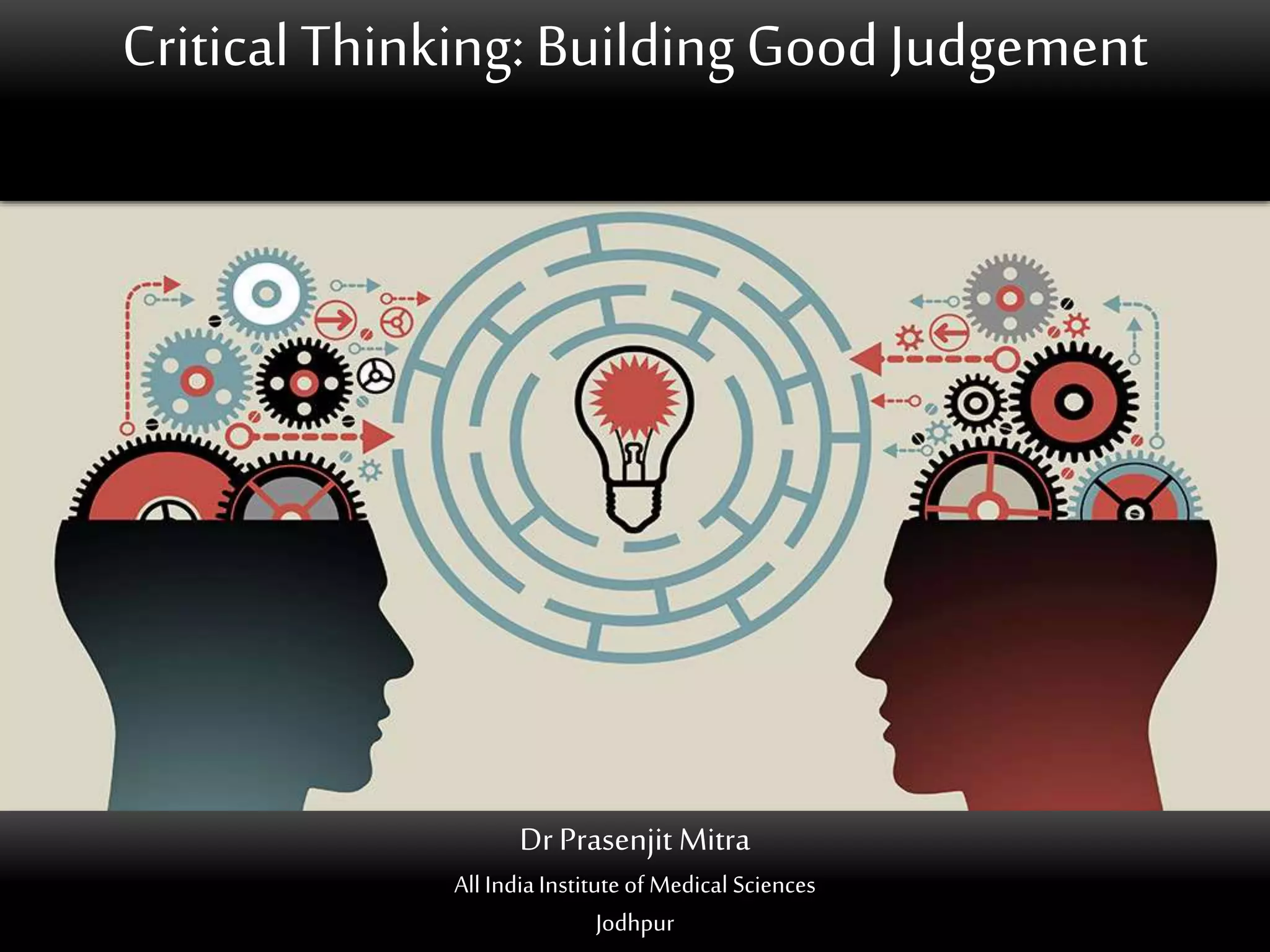

CriticalThinking:BuildingGoodJudgement
DrPrasenjit Mitra
All India Institute of Medical Sciences
Jodhpur
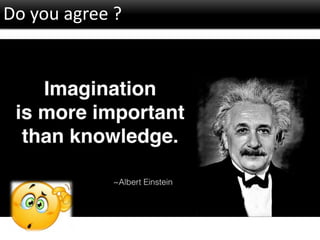
Do you agree ?
Thinking
What is Thinking?
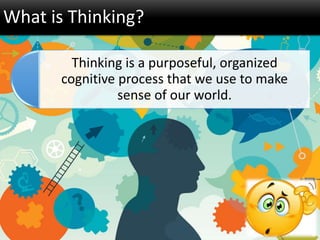
Thinking is a purposeful, organized
cognitive process that we use to make
sense of our world.
Types of Thinking?
Thinking
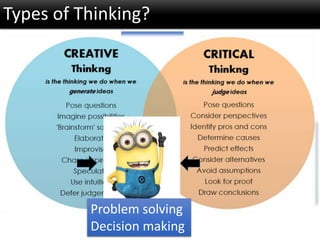
Creative ThinkingCritical Thinking
Problem solving
Decision making
Critical thinking
Critical thinking
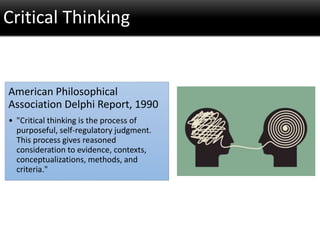
Critical Thinking
American Philosophical
Association Delphi Report, 1990
• "Critical thinking is the process of
purposeful, self-regulatory judgment.
This process gives reasoned
consideration to evidence, contexts,
conceptualizations, methods, and
criteria."
Critical thinking
“Critical thinking consists of a mental process of
analysing or evaluating information, particularly
statements or propositions that people have offered
as true. It forms a process of reflecting upon the
meaning of statements, examining the offered
evidence and reasoning, and forming judgments
about the facts
“Intellectually disciplined process of actively and skilfully
conceptualizing, applying, analysing, synthesizing, and/or
evaluating information gathered from, or generated by,
observation, experience, reflection, reasoning, or
communication, as a guide to belief and action.
Critical thinking
Critical Thinking is the general term given to
a wide range of cognitive and intellectual
skills needed to:
• Effectively identify, analyse, and evaluate arguments.
• Discover and overcome personal prejudices and
biases.
• Formulate and present convincing reasons in support
of conclusions.
• Make reasonable, intelligent decisions about what to
believe and what to do.
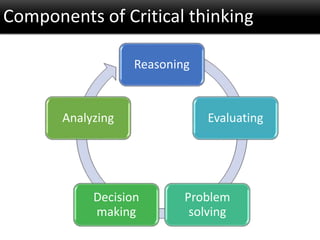
Components of Critical thinking
Reasoning
Evaluating
Problem
solving
Decision
making
Analyzing
Benefits of Critical thinking
Academic Performance
• Understand the arguments and beliefs of others
• Critically evaluating those arguments and beliefs
• Develop and defend one's own well-supported
arguments and beliefs.
Benefits of Critical thinking
Workplace
• Helps us to reflect and get a deeper
understanding of our own and others’ decisions
• Encourage open-mindedness to change
• Aid us in being more analytical in solving
problems
Benefits of Critical thinking
Daily life
• Helps us to avoid making foolish personal decisions.
• Promotes an informed and concerned citizenry capable of
making good decisions on important social, political and
economic issues.
• Aids in the development of autonomous thinkers capable
of examining their assumptions, dogmas, and prejudices.
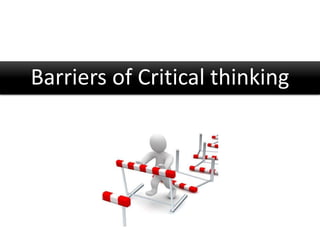
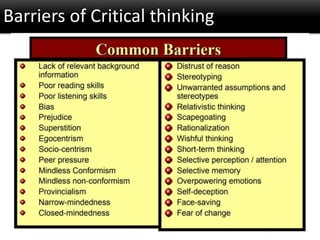
Barriers of Critical thinking
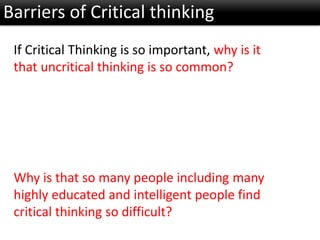
If Critical Thinking is so important, why is it
that uncritical thinking is so common?
Why is that so many people including many
highly educated and intelligent people find
critical thinking so difficult?
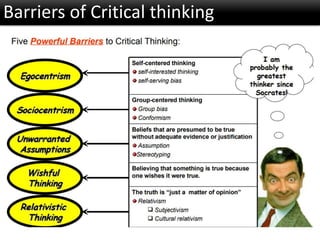
Barriers of Critical thinking
Characteristics of Critical thinker
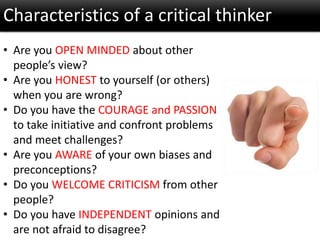
Characteristics of a critical thinker
• Are you OPEN MINDED about other
people’s view?
• Are you HONEST to yourself (or others)
when you are wrong?
• Do you have the COURAGE and PASSION
to take initiative and confront problems
and meet challenges?
• Are you AWARE of your own biases and
preconceptions?
• Do you WELCOME CRITICISM from other
people?
• Do you have INDEPENDENT opinions and
are not afraid to disagree?
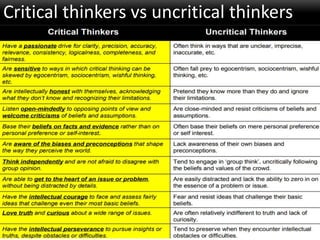
Critical thinkers vs uncritical thinkers
Judgement
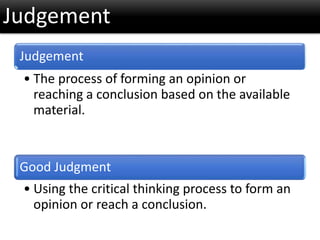
Judgement
Judgement
• The process of forming an opinion or
reaching a conclusion based on the available
material.
Good Judgment
• Using the critical thinking process to form an
opinion or reach a conclusion.
Thankyou

Critical Thinking: Building Good Judgement

  • 1.
  • 2.
  • 3.
  • 4.
    What is Thinking? Thinkingis a purposeful, organized cognitive process that we use to make sense of our world.
  • 5.
    Types of Thinking? Thinking CreativeThinkingCritical Thinking Problem solving Decision making
  • 6.
  • 7.
  • 8.
    Critical Thinking American Philosophical AssociationDelphi Report, 1990 • "Critical thinking is the process of purposeful, self-regulatory judgment. This process gives reasoned consideration to evidence, contexts, conceptualizations, methods, and criteria."
  • 9.
    Critical thinking “Critical thinkingconsists of a mental process of analysing or evaluating information, particularly statements or propositions that people have offered as true. It forms a process of reflecting upon the meaning of statements, examining the offered evidence and reasoning, and forming judgments about the facts “Intellectually disciplined process of actively and skilfully conceptualizing, applying, analysing, synthesizing, and/or evaluating information gathered from, or generated by, observation, experience, reflection, reasoning, or communication, as a guide to belief and action.
  • 10.
    Critical thinking Critical Thinkingis the general term given to a wide range of cognitive and intellectual skills needed to: • Effectively identify, analyse, and evaluate arguments. • Discover and overcome personal prejudices and biases. • Formulate and present convincing reasons in support of conclusions. • Make reasonable, intelligent decisions about what to believe and what to do.
  • 11.
    Components of Criticalthinking Reasoning Evaluating Problem solving Decision making Analyzing
  • 12.
  • 13.
    Benefits of Criticalthinking Academic Performance • Understand the arguments and beliefs of others • Critically evaluating those arguments and beliefs • Develop and defend one's own well-supported arguments and beliefs.
  • 14.
    Benefits of Criticalthinking Workplace • Helps us to reflect and get a deeper understanding of our own and others’ decisions • Encourage open-mindedness to change • Aid us in being more analytical in solving problems
  • 15.
    Benefits of Criticalthinking Daily life • Helps us to avoid making foolish personal decisions. • Promotes an informed and concerned citizenry capable of making good decisions on important social, political and economic issues. • Aids in the development of autonomous thinkers capable of examining their assumptions, dogmas, and prejudices.
  • 16.
  • 17.
    Barriers of Criticalthinking If Critical Thinking is so important, why is it that uncritical thinking is so common? Why is that so many people including many highly educated and intelligent people find critical thinking so difficult?
  • 18.
  • 19.
  • 20.
  • 21.
    Characteristics of acritical thinker • Are you OPEN MINDED about other people’s view? • Are you HONEST to yourself (or others) when you are wrong? • Do you have the COURAGE and PASSION to take initiative and confront problems and meet challenges? • Are you AWARE of your own biases and preconceptions? • Do you WELCOME CRITICISM from other people? • Do you have INDEPENDENT opinions and are not afraid to disagree?
  • 22.
    Critical thinkers vsuncritical thinkers
  • 23.
  • 24.
    Judgement Judgement • The processof forming an opinion or reaching a conclusion based on the available material. Good Judgment • Using the critical thinking process to form an opinion or reach a conclusion.
  • 25.