Topic
1. What isCritical
Thinking
2.Benefits of Critical Thinking
3.Critical thinking
characteristics
4.How to improve critical
thinking skills
5.Example of Critical Thinking
Ability
3.
Objectives
• Explaining therole of critical
thinking and decision-making in
understanding local networks.
• Explain the nature of critical
thinking as a specific form of
thinking.
• Identify, explain, and demonstrate
the applications of critical thinking
skills.
• Identify, explain, and demonstrate
the applications of critical thinking
attitudes.
4.
Guide
Questions
1. How dowe practice critical thinking?
2. What kind of thinking is critical
thinking?
3. What are the different cognitive
skills and attitudes necessary for
critical thinking?
5.
Introduce
Hello I'm JayMark Viloan I am an
Senior High Schoosl teacher who will
present everything about critical
thinking.
What is
Critical
Thinking
The abilityto think about every important
aspect of a problem rationally aims to
understand the relationship between facts
8.
What is
Critical
Thinking
inductive reasoningaims at developing a theory
while deductive reasoning aims at testing an
existing theory.
Inductive reasoning moves from specific
observations to broad generalizations, while
deductive reasoning works the other way
around.
9.
What is
Critical
Thinking
Conclusions reachedvia deductive reasoning
cannot be incorrect if the premises are true.
Inductive reasoning relies on patterns and
trends, while deductive reasoning relies on
facts and rules.
10.
Critical Thinking
Characteristics
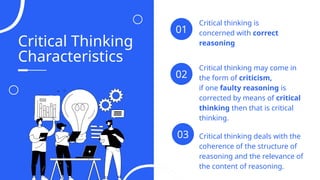
Critical thinkingis
concerned with correct
reasoning
01
Critical thinking may come in
the form of criticism,
if one faulty reasoning is
corrected by means of critical
thinking then that is critical
thinking.
02
03 Critical thinking deals with the
coherence of the structure of
reasoning and the relevance of
the content of reasoning.
04
11.
Critical Thinking
Characteristics
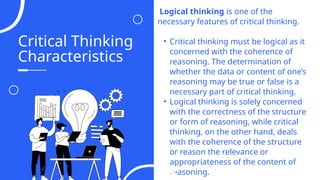
Logical thinkingis one of the
necessary features of critical thinking.
• Critical thinking must be logical as it
concerned with the coherence of
reasoning. The determination of
whether the data or content of one’s
reasoning may be true or false is a
necessary part of critical thinking.
• Logical thinking is solely concerned
with the correctness of the structure
or form of reasoning, while critical
thinking, on the other hand, deals
with the coherence of the structure
or reason the relevance or
appropriateness of the content of
reasoning.
04
12.
Critical Thinking
Characteristics
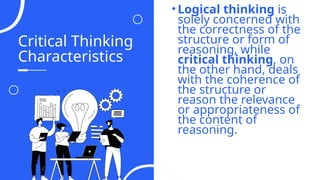
• Logicalthinking is
solely concerned with
the correctness of the
structure or form of
reasoning, while
critical thinking, on
the other hand, deals
with the coherence of
the structure or
reason the relevance
or appropriateness of
the content of
reasoning.
04
13.
Critical Thinking
Characteristics
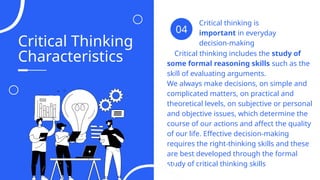
Critical thinkingis
important in everyday
decision-making
04
Critical thinking includes the study of
some formal reasoning skills such as the
skill of evaluating arguments.
We always make decisions, on simple and
complicated matters, on practical and
theoretical levels, on subjective or personal
and objective issues, which determine the
course of our actions and affect the quality
of our life. Effective decision-making
requires the right-thinking skills and these
are best developed through the formal
study of critical thinking skills
04
14.
Critical Thinking
Characteristics
Critical thinkingas good
thinking
05
• Critical thinking is also related to
other forms of thinking, which
include imagining, doubting,
recalling, and analyzing.
• Good thinking is whatever kind of
thinking that enables us to
achieve a given purpose or
objective. When we regard
thinking as a kind of tool or
instrument then it is good.
• Good thinking in this manner
04
15.
Critical Thinking
Characteristics
Strategic thinking– for what is
strategic corresponds to what is
most appropriate to achieve a
certain goal.
06
• Creative thinking is the strategic or
most appropriate form of thinking
for generating new insights, novel
approaches, fresh perspectives, and
whole new ways of understanding
and conceiving of things.
• •Meditative thinking is the strategic
or most appropriate form of thinking
for acquiring a since of inner peace
and profound (or spiritual) insights
about human existence.
04
16.
Critical Thinking
Characteristics
06
• Instinctivethinking is the strategic
or most appropriate kind of
thinking for situations that require
quick decisions especially
considering insufficient
information.
• The main goal of critical thinking is
the evaluation of reasoning or
argumentation.
• The fundamental goal of
reasoning is to provide sufficient
reasons to one’s claim or position
on a certain issue and the effect is
to be able to persuade other
04
17.
Critical Thinking
Characteristics
06
• Argumentation
Involvesonly statements, which are
linguistic expressions that are either
true or false. A statement is usually
expressed in the grammatical form of
a declarative sentence. This means
that an argument cannot contain a
question, command, or an
exclamation. An argument has a
structure consisting of a premise or a
set of premises. A premise is a
statement that provides a reason for
accepting a certain claim; and
conclusion, which is a statement that
04
18.
Critical Thinking
Characteristics
06
• Reasoning
Thereare two general types of
reasoning: inductive and deductive.
• Inductive reasoning - the support
that a premise provides is
incomplete and so its conclusion is
merely probable.(consequently,
the inductive argument can either
be weak or strong)
• Deductive reasoning – the
support that a premise provides is
complete and hence the truth of
its conclusion is certain.
04
19.
Activity
Write your insightsand reflection as you answer the
following questions. (5 sentences only per number)
1.Do you think we need to practice critical thinking
all the time? Why or why not?
2.What are examples of instances where we need to
practice critical thinking: and what are examples of
instances where we should not, or need not, practice
critical thinking?
20.
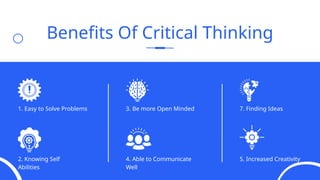
Benefits Of CriticalThinking
1. Easy to Solve Problems
2. Knowing Self
Abilities
3. Be more Open Minded
4. Able to Communicate
Well
5. Increased Creativity
7. Finding Ideas
21.
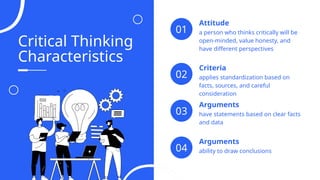
Critical Thinking
Characteristics
a personwho thinks critically will be
open-minded, value honesty, and
have different perspectives
Attitude
01
applies standardization based on
facts, sources, and careful
consideration
Criteria
02
have statements based on clear facts
and data
Arguments
03
ability to draw conclusions
Arguments
04
22.
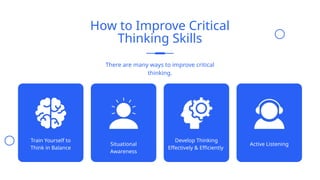
How to ImproveCritical
Thinking Skills
There are many ways to improve critical
thinking.
Train Yourself to
Think in Balance
Situational
Awareness
Develop Thinking
Effectively & Efficiently
Active Listening
23.
Example of Critical
ThinkingAbility
Able to analyze information well,
such as collecting information,
data, interpreting, and
evaluating.
1. Analytical Thinking
Example of Critical
ThinkingAbility
Considering the perspectives of
others and oneself to be able to
improve critical thinking skills in
the decision-making process
3. Open Minded
26.
Planning to managetime and
maximize time doing something.
4. Time Management
Example of
Critical Thinking
Ability
27.
Communication is aprocess of critical
thinking, discussing, sharing information
with others to show a critical thinking
side
5. Good Communication
Example of Critical
Thinking Ability
#1 As globalization and technological advancement occur, it becomes necessary to employ new tools and effective skills to make a sound judgements and correct decisions as we deal with complex issues associated with or that arises from emerging trends. These tools and skills refer to problem-solving skills and decision-making tools.
#6 Critical thinking is a way of thinking that involves questioning, analyzing, interpreting, evaluating, and making judgments about what you read, hear, say, or write. It's a skill that involves using criteria to evaluate ideas and make decisions.
Critical- Greek word “kritikos” meaning “able to judge or discern”
#7 Rationally - by reasonable or logical means.
Critical thinking is a way of thinking that involves breaking down complex ideas, asking questions, and analyzing evidence.
Critical thinkers are able to make informed decisions and solve problems by considering multiple perspectives and avoiding emotional reasoning
#8 Inductive – Specific to General
Deductive General to specific (bakit maraming bagsak sa klase Ninyo) (bg of the study general to specific)
Method means there is a procedure or process of determining the validity or truthfulness of the reasoning (data or information)
Halimbawa ng Inductive Reasoning:
Obserbasyon: Napansin mo na ang lahat ng ibon na nakita mong may pakpak ay marunong lumipad.
Konklusyon: Lahat ng ibon ay marunong lumipad.
(Bagamat may ilang pagbubukod tulad ng ostrich, ang reasoning na ito ay nagsisimula sa mga tiyak na obserbasyon at bumubuo ng pangkalahatang teorya.)
Halimbawa ng Deductive Reasoning:
Pangkalahatang Ideya: Lahat ng tao ay may puso.
Tiyak na Premiso: Si Ana ay tao.
Konklusyon: Si Ana ay may puso.
(Ang reasoning na ito ay nagsisimula sa pangkalahatang ideya at nagtutungo sa tiyak na konklusyon.)
Halimbawa ng Inductive Reasoning:
Obserbasyon 1: Ang aso ni Pedro ay mahilig kumain ng karne.
Obserbasyon 2: Ang aso ni Maria ay mahilig din kumain ng karne.
Obserbasyon 3: Ang aso ni Juan ay mahilig kumain ng karne.
Konklusyon: Lahat ng aso ay mahilig kumain ng karne.
(Mula sa mga tiyak na obserbasyon, nabuo ang isang pangkalahatang pahayag.)
Halimbawa ng Deductive Reasoning:
Pangkalahatang Premiso: Lahat ng tao ay nangangailangan ng pagkain upang mabuhay.
Tiyak na Premiso: Si Carla ay tao.
Konklusyon: Si Carla ay nangangailangan ng pagkain upang mabuhay.
(Mula sa isang pangkalahatang ideya, nakuha ang isang tiyak na konklusyon.)
#9 Ang mga konklusyong nakuha gamit ang deductive reasoning ay hindi maaaring maging mali kung ang mga premiso ay totoo.
Ang Inductive reasoning ay umaasa sa mga pattern at uso, habang ang Deductive reasoning ay nakabatay sa mga katotohanan at patakaran.
Halimbawa ng Inductive Reasoning:
Obserbasyon 1: Tuwing umuulan, napansin kong basa ang kalye.
Obserbasyon 2: Kapag umuulan sa ibang lugar, basa rin ang mga kalye roon.
Konklusyon: Kapag umuulan, lahat ng kalye ay nababasa.
(Nabuo ang konklusyon mula sa paulit-ulit na obserbasyon, ngunit maaaring hindi ito laging totoo, tulad kung may bubong ang kalye.)
Halimbawa ng Deductive Reasoning:
Premiso 1: Ang lahat ng mamamayan ng Pilipinas ay Pilipino.
Premiso 2: Si Jose ay mamamayan ng Pilipinas.
Konklusyon: Si Jose ay Pilipino.
(Ang konklusyon ay tiyak at tama kung ang mga premiso ay totoo.)
#10 2. Ang criticism (kritisismo sa Tagalog) ay tumutukoy sa proseso ng pagsusuri, paghusga, o pagbibigay ng opinyon ukol sa isang bagay, ideya, kilos, o gawain. Ang layunin nito ay maaaring:
Konstruktibo (Constructive): Magbigay ng mungkahi o rekomendasyon para mapabuti ang isang bagay. Halimbawa: Puna para mapaganda ang isang proyekto o gawain.
Destruktibo (Destructive): Tumutok sa mga kahinaan o pagkakamali nang walang layuning makabuo.
3. Ang critical thinking ay tumutukoy sa pagkakaugnay-ugnay ng istruktura ng pangangatwiran at sa kaugnayan ng nilalaman ng pangangatwiran
Tinutukoy nito ang kaugnayan at katotohanan ng mga dahilan na ginagamit upang bigyang-katwiran ang ilang mga pahayag o paniniwala.
Coherence- (pagkakaunay ugnay) the quality of being logical and consistent:
#11 The ability of an individual to think in a disciplined manner or base his thoughts on facts and evidence is known as his logical thinking skills. Very simply, logical thinking skills mean incorporating logic into one’s thinking process whenever analyzing a problem on order to produce a solution.
Sitwasyon: May balita na ang isang uri ng prutas ay nakakapagpagaling ng sakit sa puso.
Pagsusuri ng Datos:
Ang balita ba ay mula sa mapagkakatiwalaang mapagkukunan?
Mayroon bang siyentipikong pag-aaral na sumusuporta sa pahayag na ito?
Paggamit ng Lohikal na Pag-iisip:
Kung ang prutas ay nakakapagpagaling ng sakit sa puso, bakit hindi ito nirereseta ng mga doktor?
Mayroon bang ebidensiya na nagpapakita na ang lahat ng taong kumain nito ay gumaling?
Konklusyon:
Ang pahayag ay hindi mapaniniwalaan agad hangga't walang sapat na ebidensiyang pang-agham na sumusuporta rito.
Paliwanag: Sa pamamagitan ng kritikal at lohikal na pag-iisip, maiiwasan ang paniniwala sa mga pahayag na walang basehan o ebidensiya.
#12 Ang lohikong pag-iisip ay tanging nakatuon lamang sa tamang estruktura o porma ng pangangatwiran, habang ang kritikal na pag-iisip naman ay nakatuon sa pagiging magkakaugnay ng estruktura o dahilan at sa kahalagahan o pagiging angkop ng nilalaman ng pangangatwiran.
Halimbawa ng Lohikong Pag-iisip:
Pangangatwiran:
Lahat ng hayop ay may mga mata.
Ang aso ay isang hayop.
Konklusyon: Ang aso ay may mga mata.
Pagsusuri: Ang lohika ng pangangatwiran ay tama dahil sumusunod ito sa tamang estruktura ng syllogism (kung A ay totoo, at B ay isang halimbawa ng A, kung gayon ang B ay totoo). Ang estruktura ng pangangatwiran ay wasto, ngunit hindi tinutukoy ang kahalagahan o konteksto ng nilalaman.
Halimbawa ng Kritikal na Pag-iisip:
Pangangatwiran:
Lahat ng tao ay nangangailangan ng sapat na tulog upang mapanatili ang kalusugan.
Si Maria ay hindi natutulog ng sapat dahil siya ay abala sa trabaho.
Konklusyon: Si Maria ay maaaring magkaroon ng mga problema sa kalusugan dahil sa kakulangan ng tulog.
Pagsusuri: Ang pangangatwiran ay lohikal at tumutok hindi lang sa estruktura, kundi pati sa kahalagahan ng konteksto (tulad ng epekto ng kakulangan ng tulog sa kalusugan). Ang kritikal na pag-iisip ay tumitingin sa kaugnayan at pagiging angkop ng nilalaman, at hindi lamang sa pormal na anyo ng pangangatwiran.
4o mini
#15 Creative thinking skills – creating branding materials such as logos, webpage layouts, and posters
Developing lesson plans for a group training, starting a journal, a blog, or social media account, designing a quiz or test
Brainstorming ideas
#16 2. Ang criticism (kritisismo sa Tagalog) ay tumutukoy sa proseso ng pagsusuri, paghusga, o pagbibigay ng opinyon ukol sa isang bagay, ideya, kilos, o gawain. Ang layunin nito ay maaaring:
Konstruktibo (Constructive): Magbigay ng mungkahi o rekomendasyon para mapabuti ang isang bagay. Halimbawa: Puna para mapaganda ang isang proyekto o gawain.
Destruktibo (Destructive): Tumutok sa mga kahinaan o pagkakamali nang walang layuning makabuo.
3. Ang critical thinking ay tumutukoy sa pagkakaugnay-ugnay ng istruktura ng pangangatwiran at sa kaugnayan ng nilalaman ng pangangatwiran
Tinutukoy nito ang kaugnayan at katotohanan ng mga dahilan na ginagamit upang bigyang-katwiran ang ilang mga pahayag o paniniwala.
Coherence- (pagkakaunay ugnay) the quality of being logical and consistent:
#17 Misconceptions: fundamental goal of argumentation is persuasion and argumentation is the same as explanation.
Premise is a statement or idea which serves as the basis for an argument.
Persuasiveness is a psychological matter that may be influenced by things having no relevant connection reasoning. Things: appeals to force, pity, popular beliefs, ignorance, and irrelevant attacks to the person doing the reasoning or advancing the argument ( Cohen and Copi 005; Moore and Parker 2005)
#18 inductive reasoning aims at developing a theory while deductive reasoning aims at testing an existing theory.
Inductive reasoning moves from specific observations to broad generalizations, while deductive reasoning works the other way around.
Conclusions reached via deductive reasoning cannot be incorrect if the premises are true.
Inductive reasoning relies on patterns and trends, while deductive reasoning relies on facts and rules.









![Lesson Note (Week 1) first presentation [Autosaved] [Autosaved] [Autosaved].pptx](https://cdn.slidesharecdn.com/ss_thumbnails/lessonnoteweek1firstpresentationautosavedautosavedautosaved-220908060639-1867ac92-thumbnail.jpg?width=640&height=640&fit=bounds)


