Critical Thinking Press the arrows below to proceed through the show.
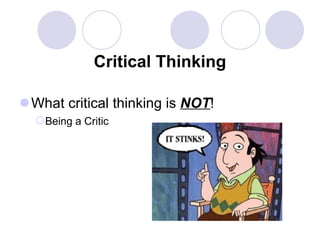
Critical Thinking What critical thinking is  NOT ! Being a Critic
What critical thinking is  NOT ! Being a Critic   (This is not the same thing. Unfortunately they sound the same, but a critic typically means someone who is negative and who cuts people down.  This is not critical thinking.) Boring (Critical thinking takes effort and can stimulate heated debates and discussion.)
Critical Thinking Defined:  The use of cognitive skills and strategies that increase the probability of a desirable outcome
Critical Thinking Who doesn’t want better outcomes?!? Psychologists study how we make decisions. Critical thinking, in this course, involves learning the skills and strategies that  TEND TO WORK!  I hope you agree, this is probably a good thing.
Components of Critical Thinking Cognitive Component – knowledge of the skills Yes, this part can be boring… Good news: you can learn the skills. Better news: your text covers these skills in a way supported by research.  If you try to learn these skills, you will probably learn to be a more critical thinker. Affective (emotional) – attitude or disposition Covered after the next slide
Cognitive Skills of Critical Thinking Verbal Reasoning Scientific Method Argument/Persuasion Probability Decision-Making / Problem-Solving We will cover all of these this semester
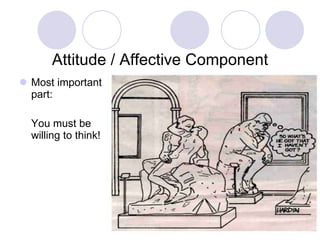
Attitude / Affective Component Most important part:  You must be willing to think!
Attitude / Affective Component Critical thinking is: Active not passive – it takes effort!  If it leads to better decisions, the effort is probably worth it. Flexible not rigid  Critical thinkers typically doubt simple answers to questions.  Rigid thinking tends to be un-critical, explores fewer alternatives, and settles on solutions. Skeptical not Cynical Skeptical – doubting certainty, questioning things – this is a critical thinker’s motto! Cynical – assuming negative explanations – this hurts critical thinking!
Review Questions  (vocabulary in bold) Define “ Critical Thinking ” What are the two components to Critical Thinking? Describe what it means to be  active  verses  passive  when thinking about a topic. How is being  rigid  in your thinking the opposite of critical thinking? Can a  cynic  be a critical thinker?  Why or why not? Which term refers to having a “questioning” approach to the world?  Skeptical  or  cynical .

Critical thinking

  • 1.
    Critical Thinking Pressthe arrows below to proceed through the show.
  • 2.
    Critical Thinking Whatcritical thinking is NOT ! Being a Critic
  • 3.
    What critical thinkingis NOT ! Being a Critic (This is not the same thing. Unfortunately they sound the same, but a critic typically means someone who is negative and who cuts people down. This is not critical thinking.) Boring (Critical thinking takes effort and can stimulate heated debates and discussion.)
  • 4.
    Critical Thinking Defined: The use of cognitive skills and strategies that increase the probability of a desirable outcome
  • 5.
    Critical Thinking Whodoesn’t want better outcomes?!? Psychologists study how we make decisions. Critical thinking, in this course, involves learning the skills and strategies that TEND TO WORK! I hope you agree, this is probably a good thing.
  • 6.
    Components of CriticalThinking Cognitive Component – knowledge of the skills Yes, this part can be boring… Good news: you can learn the skills. Better news: your text covers these skills in a way supported by research. If you try to learn these skills, you will probably learn to be a more critical thinker. Affective (emotional) – attitude or disposition Covered after the next slide
  • 7.
    Cognitive Skills ofCritical Thinking Verbal Reasoning Scientific Method Argument/Persuasion Probability Decision-Making / Problem-Solving We will cover all of these this semester
  • 8.
    Attitude / AffectiveComponent Most important part: You must be willing to think!
  • 9.
    Attitude / AffectiveComponent Critical thinking is: Active not passive – it takes effort! If it leads to better decisions, the effort is probably worth it. Flexible not rigid Critical thinkers typically doubt simple answers to questions. Rigid thinking tends to be un-critical, explores fewer alternatives, and settles on solutions. Skeptical not Cynical Skeptical – doubting certainty, questioning things – this is a critical thinker’s motto! Cynical – assuming negative explanations – this hurts critical thinking!
  • 10.
    Review Questions (vocabulary in bold) Define “ Critical Thinking ” What are the two components to Critical Thinking? Describe what it means to be active verses passive when thinking about a topic. How is being rigid in your thinking the opposite of critical thinking? Can a cynic be a critical thinker? Why or why not? Which term refers to having a “questioning” approach to the world? Skeptical or cynical .