CRITICAL THINKING
PRESENTED BY:
PRINSON RODRIGUES
“
”
THE WORLD AS WE HAVE CREATED IT,
IS A PROCESS OF OUR THINKING. IT
CANNOT BE CHANGED WITHOUT
CHANGING OUR THINKING
- Albert
Einstein
SO LET’S SEE WHAT THINKING IS…??
Thought can refer to the ideas or arrangements of ideas that
result from thinking, the act of producing thoughts, or the
process of producing thoughts. Although thought is a
fundamental human activity familiar to everyone, there is no
generally accepted agreement as to what thought is or how it is
created.
Its most simplistic, where an individual, in reaction to a range of
stimuli, starts a process that modifies or strengthens their world
view, beliefs, opinions, attitudes, and behaviours.
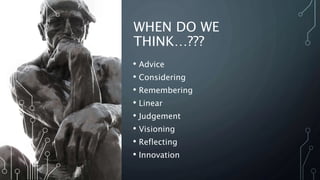
WHEN DO WE
THINK…???
• Advice
• Considering
• Remembering
• Linear
• Judgement
• Visioning
• Reflecting
• Innovation
WHAT ARE THINKING SKILLS ?
Thinking skills are the mental processes that we apply when we
seek to make sense of experience. Thinking skills enable us to
integrate each new experience into the schema that we are
constructing of "how things are". It is apparent that better
thinking will help us to learn more from our experience and to
make better use of our intelligence.
It has always been the central aim of education to improve the
quality of thinking because better thinking will not only enable
us to become more successful at learning but will also equip us
for life, enabling us to realise our own potential and to
contribute to the development of society.
WHAT ARE DIFFERENT TYPES OF
THINKING SKILLS??
• Interpretation – Ability to understand the information
• Analysis – Ability to connect pieces of the information
• Inference – Understand & recognize what elements you
need
• Evaluation – Ability to Evaluate the credibility
• Explanation – Ability to restate the information
WHAT IS CRITICAL THINKING ?
• Critical thinking is the ability to think clearly and rationally about what to do
or what to believe. It includes the ability to engage in reflective and
independent thinking. Someone with critical thinking skills is able to
understand the logical connections between ideas.
• Critical thinking is not a matter of accumulating information. A person with
a good memory and who knows a lot of facts is not necessarily good at
critical thinking. A critical thinker is able to deduce consequences from what
he knows, and he knows how to make use of information to solve problems,
and to seek relevant sources of information to inform himself.
WE THINK CRITICALLY AND IN A
PROBLEM SOLVING MIND-SET WHEN
WE :
• Rely on reason rather than emotion
• Evaluate a broad range of viewpoints and perspectives
• Maintain an open mind to alternative interpretations
• Accept new evidence, explanations and findings
• Are willing to reassess information
• Can put aside personal prejudices and biases
• Consider all reasonable possibilities
• Avoid hasty judgments
• Like any other skill, learning to think critically or problem-solve takes
time, perseverance and practice. Knowing which steps to take and how to
apply them helps us master the process.
STEPS TO CRITICAL THINKING AS IT
RELATES TO PROBLEM SOLVING :
• Identify the Problem. The first task is to determine if a problem exists.
Sometimes when you think this point through, you may come to the
conclusion that there really isn't a problem, just a misunderstanding. If that's
the case, fine. If not, and you determine that there is indeed a problem, you
need to identify exactly what it is. how systematically someone weighs the
pros and cons of a problem and how clearly the person can define and state
it, is also an indication of highly developed intelligence.
• Analyze the problem, look at it from different angles. Once you've
determined the problem, analyze it by looking at it from a variety of
perspectives. Is it solvable? Is it real or perceived? Can you solve it alone or
do you need help? Sometimes by looking at it from many angles you can
come up with a resolution right away. You may also reveal a bias or narrow
point of view that needs to be broadened
• Brainstorm and come up with a several possible
solutions. Problems can be solved in many ways. Brainstorm a list
of several possible solutions. Put down anything that comes to
mind and then go over the list and narrow it down to the best
possibilities. Having several viable options leads to obtaining the
best results.
• Decide which solution fits the situation best. Go over your list
of possible solutions. Different situations call for different
solutions. Quite often what works in one situation, may not work in
a similar one. Take time to determine what will work best for the
problem at hand. One solution usually does not fit all.
• Take action. Implement your solution. Every problem has a
solution; even if it is to accept the situation and move on.
Instead of approaching problems and challenges as
insurmountable obstacles, we can view them as opportunities to
hone our critical thinking and problem-solving skills.
Every problem we are able to resolve increases self-
confidence and self-worth. Thinking critically not only helps us
handle future challenges more skilfully, it also broadens our life
experience and helps us gain perspective.
CRITICAL THINKING ENABLES A PERSON
TO:
• Think about and evaluate their own thinking and behaviour on various
issues.
• Make reasonable and defensible decisions about issues related to
individual and community well-being
• Challenge and take action (individually and collectively) to address
social, cultural, economic, and political inequalities
• Understand the role and significance of the culture and its influence
on our daily lives and the lives of people in our community
WHAT IS THE DIFFERENCE BETWEEN
THINKING & CRITICAL THINKING?
• Critical thinking is controlled, purposeful & more likely to lead to
obvious beneficial results.
• Thinking is basically any mental activity which can be aimless &
uncontrolled; it may serve a purpose, but we often aren’t aware of its
benefits ,we might not even remember our thoughts at all.
WHAT ARE THE CHARACTERISTICS OF
CRITICAL THINKING?
i. It is rational & reflective.
ii. It involves healthy, constructive skepticism.
iii. It is autonomous.
iv. It includes creative thinking.
v. It is fair thinking.
vi. It focuses on what to believe & do.
WHAT ARE ATTITUDES OF CRITICAL
THINKERS?
They are:
1. Active thinkers.
2. Knowledgeable of their biases & limitations.
3. Fair-minded.
4. Good communicators.
5. Empathetic.
6. Open-minded.
7. Independent thinkers.
9. Curious & insightful.
10. Humble.
11. Honest with themselves & others, admitting when their
thinking may be flawed or requires more thought.
12. Organized & systematic in their approach.
13. Flexible.
14. Realistic
15. Creative
16. Team Players
ARE CRITICAL THINKING & PROBLEM
SOLVING THE SAME?
•NO. They are sometimes used interchangeably
but are separate processes that are related in
some situations. Not all decisions we make
involve solving a problem; creativity is a form
of critical thinking itself.
EMOTION AND CRITICAL THINKING
Emotions (or the self system) drive almost everything we do.
Emotions are the key element in decision making and learning,
and central to the process of rational thought. When patients have
lost the regions of their brain (such as through the removal of a
tumor) that allow them to experience emotions, their decision
making ability goes completely haywire. Their intelligence can be
working perfectly, but without emotions to guide one's
intelligence, logical decisions cannot be made.
HOW TO START THINKING CRITICALLY
?
A) Maintain a Journal : Each week, write out a certain number of
journal entries. Use the following format (keeping each numbered
stage separate):
1. Situation. Describe a situation that is, or was, emotionally
significant to you (that is, that you deeply care about). Focus on
one situation at a time.
2. Your Response. Describe what you did in response to that
situation. Be specific and exact.
3. Analysis. Then analyse, in the light of what you have written,
what precisely was going on in the situation. Dig beneath the
surface.
B) Get in touch with your emotions : Whenever you feel
some negative emotion, systematically ask yourself: What,
exactly, is the thinking leading to this emotion? For
example, if you are angry, ask yourself, what is the thinking
that is making me angry? What other ways could I think
about this situation? For example, can you think about the
situation so as to see the humour in it and what is pitiable
in it? If you can, concentrate on that thinking and your
emotions will (eventually) shift to match it.
C) Redefine the Way You See Things. We live in a world, both personal
and social, in which every situation is “defined,” that is, given a
meaning. How a situation is defined determines not only how we feel
about it, but also how we act in it, and what implications it has for us.
However, virtually every situation can be defined in more than one way.
This fact carries with it tremendous opportunities. In principle, it lies
within your power and mind to make our lives more happy and fulfilling
than they are. Many of the negative definitions that we give to
situations in our lives could in principle be transformed into positive
ones. We can be happy when otherwise we would have been sad.
FINAL
THOUGHTS.
“
”
EDUCATION IS NOT THE
LEARNING OF FACTS, BUT THE
TRAINING OF THE MIND TO
THINK.
- Albert
Einstein
Critical Thinking

Critical Thinking

  • 1.
  • 2.
    “ ” THE WORLD ASWE HAVE CREATED IT, IS A PROCESS OF OUR THINKING. IT CANNOT BE CHANGED WITHOUT CHANGING OUR THINKING - Albert Einstein
  • 3.
    SO LET’S SEEWHAT THINKING IS…?? Thought can refer to the ideas or arrangements of ideas that result from thinking, the act of producing thoughts, or the process of producing thoughts. Although thought is a fundamental human activity familiar to everyone, there is no generally accepted agreement as to what thought is or how it is created. Its most simplistic, where an individual, in reaction to a range of stimuli, starts a process that modifies or strengthens their world view, beliefs, opinions, attitudes, and behaviours.
  • 4.
    WHEN DO WE THINK…??? •Advice • Considering • Remembering • Linear • Judgement • Visioning • Reflecting • Innovation
  • 5.
    WHAT ARE THINKINGSKILLS ? Thinking skills are the mental processes that we apply when we seek to make sense of experience. Thinking skills enable us to integrate each new experience into the schema that we are constructing of "how things are". It is apparent that better thinking will help us to learn more from our experience and to make better use of our intelligence. It has always been the central aim of education to improve the quality of thinking because better thinking will not only enable us to become more successful at learning but will also equip us for life, enabling us to realise our own potential and to contribute to the development of society.
  • 6.
    WHAT ARE DIFFERENTTYPES OF THINKING SKILLS?? • Interpretation – Ability to understand the information • Analysis – Ability to connect pieces of the information • Inference – Understand & recognize what elements you need • Evaluation – Ability to Evaluate the credibility • Explanation – Ability to restate the information
  • 7.
    WHAT IS CRITICALTHINKING ? • Critical thinking is the ability to think clearly and rationally about what to do or what to believe. It includes the ability to engage in reflective and independent thinking. Someone with critical thinking skills is able to understand the logical connections between ideas. • Critical thinking is not a matter of accumulating information. A person with a good memory and who knows a lot of facts is not necessarily good at critical thinking. A critical thinker is able to deduce consequences from what he knows, and he knows how to make use of information to solve problems, and to seek relevant sources of information to inform himself.
  • 8.
    WE THINK CRITICALLYAND IN A PROBLEM SOLVING MIND-SET WHEN WE : • Rely on reason rather than emotion • Evaluate a broad range of viewpoints and perspectives • Maintain an open mind to alternative interpretations • Accept new evidence, explanations and findings • Are willing to reassess information • Can put aside personal prejudices and biases • Consider all reasonable possibilities • Avoid hasty judgments • Like any other skill, learning to think critically or problem-solve takes time, perseverance and practice. Knowing which steps to take and how to apply them helps us master the process.
  • 9.
    STEPS TO CRITICALTHINKING AS IT RELATES TO PROBLEM SOLVING : • Identify the Problem. The first task is to determine if a problem exists. Sometimes when you think this point through, you may come to the conclusion that there really isn't a problem, just a misunderstanding. If that's the case, fine. If not, and you determine that there is indeed a problem, you need to identify exactly what it is. how systematically someone weighs the pros and cons of a problem and how clearly the person can define and state it, is also an indication of highly developed intelligence. • Analyze the problem, look at it from different angles. Once you've determined the problem, analyze it by looking at it from a variety of perspectives. Is it solvable? Is it real or perceived? Can you solve it alone or do you need help? Sometimes by looking at it from many angles you can come up with a resolution right away. You may also reveal a bias or narrow point of view that needs to be broadened
  • 10.
    • Brainstorm andcome up with a several possible solutions. Problems can be solved in many ways. Brainstorm a list of several possible solutions. Put down anything that comes to mind and then go over the list and narrow it down to the best possibilities. Having several viable options leads to obtaining the best results. • Decide which solution fits the situation best. Go over your list of possible solutions. Different situations call for different solutions. Quite often what works in one situation, may not work in a similar one. Take time to determine what will work best for the problem at hand. One solution usually does not fit all.
  • 11.
    • Take action.Implement your solution. Every problem has a solution; even if it is to accept the situation and move on. Instead of approaching problems and challenges as insurmountable obstacles, we can view them as opportunities to hone our critical thinking and problem-solving skills. Every problem we are able to resolve increases self- confidence and self-worth. Thinking critically not only helps us handle future challenges more skilfully, it also broadens our life experience and helps us gain perspective.
  • 13.
    CRITICAL THINKING ENABLESA PERSON TO: • Think about and evaluate their own thinking and behaviour on various issues. • Make reasonable and defensible decisions about issues related to individual and community well-being • Challenge and take action (individually and collectively) to address social, cultural, economic, and political inequalities • Understand the role and significance of the culture and its influence on our daily lives and the lives of people in our community
  • 14.
    WHAT IS THEDIFFERENCE BETWEEN THINKING & CRITICAL THINKING? • Critical thinking is controlled, purposeful & more likely to lead to obvious beneficial results. • Thinking is basically any mental activity which can be aimless & uncontrolled; it may serve a purpose, but we often aren’t aware of its benefits ,we might not even remember our thoughts at all.
  • 15.
    WHAT ARE THECHARACTERISTICS OF CRITICAL THINKING? i. It is rational & reflective. ii. It involves healthy, constructive skepticism. iii. It is autonomous. iv. It includes creative thinking. v. It is fair thinking. vi. It focuses on what to believe & do.
  • 16.
    WHAT ARE ATTITUDESOF CRITICAL THINKERS? They are: 1. Active thinkers. 2. Knowledgeable of their biases & limitations. 3. Fair-minded. 4. Good communicators. 5. Empathetic. 6. Open-minded. 7. Independent thinkers.
  • 17.
    9. Curious &insightful. 10. Humble. 11. Honest with themselves & others, admitting when their thinking may be flawed or requires more thought. 12. Organized & systematic in their approach. 13. Flexible. 14. Realistic 15. Creative 16. Team Players
  • 18.
    ARE CRITICAL THINKING& PROBLEM SOLVING THE SAME? •NO. They are sometimes used interchangeably but are separate processes that are related in some situations. Not all decisions we make involve solving a problem; creativity is a form of critical thinking itself.
  • 19.
    EMOTION AND CRITICALTHINKING Emotions (or the self system) drive almost everything we do. Emotions are the key element in decision making and learning, and central to the process of rational thought. When patients have lost the regions of their brain (such as through the removal of a tumor) that allow them to experience emotions, their decision making ability goes completely haywire. Their intelligence can be working perfectly, but without emotions to guide one's intelligence, logical decisions cannot be made.
  • 20.
    HOW TO STARTTHINKING CRITICALLY ? A) Maintain a Journal : Each week, write out a certain number of journal entries. Use the following format (keeping each numbered stage separate): 1. Situation. Describe a situation that is, or was, emotionally significant to you (that is, that you deeply care about). Focus on one situation at a time. 2. Your Response. Describe what you did in response to that situation. Be specific and exact. 3. Analysis. Then analyse, in the light of what you have written, what precisely was going on in the situation. Dig beneath the surface.
  • 21.
    B) Get intouch with your emotions : Whenever you feel some negative emotion, systematically ask yourself: What, exactly, is the thinking leading to this emotion? For example, if you are angry, ask yourself, what is the thinking that is making me angry? What other ways could I think about this situation? For example, can you think about the situation so as to see the humour in it and what is pitiable in it? If you can, concentrate on that thinking and your emotions will (eventually) shift to match it.
  • 22.
    C) Redefine theWay You See Things. We live in a world, both personal and social, in which every situation is “defined,” that is, given a meaning. How a situation is defined determines not only how we feel about it, but also how we act in it, and what implications it has for us. However, virtually every situation can be defined in more than one way. This fact carries with it tremendous opportunities. In principle, it lies within your power and mind to make our lives more happy and fulfilling than they are. Many of the negative definitions that we give to situations in our lives could in principle be transformed into positive ones. We can be happy when otherwise we would have been sad.
  • 23.
  • 24.
    “ ” EDUCATION IS NOTTHE LEARNING OF FACTS, BUT THE TRAINING OF THE MIND TO THINK. - Albert Einstein