Critical Thinking and Problem Solving
Team teaching MK CTPS
Topics
• Thinking and reasoning
• Critical thinking: the basics
• Problem solving: basic skills
• Applied critical thinking
• Advanced problem solving
• Problem solving: further techniques
• Critical reasoning: Advanced Level
Why Critical
thinking?
Background
4
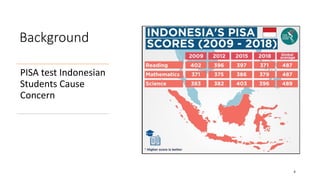
PISA test Indonesian
Students Cause
Concern
• https://www.youtube.com/watch?v=OmSCqRc8xf0
https://www.youtube.com/watch?v=-xsYoUXRDAc
Chapter 1
Thinking as a
Skill
Agung N Pramudhita
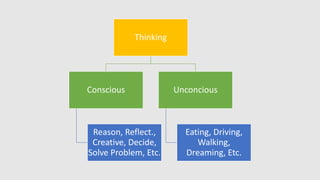
Thinking
Conscious
Reason, Reflect.,
Creative, Decide,
Solve Problem, Etc.
Unconcious
Eating, Driving,
Walking,
Dreaming, Etc.
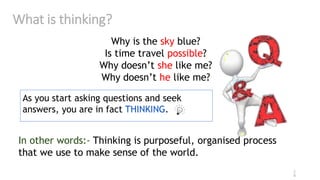
What is thinking?
Why is the sky blue?
Is time travel possible?
Why doesn’t she like me?
Why doesn’t he like me?
As you start asking questions and seek
answers, you are in fact THINKING.
In other words:- Thinking is purposeful, organised process
that we use to make sense of the world.
1
0
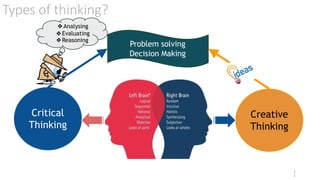
Types of thinking?
Creative
Thinking
Critical
Thinking
❖Analysing
❖Evaluating
1
1
❖Reasoning
Problem solving
Decision Making
6
Let's think!!!
(hope you remember the ans)
This is an old quiz developed by Anderson
• Consulting Worldwide. Answer each question in order.
➢ How do you put a giraffe into a refrigerator?
➢ How do you put an elephant into a refrigerator?
➢ The Lion King is hosting an animal conference. All the animals
attend ... except one. Which animal does not attend?
➢ There is a river you must cross but it is used by crocodiles,
• and you do not have a boat. How do you manage it?
The correct answers are given in
the last slide
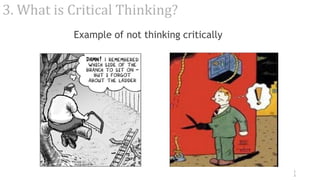
3. What is Critical Thinking?
Example of not thinking critically
1
3
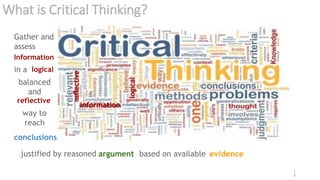
What is Critical Thinking?
logical
argument
1
4
Gather and
assess
Information
in a
balanced
and
information
way to
reach
conclusions
justified by reasoned argument based on available evidence
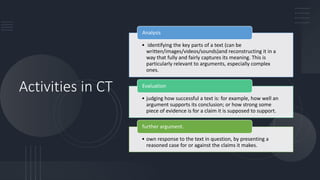
Activities in CT
• identifying the key parts of a text (can be
written/images/videos/sounds)and reconstructing it in a
way that fully and fairly captures its meaning. This is
particularly relevant to arguments, especially complex
ones.
Analysis
• judging how successful a text is: for example, how well an
argument supports its conclusion; or how strong some
piece of evidence is for a claim it is supposed to support.
Evaluation
• own response to the text in question, by presenting a
reasoned case for or against the claims it makes.
further argument.
CT Characteristic
•. Without an open mind we cannot judge fairly and objectively whether some statement or story is true or not.
fair and open-minded
•We have to be ready to take an active interest in the subject matter, and be prepared to investigate and enquire. Hasty,
uninformed judgements are never critical. At the very least we would need to read the article before an informed
judgement is possible.
active and informed
•Some degree of scepticism is also needed: a willingness to question or to entertain doubt.
Sceptical
•critical thinking requires independence. It is fine to listen to others, to respect their beliefs and opinions, to learn from
teachers, to get information from books and/or from online sources. But in order to think critically you must also be
prepared to take some initiative: to ask your own questions and reach your own conclusions.
independent.
Benefits of Critical Thinking
19
At Work
As more and more employers are looking for employees not
with specialized academic skills but with good thinking and
communications skills, who can
❏ Learn quickly and solve problems.
❏ Shows creativity.
❏ Gathers and analyze the issue meaningfully.
This has become vital skill for any professional
Benefits of Critical Thinking
Daily life
❏ Helps us avoid making foolish decision.
❏ Helps us become a good citizen capable of making good
decisions on important social, political and economic
issues.
❏ Helps us in developing good thinking skill capable of
examining our own assumptions and dogmas.
20
Barriers to Critical Thinking
You might ask,
➢If the critical thinking is so important, then why is
uncritical thinking so common?
➢Why is that so many people including the highly
educated and intellectual people find it difficult
to think critically?
21
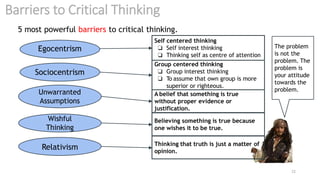
Barriers to Critical Thinking
Egocentrism
5 most powerful barriers to critical thinking.
Sociocentrism
Unwarranted
Assumptions
Wishful
Thinking
Relativism
Self centered thinking
❏ Self interest thinking
❏ Thinking self as centre of attention
Group centered thinking
❏ Group interest thinking
❏ To assume that own group is more
superior or righteous.
A belief that something is true
without proper evidence or
justification.
Believing something is true because
one wishes it to be true.
Thinking that truth is just a matter of
opinion.
The problem
is not the
problem. The
problem is
your attitude
towards the
problem.
22
7. Characteristic of Critical Thinker
23
Critical Thinker….
➢Are honest with themselves.
➢Regard problems and controversial issues as exciting
challenges.
➢Strive for understanding, keep curiosity alive remain
patient with complexity.
7. Characteristic of Critical Thinker
24
Critical Thinker….
➢Base judgments on evidence rather than personal
preferences.
➢Are interested in other people's ideas and so are
willing to read and listen attentively.
➢Practice fair mindedness, and seek a balance view.
➢Practice restraint, controlling their feelings rather
than being controlled by them.
Thank you!
Any Question?

Introduction Critical Thinking Problem Solving

  • 1.
    Critical Thinking andProblem Solving Team teaching MK CTPS
  • 2.
    Topics • Thinking andreasoning • Critical thinking: the basics • Problem solving: basic skills • Applied critical thinking • Advanced problem solving • Problem solving: further techniques • Critical reasoning: Advanced Level
  • 3.
  • 4.
  • 5.
  • 6.
  • 8.
    Chapter 1 Thinking asa Skill Agung N Pramudhita
  • 9.
    Thinking Conscious Reason, Reflect., Creative, Decide, SolveProblem, Etc. Unconcious Eating, Driving, Walking, Dreaming, Etc.
  • 10.
    What is thinking? Whyis the sky blue? Is time travel possible? Why doesn’t she like me? Why doesn’t he like me? As you start asking questions and seek answers, you are in fact THINKING. In other words:- Thinking is purposeful, organised process that we use to make sense of the world. 1 0
  • 11.
  • 12.
    6 Let's think!!! (hope youremember the ans) This is an old quiz developed by Anderson • Consulting Worldwide. Answer each question in order. ➢ How do you put a giraffe into a refrigerator? ➢ How do you put an elephant into a refrigerator? ➢ The Lion King is hosting an animal conference. All the animals attend ... except one. Which animal does not attend? ➢ There is a river you must cross but it is used by crocodiles, • and you do not have a boat. How do you manage it? The correct answers are given in the last slide
  • 13.
    3. What isCritical Thinking? Example of not thinking critically 1 3
  • 14.
    What is CriticalThinking? logical argument 1 4 Gather and assess Information in a balanced and information way to reach conclusions justified by reasoned argument based on available evidence
  • 17.
    Activities in CT •identifying the key parts of a text (can be written/images/videos/sounds)and reconstructing it in a way that fully and fairly captures its meaning. This is particularly relevant to arguments, especially complex ones. Analysis • judging how successful a text is: for example, how well an argument supports its conclusion; or how strong some piece of evidence is for a claim it is supposed to support. Evaluation • own response to the text in question, by presenting a reasoned case for or against the claims it makes. further argument.
  • 18.
    CT Characteristic •. Withoutan open mind we cannot judge fairly and objectively whether some statement or story is true or not. fair and open-minded •We have to be ready to take an active interest in the subject matter, and be prepared to investigate and enquire. Hasty, uninformed judgements are never critical. At the very least we would need to read the article before an informed judgement is possible. active and informed •Some degree of scepticism is also needed: a willingness to question or to entertain doubt. Sceptical •critical thinking requires independence. It is fine to listen to others, to respect their beliefs and opinions, to learn from teachers, to get information from books and/or from online sources. But in order to think critically you must also be prepared to take some initiative: to ask your own questions and reach your own conclusions. independent.
  • 19.
    Benefits of CriticalThinking 19 At Work As more and more employers are looking for employees not with specialized academic skills but with good thinking and communications skills, who can ❏ Learn quickly and solve problems. ❏ Shows creativity. ❏ Gathers and analyze the issue meaningfully. This has become vital skill for any professional
  • 20.
    Benefits of CriticalThinking Daily life ❏ Helps us avoid making foolish decision. ❏ Helps us become a good citizen capable of making good decisions on important social, political and economic issues. ❏ Helps us in developing good thinking skill capable of examining our own assumptions and dogmas. 20
  • 21.
    Barriers to CriticalThinking You might ask, ➢If the critical thinking is so important, then why is uncritical thinking so common? ➢Why is that so many people including the highly educated and intellectual people find it difficult to think critically? 21
  • 22.
    Barriers to CriticalThinking Egocentrism 5 most powerful barriers to critical thinking. Sociocentrism Unwarranted Assumptions Wishful Thinking Relativism Self centered thinking ❏ Self interest thinking ❏ Thinking self as centre of attention Group centered thinking ❏ Group interest thinking ❏ To assume that own group is more superior or righteous. A belief that something is true without proper evidence or justification. Believing something is true because one wishes it to be true. Thinking that truth is just a matter of opinion. The problem is not the problem. The problem is your attitude towards the problem. 22
  • 23.
    7. Characteristic ofCritical Thinker 23 Critical Thinker…. ➢Are honest with themselves. ➢Regard problems and controversial issues as exciting challenges. ➢Strive for understanding, keep curiosity alive remain patient with complexity.
  • 24.
    7. Characteristic ofCritical Thinker 24 Critical Thinker…. ➢Base judgments on evidence rather than personal preferences. ➢Are interested in other people's ideas and so are willing to read and listen attentively. ➢Practice fair mindedness, and seek a balance view. ➢Practice restraint, controlling their feelings rather than being controlled by them.
  • 25.