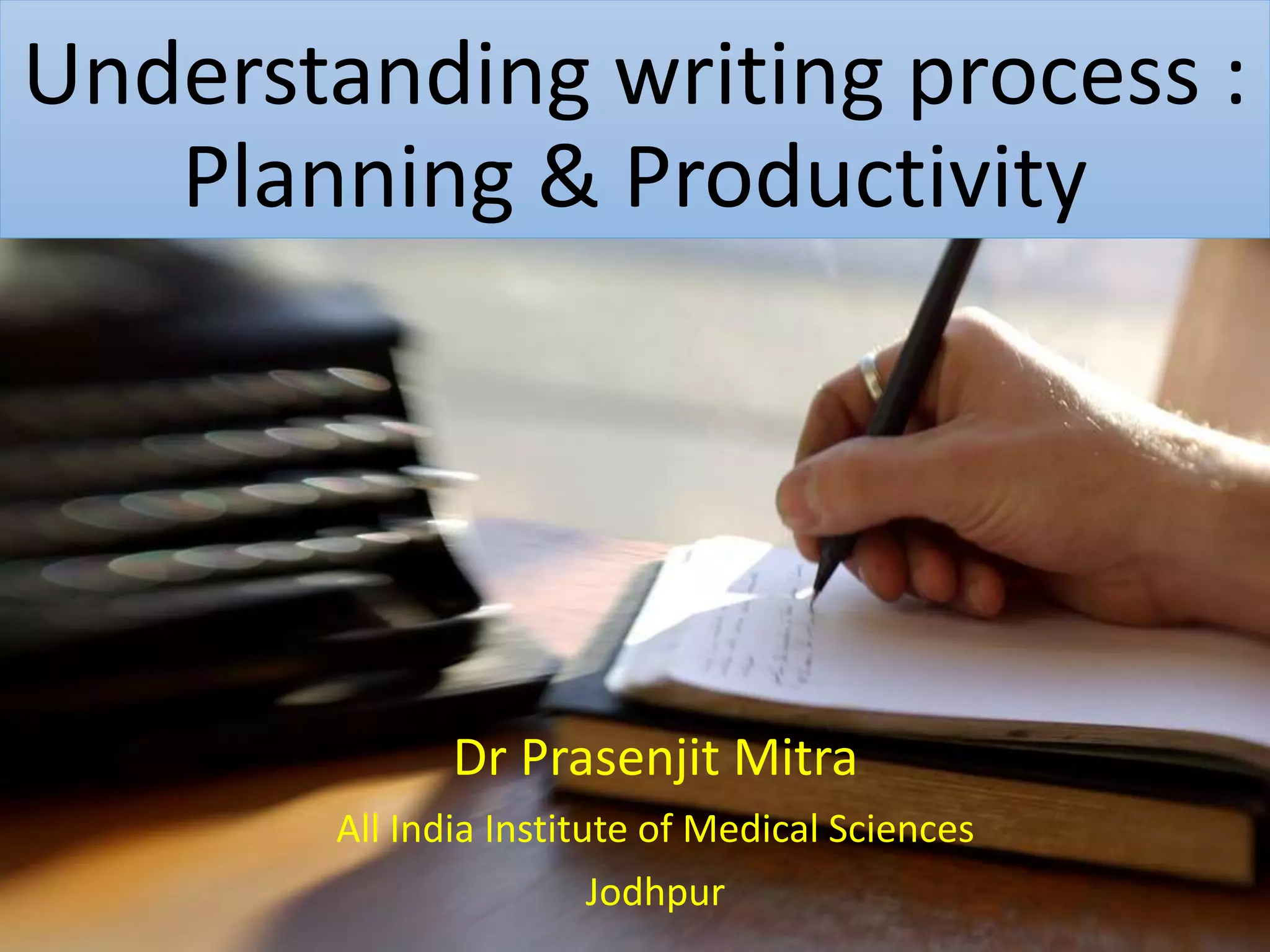
Understanding writing process :
Planning & Productivity
Dr Prasenjit Mitra
All India Institute of Medical Sciences
Jodhpur
It is unethical to conduct a study and not report the findings
You have some results that are worth reporting
You want to progress scientific thought
You want to give credibility to your research team
You want your work to reach a broad audience
Need for medical writing
Your track record will improve
You will add credibility to your reputation
You will improve your chance of promotion
You are more likely to obtain research grants
Need for medical writing
If you don’t publish it, you haven’t done it.
The credit goes to the guy who publishes first.
People who don’t submit their work for peer review do crappy
work.
Writing things down in a form for others to read makes you
understand them better.
Writing a paper is the only was you will know what you did six
months from now.
Some unpublished rules
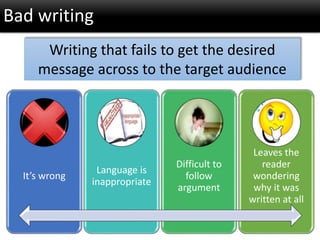
Writing that fails to get the desired
message across to the target audience
Bad writing
It’s wrong
Language is
inappropriate
Difficult to
follow
argument
Leaves the
reader
wondering
why it was
written at all
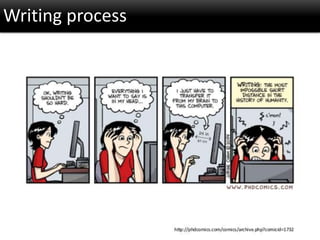
Writing process
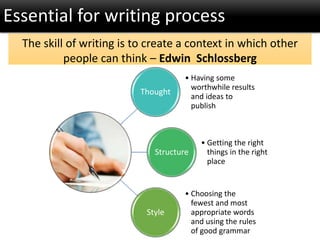
Thought
• Having some
worthwhile results
and ideas to
publish
Structure
• Getting the right
things in the right
place
Style
• Choosing the
fewest and most
appropriate words
and using the rules
of good grammar
Essential for writing process
The skill of writing is to create a context in which other
people can think – Edwin Schlossberg
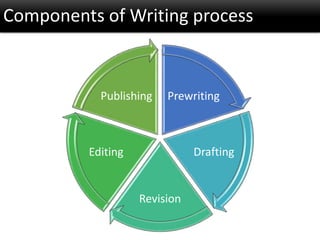
Prewriting
Drafting
Revision
Editing
Publishing
Components of Writing process
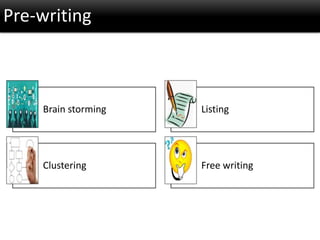
Pre-writing
Brain storming Listing
Clustering Free writing
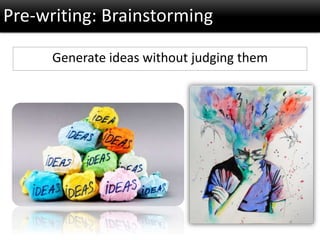
Generate ideas without judging them
Pre-writing: Brainstorming
• Listing is a quick way to
gather ideas on paper
• Make a list of as many
ideas you can think of
in a paper
Pre-writing: Listing
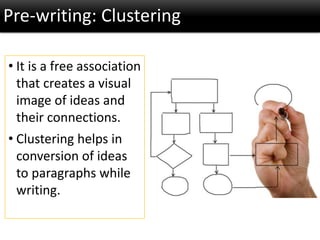
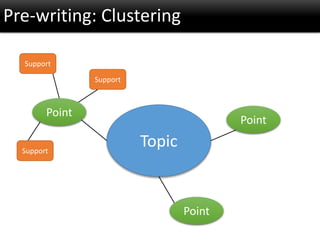
Pre-writing: Clustering
• It is a free association
that creates a visual
image of ideas and
their connections.
• Clustering helps in
conversion of ideas
to paragraphs while
writing.
Pre-writing: Clustering
Topic
Point
Point
Point
Support
Support
Support
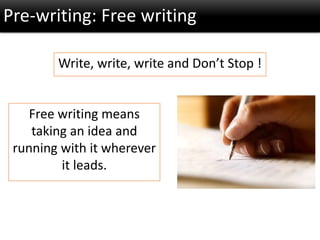
Pre-writing: Free writing
Write, write, write and Don’t Stop !
Free writing means
taking an idea and
running with it wherever
it leads.
Pre-writing: Tips
Don’t get hung up on grammar and
punctuations or spelling at this stage.
Try to get and connect all ideas on paper first.
Its normal to get off-topic from time to time.
Prewrite till you have clear idea of what details
you want to use and how might organize it.
Drafting
Organizing ideas into sentences and paragraphs
Concentration upon explaining and supporting own ideas fully
Developing a main idea, supporting details and a body
Primary attention should be the purpose and focus of the work
Less attention to spelling, grammar and punctuation
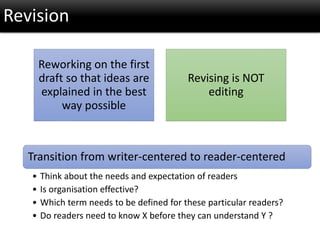
Revision
Reworking on the first
draft so that ideas are
explained in the best
way possible
Revising is NOT
editing
Transition from writer-centered to reader-centered
• Think about the needs and expectation of readers
• Is organisation effective?
• Which term needs to be defined for these particular readers?
• Do readers need to know X before they can understand Y ?
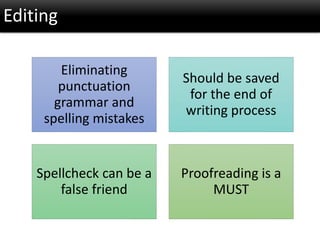
Editing
Eliminating
punctuation
grammar and
spelling mistakes
Should be saved
for the end of
writing process
Spellcheck can be a
false friend
Proofreading is a
MUST
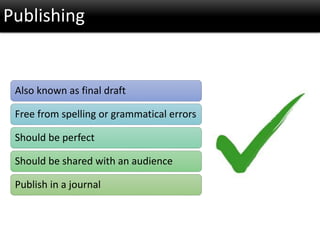
Publishing
Also known as final draft
Free from spelling or grammatical errors
Should be perfect
Should be shared with an audience
Publish in a journal
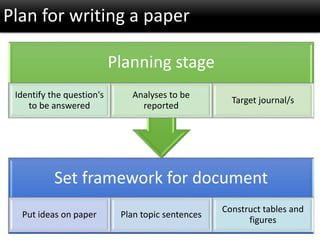
Plan for writing a paper
Set framework for document
Put ideas on paper Plan topic sentences
Construct tables and
figures
Planning stage
Identify the question's
to be answered
Analyses to be
reported
Target journal/s
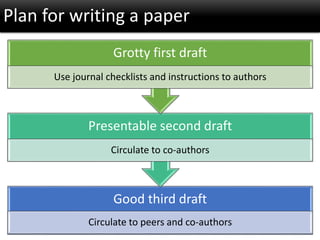
Good third draft
Circulate to peers and co-authors
Presentable second draft
Circulate to co-authors
Grotty first draft
Use journal checklists and instructions to authors
Plan for writing a paper
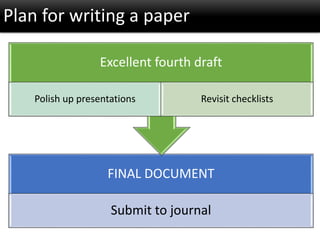
FINAL DOCUMENT
Submit to journal
Excellent fourth draft
Polish up presentations Revisit checklists
Plan for writing a paper
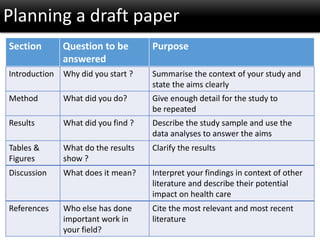
Planning a draft paper
Section Question to be
answered
Purpose
Introduction Why did you start ? Summarise the context of your study and
state the aims clearly
Method What did you do? Give enough detail for the study to
be repeated
Results What did you find ? Describe the study sample and use the
data analyses to answer the aims
Tables &
Figures
What do the results
show ?
Clarify the results
Discussion What does it mean? Interpret your findings in context of other
literature and describe their potential
impact on health care
References Who else has done
important work in
your field?
Cite the most relevant and most recent
literature
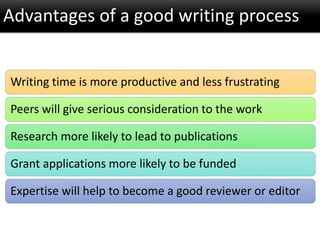
Writing time is more productive and less frustrating
Peers will give serious consideration to the work
Research more likely to lead to publications
Grant applications more likely to be funded
Expertise will help to become a good reviewer or editor
Advantages of a good writing process
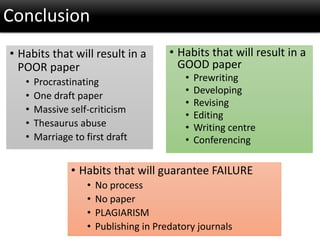
Conclusion
• Habits that will result in a
POOR paper
• Procrastinating
• One draft paper
• Massive self-criticism
• Thesaurus abuse
• Marriage to first draft
• Habits that will result in a
GOOD paper
• Prewriting
• Developing
• Revising
• Editing
• Writing centre
• Conferencing
• Habits that will guarantee FAILURE
• No process
• No paper
• PLAGIARISM
• Publishing in Predatory journals
Thank you

Understanding writing process

  • 1.
    Understanding writing process: Planning & Productivity Dr Prasenjit Mitra All India Institute of Medical Sciences Jodhpur
  • 2.
    It is unethicalto conduct a study and not report the findings You have some results that are worth reporting You want to progress scientific thought You want to give credibility to your research team You want your work to reach a broad audience Need for medical writing
  • 3.
    Your track recordwill improve You will add credibility to your reputation You will improve your chance of promotion You are more likely to obtain research grants Need for medical writing
  • 4.
    If you don’tpublish it, you haven’t done it. The credit goes to the guy who publishes first. People who don’t submit their work for peer review do crappy work. Writing things down in a form for others to read makes you understand them better. Writing a paper is the only was you will know what you did six months from now. Some unpublished rules
  • 5.
    Writing that failsto get the desired message across to the target audience Bad writing It’s wrong Language is inappropriate Difficult to follow argument Leaves the reader wondering why it was written at all
  • 6.
  • 7.
    Thought • Having some worthwhileresults and ideas to publish Structure • Getting the right things in the right place Style • Choosing the fewest and most appropriate words and using the rules of good grammar Essential for writing process The skill of writing is to create a context in which other people can think – Edwin Schlossberg
  • 8.
  • 9.
  • 10.
    Generate ideas withoutjudging them Pre-writing: Brainstorming
  • 11.
    • Listing isa quick way to gather ideas on paper • Make a list of as many ideas you can think of in a paper Pre-writing: Listing
  • 12.
    Pre-writing: Clustering • Itis a free association that creates a visual image of ideas and their connections. • Clustering helps in conversion of ideas to paragraphs while writing.
  • 13.
  • 14.
    Pre-writing: Free writing Write,write, write and Don’t Stop ! Free writing means taking an idea and running with it wherever it leads.
  • 15.
    Pre-writing: Tips Don’t gethung up on grammar and punctuations or spelling at this stage. Try to get and connect all ideas on paper first. Its normal to get off-topic from time to time. Prewrite till you have clear idea of what details you want to use and how might organize it.
  • 16.
    Drafting Organizing ideas intosentences and paragraphs Concentration upon explaining and supporting own ideas fully Developing a main idea, supporting details and a body Primary attention should be the purpose and focus of the work Less attention to spelling, grammar and punctuation
  • 17.
    Revision Reworking on thefirst draft so that ideas are explained in the best way possible Revising is NOT editing Transition from writer-centered to reader-centered • Think about the needs and expectation of readers • Is organisation effective? • Which term needs to be defined for these particular readers? • Do readers need to know X before they can understand Y ?
  • 18.
    Editing Eliminating punctuation grammar and spelling mistakes Shouldbe saved for the end of writing process Spellcheck can be a false friend Proofreading is a MUST
  • 19.
    Publishing Also known asfinal draft Free from spelling or grammatical errors Should be perfect Should be shared with an audience Publish in a journal
  • 20.
    Plan for writinga paper Set framework for document Put ideas on paper Plan topic sentences Construct tables and figures Planning stage Identify the question's to be answered Analyses to be reported Target journal/s
  • 21.
    Good third draft Circulateto peers and co-authors Presentable second draft Circulate to co-authors Grotty first draft Use journal checklists and instructions to authors Plan for writing a paper
  • 22.
    FINAL DOCUMENT Submit tojournal Excellent fourth draft Polish up presentations Revisit checklists Plan for writing a paper
  • 23.
    Planning a draftpaper Section Question to be answered Purpose Introduction Why did you start ? Summarise the context of your study and state the aims clearly Method What did you do? Give enough detail for the study to be repeated Results What did you find ? Describe the study sample and use the data analyses to answer the aims Tables & Figures What do the results show ? Clarify the results Discussion What does it mean? Interpret your findings in context of other literature and describe their potential impact on health care References Who else has done important work in your field? Cite the most relevant and most recent literature
  • 24.
    Writing time ismore productive and less frustrating Peers will give serious consideration to the work Research more likely to lead to publications Grant applications more likely to be funded Expertise will help to become a good reviewer or editor Advantages of a good writing process
  • 25.
    Conclusion • Habits thatwill result in a POOR paper • Procrastinating • One draft paper • Massive self-criticism • Thesaurus abuse • Marriage to first draft • Habits that will result in a GOOD paper • Prewriting • Developing • Revising • Editing • Writing centre • Conferencing • Habits that will guarantee FAILURE • No process • No paper • PLAGIARISM • Publishing in Predatory journals
  • 26.

Editor's Notes

  • #6 It’s wrong The writing may read easily and appear plausible but, alas, the arguments depend on facts that appear to be, or later turn out to be, not true (see scientific fraud ). There is absolutely no defence for this. The language is inappropriate The author has chosen words and constructions with which the audience is not familiar ( see jargon ). This can be fixed relatively easily, if the will is there. It is difficult to follow the argument The sentences don’t seem to follow on from one another, so that readers find it difficult to understand what is going on (see structure ;yellow marker test ). This can be fixed by altering sentences and paragraphs, though it takes considerable time and is difficult to do well. It leaves the reader wondering why it was written at all These are those pieces of writing that you gamely wade through, but by the end have no idea why (see brief setting ; message ). If the writer cannot define a clear message, then the reader will be unable to, and the writing will be doomed to fail
  • #8 Thought - is a matter of having some worthwhile results and ideas to publish. You need some new results to publish and you need to be able to interpret them correctly. Structure - is simply a matter of getting the right things in the right place. Style - is a matter of choosing the fewest and most appropriate words and using the rules of good grammar.
  • #10 It’s wrong The writing may read easily and appear plausible but, alas, the arguments depend on facts that appear to be, or later turn out to be, not true (see scientific fraud ). There is absolutely no defence for this. The language is inappropriate The author has chosen words and constructions with which the audience is not familiar ( see jargon ). This can be fixed relatively easily, if the will is there. It is difficult to follow the argument The sentences don’t seem to follow on from one another, so that readers find it difficult to understand what is going on (see structure ;yellow marker test ). This can be fixed by altering sentences and paragraphs, though it takes considerable time and is difficult to do well. It leaves the reader wondering why it was written at all These are those pieces of writing that you gamely wade through, but by the end have no idea why (see brief setting ; message ). If the writer cannot define a clear message, then the reader will be unable to, and the writing will be doomed to fail
  • #11 It’s wrong The writing may read easily and appear plausible but, alas, the arguments depend on facts that appear to be, or later turn out to be, not true (see scientific fraud ). There is absolutely no defence for this. The language is inappropriate The author has chosen words and constructions with which the audience is not familiar ( see jargon ). This can be fixed relatively easily, if the will is there. It is difficult to follow the argument The sentences don’t seem to follow on from one another, so that readers find it difficult to understand what is going on (see structure ;yellow marker test ). This can be fixed by altering sentences and paragraphs, though it takes considerable time and is difficult to do well. It leaves the reader wondering why it was written at all These are those pieces of writing that you gamely wade through, but by the end have no idea why (see brief setting ; message ). If the writer cannot define a clear message, then the reader will be unable to, and the writing will be doomed to fail
  • #12 It’s wrong The writing may read easily and appear plausible but, alas, the arguments depend on facts that appear to be, or later turn out to be, not true (see scientific fraud ). There is absolutely no defence for this. The language is inappropriate The author has chosen words and constructions with which the audience is not familiar ( see jargon ). This can be fixed relatively easily, if the will is there. It is difficult to follow the argument The sentences don’t seem to follow on from one another, so that readers find it difficult to understand what is going on (see structure ;yellow marker test ). This can be fixed by altering sentences and paragraphs, though it takes considerable time and is difficult to do well. It leaves the reader wondering why it was written at all These are those pieces of writing that you gamely wade through, but by the end have no idea why (see brief setting ; message ). If the writer cannot define a clear message, then the reader will be unable to, and the writing will be doomed to fail
  • #13 It’s wrong The writing may read easily and appear plausible but, alas, the arguments depend on facts that appear to be, or later turn out to be, not true (see scientific fraud ). There is absolutely no defence for this. The language is inappropriate The author has chosen words and constructions with which the audience is not familiar ( see jargon ). This can be fixed relatively easily, if the will is there. It is difficult to follow the argument The sentences don’t seem to follow on from one another, so that readers find it difficult to understand what is going on (see structure ;yellow marker test ). This can be fixed by altering sentences and paragraphs, though it takes considerable time and is difficult to do well. It leaves the reader wondering why it was written at all These are those pieces of writing that you gamely wade through, but by the end have no idea why (see brief setting ; message ). If the writer cannot define a clear message, then the reader will be unable to, and the writing will be doomed to fail
  • #14 It’s wrong The writing may read easily and appear plausible but, alas, the arguments depend on facts that appear to be, or later turn out to be, not true (see scientific fraud ). There is absolutely no defence for this. The language is inappropriate The author has chosen words and constructions with which the audience is not familiar ( see jargon ). This can be fixed relatively easily, if the will is there. It is difficult to follow the argument The sentences don’t seem to follow on from one another, so that readers find it difficult to understand what is going on (see structure ;yellow marker test ). This can be fixed by altering sentences and paragraphs, though it takes considerable time and is difficult to do well. It leaves the reader wondering why it was written at all These are those pieces of writing that you gamely wade through, but by the end have no idea why (see brief setting ; message ). If the writer cannot define a clear message, then the reader will be unable to, and the writing will be doomed to fail
  • #15 It’s wrong The writing may read easily and appear plausible but, alas, the arguments depend on facts that appear to be, or later turn out to be, not true (see scientific fraud ). There is absolutely no defence for this. The language is inappropriate The author has chosen words and constructions with which the audience is not familiar ( see jargon ). This can be fixed relatively easily, if the will is there. It is difficult to follow the argument The sentences don’t seem to follow on from one another, so that readers find it difficult to understand what is going on (see structure ;yellow marker test ). This can be fixed by altering sentences and paragraphs, though it takes considerable time and is difficult to do well. It leaves the reader wondering why it was written at all These are those pieces of writing that you gamely wade through, but by the end have no idea why (see brief setting ; message ). If the writer cannot define a clear message, then the reader will be unable to, and the writing will be doomed to fail
  • #16 It’s wrong The writing may read easily and appear plausible but, alas, the arguments depend on facts that appear to be, or later turn out to be, not true (see scientific fraud ). There is absolutely no defence for this. The language is inappropriate The author has chosen words and constructions with which the audience is not familiar ( see jargon ). This can be fixed relatively easily, if the will is there. It is difficult to follow the argument The sentences don’t seem to follow on from one another, so that readers find it difficult to understand what is going on (see structure ;yellow marker test ). This can be fixed by altering sentences and paragraphs, though it takes considerable time and is difficult to do well. It leaves the reader wondering why it was written at all These are those pieces of writing that you gamely wade through, but by the end have no idea why (see brief setting ; message ). If the writer cannot define a clear message, then the reader will be unable to, and the writing will be doomed to fail
  • #17 It’s wrong The writing may read easily and appear plausible but, alas, the arguments depend on facts that appear to be, or later turn out to be, not true (see scientific fraud ). There is absolutely no defence for this. The language is inappropriate The author has chosen words and constructions with which the audience is not familiar ( see jargon ). This can be fixed relatively easily, if the will is there. It is difficult to follow the argument The sentences don’t seem to follow on from one another, so that readers find it difficult to understand what is going on (see structure ;yellow marker test ). This can be fixed by altering sentences and paragraphs, though it takes considerable time and is difficult to do well. It leaves the reader wondering why it was written at all These are those pieces of writing that you gamely wade through, but by the end have no idea why (see brief setting ; message ). If the writer cannot define a clear message, then the reader will be unable to, and the writing will be doomed to fail
  • #18 It’s wrong The writing may read easily and appear plausible but, alas, the arguments depend on facts that appear to be, or later turn out to be, not true (see scientific fraud ). There is absolutely no defence for this. The language is inappropriate The author has chosen words and constructions with which the audience is not familiar ( see jargon ). This can be fixed relatively easily, if the will is there. It is difficult to follow the argument The sentences don’t seem to follow on from one another, so that readers find it difficult to understand what is going on (see structure ;yellow marker test ). This can be fixed by altering sentences and paragraphs, though it takes considerable time and is difficult to do well. It leaves the reader wondering why it was written at all These are those pieces of writing that you gamely wade through, but by the end have no idea why (see brief setting ; message ). If the writer cannot define a clear message, then the reader will be unable to, and the writing will be doomed to fail
  • #19 It’s wrong The writing may read easily and appear plausible but, alas, the arguments depend on facts that appear to be, or later turn out to be, not true (see scientific fraud ). There is absolutely no defence for this. The language is inappropriate The author has chosen words and constructions with which the audience is not familiar ( see jargon ). This can be fixed relatively easily, if the will is there. It is difficult to follow the argument The sentences don’t seem to follow on from one another, so that readers find it difficult to understand what is going on (see structure ;yellow marker test ). This can be fixed by altering sentences and paragraphs, though it takes considerable time and is difficult to do well. It leaves the reader wondering why it was written at all These are those pieces of writing that you gamely wade through, but by the end have no idea why (see brief setting ; message ). If the writer cannot define a clear message, then the reader will be unable to, and the writing will be doomed to fail
  • #20 It’s wrong The writing may read easily and appear plausible but, alas, the arguments depend on facts that appear to be, or later turn out to be, not true (see scientific fraud ). There is absolutely no defence for this. The language is inappropriate The author has chosen words and constructions with which the audience is not familiar ( see jargon ). This can be fixed relatively easily, if the will is there. It is difficult to follow the argument The sentences don’t seem to follow on from one another, so that readers find it difficult to understand what is going on (see structure ;yellow marker test ). This can be fixed by altering sentences and paragraphs, though it takes considerable time and is difficult to do well. It leaves the reader wondering why it was written at all These are those pieces of writing that you gamely wade through, but by the end have no idea why (see brief setting ; message ). If the writer cannot define a clear message, then the reader will be unable to, and the writing will be doomed to fail