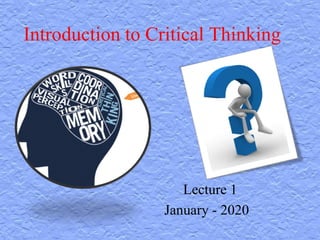
Introduction to Critical Thinking
Lecture 1
January - 2020
Introduction to critical thinking
Table of content
• What is critical thinking?
• Characteristics of a critical thinking
• Critical thinking standards
• benefits to critical thinking
• barriers of critical thinking
• How to improve critical thinking
What is Critical Thinking
Critical thinking:
• Consists of a mental process of analyzing or evaluating
information, particular statement or propositions that people have
offered as true.
Critical thinking:
• Is the intellectually disciplined process of actively and skillfully
conceptualizing, applying, synthesizing, and/or evaluating
information gathered from, or generated by, observation,
experience, reflection, reasoning, or communication, as a guide to
belief and action .
What is critical thinking
 Critical thinking is general term given to a wide range
of cognitive and intellectual skills needed to :
Effectively identify, analyze, and evaluate arguments.
Discover and overcome personal prejudices and biases
Formulate and present convincing reasons in support of
Conclusions
Make reasonable, intelligent decision about what to
believe and what to do
critical thinking standard
the standard of thinking
Bringing together the element of reasoning and
intellectual standards to asses your thinking.
The most significant critical (intellectual)
thinking standards
A collection of criteria that strength your claim
and evidence
clarity
relevance
Accuracy
depth
precision
breadth
significant
logicalness
THE STANDAR OF CRITICAL THINKING
Clarity –means the quality of being expressed
clearly
Accuracy-the state of being exact or correct the
ability to do something skillfully
Precision-the quality of being exactly, careful
Relevance-how this idea connected to the question
Depth-quality of knowing or understanding a lot of
details about something.
breadth –quality of a wide range (of
knowledge),interests
• Logicalness:
When the combined thoughts are mutually
supported and make sense in combination, the
thinking is logical.
• Significance:
When we reason through issues , we want to
concentrate on the most important information
in our reasoning and take into account the
most important ideas or concepts.
Characteristic of a critical thinker
If you are this property you are critical person
• Are you open minded about other people’s?
• Are you hones to yourself or others when you are
wrong?
• Do you have the courage and passion to take
initiative and confront problems and meet
challenges?
• Are aware of your own biases and
preconceptions?
• Do you welcome criticism from other people
Benefits of critical thinking
• Academic performance
understand the arguments and beliefs of others
critical evaluation those arguments and beliefs
Workplace
Helps us to reflect and get a deeper understanding of our own others’
decision
Encourage open-mindedness to change
aid us in being more analytical in solving problem
daily life
helps us to avoid making foolish personal decisions
capable of making good decisions on important social , political and
economic issues .
Barriers to critical thinking
• If critical thinking is so important, why is it that
uncritical thinking is so common?
• Why is that so many people including many highly
educated and intelligent people find critical thinking
so difficult?
Common barriers or pitfalls to critical thinking
1 Egocentrism means self-centered thinking only
self interested thinking
2 Wishful thinking-believing that something is true
because one wishes it were true
3. Misunderstanding means this can arise due to
language or cultural differences, a lack of
awareness of the processes involved or
misunderstanding the critical thinking
4. Lack of detailed knowledge superficial
knowledge (not having read deeply enough
around the subject).
1 Ask basic question sometimes an explanation become that
the original question get lost
2 be aware of your mental processes Human thought is
amazing, but the speed and automation with which it happens
can be a disadvantage when we’re trying to think critically
3 Try Reversing Things A great way to get “unstuck” on a
hard problem is to try reversing things. It may seem obvious
that X causes Y, but what if Y caused X?
Way is of more critically thinking
4 Understand That No One Thinks Critically 100% of
the Time You can’t think critically all the time, and that’s okay.
Critical thinking is a tool that you should deploy when you need
to make important decisions or solve difficult problems,
Critical thinking
Critical thinking

Critical thinking

  • 1.
    Introduction to CriticalThinking Lecture 1 January - 2020
  • 2.
    Introduction to criticalthinking Table of content • What is critical thinking? • Characteristics of a critical thinking • Critical thinking standards • benefits to critical thinking • barriers of critical thinking • How to improve critical thinking
  • 3.
    What is CriticalThinking Critical thinking: • Consists of a mental process of analyzing or evaluating information, particular statement or propositions that people have offered as true. Critical thinking: • Is the intellectually disciplined process of actively and skillfully conceptualizing, applying, synthesizing, and/or evaluating information gathered from, or generated by, observation, experience, reflection, reasoning, or communication, as a guide to belief and action .
  • 4.
    What is criticalthinking  Critical thinking is general term given to a wide range of cognitive and intellectual skills needed to : Effectively identify, analyze, and evaluate arguments. Discover and overcome personal prejudices and biases Formulate and present convincing reasons in support of Conclusions Make reasonable, intelligent decision about what to believe and what to do
  • 5.
    critical thinking standard thestandard of thinking Bringing together the element of reasoning and intellectual standards to asses your thinking. The most significant critical (intellectual) thinking standards A collection of criteria that strength your claim and evidence
  • 6.
  • 7.
    THE STANDAR OFCRITICAL THINKING Clarity –means the quality of being expressed clearly Accuracy-the state of being exact or correct the ability to do something skillfully Precision-the quality of being exactly, careful Relevance-how this idea connected to the question Depth-quality of knowing or understanding a lot of details about something. breadth –quality of a wide range (of knowledge),interests
  • 8.
    • Logicalness: When thecombined thoughts are mutually supported and make sense in combination, the thinking is logical. • Significance: When we reason through issues , we want to concentrate on the most important information in our reasoning and take into account the most important ideas or concepts.
  • 9.
    Characteristic of acritical thinker If you are this property you are critical person • Are you open minded about other people’s? • Are you hones to yourself or others when you are wrong? • Do you have the courage and passion to take initiative and confront problems and meet challenges? • Are aware of your own biases and preconceptions? • Do you welcome criticism from other people
  • 10.
    Benefits of criticalthinking • Academic performance understand the arguments and beliefs of others critical evaluation those arguments and beliefs Workplace Helps us to reflect and get a deeper understanding of our own others’ decision Encourage open-mindedness to change aid us in being more analytical in solving problem daily life helps us to avoid making foolish personal decisions capable of making good decisions on important social , political and economic issues .
  • 11.
    Barriers to criticalthinking • If critical thinking is so important, why is it that uncritical thinking is so common? • Why is that so many people including many highly educated and intelligent people find critical thinking so difficult? Common barriers or pitfalls to critical thinking 1 Egocentrism means self-centered thinking only self interested thinking 2 Wishful thinking-believing that something is true because one wishes it were true
  • 12.
    3. Misunderstanding meansthis can arise due to language or cultural differences, a lack of awareness of the processes involved or misunderstanding the critical thinking 4. Lack of detailed knowledge superficial knowledge (not having read deeply enough around the subject).
  • 13.
    1 Ask basicquestion sometimes an explanation become that the original question get lost 2 be aware of your mental processes Human thought is amazing, but the speed and automation with which it happens can be a disadvantage when we’re trying to think critically 3 Try Reversing Things A great way to get “unstuck” on a hard problem is to try reversing things. It may seem obvious that X causes Y, but what if Y caused X? Way is of more critically thinking
  • 14.
    4 Understand ThatNo One Thinks Critically 100% of the Time You can’t think critically all the time, and that’s okay. Critical thinking is a tool that you should deploy when you need to make important decisions or solve difficult problems,