
CRITICAL THINKING
GREGOR HORVAT
agenda
Introduction
Belief preservation
Argumentation
Socratic questioning
Thinking hats
Wrap up
GREGOR HORVAT CRITICAL THINKING
INTRODUCTION
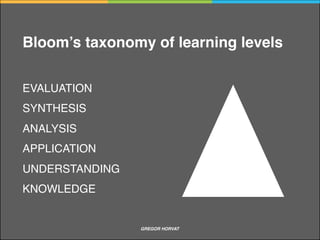
EVALUATION
SYNTHESIS
ANALYSIS
APPLICATION
UNDERSTANDING
KNOWLEDGE
Bloom’s taxonomy of learning levels
GREGOR HORVAT CRITICAL THINKING
introduction
Critical thinking is a type of reflective thinking
that is aimed at deciding what to believe
or what to do
What is critical thinking?
Why should I practice it?
Where can I use critical thinking?
Who is a critical thinker?
GREGOR HORVAT CRITICAL THINKING
Critical thinking is a complex activity built up out of other skills which
are simpler and easier to acquire.
Critical thinking is thinking that aims at well-founded judgement and utilises appropriate
standards in the attempt to determine the true worth of something
Critical thinking is not negative, destructive or criticising thinking and it is not opposed to
creative thinking
The ability to think critically involves three things:
An attitude of being disposed to consider in a thoughtful way the problems and subjects
Knowledge of the methods of logical inquiry and reasoning
Some skills in applying those methods
GREGOR HORVAT CRITICAL THINKING
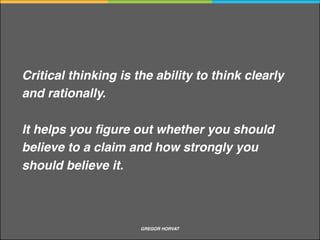
Critical thinking is the ability to think clearly and
rationally
overview
Memorise the solution to a problem and you will master that particular problem. Improve your
critical thinking and you will give yourself tools to create solutions to multitude of problems.
Why should I practice critical thinking
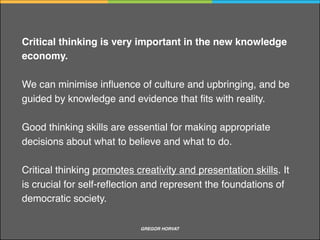
Critical thinking is very important in the new knowledge economy
We can minimise influence of culture and upbringing, and be guided by knowledge and evidence
that fits with reality
Good thinking skills are essential for making appropriate decisions about what to believe and
what to do
Critical thinking promotes creativity and presentation skills. It is crucial for self-reflection and
represent the foundations of democratic society
GREGOR HORVAT CRITICAL THINKING
Critical thinker raises vital questions and problems, and formulates them clearly and precisely
Critical thinker gathers and assesses relevant information and uses abstract ideas to interpret it
effectively
Critical thinker comes to well-reasoned conclusions and solutions
Critical thinker thinks open-mindedly within alternative systems of thought
Critical thinker communicates effectively with other
GREGOR HORVAT CRITICAL THINKING
Who is a critical thinker
The mind has tendencies to illusion, distortion and error
Much of our thinking is biased, distorted, partial and uninformed
The problem with critical thinking
GREGOR HORVAT CRITICAL THINKING
Belief preservation
Arguments
Socratic questioning
Thinking hats
Techniques for improving critical thinking
GREGOR HORVAT CRITICAL THINKING
BELIEF PRESERVATION
When we strongly believe something then we tend to do the following
We seek out evidence which supports what we believe, and avoid or ignore evidence that goes
against it
We rate evidence as good or bad, depending whether it supports our belief or not
We stick with our belief even in the face of overwhelming contrary evidence
Critical thinker need to be aware of cognitive biases and blind spots
Belief preservation
GREGOR HORVAT CRITICAL THINKING
Critical thinker must try to avoid blind spots
You need to be aware of the preservation phenomenon
Counter belief preservation by exploring the
evidence against your belief
GREGOR HORVAT CRITICAL THINKING
ARGUMENTATION
What is an argument
GREGOR HORVAT CRITICAL THINKING
A core part of critical thinking is dealing with arguments
An argument is a connected series of statements intended to establish a definite conclusion
Arguments express a body of evidence in relation to some conclusion
Elements of arguments
The conclusion is the claim you try to establish
The premises are offered as reasons or evidence in support of the conclusion
There needs to be a logical connection between them
The scientists determined that the waves could not
be coming from natural forces because those would
follow a schedule of the tides.
Instead, it must be human activity. It's something
we're doing because it's following our schedule.
Example of a argument
GREGOR HORVAT CRITICAL THINKING
The scientists determined that the waves could not be coming from natural forces because those would
follow a schedule of the tides. Instead, it must be human activity, said Dr. Michael S. Bruno. "It's something
we're doing because it's following our schedule.”
The waves are caused by human activity
The waves are caused by natural forces
or by human activity
The waves could not be caused
by natural forces
The waves follow a human schedule
Waves caused by natural forces would
follow a schedule of the tides
Example of a argument
SOCRATIC QUESTIONING
Socratic Questioning provides unique opportunities for critical thinking and reflection
Questions define tasks, express problems and delineate issues
Deep questions drive our thought underneath the surface of things, force us to deal with
complexity
The art of Socratic questioning is important for the critical thinker because the art of questioning
is important to excellence of thought
Thinking is driven by questions
GREGOR HORVAT CRITICAL THINKING
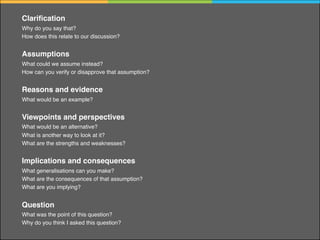
Clarification
Why do you say that?
How does this relate to our discussion?
Assumptions
What could we assume instead?
How can you verify or disapprove that assumption?
Reasons and evidence
What would be an example?
Viewpoints and perspectives
What would be an alternative?
What is another way to look at it?
What are the strengths and weaknesses?
Implications and consequences
What generalisations can you make?
What are the consequences of that assumption?
What are you implying?
Question
What was the point of this question?
Why do you think I asked this question?
SIX THINKING HATS
Six thinking hats is a simple, effective thinking process that helps people be more productive,
focused, and mindfully involved
You can learn how to separate thinking into six clear functions and roles. Each thinking role is
identified with a coloured symbolic thinking hat
Part of critical thinking is to understand that there are different ways of thinking
Edward de Bono
GREGOR HORVAT CRITICAL THINKING
The white hat
Only information and facts
The white hat calls for known or needed
Neutral and objective
The red hat
Feelings and intuition, you can express emotions and share fears, likes and dislikes
The black hat
Logic and judgement
Spot the difficulties and danger, where things may go wrong
The yellow hat
Symbolises brightness and optimism
Under this hat you explore the positives
The green hat
Focus on creativity, possibilities, alternatives and new ideas
What are the consequences of that assumption?
The blue hat
It is used to manage the thinking process
CRITICAL THINKING
SUMMARY
Critical thinking is the ability to think clearly
and rationally
It helps you figure out whether you should believe
to a claim and how strongly you should believe it
GREGOR HORVAT CRITICAL THINKING
Belief preservation
Arguments
Socratic questioning
Thinking hats
Techniques for improving critical thinking
GREGOR HORVAT CRITICAL THINKING

Critical thinking

  • 1.
  • 2.
  • 3.
  • 4.
  • 5.
    introduction Critical thinking isa type of reflective thinking that is aimed at deciding what to believe or what to do What is critical thinking? Why should I practice it? Where can I use critical thinking? Who is a critical thinker? GREGOR HORVAT CRITICAL THINKING
  • 6.
    Critical thinking isa complex activity built up out of other skills which are simpler and easier to acquire.
  • 7.
    Critical thinking isthinking that aims at well-founded judgement and utilises appropriate standards in the attempt to determine the true worth of something Critical thinking is not negative, destructive or criticising thinking and it is not opposed to creative thinking The ability to think critically involves three things: An attitude of being disposed to consider in a thoughtful way the problems and subjects Knowledge of the methods of logical inquiry and reasoning Some skills in applying those methods GREGOR HORVAT CRITICAL THINKING Critical thinking is the ability to think clearly and rationally
  • 8.
  • 9.
    Memorise the solutionto a problem and you will master that particular problem. Improve your critical thinking and you will give yourself tools to create solutions to multitude of problems.
  • 11.
    Why should Ipractice critical thinking Critical thinking is very important in the new knowledge economy We can minimise influence of culture and upbringing, and be guided by knowledge and evidence that fits with reality Good thinking skills are essential for making appropriate decisions about what to believe and what to do Critical thinking promotes creativity and presentation skills. It is crucial for self-reflection and represent the foundations of democratic society GREGOR HORVAT CRITICAL THINKING
  • 12.
    Critical thinker raisesvital questions and problems, and formulates them clearly and precisely Critical thinker gathers and assesses relevant information and uses abstract ideas to interpret it effectively Critical thinker comes to well-reasoned conclusions and solutions Critical thinker thinks open-mindedly within alternative systems of thought Critical thinker communicates effectively with other GREGOR HORVAT CRITICAL THINKING Who is a critical thinker
  • 14.
    The mind hastendencies to illusion, distortion and error Much of our thinking is biased, distorted, partial and uninformed The problem with critical thinking GREGOR HORVAT CRITICAL THINKING
  • 15.
    Belief preservation Arguments Socratic questioning Thinkinghats Techniques for improving critical thinking GREGOR HORVAT CRITICAL THINKING
  • 16.
  • 17.
    When we stronglybelieve something then we tend to do the following We seek out evidence which supports what we believe, and avoid or ignore evidence that goes against it We rate evidence as good or bad, depending whether it supports our belief or not We stick with our belief even in the face of overwhelming contrary evidence Critical thinker need to be aware of cognitive biases and blind spots Belief preservation GREGOR HORVAT CRITICAL THINKING
  • 18.
    Critical thinker musttry to avoid blind spots You need to be aware of the preservation phenomenon Counter belief preservation by exploring the evidence against your belief GREGOR HORVAT CRITICAL THINKING
  • 19.
  • 20.
    What is anargument GREGOR HORVAT CRITICAL THINKING A core part of critical thinking is dealing with arguments An argument is a connected series of statements intended to establish a definite conclusion Arguments express a body of evidence in relation to some conclusion Elements of arguments The conclusion is the claim you try to establish The premises are offered as reasons or evidence in support of the conclusion There needs to be a logical connection between them
  • 21.
    The scientists determinedthat the waves could not be coming from natural forces because those would follow a schedule of the tides. Instead, it must be human activity. It's something we're doing because it's following our schedule. Example of a argument GREGOR HORVAT CRITICAL THINKING
  • 22.
    The scientists determinedthat the waves could not be coming from natural forces because those would follow a schedule of the tides. Instead, it must be human activity, said Dr. Michael S. Bruno. "It's something we're doing because it's following our schedule.” The waves are caused by human activity The waves are caused by natural forces or by human activity The waves could not be caused by natural forces The waves follow a human schedule Waves caused by natural forces would follow a schedule of the tides Example of a argument
  • 23.
    SOCRATIC QUESTIONING Socratic Questioningprovides unique opportunities for critical thinking and reflection
  • 24.
    Questions define tasks,express problems and delineate issues Deep questions drive our thought underneath the surface of things, force us to deal with complexity The art of Socratic questioning is important for the critical thinker because the art of questioning is important to excellence of thought Thinking is driven by questions GREGOR HORVAT CRITICAL THINKING
  • 25.
    Clarification Why do yousay that? How does this relate to our discussion? Assumptions What could we assume instead? How can you verify or disapprove that assumption? Reasons and evidence What would be an example? Viewpoints and perspectives What would be an alternative? What is another way to look at it? What are the strengths and weaknesses? Implications and consequences What generalisations can you make? What are the consequences of that assumption? What are you implying? Question What was the point of this question? Why do you think I asked this question?
  • 26.
  • 27.
    Six thinking hatsis a simple, effective thinking process that helps people be more productive, focused, and mindfully involved You can learn how to separate thinking into six clear functions and roles. Each thinking role is identified with a coloured symbolic thinking hat Part of critical thinking is to understand that there are different ways of thinking Edward de Bono GREGOR HORVAT CRITICAL THINKING
  • 28.
    The white hat Onlyinformation and facts The white hat calls for known or needed Neutral and objective The red hat Feelings and intuition, you can express emotions and share fears, likes and dislikes The black hat Logic and judgement Spot the difficulties and danger, where things may go wrong The yellow hat Symbolises brightness and optimism Under this hat you explore the positives The green hat Focus on creativity, possibilities, alternatives and new ideas What are the consequences of that assumption? The blue hat It is used to manage the thinking process
  • 29.
  • 30.
    Critical thinking isthe ability to think clearly and rationally It helps you figure out whether you should believe to a claim and how strongly you should believe it GREGOR HORVAT CRITICAL THINKING
  • 33.
    Belief preservation Arguments Socratic questioning Thinkinghats Techniques for improving critical thinking GREGOR HORVAT CRITICAL THINKING