Zaid Ali Alsagoff [email_address]   Module 1: Introduction to  Critical Thinking
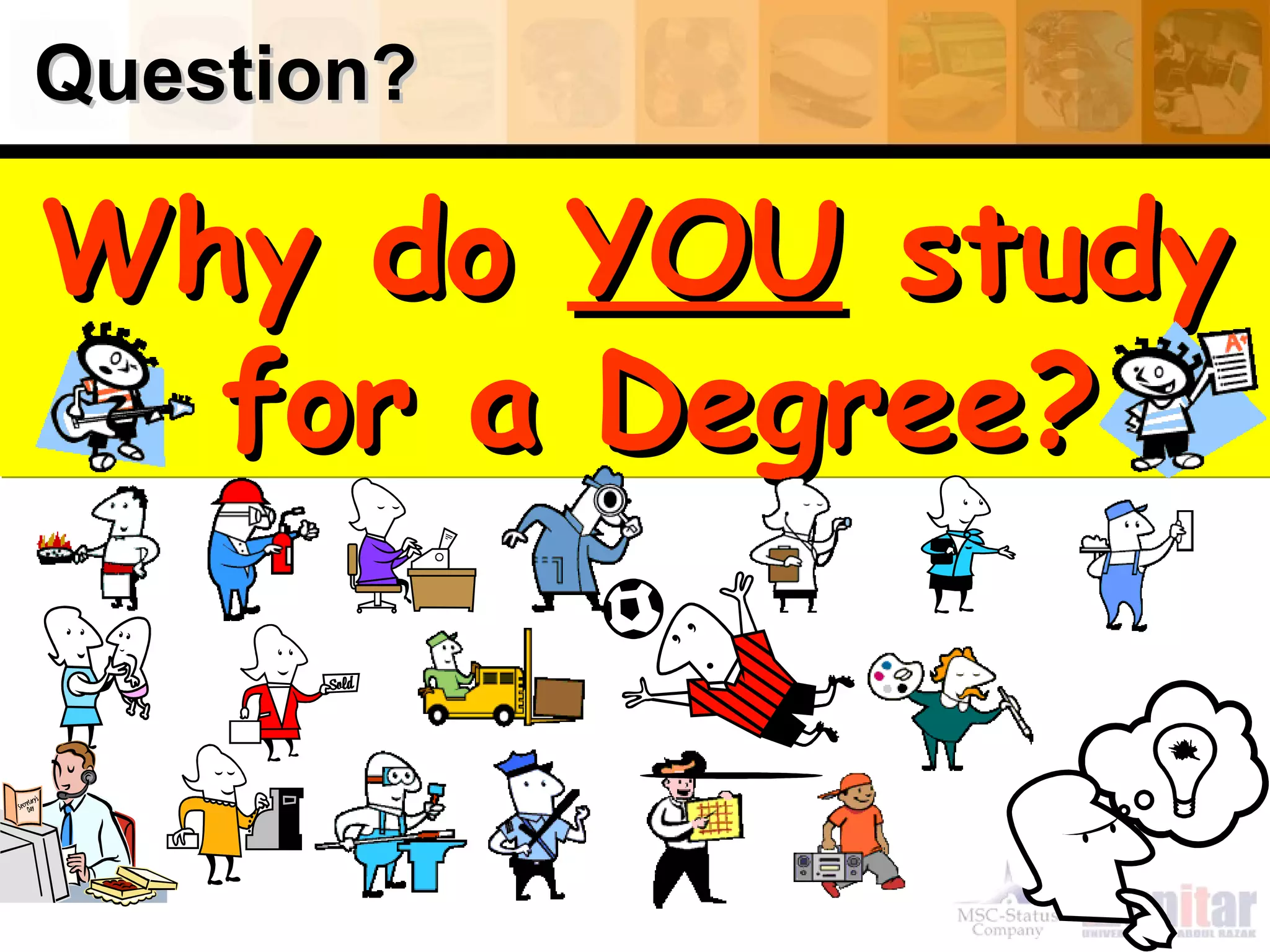
Question? Why do  YOU  study for a Degree?
Do You Agree With This Statement? “ Some people study all their life and at their death they have   learned everything except to THINK ” –  Francois Domergue     Why?
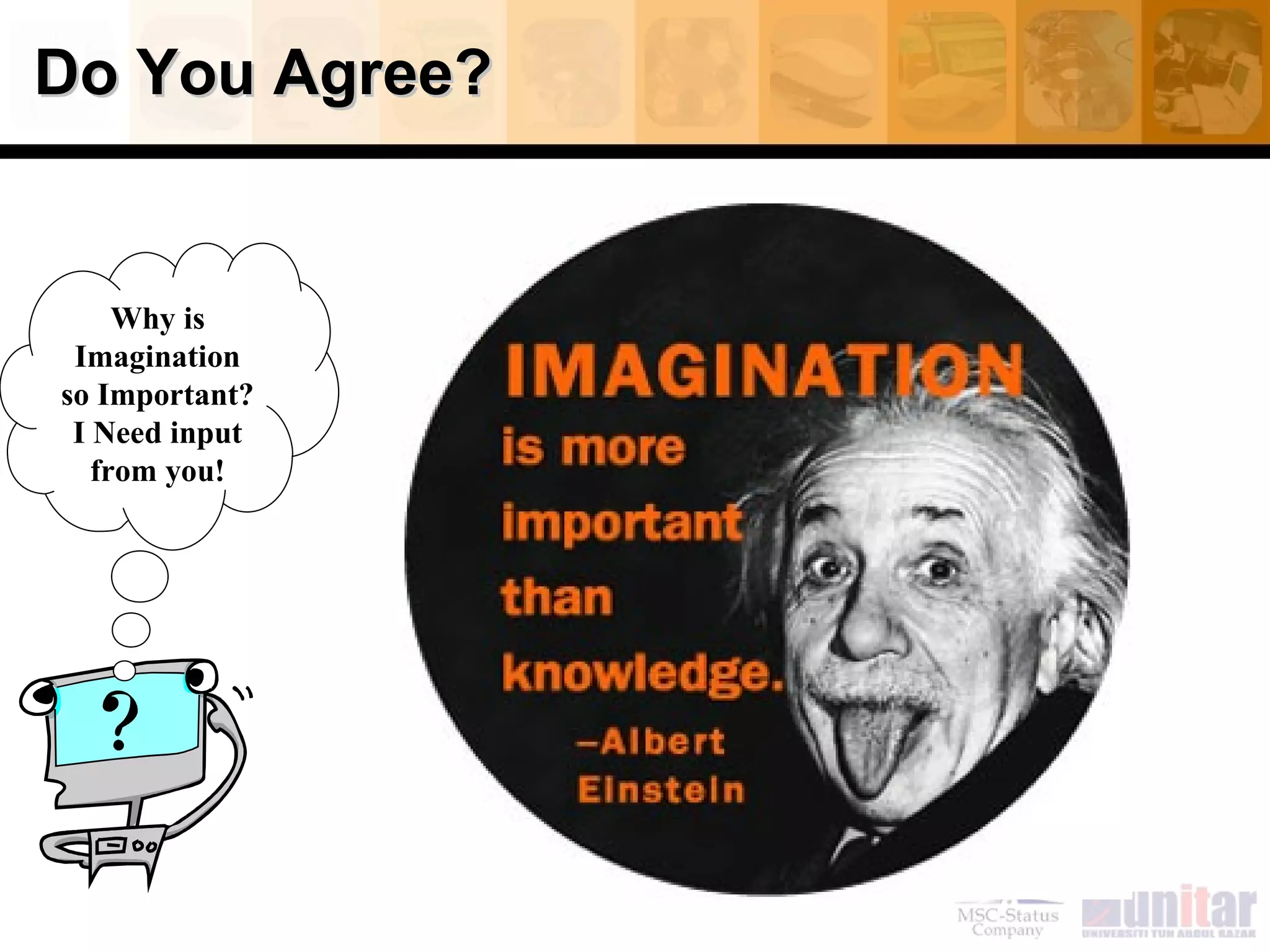
Do You Agree?  Why is Imagination so Important? I Need input from you!
Why does UNITAR have this course? To help you improve your Thinking Skills   HOW TO THINK!
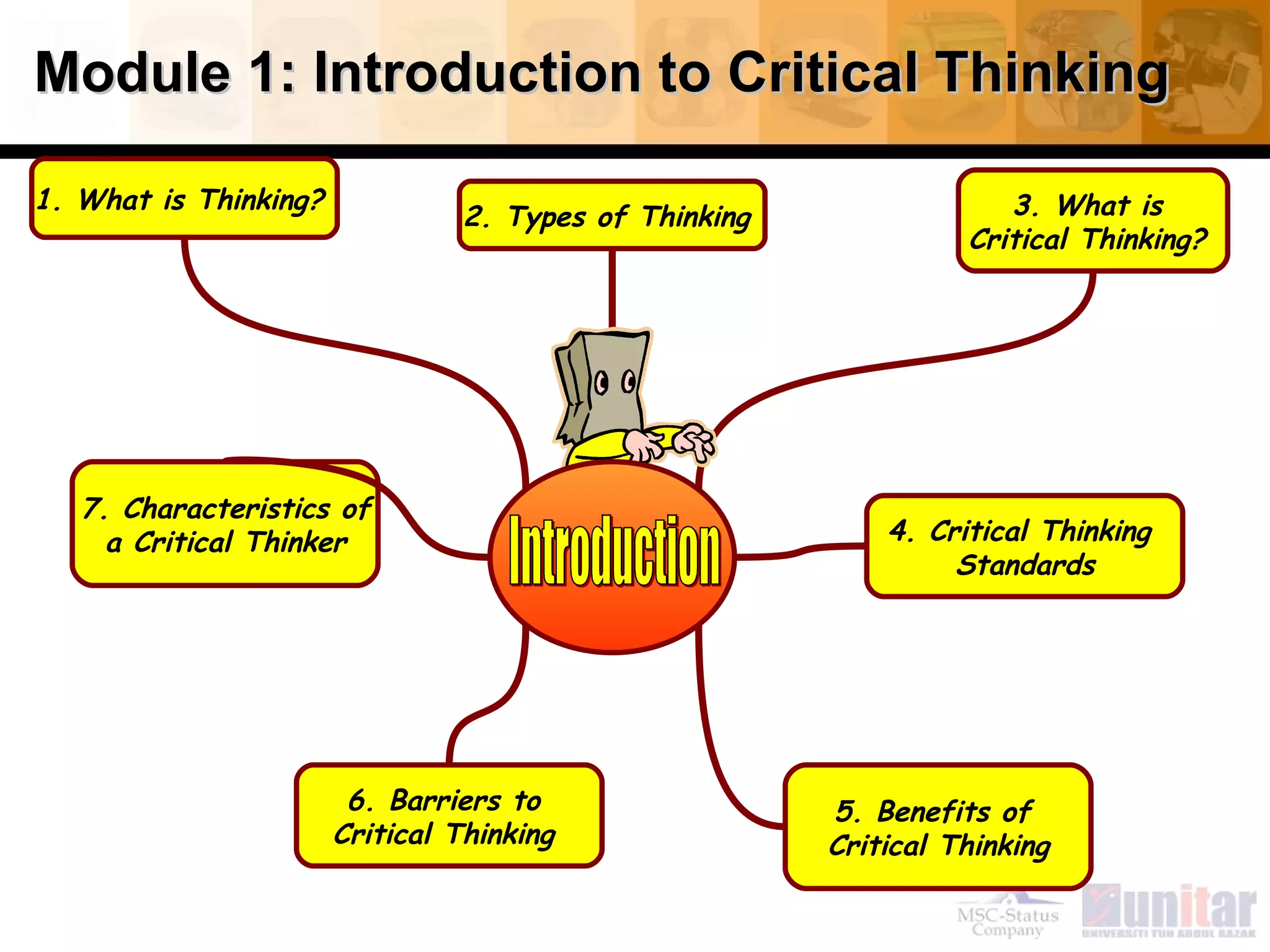
Module 1: Introduction to Critical Thinking 1. What is Thinking?  6. Barriers to  Critical Thinking  2. Types of Thinking  4. Critical Thinking  Standards 5. Benefits of  Critical Thinking 7. Characteristics of a Critical Thinker  3. What is  Critical Thinking?  Introduction
What is Thinking?
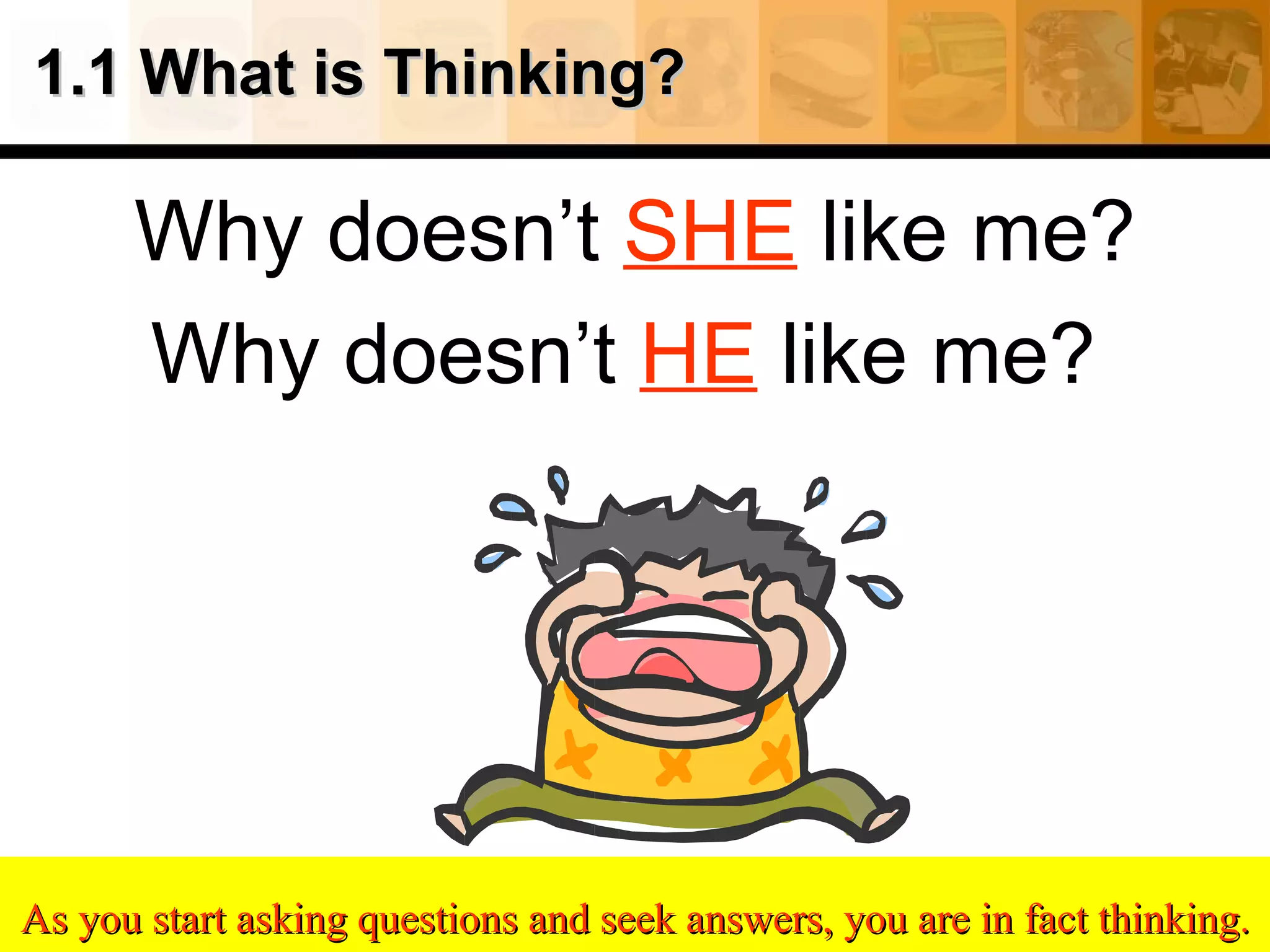
1.1 What is Thinking? Why doesn’t  SHE  like me? Why doesn’t  HE  like me?  As you start asking questions and seek answers, you are in fact thinking.
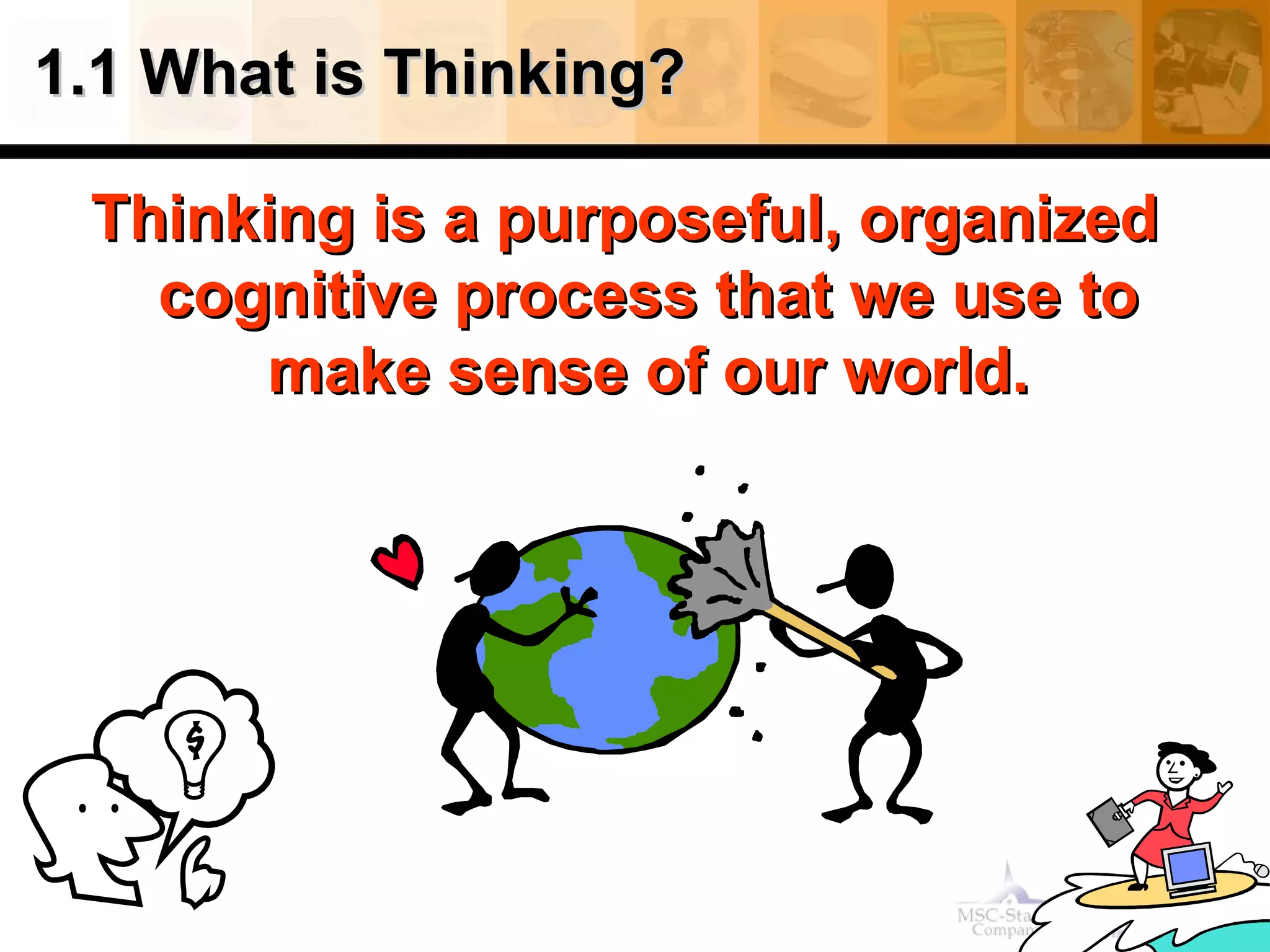
1.1 What is Thinking?  Thinking is a purposeful, organized cognitive process that we use to make sense of our world.
Types of Thinking
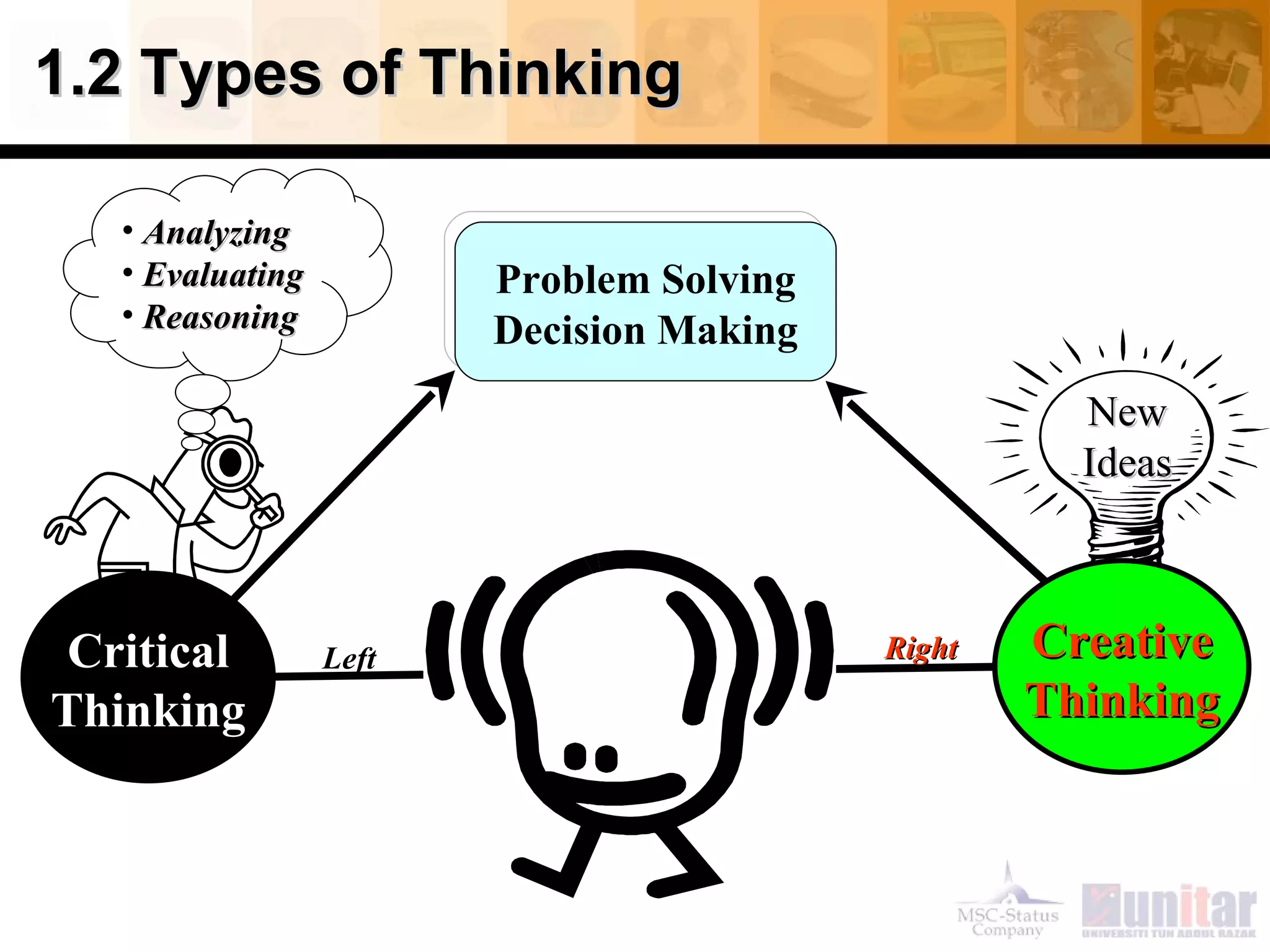
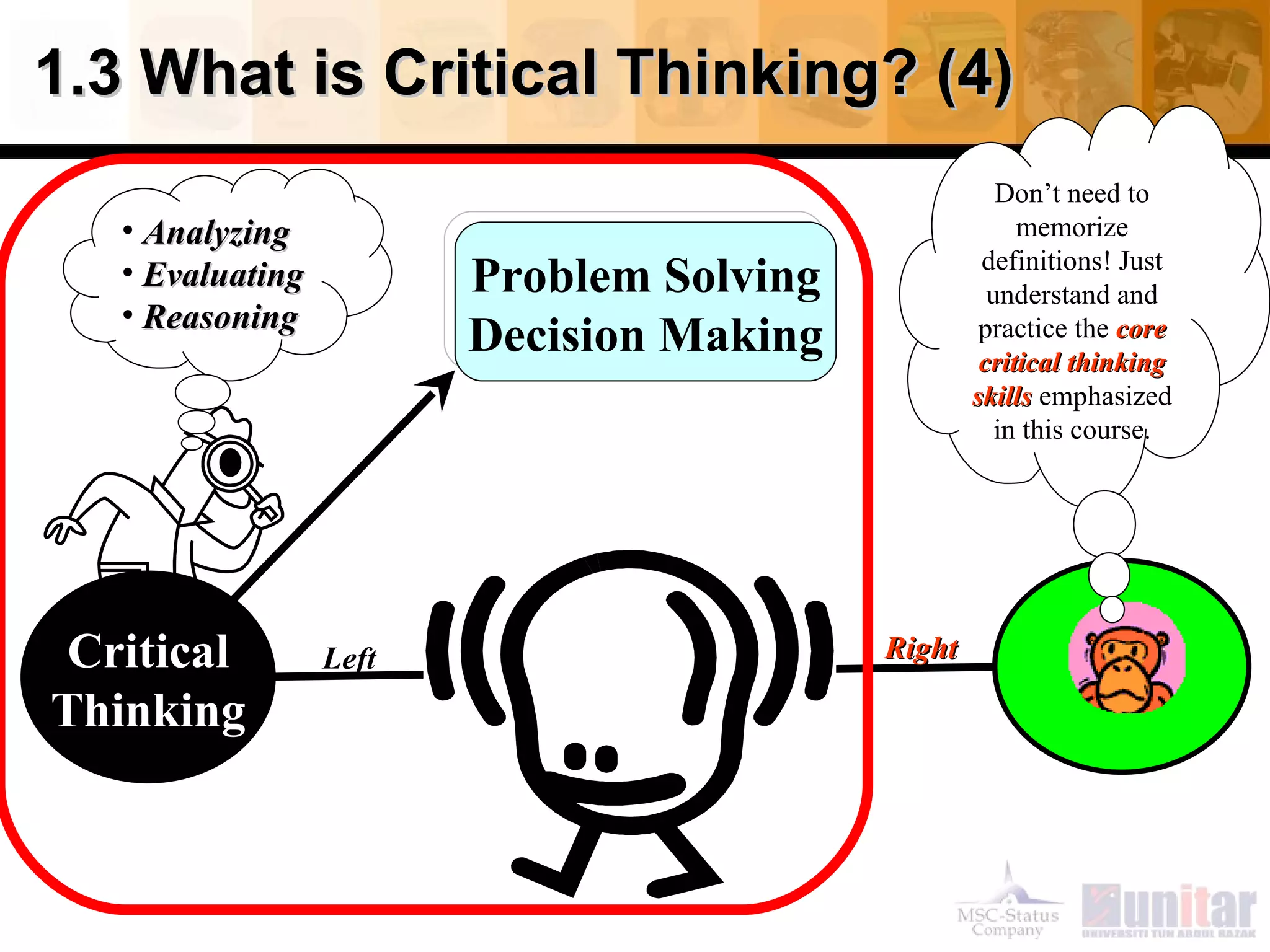
1.2 Types of Thinking Problem Solving Decision Making Right Left Critical Thinking Analyzing Evaluating Reasoning New Ideas Creative Thinking
What is Critical Thinking?
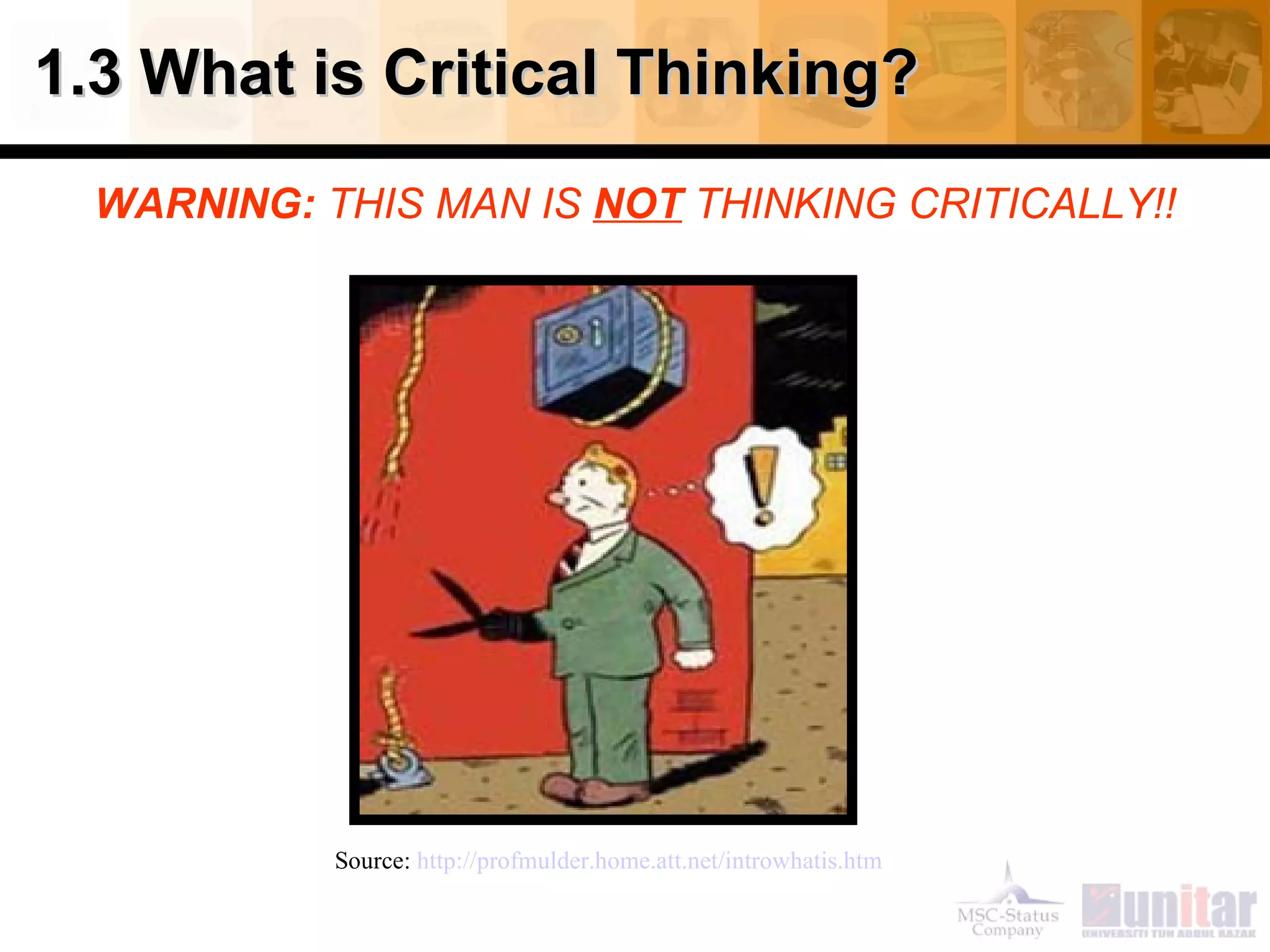
1.3 What is Critical Thinking? WARNING:  THIS MAN IS  NOT  THINKING CRITICALLY!! Source:  http://profmulder.home.att.net/introwhatis.htm
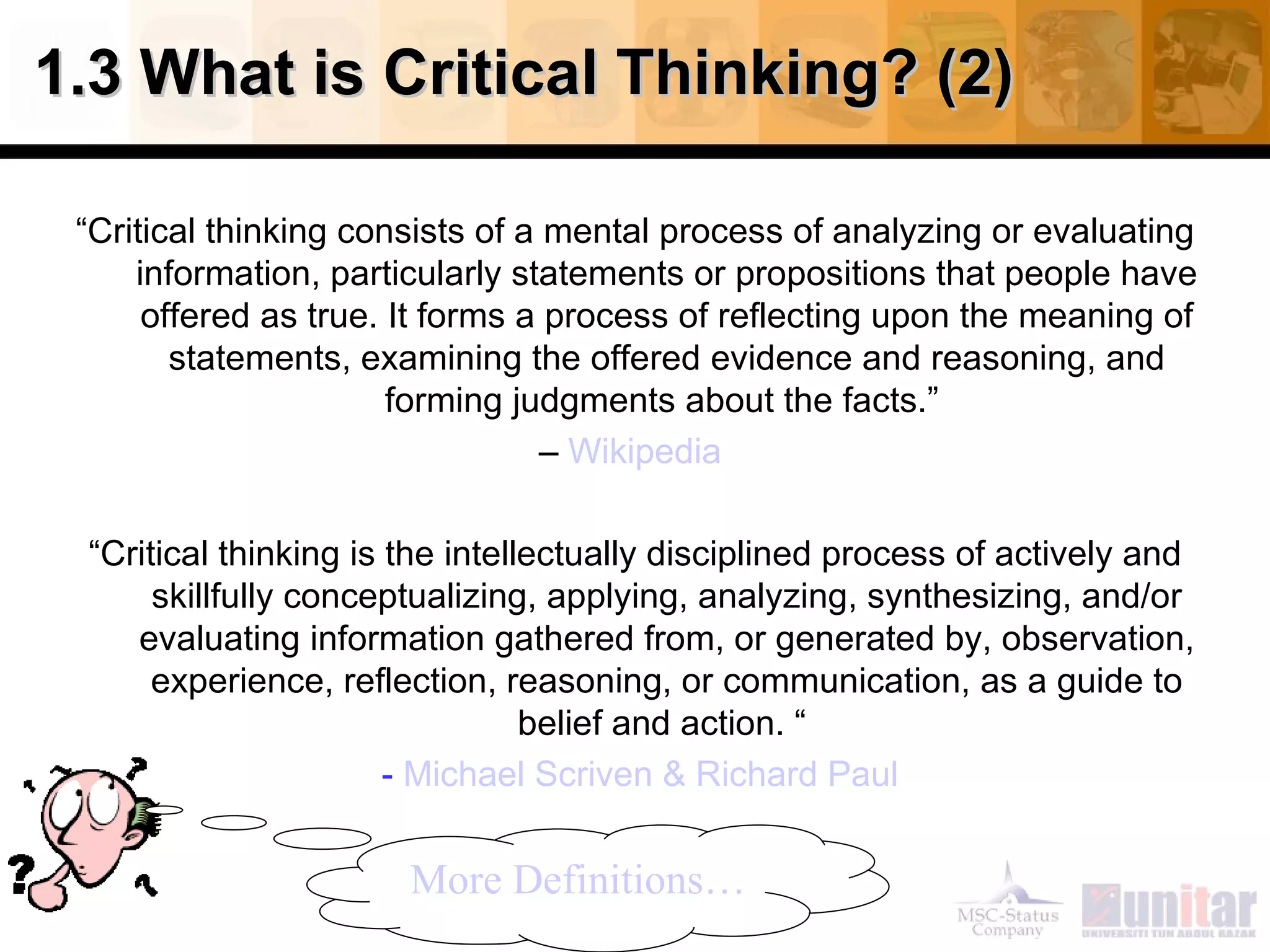
1.3 What is Critical Thinking? (2) “ Critical thinking consists of a mental process of analyzing or evaluating information, particularly statements or propositions that people have offered as true. It forms a process of reflecting upon the meaning of statements, examining the offered evidence and reasoning, and forming judgments about the facts.”  –  Wikipedia   “ Critical thinking is the intellectually disciplined process of actively and skillfully conceptualizing, applying, analyzing, synthesizing, and/or evaluating information gathered from, or generated by, observation, experience, reflection, reasoning, or communication, as a guide to belief and action. “  -  Michael  Scriven  & Richard Paul More Definitions…
1.3 What is Critical Thinking? (3) Critical Thinking  is the general term given to a wide range of cognitive and intellectual skills needed to: Effectively identify, analyze, and evaluate arguments. Discover and overcome personal prejudices and biases. Formulate and present convincing reasons in support of conclusions. Make reasonable, intelligent decisions about what to believe and what to do.
1.3 What is Critical Thinking? (4)  Problem Solving Decision Making Right Left Don’t need to memorize definitions! Just understand and practice the  core critical thinking skills  emphasized in this course. Critical Thinking Analyzing Evaluating Reasoning
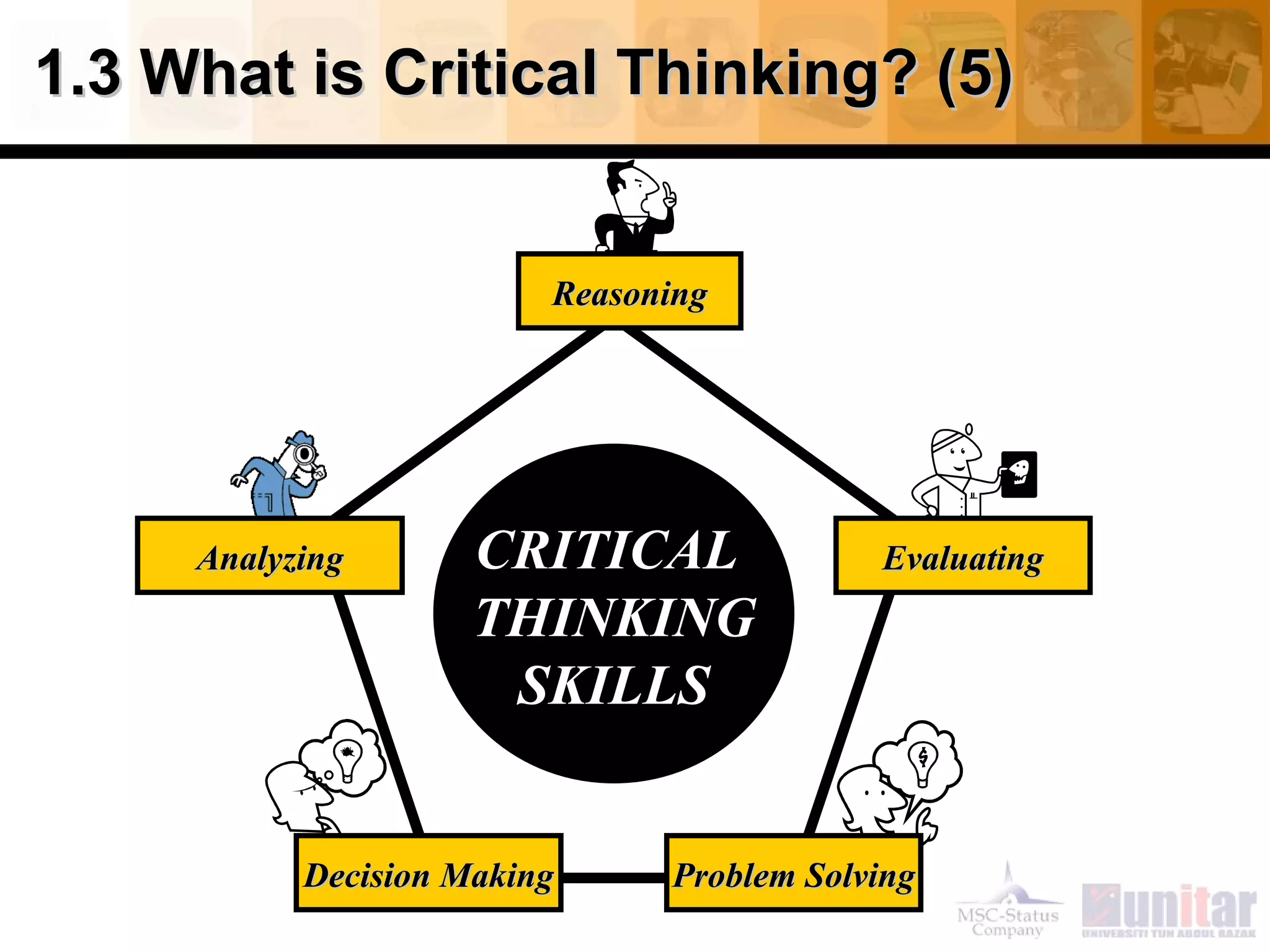
1.3 What is Critical Thinking? (5) CRITICAL  THINKING SKILLS Analyzing Reasoning Evaluating Decision Making Problem Solving
Critical Thinking Standards
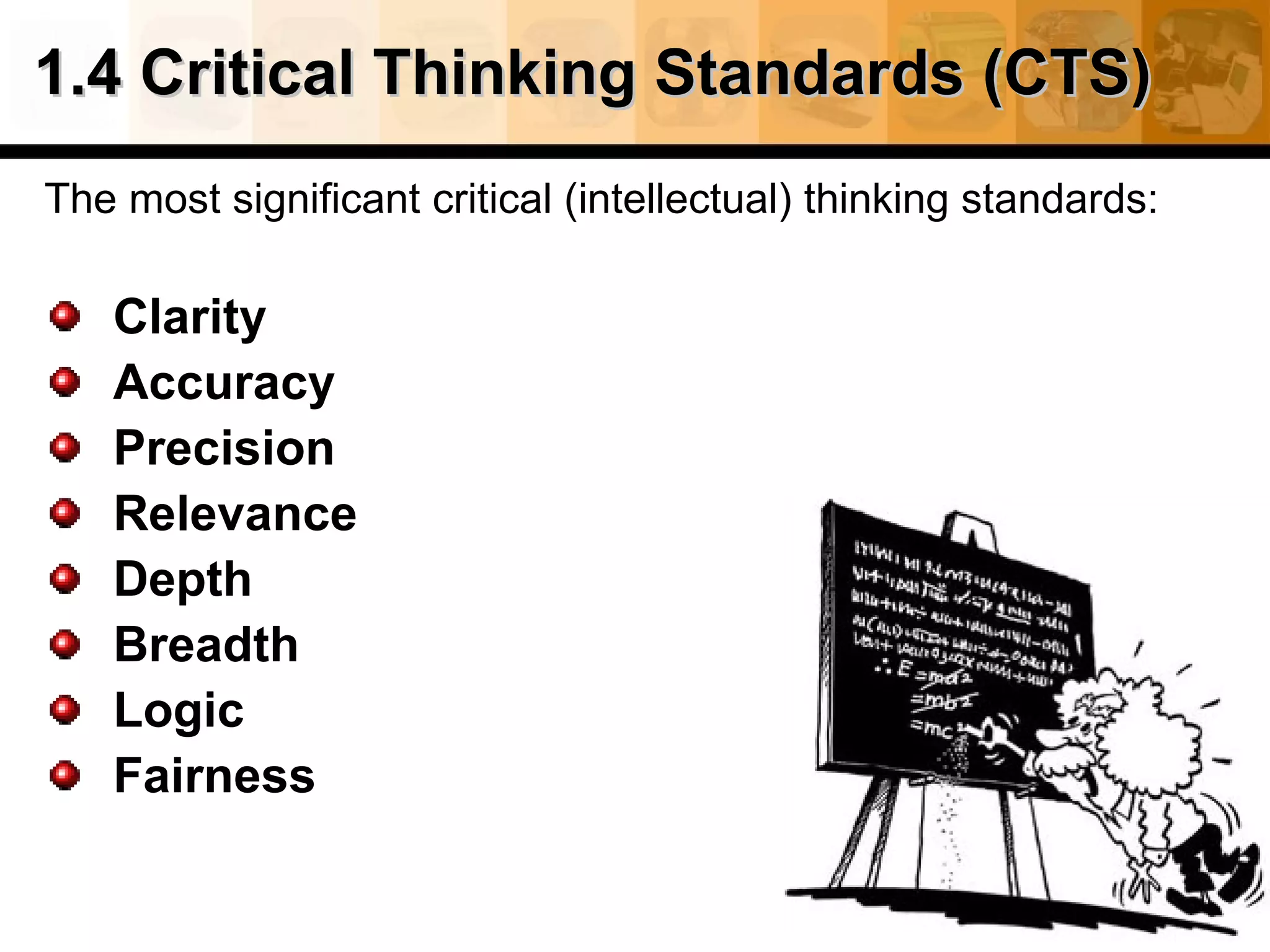
1.4 Critical Thinking Standards (CTS) The most significant critical (intellectual) thinking standards: Clarity Accuracy  Precision  Relevance  Depth  Breadth  Logic  Fairness
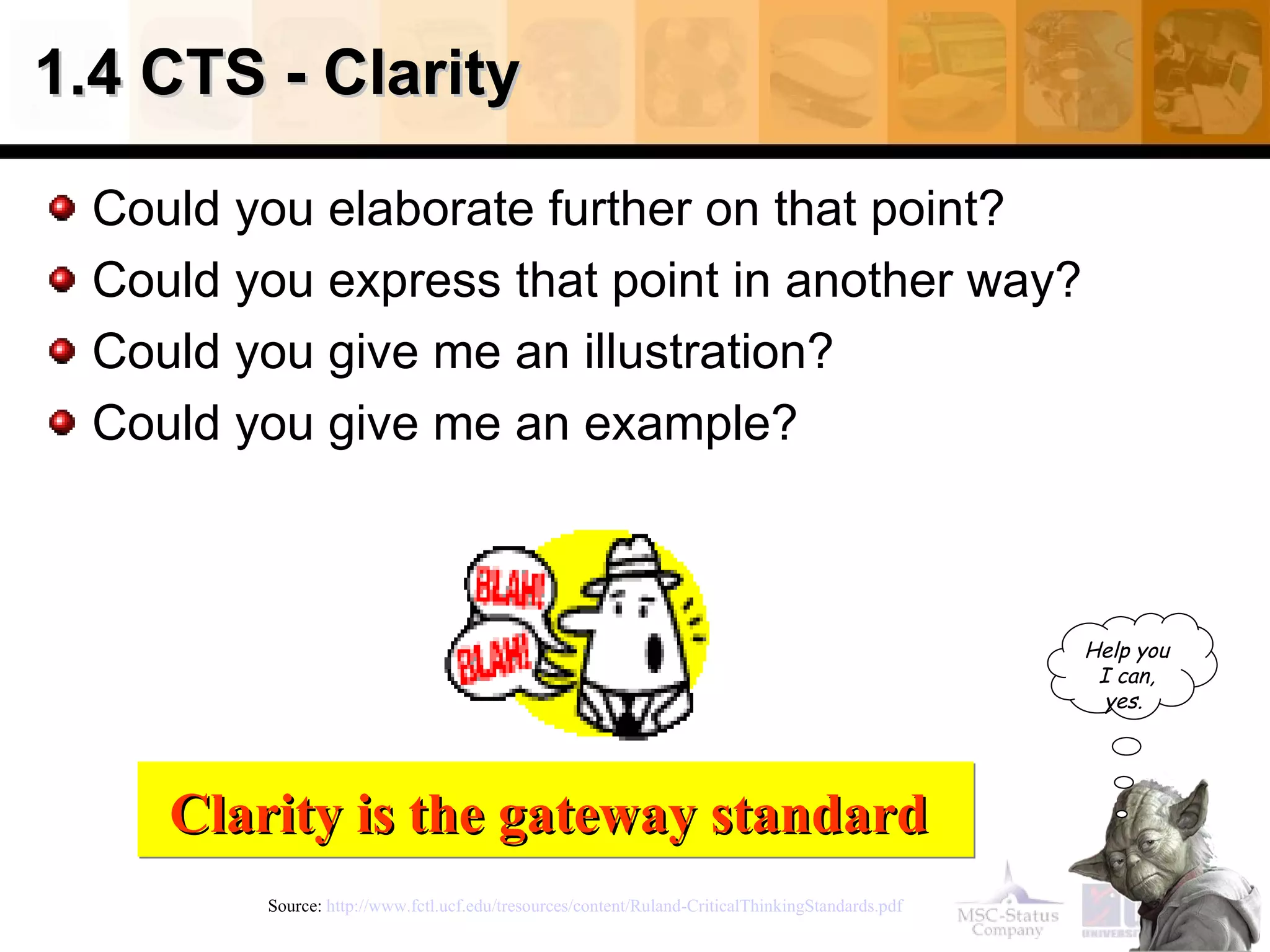
1.4 CTS - Clarity Could you elaborate further on that point? Could you express that point in another way? Could you give me an illustration? Could you give me an example? Source:  http://www.fctl.ucf.edu/tresources/content/Ruland-CriticalThinkingStandards.pdf   Clarity is the gateway standard   Help you I can, yes.
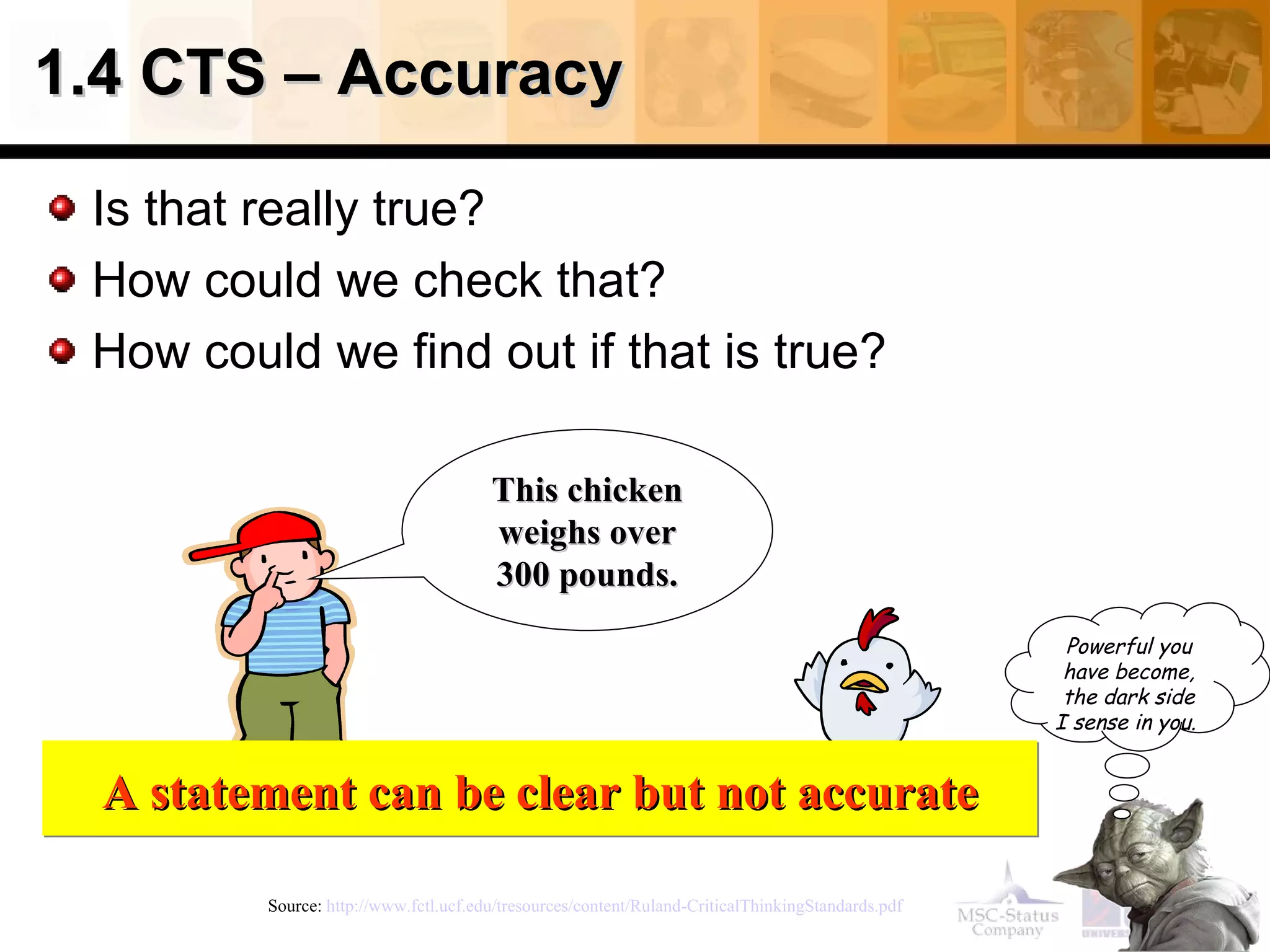
1.4 CTS – Accuracy  Is that really true? How could we check that? How could we find out if that is true? Source:  http://www.fctl.ucf.edu/tresources/content/Ruland-CriticalThinkingStandards.pdf   This chicken weighs over 300 pounds. A statement can be clear but not accurate Powerful you have become, the dark side I sense in you.
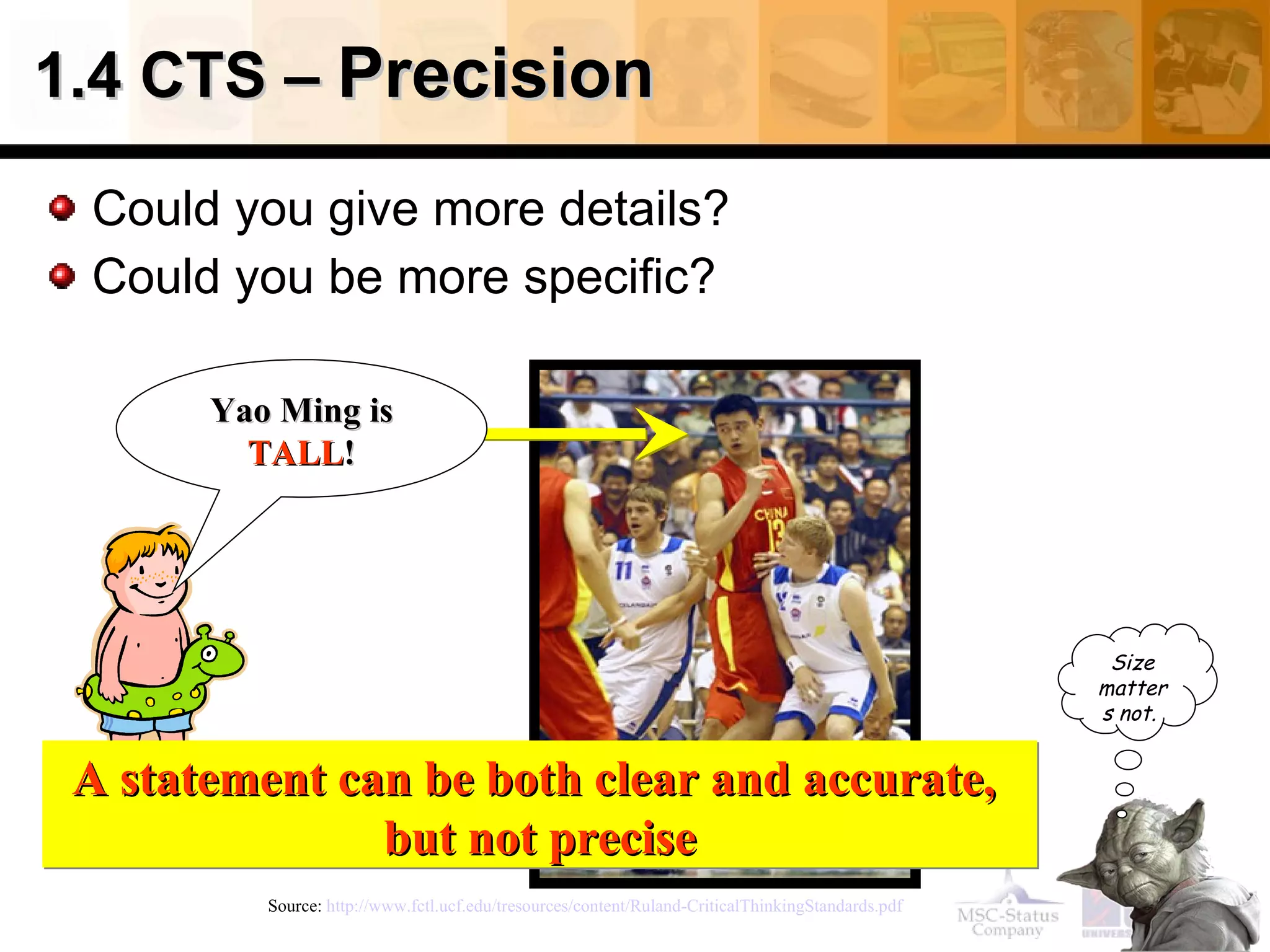
1.4 CTS –  Precision Could you give more details? Could you be more specific?   Source:  http://www.fctl.ucf.edu/tresources/content/Ruland-CriticalThinkingStandards.pdf   A statement can be both clear and accurate,  but not precise Yao Ming is  TALL ! Size matters not.
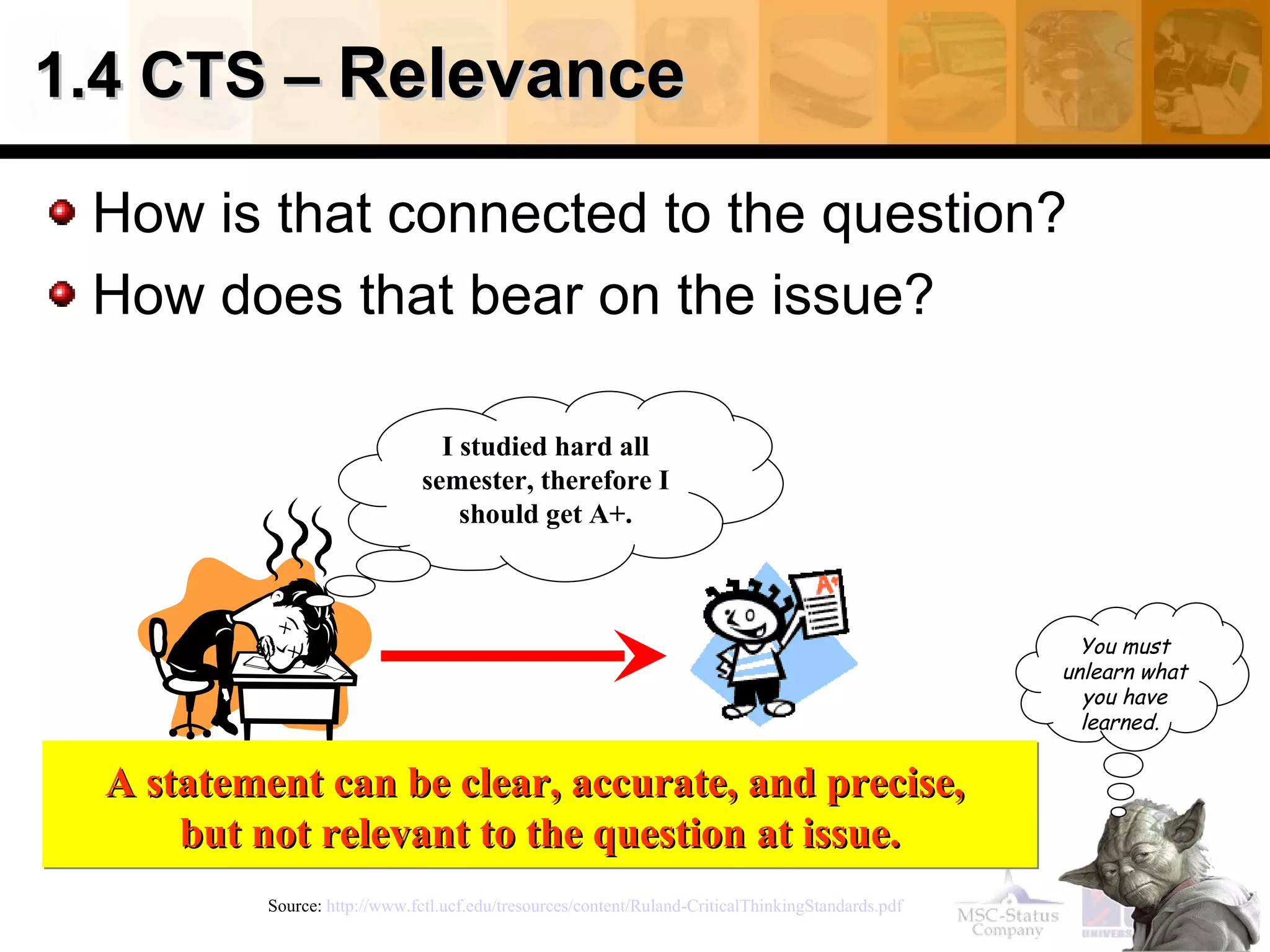
1.4 CTS –  Relevance How is that connected to the question? How does that bear on the issue? Source:  http://www.fctl.ucf.edu/tresources/content/Ruland-CriticalThinkingStandards.pdf   I studied hard all semester, therefore I should get A+. A statement can be clear, accurate, and precise,  but not relevant to the question at issue. You must unlearn what you have learned.
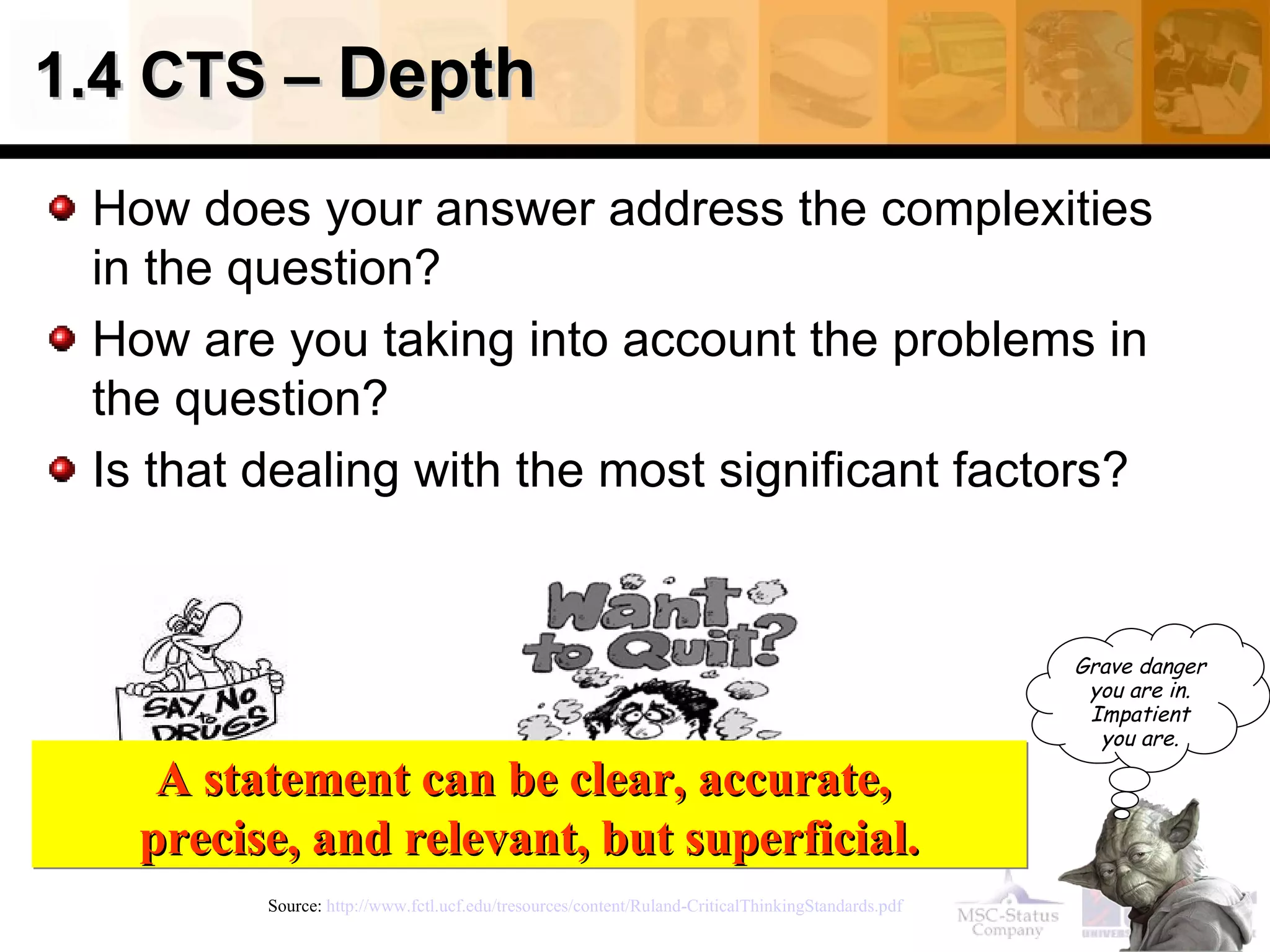
1.4 CTS –  Depth How does your answer address the complexities in the question? How are you taking into account the problems in the question? Is that dealing with the most significant factors? Source:  http://www.fctl.ucf.edu/tresources/content/Ruland-CriticalThinkingStandards.pdf   A statement can be clear, accurate,  precise, and relevant, but superficial. Grave danger you are in. Impatient you are.
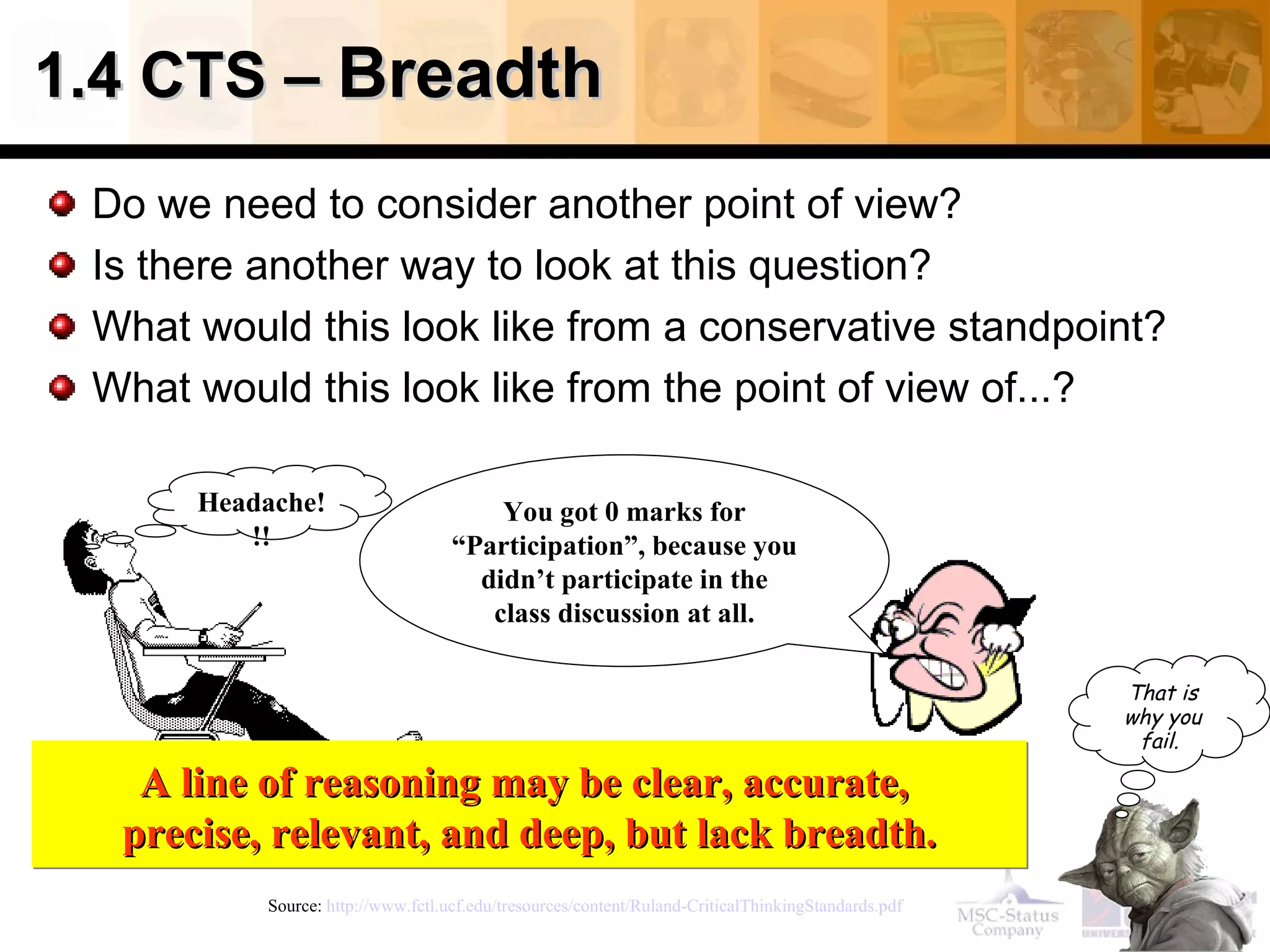
1.4 CTS –  Breadth Do we need to consider another point of view? Is there another way to look at this question? What would this look like from a conservative standpoint? What would this look like from the point of view of...? Source:  http://www.fctl.ucf.edu/tresources/content/Ruland-CriticalThinkingStandards.pdf   A line of reasoning may be clear, accurate,  precise, relevant, and deep, but lack breadth. Headache!!! You got 0 marks for “Participation”, because you didn’t participate in the class discussion at all. That is why you fail .
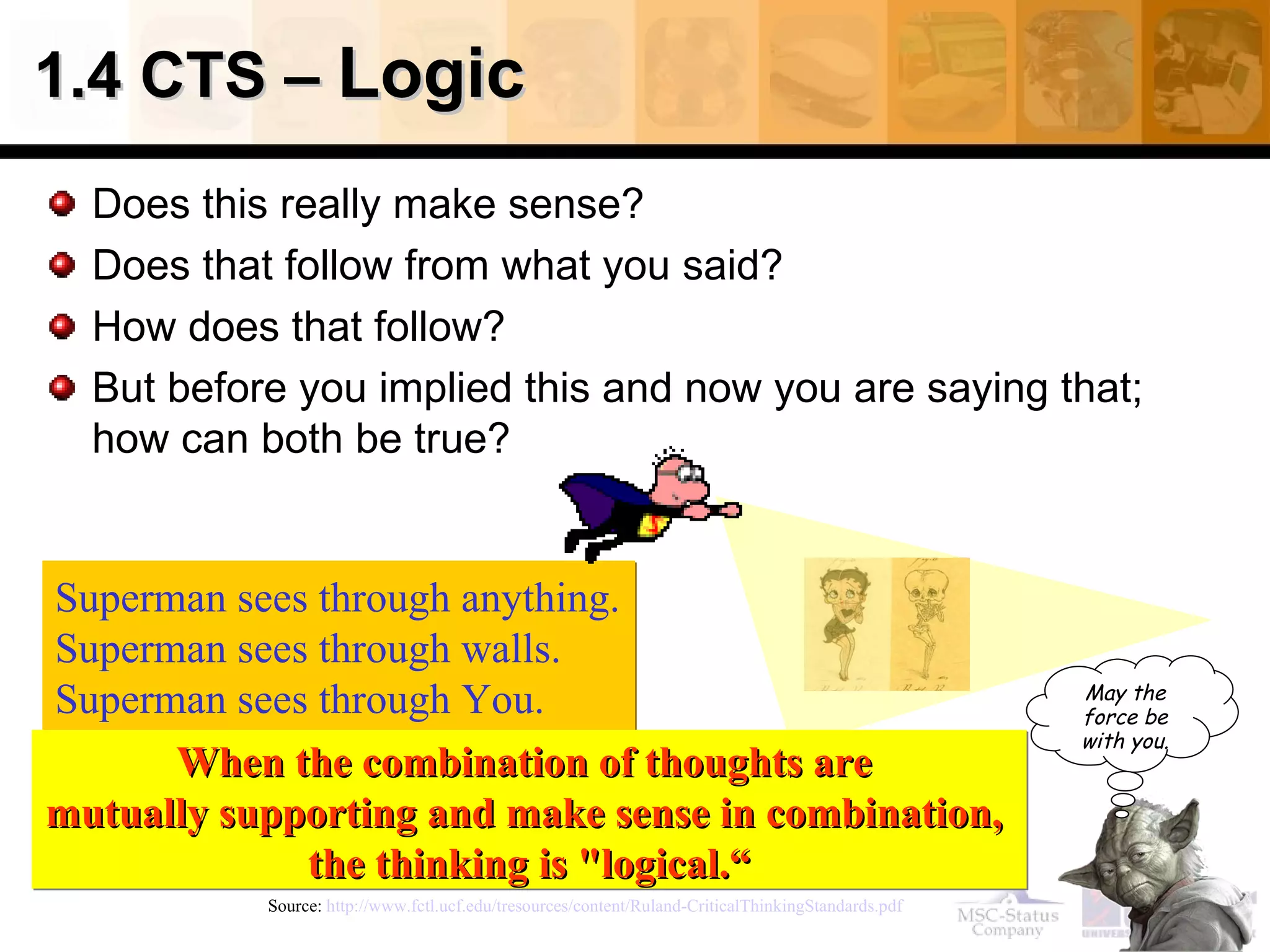
1.4 CTS –  Logic  Does this really make sense? Does that follow from what you said? How does that follow? But before you implied this and now you are saying that; how can both be true? Source:  http://www.fctl.ucf.edu/tresources/content/Ruland-CriticalThinkingStandards.pdf   Superman sees through anything. Superman sees through walls. Superman sees through You.   When the combination of thoughts are  mutually supporting and make sense in combination,  the thinking is "logical.“ May the force be with you.
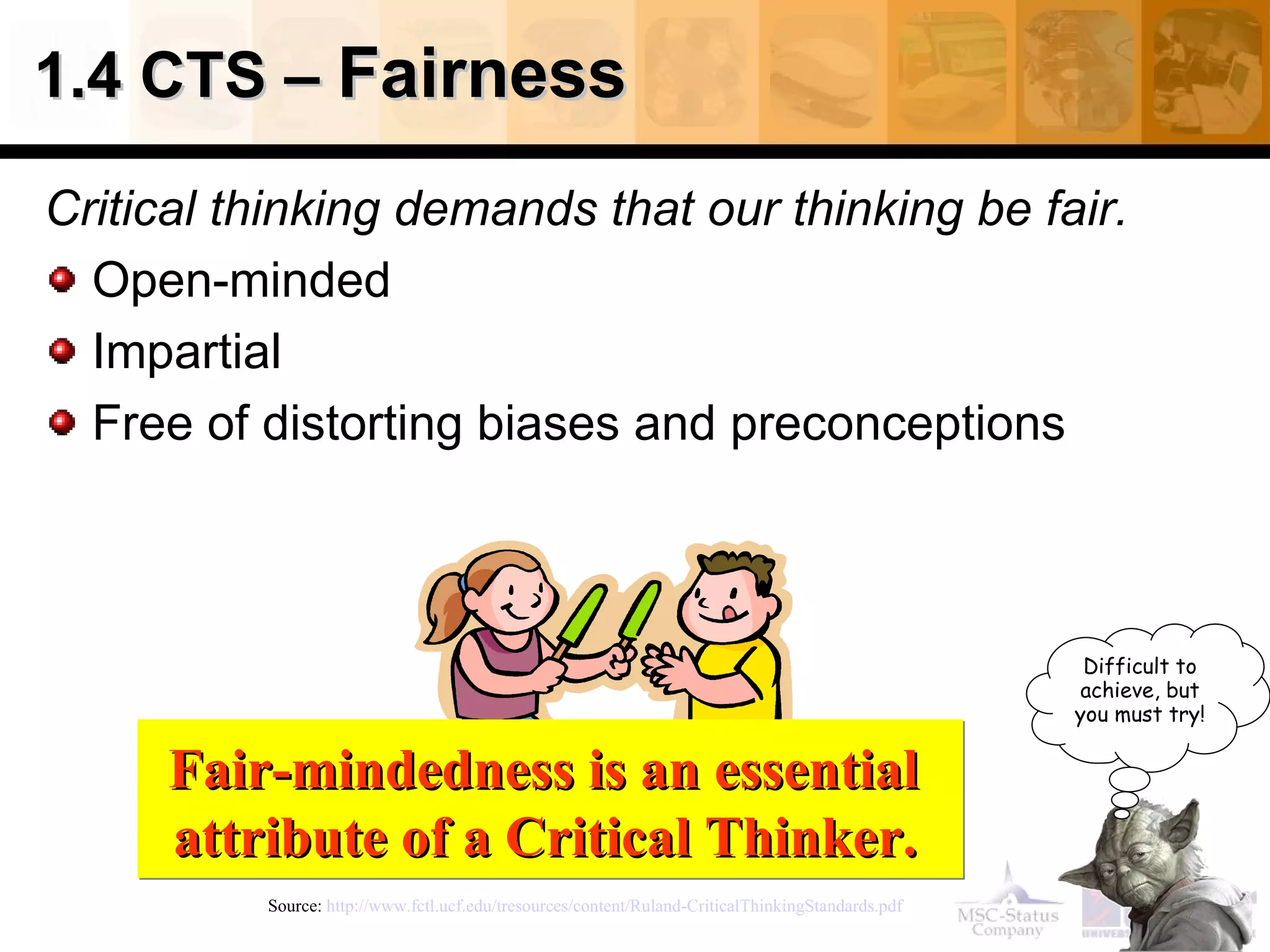
1.4 CTS –  Fairness Critical thinking demands that our thinking be fair. Open-minded  Impartial Free of distorting biases and preconceptions Source:  http://www.fctl.ucf.edu/tresources/content/Ruland-CriticalThinkingStandards.pdf   Fair-mindedness is an essential  attribute of a Critical Thinker.   Difficult to achieve, but you must try!
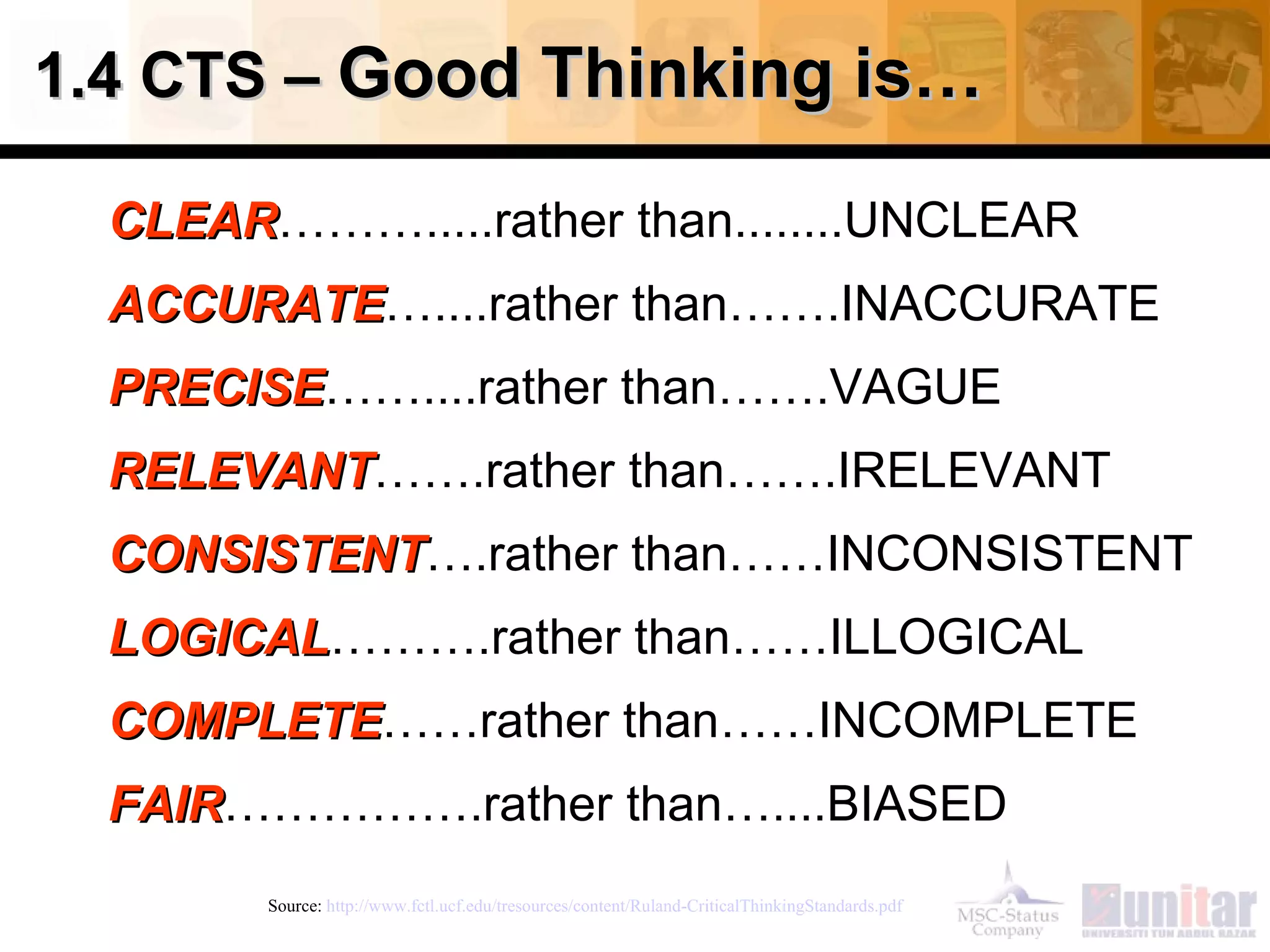
1.4 CTS –  Good Thinking is… CLEAR ……….....rather than........UNCLEAR ACCURATE …....rather than…….INACCURATE PRECISE ……....rather than…….VAGUE RELEVANT …….rather than…….IRELEVANT CONSISTENT ….rather than……INCONSISTENT LOGICAL ……….rather than……ILLOGICAL COMPLETE ……rather than……INCOMPLETE FAIR …………….rather than…....BIASED Source:  http://www.fctl.ucf.edu/tresources/content/Ruland-CriticalThinkingStandards.pdf
Benefits of Critical Thinking
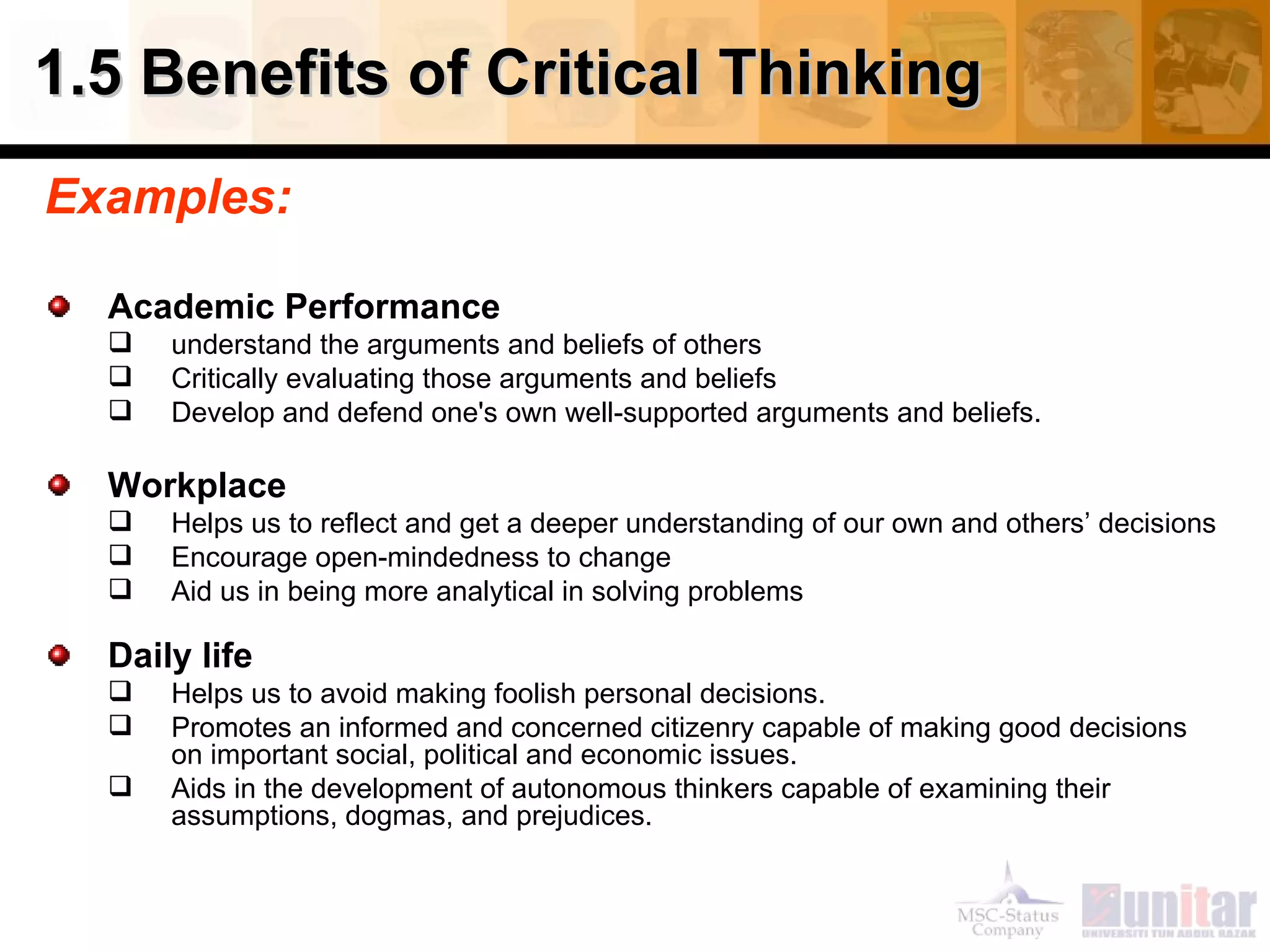
1.5 Benefits of Critical Thinking Examples: Academic Performance understand the arguments and beliefs of others Critically evaluating those arguments and beliefs Develop and defend one's own well-supported arguments and beliefs. Workplace Helps us to reflect and get a deeper understanding of our own and others’ decisions Encourage open-mindedness to change Aid us in being more analytical in solving problems Daily life Helps us to avoid making foolish personal decisions. Promotes an informed and concerned citizenry capable of making good decisions on important social, political and economic issues.  Aids in the development of autonomous thinkers capable of examining their assumptions, dogmas, and prejudices.
Barriers to Critical Thinking
1.6 Barriers to Critical Thinking If Critical Thinking is so important, why is it that  uncritical thinking is so common ? Why is that so many people including many highly educated and intelligent people  find critical thinking so difficult?
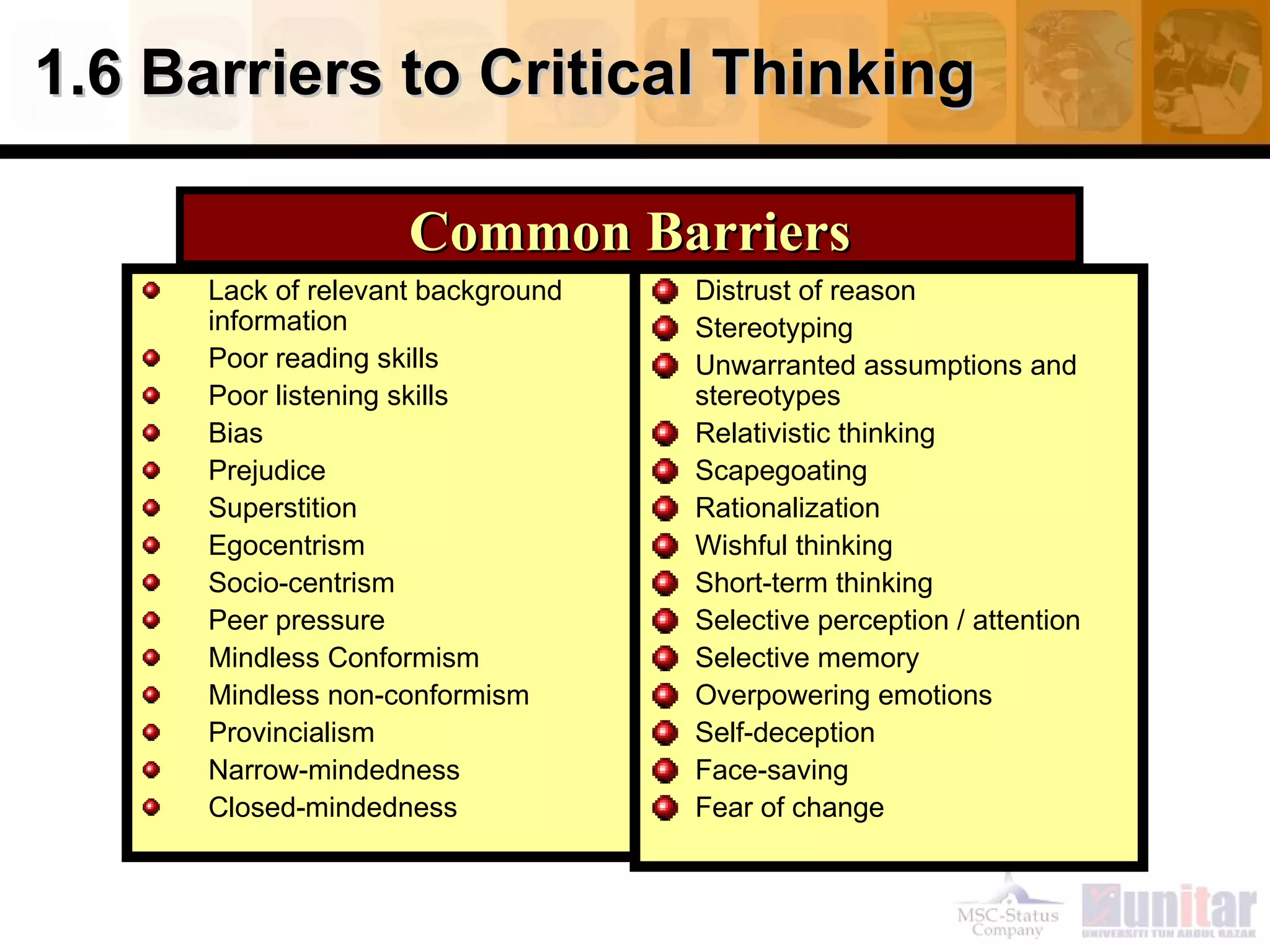
1.6 Barriers to Critical Thinking Lack of relevant background information Poor reading skills Poor listening skills Bias Prejudice Superstition Egocentrism  Socio-centrism  Peer pressure Mindless Conformism Mindless non-conformism Provincialism Narrow-mindedness Closed-mindedness Distrust of reason Stereotyping Unwarranted assumptions and stereotypes  Relativistic thinking Scapegoating Rationalization  Wishful thinking Short-term thinking Selective perception / attention Selective memory Overpowering emotions  Self-deception Face-saving Fear of change Common Barriers
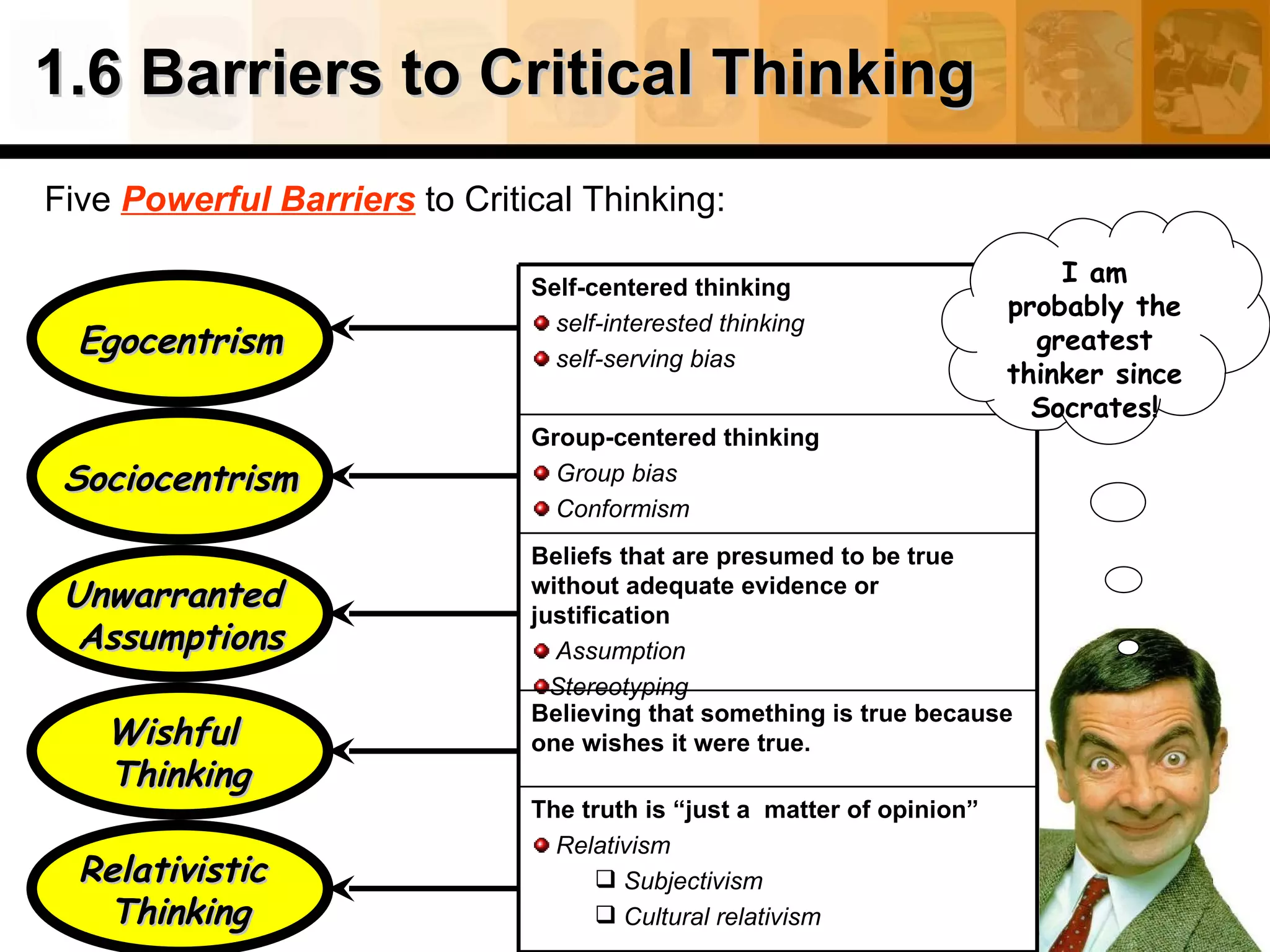
1.6 Barriers to Critical Thinking Five  Powerful Barriers  to Critical Thinking: Egocentrism Unwarranted  Assumptions Sociocentrism Relativistic  Thinking Wishful  Thinking I am probably the greatest thinker since Socrates! The truth is “just a  matter of opinion” Relativism Subjectivism Cultural relativism Believing that something is true because one wishes it were true. Beliefs that are presumed to be true without adequate evidence or justification Assumption   Stereotyping Group-centered thinking Group bias Conformism Self-centered thinking self-interested thinking  self-serving bias
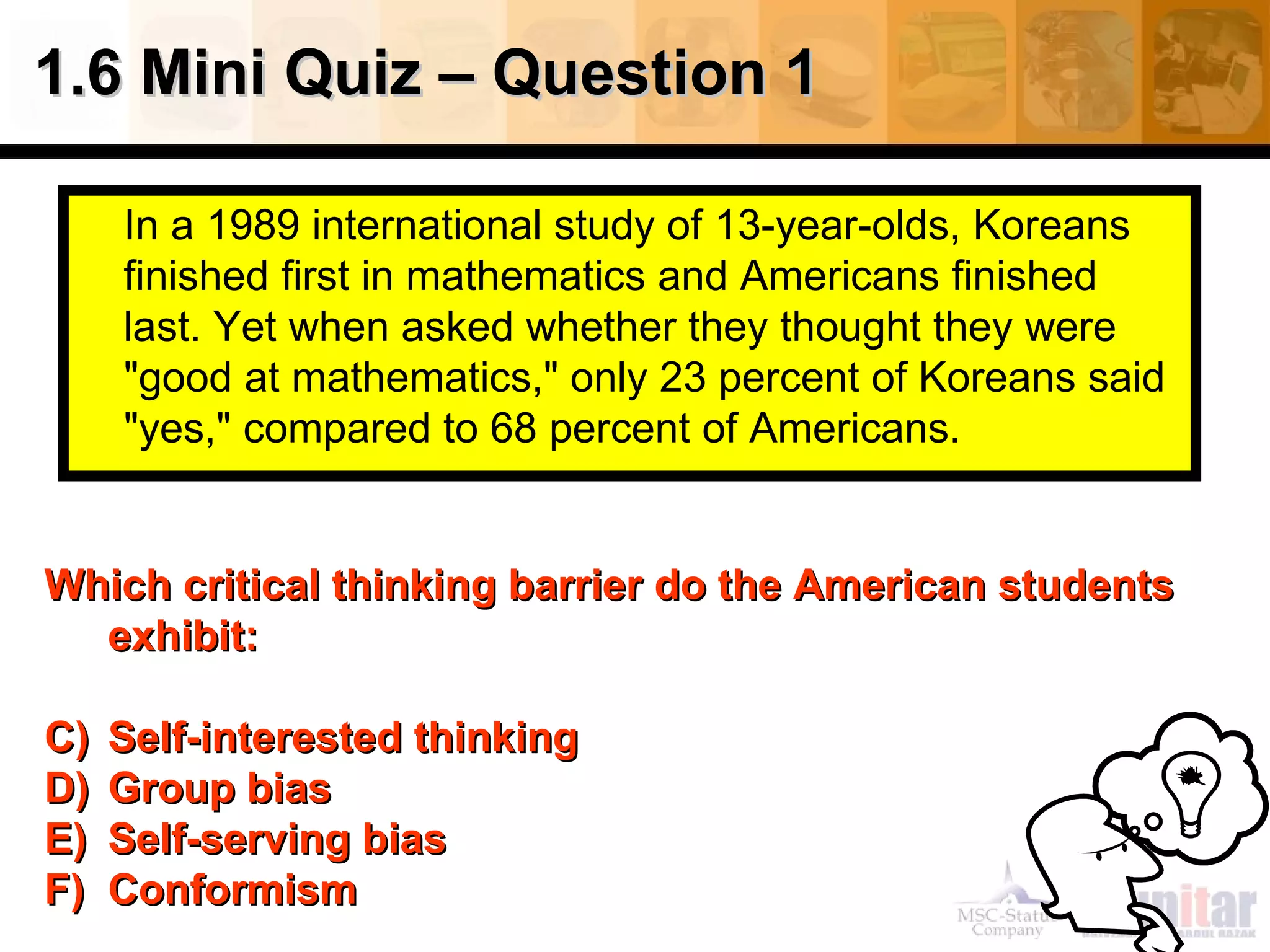
In a 1989 international study of 13-year-olds, Koreans finished first in mathematics and Americans finished last. Yet when asked whether they thought they were "good at mathematics," only 23 percent of Koreans said "yes," compared to 68 percent of Americans.  1.6 Mini Quiz – Question 1 Which critical thinking barrier do the American students exhibit: Self-interested thinking  Group bias Self-serving bias Conformism
1.6 Mini Quiz – Question 2 Which critical thinking barrier   does Ali display in this passage? A) Self-interested thinking  B) Group bias C) Self-serving bias D) Conformism Muhammad Ali [speaking in Zaire, Africa]: "There's no country  as great as the smallest city in America. I mean [here in Zaire]  you can't watch television. The water won't even run right.  The toilets won't flush. The roads, the cars- there's nothing as  great as America."
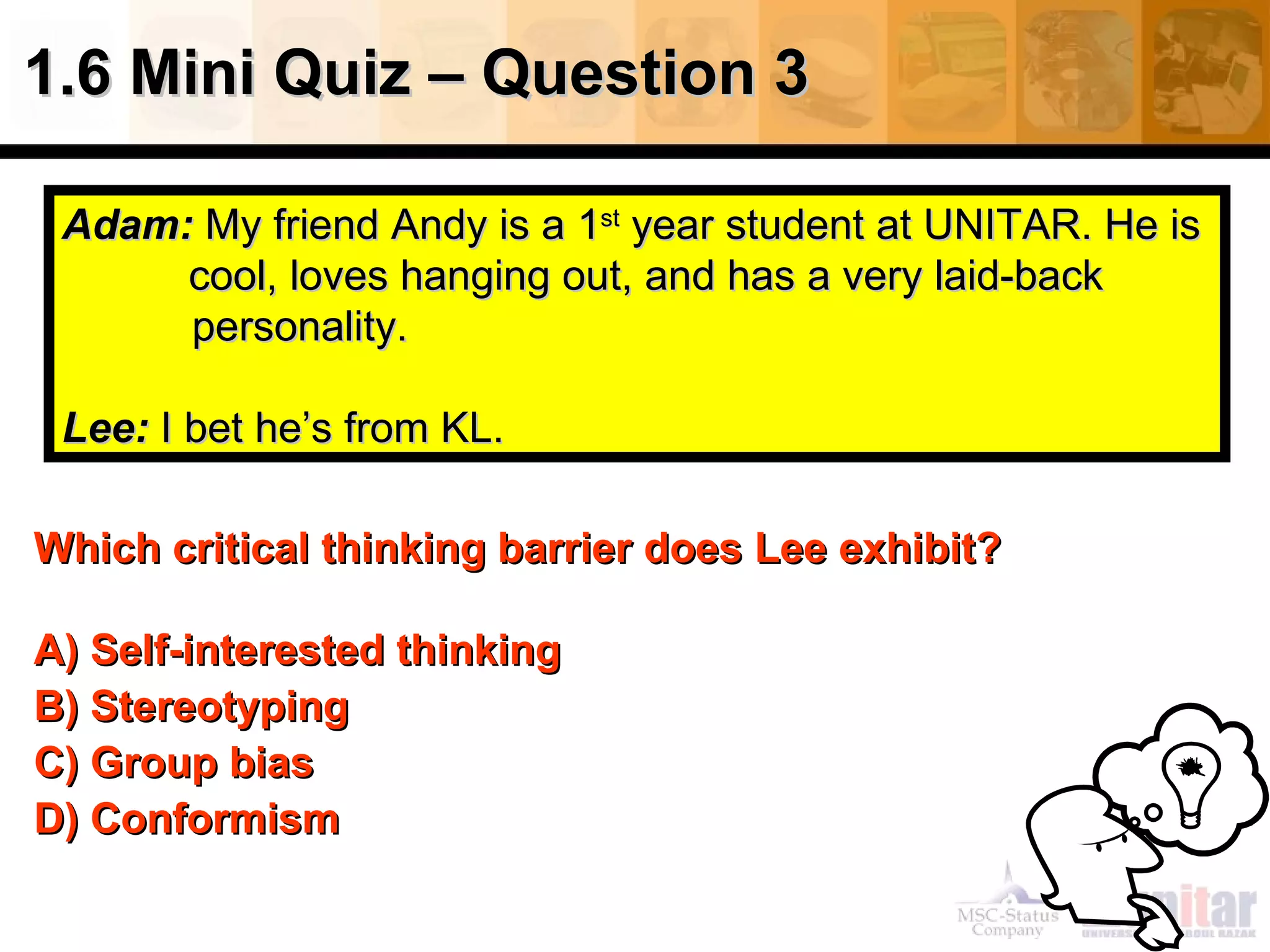
1.6 Mini Quiz – Question 3 Which critical thinking barrier   does Lee exhibit? A) Self-interested thinking  B) Stereotyping C) Group bias D) Conformism Adam:   My friend Andy is a 1 st  year student at UNITAR. He is  cool, loves hanging out, and has a very laid-back    personality.  Lee:  I bet he’s from KL.
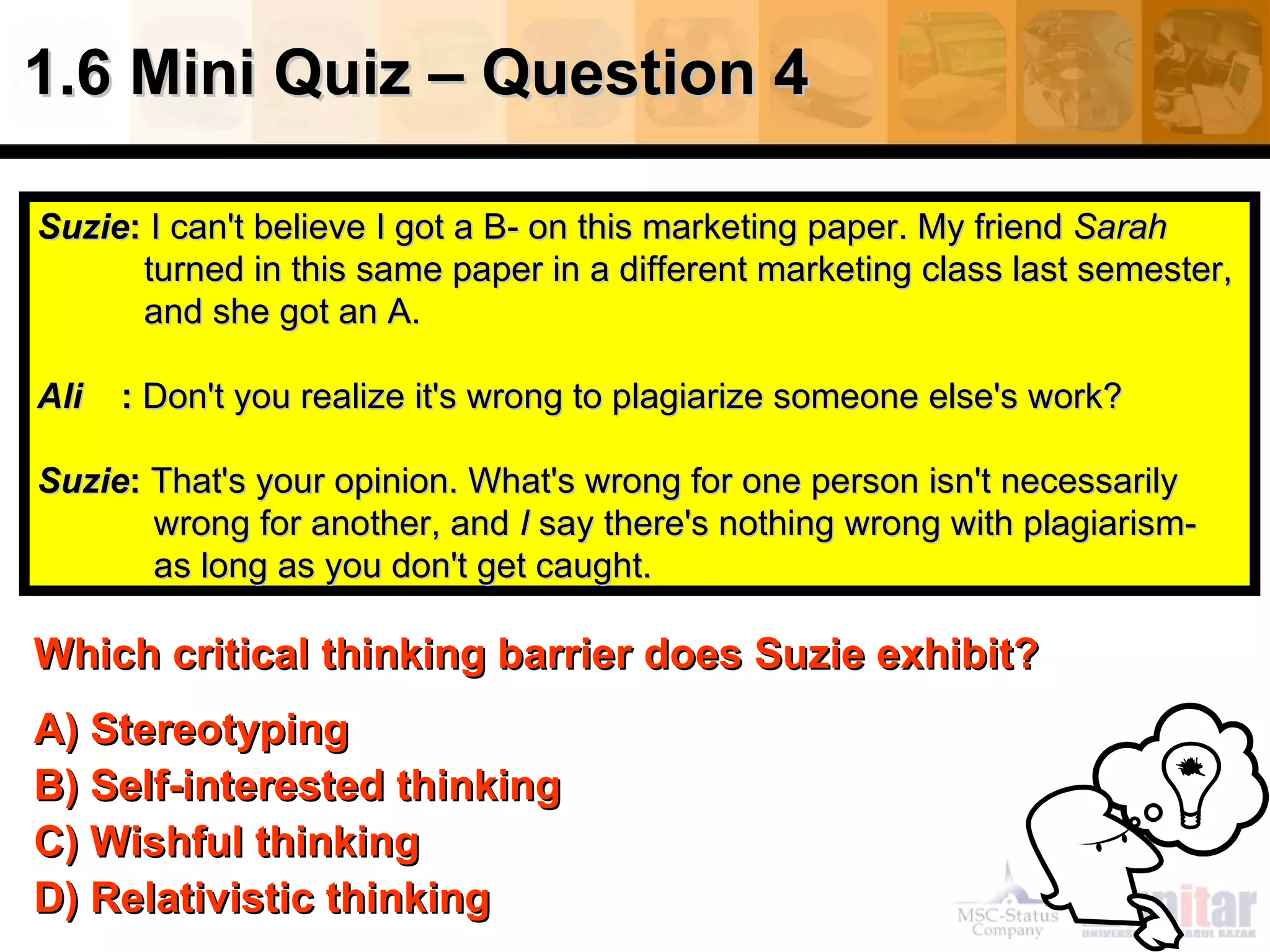
1.6 Mini Quiz – Question 4 Which critical thinking barrier   does Suzie exhibit? A) Stereotyping B) Self-interested thinking C) Wishful thinking D) Relativistic thinking Suzie :  I can't believe I got a B- on this marketing paper. My friend  Sarah   turned in this same paper in a different marketing class last semester,  and she got an A. Ali  :  Don't you realize it's wrong to plagiarize someone else's work? Suzie :  That's your opinion. What's wrong for one person isn't necessarily  wrong for another, and  I  say there's nothing wrong with plagiarism- as long as you don't get caught.
Characteristics of a Critical Thinker
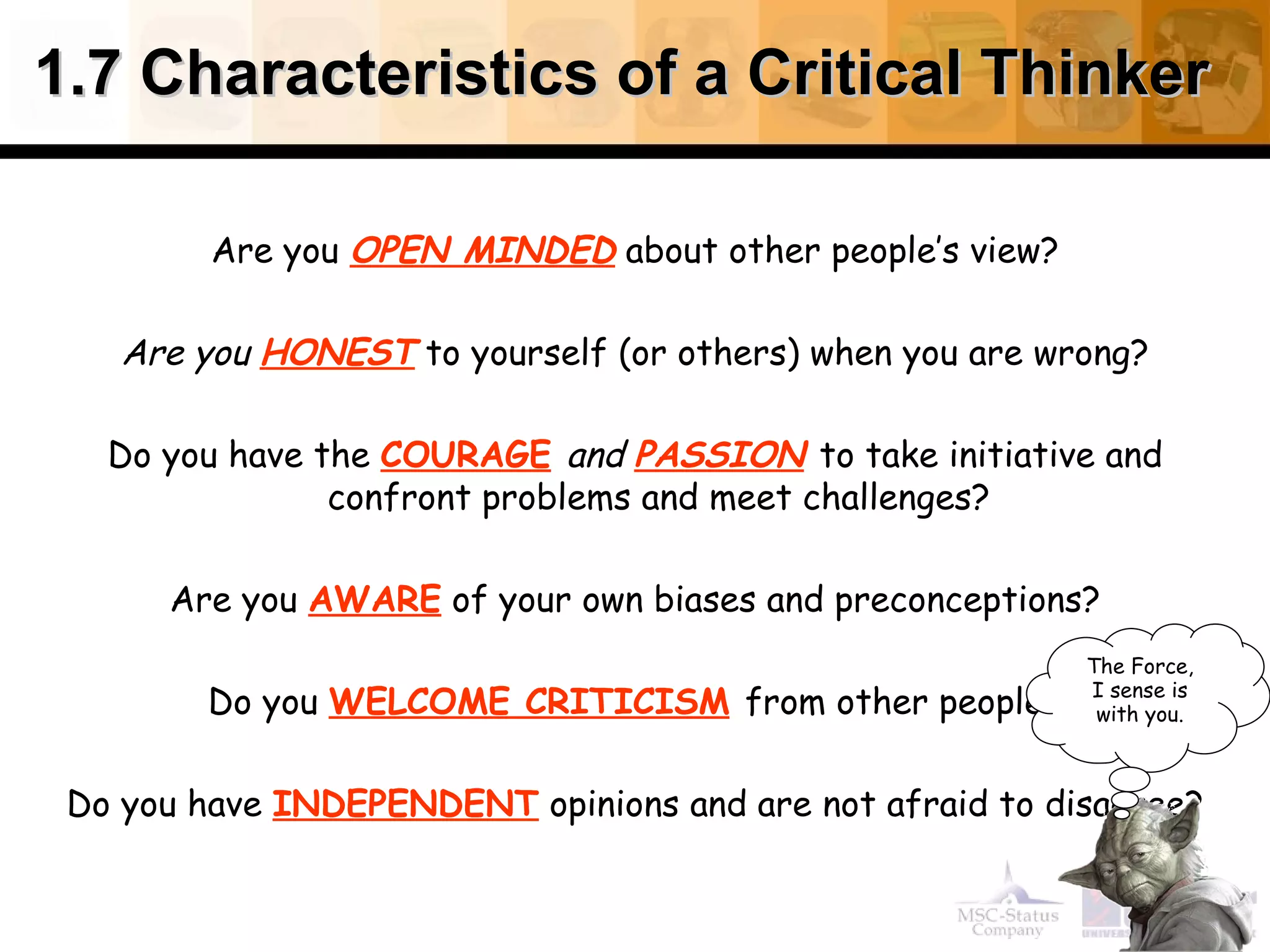
1.7 Characteristics of a Critical Thinker  Are you  OPEN MINDED  about other people’s view? Are you  HONEST  to yourself (or others) when you are wrong? Do you have the  COURAGE   and  PASSION   to take initiative and confront problems and meet challenges? Are you  AWARE  of your own biases and preconceptions? Do you  WELCOME CRITICISM   from other people? Do you have  INDEPENDENT  opinions and are not afraid to disagree? The Force, I sense is with you.
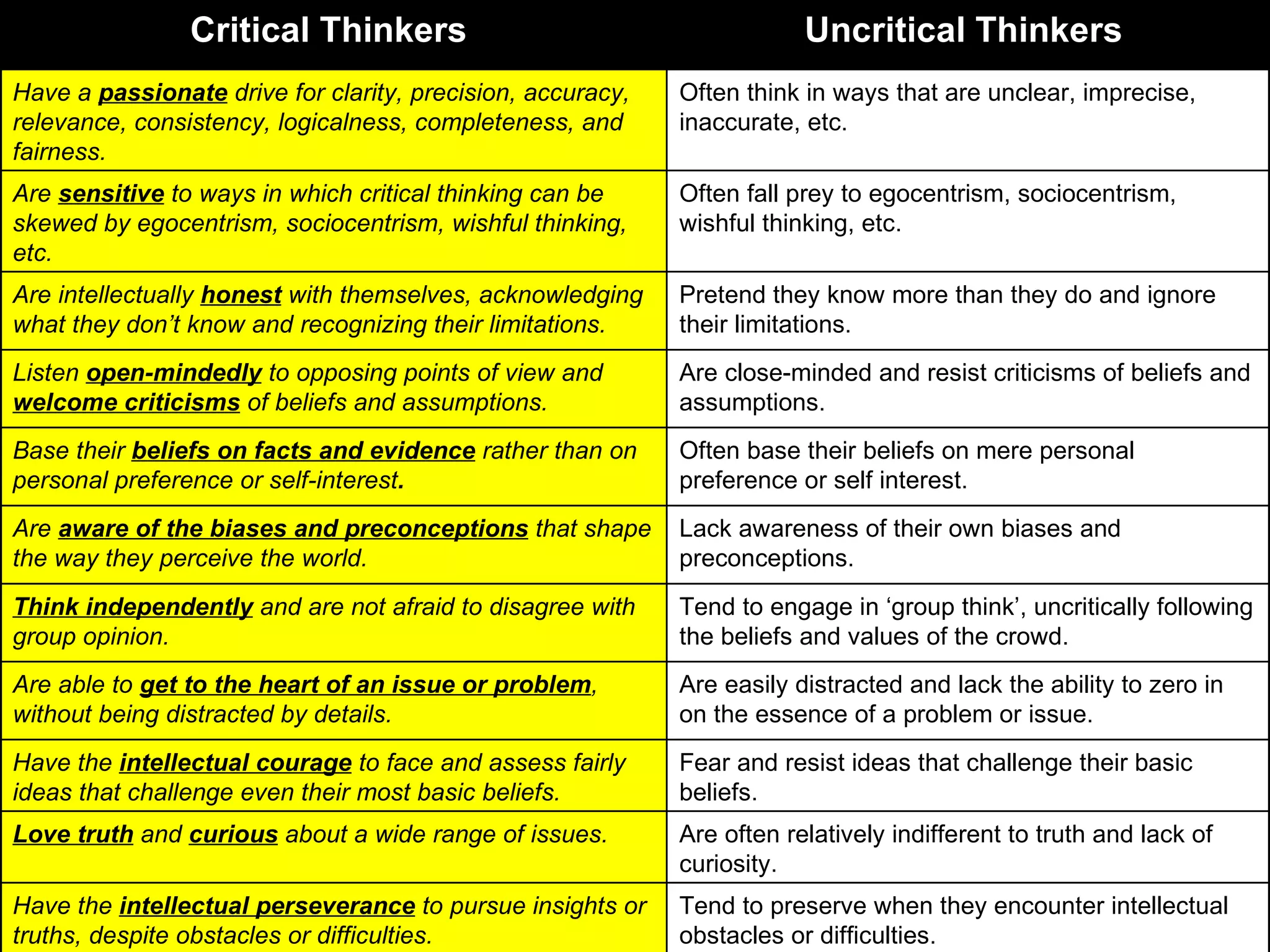
1.7 Characteristics of a Critical Thinker  Tend to preserve when they encounter intellectual obstacles or difficulties.  Have the  intellectual perseverance  to pursue insights or truths, despite obstacles or difficulties.   Are often relatively indifferent to truth and lack of curiosity.  Love truth  and  curious   about a wide range of issues.   Fear and resist ideas that challenge their basic beliefs.  Have the  intellectual courage  to face and assess fairly ideas that challenge even their most basic beliefs.   Are easily distracted and lack the ability to zero in on the essence of a problem or issue.  Are able to  get to the heart of an issue or problem , without being distracted by details.   Tend to engage in ‘group think’, uncritically following the beliefs and values of the crowd.  Think independently  and are not afraid to disagree with group opinion.   Lack awareness of their own biases and preconceptions.  Are  aware of the biases and preconceptions  that shape the way they perceive the world.   Often base their beliefs on mere personal preference or self interest.  Base their  beliefs on facts and evidence  rather than on personal preference or self-interest .   Are close-minded and resist criticisms of beliefs and assumptions.  Listen  open-mindedly  to opposing points of view and  welcome criticisms  of beliefs and assumptions.   Pretend they know more than they do and ignore their limitations.  Are intellectually  honest  with themselves, acknowledging what they don’t know and recognizing their limitations.   Often fall prey to egocentrism, sociocentrism, wishful thinking, etc.  Are  sensitive  to ways in which critical thinking can be skewed by egocentrism, sociocentrism, wishful thinking, etc.   Often think in ways that are unclear, imprecise, inaccurate, etc.  Have a  passionate   drive for clarity, precision, accuracy, relevance, consistency, logicalness, completeness, and fairness.   Uncritical Thinkers   Critical Thinkers
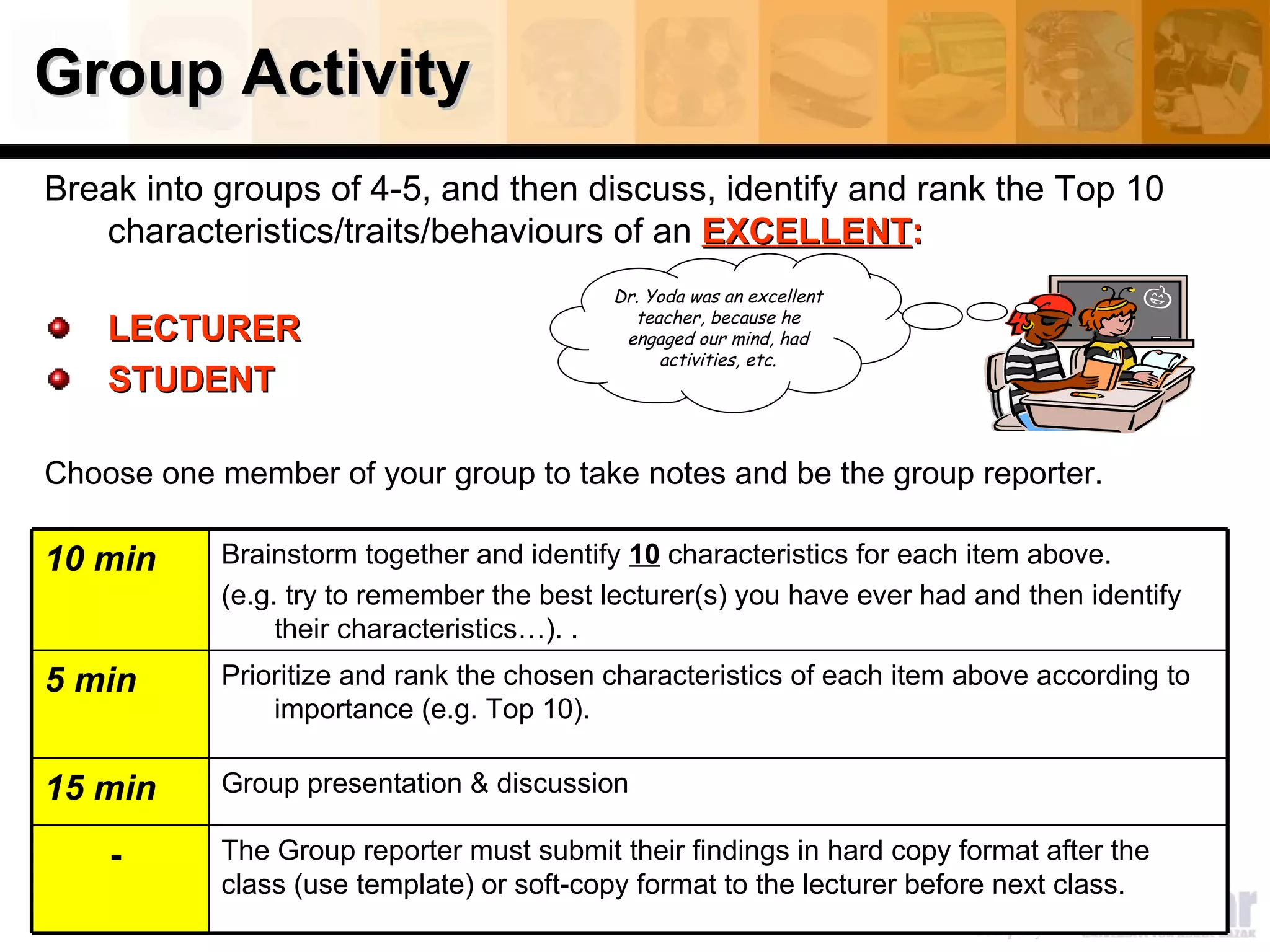
Group Activity Break into groups of 4-5, and then discuss, identify and rank the Top 10 characteristics/traits /behaviours  of an  EXCELLENT : LECTURER STUDENT Choose one member of your group to take notes and be the group reporter.  Dr. Yoda was an excellent teacher, because he engaged our mind, had activities, etc. The Group reporter must submit their findings in hard copy format after the class (use template) or soft-copy format to the lecturer before next class.  -  Group presentation & discussion 15 min Prioritize and rank the chosen characteristics of each item above according to importance (e.g. Top 10).  5 min Brainstorm together and identify  10  characteristics for each item above.  (e.g. try to remember the best lecturer(s) you have ever had and then identify their characteristics…). . 10 min
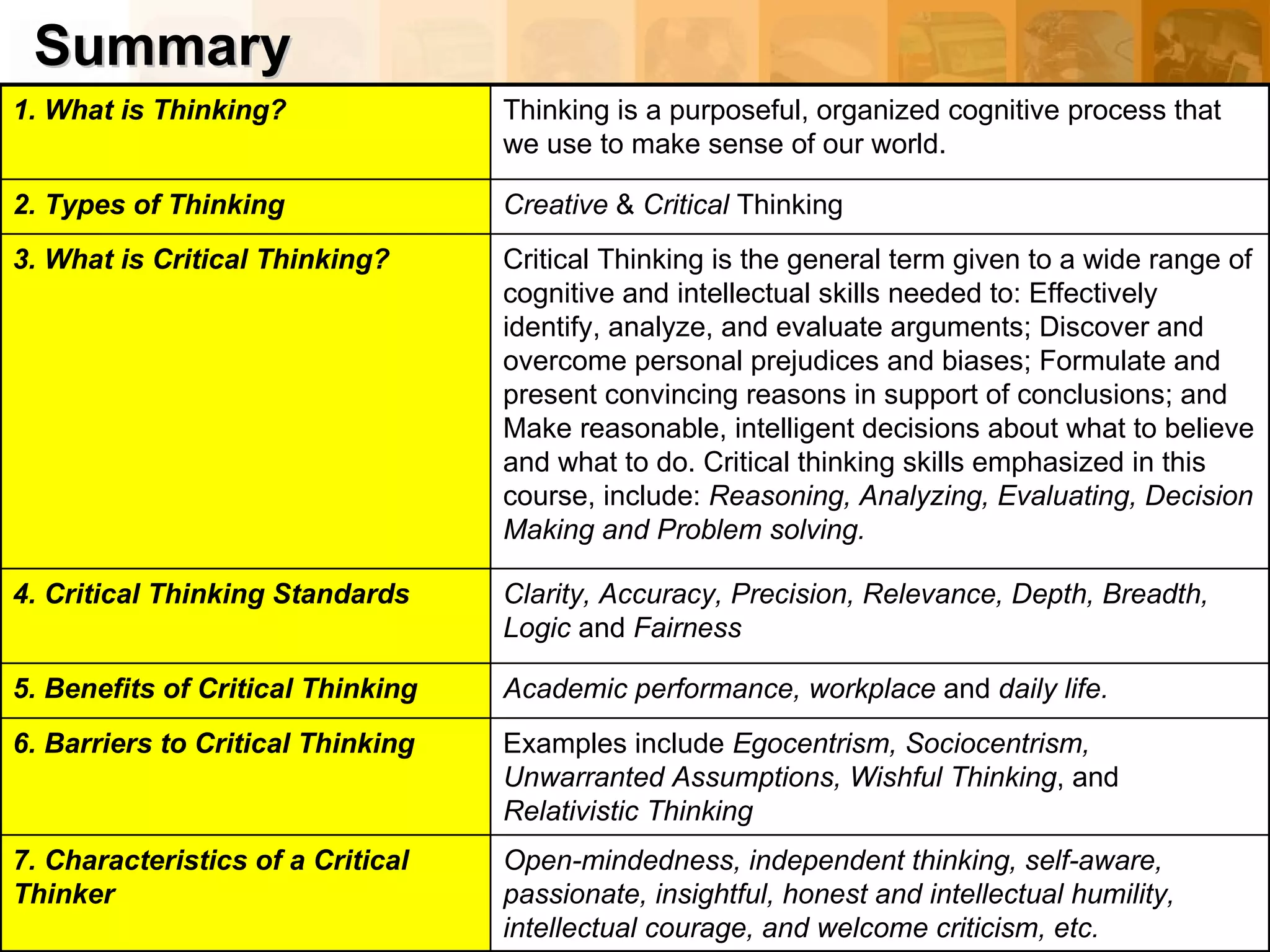
Summary Academic performance, workplace  and  daily life. 5. Benefits of Critical Thinking Examples include  Egocentrism, Sociocentrism, Unwarranted Assumptions, Wishful Thinking , and  Relativistic Thinking 6. Barriers to Critical Thinking Open-mindedness, independent thinking, self-aware, passionate, insightful, honest and intellectual humility, intellectual courage, and welcome criticism, etc.   7. Characteristics of a Critical Thinker Clarity, Accuracy, Precision, Relevance, Depth, Breadth, Logic  and  Fairness 4. Critical Thinking Standards Critical Thinking is the general term given to a wide range of cognitive and intellectual skills needed to: Effectively identify, analyze, and evaluate arguments; Discover and overcome personal prejudices and biases; Formulate and present convincing reasons in support of conclusions; and Make reasonable, intelligent decisions about what to believe and what to do. Critical thinking skills emphasized in this course, include:  Reasoning, Analyzing, Evaluating, Decision Making and Problem solving. 3. What is Critical Thinking? Creative  &  Critical  Thinking 2. Types of Thinking Thinking is a purposeful, organized cognitive process that we use to make sense of our world. 1. What is Thinking?
Any Questions?
The End
Contact Details Zaid Ali Alsagoff UNIVERSITI TUN ABDUL RAZAK  16-5, Jalan SS 6/12 47301 Kelana Jaya Selangor Darul Ehsan Malaysia E-mail:   [email_address]        Tel:  603-7627 7238  Fax:  603-7627 7246
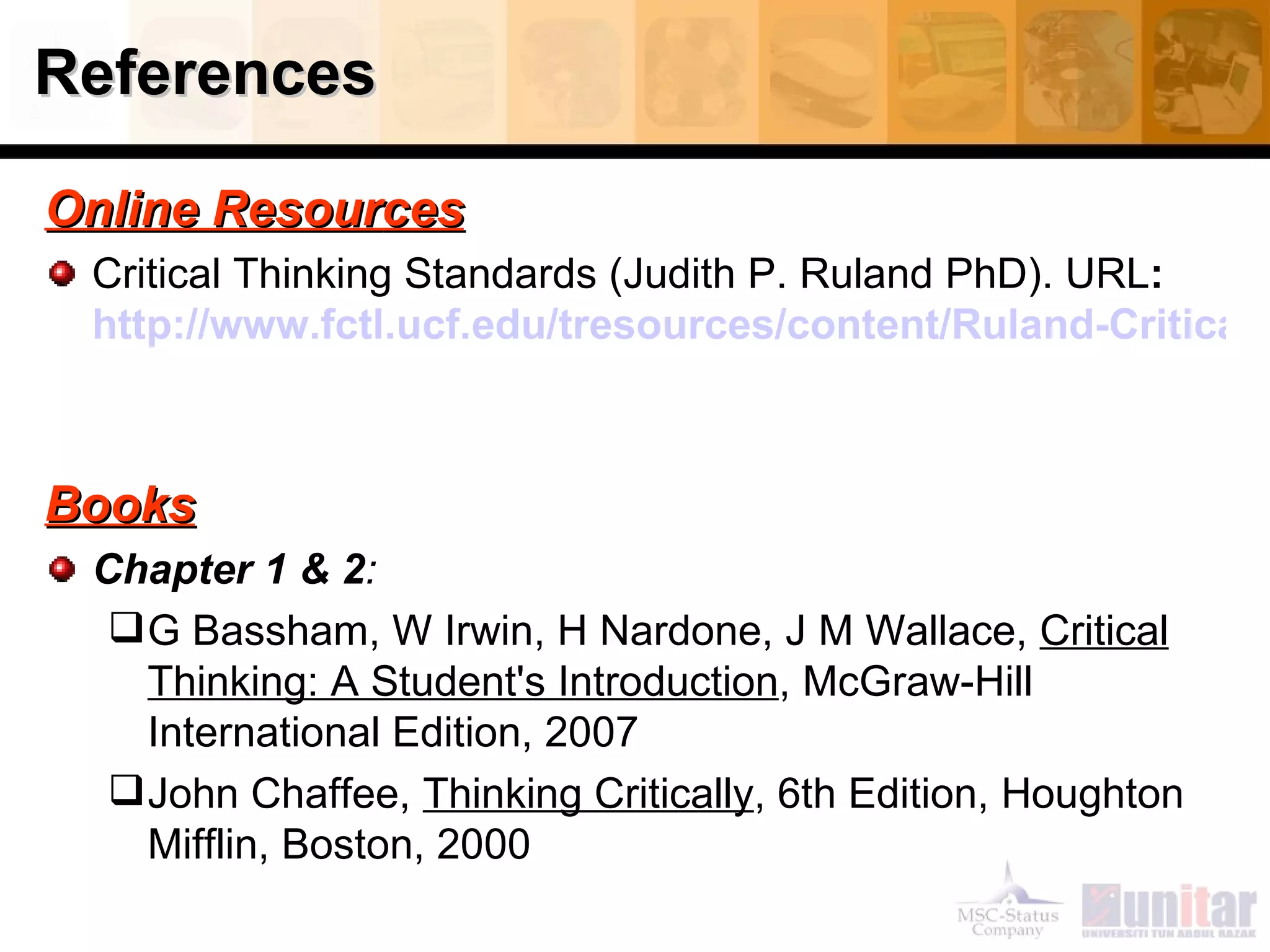
References O n l i n e   R e s o u r c e s Critical Thinking Standards (Judith P. Ruland PhD). URL :  http://www.fctl.ucf.edu/tresources/content/Ruland-CriticalThinkingStandards.pdf   Books Chapter 1 & 2 : G Bassham, W Irwin, H Nardone, J M Wallace,  Critical Thinking: A Student's Introduction , McGraw-Hill International Edition, 2007 John Chaffee,  Thinking Critically , 6th Edition, Houghton Mifflin, Boston, 2000

Introduction To Critical Thinking

  • 1.
    Zaid Ali Alsagoff[email_address] Module 1: Introduction to Critical Thinking
  • 2.
    Question? Why do YOU study for a Degree?
  • 3.
    Do You AgreeWith This Statement? “ Some people study all their life and at their death they have learned everything except to THINK ” – Francois Domergue   Why?
  • 4.
    Do You Agree? Why is Imagination so Important? I Need input from you!
  • 5.
    Why does UNITARhave this course? To help you improve your Thinking Skills  HOW TO THINK!
  • 6.
    Module 1: Introductionto Critical Thinking 1. What is Thinking? 6. Barriers to Critical Thinking 2. Types of Thinking 4. Critical Thinking Standards 5. Benefits of Critical Thinking 7. Characteristics of a Critical Thinker 3. What is Critical Thinking? Introduction
  • 7.
  • 8.
    1.1 What isThinking? Why doesn’t SHE like me? Why doesn’t HE like me? As you start asking questions and seek answers, you are in fact thinking.
  • 9.
    1.1 What isThinking? Thinking is a purposeful, organized cognitive process that we use to make sense of our world.
  • 10.
  • 11.
    1.2 Types ofThinking Problem Solving Decision Making Right Left Critical Thinking Analyzing Evaluating Reasoning New Ideas Creative Thinking
  • 12.
  • 13.
    1.3 What isCritical Thinking? WARNING: THIS MAN IS NOT THINKING CRITICALLY!! Source: http://profmulder.home.att.net/introwhatis.htm
  • 14.
    1.3 What isCritical Thinking? (2) “ Critical thinking consists of a mental process of analyzing or evaluating information, particularly statements or propositions that people have offered as true. It forms a process of reflecting upon the meaning of statements, examining the offered evidence and reasoning, and forming judgments about the facts.” – Wikipedia “ Critical thinking is the intellectually disciplined process of actively and skillfully conceptualizing, applying, analyzing, synthesizing, and/or evaluating information gathered from, or generated by, observation, experience, reflection, reasoning, or communication, as a guide to belief and action. “ - Michael Scriven & Richard Paul More Definitions…
  • 15.
    1.3 What isCritical Thinking? (3) Critical Thinking is the general term given to a wide range of cognitive and intellectual skills needed to: Effectively identify, analyze, and evaluate arguments. Discover and overcome personal prejudices and biases. Formulate and present convincing reasons in support of conclusions. Make reasonable, intelligent decisions about what to believe and what to do.
  • 16.
    1.3 What isCritical Thinking? (4) Problem Solving Decision Making Right Left Don’t need to memorize definitions! Just understand and practice the core critical thinking skills emphasized in this course. Critical Thinking Analyzing Evaluating Reasoning
  • 17.
    1.3 What isCritical Thinking? (5) CRITICAL THINKING SKILLS Analyzing Reasoning Evaluating Decision Making Problem Solving
  • 18.
  • 19.
    1.4 Critical ThinkingStandards (CTS) The most significant critical (intellectual) thinking standards: Clarity Accuracy Precision Relevance Depth Breadth Logic Fairness
  • 20.
    1.4 CTS -Clarity Could you elaborate further on that point? Could you express that point in another way? Could you give me an illustration? Could you give me an example? Source: http://www.fctl.ucf.edu/tresources/content/Ruland-CriticalThinkingStandards.pdf Clarity is the gateway standard Help you I can, yes.
  • 21.
    1.4 CTS –Accuracy Is that really true? How could we check that? How could we find out if that is true? Source: http://www.fctl.ucf.edu/tresources/content/Ruland-CriticalThinkingStandards.pdf This chicken weighs over 300 pounds. A statement can be clear but not accurate Powerful you have become, the dark side I sense in you.
  • 22.
    1.4 CTS – Precision Could you give more details? Could you be more specific? Source: http://www.fctl.ucf.edu/tresources/content/Ruland-CriticalThinkingStandards.pdf A statement can be both clear and accurate, but not precise Yao Ming is TALL ! Size matters not.
  • 23.
    1.4 CTS – Relevance How is that connected to the question? How does that bear on the issue? Source: http://www.fctl.ucf.edu/tresources/content/Ruland-CriticalThinkingStandards.pdf I studied hard all semester, therefore I should get A+. A statement can be clear, accurate, and precise, but not relevant to the question at issue. You must unlearn what you have learned.
  • 24.
    1.4 CTS – Depth How does your answer address the complexities in the question? How are you taking into account the problems in the question? Is that dealing with the most significant factors? Source: http://www.fctl.ucf.edu/tresources/content/Ruland-CriticalThinkingStandards.pdf A statement can be clear, accurate, precise, and relevant, but superficial. Grave danger you are in. Impatient you are.
  • 25.
    1.4 CTS – Breadth Do we need to consider another point of view? Is there another way to look at this question? What would this look like from a conservative standpoint? What would this look like from the point of view of...? Source: http://www.fctl.ucf.edu/tresources/content/Ruland-CriticalThinkingStandards.pdf A line of reasoning may be clear, accurate, precise, relevant, and deep, but lack breadth. Headache!!! You got 0 marks for “Participation”, because you didn’t participate in the class discussion at all. That is why you fail .
  • 26.
    1.4 CTS – Logic Does this really make sense? Does that follow from what you said? How does that follow? But before you implied this and now you are saying that; how can both be true? Source: http://www.fctl.ucf.edu/tresources/content/Ruland-CriticalThinkingStandards.pdf Superman sees through anything. Superman sees through walls. Superman sees through You. When the combination of thoughts are mutually supporting and make sense in combination, the thinking is "logical.“ May the force be with you.
  • 27.
    1.4 CTS – Fairness Critical thinking demands that our thinking be fair. Open-minded Impartial Free of distorting biases and preconceptions Source: http://www.fctl.ucf.edu/tresources/content/Ruland-CriticalThinkingStandards.pdf Fair-mindedness is an essential attribute of a Critical Thinker. Difficult to achieve, but you must try!
  • 28.
    1.4 CTS – Good Thinking is… CLEAR ……….....rather than........UNCLEAR ACCURATE …....rather than…….INACCURATE PRECISE ……....rather than…….VAGUE RELEVANT …….rather than…….IRELEVANT CONSISTENT ….rather than……INCONSISTENT LOGICAL ……….rather than……ILLOGICAL COMPLETE ……rather than……INCOMPLETE FAIR …………….rather than…....BIASED Source: http://www.fctl.ucf.edu/tresources/content/Ruland-CriticalThinkingStandards.pdf
  • 29.
  • 30.
    1.5 Benefits ofCritical Thinking Examples: Academic Performance understand the arguments and beliefs of others Critically evaluating those arguments and beliefs Develop and defend one's own well-supported arguments and beliefs. Workplace Helps us to reflect and get a deeper understanding of our own and others’ decisions Encourage open-mindedness to change Aid us in being more analytical in solving problems Daily life Helps us to avoid making foolish personal decisions. Promotes an informed and concerned citizenry capable of making good decisions on important social, political and economic issues. Aids in the development of autonomous thinkers capable of examining their assumptions, dogmas, and prejudices.
  • 31.
  • 32.
    1.6 Barriers toCritical Thinking If Critical Thinking is so important, why is it that uncritical thinking is so common ? Why is that so many people including many highly educated and intelligent people find critical thinking so difficult?
  • 33.
    1.6 Barriers toCritical Thinking Lack of relevant background information Poor reading skills Poor listening skills Bias Prejudice Superstition Egocentrism Socio-centrism Peer pressure Mindless Conformism Mindless non-conformism Provincialism Narrow-mindedness Closed-mindedness Distrust of reason Stereotyping Unwarranted assumptions and stereotypes Relativistic thinking Scapegoating Rationalization Wishful thinking Short-term thinking Selective perception / attention Selective memory Overpowering emotions Self-deception Face-saving Fear of change Common Barriers
  • 34.
    1.6 Barriers toCritical Thinking Five Powerful Barriers to Critical Thinking: Egocentrism Unwarranted Assumptions Sociocentrism Relativistic Thinking Wishful Thinking I am probably the greatest thinker since Socrates! The truth is “just a matter of opinion” Relativism Subjectivism Cultural relativism Believing that something is true because one wishes it were true. Beliefs that are presumed to be true without adequate evidence or justification Assumption Stereotyping Group-centered thinking Group bias Conformism Self-centered thinking self-interested thinking self-serving bias
  • 35.
    In a 1989international study of 13-year-olds, Koreans finished first in mathematics and Americans finished last. Yet when asked whether they thought they were "good at mathematics," only 23 percent of Koreans said "yes," compared to 68 percent of Americans. 1.6 Mini Quiz – Question 1 Which critical thinking barrier do the American students exhibit: Self-interested thinking Group bias Self-serving bias Conformism
  • 36.
    1.6 Mini Quiz– Question 2 Which critical thinking barrier does Ali display in this passage? A) Self-interested thinking B) Group bias C) Self-serving bias D) Conformism Muhammad Ali [speaking in Zaire, Africa]: "There's no country as great as the smallest city in America. I mean [here in Zaire] you can't watch television. The water won't even run right. The toilets won't flush. The roads, the cars- there's nothing as great as America."
  • 37.
    1.6 Mini Quiz– Question 3 Which critical thinking barrier does Lee exhibit? A) Self-interested thinking B) Stereotyping C) Group bias D) Conformism Adam: My friend Andy is a 1 st year student at UNITAR. He is cool, loves hanging out, and has a very laid-back personality. Lee: I bet he’s from KL.
  • 38.
    1.6 Mini Quiz– Question 4 Which critical thinking barrier does Suzie exhibit? A) Stereotyping B) Self-interested thinking C) Wishful thinking D) Relativistic thinking Suzie : I can't believe I got a B- on this marketing paper. My friend Sarah turned in this same paper in a different marketing class last semester, and she got an A. Ali : Don't you realize it's wrong to plagiarize someone else's work? Suzie : That's your opinion. What's wrong for one person isn't necessarily wrong for another, and I say there's nothing wrong with plagiarism- as long as you don't get caught.
  • 39.
    Characteristics of aCritical Thinker
  • 40.
    1.7 Characteristics ofa Critical Thinker Are you OPEN MINDED about other people’s view? Are you HONEST to yourself (or others) when you are wrong? Do you have the COURAGE and PASSION to take initiative and confront problems and meet challenges? Are you AWARE of your own biases and preconceptions? Do you WELCOME CRITICISM from other people? Do you have INDEPENDENT opinions and are not afraid to disagree? The Force, I sense is with you.
  • 41.
    1.7 Characteristics ofa Critical Thinker Tend to preserve when they encounter intellectual obstacles or difficulties. Have the intellectual perseverance to pursue insights or truths, despite obstacles or difficulties. Are often relatively indifferent to truth and lack of curiosity. Love truth and curious about a wide range of issues. Fear and resist ideas that challenge their basic beliefs. Have the intellectual courage to face and assess fairly ideas that challenge even their most basic beliefs. Are easily distracted and lack the ability to zero in on the essence of a problem or issue. Are able to get to the heart of an issue or problem , without being distracted by details. Tend to engage in ‘group think’, uncritically following the beliefs and values of the crowd. Think independently and are not afraid to disagree with group opinion. Lack awareness of their own biases and preconceptions. Are aware of the biases and preconceptions that shape the way they perceive the world. Often base their beliefs on mere personal preference or self interest. Base their beliefs on facts and evidence rather than on personal preference or self-interest . Are close-minded and resist criticisms of beliefs and assumptions. Listen open-mindedly to opposing points of view and welcome criticisms of beliefs and assumptions. Pretend they know more than they do and ignore their limitations. Are intellectually honest with themselves, acknowledging what they don’t know and recognizing their limitations. Often fall prey to egocentrism, sociocentrism, wishful thinking, etc. Are sensitive to ways in which critical thinking can be skewed by egocentrism, sociocentrism, wishful thinking, etc. Often think in ways that are unclear, imprecise, inaccurate, etc. Have a passionate drive for clarity, precision, accuracy, relevance, consistency, logicalness, completeness, and fairness. Uncritical Thinkers Critical Thinkers
  • 42.
    Group Activity Breakinto groups of 4-5, and then discuss, identify and rank the Top 10 characteristics/traits /behaviours of an EXCELLENT : LECTURER STUDENT Choose one member of your group to take notes and be the group reporter. Dr. Yoda was an excellent teacher, because he engaged our mind, had activities, etc. The Group reporter must submit their findings in hard copy format after the class (use template) or soft-copy format to the lecturer before next class. - Group presentation & discussion 15 min Prioritize and rank the chosen characteristics of each item above according to importance (e.g. Top 10). 5 min Brainstorm together and identify 10 characteristics for each item above. (e.g. try to remember the best lecturer(s) you have ever had and then identify their characteristics…). . 10 min
  • 43.
    Summary Academic performance,workplace and daily life. 5. Benefits of Critical Thinking Examples include Egocentrism, Sociocentrism, Unwarranted Assumptions, Wishful Thinking , and Relativistic Thinking 6. Barriers to Critical Thinking Open-mindedness, independent thinking, self-aware, passionate, insightful, honest and intellectual humility, intellectual courage, and welcome criticism, etc. 7. Characteristics of a Critical Thinker Clarity, Accuracy, Precision, Relevance, Depth, Breadth, Logic and Fairness 4. Critical Thinking Standards Critical Thinking is the general term given to a wide range of cognitive and intellectual skills needed to: Effectively identify, analyze, and evaluate arguments; Discover and overcome personal prejudices and biases; Formulate and present convincing reasons in support of conclusions; and Make reasonable, intelligent decisions about what to believe and what to do. Critical thinking skills emphasized in this course, include: Reasoning, Analyzing, Evaluating, Decision Making and Problem solving. 3. What is Critical Thinking? Creative & Critical Thinking 2. Types of Thinking Thinking is a purposeful, organized cognitive process that we use to make sense of our world. 1. What is Thinking?
  • 44.
  • 45.
  • 46.
    Contact Details ZaidAli Alsagoff UNIVERSITI TUN ABDUL RAZAK 16-5, Jalan SS 6/12 47301 Kelana Jaya Selangor Darul Ehsan Malaysia E-mail: [email_address]     Tel: 603-7627 7238 Fax: 603-7627 7246
  • 47.
    References O nl i n e R e s o u r c e s Critical Thinking Standards (Judith P. Ruland PhD). URL : http://www.fctl.ucf.edu/tresources/content/Ruland-CriticalThinkingStandards.pdf Books Chapter 1 & 2 : G Bassham, W Irwin, H Nardone, J M Wallace, Critical Thinking: A Student's Introduction , McGraw-Hill International Edition, 2007 John Chaffee, Thinking Critically , 6th Edition, Houghton Mifflin, Boston, 2000

Editor's Notes

  • #17 Analyzing Comparing and contrasting Classification/definition Determining parts-whole relationships Sequencing Finding reasons and conclusions Uncovering assumptions Evaluation Assessing basic information Determining the reliability of sources Determining the accuracy of sources Well-founded inferences The use of evidence Deduction Decision Making What makes a decision necessary? What are my options? What are the likely consequences of each option? How important are the consequences? Which option is best in light of the consequences? Monitor and review your decision and ask, are there any necessary adjustments? Problem Solving What is the Problem? What Are the Alternatives? What Are the Advantages and/or Disadvantages of Each Alternative? What Is the Solution? How Well Is the Solution Working? Reasoning The type of thinking that uses arguments - reasons in support of conclusions to decide, explain, predict, and persuade.
  • #18 Analyzing (Module 1-7) Comparing and contrasting Classification/definition Determining parts-whole relationships Sequencing Finding reasons and conclusions Uncovering assumptions Evaluation (Module 1-7) Assessing basic information Determining the reliability of sources Determining the accuracy of sources Well-founded inferences The use of evidence Deduction Decision Making (Module 2, 6 & 7) What makes a decision necessary? What are my options? What are the likely consequences of each option? How important are the consequences? Which option is best in light of the consequences? Monitor and review your decision and ask, are there any necessary adjustments? Problem Solving (Module 2 & 7) What is the Problem? What Are the Alternatives? What Are the Advantages and/or Disadvantages of Each Alternative? What Is the Solution? How Well Is the Solution Working? Reasoning (Module 1-7) The type of thinking that uses arguments - reasons in support of conclusions to decide, explain, predict, and persuade.
  • #20 Universal intellectual (Critical) standards are standards which must be applied to thinking whenever one is interested in checking the quality of reasoning about a problem, issue, or situation. To help students learn them, teachers should pose questions which probe student thinking, questions which hold students accountable for their thinking, questions which, through consistent use by the teacher in the classroom, become internalized by students as questions they need to ask themselves. The ultimate goal, then, is for these questions to become infused in the thinking of students, forming part of their inner voice, which then guides them to better and better reasoning. While there are a number of universal standards, the following are the most significant: (Source: http://www.fctl.ucf.edu/tresources/content/Ruland-CriticalThinkingStandards.pdf)
  • #21 Clarity is the gateway standard. If a statement is unclear, we cannot determine whether it is accurate or relevant. In fact, we cannot tell anything about it because we don't yet know what it is saying.
  • #22 A statement can be clear but not accurate, as in “This chicken weighs over 300 pounds."
  • #23 A statement can be both clear and accurate, but not precise, as in “Yao Ming is tall!" (We don't know how Tall Yao Ming is. E.g. Precise = Yao Ming is 2.29 (7-6) meters tall. )
  • #24 A statement can be clear, accurate, and precise, but not relevant to the question at issue. For example, students often think that the amount of effort they put into a course should be used in raising their grade in a course. Often, however, the "effort" does not measure the quality of student learning, and when this is so, effort is irrelevant to their appropriate grade.
  • #25 A statement can be clear, accurate, precise, and relevant, but superficial (that is, lack depth). For example, the statement "Just say No" which is often used to discourage children and teens from using drugs, is clear, accurate, precise, and relevant. Nevertheless, it lacks depth because it treats an extremely complex issue, the pervasive problem of drug use among young people, superficially. It fails to deal with the complexities of the issue.
  • #26 A line of reasoning may be clear accurate, precise, relevant, and deep, but lack breadth (as in an argument from either teacher or student standpoint which gets deeply into an issue, but only recognizes the insights of one side of the question.)
  • #27 When we think, we bring a variety of thoughts together into some order. When the combination of thoughts are mutually supporting and make sense in combination, the thinking is "logical." When the combination is not mutually supporting, is contradictory in some sense, or does not "make sense," the combination is not logical.
  • #33 The reasons are quite complex.
  • #34 The reasons are quite complex.