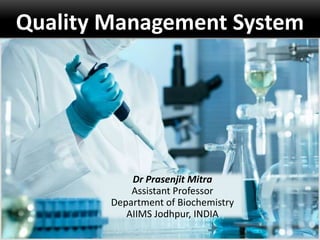

Quality Management System
Dr Prasenjit Mitra
Assistant Professor
Department of Biochemistry
AIIMS Jodhpur, INDIA
What is Quality ?
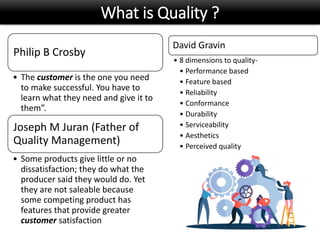
What is Quality ?
Philip B Crosby
• The customer is the one you need
to make successful. You have to
learn what they need and give it to
them”.
Joseph M Juran (Father of
Quality Management)
• Some products give little or no
dissatisfaction; they do what the
producer said they would do. Yet
they are not saleable because
some competing product has
features that provide greater
customer satisfaction
David Gravin
• 8 dimensions to quality-
• Performance based
• Feature based
• Reliability
• Conformance
• Durability
• Serviceability
• Aesthetics
• Perceived quality
What is Quality ?
ISO 9001:2005
• “the degree to which a set of inherent characteristics meet
requirements”.
Management
• GET IT DONE !!!!!
What are Quality metrics/indicators?
Established measures used to determine how well an
organization meets needs and operational and
performance expectations
• Laboratory shall implement quality indicators to
systematically monitor and evaluate its contribution to
patient care. ISO 15189 [4.12.4]
• When the programme identifies opportunities for
improvement, the laboratory management shall address
them, regardless of where they occur.
• Laboratory management shall ensure that the laboratory
participates in quality improvement activities that deal
with relevant areas and outcomes of patient care.
How to manage Quality ?
• Plan- Define course of action toward a measurable goal.
• Organize- How and How much
• Staff- Who does what
• Lead/ Direct- Do it
• Control- system functions in line with the plan
How to manage Quality ?
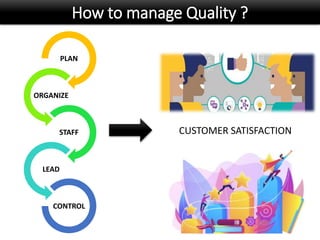
PLAN
ORGANIZE
STAFF
LEAD
CONTROL
CUSTOMER SATISFACTION
Quality Management System
Coordinated activities to direct and control an organization
with regard to quality (ISO,CLSI).
All aspects of the laboratory operation need to be
addressed to assure quality; this constitutes a quality
management system.
9
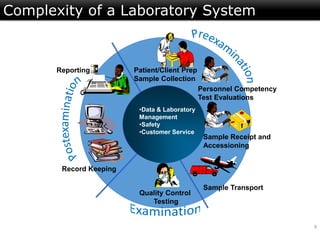
Complexity of a Laboratory System
•Data & Laboratory
Management
•Safety
•Customer Service
Patient/Client Prep
Sample Collection
Sample Receipt and
Accessioning
Sample Transport
Quality Control
Testing
Record Keeping
Reporting
Personnel Competency
Test Evaluations
10
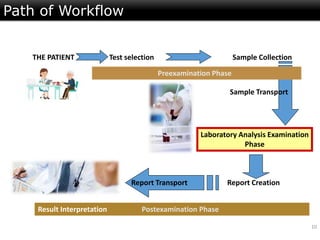
THE PATIENT Test selection Sample Collection
Sample Transport
Laboratory Analysis Examination
Phase
Report CreationReport Transport
Preexamination Phase
Result Interpretation Postexamination Phase
Path of Workflow
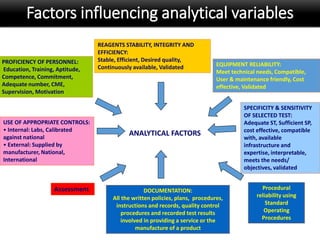
Factors influencing analytical variables
EQUIPMENT RELIABILITY:
Meet technical needs, Compatible,
User & maintenance friendly, Cost
effective, Validated
Procedural
reliability using
Standard
Operating
Procedures
REAGENTS STABILITY, INTEGRITY AND
EFFICIENCY:
Stable, Efficient, Desired quality,
Continuously available, Validated
SPECIFICITY & SENSITIVITY
OF SELECTED TEST:
Adequate ST, Sufficient SP,
cost effective, compatible
with, available
infrastructure and
expertise, interpretable,
meets the needs/
objectives, validated
PROFICIENCY OF PERSONNEL:
Education, Training, Aptitude,
Competence, Commitment,
Adequate number, CME,
Supervision, Motivation
USE OF APPROPRIATE CONTROLS:
• Internal: Labs, Calibrated
against national
• External: Supplied by
manufacturer, National,
International
DOCUMENTATION:
All the written policies, plans, procedures,
instructions and records, quality control
procedures and recorded test results
involved in providing a service or the
manufacture of a product
Assessment
ANALYTICAL FACTORS
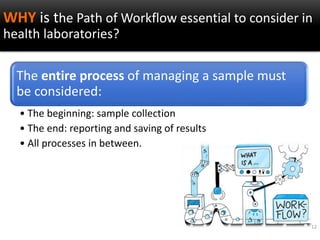
WHY is the Path of Workflow essential to consider in
health laboratories?
12
The entire process of managing a sample must
be considered:
• The beginning: sample collection
• The end: reporting and saving of results
• All processes in between.
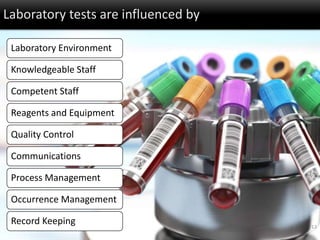
Laboratory tests are influenced by
13
Laboratory Environment
Knowledgeable Staff
Competent Staff
Reagents and Equipment
Quality Control
Communications
Process Management
Occurrence Management
Record Keeping
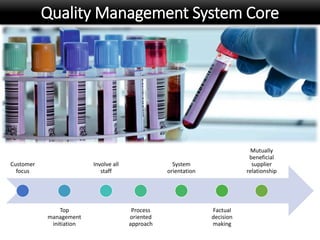
Quality Management System Core
Customer
focus
Top
management
initiation
Involve all
staff
Process
oriented
approach
System
orientation
Factual
decision
making
Mutually
beneficial
supplier
relationship
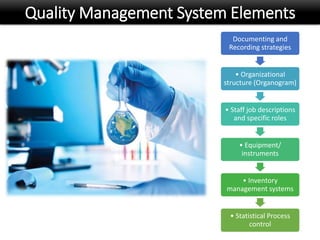
Quality Management System Elements
Documenting and
Recording strategies
• Organizational
structure (Organogram)
• Staff job descriptions
and specific roles
• Equipment/
instruments
• Inventory
management systems
• Statistical Process
control
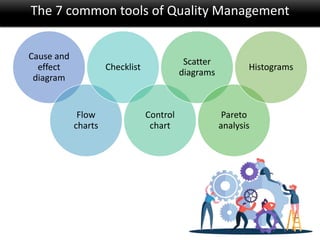
The 7 common tools of Quality Management
Cause and
effect
diagram
Flow
charts
Checklist
Control
chart
Scatter
diagrams
Pareto
analysis
Histograms
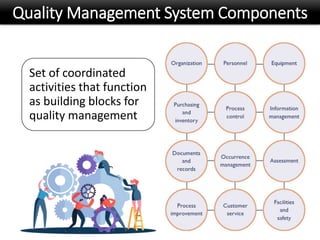
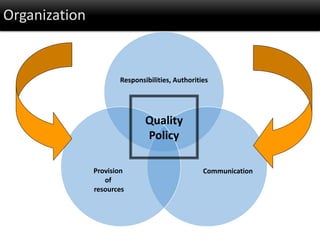
Quality Management System Components
Set of coordinated
activities that function
as building blocks for
quality management
Organization
Responsibilities, Authorities
CommunicationProvision
of
resources
Quality
Policy
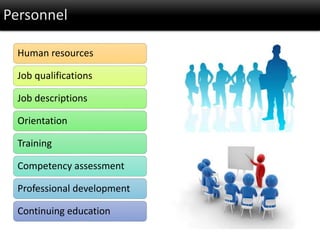
Personnel
Human resources
Job qualifications
Job descriptions
Orientation
Training
Competency assessment
Professional development
Continuing education
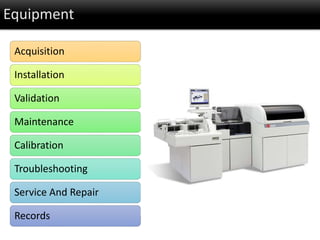
Equipment
Acquisition
Installation
Validation
Maintenance
Calibration
Troubleshooting
Service And Repair
Records
Purchasing and Inventory
Vendor qualifications
Supplies and reagents
Critical services
Contract review
Inventory management
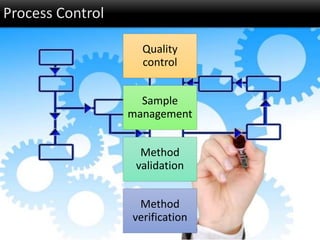
Process Control
Quality
control
Sample
management
Method
validation
Method
verification
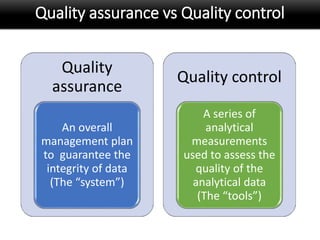
Quality assurance vs Quality control
Quality
assurance
An overall
management plan
to guarantee the
integrity of data
(The “system”)
Quality control
A series of
analytical
measurements
used to assess the
quality of the
analytical data
(The “tools”)
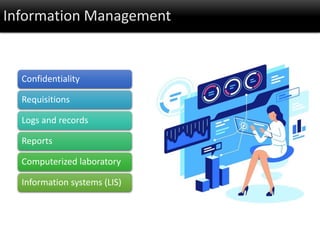
Information Management
Confidentiality
Requisitions
Logs and records
Reports
Computerized laboratory
Information systems (LIS)
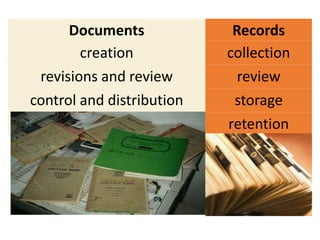
Documents Records
creation collection
revisions and review review
control and distribution storage
retention
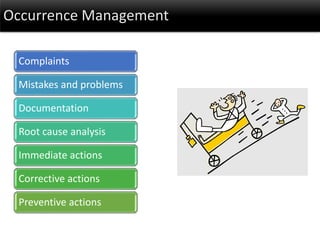
Occurrence Management
Complaints
Mistakes and problems
Documentation
Root cause analysis
Immediate actions
Corrective actions
Preventive actions
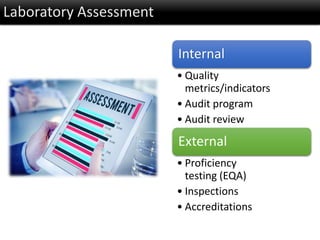
Laboratory Assessment
Internal
• Quality
metrics/indicators
• Audit program
• Audit review
External
• Proficiency
testing (EQA)
• Inspections
• Accreditations
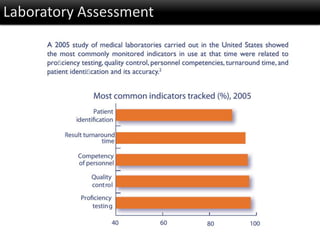
Laboratory Assessment
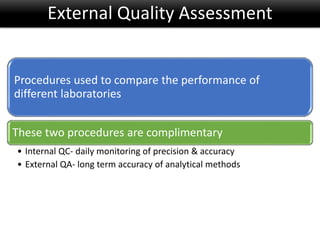
External Quality Assessment
Procedures used to compare the performance of
different laboratories
These two procedures are complimentary
• Internal QC- daily monitoring of precision & accuracy
• External QA- long term accuracy of analytical methods
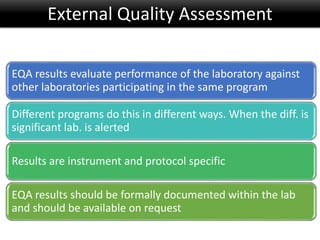
EQA results evaluate performance of the laboratory against
other laboratories participating in the same program
Different programs do this in different ways. When the diff. is
significant lab. is alerted
Results are instrument and protocol specific
EQA results should be formally documented within the lab
and should be available on request
External Quality Assessment
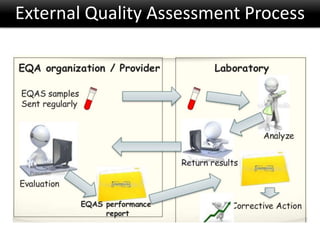
External Quality Assessment Process
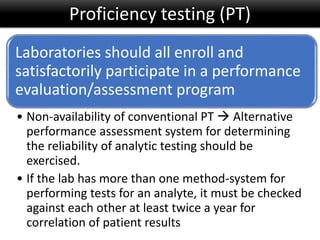
Laboratories should all enroll and
satisfactorily participate in a performance
evaluation/assessment program
• Non-availability of conventional PT  Alternative
performance assessment system for determining
the reliability of analytic testing should be
exercised.
• If the lab has more than one method-system for
performing tests for an analyte, it must be checked
against each other at least twice a year for
correlation of patient results
Proficiency testing (PT)
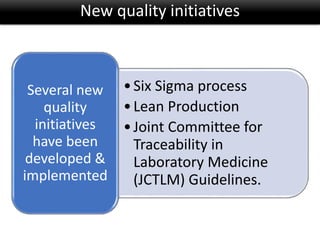
•Six Sigma process
•Lean Production
•Joint Committee for
Traceability in
Laboratory Medicine
(JCTLM) Guidelines.
Several new
quality
initiatives
have been
developed &
implemented
New quality initiatives
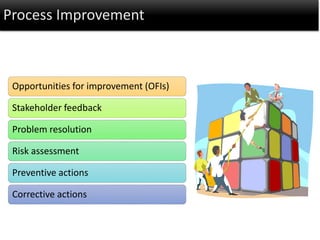
Process Improvement
Opportunities for improvement (OFIs)
Stakeholder feedback
Problem resolution
Risk assessment
Preventive actions
Corrective actions
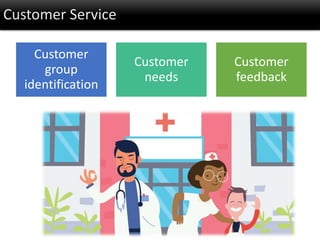
Customer Service
Customer
group
identification
Customer
needs
Customer
feedback
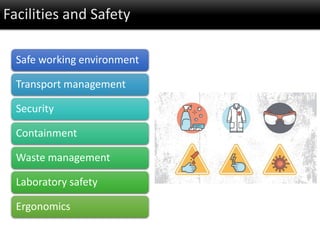
Facilities and Safety
Safe working environment
Transport management
Security
Containment
Waste management
Laboratory safety
Ergonomics
Implementing
Quality Management
does not
guarantee
an
ERROR-FREE
Laboratory
But it detects errors
that may occur and
prevents them from
recurring
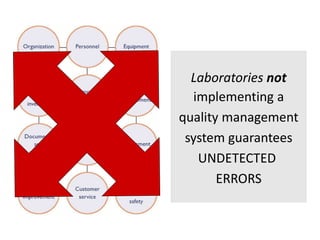
Laboratories not
implementing a
quality management
system guarantees
UNDETECTED
ERRORS
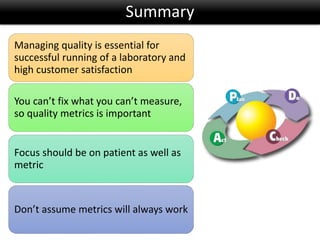
Summary
Managing quality is essential for
successful running of a laboratory and
high customer satisfaction
You can’t fix what you can’t measure,
so quality metrics is important
Focus should be on patient as well as
metric
Don’t assume metrics will always work
Thank you

Quality Management System

  • 1.
    Quality Management System DrPrasenjit Mitra Assistant Professor Department of Biochemistry AIIMS Jodhpur, INDIA
  • 2.
  • 3.
    What is Quality? Philip B Crosby • The customer is the one you need to make successful. You have to learn what they need and give it to them”. Joseph M Juran (Father of Quality Management) • Some products give little or no dissatisfaction; they do what the producer said they would do. Yet they are not saleable because some competing product has features that provide greater customer satisfaction David Gravin • 8 dimensions to quality- • Performance based • Feature based • Reliability • Conformance • Durability • Serviceability • Aesthetics • Perceived quality
  • 4.
    What is Quality? ISO 9001:2005 • “the degree to which a set of inherent characteristics meet requirements”. Management • GET IT DONE !!!!!
  • 5.
    What are Qualitymetrics/indicators? Established measures used to determine how well an organization meets needs and operational and performance expectations • Laboratory shall implement quality indicators to systematically monitor and evaluate its contribution to patient care. ISO 15189 [4.12.4] • When the programme identifies opportunities for improvement, the laboratory management shall address them, regardless of where they occur. • Laboratory management shall ensure that the laboratory participates in quality improvement activities that deal with relevant areas and outcomes of patient care.
  • 6.
    How to manageQuality ? • Plan- Define course of action toward a measurable goal. • Organize- How and How much • Staff- Who does what • Lead/ Direct- Do it • Control- system functions in line with the plan
  • 7.
    How to manageQuality ? PLAN ORGANIZE STAFF LEAD CONTROL CUSTOMER SATISFACTION
  • 8.
    Quality Management System Coordinatedactivities to direct and control an organization with regard to quality (ISO,CLSI). All aspects of the laboratory operation need to be addressed to assure quality; this constitutes a quality management system.
  • 9.
    9 Complexity of aLaboratory System •Data & Laboratory Management •Safety •Customer Service Patient/Client Prep Sample Collection Sample Receipt and Accessioning Sample Transport Quality Control Testing Record Keeping Reporting Personnel Competency Test Evaluations
  • 10.
    10 THE PATIENT Testselection Sample Collection Sample Transport Laboratory Analysis Examination Phase Report CreationReport Transport Preexamination Phase Result Interpretation Postexamination Phase Path of Workflow
  • 11.
    Factors influencing analyticalvariables EQUIPMENT RELIABILITY: Meet technical needs, Compatible, User & maintenance friendly, Cost effective, Validated Procedural reliability using Standard Operating Procedures REAGENTS STABILITY, INTEGRITY AND EFFICIENCY: Stable, Efficient, Desired quality, Continuously available, Validated SPECIFICITY & SENSITIVITY OF SELECTED TEST: Adequate ST, Sufficient SP, cost effective, compatible with, available infrastructure and expertise, interpretable, meets the needs/ objectives, validated PROFICIENCY OF PERSONNEL: Education, Training, Aptitude, Competence, Commitment, Adequate number, CME, Supervision, Motivation USE OF APPROPRIATE CONTROLS: • Internal: Labs, Calibrated against national • External: Supplied by manufacturer, National, International DOCUMENTATION: All the written policies, plans, procedures, instructions and records, quality control procedures and recorded test results involved in providing a service or the manufacture of a product Assessment ANALYTICAL FACTORS
  • 12.
    WHY is thePath of Workflow essential to consider in health laboratories? 12 The entire process of managing a sample must be considered: • The beginning: sample collection • The end: reporting and saving of results • All processes in between.
  • 13.
    Laboratory tests areinfluenced by 13 Laboratory Environment Knowledgeable Staff Competent Staff Reagents and Equipment Quality Control Communications Process Management Occurrence Management Record Keeping
  • 14.
    Quality Management SystemCore Customer focus Top management initiation Involve all staff Process oriented approach System orientation Factual decision making Mutually beneficial supplier relationship
  • 15.
    Quality Management SystemElements Documenting and Recording strategies • Organizational structure (Organogram) • Staff job descriptions and specific roles • Equipment/ instruments • Inventory management systems • Statistical Process control
  • 16.
    The 7 commontools of Quality Management Cause and effect diagram Flow charts Checklist Control chart Scatter diagrams Pareto analysis Histograms
  • 17.
    Quality Management SystemComponents Set of coordinated activities that function as building blocks for quality management
  • 18.
  • 19.
    Personnel Human resources Job qualifications Jobdescriptions Orientation Training Competency assessment Professional development Continuing education
  • 20.
  • 21.
    Purchasing and Inventory Vendorqualifications Supplies and reagents Critical services Contract review Inventory management
  • 22.
  • 23.
    Quality assurance vsQuality control Quality assurance An overall management plan to guarantee the integrity of data (The “system”) Quality control A series of analytical measurements used to assess the quality of the analytical data (The “tools”)
  • 24.
    Information Management Confidentiality Requisitions Logs andrecords Reports Computerized laboratory Information systems (LIS)
  • 25.
    Documents Records creation collection revisionsand review review control and distribution storage retention
  • 26.
    Occurrence Management Complaints Mistakes andproblems Documentation Root cause analysis Immediate actions Corrective actions Preventive actions
  • 27.
    Laboratory Assessment Internal • Quality metrics/indicators •Audit program • Audit review External • Proficiency testing (EQA) • Inspections • Accreditations
  • 28.
  • 29.
    External Quality Assessment Proceduresused to compare the performance of different laboratories These two procedures are complimentary • Internal QC- daily monitoring of precision & accuracy • External QA- long term accuracy of analytical methods
  • 30.
    EQA results evaluateperformance of the laboratory against other laboratories participating in the same program Different programs do this in different ways. When the diff. is significant lab. is alerted Results are instrument and protocol specific EQA results should be formally documented within the lab and should be available on request External Quality Assessment
  • 31.
  • 32.
    Laboratories should allenroll and satisfactorily participate in a performance evaluation/assessment program • Non-availability of conventional PT  Alternative performance assessment system for determining the reliability of analytic testing should be exercised. • If the lab has more than one method-system for performing tests for an analyte, it must be checked against each other at least twice a year for correlation of patient results Proficiency testing (PT)
  • 33.
    •Six Sigma process •LeanProduction •Joint Committee for Traceability in Laboratory Medicine (JCTLM) Guidelines. Several new quality initiatives have been developed & implemented New quality initiatives
  • 34.
    Process Improvement Opportunities forimprovement (OFIs) Stakeholder feedback Problem resolution Risk assessment Preventive actions Corrective actions
  • 35.
  • 36.
    Facilities and Safety Safeworking environment Transport management Security Containment Waste management Laboratory safety Ergonomics
  • 37.
    Implementing Quality Management does not guarantee an ERROR-FREE Laboratory Butit detects errors that may occur and prevents them from recurring
  • 38.
    Laboratories not implementing a qualitymanagement system guarantees UNDETECTED ERRORS
  • 39.
    Summary Managing quality isessential for successful running of a laboratory and high customer satisfaction You can’t fix what you can’t measure, so quality metrics is important Focus should be on patient as well as metric Don’t assume metrics will always work
  • 40.