Critical   Thinking Critical thinking is the ability to think clearly and rationally. It includes the ability to engage in reflective and independent thinking. Someone with critical thinking skills is able to do the following :  understand the logical connections between ideas  identify, construct and evaluate arguments  detect inconsistencies and mistakes in reasoning  solve problems systematically  identify the relevance and importance of ideas  reflect on the justification of one's own beliefs and values
A Critical Thinker: asks pertinent questions   assesses statements and arguments   is able to admit a lack of understanding or information   has a sense of curiosity   is interested in finding new solutions   is able to clearly define a set of criteria for analyzing ideas  examines beliefs, assumptions, and opinions and weighs them against facts   listens carefully to others and is able to give feedback   suspends judgment until all facts have been gathered and considered   looks for evidence to support assumption and beliefs   is able to adjust opinions when new facts are found   examines problems closely  is able to reject information that is incorrect or irrelevant 
Writing a critical thinking question  (CTQ) CTQ’s are incisive and penetrating questions that get beneath the surface of a topic and revel its complexity and subtlety.
Socratic Questions Questions for clarification Questions that probe assumptions Questions that probe reasons and evidence Questions about Viewpoints and Perspectives Questions that probe implications and consequences Questions about the question
Questions for clarification Why do you say that?  How does this relate to our discussion?
Questions that probe assumptions What could we assume instead?  How can you verify or disapprove that assumption?
Questions that probe reasons and evidence What would be an example?  What is....analogous to?  What do you think causes to happen...? Why:?
Questions about Viewpoints and Perspectives What would be an alternative?  What is another way to look at it?  Would you explain why it is necessary or beneficial, and who benefits?  Why is the best?  What are the strengths and weaknesses of...?  How are...and ...similar?  What is a counterargument for...?
Questions that probe implications and consequences What generalizations can you make?  What are the consequences of that assumption?  What are you implying?  How does...affect...?  How does...tie in with what we learned before?
Questions about the Question What was the point of this question?  Why do you think I asked this question?  What does...mean?  How does...apply to everyday life?
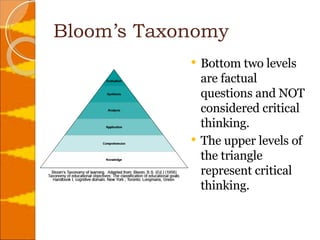
Bloom’s Taxonomy Bottom two levels are factual questions and NOT considered critical thinking. The upper levels of the triangle represent critical thinking.
Not Critical Thinking! cite, label, name, reproduce, define, list, quote, pronounce, identify, match, recite, state  alter, discover, manage, relate, change, explain, rephrase, substitute, convert,  give examples, represent, summarize, depict, give main idea, restate, translate, describe, illustrate, reword, vary, interpret, paraphrase Knowledge  Comprehension  From Bloom, B. Taxonomy of Educational Objectives.  Published by Allyn and Bacon, Boston, MA 1984
Summary and Definition Questions what is (are)...?  who...? when...?  how much...?  how many...?  what is an example of...?  NOT CRITICAL THINKING
Beginning of Critical Thinking apply, discover, manage, relate, classify, employ, predict, show, compute, evidence, prepare, solve, demonstrate, manifest, present, utilize, direct  ascertain, diagnose, distinguish, outline, analyze, diagram, divide, point out, associate, differentiate, examine, reduce, conclude, discriminate, find, separate, designate, dissect, infer, determine  Application  Analysis From Bloom, B. Taxonomy of Educational Objectives.  Published by Allyn and Bacon, Boston, MA 1984
Analysis Questions how...? why...?  what are the reasons for...?  what the types of...?  What are the functions of...?  what is the process of...?  what other examples of...?  what evidence or proof or support is offered...?  what are other theories arguments from other authors...?  what are the causes/ results of...?  what is the relationship between ...and ...? what is the similarity or difference between... and...?  how does ...apply to ...?  what is (are) the problems or conflicts or issues...?  what are possible solutions/ resolutions to these problems or conflicts or issues...?  what is the main argument or thesis of...?  how is this argument developed...?
High Level Critical Thinking! combine,  devise, originate, revise, compile, expand, plan, rewrite, compose, extend, pose, synthesize, conceive, generalize, propose, theorize, create, integrate, project, write, design, invent, rearrange, develop, modify  appraise, conclude, critique, judge, assess, contrast, deduce, weigh, compare, criticize, evaluate Synthesis  Evaluation  From Bloom, B. Taxonomy of Educational Objectives.  Published by Allyn and Bacon, Boston, MA 1984
Examples of Critical Thinking Create a song that an Ancient Egyptian might have sung in church. If you were an ancient Egyptian teenager, tell what your day would be like. Compare the social structure in Ancient Egypt to the social structure of our nation today. Compare and contrast a tool used by the Ancient Egyptians to one used in your home. Application  Analysis From Bloom, B. Taxonomy of Educational Objectives.  Published by Allyn and Bacon, Boston, MA 1984
Hypothesis Questions if...occurs, then what happens...?  if ...had happened, then what would be different...?  what does theory x predict will happen...?
High Level Critical Thinking! Describe a environmental problem the Ancient Egyptians might have faced in meeting their basic needs of food, clothing, or shelter and use modern technology to solve it. If you were an ancient Egyptian teen ager, what types of clothing could you design to wear to a dance. Keep in mind the types of material available at that time. Compare the game Senet to a game you play with your friends and tell which you like better and why. Synthesis  Evaluation  From Bloom, B. Taxonomy of Educational Objectives.  Published by Allyn and Bacon, Boston, MA 1984
Evaluation Questions is...good or bad...?  .....correct or incorrect...?  .....effective or ineffective...?  .....relevant or irrelevant...?  .....clear or unclear...?  .....logical or illogical...?  .....applicable or not applicable...?  ..... proven or not proven...?  .....ethical or unethical...?  what are the advantages or disadvantages of...? what are the pros or cons of...?  what is the best solution to the problem / conflict / issue...?  what should or should not happen...? • do i agree or disagree ...? what is my opinion...?  what is my support for my opinion...? From Bloom, B. Taxonomy of Educational Objectives.  Published by Allyn and Bacon, Boston, MA 1984
Writing a CTQ? The first step in writing a CTQ is finding something you truly have a question about.  Socratic Questions are good for literary analysis and political debates. Questions using Bloom’s Taxonomy are good for analyzing non-fiction texts.
CTQ for Historical Significance Identify a major event, person or concept from the reading. Narrow the topic until it is manageable. Example  Topic – Greek Gods Narrowing of topic – Zeus Formulate a question regarding the significance of the topic. Begin your question with how or why or what combined with a key word. Key words – affect, cause, signify, start, end,  Example – Why did Zeus have more significance in the Greek culture than other Gods?
CTQ for Literary Analysis Steps Choose a literary element (motif, figurative language, irony, hyperbole, symbols) Relate the element to the text or theme Formulate a question using steps one and two.  Example: How did the author’s use of the motif of birds accentuate the character’s emotions?
NEVER STOP ASKING  “WHY?” AND “WHAT ABOUT THIS?”   It’s not the answers that enlighten us,  but the questions.”  - Descouvertes de la Salle
References Bloom, B. (1984). Taxonomy of Educational Objectives. Boston: Allyn and Bacon. Brookfield,S. (1987). Developing Critical Thinkers. San Francisco: Jossey-Bass.  Costa, A. (2001) Developing Minds:  A Resource Book for Teaching Thinking. Alexandria: ASCD. Paul, R. (1995). Critical thinking: How to prepare students for a rapidly changing world. Santa Rosa, CA: Foundation for Critical Thinking Ruffiero, V. (1991). The Art of Thinking: A Guide to Critical and Creative Thought. Illinois: HarperCollins.

Critical Thinking

  • 1.
  • 2.
    Critical Thinking Critical thinking is the ability to think clearly and rationally. It includes the ability to engage in reflective and independent thinking. Someone with critical thinking skills is able to do the following : understand the logical connections between ideas identify, construct and evaluate arguments detect inconsistencies and mistakes in reasoning solve problems systematically identify the relevance and importance of ideas reflect on the justification of one's own beliefs and values
  • 3.
    A Critical Thinker:asks pertinent questions  assesses statements and arguments  is able to admit a lack of understanding or information  has a sense of curiosity  is interested in finding new solutions  is able to clearly define a set of criteria for analyzing ideas examines beliefs, assumptions, and opinions and weighs them against facts  listens carefully to others and is able to give feedback  suspends judgment until all facts have been gathered and considered  looks for evidence to support assumption and beliefs  is able to adjust opinions when new facts are found  examines problems closely is able to reject information that is incorrect or irrelevant 
  • 4.
    Writing a criticalthinking question (CTQ) CTQ’s are incisive and penetrating questions that get beneath the surface of a topic and revel its complexity and subtlety.
  • 5.
    Socratic Questions Questionsfor clarification Questions that probe assumptions Questions that probe reasons and evidence Questions about Viewpoints and Perspectives Questions that probe implications and consequences Questions about the question
  • 6.
    Questions for clarificationWhy do you say that? How does this relate to our discussion?
  • 7.
    Questions that probeassumptions What could we assume instead? How can you verify or disapprove that assumption?
  • 8.
    Questions that probereasons and evidence What would be an example? What is....analogous to? What do you think causes to happen...? Why:?
  • 9.
    Questions about Viewpointsand Perspectives What would be an alternative? What is another way to look at it? Would you explain why it is necessary or beneficial, and who benefits? Why is the best? What are the strengths and weaknesses of...? How are...and ...similar? What is a counterargument for...?
  • 10.
    Questions that probeimplications and consequences What generalizations can you make? What are the consequences of that assumption? What are you implying? How does...affect...? How does...tie in with what we learned before?
  • 11.
    Questions about theQuestion What was the point of this question? Why do you think I asked this question? What does...mean? How does...apply to everyday life?
  • 12.
    Bloom’s Taxonomy Bottomtwo levels are factual questions and NOT considered critical thinking. The upper levels of the triangle represent critical thinking.
  • 13.
    Not Critical Thinking!cite, label, name, reproduce, define, list, quote, pronounce, identify, match, recite, state alter, discover, manage, relate, change, explain, rephrase, substitute, convert, give examples, represent, summarize, depict, give main idea, restate, translate, describe, illustrate, reword, vary, interpret, paraphrase Knowledge Comprehension From Bloom, B. Taxonomy of Educational Objectives. Published by Allyn and Bacon, Boston, MA 1984
  • 14.
    Summary and DefinitionQuestions what is (are)...? who...? when...? how much...? how many...? what is an example of...? NOT CRITICAL THINKING
  • 15.
    Beginning of CriticalThinking apply, discover, manage, relate, classify, employ, predict, show, compute, evidence, prepare, solve, demonstrate, manifest, present, utilize, direct ascertain, diagnose, distinguish, outline, analyze, diagram, divide, point out, associate, differentiate, examine, reduce, conclude, discriminate, find, separate, designate, dissect, infer, determine Application Analysis From Bloom, B. Taxonomy of Educational Objectives. Published by Allyn and Bacon, Boston, MA 1984
  • 16.
    Analysis Questions how...?why...? what are the reasons for...? what the types of...? What are the functions of...? what is the process of...? what other examples of...? what evidence or proof or support is offered...? what are other theories arguments from other authors...? what are the causes/ results of...? what is the relationship between ...and ...? what is the similarity or difference between... and...? how does ...apply to ...? what is (are) the problems or conflicts or issues...? what are possible solutions/ resolutions to these problems or conflicts or issues...? what is the main argument or thesis of...? how is this argument developed...?
  • 17.
    High Level CriticalThinking! combine, devise, originate, revise, compile, expand, plan, rewrite, compose, extend, pose, synthesize, conceive, generalize, propose, theorize, create, integrate, project, write, design, invent, rearrange, develop, modify appraise, conclude, critique, judge, assess, contrast, deduce, weigh, compare, criticize, evaluate Synthesis Evaluation From Bloom, B. Taxonomy of Educational Objectives. Published by Allyn and Bacon, Boston, MA 1984
  • 18.
    Examples of CriticalThinking Create a song that an Ancient Egyptian might have sung in church. If you were an ancient Egyptian teenager, tell what your day would be like. Compare the social structure in Ancient Egypt to the social structure of our nation today. Compare and contrast a tool used by the Ancient Egyptians to one used in your home. Application Analysis From Bloom, B. Taxonomy of Educational Objectives. Published by Allyn and Bacon, Boston, MA 1984
  • 19.
    Hypothesis Questions if...occurs,then what happens...? if ...had happened, then what would be different...? what does theory x predict will happen...?
  • 20.
    High Level CriticalThinking! Describe a environmental problem the Ancient Egyptians might have faced in meeting their basic needs of food, clothing, or shelter and use modern technology to solve it. If you were an ancient Egyptian teen ager, what types of clothing could you design to wear to a dance. Keep in mind the types of material available at that time. Compare the game Senet to a game you play with your friends and tell which you like better and why. Synthesis Evaluation From Bloom, B. Taxonomy of Educational Objectives. Published by Allyn and Bacon, Boston, MA 1984
  • 21.
    Evaluation Questions is...goodor bad...? .....correct or incorrect...? .....effective or ineffective...? .....relevant or irrelevant...? .....clear or unclear...? .....logical or illogical...? .....applicable or not applicable...? ..... proven or not proven...? .....ethical or unethical...? what are the advantages or disadvantages of...? what are the pros or cons of...? what is the best solution to the problem / conflict / issue...? what should or should not happen...? • do i agree or disagree ...? what is my opinion...? what is my support for my opinion...? From Bloom, B. Taxonomy of Educational Objectives. Published by Allyn and Bacon, Boston, MA 1984
  • 22.
    Writing a CTQ?The first step in writing a CTQ is finding something you truly have a question about. Socratic Questions are good for literary analysis and political debates. Questions using Bloom’s Taxonomy are good for analyzing non-fiction texts.
  • 23.
    CTQ for HistoricalSignificance Identify a major event, person or concept from the reading. Narrow the topic until it is manageable. Example Topic – Greek Gods Narrowing of topic – Zeus Formulate a question regarding the significance of the topic. Begin your question with how or why or what combined with a key word. Key words – affect, cause, signify, start, end, Example – Why did Zeus have more significance in the Greek culture than other Gods?
  • 24.
    CTQ for LiteraryAnalysis Steps Choose a literary element (motif, figurative language, irony, hyperbole, symbols) Relate the element to the text or theme Formulate a question using steps one and two. Example: How did the author’s use of the motif of birds accentuate the character’s emotions?
  • 25.
    NEVER STOP ASKING “WHY?” AND “WHAT ABOUT THIS?”   It’s not the answers that enlighten us, but the questions.” - Descouvertes de la Salle
  • 26.
    References Bloom, B.(1984). Taxonomy of Educational Objectives. Boston: Allyn and Bacon. Brookfield,S. (1987). Developing Critical Thinkers. San Francisco: Jossey-Bass. Costa, A. (2001) Developing Minds: A Resource Book for Teaching Thinking. Alexandria: ASCD. Paul, R. (1995). Critical thinking: How to prepare students for a rapidly changing world. Santa Rosa, CA: Foundation for Critical Thinking Ruffiero, V. (1991). The Art of Thinking: A Guide to Critical and Creative Thought. Illinois: HarperCollins.