Critical Thinking
Critical thinking is a cognitive process that involves analyzing,
evaluating, and synthesizing information to make well-reasoned
judgments. It goes beyond accepting information at face value and
requires a systematic, logical, and reflective approach.
by Mohd Fakrul Razi Jamaluddin
Definition of Critical Thinking
• Analysis: Breaking down complex information to understand
relationships and implications.
• Evaluation: Assessing the validity, credibility, and relevance of information.
• Synthesis: Combining information to create a comprehensive
understanding.
• Inference: Drawing logical conclusions based on evidence and reasoning.
• Self-Reflection: Being aware of biases and limitations in thinking.
• Open-Mindedness: Being receptive to different viewpoints.
• Problem-Solving: Applying critical thinking to solve problems.
• Effective Communication: Expressing ideas clearly and persuasively.
Critical thinking is valuable in education, professional settings, decision-
making, and interpersonal interactions. It empowers individuals to make
informed choices, avoid biases, and adapt to new information.
Critical Thinking Theories
• Bloom's Taxonomy: Categorizes cognitive skills into a hierarchy, with critical thinking
associated with higher-order skills.
• Paul-Elder Model: Emphasizes dimensions like purpose, questions, information,
inference, concepts, assumptions, implications, and viewpoints.
• Watson-Glaser Critical Thinking Appraisal: Measures critical thinking ability,
evaluating skills like recognizing assumptions and evaluating arguments.
• Social-Cognitive Theory: Focuses on social aspects of critical thinking and how
individuals learn through interactions.
• Argumentation Theory: Explores logical structures of arguments and principles of
sound reasoning.
• Dual Process Theory: Considers two cognitive processes in decision-making: intuitive
and analytical thinking.
• Socratic Method: Involves asking probing questions to stimulate critical thinking.
These theories provide insights into critical thinking and inform educational strategies and
training programs.
Types of Critical Thinking
• Analytical Thinking: Breaking down complex information to understand relationships.
• Evaluative Thinking: Assessing the credibility and quality of information.
•
C
r
e
a
t
i
v
e
T
h
i
n
k
i
n
g
:
G
e
n
e
r
a
t
i
n
g
i
n
n
o
v
a
t
i
v
e
i
d
e
a
s
a
n
d
s
o
l
u
t
i
o
n
s
.
• Reflective Thinking: Introspection and self-assessment of thought processes.
• Problem-Solving: Identifying, analyzing, and selecting solutions.
• Decision Making: Considering relevant information to make choices.
• Inductive Reasoning: Drawing general conclusions from specific observations.
• Deductive Reasoning: Using general principles to reach specific conclusions.
• Problem Recognition: Identifying problems to initiate the problem-solving process.
• Information Synthesis: Integrating information from diverse sources.
These types of critical thinking overlap and are used depending on the context and
problem at hand.
Characteristics and Skills of a Critical
Thinker
Characteristics:
• Curiosity: Eager to learn and understand.
• Open-Mindedness: Receptive to new ideas and perspectives.
• Objectivity: Unbiased and objective in analysis.
• Intellectual Humility: Recognize limitations and learn from others.
• Analytical Skills: Break down complex problems.
• Problem-Solving Abilities: Approach challenges methodically.
• Inquisitiveness: Ask probing questions.
• Attention to Detail: Pay close attention to critical elements.
Skills:
• Information Gathering: Find and collect relevant information.
• Evidence Evaluation: Assess credibility and reliability.
• Logical Reasoning: Make valid connections and avoid fallacies.
• Effective Communication: Articulate thoughts clearly.
• Reflection and Meta-cognition: Analyze thought processes and minimize biases.
• Decision-Making: Weigh options and make informed choices.
• Creativity: Think innovatively and approach challenges uniquely.
Application of Critical Thinking Skills
• Education: Developing analytical and problem-solving skills in students.
• Business: Making informed decisions and solving complex problems.
• Healthcare: Evaluating treatment options and assessing patient conditions.
• Research: Analyzing data and drawing meaningful conclusions.
• Technology: Innovating and solving technical challenges.
• Law: Examining evidence and constructing strong arguments.
• Politics: Analyzing policies and making informed political decisions.
Critical thinking is essential in various fields to ensure effective problem-solving, decision-
making, and innovation.
Benefits of Critical Thinking
Enhanced Decision-Making
By critically analyzing information,
individuals can make more informed
choices.
Improved Problem-Solving
Critical thinkers can identify and
address complex problems effectively.
Effective Communication
Through critical thinking, individuals
can express their ideas and arguments
clearly.
Reduced Bias
Critical thinking helps individuals
recognize and minimize biases in their
thinking process.
Developing Critical Thinking Skills
1 Continuous Learning
Engage in lifelong learning to expand knowledge and perspectives.
2 Cultivate Curiosity
Embrace curiosity to explore new ideas and challenge assumptions.
3 Practice Self-Reflection
Regularly reflect on your thought processes and biases to improve critical
thinking skills.
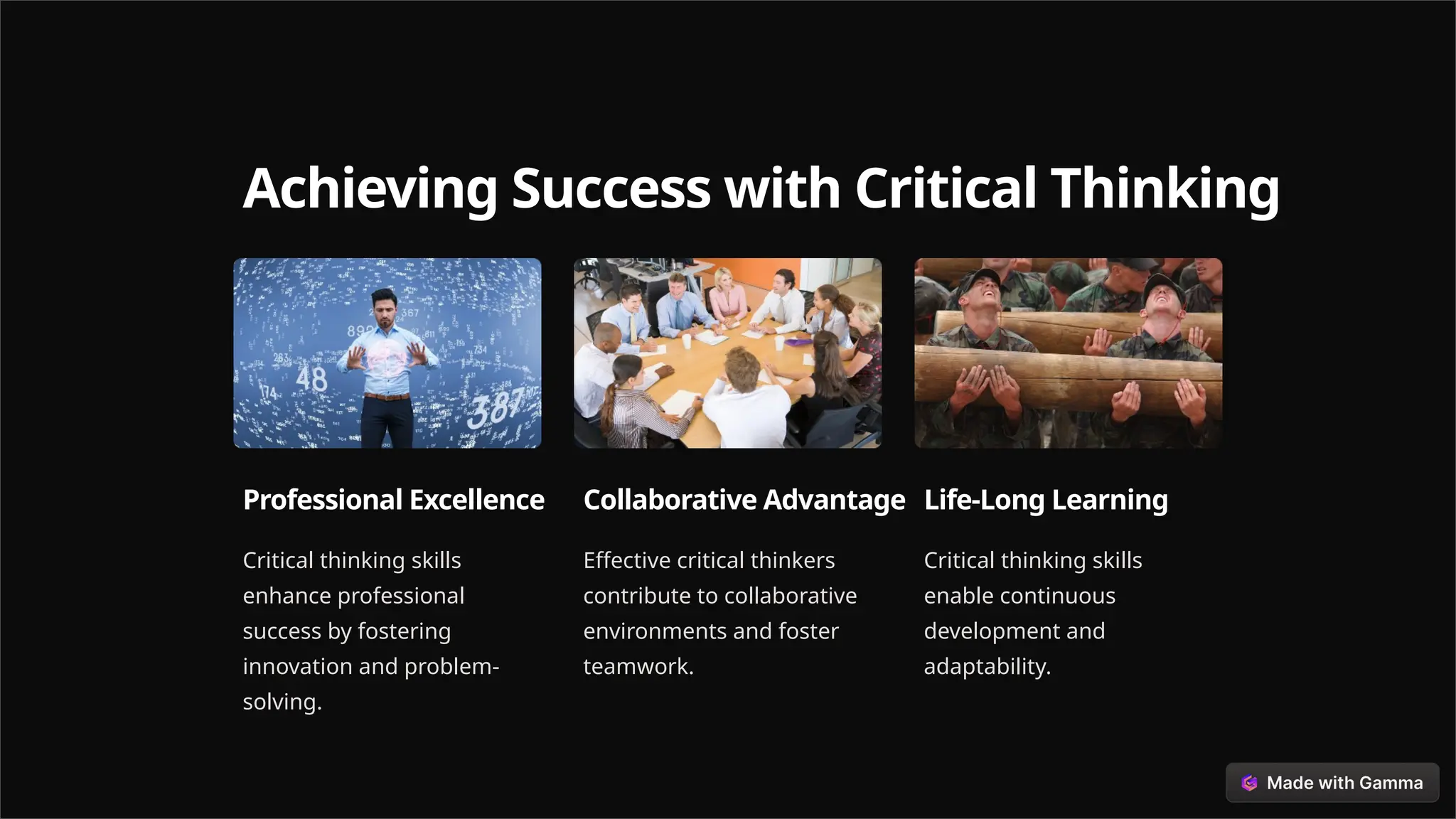
Achieving Success with Critical Thinking
Professional Excellence
Critical thinking skills
enhance professional
success by fostering
innovation and problem-
solving.
Collaborative Advantage
Effective critical thinkers
contribute to collaborative
environments and foster
teamwork.
Life-Long Learning
Critical thinking skills
enable continuous
development and
adaptability.

Chapter 1 - Introduction to Critical Thinking.pptx

  • 1.
    Critical Thinking Critical thinkingis a cognitive process that involves analyzing, evaluating, and synthesizing information to make well-reasoned judgments. It goes beyond accepting information at face value and requires a systematic, logical, and reflective approach. by Mohd Fakrul Razi Jamaluddin
  • 2.
    Definition of CriticalThinking • Analysis: Breaking down complex information to understand relationships and implications. • Evaluation: Assessing the validity, credibility, and relevance of information. • Synthesis: Combining information to create a comprehensive understanding. • Inference: Drawing logical conclusions based on evidence and reasoning. • Self-Reflection: Being aware of biases and limitations in thinking. • Open-Mindedness: Being receptive to different viewpoints. • Problem-Solving: Applying critical thinking to solve problems. • Effective Communication: Expressing ideas clearly and persuasively. Critical thinking is valuable in education, professional settings, decision- making, and interpersonal interactions. It empowers individuals to make informed choices, avoid biases, and adapt to new information.
  • 3.
    Critical Thinking Theories •Bloom's Taxonomy: Categorizes cognitive skills into a hierarchy, with critical thinking associated with higher-order skills. • Paul-Elder Model: Emphasizes dimensions like purpose, questions, information, inference, concepts, assumptions, implications, and viewpoints. • Watson-Glaser Critical Thinking Appraisal: Measures critical thinking ability, evaluating skills like recognizing assumptions and evaluating arguments. • Social-Cognitive Theory: Focuses on social aspects of critical thinking and how individuals learn through interactions. • Argumentation Theory: Explores logical structures of arguments and principles of sound reasoning. • Dual Process Theory: Considers two cognitive processes in decision-making: intuitive and analytical thinking. • Socratic Method: Involves asking probing questions to stimulate critical thinking. These theories provide insights into critical thinking and inform educational strategies and training programs.
  • 4.
    Types of CriticalThinking • Analytical Thinking: Breaking down complex information to understand relationships. • Evaluative Thinking: Assessing the credibility and quality of information. • C r e a t i v e T h i n k i n g : G e n e r a t i n g i n n o v a t i v e i d e a s a n d s o l u t i o n s . • Reflective Thinking: Introspection and self-assessment of thought processes. • Problem-Solving: Identifying, analyzing, and selecting solutions. • Decision Making: Considering relevant information to make choices. • Inductive Reasoning: Drawing general conclusions from specific observations. • Deductive Reasoning: Using general principles to reach specific conclusions. • Problem Recognition: Identifying problems to initiate the problem-solving process. • Information Synthesis: Integrating information from diverse sources. These types of critical thinking overlap and are used depending on the context and problem at hand.
  • 5.
    Characteristics and Skillsof a Critical Thinker Characteristics: • Curiosity: Eager to learn and understand. • Open-Mindedness: Receptive to new ideas and perspectives. • Objectivity: Unbiased and objective in analysis. • Intellectual Humility: Recognize limitations and learn from others. • Analytical Skills: Break down complex problems. • Problem-Solving Abilities: Approach challenges methodically. • Inquisitiveness: Ask probing questions. • Attention to Detail: Pay close attention to critical elements. Skills: • Information Gathering: Find and collect relevant information. • Evidence Evaluation: Assess credibility and reliability. • Logical Reasoning: Make valid connections and avoid fallacies. • Effective Communication: Articulate thoughts clearly. • Reflection and Meta-cognition: Analyze thought processes and minimize biases. • Decision-Making: Weigh options and make informed choices. • Creativity: Think innovatively and approach challenges uniquely.
  • 6.
    Application of CriticalThinking Skills • Education: Developing analytical and problem-solving skills in students. • Business: Making informed decisions and solving complex problems. • Healthcare: Evaluating treatment options and assessing patient conditions. • Research: Analyzing data and drawing meaningful conclusions. • Technology: Innovating and solving technical challenges. • Law: Examining evidence and constructing strong arguments. • Politics: Analyzing policies and making informed political decisions. Critical thinking is essential in various fields to ensure effective problem-solving, decision- making, and innovation.
  • 7.
    Benefits of CriticalThinking Enhanced Decision-Making By critically analyzing information, individuals can make more informed choices. Improved Problem-Solving Critical thinkers can identify and address complex problems effectively. Effective Communication Through critical thinking, individuals can express their ideas and arguments clearly. Reduced Bias Critical thinking helps individuals recognize and minimize biases in their thinking process.
  • 8.
    Developing Critical ThinkingSkills 1 Continuous Learning Engage in lifelong learning to expand knowledge and perspectives. 2 Cultivate Curiosity Embrace curiosity to explore new ideas and challenge assumptions. 3 Practice Self-Reflection Regularly reflect on your thought processes and biases to improve critical thinking skills.
  • 9.
    Achieving Success withCritical Thinking Professional Excellence Critical thinking skills enhance professional success by fostering innovation and problem- solving. Collaborative Advantage Effective critical thinkers contribute to collaborative environments and foster teamwork. Life-Long Learning Critical thinking skills enable continuous development and adaptability.