10 Effective Methods:
Infusing Critical Thinking in
Online Education
“Changing the Game”
Florida Distance
Education
Association
Dr. Frederick A. Ricci
Why Critical Thinking…
Cultivates and enhances
student’s
intellectual curiosity.
Expands and Encourages
 engagement,
 integrity,
 empathy,
 and responsibility.
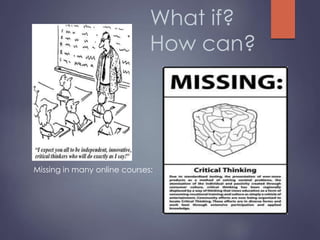
What if?
How can?
Missing in many online courses:
What student say in the
U.S. about critical thinking
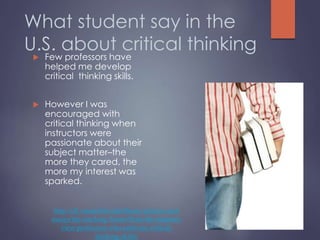
 Few professors have
helped me develop
critical thinking skills.
 However I was
encouraged with
critical thinking when
instructors were
passionate about their
subject matter–the
more they cared, the
more my interest was
sparked.
http://cft.vanderbilt.edu/library/articles-and-
essays/the-teaching-forum/from-the-students-
view-professors-who-cultivate-critical-
thinking-skills/
Why should an Instructor
Entice On-Line Critical
Thinking?
The What and Why?
Encourages students to
 examine evidence
 consider implications
 question assumptions
 explore perspectives
 and consider other questions..
 Reference:
http://www.blurtit.com/q526651.html
How does an online
instructor Cultivating
Critical Thinking?
 Begin by providing a course of study with Challenging
Experiences within the Assignments and Exercises
HOW? Effective Methods: Let’s identify 10
10 Effective methods:
Encouraging Critical Thinking
within Online Instruction.
1. Lead: Provide and
Encourage Thoughtful Online
Curriculum
Bai’s study: to promote critical thinking online, an
instructor needs to convey to student about what is
expected.
 Develop Guidelines: Checklists, rubrics, guides,
or models of critical thinking questions.
 Promote Discussions: Create threaded
discussions: i.e., encourage postings and
comments to postings
2. Create and
Design Critical Thinking
Questions
Convey well-
designed
discussion
questions ---
It’s fundamental
in developing
critical thinking
skills
HOW?
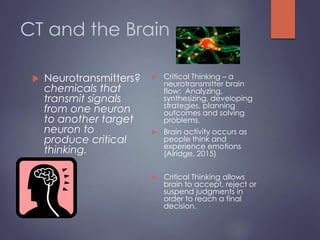
CT and the Brain
 Neurotransmitters?
chemicals that
transmit signals
from one neuron
to another target
neuron to
produce critical
thinking.
 Critical Thinking – a
neurotransmitter brain
flow: Analyzing,
synthesizing, developing
strategies, planning
outcomes and solving
problems,
 Brain activity occurs as
people think and
experience emotions
(Alridge, 2015)
 Critical Thinking allows
brain to accept, reject or
suspend judgments in
order to reach a final
decision.
HOW? Try Bloom Taxonomy
of Learning Domains
Remember: Bloom's Taxonomy 1956
Educational psychologist Dr Benjamin
Bloom in order to promote higher forms of
thinking in education, such as analyzing and
evaluating concepts, processes, procedures,
and principles, rather than just remembering
facts (rote learning). It is most often used
when designing instruction or learning
processes (Instructional Design)
- See more at:
http://www.nwlink.com/~donclark/hrd/bloom.html#sth
ash.jgVRjnqG.dpuf
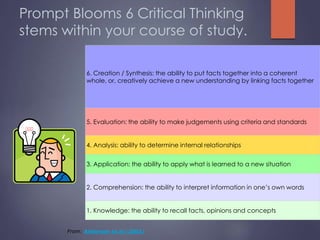
Prompt Blooms 6 Critical Thinking
stems within your course of study.
6. Creation / Synthesis: the ability to put facts together into a coherent
whole, or, creatively achieve a new understanding by linking facts together
5. Evaluation: the ability to make judgements using criteria and standards
4. Analysis: ability to determine internal relationships
3. Application: the ability to apply what is learned to a new situation
2. Comprehension: the ability to interpret information in one’s own words
1. Knowledge: the ability to recall facts, opinions and concepts
From: Anderson et al (2001)
Bloom’s Taxonomy sample
questions: Stem Questions
1: Knowledge Exhibits previously learned material by recalling
facts, terms, basic concepts and answers.
What is . . . ?
When did ____ happen?
How would you explain . . . ?
Why did . .. ?
How would you describe . .. ?
2: Comprehension Demonstrating understanding of facts and
ideas by organising, comparing, translating, interpreting, giving
descriptions and stating main ideas.
How would you compare . .. ? contrast.. ?
Explain in your own words . . . ?
What facts or ideas show . .. ?
What evidence is there that…?
3: Application Solving problems by applying acquired
knowledge, facts, techniques and rules in a different way.
What examples can you find to . . . ?
How would you show your understanding of. .. ?
What approach would you use to ... ?
What might have happened if. . . ?
4: Analysis Examining and breaking information
into parts by identifying motives or causes; making
inferences and finding evidence to support
generalisations.
What inference can you make from. . . ?
How would you classify . . . ?
How would you categorise . .. ?
Can you identify the difference parts... ?
5: Evaluation Presenting and defending opinions by
making judgments about information, validity of
ideas or quality of work based on a set of criteria.
How would you compare ……?
Which do you think is better….?
Evaluate contribution of ….. to …………….
What was the value or importance of …….. in
…………..?
What would you have recommended if you had been
……?
6: Creation / Synthesis: Compiling information
together in a different way by combining elements in
a new pattern or proposing alternative solutions.
What might have happened if… ?
Can you propose an alternative interpretation to that
of ……. . ?
Is there a marmite solution [1] here?http://www.ucdoer.ie/index.php/How_to_Ask_Questions_that_Prompt_Critical_Thinking
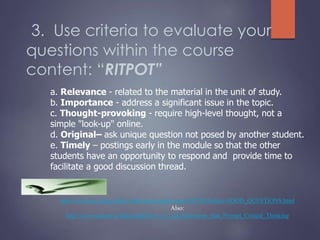
3. Use criteria to evaluate your
questions within the course
content: “RITPOT”
a. Relevance - related to the material in the unit of study.
b. Importance - address a significant issue in the topic.
c. Thought-provoking - require high-level thought, not a
simple "look-up" online.
d. Original– ask unique question not posed by another student.
e. Timely – postings early in the module so that the other
students have an opportunity to respond and provide time to
facilitate a good discussion thread.
http://www.qcc.cuny.edu/socialsciences/ppecorino/SS770/Outline-GOOD_QUESTIONS.html
Also:
http://www.ucdoer.ie/index.php/How_to_Ask_Questions_that_Prompt_Critical_Thinking
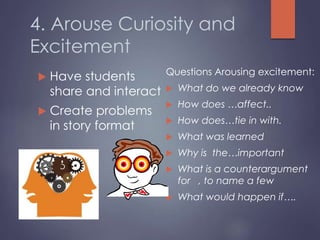
4. Arouse Curiosity and
Excitement
 Have students
share and interact
 Create problems
in story format
Questions Arousing excitement:
 What do we already know
 How does …affect..
 How does…tie in with.
 What was learned
 Why is the…important
 What is a counterargument
for , to name a few
 What would happen if….
Arouse Curiosity
(CREATE A CHECKLIST TO
HELP STUDENT POSTINGS.
DO YOU…
• HAVE ADEQUATE
INFORMATION
 CONVEY CLEARLY AND
LOGICALLY
 IDENTIFY SIGNIFICANCE
OF WHAT I AM WRITING
 PROVIDE ACCURATE
INFORMATION, FACTS,
LOGIC, EVIDENCE AND
CREDIBLE RESOURCES.
PAUL (2006)
5. Stress Importance of
Critical Thinking in One’s Life.
 Why important? To make dramatically
better decisions in life.
 “Continuously discussing the thought processes within
government, business, education, cultures, and
societal systems with others …….is the key to
discovering new methods to eliminate
current problems and enhance future
society.”
FYI: Importance of CT by
International Associations
 The National Council of Teachers of English (NCTE) Committee on Critical
Thinking "a process which stresses an attitude of suspended judgment,
incorporates logical inquiry and problem solving, and leads to an evaluative
decision or action." Critical thinking refers to a "way of reasoning that
demands adequate support for one's beliefs and an unwillingness to
be persuaded unless the support is forthcoming."
 Association of American Colleges and Universities (AACU) survey of business
and non-profit leaders found that 93% believe "a demonstrated capacity to
think critically, communicate clearly, and solve complex problems is more
important than [a job candidate’s] undergraduate major." More than 75% of
those surveyed say they want more emphasis on critical thinking, complex
problem solving, written and oral communication, and applied knowledge in
real-world settings for all colleges and universities.
6. Provide In-depth Critical
Thinking Assignments
 To develop thinking and
obtain information utilizing
the new and emerging
technologies which
enhance information
 To apply theory to
practice with all
information technology
 .
 Assist with surfing the
net when obtaining
information.
 Create strategic
group thinking,
planning, and
strategizing which are
identified with
organizational
success.
Assign Analytical Research
Papers
 HAVE STUDENTS EVALUATE
OTHER WRITINGS WITHIN
THE COURSE CONTENT
AREAS.
 ANALYZE AND JUDGE
WHICH ARE CREDIBLE
SOURCES.
 ENCOURAGE THEM TO
FORMULATE LOGICAL
THINKING PROCESS.
CONSIDER CULTURAL
CONDITIONING AND ONE’S
THOUGHT INFLUENCE
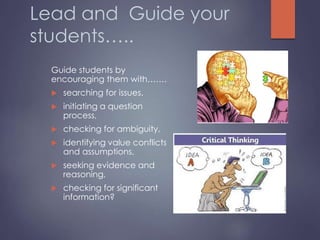
Lead and Guide your
students…..
Guide students by
encouraging them with…….
 searching for issues.
 initiating a question
process,
 checking for ambiguity,
 identifying value conflicts
and assumptions,
 seeking evidence and
reasoning,
 checking for significant
information?
7. Teach Transfer Abilities
toward Decision Making and
Good Judgment
 Critical thinkers become good decision makers and
problem solvers……..
Excel at reviewing textbooks, periodicals and journals, or
surfing the web
 Provides practice toward gaining better judgment when
reading and writing in today’s social media such as blogs,
Facebook, twitter, etc.
 Assists with thinking process,
 Contributes to enrich discussion forums and group
assignments valuable to organizations, societies, and
governments.
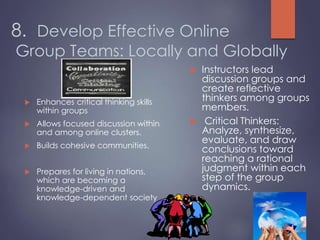
8. Develop Effective Online
Group Teams: Locally and Globally
 Enhances critical thinking skills
within groups
 Allows focused discussion within
and among online clusters.
 Builds cohesive communities.
 Prepares for living in nations,
which are becoming a
knowledge-driven and
knowledge-dependent society
 Instructors lead
discussion groups and
create reflective
thinkers among groups
members.
 Critical Thinkers:
Analyze, synthesize,
evaluate, and draw
conclusions toward
reaching a rational
judgment within each
step of the group
dynamics.
Procedures Supporting Critical Thinking in
Distance Learning Groups
 Online
Discussions
 Case Studies
 Group
Assignments
 Debates
 Live Discussions
 Carefully
constructed
questions
 Skilled Moderator
 Clear Guidelines
 Feedback
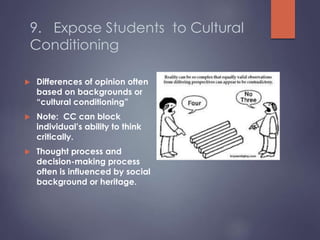
9. Expose Students to Cultural
Conditioning
 Differences of opinion often
based on backgrounds or
“cultural conditioning”
 Note: CC can block
individual’s ability to think
critically.
 Thought process and
decision-making process
often is influenced by social
background or heritage.
Importance of Cultural
Conditioning
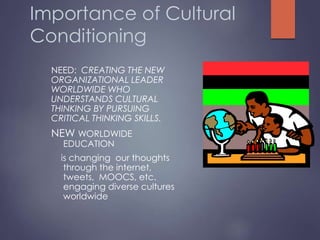
NEED: CREATING THE NEW
ORGANIZATIONAL LEADER
WORLDWIDE WHO
UNDERSTANDS CULTURAL
THINKING BY PURSUING
CRITICAL THINKING SKILLS.
NEW WORLDWIDE
EDUCATION
is changing our thoughts
through the internet,
tweets, MOOCS, etc.
engaging diverse cultures
worldwide
Cultural Conditioning and
Critical Thinking
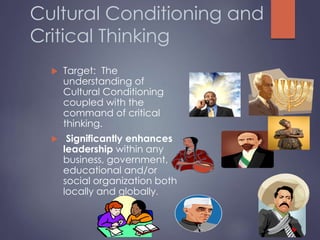
 Target: The
understanding of
Cultural Conditioning
coupled with the
command of critical
thinking.
 Significantly enhances
leadership within any
business, government,
educational and/or
social organization both
locally and globally.
10. Implement and Evaluate the
Virtual World within online classes
 Infuse new
networks within
the course of
study.
 Use the abundant
electronic
information
 Encourage
students to
reason about all
online information
 Needed: ability to determine
accuracy levels and credibility
Helpful web sites: USE the following
websites.
 EasyBib – Website Evaluation Guide
 Finding Dulcinea – Website
Credibility and Guidelines
 Berkeley – Evaluating Webpages
Techniques
Your Role: Prepare Visionary
Leaders
 Needed:— YOU
You have the
capacity to
inspire and
energize others to
perform at their
highest level
individually and
collectively.
 Focus: Vision and
Values
“Truly effective leaders
in the years ahead…will
be visionary”
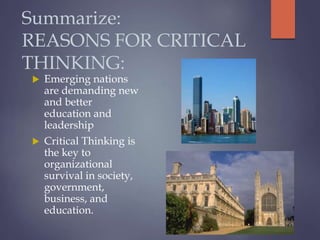
Summarize:
REASONS FOR CRITICAL
THINKING:
 Emerging nations
are demanding new
and better
education and
leadership
 Critical Thinking is
the key to
organizational
survival in society,
government,
business, and
education.
Your Role: Organizational
Leadership of the 21st
Century
 “There’s nothing
more important
than growing
people. That’s
your profession’s
no. 1 job.
Thank you.
Dr. Fred Ricci
Additional References for review
 Aldridge, J. M. (2005). Correlation as causation (fMRI) letter.
 Brookings Institute. (2014). Problem solving through critical thinking.
 Brown, T. (2008, June). Design thinking. Harvard Business Review: The Magazine. Retrieved from http://hbr.org/2008/06/design-thinking/
 Budryk, Z. (2013). More than a major. Inside Higher Ed. Retrieved from http://www.insidehighered.com/news/2013/04/10/survey-finds-business-executives-arent-focused-majors-those-they-hire
 Burnette, C. (2005). What is design thinking? Retrieved from http://www.idesignthinking.com/01whyteach/01whyteach.html
 Burnette, C. (2009). A theory of design thinking. FAIA Prepared in response to the Torquay Conference on Design Thinking, Swinburne University of Technology, Melbourne, Australia, Nov 1, 2009.
 Changing Minds. (2012). Socratic questions. Retrieved from http://changingminds.org/ techniques/questioning/socratic_questions.htm
 Chartrand, J., Ishikawa H., & Flanigan, S. (2009). Critical thinking means business: Learn to apply and develop the NEW #1 workplace skill. Pearson Education, Retrieved from http://www.talentlens.com/en/ downloads/whitepapers/
Pearson_TalentLens_Critical_Thinking_Means_Business.pdf
 Dass, T. K. (1994, October). Educating tomorrow’s managers: The role of critical thinking. The International Journal of Organizational Analysis, 2, 333-360. Retrieved from
http://aux.zicklin.baruch.cuny.edu/tkdas/publications/das_ijoa94_criticalthinking.pdf
 Fast Company Staff. (2014). Design thinking: What is that? Retrieved from http://www.fastcompany.com/919258/design-thinking-what
 Foundation for Critical Thinking. (2007). To analyze critical thinking, we must analyze and question its elemental structures. Retrieved from http://www.criticalthinking.org/ctmodel/logic-model1.htm
 Foundation for Critical Thinking. (2013). Critical thinking: Where to begin. Retrieved from http://www.criticalthinking.org/pages/critical-thinking-where-to-begin/796
 Humphreys, Debra, (2013) . Employers More Interested in Critical Thinking and Problem Solving Than College Major,aacu.org.
 Jenkins, D. M., & Cutchens, A. B. (2011, Summer). Leading critically: A grounded theory of applied critical thinking in leadership studies, Journal of Leadership Education, 10, Retrieved from https://www.academ75ia.edu/1214625/
 Jones, M. (2005). New paradigm for executive education. Executive White Paper. International Institute of Management 9IIM. Retrieved from http://www.iim-edu.org/executiveeducationbestpracticeskasac/
 Karr, S. S. (2009, December). Critical thinking: A critical strategy for financial executives. Journal of Instructional Psychology, 26, 2.
 Lau, J., & Chan, J. (2014). Welcome to critical thinking web. Retrieved from http://philosophy.hku.hk/think/
 Marbles, the Brain Store. (2012). About the Brain, Critical Thinking. Retrieved from, http://www.marblesthebrainstore.com/about-critical-thinking/
 McGraw-Hill Companies. (2000). Reichenbach: An introduction to critical thinking. Retrieved from http://www.mhhe.com/socscience/philosophy/reichenbach/ m1_chap02studyguide.html
 Natale, S., & Ricci, F. (2006). Critical thinking in organizations. Team Performance Management, 12(7), 272-278.
 National Institutes of Health. (n.d.). The brain, lesson 1: What’s going on there? Retrieved from http://science.education.nih.gov/supplements/nih2/addiction/activities/lesson1_brainparts.htm)
 Purdue University Center for Student Achievement. (n.d.). Critical thinking. Retrieved from http://webs.purduecal.edu/csa/files/2012/05/Critical-Thinking.pdf
 Ratcliffe, J. (ed.). (2009, August 1). Steps in design thinking: Retrieved from https://dschool.stanford.edu/groups/k12/wiki/17cff/Design_Process_Steps.html
 Stanford Graduate School of Business. (2014). Design Thinking Boot Camp: From insights
to innovation. Retrieved from http://www.gsb.stanford.edu/exed/dtbc/
 Stotz, D. (2012). The future of executive education. Executive Education in the News. Retrieved from http://uniconexed.org/en/89-unicon-articles-category/in-the-news/170-future-of-education.html
 The Almanac. (2012, September 24). New Stanford courses stress critical thinking. Retrieved from http://www.almanacnews.com/news/2012/09/24/new-stanford-courses-stress-critical-thinking
 Welsh, M. A., & Dehler, G. E. (2013). Combining critical reflection and design thinking to develop integrative learners, Journal of Management Education, 37, 771-802
Reference Websites:
 http://onlinelearninginsights.wordpress.com/2013/10/01/how-to-
promote-critical-thinkin-with-online-discussion-forums/
 http://www.saylor.org/courses/phil102/
 http://onlinelearninginsights.wordpress.com/2013/10/01/how-to-
promote-critical-thinking-with-online-discussion-forums/
 http://austhink.com/critical/
 http://www.editlib.org/p/36242/ ]
 http://www.editlib.org/noaccess/36242/

10 Effective Methods: Infusing Critical Thinking in Online Education

  • 1.
    10 Effective Methods: InfusingCritical Thinking in Online Education “Changing the Game” Florida Distance Education Association Dr. Frederick A. Ricci
  • 2.
    Why Critical Thinking… Cultivatesand enhances student’s intellectual curiosity. Expands and Encourages  engagement,  integrity,  empathy,  and responsibility.
  • 3.
    What if? How can? Missingin many online courses:
  • 4.
    What student sayin the U.S. about critical thinking  Few professors have helped me develop critical thinking skills.  However I was encouraged with critical thinking when instructors were passionate about their subject matter–the more they cared, the more my interest was sparked. http://cft.vanderbilt.edu/library/articles-and- essays/the-teaching-forum/from-the-students- view-professors-who-cultivate-critical- thinking-skills/
  • 5.
    Why should anInstructor Entice On-Line Critical Thinking? The What and Why? Encourages students to  examine evidence  consider implications  question assumptions  explore perspectives  and consider other questions..  Reference: http://www.blurtit.com/q526651.html
  • 6.
    How does anonline instructor Cultivating Critical Thinking?  Begin by providing a course of study with Challenging Experiences within the Assignments and Exercises HOW? Effective Methods: Let’s identify 10
  • 7.
    10 Effective methods: EncouragingCritical Thinking within Online Instruction.
  • 8.
    1. Lead: Provideand Encourage Thoughtful Online Curriculum Bai’s study: to promote critical thinking online, an instructor needs to convey to student about what is expected.  Develop Guidelines: Checklists, rubrics, guides, or models of critical thinking questions.  Promote Discussions: Create threaded discussions: i.e., encourage postings and comments to postings
  • 9.
    2. Create and DesignCritical Thinking Questions Convey well- designed discussion questions --- It’s fundamental in developing critical thinking skills HOW?
  • 10.
    CT and theBrain  Neurotransmitters? chemicals that transmit signals from one neuron to another target neuron to produce critical thinking.  Critical Thinking – a neurotransmitter brain flow: Analyzing, synthesizing, developing strategies, planning outcomes and solving problems,  Brain activity occurs as people think and experience emotions (Alridge, 2015)  Critical Thinking allows brain to accept, reject or suspend judgments in order to reach a final decision.
  • 11.
    HOW? Try BloomTaxonomy of Learning Domains Remember: Bloom's Taxonomy 1956 Educational psychologist Dr Benjamin Bloom in order to promote higher forms of thinking in education, such as analyzing and evaluating concepts, processes, procedures, and principles, rather than just remembering facts (rote learning). It is most often used when designing instruction or learning processes (Instructional Design) - See more at: http://www.nwlink.com/~donclark/hrd/bloom.html#sth ash.jgVRjnqG.dpuf
  • 12.
    Prompt Blooms 6Critical Thinking stems within your course of study. 6. Creation / Synthesis: the ability to put facts together into a coherent whole, or, creatively achieve a new understanding by linking facts together 5. Evaluation: the ability to make judgements using criteria and standards 4. Analysis: ability to determine internal relationships 3. Application: the ability to apply what is learned to a new situation 2. Comprehension: the ability to interpret information in one’s own words 1. Knowledge: the ability to recall facts, opinions and concepts From: Anderson et al (2001)
  • 13.
    Bloom’s Taxonomy sample questions:Stem Questions 1: Knowledge Exhibits previously learned material by recalling facts, terms, basic concepts and answers. What is . . . ? When did ____ happen? How would you explain . . . ? Why did . .. ? How would you describe . .. ? 2: Comprehension Demonstrating understanding of facts and ideas by organising, comparing, translating, interpreting, giving descriptions and stating main ideas. How would you compare . .. ? contrast.. ? Explain in your own words . . . ? What facts or ideas show . .. ? What evidence is there that…? 3: Application Solving problems by applying acquired knowledge, facts, techniques and rules in a different way. What examples can you find to . . . ? How would you show your understanding of. .. ? What approach would you use to ... ? What might have happened if. . . ? 4: Analysis Examining and breaking information into parts by identifying motives or causes; making inferences and finding evidence to support generalisations. What inference can you make from. . . ? How would you classify . . . ? How would you categorise . .. ? Can you identify the difference parts... ? 5: Evaluation Presenting and defending opinions by making judgments about information, validity of ideas or quality of work based on a set of criteria. How would you compare ……? Which do you think is better….? Evaluate contribution of ….. to ……………. What was the value or importance of …….. in …………..? What would you have recommended if you had been ……? 6: Creation / Synthesis: Compiling information together in a different way by combining elements in a new pattern or proposing alternative solutions. What might have happened if… ? Can you propose an alternative interpretation to that of ……. . ? Is there a marmite solution [1] here?http://www.ucdoer.ie/index.php/How_to_Ask_Questions_that_Prompt_Critical_Thinking
  • 14.
    3. Use criteriato evaluate your questions within the course content: “RITPOT” a. Relevance - related to the material in the unit of study. b. Importance - address a significant issue in the topic. c. Thought-provoking - require high-level thought, not a simple "look-up" online. d. Original– ask unique question not posed by another student. e. Timely – postings early in the module so that the other students have an opportunity to respond and provide time to facilitate a good discussion thread. http://www.qcc.cuny.edu/socialsciences/ppecorino/SS770/Outline-GOOD_QUESTIONS.html Also: http://www.ucdoer.ie/index.php/How_to_Ask_Questions_that_Prompt_Critical_Thinking
  • 15.
    4. Arouse Curiosityand Excitement  Have students share and interact  Create problems in story format Questions Arousing excitement:  What do we already know  How does …affect..  How does…tie in with.  What was learned  Why is the…important  What is a counterargument for , to name a few  What would happen if….
  • 16.
    Arouse Curiosity (CREATE ACHECKLIST TO HELP STUDENT POSTINGS. DO YOU… • HAVE ADEQUATE INFORMATION  CONVEY CLEARLY AND LOGICALLY  IDENTIFY SIGNIFICANCE OF WHAT I AM WRITING  PROVIDE ACCURATE INFORMATION, FACTS, LOGIC, EVIDENCE AND CREDIBLE RESOURCES. PAUL (2006)
  • 17.
    5. Stress Importanceof Critical Thinking in One’s Life.  Why important? To make dramatically better decisions in life.  “Continuously discussing the thought processes within government, business, education, cultures, and societal systems with others …….is the key to discovering new methods to eliminate current problems and enhance future society.”
  • 18.
    FYI: Importance ofCT by International Associations  The National Council of Teachers of English (NCTE) Committee on Critical Thinking "a process which stresses an attitude of suspended judgment, incorporates logical inquiry and problem solving, and leads to an evaluative decision or action." Critical thinking refers to a "way of reasoning that demands adequate support for one's beliefs and an unwillingness to be persuaded unless the support is forthcoming."  Association of American Colleges and Universities (AACU) survey of business and non-profit leaders found that 93% believe "a demonstrated capacity to think critically, communicate clearly, and solve complex problems is more important than [a job candidate’s] undergraduate major." More than 75% of those surveyed say they want more emphasis on critical thinking, complex problem solving, written and oral communication, and applied knowledge in real-world settings for all colleges and universities.
  • 19.
    6. Provide In-depthCritical Thinking Assignments  To develop thinking and obtain information utilizing the new and emerging technologies which enhance information  To apply theory to practice with all information technology  .  Assist with surfing the net when obtaining information.  Create strategic group thinking, planning, and strategizing which are identified with organizational success.
  • 20.
    Assign Analytical Research Papers HAVE STUDENTS EVALUATE OTHER WRITINGS WITHIN THE COURSE CONTENT AREAS.  ANALYZE AND JUDGE WHICH ARE CREDIBLE SOURCES.  ENCOURAGE THEM TO FORMULATE LOGICAL THINKING PROCESS. CONSIDER CULTURAL CONDITIONING AND ONE’S THOUGHT INFLUENCE
  • 21.
    Lead and Guideyour students….. Guide students by encouraging them with…….  searching for issues.  initiating a question process,  checking for ambiguity,  identifying value conflicts and assumptions,  seeking evidence and reasoning,  checking for significant information?
  • 22.
    7. Teach TransferAbilities toward Decision Making and Good Judgment  Critical thinkers become good decision makers and problem solvers…….. Excel at reviewing textbooks, periodicals and journals, or surfing the web  Provides practice toward gaining better judgment when reading and writing in today’s social media such as blogs, Facebook, twitter, etc.  Assists with thinking process,  Contributes to enrich discussion forums and group assignments valuable to organizations, societies, and governments.
  • 23.
    8. Develop EffectiveOnline Group Teams: Locally and Globally  Enhances critical thinking skills within groups  Allows focused discussion within and among online clusters.  Builds cohesive communities.  Prepares for living in nations, which are becoming a knowledge-driven and knowledge-dependent society  Instructors lead discussion groups and create reflective thinkers among groups members.  Critical Thinkers: Analyze, synthesize, evaluate, and draw conclusions toward reaching a rational judgment within each step of the group dynamics.
  • 24.
    Procedures Supporting CriticalThinking in Distance Learning Groups  Online Discussions  Case Studies  Group Assignments  Debates  Live Discussions  Carefully constructed questions  Skilled Moderator  Clear Guidelines  Feedback
  • 25.
    9. Expose Studentsto Cultural Conditioning  Differences of opinion often based on backgrounds or “cultural conditioning”  Note: CC can block individual’s ability to think critically.  Thought process and decision-making process often is influenced by social background or heritage.
  • 26.
    Importance of Cultural Conditioning NEED:CREATING THE NEW ORGANIZATIONAL LEADER WORLDWIDE WHO UNDERSTANDS CULTURAL THINKING BY PURSUING CRITICAL THINKING SKILLS. NEW WORLDWIDE EDUCATION is changing our thoughts through the internet, tweets, MOOCS, etc. engaging diverse cultures worldwide
  • 27.
    Cultural Conditioning and CriticalThinking  Target: The understanding of Cultural Conditioning coupled with the command of critical thinking.  Significantly enhances leadership within any business, government, educational and/or social organization both locally and globally.
  • 28.
    10. Implement andEvaluate the Virtual World within online classes  Infuse new networks within the course of study.  Use the abundant electronic information  Encourage students to reason about all online information  Needed: ability to determine accuracy levels and credibility Helpful web sites: USE the following websites.  EasyBib – Website Evaluation Guide  Finding Dulcinea – Website Credibility and Guidelines  Berkeley – Evaluating Webpages Techniques
  • 29.
    Your Role: PrepareVisionary Leaders  Needed:— YOU You have the capacity to inspire and energize others to perform at their highest level individually and collectively.  Focus: Vision and Values “Truly effective leaders in the years ahead…will be visionary”
  • 30.
    Summarize: REASONS FOR CRITICAL THINKING: Emerging nations are demanding new and better education and leadership  Critical Thinking is the key to organizational survival in society, government, business, and education.
  • 31.
    Your Role: Organizational Leadershipof the 21st Century  “There’s nothing more important than growing people. That’s your profession’s no. 1 job.
  • 32.
  • 33.
    Additional References forreview  Aldridge, J. M. (2005). Correlation as causation (fMRI) letter.  Brookings Institute. (2014). Problem solving through critical thinking.  Brown, T. (2008, June). Design thinking. Harvard Business Review: The Magazine. Retrieved from http://hbr.org/2008/06/design-thinking/  Budryk, Z. (2013). More than a major. Inside Higher Ed. Retrieved from http://www.insidehighered.com/news/2013/04/10/survey-finds-business-executives-arent-focused-majors-those-they-hire  Burnette, C. (2005). What is design thinking? Retrieved from http://www.idesignthinking.com/01whyteach/01whyteach.html  Burnette, C. (2009). A theory of design thinking. FAIA Prepared in response to the Torquay Conference on Design Thinking, Swinburne University of Technology, Melbourne, Australia, Nov 1, 2009.  Changing Minds. (2012). Socratic questions. Retrieved from http://changingminds.org/ techniques/questioning/socratic_questions.htm  Chartrand, J., Ishikawa H., & Flanigan, S. (2009). Critical thinking means business: Learn to apply and develop the NEW #1 workplace skill. Pearson Education, Retrieved from http://www.talentlens.com/en/ downloads/whitepapers/ Pearson_TalentLens_Critical_Thinking_Means_Business.pdf  Dass, T. K. (1994, October). Educating tomorrow’s managers: The role of critical thinking. The International Journal of Organizational Analysis, 2, 333-360. Retrieved from http://aux.zicklin.baruch.cuny.edu/tkdas/publications/das_ijoa94_criticalthinking.pdf  Fast Company Staff. (2014). Design thinking: What is that? Retrieved from http://www.fastcompany.com/919258/design-thinking-what  Foundation for Critical Thinking. (2007). To analyze critical thinking, we must analyze and question its elemental structures. Retrieved from http://www.criticalthinking.org/ctmodel/logic-model1.htm  Foundation for Critical Thinking. (2013). Critical thinking: Where to begin. Retrieved from http://www.criticalthinking.org/pages/critical-thinking-where-to-begin/796  Humphreys, Debra, (2013) . Employers More Interested in Critical Thinking and Problem Solving Than College Major,aacu.org.  Jenkins, D. M., & Cutchens, A. B. (2011, Summer). Leading critically: A grounded theory of applied critical thinking in leadership studies, Journal of Leadership Education, 10, Retrieved from https://www.academ75ia.edu/1214625/  Jones, M. (2005). New paradigm for executive education. Executive White Paper. International Institute of Management 9IIM. Retrieved from http://www.iim-edu.org/executiveeducationbestpracticeskasac/  Karr, S. S. (2009, December). Critical thinking: A critical strategy for financial executives. Journal of Instructional Psychology, 26, 2.  Lau, J., & Chan, J. (2014). Welcome to critical thinking web. Retrieved from http://philosophy.hku.hk/think/  Marbles, the Brain Store. (2012). About the Brain, Critical Thinking. Retrieved from, http://www.marblesthebrainstore.com/about-critical-thinking/  McGraw-Hill Companies. (2000). Reichenbach: An introduction to critical thinking. Retrieved from http://www.mhhe.com/socscience/philosophy/reichenbach/ m1_chap02studyguide.html  Natale, S., & Ricci, F. (2006). Critical thinking in organizations. Team Performance Management, 12(7), 272-278.  National Institutes of Health. (n.d.). The brain, lesson 1: What’s going on there? Retrieved from http://science.education.nih.gov/supplements/nih2/addiction/activities/lesson1_brainparts.htm)  Purdue University Center for Student Achievement. (n.d.). Critical thinking. Retrieved from http://webs.purduecal.edu/csa/files/2012/05/Critical-Thinking.pdf  Ratcliffe, J. (ed.). (2009, August 1). Steps in design thinking: Retrieved from https://dschool.stanford.edu/groups/k12/wiki/17cff/Design_Process_Steps.html  Stanford Graduate School of Business. (2014). Design Thinking Boot Camp: From insights to innovation. Retrieved from http://www.gsb.stanford.edu/exed/dtbc/  Stotz, D. (2012). The future of executive education. Executive Education in the News. Retrieved from http://uniconexed.org/en/89-unicon-articles-category/in-the-news/170-future-of-education.html  The Almanac. (2012, September 24). New Stanford courses stress critical thinking. Retrieved from http://www.almanacnews.com/news/2012/09/24/new-stanford-courses-stress-critical-thinking  Welsh, M. A., & Dehler, G. E. (2013). Combining critical reflection and design thinking to develop integrative learners, Journal of Management Education, 37, 771-802
  • 34.
    Reference Websites:  http://onlinelearninginsights.wordpress.com/2013/10/01/how-to- promote-critical-thinkin-with-online-discussion-forums/ http://www.saylor.org/courses/phil102/  http://onlinelearninginsights.wordpress.com/2013/10/01/how-to- promote-critical-thinking-with-online-discussion-forums/  http://austhink.com/critical/  http://www.editlib.org/p/36242/ ]  http://www.editlib.org/noaccess/36242/

Editor's Notes