2
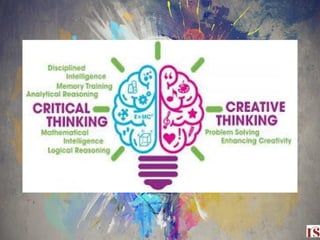
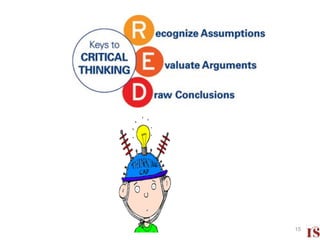
CRITICAL THINKING
&
CREATIVIE THINKING
3
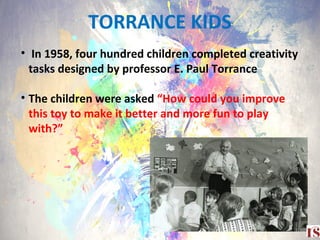
TORRANCE KIDS
4
• In 1958, four hundred children completed creativity
tasks designed by professor E. Paul Torrance
• The children were asked “How could you improve
this toy to make it better and more fun to play
with?”
• Those who came up with more good ideas on
Torrance’s tasks grew up to be entrepreneurs,
inventors, college presidents, authors, doctors,
diplomats, and software developers.
• Jonathan Plucker of Indiana University recently
reanalyzed Torrance’s data. The correlation to lifetime
creative accomplishment was more than three times

stronger for childhood creativity than childhood IQ.
5
6
7
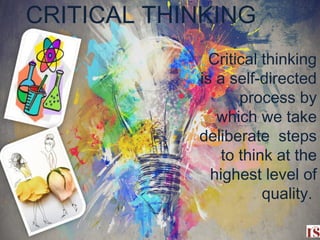
Critical thinking
is a self-directed
process by
which we take
deliberate steps
to think at the
highest level of
quality.
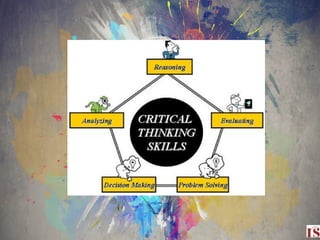
CRITICAL THINKING
8
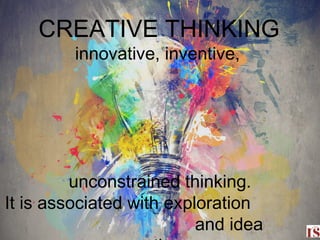
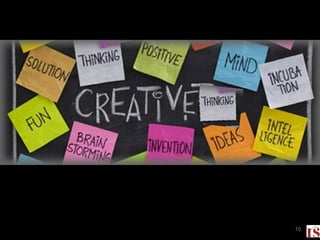
CREATIVE THINKING
innovative, inventive,
unconstrained thinking.
It is associated with exploration
and idea
10
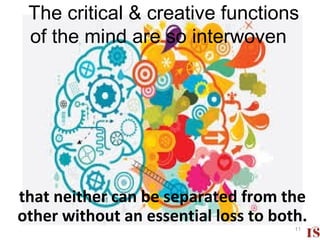
The critical & creative functions
of the mind are so interwoven
that neither can be separated from the
other without an essential loss to both.
11
12
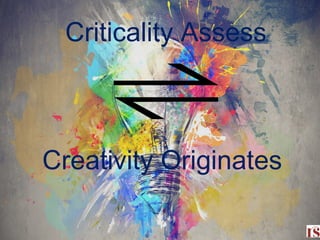
Criticality Assess
Creativity Originates
13
WHY
The aim of Critical Thinking is to
promote independent thinking,
personal autonomy and reasoned
judgment in thought and action. ...
the ability to reason well and. the
disposition to do so.
4
15
16
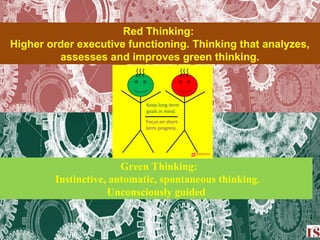
Red Thinking:
Higher order executive functioning. Thinking that analyzes,
assesses and improves green thinking.
Green Thinking:
Instinctive, automatic, spontaneous thinking.
Unconsciously guided
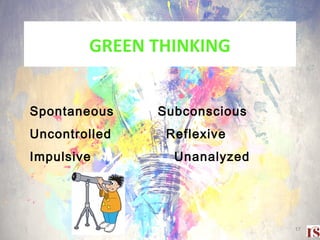
GREEN THINKING
17
Spontaneous Subconscious
Uncontrolled Reflexive
Impulsive Unanalyzed
RED THINKING
Disciplined Seeks the truth
Self assessing Critical Thinking
Self correcting Probing
18
19
20
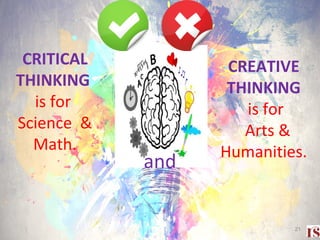
CRITICAL
THINKING
is for
Science &
Math.
CREATIVE
THINKING
is for
Arts &
Humanities.
21
and
CRITICAL & CREATIVE thinking
can and should be applied to
ANY subject, content or problem.
22
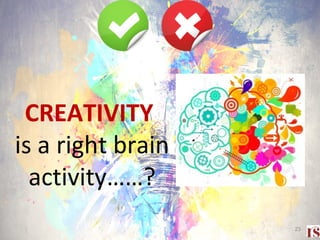
CREATIVITY
is a right brain
activity……?
23
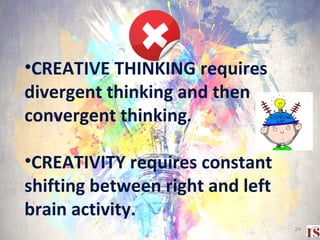
•CREATIVE THINKING requires
divergent thinking and then
convergent thinking.
•CREATIVITY requires constant
shifting between right and left
brain activity.
24
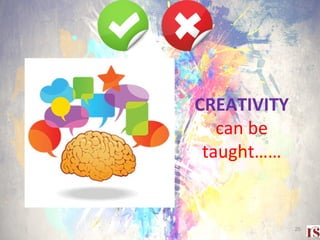
CREATIVITY
can be
taught……
25
CREATIVITY
…… can be taught.
Practicing promotes more
creative learning.
26
Strategies for
Teaching Critical
and
Creative Thinking:
27
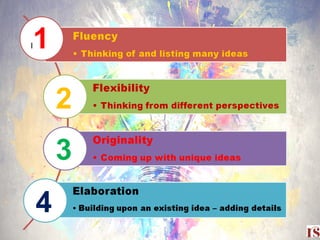
I1
2
3
4
29
Creative or Critical……. thinking is a skill that
young minds will undeniably need and exercise
well beyond their school years. Experts agree
that in keeping up with the ever-changing
technological advances, students will need to
obtain, understand, and analyze information on a
much more efficient scale. It is our job as
educators to equip our students with the
strategies and skills they need to think critically in
order to cope with these tech problems and
obstacles they face elsewhere.
30
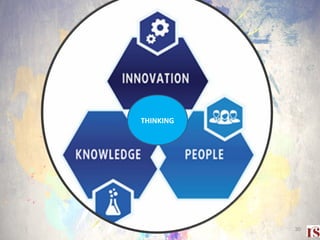
THINKING
31
32
Go as far as you
can see. When
you get there,
you can see
farther.
Thomas Carlyle33

Critical and Creative thinking

Editor's Notes

  • #25 Creative thinking requires divergent thinking (generating many unique ideas) and then convergent thinking (combining those ideas into the best result). Creativity requires constant shifting, blender pulses of both types of thinking (right and left brain activity) to arrive at original and useful ideas.