Critical Thinking Skills
Critical
Thinking?
 Reflect on the question What is Critical thinking?
Critical thinking is what a college education is all about.
In many high schools, the emphasis tends to be on “lower-order
thinking.” Students are simply expected to passively absorb
information and then repeat it back on tests.
In college, by contrast, the emphasis is on fostering “higher-order
thinking”: the active, intelligent evaluation of ideas and
information.
Instead of teaching the students what to think, the focus is on how
to think. —that is, how to become independent, self-directed
thinkers and learners.
“The function of education is to teach one to think intensively and
to think critically.” —Martin Luther King Jr.
“It is possible to store the mind with a million facts and still be
entirely uneducated.” — Alec Bourne
Definitions of
CriticalThinking
 Robert Ennis’s classic definition:
Critical thinking is reasonable, reflective thinking that is
focused on deciding what to believe or do.
 Matthew Lipman’s definition:
Critical thinking is skillful, responsible thinking that is
conducive to good judgment because it is sensitive to
context, relies on criteria, and is self-correcting.
 Richard Paul’s definition:
Critical thinking is thinking about your thinking, while you’re
thinking, in order to make your thinking better.
Meaningofthe
world critical in
Critical
Thinking…
 Often when we use the word critical we mean “negative
and fault-finding But ‘critical’ does not merely mean
finding fault or expressing dislike.
 ‘Critical’,‘criticism’ and ‘critic’ all originate from the
ancient Greek word kritikos, meaning able to judge,
discern or decide. In this sense,‘critical also means
giving a fair and unbiased opinion of something.
 In modern English, a ‘critic’ is someone whose job it is
to make evaluative judgements, for example about
films, books, music or food.
 Remember, being critical and thinking critically are not
the same thing.
CriticalThinking
is…
 Critical thinking is a higher order of thinking: it is the
practice of using a number of different advanced
thinking skills in a variety of complex ways.
 Critical thinking focuses on thought: it looks at how
facts are proven, arguments are formed, conclusions are
reached, not just what the facts, argument or conclusion
may be.
 Critical thinking is self-reflexive: it involves reflecting
on, questioning and testing your own thinking
processes.
 Critical thinking is discipline-specific: it engages in
particular forms of reasoning, such as mathematical
reasoning, historical analysis or literary interpretation,
which are specific to a particular discipline.
CriticalThinking
Standards…
Good critical thinking meets the criteria of these
intellectual values:
 Clarity
 Accuracy
 Precision
 Consistency
 Relevance
 Sound Evidence
 Logical correctness
 Depth
 Breadth
 Fairness
How to think
Critically?
1.We Begin With the Right Approach
 Reason:We base our thinking in logic, not feelings.
 Self-Awareness:We pay attention to our own and others’
assumptions, biases and perspectives.
 Integrity:We care about doing our intellectual work
honestly and accurately rather than about being right.
 Discipline:We put effort into doing our work
comprehensively and precisely.
 Open-mindedness:We consider alternatives and other
points of view.
How to think
Critically?
2.We Look Deeper and Farther
There are countless ways in which we look deeper and
farther when thinking critically. For example, we look
deeper when we make inferences about an argument’s
hidden assumptions and values.We look farther when we
connect a study to theories in our discipline.We always
think about the implications and importance of what we
find.
How to think
Critically?
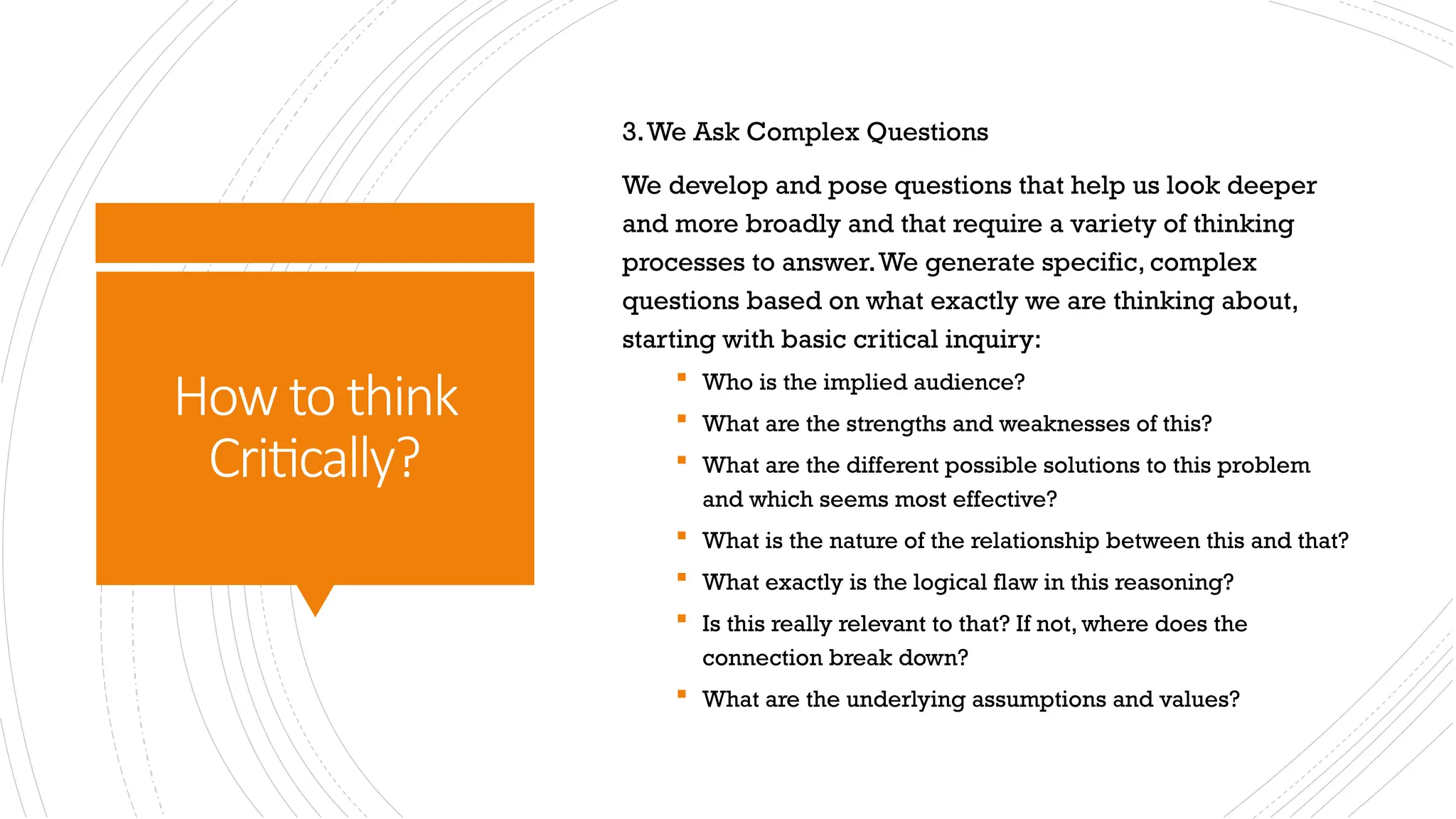
3.We Ask Complex Questions
We develop and pose questions that help us look deeper
and more broadly and that require a variety of thinking
processes to answer.We generate specific, complex
questions based on what exactly we are thinking about,
starting with basic critical inquiry:
 Who is the implied audience?
 What are the strengths and weaknesses of this?
 What are the different possible solutions to this problem
and which seems most effective?
 What is the nature of the relationship between this and that?
 What exactly is the logical flaw in this reasoning?
 Is this really relevant to that? If not, where does the
connection break down?
 What are the underlying assumptions and values?
How to think
Critically?
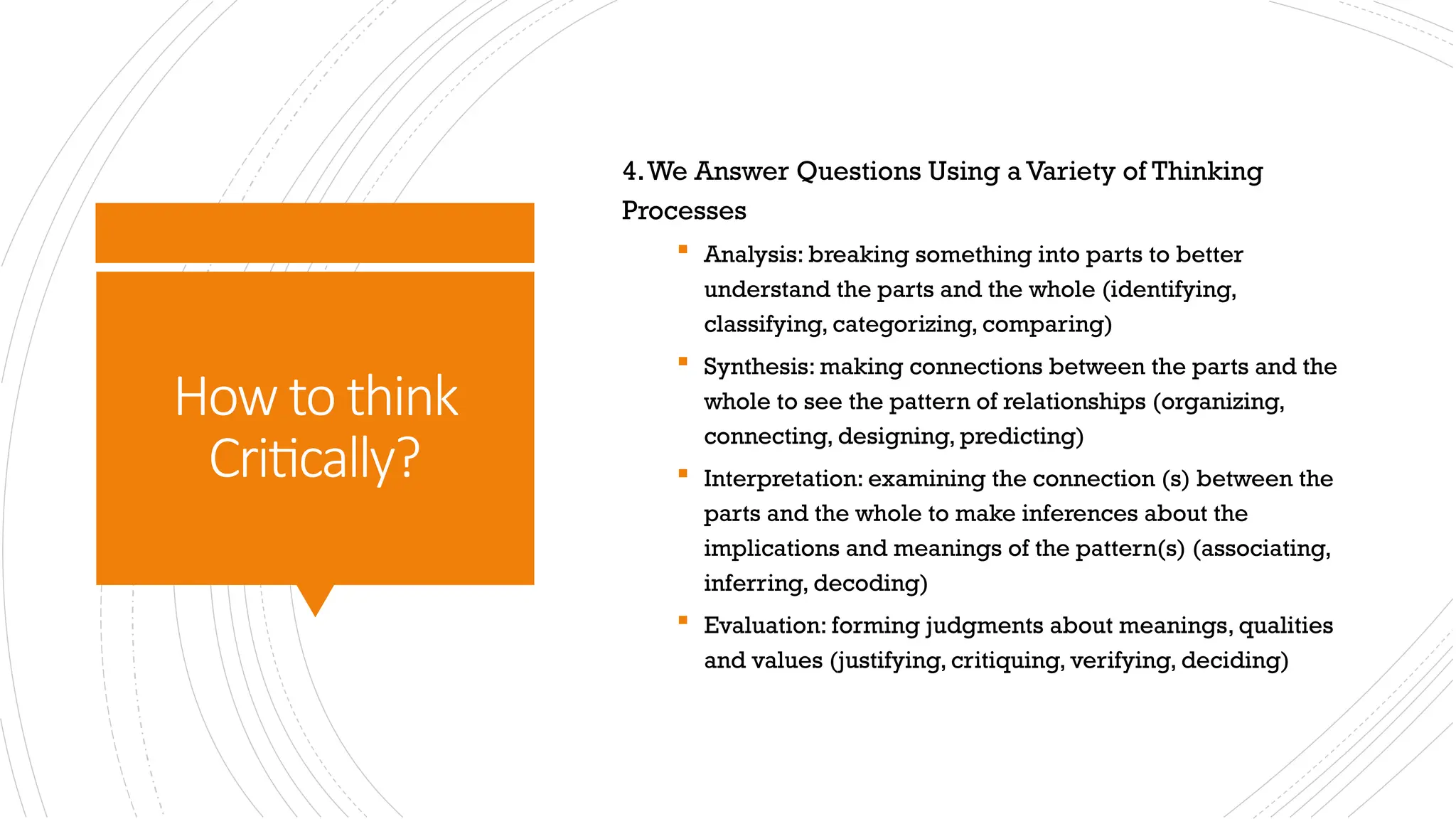
4.We Answer Questions Using a Variety of Thinking
Processes
 Analysis: breaking something into parts to better
understand the parts and the whole (identifying,
classifying, categorizing, comparing)
 Synthesis: making connections between the parts and the
whole to see the pattern of relationships (organizing,
connecting, designing, predicting)
 Interpretation: examining the connection (s) between the
parts and the whole to make inferences about the
implications and meanings of the pattern(s) (associating,
inferring, decoding)
 Evaluation: forming judgments about meanings, qualities
and values (justifying, critiquing, verifying, deciding)
How to think
Critically?
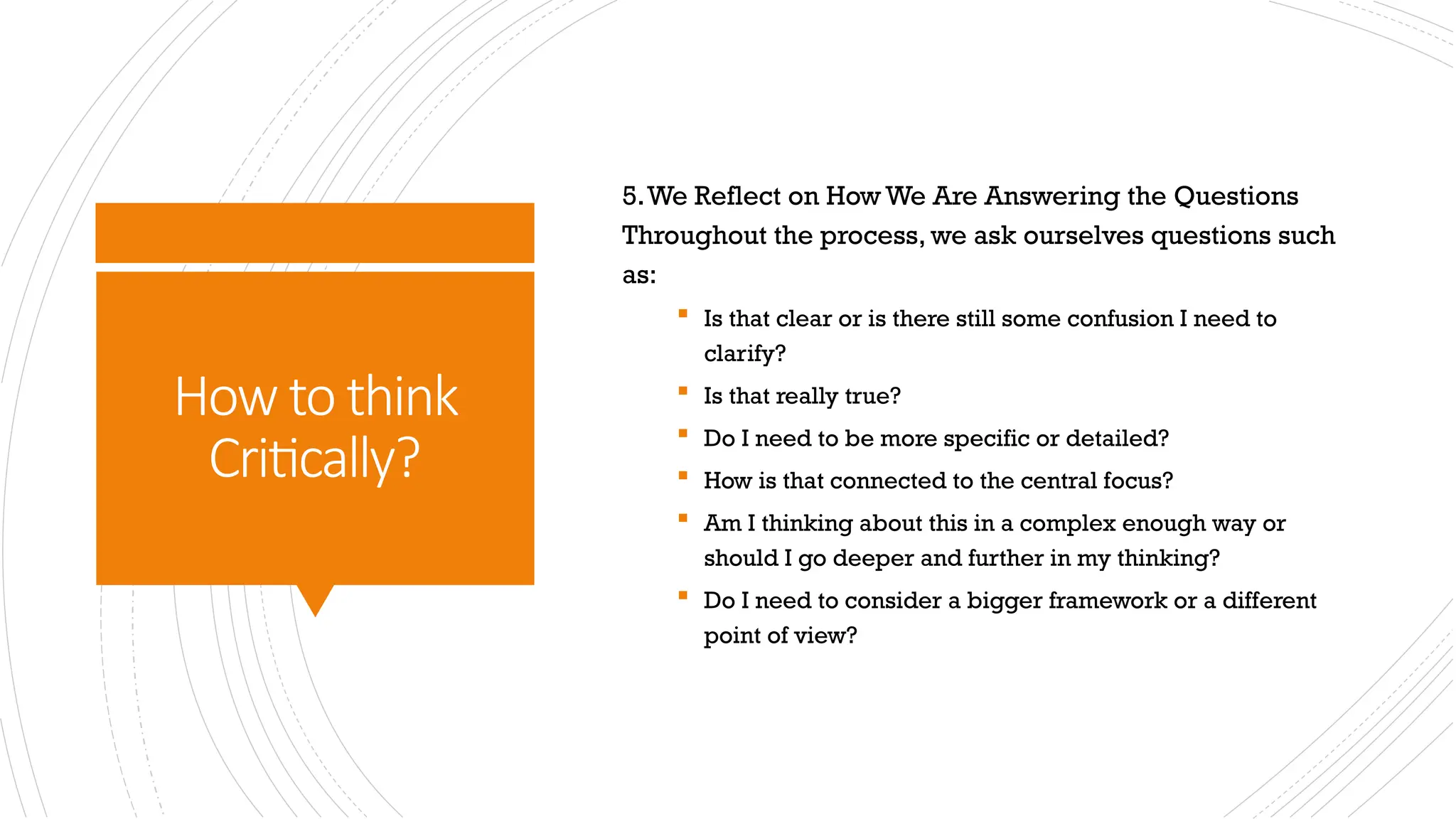
5.We Reflect on How We Are Answering the Questions
Throughout the process, we ask ourselves questions such
as:
 Is that clear or is there still some confusion I need to
clarify?
 Is that really true?
 Do I need to be more specific or detailed?
 How is that connected to the central focus?
 Am I thinking about this in a complex enough way or
should I go deeper and further in my thinking?
 Do I need to consider a bigger framework or a different
point of view?
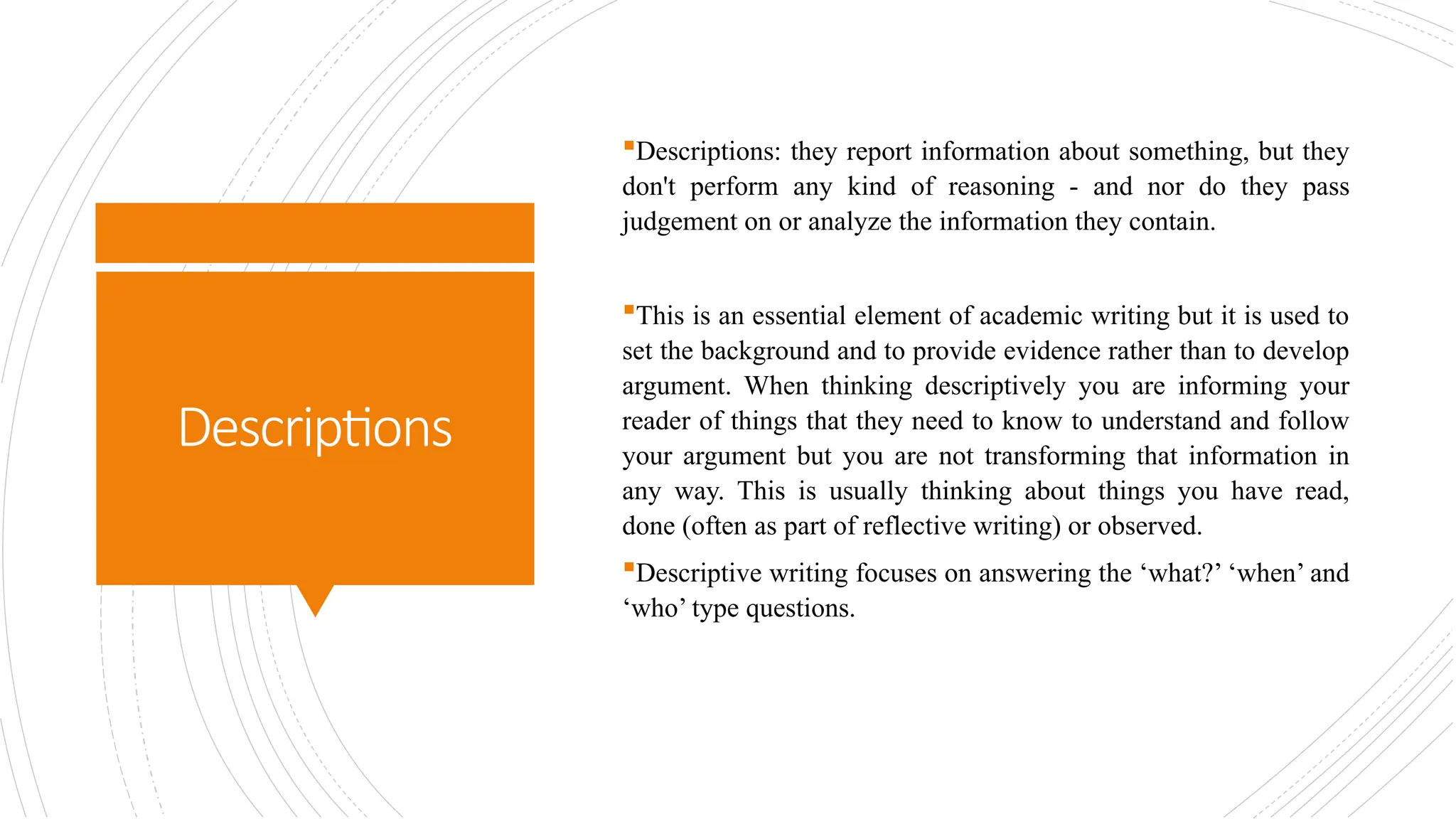
Descriptions
Descriptions: they report information about something, but they
don't perform any kind of reasoning - and nor do they pass
judgement on or analyze the information they contain.
This is an essential element of academic writing but it is used to
set the background and to provide evidence rather than to develop
argument. When thinking descriptively you are informing your
reader of things that they need to know to understand and follow
your argument but you are not transforming that information in
any way. This is usually thinking about things you have read,
done (often as part of reflective writing) or observed.
Descriptive writing focuses on answering the ‘what?’ ‘when’ and
‘who’ type questions.
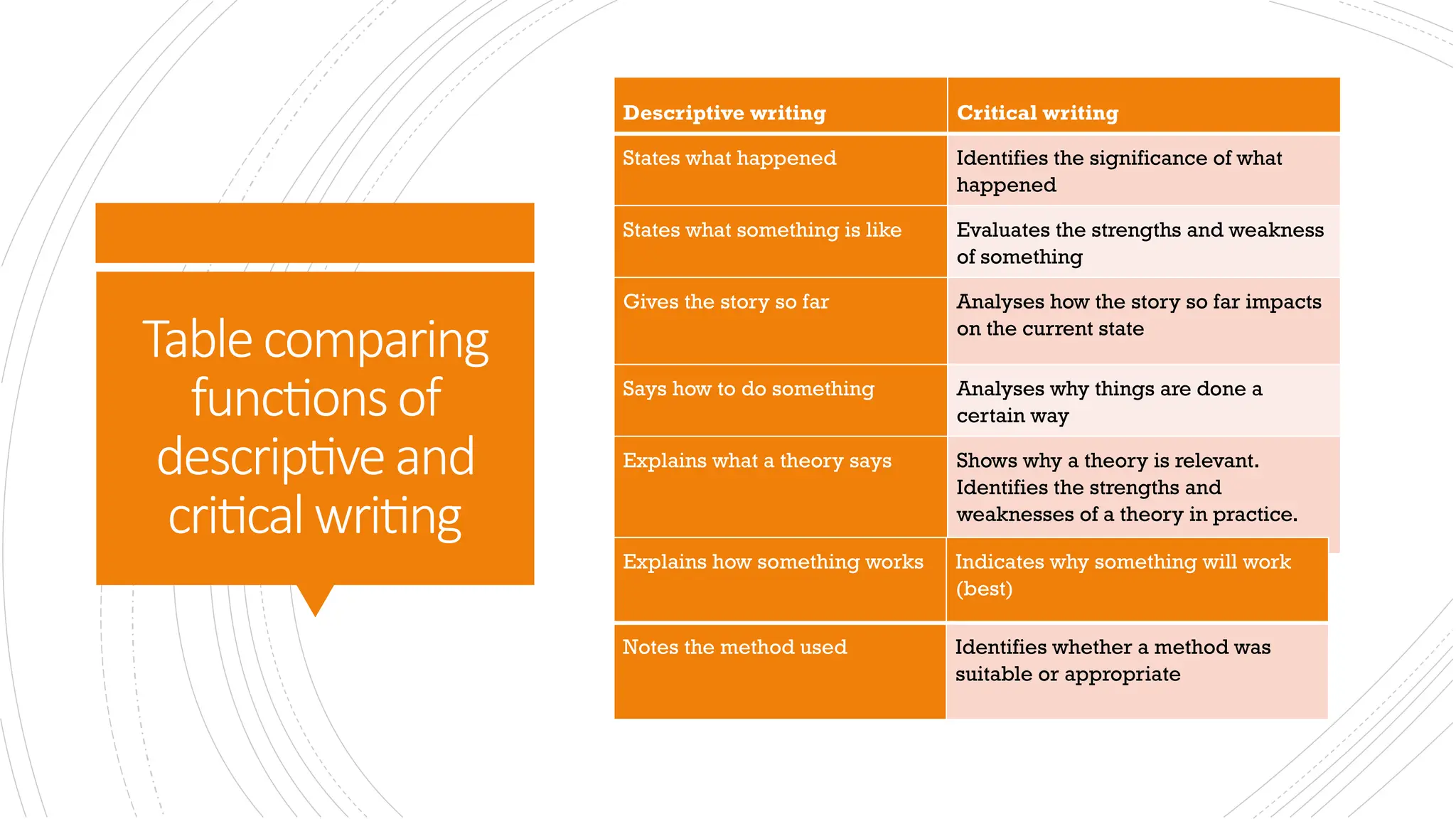
Tablecomparing
functionsof
descriptiveand
criticalwriting
Descriptive writing Critical writing
States what happened Identifies the significance of what
happened
States what something is like Evaluates the strengths and weakness
of something
Gives the story so far Analyses how the story so far impacts
on the current state
Says how to do something Analyses why things are done a
certain way
Explains what a theory says Shows why a theory is relevant.
Identifies the strengths and
weaknesses of a theory in practice.
Explains how something works Indicates why something will work
(best)
Notes the method used Identifies whether a method was
suitable or appropriate
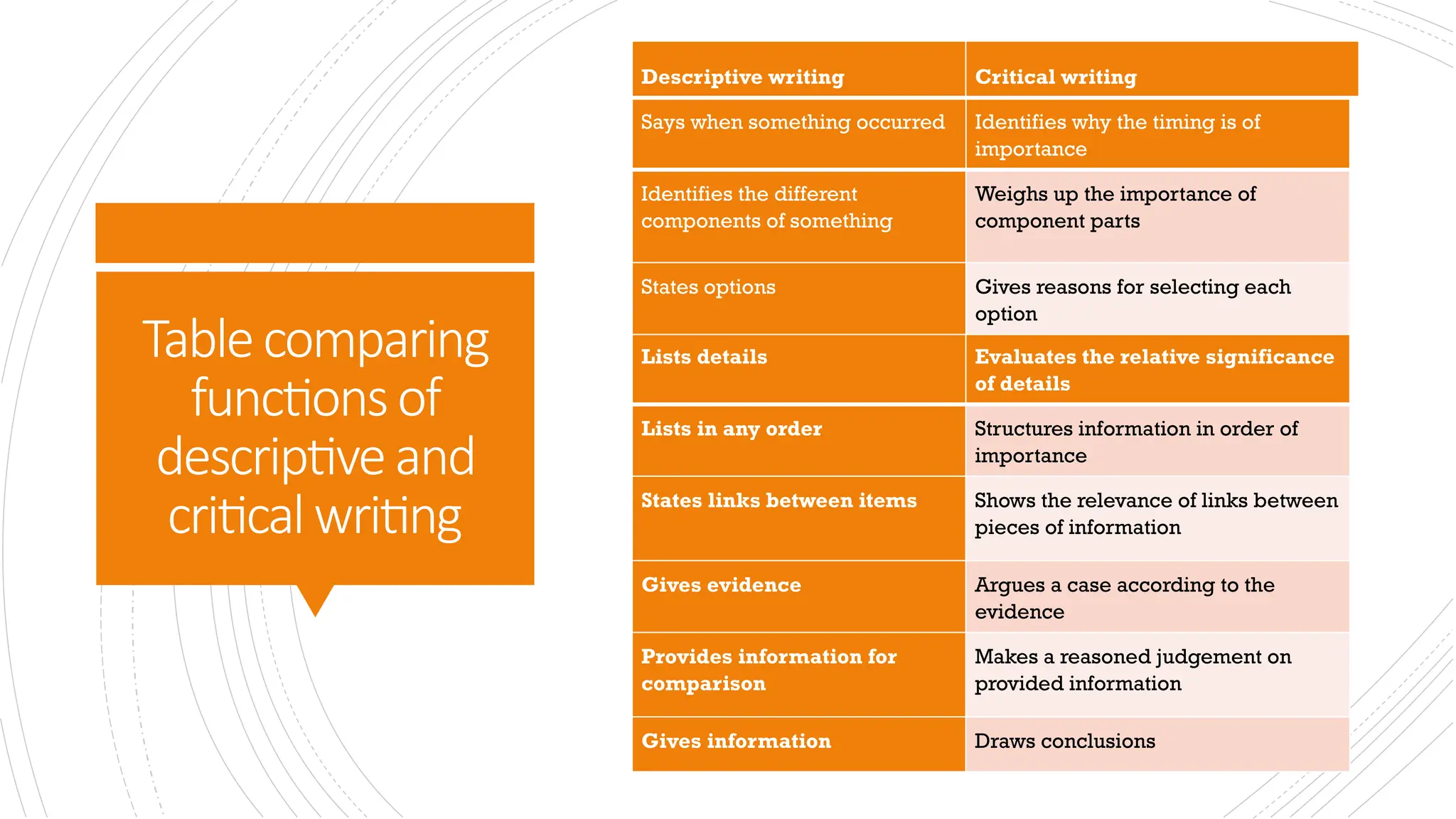
Tablecomparing
functionsof
descriptiveand
criticalwriting
Lists details Evaluates the relative significance
of details
Lists in any order Structures information in order of
importance
States links between items Shows the relevance of links between
pieces of information
Gives evidence Argues a case according to the
evidence
Provides information for
comparison
Makes a reasoned judgement on
provided information
Gives information Draws conclusions
Says when something occurred Identifies why the timing is of
importance
Identifies the different
components of something
Weighs up the importance of
component parts
States options Gives reasons for selecting each
option
Descriptive writing Critical writing
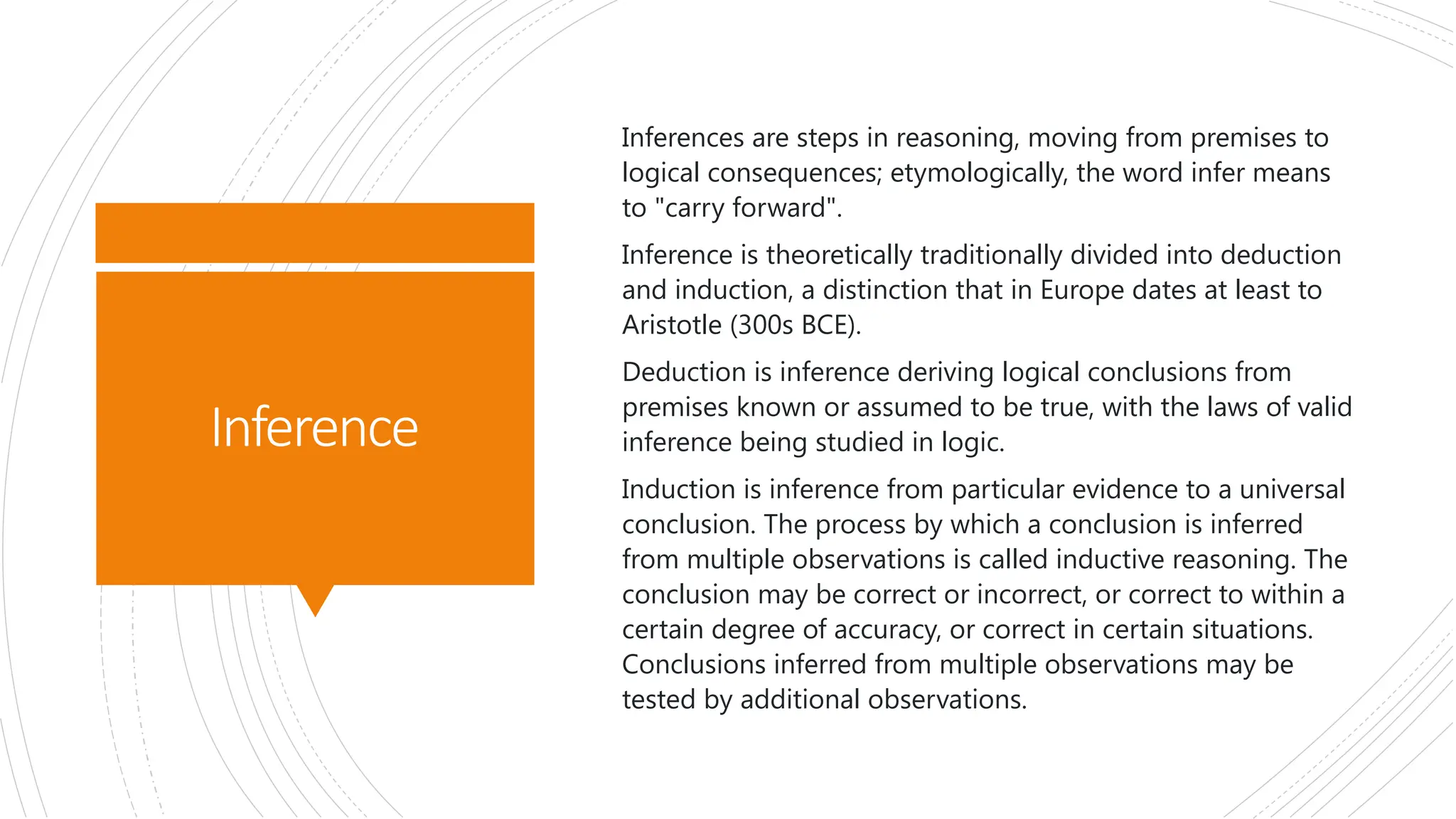
Inference
Inferences are steps in reasoning, moving from premises to
logical consequences; etymologically, the word infer means
to "carry forward".
Inference is theoretically traditionally divided into deduction
and induction, a distinction that in Europe dates at least to
Aristotle (300s BCE).
Deduction is inference deriving logical conclusions from
premises known or assumed to be true, with the laws of valid
inference being studied in logic.
Induction is inference from particular evidence to a universal
conclusion. The process by which a conclusion is inferred
from multiple observations is called inductive reasoning. The
conclusion may be correct or incorrect, or correct to within a
certain degree of accuracy, or correct in certain situations.
Conclusions inferred from multiple observations may be
tested by additional observations.
Examplesof
inductiveand
deductive
reasoning
 Deductive reasoning
"All spiders have eight legs. A tarantula is a spider.
Therefore, tarantulas have eight legs."
For deductive reasoning to be sound, the hypothesis must
be correct. It is assumed that the statements, "All spiders
have eight legs" and "a tarantula is a spider" are true.
Therefore, the conclusion is logical and true.
 Inductive reasoning
In inductive inference, we go from the specific to the
general.We make many observations, discern a pattern,
make a generalization, and infer an explanation or a theory
"Penguins are birds. Penguins can't fly.Therefore, all birds
can't fly."

2_critical thinking 1.pptx ho to to tu to

  • 1.
  • 2.
    Critical Thinking?  Reflect onthe question What is Critical thinking? Critical thinking is what a college education is all about. In many high schools, the emphasis tends to be on “lower-order thinking.” Students are simply expected to passively absorb information and then repeat it back on tests. In college, by contrast, the emphasis is on fostering “higher-order thinking”: the active, intelligent evaluation of ideas and information. Instead of teaching the students what to think, the focus is on how to think. —that is, how to become independent, self-directed thinkers and learners. “The function of education is to teach one to think intensively and to think critically.” —Martin Luther King Jr. “It is possible to store the mind with a million facts and still be entirely uneducated.” — Alec Bourne
  • 3.
    Definitions of CriticalThinking  RobertEnnis’s classic definition: Critical thinking is reasonable, reflective thinking that is focused on deciding what to believe or do.  Matthew Lipman’s definition: Critical thinking is skillful, responsible thinking that is conducive to good judgment because it is sensitive to context, relies on criteria, and is self-correcting.  Richard Paul’s definition: Critical thinking is thinking about your thinking, while you’re thinking, in order to make your thinking better.
  • 4.
    Meaningofthe world critical in Critical Thinking… Often when we use the word critical we mean “negative and fault-finding But ‘critical’ does not merely mean finding fault or expressing dislike.  ‘Critical’,‘criticism’ and ‘critic’ all originate from the ancient Greek word kritikos, meaning able to judge, discern or decide. In this sense,‘critical also means giving a fair and unbiased opinion of something.  In modern English, a ‘critic’ is someone whose job it is to make evaluative judgements, for example about films, books, music or food.  Remember, being critical and thinking critically are not the same thing.
  • 5.
    CriticalThinking is…  Critical thinkingis a higher order of thinking: it is the practice of using a number of different advanced thinking skills in a variety of complex ways.  Critical thinking focuses on thought: it looks at how facts are proven, arguments are formed, conclusions are reached, not just what the facts, argument or conclusion may be.  Critical thinking is self-reflexive: it involves reflecting on, questioning and testing your own thinking processes.  Critical thinking is discipline-specific: it engages in particular forms of reasoning, such as mathematical reasoning, historical analysis or literary interpretation, which are specific to a particular discipline.
  • 6.
    CriticalThinking Standards… Good critical thinkingmeets the criteria of these intellectual values:  Clarity  Accuracy  Precision  Consistency  Relevance  Sound Evidence  Logical correctness  Depth  Breadth  Fairness
  • 7.
    How to think Critically? 1.WeBegin With the Right Approach  Reason:We base our thinking in logic, not feelings.  Self-Awareness:We pay attention to our own and others’ assumptions, biases and perspectives.  Integrity:We care about doing our intellectual work honestly and accurately rather than about being right.  Discipline:We put effort into doing our work comprehensively and precisely.  Open-mindedness:We consider alternatives and other points of view.
  • 8.
    How to think Critically? 2.WeLook Deeper and Farther There are countless ways in which we look deeper and farther when thinking critically. For example, we look deeper when we make inferences about an argument’s hidden assumptions and values.We look farther when we connect a study to theories in our discipline.We always think about the implications and importance of what we find.
  • 9.
    How to think Critically? 3.WeAsk Complex Questions We develop and pose questions that help us look deeper and more broadly and that require a variety of thinking processes to answer.We generate specific, complex questions based on what exactly we are thinking about, starting with basic critical inquiry:  Who is the implied audience?  What are the strengths and weaknesses of this?  What are the different possible solutions to this problem and which seems most effective?  What is the nature of the relationship between this and that?  What exactly is the logical flaw in this reasoning?  Is this really relevant to that? If not, where does the connection break down?  What are the underlying assumptions and values?
  • 10.
    How to think Critically? 4.WeAnswer Questions Using a Variety of Thinking Processes  Analysis: breaking something into parts to better understand the parts and the whole (identifying, classifying, categorizing, comparing)  Synthesis: making connections between the parts and the whole to see the pattern of relationships (organizing, connecting, designing, predicting)  Interpretation: examining the connection (s) between the parts and the whole to make inferences about the implications and meanings of the pattern(s) (associating, inferring, decoding)  Evaluation: forming judgments about meanings, qualities and values (justifying, critiquing, verifying, deciding)
  • 11.
    How to think Critically? 5.WeReflect on How We Are Answering the Questions Throughout the process, we ask ourselves questions such as:  Is that clear or is there still some confusion I need to clarify?  Is that really true?  Do I need to be more specific or detailed?  How is that connected to the central focus?  Am I thinking about this in a complex enough way or should I go deeper and further in my thinking?  Do I need to consider a bigger framework or a different point of view?
  • 13.
    Descriptions Descriptions: they reportinformation about something, but they don't perform any kind of reasoning - and nor do they pass judgement on or analyze the information they contain. This is an essential element of academic writing but it is used to set the background and to provide evidence rather than to develop argument. When thinking descriptively you are informing your reader of things that they need to know to understand and follow your argument but you are not transforming that information in any way. This is usually thinking about things you have read, done (often as part of reflective writing) or observed. Descriptive writing focuses on answering the ‘what?’ ‘when’ and ‘who’ type questions.
  • 14.
    Tablecomparing functionsof descriptiveand criticalwriting Descriptive writing Criticalwriting States what happened Identifies the significance of what happened States what something is like Evaluates the strengths and weakness of something Gives the story so far Analyses how the story so far impacts on the current state Says how to do something Analyses why things are done a certain way Explains what a theory says Shows why a theory is relevant. Identifies the strengths and weaknesses of a theory in practice. Explains how something works Indicates why something will work (best) Notes the method used Identifies whether a method was suitable or appropriate
  • 15.
    Tablecomparing functionsof descriptiveand criticalwriting Lists details Evaluatesthe relative significance of details Lists in any order Structures information in order of importance States links between items Shows the relevance of links between pieces of information Gives evidence Argues a case according to the evidence Provides information for comparison Makes a reasoned judgement on provided information Gives information Draws conclusions Says when something occurred Identifies why the timing is of importance Identifies the different components of something Weighs up the importance of component parts States options Gives reasons for selecting each option Descriptive writing Critical writing
  • 16.
    Inference Inferences are stepsin reasoning, moving from premises to logical consequences; etymologically, the word infer means to "carry forward". Inference is theoretically traditionally divided into deduction and induction, a distinction that in Europe dates at least to Aristotle (300s BCE). Deduction is inference deriving logical conclusions from premises known or assumed to be true, with the laws of valid inference being studied in logic. Induction is inference from particular evidence to a universal conclusion. The process by which a conclusion is inferred from multiple observations is called inductive reasoning. The conclusion may be correct or incorrect, or correct to within a certain degree of accuracy, or correct in certain situations. Conclusions inferred from multiple observations may be tested by additional observations.
  • 17.
    Examplesof inductiveand deductive reasoning  Deductive reasoning "Allspiders have eight legs. A tarantula is a spider. Therefore, tarantulas have eight legs." For deductive reasoning to be sound, the hypothesis must be correct. It is assumed that the statements, "All spiders have eight legs" and "a tarantula is a spider" are true. Therefore, the conclusion is logical and true.  Inductive reasoning In inductive inference, we go from the specific to the general.We make many observations, discern a pattern, make a generalization, and infer an explanation or a theory "Penguins are birds. Penguins can't fly.Therefore, all birds can't fly."