Psychoanalytical Criticism
Psychoanalytical criticism is a type of
criticism that uses theories of psychology
   to analyze literature. It focuses on the
author’s state of mind or the state of the
             mind of fictional characters.
Sigmund Freud
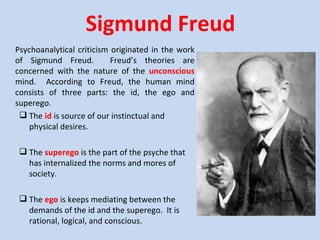
Psychoanalytical criticism originated in the work
of Sigmund Freud.          Freud’s theories are
concerned with the nature of the unconscious
mind. According to Freud, the human mind
consists of three parts: the id, the ego and
superego.
  The id is source of our instinctual and
    physical desires.

  The superego is the part of the psyche that
   has internalized the norms and mores of
   society.

  The ego is keeps mediating between the
   demands of the id and the superego. It is
   rational, logical, and conscious.
Repression
     We often repress what the id encourages us to
  think and do because the ego and superego tell us not
  to think and do, therefore forcing these unacceptable
  wishes into the unconscious. All of us have repressed
  wishes and fears.
     Repressed desires emerge in disguised forms:
  dreams and language (slips). They emerge in symbolic
  form that require analysis to reveal their meaning.
     Many elements of psychology that Freud described
  appear in literary works.
Freudian Literary Criticism
    Freudian critics try to understand how the
     operations of repression structure or
 inform the work?
 They pay close attention to unconscious
     motives and feelings, whether these be
     those of the author, or of the characters
     depicted in the work.
 They demonstrate the presence in the
     literary work of classic psychoanalytic
 symptoms or conditions.
Carl Gustav Jung and Jungian
           literary Criticism
   Jung developed the theory of the collective unconscious, a
  collection of shared unconscious memories dating back to the
  origins of human experience and manifested in dreams,
  myths, and literature.
 A great work of literature is not a disguised expression of
  repressed wishes, but a manifestation of the desires one held
  by the whole human race, and now repressed because of the
  advent of civilization.
 Jungian analysis of literature tries to discover the images in a
  work of literature that a permanent and universal significance.
Harold Bloom and the anxiety of
           Influence
The most important contemporary psychological critic
is Harold Bloom. Bloom uses the Freudian concept of
repression to apply it to literary history in general. No
poet creates in isolation from his predecessors. In The
Anxiety of Influence, he argues that poets
unconsciously misread the poems of their great
predecessors.      The new poems are essentially
rewritings of poems by a father-figure predecessor.
Poets keep struggling to free themselves from this
influence of father-figure poets.

Psychoanalytical criticism

  • 1.
  • 2.
    Psychoanalytical criticism isa type of criticism that uses theories of psychology to analyze literature. It focuses on the author’s state of mind or the state of the mind of fictional characters.
  • 3.
    Sigmund Freud Psychoanalytical criticismoriginated in the work of Sigmund Freud. Freud’s theories are concerned with the nature of the unconscious mind. According to Freud, the human mind consists of three parts: the id, the ego and superego.  The id is source of our instinctual and physical desires.  The superego is the part of the psyche that has internalized the norms and mores of society.  The ego is keeps mediating between the demands of the id and the superego. It is rational, logical, and conscious.
  • 4.
    Repression  We often repress what the id encourages us to think and do because the ego and superego tell us not to think and do, therefore forcing these unacceptable wishes into the unconscious. All of us have repressed wishes and fears.  Repressed desires emerge in disguised forms: dreams and language (slips). They emerge in symbolic form that require analysis to reveal their meaning.  Many elements of psychology that Freud described appear in literary works.
  • 5.
    Freudian Literary Criticism  Freudian critics try to understand how the operations of repression structure or inform the work?  They pay close attention to unconscious motives and feelings, whether these be those of the author, or of the characters depicted in the work.  They demonstrate the presence in the literary work of classic psychoanalytic symptoms or conditions.
  • 6.
    Carl Gustav Jungand Jungian literary Criticism  Jung developed the theory of the collective unconscious, a collection of shared unconscious memories dating back to the origins of human experience and manifested in dreams, myths, and literature.  A great work of literature is not a disguised expression of repressed wishes, but a manifestation of the desires one held by the whole human race, and now repressed because of the advent of civilization.  Jungian analysis of literature tries to discover the images in a work of literature that a permanent and universal significance.
  • 7.
    Harold Bloom andthe anxiety of Influence The most important contemporary psychological critic is Harold Bloom. Bloom uses the Freudian concept of repression to apply it to literary history in general. No poet creates in isolation from his predecessors. In The Anxiety of Influence, he argues that poets unconsciously misread the poems of their great predecessors. The new poems are essentially rewritings of poems by a father-figure predecessor. Poets keep struggling to free themselves from this influence of father-figure poets.