Critical Thinking
EMILY MILLER, CARLY COOPER, KATHERINE INGEGNERI, & HANNAH BROGAN
Description
Critical thinking is that mode of thinking — about any subject, content, or
problem — in which the thinker improves the quality of his or her thinking by
skillfully analyzing, assessing, and reconstructing it. Critical thinking is selfdirected, self-disciplined, self-monitored, and self-corrective thinking. It

presupposes assent to rigorous standards of excellence and mindful
command of their use. It entails effective communication and problemsolving abilities, as well as a commitment to overcome our native
egocentrism and sociocentrism.
Characerisitcs
A well-cultivated critical thinker:


Raises vital questions and problems, formulating them clearly and precisely



Gathers and assesses relevant information, using abstract ideas to interpret
it effectively



Comes to well-reasoned conclusions and solutions, testing them against
relevant criteria and standards
Characteristics Continued


Thinks open mindedly within alternative systems of thought, recognizing
and assessing, as needs be, their assumptions, implications, and practical
consequences



Communicates effectively with others in figuring out solutions to complex
problems
Importance
Critical thinking is important to:


Exercising sound reasoning in understanding



Making complex choices and decisions



Understanding the interconnections among systems



Identifying and asking significant questions that clarify various points of
view and lead to better solutions



Framing, analyzing and synthesizing information in order to solve problems
and answer questions
Role in 21st Century
The 21st century is constantly changing, and the best way to thrive in a time of
change is to use critical thinking to:


Question your assumptions.



Be open to seeing the world in new ways.



Make sure you are working with current information rather than old beliefs.



Understand how to make good decisions more consistently.



Using more in depth thinking to different problems and issues.



Applying the right reasoning in how you analyze and answer decisions about
ways to solve a problem, more importantly effective ways.

Critical Thinking plays a giant role in the success and growth of thought
processes, decision-making, curiosity, and learning capabilities whether it be in the
classroom, work place, or life in general.
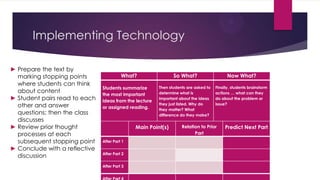
Implementing Technology
► Prepare the text by
marking stopping points
where students can think
about content
► Student pairs read to each
other and answer
questions; then the class
discusses
► Review prior thought
processes at each
subsequent stopping point
► Conclude with a reflective
discussion

What?
Students summarize
the most important
ideas from the lecture
or assigned reading.

So What?

Now What?

Then students are asked to
determine what is
important about the ideas
they just listed. Why do
they matter? What
difference do they make?

Finally, students brainstorm
actions … what can they
do about the problem or
issue?

Main Point(s)
After Part 1
After Part 2
After Part 3

Relation to Prior
Part

Predict Next Part
Five Tools


Youtube- allows people from all over the world to entertain, interact, and
express themselves through videos. It is a place to find music, comedic
videos and even has tutorials.



Photoshop- allows people to crop and edit pictures in many different
ways. This tool can be used to manipulate pictures in any way.



Webquest- is an assignment that allows students to use the internet to learn
about a specific topic. It is a tool that lets the students discover the point
of the lesson on their own.



Podcasts- have a huge variety of topics. The word podcast is a play on
broadcast. People from all over use them to communicate topics such as
education, politics, religion, cars, etc.
Five Tools Continued


Blogs- allow people from all over the world to intact and express their
opinions on many topics. Blogs can be used as diaries, scientific journals, or
as a day to day activity that helps people keep in touch with others.
One Example - Blogs
Blogs can be used in the classroom for students to keep in touch, share ideas,
and help each other when problems occur. They can also help them expand
on current beliefs. Blogs can be worked on at virtually any time, in any place
with an Internet-enabled computer. Hence, they can be used by computer
savvy teachers to create a classroom that extends beyond the boundaries of
the school yard.


Discussion boards (debates, topics, etc.)



Informative



Tutoring



Motivation
Conclusion
“If we want to be better critical thinkers, we can be. People can learn how to
recognize assumptions, evaluate arguments, draw conclusions, make better
decisions, and perform more effectively. Critical thinking skills are associated
with learning, a crucial skill for individuals to stay employed and relevant.”
- Anne and Charles Kreitzberg
Critical Thinking’s association with learning emphasizes it’s importance in 21st
century education and the growth/success of all students.
Work Cited


http://www.criticalthinking.org/pages/our-concept-of-critical-thinking/411



http://www.educatorstechnology.com/2012/07/a-quick-guide-to-21stcentury-critical.html



http://www.education.com/reference/article/Ref_Critical_Thinking/



http://www.agilecriticalthinking.com/Portals/0/WhitePapers/Critical%20Thi
nking%20for%20the%2021st%20Century%20for%20Website.pd

Ci 350 group powerpoint

  • 1.
    Critical Thinking EMILY MILLER,CARLY COOPER, KATHERINE INGEGNERI, & HANNAH BROGAN
  • 2.
    Description Critical thinking isthat mode of thinking — about any subject, content, or problem — in which the thinker improves the quality of his or her thinking by skillfully analyzing, assessing, and reconstructing it. Critical thinking is selfdirected, self-disciplined, self-monitored, and self-corrective thinking. It presupposes assent to rigorous standards of excellence and mindful command of their use. It entails effective communication and problemsolving abilities, as well as a commitment to overcome our native egocentrism and sociocentrism.
  • 3.
    Characerisitcs A well-cultivated criticalthinker:  Raises vital questions and problems, formulating them clearly and precisely  Gathers and assesses relevant information, using abstract ideas to interpret it effectively  Comes to well-reasoned conclusions and solutions, testing them against relevant criteria and standards
  • 4.
    Characteristics Continued  Thinks openmindedly within alternative systems of thought, recognizing and assessing, as needs be, their assumptions, implications, and practical consequences  Communicates effectively with others in figuring out solutions to complex problems
  • 5.
    Importance Critical thinking isimportant to:  Exercising sound reasoning in understanding  Making complex choices and decisions  Understanding the interconnections among systems  Identifying and asking significant questions that clarify various points of view and lead to better solutions  Framing, analyzing and synthesizing information in order to solve problems and answer questions
  • 6.
    Role in 21stCentury The 21st century is constantly changing, and the best way to thrive in a time of change is to use critical thinking to:  Question your assumptions.  Be open to seeing the world in new ways.  Make sure you are working with current information rather than old beliefs.  Understand how to make good decisions more consistently.  Using more in depth thinking to different problems and issues.  Applying the right reasoning in how you analyze and answer decisions about ways to solve a problem, more importantly effective ways. Critical Thinking plays a giant role in the success and growth of thought processes, decision-making, curiosity, and learning capabilities whether it be in the classroom, work place, or life in general.
  • 7.
    Implementing Technology ► Preparethe text by marking stopping points where students can think about content ► Student pairs read to each other and answer questions; then the class discusses ► Review prior thought processes at each subsequent stopping point ► Conclude with a reflective discussion What? Students summarize the most important ideas from the lecture or assigned reading. So What? Now What? Then students are asked to determine what is important about the ideas they just listed. Why do they matter? What difference do they make? Finally, students brainstorm actions … what can they do about the problem or issue? Main Point(s) After Part 1 After Part 2 After Part 3 Relation to Prior Part Predict Next Part
  • 8.
    Five Tools  Youtube- allowspeople from all over the world to entertain, interact, and express themselves through videos. It is a place to find music, comedic videos and even has tutorials.  Photoshop- allows people to crop and edit pictures in many different ways. This tool can be used to manipulate pictures in any way.  Webquest- is an assignment that allows students to use the internet to learn about a specific topic. It is a tool that lets the students discover the point of the lesson on their own.  Podcasts- have a huge variety of topics. The word podcast is a play on broadcast. People from all over use them to communicate topics such as education, politics, religion, cars, etc.
  • 9.
    Five Tools Continued  Blogs-allow people from all over the world to intact and express their opinions on many topics. Blogs can be used as diaries, scientific journals, or as a day to day activity that helps people keep in touch with others.
  • 10.
    One Example -Blogs Blogs can be used in the classroom for students to keep in touch, share ideas, and help each other when problems occur. They can also help them expand on current beliefs. Blogs can be worked on at virtually any time, in any place with an Internet-enabled computer. Hence, they can be used by computer savvy teachers to create a classroom that extends beyond the boundaries of the school yard.  Discussion boards (debates, topics, etc.)  Informative  Tutoring  Motivation
  • 11.
    Conclusion “If we wantto be better critical thinkers, we can be. People can learn how to recognize assumptions, evaluate arguments, draw conclusions, make better decisions, and perform more effectively. Critical thinking skills are associated with learning, a crucial skill for individuals to stay employed and relevant.” - Anne and Charles Kreitzberg Critical Thinking’s association with learning emphasizes it’s importance in 21st century education and the growth/success of all students.
  • 12.