Introduction &
Applications of CRISPR
ABRAR HUSSAIN
INTERNATIONAL CENTER FOR CHEMICAL AND BIOLOGICAL SCIENCES, UNIVERSITY OF
KARACHI, PAKISTAN
1
science
discovery
focus and
determined
No hurdle
of time,
age, place
internal
affection
by: Abrar Hussain
2
Objective of webinar
Contents
Introduction to CRISPR
History and discovery of CRISPR
Structure of CRISPR
Mechanism of action
Classification of CRISPR
Application of CRISPR technology
Lesson from CRISPR
by: Abrar Hussain
3
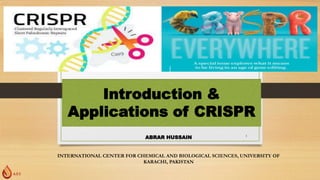
• CRISPR stands for Clustered Regularly Interspaced Short Palindromic Repeats.
• It is a component of bacterial immune systems that can cut DNA, and has been
repurposed as a gene editing tool.
• It acts as a precise pair of molecular scissors that can cut a target DNA sequence,
directed by a customizable guide.
• CRISPRs are short palindromic repeats made up of an array of 30–40 bp short
direct repeat sequences separated by foreign sequence-matching spacer sequences
and clustered regularly interspaced.
• CRISPR-Cas9 is a unique technology that enables geneticists and medical
researchers to edit parts of the genome by removing, adding or altering sections of
the DNASequence.
Eric S. Lander ., 2016; Vaid et al., 2022; Barrangou et al., 2019
by: Abrar Hussain
4
Discovery
• The story starts in the Mediterranean port
of Santa Pola on Spain’s Costa Blanca.
• Francisco Mojica, In the first DNA
fragment he examined a curious
structure—multiple copies of a near-
perfect, roughly palindromic, repeated
sequence of 30 bases, separated by spacers
of roughly 36 bases—that did not resemble
any family of repeats known in microbes.
• He called this is short regularly spaced
repeats (SRSRs); the name would later be
changed, at his suggestion, to clustered
regularly interspaced palindromic repeats
(CRISPR).
Eric S. Lander ., 2016
18 Cell 164, January 14, 2016
342 | NATURE | VOL 535 | 21 JULY 2016
by: Abrar Hussain
5
Development history of the CRISPR/Cas9-based gene editing tools
by: Abrar Hussain
6
TIMELINE DISCOVERY OF CRISPR
Discovery of CRISPR and its function; 1993 - 2005
 Francisco Mojica was the first to characterize CRISPR ,1993.
 In 2005 he reported that these sequences matched to the genomes of bacteriophage.
Discovery of Cas9 and PAM; May, 2005
 Bolotin was studying the S. thermophiles, contained novel Cas genes, which have nuclease activity, aka cas9.
 They find Protospacer adjacent motif (PAM) are sequence similar to viral genes is used for target recognition.
Hypothetical scheme of adaptive immunity; March, 2006
 Koonin studying clusters of proteins for hypothetical scheme for CRISPR cascades as bacterial immune system.
 Find out that Cas proteins might comprise a novel DNA repair system.
Experimental demonstration of adaptive immunity; March, 2007
o Danisco trying to explore the phage attack on yogurt.
o Horvath and colleagues experimentally showed that CRISPR systems are indeed an adaptive immune system
https://www.broadinstitute.org/what-broad/areas-focus/project-spotlight/crispr-timeline
by: Abrar Hussain 7
Spacer sequences are transcribed into guide RNAs; August, 2008
 John and colleagues showed that E- coli, spacer sequences are derived from phage, are transcribed into
small RNAs, termed CRISPR RNAs (crRNAs), that guide Cas proteins to the target DNA.
CRISPR acts on DNA targets; December, 2008
• Marraffini et al., demonstrated that the target molecule is DNA, not RNA.
• They showed that this system could be a powerful tool if it could be transferred to non-bacterial systems.
Cas9 cleaves target DNA; December, 2010
o Moineau demonstrated that CRISPR-Cas9 creates double-stranded breaks in target DNA at precise
positions, 3 nucleotides upstream of the PAM.
o They also confirmed that Cas9 is the only protein required for cleavage in the CRISPR-Cas9 system.
Discovery of tracrRNA for Cas9 system; March, 2011
 E. Charpentier, performed small RNA sequencing on S. pyrogenes, which has a Cas9 CRISPR system
 They discovered a second small RNA which they called trans-activating CRISPR RNA (tracrRNA).
 They showed that tracrRNA forms a duplex with crRNA that guides Cas9 to its targets.
by: Abrar Hussain 8
CRISPR systems can function heterologously in other species; July, 2011
 Siksnys and colleagues cloned the entire CRISPR-Cas locus from S. thermophilus and expressed it in E. coli,
 they demonstrated plasmid resistance.
Biochemical characterization of Cas9-mediated cleavage; September, 2012
 Siksnys team purified Cas9 complex with crRNA from the E. coli and perform try to characterize Cas9’s action.
 They verified the cleavage site and the requirement for the PAM.
 they showed that Cas9 is reprogram to target a site of their choice by changing the sequence of the crRNA.
CRISPR-Cas9 harnessed for genome editing; January, 2013
 Zhang, first successfully adapt CRISPR-Cas9 for genome editing in eukaryotic cells.
 They engineered two different Cas9 and demonstrated targeted genome cleavage in human and mouse cells.
 They also showed that the system
(i) could be programmed to target multiple genomic loci, and
(ii) could drive homology-directed repair
by: Abrar Hussain 9
The first CRISPR clinical trials began, harvesting cells from patients with sickle cell disease (SCD) and editing
them in vitro before infusing them back into the body - a method known as cell therapy.
First CRISPR clinical trials; In 2019
 After the success of SCD cell therapy trials, a CRISPR treatment was injected directly into human
patients for the first time in 2020.
 This technique is known as gene therapy, and was used to treat hereditary blindness.
First human treatment; In 2020
In 2020
Nobel prize to Emmanuelle Charpentier and
Doudna Jennifer
from University of California, Berkeley in 2020
for genome editing.
by: Abrar Hussain 10
Feng
Zhang
Jennifer
Doudna
Emmanuelle
Charpentier
by: Abrar Hussain
11
Timeline of history of CRISPR
Int. J. Mol. Sci. 2021, 22, 3327
by: Abrar Hussain
12
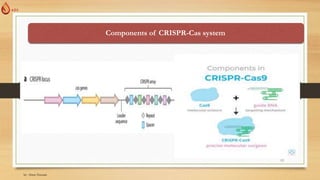
Components of CRISPR-Cas system
by: Abrar Hussain
13
Cas genes:
Small clusters of Cas genes are often located next to CRISPR repeat-spacer arrays.
Collectively the 93 Cas genes are grouped into 35 families based on sequence
similarity 11 of the 35 families form the cas core, which includes the protein families
Cas1 through Cas9.
A complete CRISPR-Cas locus has at least one gene belonging to the cas core.
Cas proteins play a major role in the acquisition and destruction of foreign sequences
Leader sequence:
 The leader sequence is commonly adjacent to the CRISPR array and is involved
in adaptation and transcription.
 These regions exhibit only limited conservation in sequence. It was observed that
leaderless CRISPR loci are inactive in adaptation but still able to contribute to
crRNA-directed interference.
by: Abrar Hussain
14
 The CRISPR array is made up of an AT-rich leader sequence followed by
short repeats that are separated by unique spacers
CRISPR array
Repeats:
 The direct repeats are nucleotide
sequences in the genome with
identical sequence and length.
 CRISPR repeats typically range in
size from 28 to 37 base pairs (bps),
though there can be as few as 21 bp
and as many as 47 bp.
 Some show dyad symmetry,
implying the formation of
a secondary structure 'hairpin‘ in the
RNA, while others are designed to
be unstructured.
Spacer:
 The spacers are nucleotide sequences
with a fixed length, but they are highly
variable in sequences
 The size of spacers in different
CRISPR arrays is typically 32 to 38
bp (range 20 to 72 bp).
 New spacers can appear rapidly as
part of the immune response to phage
infection.
 There are usually fewer than 50 units
of the repeat-spacer sequence in a
CRISPR array.
by: Abrar Hussain
15
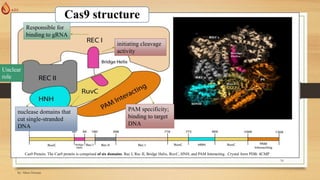
Cas9 Protein. The Cas9 protein is comprised of six domains: Rec I, Rec II, Bridge Helix, RuvC, HNH, and PAM Interacting. Crystal form PDB: 4CMP
Responsible for
binding to gRNA
Unclear
role
initiating cleavage
activity
PAM specificity;
binding to target
DNA
nuclease domains that
cut single-stranded
DNA
Cas9 structure
by: Abrar Hussain
16
CRISPR Mechanism
• CRISPR utilizes Cas nucleases, which are enzymes that can bind
and create double-stranded breaks (DSBs) in DNA.
• When a bacterium is infected by a virus, it uses a Cas nuclease to
snip off a piece of viral DNA known as a protospacer.
• This fragment is stored in the bacterial genome with fragments
from other viruses that have previously infected the cell - an
immune memory.
• These viral spacer fragments are placed between repeated
palindromic sequences OF CRISPR.
https://www.synthego.com/learn/crispr
by: Abrar Hussain
17
• Upon reinfection with the same virus, the bacterium can recognize and destroy it
with Cas9.
• Cas9 activity relies on a CRISPR RNA (crRNA) and a trans-activating CRISPR
RNA (tracrRNA).
• The crRNA is complementary to the viral spacer that was stored after the
original infection, while the tracrRNA serves as a scaffold; these two RNAs
form a complex known as a guide RNA (gRNA).
• Before cutting, the Cas9 search the viral DNA for a short sequence downstream
of the target site, called protospacer adjacent motif (PAM).
• When it recognizes PAM cas9 is directed by the gRNA and create a double-
stranded break (DSB).
• DSBs incapacitate the virus because viruses lack their own DNA repair
mechanisms.
by: Abrar Hussain
18
by: Abrar Hussain
19
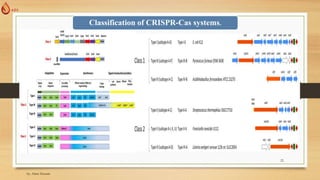
CLASSIFICATION OF CRISPR-Cas system
• CRISPR-Cas systems are categorized into two classes based on Cas effector proteins.
• multi-subunit effector complexes in Class 1
• single-protein effector modules in Class 2
• The diversity of these systems was further highlighted by the subgrouping of these classes into 6 types
• Type I, III and IV in Class 1;
• Type II, V and VI in Class 2.
• And 34 subtypes identified to date, based on their genomic architecture, CRISPR repeats, Cas protein
composition, effector complex structure, and the mechanisms of adaptation, crRNA processing and
interference.
• The most widespread CRISPR–Cas systems belong to the Type I category, which accounts for 50% of
all systems documented to date,
• whereas the popular Cas9 is derived from Type II systems.
Cantabrana et al., 2017
by: Abrar Hussain
20
Stout et al., 2017
by: Abrar Hussain
21
Classification of CRISPR-Cas systems.
by: Abrar Hussain
22
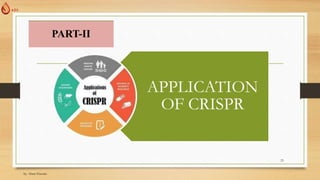
APPLICATION
OF CRISPR
PART-II
by: Abrar Hussain
23
1. Cell and gene therapies
• CRISPR is poised to revolutionize medicine, with the potential to cure a
range of genetic diseases, including neurodegenerative disease, blood
disorders, cancer, and ocular disorders.
• the first trial of a CRISPR cell therapy was performed in 2019, treating
patients with sickle cell disease.
• In 2021, a significant CRISPR trial for transthyretin amyloidosis, a
neurodegenerative disease, showed very promising results.
• CRISPR can also be used to generate chimeric antigen receptor (CAR)
T cells, a form of immunotherapy used to treat cancer. This T cell
expressed more CAR and destroy the cancer cells
• This technology could be used to treat thousands of genetic conditions
in the future, including breast and ovarian cancer linked to BRCA
mutations, Huntington’s disease, Tay-Sachs, beta-thalassemia, cystic
fibrosis, and early-onset Alzheimer’s.
by: Abrar Hussain
24
2. Agriculture
• Gene editing technology has huge potential in
agriculture, and experts suggest that CRISPR-
modified foods will be available within 5-10
years. This is because it is used to create crops
that are disease-resistant and drought-resistant.
• It can also be used to prolong the shelf-life of
other perishable foods, reducing food waste
and allowing access to healthy foods at
relatively low cost.
by: Abrar Hussain
25
3. Genome editing tool
• CRISPR-Cas9 is used to target and modify “typos” in the
three-billion-letter sequence of the human genome in an effort
to treat genetic disease.
• CRISPR-Cas9 can be used to delete (KO) or insert (KI)
genes, and regulate the expression of genes. This is known
as CRISPR activation (CRISPRa) and CRISPR interference
(CRISPRi).
• CRISPRa is used to increase (upregulate) the expression of a
gene, while CRISPRi can reduce (downregulate) the
expression of a gene
• Researchers trying to activate gene expression instead of
cutting the DNA.
• This technology is now widely used to examine gene
function, but it can also be applied to examine specific
evolutionary question
by: Abrar Hussain
26
4. Treating of Diseases
• CRISPR genome editing allows scientists to
quickly create cell and animal models, which
researchers can use to accelerate research into
diseases such as cancer and mental illness.
• The CRISPR modified genes have many
research applications, including developmental
biology, infectious disease, disease progression,
functional genomics, and screening for genetic
elements that mediate drug resistance.
• CRISPR-Cas9 can also be used to target multiple
genes simultaneously.
by: Abrar Hussain
27
5. Bioenergy
• Bioenergy is the alternatives of fossil fuels,
bioenergy. By using CRISPR, scientists have
recently been able to make some significant
advances in this area.
• Used multiple transcription factors that
control production of lipids in algae has led to
a huge increase in lipid production for
generating biodiesel.
• gene editing can improve the tolerance of
yeast to harsh conditions during the
production of biofuels.
• It has also increased editing efficiencies in
bacterial species that are used to produce
ethanol.
by: Abrar Hussain
28
6. Diagnostics
• Diagnostics utilizing the search function of Cas9 have also been
engineered to identify other diseases, both infectious and genetic.
• During the COVID 19 pandemic, CRISPR was used as both a
potential therapeutics tool and as a diagnostic tool for the
coronavirus. The SHERLOCK™ CRISPR SARS-CoV-2 test kit
was granted Emergency Use Authorization from the federal
authorities to be used in laboratory settings.
• Scientists developed a CRISPR-based Covid-19 diagnostic
method, known as DETECTR. DETECTR utilizes Cas9’s search
function to detect genetic material from the virus, employing
naturally occurring Cas nucleases, like Cas12 and Cas13.
• 50% of disease-causing mutations in humans are SNPs. So in
2021 scientists develop a tiny chip that can detect pathogenic
single nucleotide polymorphisms (SNPs).
by: Abrar Hussain
29
7. Ecological and Epidemiological Studies
• The highly variable sequence content of CRISPR loci
can and has been exploited to distinguish closely
related bacterial strains by use of hybridization-based
methods, or using sequencing-based methods.
• Scientists used the sequence information stored in
CRISPR loci to link different strains to distinct
geographical locations.
• CRISPR sequences have also been used to study
Salmonella outbreaks or phylogeny.
• CRISPR sequence– based typing coupled to multi-
virulence-locus sequence typing (CRISPR-MVLST)
has been used to identify outbreak isolates in patients.
• CRISPR is developed to identify Shiga-toxin-
producing Escherichia coli sero groups.
by: Abrar Hussain
30
8. Manipulating Community Composition
• CRISPR-Cas are used to specifically
manipulate species communities. i.e.
CRISPR-Cas9 has been used to target
specific viruses.
• In a microbial population, a CRISPR- Cas
system encoded by a mobile genetic
element, can be programmed such that it
kills one specific host genotype.
• Approach of using a virus-encoded Class 1/
Class 2 CRISPR-Cas system is used to
target antibiotic resistance genes in E. coli.
by: Abrar Hussain
31
9. Model to Study Host–Parasite Coevolution
 CRISPR-Cas can be used as a model system to
investigate general questions concerning the
evolutionary ecology of host–parasite interactions.
• For example, bacteria–phage interactions have been
used recently to examine induced defense and
constitutive defense, such as surface modification.
• the impact of host resistance allele diversity on
parasite persistence and evolution was examined.
• It is predicated that CRISPR–virus interactions will
further emerge as an important model system for
experimental evolution regarding host–parasite
interactions
by: Abrar Hussain
32
10. Industry
• Scientists have used a modified CRISPR-Cas9
system to create a yeast strain to produce lipids
and polymers.
• These molecules could be useful in the
development of biofuels, adhesives, and
fragrances.
• Currently, these lipids and polymers are made
synthetically from non-renewable petroleum-
based materials that are more expensive and
could present safety risks
by: Abrar Hussain
33
11. Public Health
• Scientists are experimenting with using
CRISPR to engineer "gene drives" to
spread specific genes through a
population of insect pests that cause
them to die or become infertile.
• This technique is being considered to
eradicate mosquitoes carrying human
pathogens like malaria parasites or Zika
virus.
by: Abrar Hussain
34
CD Biosynsis
Applications
by: Abrar Hussain
35
• CRISPR is important to rewrite the genetic code in almost any organism.
• It is simpler, cheaper, most versatile and more precise gene editing techniques.
• it has a range of real-world applications in almost every field.
• CRISPR is a powerful tool for changing the makeup and functional activities of
the gut microbiome.
• it can help researchers better understand the complex interactions between bacteria
and our gut microbiome.
• The advanced usage of CRISPR is for developing or producing next-generation
probiotics and microorganisms with enhanced functionalities.
• CRISPR-Cas is useful in tracking and identifying food-borne pathogens.
Importance of CRISPR Technology
https://www.synthego.com/learn/crispr
Stout et al., 2017
by: Abrar Hussain
36
Limitations
• It is difficult to deliver the CRISPR/Cas material to mature cells in large numbers.
• Viral vectors are the most common delivery method.
• Not 100% efficient, so even the cells that take in CRISPR/Cas may not have genome editing activity.
• Not 100% accurate, and “off-target” edits, while rare, may have severe consequences, particularly in
clinical applications.
• Ethical issues
• editing somatic cells, genomes of gametes and early embryos in humans would not only affect an
individual but also his or her progeny.
• They could also theoretically be used to enhance desirable traits instead of curing disease.
• Scientists have therefore called for a moratorium on human germline editing until the serious ethical
and societal implications are more fully understood.
https://www.jax.org/personalized-medicine/precision-medicine-and-you/what-is-crispr
by: Abrar Hussain
37
The Future Of CRISPR
• no doubt that CRISPR-Cas9 has revolutionized the field of genome engineering.
• Due to this incredible technology, the dream of curing human disease by editing
our DNA is now very real.
• Researchers are continually applying this technology to solve real-world
problems, including
• epigenome editing,
• new cell and gene therapies
• infectious disease research
• conservation of endangered species.
• There are also an increasing number of biotech startup companies focusing on
CRISPR-Cas9 gene editing technology. https://www.synthego.com/learn/crispr
by: Abrar Hussain
38
by: Abrar Hussain
39
Unpredictable
origins
Hypothesis-
free discovery
No restriction
to web lab
Early age
Discovery
Willingness to
risk
Internal
Eureka
The Lessons of CRISPR
by: Abrar Hussain
40
CD Biosynsis
by: Abrar Hussain
41
Important links
A video micro-lecture by Paul Andersen, Bozeman Science, that ‘explains how the
CRISPR/Cas immune system was identified in bacteria and how the CRISPR/Cas9
system was developed to edit genomes.
https://www.youtube.com/watch?v=MnYppmstxIs
A video to introduce the CRISPR-Cas9 pathway in bacteria and the CRISPR gene
editing technique.
https://www.youtube.com/watch?v=2pp17E4E-O8
Significance of CRISPR technology as a gene editing tool in biomedical science
https://www.youtube.com/watch?v=sweN8d4_MUg
CRISPR mechanism of Action (CRISPR Office Hours with Jennifer Doudna, Ph.D.)
https://youtu.be/2kZN3TJA60k
by: Abrar Hussain
42
by: Abrar Hussain 43
by: Abrar Hussain 44

CRISPR Technology

  • 1.
    Introduction & Applications ofCRISPR ABRAR HUSSAIN INTERNATIONAL CENTER FOR CHEMICAL AND BIOLOGICAL SCIENCES, UNIVERSITY OF KARACHI, PAKISTAN 1
  • 2.
    science discovery focus and determined No hurdle oftime, age, place internal affection by: Abrar Hussain 2 Objective of webinar
  • 3.
    Contents Introduction to CRISPR Historyand discovery of CRISPR Structure of CRISPR Mechanism of action Classification of CRISPR Application of CRISPR technology Lesson from CRISPR by: Abrar Hussain 3
  • 4.
    • CRISPR standsfor Clustered Regularly Interspaced Short Palindromic Repeats. • It is a component of bacterial immune systems that can cut DNA, and has been repurposed as a gene editing tool. • It acts as a precise pair of molecular scissors that can cut a target DNA sequence, directed by a customizable guide. • CRISPRs are short palindromic repeats made up of an array of 30–40 bp short direct repeat sequences separated by foreign sequence-matching spacer sequences and clustered regularly interspaced. • CRISPR-Cas9 is a unique technology that enables geneticists and medical researchers to edit parts of the genome by removing, adding or altering sections of the DNASequence. Eric S. Lander ., 2016; Vaid et al., 2022; Barrangou et al., 2019 by: Abrar Hussain 4
  • 5.
    Discovery • The storystarts in the Mediterranean port of Santa Pola on Spain’s Costa Blanca. • Francisco Mojica, In the first DNA fragment he examined a curious structure—multiple copies of a near- perfect, roughly palindromic, repeated sequence of 30 bases, separated by spacers of roughly 36 bases—that did not resemble any family of repeats known in microbes. • He called this is short regularly spaced repeats (SRSRs); the name would later be changed, at his suggestion, to clustered regularly interspaced palindromic repeats (CRISPR). Eric S. Lander ., 2016 18 Cell 164, January 14, 2016 342 | NATURE | VOL 535 | 21 JULY 2016 by: Abrar Hussain 5
  • 6.
    Development history ofthe CRISPR/Cas9-based gene editing tools by: Abrar Hussain 6
  • 7.
    TIMELINE DISCOVERY OFCRISPR Discovery of CRISPR and its function; 1993 - 2005  Francisco Mojica was the first to characterize CRISPR ,1993.  In 2005 he reported that these sequences matched to the genomes of bacteriophage. Discovery of Cas9 and PAM; May, 2005  Bolotin was studying the S. thermophiles, contained novel Cas genes, which have nuclease activity, aka cas9.  They find Protospacer adjacent motif (PAM) are sequence similar to viral genes is used for target recognition. Hypothetical scheme of adaptive immunity; March, 2006  Koonin studying clusters of proteins for hypothetical scheme for CRISPR cascades as bacterial immune system.  Find out that Cas proteins might comprise a novel DNA repair system. Experimental demonstration of adaptive immunity; March, 2007 o Danisco trying to explore the phage attack on yogurt. o Horvath and colleagues experimentally showed that CRISPR systems are indeed an adaptive immune system https://www.broadinstitute.org/what-broad/areas-focus/project-spotlight/crispr-timeline by: Abrar Hussain 7
  • 8.
    Spacer sequences aretranscribed into guide RNAs; August, 2008  John and colleagues showed that E- coli, spacer sequences are derived from phage, are transcribed into small RNAs, termed CRISPR RNAs (crRNAs), that guide Cas proteins to the target DNA. CRISPR acts on DNA targets; December, 2008 • Marraffini et al., demonstrated that the target molecule is DNA, not RNA. • They showed that this system could be a powerful tool if it could be transferred to non-bacterial systems. Cas9 cleaves target DNA; December, 2010 o Moineau demonstrated that CRISPR-Cas9 creates double-stranded breaks in target DNA at precise positions, 3 nucleotides upstream of the PAM. o They also confirmed that Cas9 is the only protein required for cleavage in the CRISPR-Cas9 system. Discovery of tracrRNA for Cas9 system; March, 2011  E. Charpentier, performed small RNA sequencing on S. pyrogenes, which has a Cas9 CRISPR system  They discovered a second small RNA which they called trans-activating CRISPR RNA (tracrRNA).  They showed that tracrRNA forms a duplex with crRNA that guides Cas9 to its targets. by: Abrar Hussain 8
  • 9.
    CRISPR systems canfunction heterologously in other species; July, 2011  Siksnys and colleagues cloned the entire CRISPR-Cas locus from S. thermophilus and expressed it in E. coli,  they demonstrated plasmid resistance. Biochemical characterization of Cas9-mediated cleavage; September, 2012  Siksnys team purified Cas9 complex with crRNA from the E. coli and perform try to characterize Cas9’s action.  They verified the cleavage site and the requirement for the PAM.  they showed that Cas9 is reprogram to target a site of their choice by changing the sequence of the crRNA. CRISPR-Cas9 harnessed for genome editing; January, 2013  Zhang, first successfully adapt CRISPR-Cas9 for genome editing in eukaryotic cells.  They engineered two different Cas9 and demonstrated targeted genome cleavage in human and mouse cells.  They also showed that the system (i) could be programmed to target multiple genomic loci, and (ii) could drive homology-directed repair by: Abrar Hussain 9
  • 10.
    The first CRISPRclinical trials began, harvesting cells from patients with sickle cell disease (SCD) and editing them in vitro before infusing them back into the body - a method known as cell therapy. First CRISPR clinical trials; In 2019  After the success of SCD cell therapy trials, a CRISPR treatment was injected directly into human patients for the first time in 2020.  This technique is known as gene therapy, and was used to treat hereditary blindness. First human treatment; In 2020 In 2020 Nobel prize to Emmanuelle Charpentier and Doudna Jennifer from University of California, Berkeley in 2020 for genome editing. by: Abrar Hussain 10
  • 11.
  • 12.
    Timeline of historyof CRISPR Int. J. Mol. Sci. 2021, 22, 3327 by: Abrar Hussain 12
  • 13.
    Components of CRISPR-Cassystem by: Abrar Hussain 13
  • 14.
    Cas genes: Small clustersof Cas genes are often located next to CRISPR repeat-spacer arrays. Collectively the 93 Cas genes are grouped into 35 families based on sequence similarity 11 of the 35 families form the cas core, which includes the protein families Cas1 through Cas9. A complete CRISPR-Cas locus has at least one gene belonging to the cas core. Cas proteins play a major role in the acquisition and destruction of foreign sequences Leader sequence:  The leader sequence is commonly adjacent to the CRISPR array and is involved in adaptation and transcription.  These regions exhibit only limited conservation in sequence. It was observed that leaderless CRISPR loci are inactive in adaptation but still able to contribute to crRNA-directed interference. by: Abrar Hussain 14
  • 15.
     The CRISPRarray is made up of an AT-rich leader sequence followed by short repeats that are separated by unique spacers CRISPR array Repeats:  The direct repeats are nucleotide sequences in the genome with identical sequence and length.  CRISPR repeats typically range in size from 28 to 37 base pairs (bps), though there can be as few as 21 bp and as many as 47 bp.  Some show dyad symmetry, implying the formation of a secondary structure 'hairpin‘ in the RNA, while others are designed to be unstructured. Spacer:  The spacers are nucleotide sequences with a fixed length, but they are highly variable in sequences  The size of spacers in different CRISPR arrays is typically 32 to 38 bp (range 20 to 72 bp).  New spacers can appear rapidly as part of the immune response to phage infection.  There are usually fewer than 50 units of the repeat-spacer sequence in a CRISPR array. by: Abrar Hussain 15
  • 16.
    Cas9 Protein. TheCas9 protein is comprised of six domains: Rec I, Rec II, Bridge Helix, RuvC, HNH, and PAM Interacting. Crystal form PDB: 4CMP Responsible for binding to gRNA Unclear role initiating cleavage activity PAM specificity; binding to target DNA nuclease domains that cut single-stranded DNA Cas9 structure by: Abrar Hussain 16
  • 17.
    CRISPR Mechanism • CRISPRutilizes Cas nucleases, which are enzymes that can bind and create double-stranded breaks (DSBs) in DNA. • When a bacterium is infected by a virus, it uses a Cas nuclease to snip off a piece of viral DNA known as a protospacer. • This fragment is stored in the bacterial genome with fragments from other viruses that have previously infected the cell - an immune memory. • These viral spacer fragments are placed between repeated palindromic sequences OF CRISPR. https://www.synthego.com/learn/crispr by: Abrar Hussain 17
  • 18.
    • Upon reinfectionwith the same virus, the bacterium can recognize and destroy it with Cas9. • Cas9 activity relies on a CRISPR RNA (crRNA) and a trans-activating CRISPR RNA (tracrRNA). • The crRNA is complementary to the viral spacer that was stored after the original infection, while the tracrRNA serves as a scaffold; these two RNAs form a complex known as a guide RNA (gRNA). • Before cutting, the Cas9 search the viral DNA for a short sequence downstream of the target site, called protospacer adjacent motif (PAM). • When it recognizes PAM cas9 is directed by the gRNA and create a double- stranded break (DSB). • DSBs incapacitate the virus because viruses lack their own DNA repair mechanisms. by: Abrar Hussain 18
  • 19.
  • 20.
    CLASSIFICATION OF CRISPR-Cassystem • CRISPR-Cas systems are categorized into two classes based on Cas effector proteins. • multi-subunit effector complexes in Class 1 • single-protein effector modules in Class 2 • The diversity of these systems was further highlighted by the subgrouping of these classes into 6 types • Type I, III and IV in Class 1; • Type II, V and VI in Class 2. • And 34 subtypes identified to date, based on their genomic architecture, CRISPR repeats, Cas protein composition, effector complex structure, and the mechanisms of adaptation, crRNA processing and interference. • The most widespread CRISPR–Cas systems belong to the Type I category, which accounts for 50% of all systems documented to date, • whereas the popular Cas9 is derived from Type II systems. Cantabrana et al., 2017 by: Abrar Hussain 20
  • 21.
    Stout et al.,2017 by: Abrar Hussain 21
  • 22.
    Classification of CRISPR-Cassystems. by: Abrar Hussain 22
  • 23.
  • 24.
    1. Cell andgene therapies • CRISPR is poised to revolutionize medicine, with the potential to cure a range of genetic diseases, including neurodegenerative disease, blood disorders, cancer, and ocular disorders. • the first trial of a CRISPR cell therapy was performed in 2019, treating patients with sickle cell disease. • In 2021, a significant CRISPR trial for transthyretin amyloidosis, a neurodegenerative disease, showed very promising results. • CRISPR can also be used to generate chimeric antigen receptor (CAR) T cells, a form of immunotherapy used to treat cancer. This T cell expressed more CAR and destroy the cancer cells • This technology could be used to treat thousands of genetic conditions in the future, including breast and ovarian cancer linked to BRCA mutations, Huntington’s disease, Tay-Sachs, beta-thalassemia, cystic fibrosis, and early-onset Alzheimer’s. by: Abrar Hussain 24
  • 25.
    2. Agriculture • Geneediting technology has huge potential in agriculture, and experts suggest that CRISPR- modified foods will be available within 5-10 years. This is because it is used to create crops that are disease-resistant and drought-resistant. • It can also be used to prolong the shelf-life of other perishable foods, reducing food waste and allowing access to healthy foods at relatively low cost. by: Abrar Hussain 25
  • 26.
    3. Genome editingtool • CRISPR-Cas9 is used to target and modify “typos” in the three-billion-letter sequence of the human genome in an effort to treat genetic disease. • CRISPR-Cas9 can be used to delete (KO) or insert (KI) genes, and regulate the expression of genes. This is known as CRISPR activation (CRISPRa) and CRISPR interference (CRISPRi). • CRISPRa is used to increase (upregulate) the expression of a gene, while CRISPRi can reduce (downregulate) the expression of a gene • Researchers trying to activate gene expression instead of cutting the DNA. • This technology is now widely used to examine gene function, but it can also be applied to examine specific evolutionary question by: Abrar Hussain 26
  • 27.
    4. Treating ofDiseases • CRISPR genome editing allows scientists to quickly create cell and animal models, which researchers can use to accelerate research into diseases such as cancer and mental illness. • The CRISPR modified genes have many research applications, including developmental biology, infectious disease, disease progression, functional genomics, and screening for genetic elements that mediate drug resistance. • CRISPR-Cas9 can also be used to target multiple genes simultaneously. by: Abrar Hussain 27
  • 28.
    5. Bioenergy • Bioenergyis the alternatives of fossil fuels, bioenergy. By using CRISPR, scientists have recently been able to make some significant advances in this area. • Used multiple transcription factors that control production of lipids in algae has led to a huge increase in lipid production for generating biodiesel. • gene editing can improve the tolerance of yeast to harsh conditions during the production of biofuels. • It has also increased editing efficiencies in bacterial species that are used to produce ethanol. by: Abrar Hussain 28
  • 29.
    6. Diagnostics • Diagnosticsutilizing the search function of Cas9 have also been engineered to identify other diseases, both infectious and genetic. • During the COVID 19 pandemic, CRISPR was used as both a potential therapeutics tool and as a diagnostic tool for the coronavirus. The SHERLOCK™ CRISPR SARS-CoV-2 test kit was granted Emergency Use Authorization from the federal authorities to be used in laboratory settings. • Scientists developed a CRISPR-based Covid-19 diagnostic method, known as DETECTR. DETECTR utilizes Cas9’s search function to detect genetic material from the virus, employing naturally occurring Cas nucleases, like Cas12 and Cas13. • 50% of disease-causing mutations in humans are SNPs. So in 2021 scientists develop a tiny chip that can detect pathogenic single nucleotide polymorphisms (SNPs). by: Abrar Hussain 29
  • 30.
    7. Ecological andEpidemiological Studies • The highly variable sequence content of CRISPR loci can and has been exploited to distinguish closely related bacterial strains by use of hybridization-based methods, or using sequencing-based methods. • Scientists used the sequence information stored in CRISPR loci to link different strains to distinct geographical locations. • CRISPR sequences have also been used to study Salmonella outbreaks or phylogeny. • CRISPR sequence– based typing coupled to multi- virulence-locus sequence typing (CRISPR-MVLST) has been used to identify outbreak isolates in patients. • CRISPR is developed to identify Shiga-toxin- producing Escherichia coli sero groups. by: Abrar Hussain 30
  • 31.
    8. Manipulating CommunityComposition • CRISPR-Cas are used to specifically manipulate species communities. i.e. CRISPR-Cas9 has been used to target specific viruses. • In a microbial population, a CRISPR- Cas system encoded by a mobile genetic element, can be programmed such that it kills one specific host genotype. • Approach of using a virus-encoded Class 1/ Class 2 CRISPR-Cas system is used to target antibiotic resistance genes in E. coli. by: Abrar Hussain 31
  • 32.
    9. Model toStudy Host–Parasite Coevolution  CRISPR-Cas can be used as a model system to investigate general questions concerning the evolutionary ecology of host–parasite interactions. • For example, bacteria–phage interactions have been used recently to examine induced defense and constitutive defense, such as surface modification. • the impact of host resistance allele diversity on parasite persistence and evolution was examined. • It is predicated that CRISPR–virus interactions will further emerge as an important model system for experimental evolution regarding host–parasite interactions by: Abrar Hussain 32
  • 33.
    10. Industry • Scientistshave used a modified CRISPR-Cas9 system to create a yeast strain to produce lipids and polymers. • These molecules could be useful in the development of biofuels, adhesives, and fragrances. • Currently, these lipids and polymers are made synthetically from non-renewable petroleum- based materials that are more expensive and could present safety risks by: Abrar Hussain 33
  • 34.
    11. Public Health •Scientists are experimenting with using CRISPR to engineer "gene drives" to spread specific genes through a population of insect pests that cause them to die or become infertile. • This technique is being considered to eradicate mosquitoes carrying human pathogens like malaria parasites or Zika virus. by: Abrar Hussain 34
  • 35.
  • 36.
    • CRISPR isimportant to rewrite the genetic code in almost any organism. • It is simpler, cheaper, most versatile and more precise gene editing techniques. • it has a range of real-world applications in almost every field. • CRISPR is a powerful tool for changing the makeup and functional activities of the gut microbiome. • it can help researchers better understand the complex interactions between bacteria and our gut microbiome. • The advanced usage of CRISPR is for developing or producing next-generation probiotics and microorganisms with enhanced functionalities. • CRISPR-Cas is useful in tracking and identifying food-borne pathogens. Importance of CRISPR Technology https://www.synthego.com/learn/crispr Stout et al., 2017 by: Abrar Hussain 36
  • 37.
    Limitations • It isdifficult to deliver the CRISPR/Cas material to mature cells in large numbers. • Viral vectors are the most common delivery method. • Not 100% efficient, so even the cells that take in CRISPR/Cas may not have genome editing activity. • Not 100% accurate, and “off-target” edits, while rare, may have severe consequences, particularly in clinical applications. • Ethical issues • editing somatic cells, genomes of gametes and early embryos in humans would not only affect an individual but also his or her progeny. • They could also theoretically be used to enhance desirable traits instead of curing disease. • Scientists have therefore called for a moratorium on human germline editing until the serious ethical and societal implications are more fully understood. https://www.jax.org/personalized-medicine/precision-medicine-and-you/what-is-crispr by: Abrar Hussain 37
  • 38.
    The Future OfCRISPR • no doubt that CRISPR-Cas9 has revolutionized the field of genome engineering. • Due to this incredible technology, the dream of curing human disease by editing our DNA is now very real. • Researchers are continually applying this technology to solve real-world problems, including • epigenome editing, • new cell and gene therapies • infectious disease research • conservation of endangered species. • There are also an increasing number of biotech startup companies focusing on CRISPR-Cas9 gene editing technology. https://www.synthego.com/learn/crispr by: Abrar Hussain 38
  • 39.
  • 40.
    Unpredictable origins Hypothesis- free discovery No restriction toweb lab Early age Discovery Willingness to risk Internal Eureka The Lessons of CRISPR by: Abrar Hussain 40
  • 41.
  • 42.
    Important links A videomicro-lecture by Paul Andersen, Bozeman Science, that ‘explains how the CRISPR/Cas immune system was identified in bacteria and how the CRISPR/Cas9 system was developed to edit genomes. https://www.youtube.com/watch?v=MnYppmstxIs A video to introduce the CRISPR-Cas9 pathway in bacteria and the CRISPR gene editing technique. https://www.youtube.com/watch?v=2pp17E4E-O8 Significance of CRISPR technology as a gene editing tool in biomedical science https://www.youtube.com/watch?v=sweN8d4_MUg CRISPR mechanism of Action (CRISPR Office Hours with Jennifer Doudna, Ph.D.) https://youtu.be/2kZN3TJA60k by: Abrar Hussain 42
  • 43.
  • 44.

Editor's Notes

  • #16 Dyad symmetry refers to two areas of a DNA strand whose base-pair sequences are inverted repeats of each other.