

WELCOME
1
CRISPR-Cas: BIOLOGY,
MECHANISMS AND ITS
APPLICATION IN PLANT
PATHOLOGY
C. GUNASEELI
I-Ph.D.,(Ag.)-PLANT
PATHOLOGY 2
• CRISPR - Clustered Regularly Interspaced Short
Palindromic Repeats
• Adaptive immune system in bacteria and archaea
• Crispr sequence are present in more than 40% of
bacteria and 90% of archae
• In 1987, Atsuo Nakata and his group from Osaka
university described crispr in E. coli K12 strain
• In 2005, Bolotin and his group identified the
crispr’s function
INTRODUCTION
3
1987-Researchers found CRISPR
sequence in Escherichia coli(E coli),but
did not characterize their function.
(Ishano et al.1987)
2000 - CRISPR sequences are
found to be common in other
microbes. (Mojica et al 2000)
2005- Bolotin et al.,
identified the role of
CRISPR as adaptive
immune system in
prokaryotes
2012 - Proposal CRISPR for
Genome editing (Jinek, Doudna,
Charpentier et al. 2012)
2013-first demonstration of
Cas 9 genome engineering in
eukaryotic cell. (Zhang et al
2013)
2013-first demonstration of Cas9
genome engineering in plant cells.
(Zhang et al 2013)
HISTORY
4
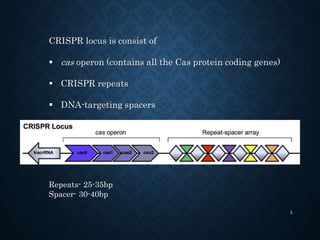
CRISPR locus is consist of
 cas operon (contains all the Cas protein coding genes)
 CRISPR repeats
 DNA-targeting spacers
Repeats- 25-35bp
Spacer- 30-40bp
5
 Adaptation
 crRNA biogenesis
 Target interference
GENERAL MECHANISMOF CRISPRCAS in bacteria
Qomi et al. 2019
6
7
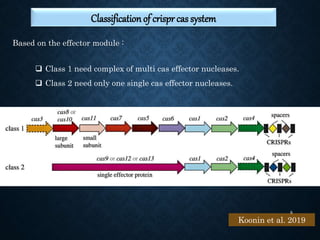
Based on the effector module :
 Class 1 need complex of multi cas effector nucleases.
 Class 2 need only one single cas effector nucleases.
Classificationof crispr cas system
Koonin et al. 2019
8
Koonin et al. 2019
TYPES
9
CRISPR CAS 9 TECHNOLOGY
2020 - Emmanuelle
Charpentier and Jennifer
doudna was awarded Nobel
price in chemistry for
developing the CRISPR cas
9 technology.
CLASS 2 CRISPR SYSTEM
Type II CRISPR-Cas System
10
COMPONENTS OF CRISPR Cas 9
 crRNA
 tracrRNA ( trans-activating CRISPR
RNA)
 RNaseIII
 Cas 9 endonunuclease protein 11
Structure of cas 9
Cas9 protein has 6
domains
Recognition lobe
• REC I
• REC II
Nuclease lobe
• HNH
• RuvC
• single bridge helix
• PAM-interacting
domain
12
Mechanismof CRISPR Cas 9
 crRNA biogenesis
 Target interference
 Adaptation
13
Robert. 2021
14
DNArepairmechanism
Robertson et al. 2022
15
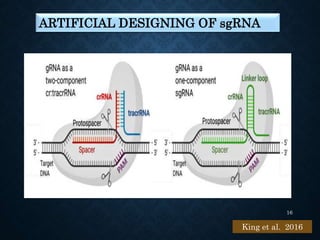
ARTIFICIAL DESIGNING OF sgRNA
King et al. 2016
16
Sandhya et al. 2020
DELIVERY SYSTEM
17
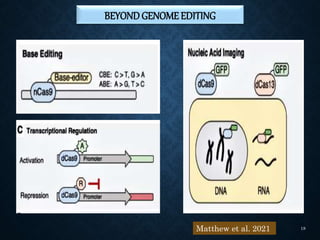
BEYONDGENOMEEDITING
Matthew et al. 2021 18
STRUCTUREOF CAS9, CAS 12 ANDCAS13
Mathew et al. 2021
Molecular weight:
Cas9 -160 kDa
Cas12 - 145kDa
Cas13 – 143.7kDa
19
TYPE V CRISPR CAS SYSTEM
Hillary et al. 2022
20
Hillary et al. 2022
Molecular weight: 40 – 70kDa
21
TYPE VI CRISPRCAS SYSTEM
Hillary et al. 2022
22
Applicationof cas 12 and cas 13 protein
Hillary et al.
23
DETECTR – DNA endonuclease targeted CRISPR trans reporter
SHERLOCK – Specific high sensitivity enzymatic reporter unlocking
COMPARISONOF CRISPRCAS 9, CAS12 ANDCAS13
Serra et al. 2022
24
Supportive
article
25
Zafar et al. 2020
S gene : osSWEET14
CRISPR - Cas9 system
26
Zafar et al. 2020
27
Zafar et al. 2020
28
Zafar et al. 2020
Expression
osSWEET14
29
Xoo strains of Avr Xa 7 binding tale
Plant Modification Target Pathogen Reference
Tomato Gene knockout DMR6
Pseudomonas
Xanthomonas spp.
(Thomazella et al.
2016)
Apple Gene knockout
DIPM-1, DIPM-
2, DIPM-4
Erwinia amylovora
(Malnoy et al.
2016)
Rice Gene knockout SWEET13
Xanthomonas
oryzae pv. oryzae
(Zhou et al. 2015)
Citrus Promoter editing CsLOB1
Xanthomonas
citri subsp. citri
(Jia et al.
2017; Peng et al.
2017)
Rice Promoter editing
OsSWEET11OsS
WEET13OsSWE
ET14
Xanthomonas
oryzae pv. oryzae
(Oliva et al. 2019)
30
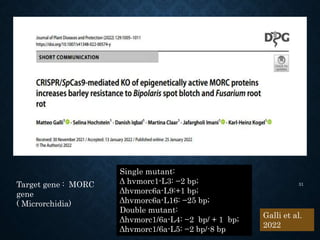
Single mutant:
Δ hvmorc1-L3: −2 bp;
Δhvmorc6a-L9:+1 bp;
Δhvmorc6a-L16: −25 bp;
Double mutant:
Δhvmorc1/6a-L4: −2 bp/ + 1 bp;
Δhvmorc1/6a-L5: −2 bp/-8 bp
Target gene : MORC
gene
( Microrchidia)
31
Galli et al.
2022
Galli et al. 2022
32
Plant Modification Target Pathogen Reference
Grape Gene knockout WRKY52 Botrytis cinerea (Wang et al. 2018)
Cacao Gene knockout NPR3 Phytophthora tropicalis (Fister et al. 2018)
Wheat Gene knockout
TaMLO-A1,
TaMLO-B1,
TaMLO-D1
Blumeria graminis f.
sp. tritici
(Shan et al. 2013; Wang
et al. 2014)
Wheat Gene knockout TaEDR1
Blumeria graminis f.
sp. tritici
(Zhang et al. 2017)
Wheat Gene knockout TaNFXL1 Fusarium graminearum (Brauer et al. 2019)
Rice Gene knockout OsMPK5
Magnaporthe
griseaBurkholderia
glumae
(Xie and Yang 2013)
Rice Gene knockout SEC3A Magnaporthe oryzae (Ma et al. 2017)
Rice Gene knockout ERF922 Magnaporthe oryzae (Wang et al. 2016)
Rice Base editing Pi-ta Magnaporthe oryzae (Ren et al. 2018)
33
S gene - eukaryotic translation initiation factor 4 E
(eIF4E)
Three TaeIF4 E homoeoalleles were obtained.
Kan et al. 2023
34
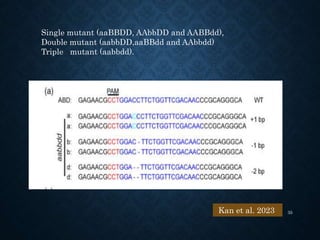
Single mutant (aaBBDD, AAbbDD and AABBdd),
Double mutant (aabbDD,aaBBdd and AAbbdd)
Triple mutant (aabbdd).
Kan et al. 2023 35
Kan et al. 2023
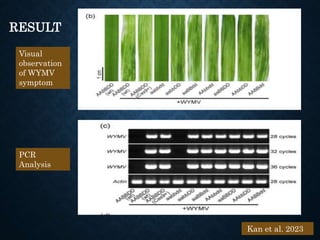
Visual
observation
of WYMV
symptom
RESULT
PCR
Analysis
36
Plant species Name of the susceptibility (S)
gene targeted
Virus name Reference
Arabidopsis thaliana AteIF(iso)4E Turnip mosaic virus (TMV) Pyott et al. (2016)
eIF4E1 Clover yellow vein virus
(CYVV)
Bastet et al. (2019)
Hordeum vulgare (barley) eIF4E1 Barley mild mosaic virus
(BaMMV)
Hoffie et al. (2021)
Manihot esculenta (cassava) nCBP-1/2 Cassava brown streak virus
(CBSV)
Gomez et al. (2019)
Cucumis sativus (cucumber) CseIF4E Zucchini yellow mosaic virus
(ZYMV)
Cucumber vein yellowing virus
(CVYV)
Papaya ring spot mosaic virus-
W (PRSV-W)
Chandrasekaran et al. (2016)
Nicotiana benthamiana CLC-Nb1a/b Potato virus Y (PVY) Sun et al. (2018)
Oryza sativa (rice) OseIF4G Rice tungro spherical virus
(RTSV)
Macovei et al. (2018)
Solanum tuberosum (potato) Coilin Potato virus Y (PVY) Makhotenko et al. (2019)
Glycine max (soybean) GmF3H1/2, FNSII-1 Soybean mosaic virus (SMV) Zhang et al. (2020)
Solanum lycopersicum (tomato) TOM1 Tomato brown rugose fruit
virus (ToBRFV)
Ishikawa et al. (2022)
eIF4E1 Pepper mottle virus (PepMoV) Yoon et al. (2020)
eIF4E1 Cucumber mosaic virus (CMV)
Potato virus Y (PVY)
Atarashi et al. (2020)
eIF4E1 Pepper veinal mottle virus
(PVMV)
Kuroiwa et al. (2022)
SleIF4E1, SleIF4E2 Potato virus Y (PVY) Kumar et al. (2022)
Triticum aestivum (wheat) TaPDIL5-1 Wheat yellow mosaic virus
(WYMV)
Kan et al. (2022)
37
CRISPR – Cas12 system
Wang et al. 2022
38
Wang et al. 2022
39
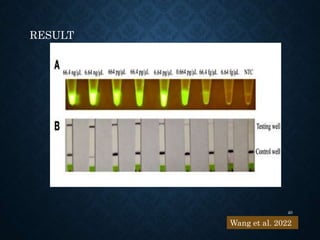
RESULT
Wang et al. 2022
40
Diagnostic method Organism
detected
Reference
One-Pot RT-RPA–
CRISPR/Cas12a
Assay
PVX and PVY Aman et al.,2020
One pot lateral flow
detection and all-in-
one chip lateral flow
assay (AOCLFA)
Leptosphaeria
maculans
Lei et al., 2021
41
CRISPR – Cas13 system
Zhan et al. 2019
42
sgRNA was designed against the 4
conserverd region of PVY namely P3,
CI, NIB,CP
Analysis of the relative expression of the Cas13a gene in transgenic lines
Zhan et al. 2019
43
RESUL
T
Zhan et al. 2019
44
Advantages of
CRISPR/Cas
technology
3.Applicablility
across a wide
range of organisms
4.Efficient and
easy to use
5.Less time consuming
Joginder pal et al. 2019
1.Site specific
mutagenesis
2. Minimizing off-
target mutations
6.Multifunctional
programmability;
Delete, insert or
repair
45
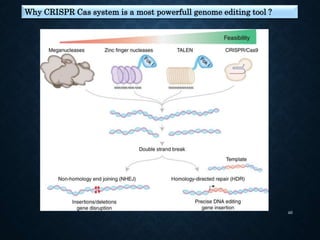
Why CRISPR Cas system is a most powerfull genome editing tool ?
46
Zhang et al. 2021
47
CONCLUSION
48
49

CRISPR PPT.pptx

  • 1.
  • 2.
    CRISPR-Cas: BIOLOGY, MECHANISMS ANDITS APPLICATION IN PLANT PATHOLOGY C. GUNASEELI I-Ph.D.,(Ag.)-PLANT PATHOLOGY 2
  • 3.
    • CRISPR -Clustered Regularly Interspaced Short Palindromic Repeats • Adaptive immune system in bacteria and archaea • Crispr sequence are present in more than 40% of bacteria and 90% of archae • In 1987, Atsuo Nakata and his group from Osaka university described crispr in E. coli K12 strain • In 2005, Bolotin and his group identified the crispr’s function INTRODUCTION 3
  • 4.
    1987-Researchers found CRISPR sequencein Escherichia coli(E coli),but did not characterize their function. (Ishano et al.1987) 2000 - CRISPR sequences are found to be common in other microbes. (Mojica et al 2000) 2005- Bolotin et al., identified the role of CRISPR as adaptive immune system in prokaryotes 2012 - Proposal CRISPR for Genome editing (Jinek, Doudna, Charpentier et al. 2012) 2013-first demonstration of Cas 9 genome engineering in eukaryotic cell. (Zhang et al 2013) 2013-first demonstration of Cas9 genome engineering in plant cells. (Zhang et al 2013) HISTORY 4
  • 5.
    CRISPR locus isconsist of  cas operon (contains all the Cas protein coding genes)  CRISPR repeats  DNA-targeting spacers Repeats- 25-35bp Spacer- 30-40bp 5
  • 6.
     Adaptation  crRNAbiogenesis  Target interference GENERAL MECHANISMOF CRISPRCAS in bacteria Qomi et al. 2019 6
  • 7.
  • 8.
    Based on theeffector module :  Class 1 need complex of multi cas effector nucleases.  Class 2 need only one single cas effector nucleases. Classificationof crispr cas system Koonin et al. 2019 8
  • 9.
    Koonin et al.2019 TYPES 9
  • 10.
    CRISPR CAS 9TECHNOLOGY 2020 - Emmanuelle Charpentier and Jennifer doudna was awarded Nobel price in chemistry for developing the CRISPR cas 9 technology. CLASS 2 CRISPR SYSTEM Type II CRISPR-Cas System 10
  • 11.
    COMPONENTS OF CRISPRCas 9  crRNA  tracrRNA ( trans-activating CRISPR RNA)  RNaseIII  Cas 9 endonunuclease protein 11
  • 12.
    Structure of cas9 Cas9 protein has 6 domains Recognition lobe • REC I • REC II Nuclease lobe • HNH • RuvC • single bridge helix • PAM-interacting domain 12
  • 13.
    Mechanismof CRISPR Cas9  crRNA biogenesis  Target interference  Adaptation 13
  • 14.
  • 15.
  • 16.
    ARTIFICIAL DESIGNING OFsgRNA King et al. 2016 16
  • 17.
    Sandhya et al.2020 DELIVERY SYSTEM 17
  • 18.
  • 19.
    STRUCTUREOF CAS9, CAS12 ANDCAS13 Mathew et al. 2021 Molecular weight: Cas9 -160 kDa Cas12 - 145kDa Cas13 – 143.7kDa 19
  • 20.
    TYPE V CRISPRCAS SYSTEM Hillary et al. 2022 20
  • 21.
    Hillary et al.2022 Molecular weight: 40 – 70kDa 21
  • 22.
    TYPE VI CRISPRCASSYSTEM Hillary et al. 2022 22
  • 23.
    Applicationof cas 12and cas 13 protein Hillary et al. 23 DETECTR – DNA endonuclease targeted CRISPR trans reporter SHERLOCK – Specific high sensitivity enzymatic reporter unlocking
  • 24.
    COMPARISONOF CRISPRCAS 9,CAS12 ANDCAS13 Serra et al. 2022 24
  • 25.
  • 26.
    Zafar et al.2020 S gene : osSWEET14 CRISPR - Cas9 system 26
  • 27.
    Zafar et al.2020 27
  • 28.
    Zafar et al.2020 28
  • 29.
    Zafar et al.2020 Expression osSWEET14 29 Xoo strains of Avr Xa 7 binding tale
  • 30.
    Plant Modification TargetPathogen Reference Tomato Gene knockout DMR6 Pseudomonas Xanthomonas spp. (Thomazella et al. 2016) Apple Gene knockout DIPM-1, DIPM- 2, DIPM-4 Erwinia amylovora (Malnoy et al. 2016) Rice Gene knockout SWEET13 Xanthomonas oryzae pv. oryzae (Zhou et al. 2015) Citrus Promoter editing CsLOB1 Xanthomonas citri subsp. citri (Jia et al. 2017; Peng et al. 2017) Rice Promoter editing OsSWEET11OsS WEET13OsSWE ET14 Xanthomonas oryzae pv. oryzae (Oliva et al. 2019) 30
  • 31.
    Single mutant: Δ hvmorc1-L3:−2 bp; Δhvmorc6a-L9:+1 bp; Δhvmorc6a-L16: −25 bp; Double mutant: Δhvmorc1/6a-L4: −2 bp/ + 1 bp; Δhvmorc1/6a-L5: −2 bp/-8 bp Target gene : MORC gene ( Microrchidia) 31 Galli et al. 2022
  • 32.
    Galli et al.2022 32
  • 33.
    Plant Modification TargetPathogen Reference Grape Gene knockout WRKY52 Botrytis cinerea (Wang et al. 2018) Cacao Gene knockout NPR3 Phytophthora tropicalis (Fister et al. 2018) Wheat Gene knockout TaMLO-A1, TaMLO-B1, TaMLO-D1 Blumeria graminis f. sp. tritici (Shan et al. 2013; Wang et al. 2014) Wheat Gene knockout TaEDR1 Blumeria graminis f. sp. tritici (Zhang et al. 2017) Wheat Gene knockout TaNFXL1 Fusarium graminearum (Brauer et al. 2019) Rice Gene knockout OsMPK5 Magnaporthe griseaBurkholderia glumae (Xie and Yang 2013) Rice Gene knockout SEC3A Magnaporthe oryzae (Ma et al. 2017) Rice Gene knockout ERF922 Magnaporthe oryzae (Wang et al. 2016) Rice Base editing Pi-ta Magnaporthe oryzae (Ren et al. 2018) 33
  • 34.
    S gene -eukaryotic translation initiation factor 4 E (eIF4E) Three TaeIF4 E homoeoalleles were obtained. Kan et al. 2023 34
  • 35.
    Single mutant (aaBBDD,AAbbDD and AABBdd), Double mutant (aabbDD,aaBBdd and AAbbdd) Triple mutant (aabbdd). Kan et al. 2023 35
  • 36.
    Kan et al.2023 Visual observation of WYMV symptom RESULT PCR Analysis 36
  • 37.
    Plant species Nameof the susceptibility (S) gene targeted Virus name Reference Arabidopsis thaliana AteIF(iso)4E Turnip mosaic virus (TMV) Pyott et al. (2016) eIF4E1 Clover yellow vein virus (CYVV) Bastet et al. (2019) Hordeum vulgare (barley) eIF4E1 Barley mild mosaic virus (BaMMV) Hoffie et al. (2021) Manihot esculenta (cassava) nCBP-1/2 Cassava brown streak virus (CBSV) Gomez et al. (2019) Cucumis sativus (cucumber) CseIF4E Zucchini yellow mosaic virus (ZYMV) Cucumber vein yellowing virus (CVYV) Papaya ring spot mosaic virus- W (PRSV-W) Chandrasekaran et al. (2016) Nicotiana benthamiana CLC-Nb1a/b Potato virus Y (PVY) Sun et al. (2018) Oryza sativa (rice) OseIF4G Rice tungro spherical virus (RTSV) Macovei et al. (2018) Solanum tuberosum (potato) Coilin Potato virus Y (PVY) Makhotenko et al. (2019) Glycine max (soybean) GmF3H1/2, FNSII-1 Soybean mosaic virus (SMV) Zhang et al. (2020) Solanum lycopersicum (tomato) TOM1 Tomato brown rugose fruit virus (ToBRFV) Ishikawa et al. (2022) eIF4E1 Pepper mottle virus (PepMoV) Yoon et al. (2020) eIF4E1 Cucumber mosaic virus (CMV) Potato virus Y (PVY) Atarashi et al. (2020) eIF4E1 Pepper veinal mottle virus (PVMV) Kuroiwa et al. (2022) SleIF4E1, SleIF4E2 Potato virus Y (PVY) Kumar et al. (2022) Triticum aestivum (wheat) TaPDIL5-1 Wheat yellow mosaic virus (WYMV) Kan et al. (2022) 37
  • 38.
    CRISPR – Cas12system Wang et al. 2022 38
  • 39.
    Wang et al.2022 39
  • 40.
  • 41.
    Diagnostic method Organism detected Reference One-PotRT-RPA– CRISPR/Cas12a Assay PVX and PVY Aman et al.,2020 One pot lateral flow detection and all-in- one chip lateral flow assay (AOCLFA) Leptosphaeria maculans Lei et al., 2021 41
  • 42.
    CRISPR – Cas13system Zhan et al. 2019 42 sgRNA was designed against the 4 conserverd region of PVY namely P3, CI, NIB,CP
  • 43.
    Analysis of therelative expression of the Cas13a gene in transgenic lines Zhan et al. 2019 43
  • 44.
  • 45.
    Advantages of CRISPR/Cas technology 3.Applicablility across awide range of organisms 4.Efficient and easy to use 5.Less time consuming Joginder pal et al. 2019 1.Site specific mutagenesis 2. Minimizing off- target mutations 6.Multifunctional programmability; Delete, insert or repair 45
  • 46.
    Why CRISPR Cassystem is a most powerfull genome editing tool ? 46
  • 47.
    Zhang et al.2021 47
  • 48.
  • 49.