DR JAWERIA
Dental consultant
(AKHSP)
 SQUAMOUS CELL CARCINOMA
 Introduction
 Epidemiology
 Clinical Features
 Diagnosis
 Treatment plan
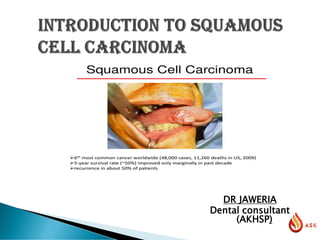
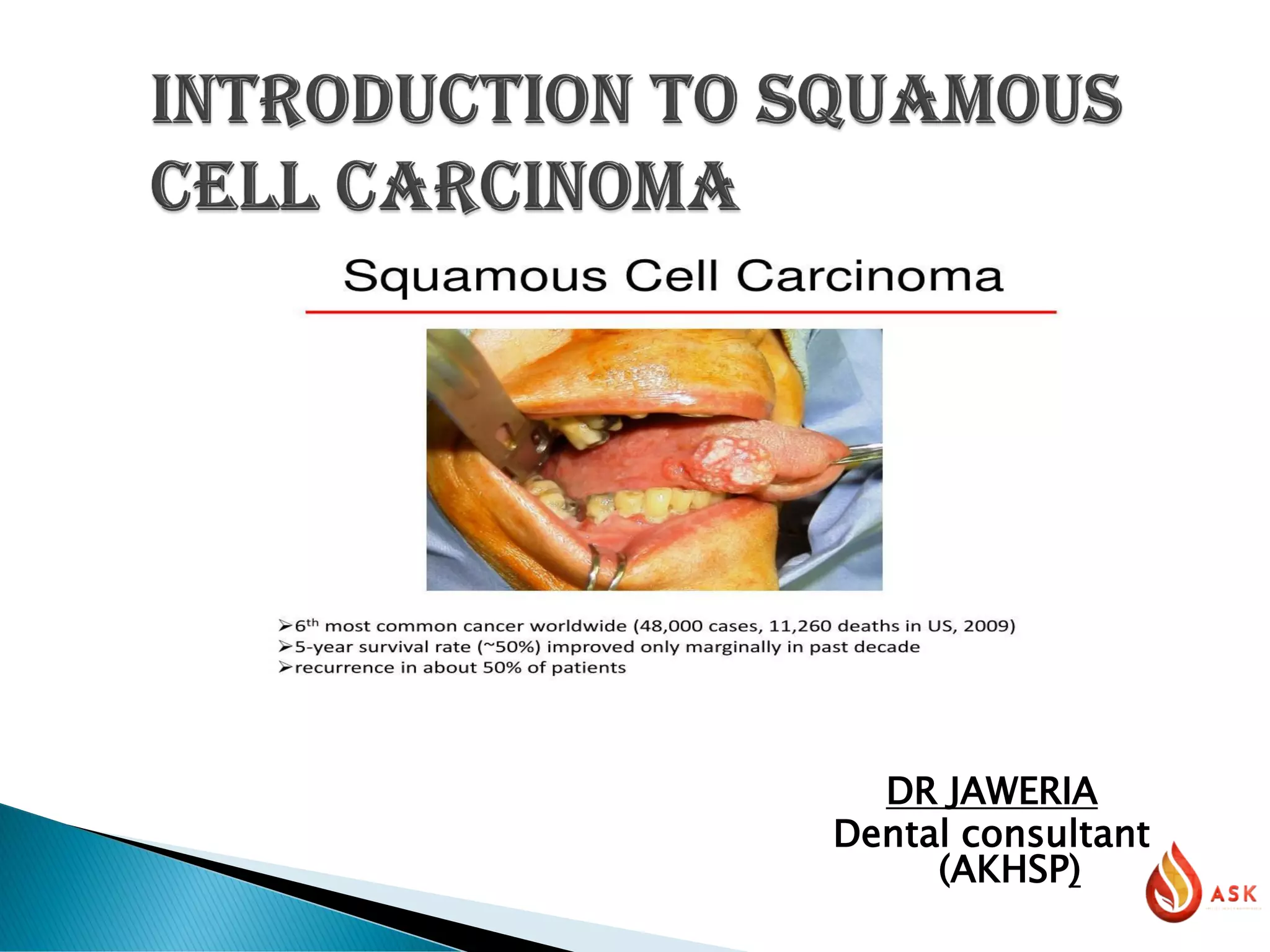
 Definition:
It’s a malignant neoplasm of stratified
squamous epithelium in the oral cavity
capable of local destructive growth and
distant metastasis.
 Epidemiology:
 Accounts for 90% or more of all oral malignant
neoplasms.
 30-40% occurs in South East Asia.
 Incidence rates tend to be higher in urban as
opposed to rural communities.
 Fourth commonest cancer in men and sixth
commonest in women.
 Sixth commonest form of malignant disease in
both sexes.
 Eighth in incidence for all cancers in developed
countries
 Third in incidence in developing
countries.
 98% of patients are over the age of 40.
 More common in men.
 Incidence of oral cancer rises steeply
with age and with an ageing
population.
 May occur on any part of the oral
mucosa, but buccal mucosa is the most
frequent site.
 Possible aetiological factors:
 Tobacco smoking in the form of pipes, cigars
cigarettes, bidis, reverse smoking.40 cigarettes/day,
R/R increaes upto 10 to 20 times
 Smokeless tobacco in the form of snuff dipping,
tobacco sachets and tobacco chewing like betel
chewing and betel quid.
 Smoking is considered to be a major aetiological
factor, particularly in association with alcohol.
 Main carcinogens in tobacco are N-nitrosamines
derived from nicotine
 Alcohol may enhance transport of carcinogens across
mucosal barrier.
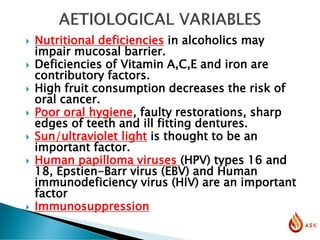
 Nutritional deficiencies in alcoholics may
impair mucosal barrier.
 Deficiencies of Vitamin A,C,E and iron are
contributory factors.
 High fruit consumption decreases the risk of
oral cancer.
 Poor oral hygiene, faulty restorations, sharp
edges of teeth and ill fitting dentures.
 Sun/ultraviolet light is thought to be an
important factor.
 Human papilloma viruses (HPV) types 16 and
18, Epstien-Barr virus (EBV) and Human
immunodeficiency virus (HIV) are an important
factor
 Immunosuppression
 Genetic mutations are responsible for
generation of malignant cells.
 Mutation may resuklts in abnormal quantity
and/or function of protein products that
regulate cell growth , division and repair.
Oncogenes
 These are abnormal form of normal genes
(protooncogenes) that regulate cell
growth.
 These genes encode for range of growth-
promoting proteins found in normal cells.
 - GFR protein
 - signal transmitting protein
 - stimulatory cell cycle regulating proteins
 - Growth factors
 - intracellular signal transduction
pathways
 Are inherent genes that play a role in cell
division and DNA repair and are critical for
detecting in appropriate growth signals in
cells. If they are mutated genetic mutation in
other genes can proceed unchecked, leading
to neoplastic transformation.
 Tumour suppressor-genes that
encode for growth inhibitory protiens.
 - p 53
 - p 54
 Under normal circumstances cellular
proliferation is controlled by the
balance between these growth-
promoting and growth-inhibiting
genes.
 During carcinogenesis a proto-oncogene may
undergo mutation and become an activated
oncogene resulting an enhanced activity and
tumour formation.
 Clinical Presentation:
 Early lesions are usually asymptomatic.
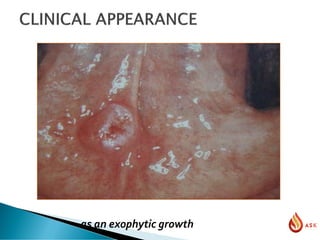
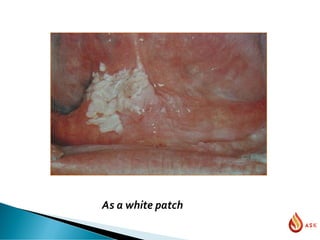
 White patch with small exophytic growth which
in the early stages may show no uleration or
erythema.
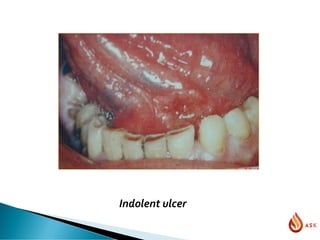
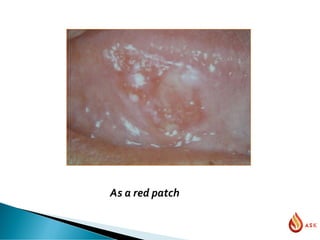
 Small indolent ulcer or an area of erythroplakia.
 Pain is seldom present.
 Persistent ulceration, induration and fixation of
affected tissue to underlying structures and
underlying bone destructions should arouse
suspicion of an early carcinoma.
 Unusual surface changes
 sudden tooth mobility without apparent
cause
 Unusual oral bleeding or epistaxis
 Prolonged hoarseness of voice
as an exophytic growth
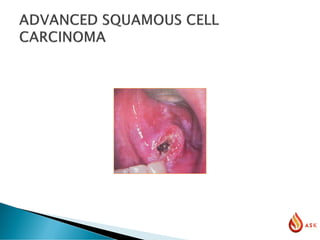
 As carcinoma enlarges it may develop into a
raised nodule or become ulcerated.
 Induration results from inflammation and
fibrosis and infiltration of the tissues.
 By the time a carcinoma has formed an
indurated ulcer with the typical rolled border.
 Ulceration may cause soreness or stinging pain
when sharply flavoured food is eaten.
 Bleeding, either spontaneously or from mild
trauma.
 Paraesthesia or anaesthesia of the lip or
tongue
 Airway obstruction
 Chronic earache
 Trismus/ dysphagia
 Altered vision
 Epiphora
 Lymphadenopathy
As a white patch
Indolent ulcer
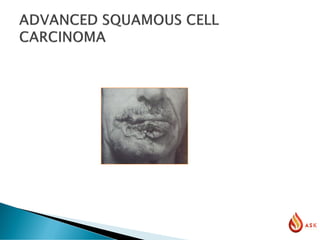
 Sites of Oral Cancer:
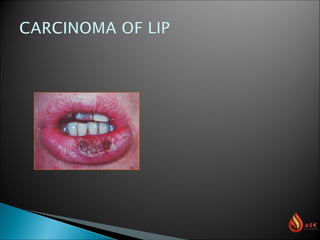
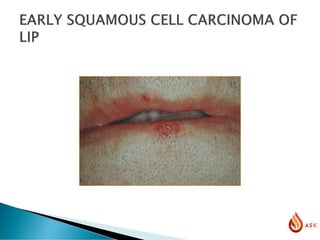
 Lower lip is the most frequent site of oral
cancer overall.
 Tongue is the most frquently affected site
within the mouth.
 In the oral cavity, the majority of oral cancers
are concentrated in the lower part of the
mouth, particularly the lateral borders of the
tongue, adjacent floor of the mouth and lingual
aspect of the alveolar margin.
 Hard palate and dorsum of the tongue are
rarely affected.
As a red patch
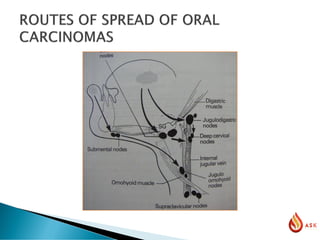
 Spread of Oral Carcinoma:
 Carcinoma invades adjacent tissue by direct
extension. Bone initially forms a barrier but is
eventually destroyed, usually by superficial
erosion, but once the cortex is breached
carcinoma may invade laterally along the
medullary cavity.
 Metastatic spread is primarily through the
lymphatics to the regional lymph nodes.
 Blood stream is an uncommon, late feature of
the disease.
25
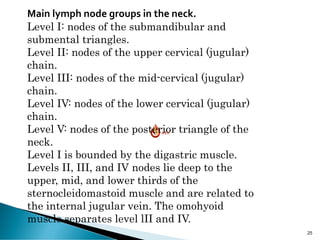
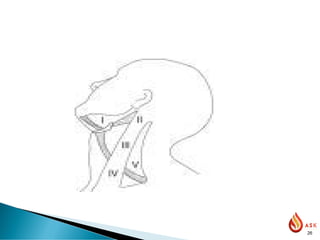
Main lymph node groups in the neck.
Level I: nodes of the submandibular and
submental triangles.
Level II: nodes of the upper cervical (jugular)
chain.
Level III: nodes of the mid-cervical (jugular)
chain.
Level IV: nodes of the lower cervical (jugular)
chain.
Level V: nodes of the posterior triangle of the
neck.
Level I is bounded by the digastric muscle.
Levels II, III, and IV nodes lie deep to the
upper, mid, and lower thirds of the
sternocleidomastoid muscle and are related to
the internal jugular vein. The omohyoid
muscle separates level lII and IV.
26
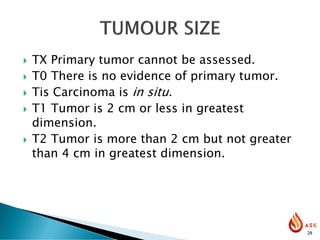
 TX Primary tumor cannot be assessed.
 T0 There is no evidence of primary tumor.
 Tis Carcinoma is in situ.
 T1 Tumor is 2 cm or less in greatest
dimension.
 T2 Tumor is more than 2 cm but not greater
than 4 cm in greatest dimension.
28
 T3 Tumor is more than 4 cm in greatest
dimension.
 T4 (lip) Tumor invades through cortical bone,
inferior alveolar nerve, floor of mouth, or skin
of face—i.e., chin or nose.
 T4a (oral Tumor invades adjacent structures
(e.g., through cavity) cortical bone, into deep
[extrinsic] muscle of tongue
 [genioglossus, hypoglossus, palataglossus,
and styloglossus], maxillary sinus, skin of
face).
 T4b Tumor invades masticator space,
pterygoid plates, or skull base and/or
encases the internal carotid artery.
 Note: Superficial erosion alone of bone/tooth
socket by gingival primary
is not sufficient to classify as T4.
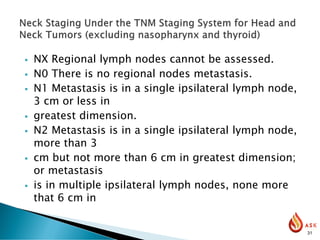
▪ NX Regional lymph nodes cannot be assessed.
▪ N0 There is no regional nodes metastasis.
▪ N1 Metastasis is in a single ipsilateral lymph node,
3 cm or less in
▪ greatest dimension.
▪ N2 Metastasis is in a single ipsilateral lymph node,
more than 3
▪ cm but not more than 6 cm in greatest dimension;
or metastasis
▪ is in multiple ipsilateral lymph nodes, none more
that 6 cm in
31
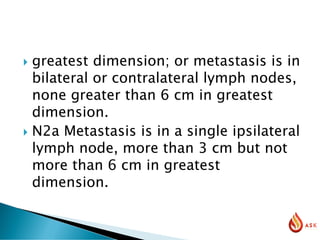
 greatest dimension; or metastasis is in
bilateral or contralateral lymph nodes,
none greater than 6 cm in greatest
dimension.
 N2a Metastasis is in a single ipsilateral
lymph node, more than 3 cm but not
more than 6 cm in greatest
dimension.
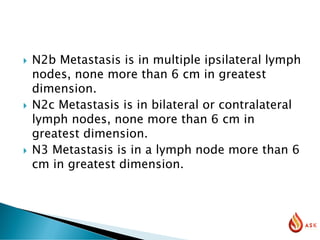
 N2b Metastasis is in multiple ipsilateral lymph
nodes, none more than 6 cm in greatest
dimension.
 N2c Metastasis is in bilateral or contralateral
lymph nodes, none more than 6 cm in
greatest dimension.
 N3 Metastasis is in a lymph node more than 6
cm in greatest dimension.
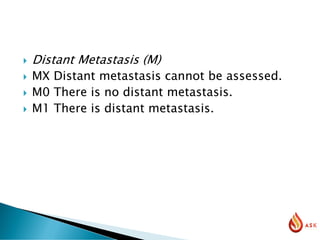
 Distant Metastasis (M)
 MX Distant metastasis cannot be assessed.
 M0 There is no distant metastasis.
 M1 There is distant metastasis.
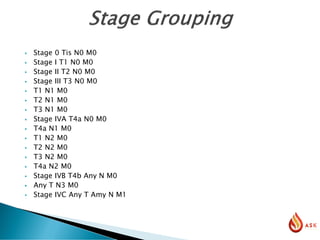
▪ Stage 0 Tis N0 M0
▪ Stage I T1 N0 M0
▪ Stage II T2 N0 M0
▪ Stage III T3 N0 M0
▪ T1 N1 M0
▪ T2 N1 M0
▪ T3 N1 M0
▪ Stage IVA T4a N0 M0
▪ T4a N1 M0
▪ T1 N2 M0
▪ T2 N2 M0
▪ T3 N2 M0
▪ T4a N2 M0
▪ Stage IVB T4b Any N M0
▪ Any T N3 M0
▪ Stage IVC Any T Amy N M1
 WELL DIFFERENTIATED
 MODERATELY DIFFERENTIATED
 POORLY DIFFERENTIATED
36
 In well-differentiated tumours, the neoplastic
epithelium is obviously squamous in type and
consists of masses of prickle cells with a
limiting layer of basal cells around the
periphery. Intercellular bridges are readily
recognizable.
37
 Keratin pearls are often found within the
masses of infiltrating cells, each pearl
consisting of a central area of keratin
surrounded by whorls of prickle cells. Nuclear
and cellular pleomorphism is not prominent
and there are relatively few mitotic figures.
38
 Moderately differentiated tumours show less
keratinization and more nuclear and cellular
pleomorphism and mitotic activity, but are
still readily identified as squamous in type. In
contrast, in poorly differentiated tumours
keratinization is usually absent and the cells
show prominent nuclear and cellular
pleomorphism and abundant, often bizarre,
mitoses.
39
 In poorly differentiated tumours the cells may
be so abnormal as to hardly be recognizable
as epithelial cells. In such
cases,immunohistochemistry to demonstrate
cytokeratins (intermediate filament proteins
that characterize epithelia) is particularly
valuable
 HISTORY
 CLINICAL EXAMINATION
 INVESTIGATIONS
- RADIOLOGICAL
- Plain radiographs
- CT, MRI, PET
- LAB
- HISTOPATHOLOGICAL
- HEAMATOLOGICAL
44
 TREATMENT PLANNING
 SURGERY
 RADIOTHERAPY
 CHEMOTHERAPY
 COMBINATION TREATMENTS
45
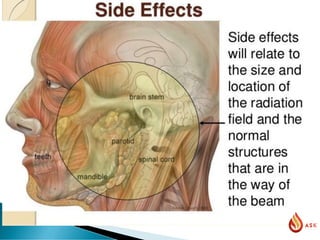
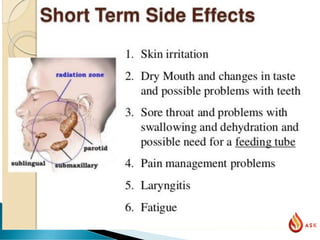
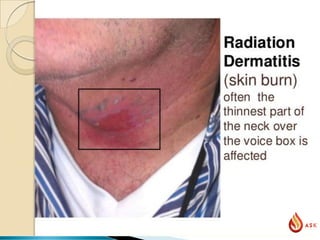
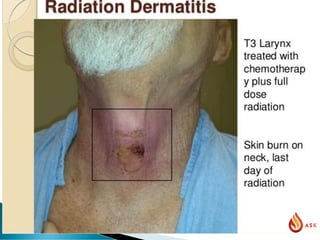
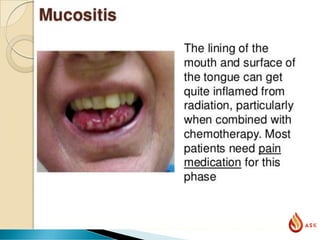
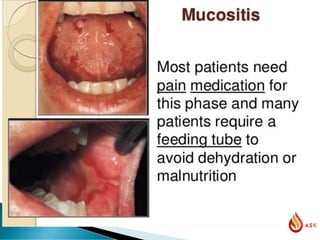
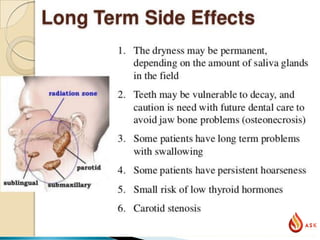
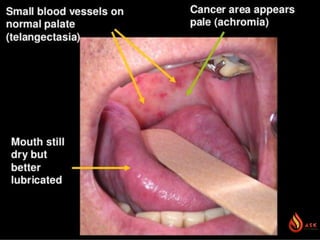
Radiation side effects
 · early diagnosis is the major factor
determining prognosis
 · site and late onset of symptoms adversely
affect early diagnosis
 · prognosis decreases with increasing clinical
stage (related to early diagnosis)
 · histopathological features influence
prognosis
55
THANK YOU

"Oral Squamous Cell Carcinoma"

  • 1.
  • 2.
     SQUAMOUS CELLCARCINOMA  Introduction  Epidemiology  Clinical Features  Diagnosis  Treatment plan
  • 3.
     Definition: It’s amalignant neoplasm of stratified squamous epithelium in the oral cavity capable of local destructive growth and distant metastasis.
  • 4.
     Epidemiology:  Accountsfor 90% or more of all oral malignant neoplasms.  30-40% occurs in South East Asia.  Incidence rates tend to be higher in urban as opposed to rural communities.  Fourth commonest cancer in men and sixth commonest in women.  Sixth commonest form of malignant disease in both sexes.  Eighth in incidence for all cancers in developed countries
  • 5.
     Third inincidence in developing countries.  98% of patients are over the age of 40.  More common in men.  Incidence of oral cancer rises steeply with age and with an ageing population.  May occur on any part of the oral mucosa, but buccal mucosa is the most frequent site.
  • 6.
     Possible aetiologicalfactors:  Tobacco smoking in the form of pipes, cigars cigarettes, bidis, reverse smoking.40 cigarettes/day, R/R increaes upto 10 to 20 times  Smokeless tobacco in the form of snuff dipping, tobacco sachets and tobacco chewing like betel chewing and betel quid.  Smoking is considered to be a major aetiological factor, particularly in association with alcohol.  Main carcinogens in tobacco are N-nitrosamines derived from nicotine  Alcohol may enhance transport of carcinogens across mucosal barrier.
  • 7.
     Nutritional deficienciesin alcoholics may impair mucosal barrier.  Deficiencies of Vitamin A,C,E and iron are contributory factors.  High fruit consumption decreases the risk of oral cancer.  Poor oral hygiene, faulty restorations, sharp edges of teeth and ill fitting dentures.  Sun/ultraviolet light is thought to be an important factor.  Human papilloma viruses (HPV) types 16 and 18, Epstien-Barr virus (EBV) and Human immunodeficiency virus (HIV) are an important factor  Immunosuppression
  • 8.
     Genetic mutationsare responsible for generation of malignant cells.  Mutation may resuklts in abnormal quantity and/or function of protein products that regulate cell growth , division and repair.
  • 9.
    Oncogenes  These areabnormal form of normal genes (protooncogenes) that regulate cell growth.  These genes encode for range of growth- promoting proteins found in normal cells.  - GFR protein  - signal transmitting protein  - stimulatory cell cycle regulating proteins  - Growth factors  - intracellular signal transduction pathways
  • 10.
     Are inherentgenes that play a role in cell division and DNA repair and are critical for detecting in appropriate growth signals in cells. If they are mutated genetic mutation in other genes can proceed unchecked, leading to neoplastic transformation.
  • 11.
     Tumour suppressor-genesthat encode for growth inhibitory protiens.  - p 53  - p 54  Under normal circumstances cellular proliferation is controlled by the balance between these growth- promoting and growth-inhibiting genes.
  • 12.
     During carcinogenesisa proto-oncogene may undergo mutation and become an activated oncogene resulting an enhanced activity and tumour formation.
  • 13.
     Clinical Presentation: Early lesions are usually asymptomatic.  White patch with small exophytic growth which in the early stages may show no uleration or erythema.  Small indolent ulcer or an area of erythroplakia.  Pain is seldom present.  Persistent ulceration, induration and fixation of affected tissue to underlying structures and underlying bone destructions should arouse suspicion of an early carcinoma.
  • 14.
     Unusual surfacechanges  sudden tooth mobility without apparent cause  Unusual oral bleeding or epistaxis  Prolonged hoarseness of voice
  • 15.
  • 16.
     As carcinomaenlarges it may develop into a raised nodule or become ulcerated.  Induration results from inflammation and fibrosis and infiltration of the tissues.  By the time a carcinoma has formed an indurated ulcer with the typical rolled border.  Ulceration may cause soreness or stinging pain when sharply flavoured food is eaten.  Bleeding, either spontaneously or from mild trauma.
  • 17.
     Paraesthesia oranaesthesia of the lip or tongue  Airway obstruction  Chronic earache  Trismus/ dysphagia  Altered vision  Epiphora  Lymphadenopathy
  • 18.
  • 19.
  • 20.
     Sites ofOral Cancer:  Lower lip is the most frequent site of oral cancer overall.  Tongue is the most frquently affected site within the mouth.  In the oral cavity, the majority of oral cancers are concentrated in the lower part of the mouth, particularly the lateral borders of the tongue, adjacent floor of the mouth and lingual aspect of the alveolar margin.  Hard palate and dorsum of the tongue are rarely affected.
  • 22.
    As a redpatch
  • 23.
     Spread ofOral Carcinoma:  Carcinoma invades adjacent tissue by direct extension. Bone initially forms a barrier but is eventually destroyed, usually by superficial erosion, but once the cortex is breached carcinoma may invade laterally along the medullary cavity.  Metastatic spread is primarily through the lymphatics to the regional lymph nodes.  Blood stream is an uncommon, late feature of the disease.
  • 25.
    25 Main lymph nodegroups in the neck. Level I: nodes of the submandibular and submental triangles. Level II: nodes of the upper cervical (jugular) chain. Level III: nodes of the mid-cervical (jugular) chain. Level IV: nodes of the lower cervical (jugular) chain. Level V: nodes of the posterior triangle of the neck. Level I is bounded by the digastric muscle. Levels II, III, and IV nodes lie deep to the upper, mid, and lower thirds of the sternocleidomastoid muscle and are related to the internal jugular vein. The omohyoid muscle separates level lII and IV.
  • 26.
  • 28.
     TX Primarytumor cannot be assessed.  T0 There is no evidence of primary tumor.  Tis Carcinoma is in situ.  T1 Tumor is 2 cm or less in greatest dimension.  T2 Tumor is more than 2 cm but not greater than 4 cm in greatest dimension. 28
  • 29.
     T3 Tumoris more than 4 cm in greatest dimension.  T4 (lip) Tumor invades through cortical bone, inferior alveolar nerve, floor of mouth, or skin of face—i.e., chin or nose.  T4a (oral Tumor invades adjacent structures (e.g., through cavity) cortical bone, into deep [extrinsic] muscle of tongue
  • 30.
     [genioglossus, hypoglossus,palataglossus, and styloglossus], maxillary sinus, skin of face).  T4b Tumor invades masticator space, pterygoid plates, or skull base and/or encases the internal carotid artery.  Note: Superficial erosion alone of bone/tooth socket by gingival primary is not sufficient to classify as T4.
  • 31.
    ▪ NX Regionallymph nodes cannot be assessed. ▪ N0 There is no regional nodes metastasis. ▪ N1 Metastasis is in a single ipsilateral lymph node, 3 cm or less in ▪ greatest dimension. ▪ N2 Metastasis is in a single ipsilateral lymph node, more than 3 ▪ cm but not more than 6 cm in greatest dimension; or metastasis ▪ is in multiple ipsilateral lymph nodes, none more that 6 cm in 31
  • 32.
     greatest dimension;or metastasis is in bilateral or contralateral lymph nodes, none greater than 6 cm in greatest dimension.  N2a Metastasis is in a single ipsilateral lymph node, more than 3 cm but not more than 6 cm in greatest dimension.
  • 33.
     N2b Metastasisis in multiple ipsilateral lymph nodes, none more than 6 cm in greatest dimension.  N2c Metastasis is in bilateral or contralateral lymph nodes, none more than 6 cm in greatest dimension.  N3 Metastasis is in a lymph node more than 6 cm in greatest dimension.
  • 34.
     Distant Metastasis(M)  MX Distant metastasis cannot be assessed.  M0 There is no distant metastasis.  M1 There is distant metastasis.
  • 35.
    ▪ Stage 0Tis N0 M0 ▪ Stage I T1 N0 M0 ▪ Stage II T2 N0 M0 ▪ Stage III T3 N0 M0 ▪ T1 N1 M0 ▪ T2 N1 M0 ▪ T3 N1 M0 ▪ Stage IVA T4a N0 M0 ▪ T4a N1 M0 ▪ T1 N2 M0 ▪ T2 N2 M0 ▪ T3 N2 M0 ▪ T4a N2 M0 ▪ Stage IVB T4b Any N M0 ▪ Any T N3 M0 ▪ Stage IVC Any T Amy N M1
  • 36.
     WELL DIFFERENTIATED MODERATELY DIFFERENTIATED  POORLY DIFFERENTIATED 36
  • 37.
     In well-differentiatedtumours, the neoplastic epithelium is obviously squamous in type and consists of masses of prickle cells with a limiting layer of basal cells around the periphery. Intercellular bridges are readily recognizable. 37
  • 38.
     Keratin pearlsare often found within the masses of infiltrating cells, each pearl consisting of a central area of keratin surrounded by whorls of prickle cells. Nuclear and cellular pleomorphism is not prominent and there are relatively few mitotic figures. 38
  • 39.
     Moderately differentiatedtumours show less keratinization and more nuclear and cellular pleomorphism and mitotic activity, but are still readily identified as squamous in type. In contrast, in poorly differentiated tumours keratinization is usually absent and the cells show prominent nuclear and cellular pleomorphism and abundant, often bizarre, mitoses. 39
  • 40.
     In poorlydifferentiated tumours the cells may be so abnormal as to hardly be recognizable as epithelial cells. In such cases,immunohistochemistry to demonstrate cytokeratins (intermediate filament proteins that characterize epithelia) is particularly valuable
  • 44.
     HISTORY  CLINICALEXAMINATION  INVESTIGATIONS - RADIOLOGICAL - Plain radiographs - CT, MRI, PET - LAB - HISTOPATHOLOGICAL - HEAMATOLOGICAL 44
  • 45.
     TREATMENT PLANNING SURGERY  RADIOTHERAPY  CHEMOTHERAPY  COMBINATION TREATMENTS 45
  • 46.
  • 55.
     · earlydiagnosis is the major factor determining prognosis  · site and late onset of symptoms adversely affect early diagnosis  · prognosis decreases with increasing clinical stage (related to early diagnosis)  · histopathological features influence prognosis 55
  • 57.