CRISPR
A Genome Editing Tool
INTRODUCTION:
Clustered Regularly Interspaced Short Palindromic Repeats”
New gene editing technology with the potential to
revolutionize genetic engineering and the biotechnology
industry.
Use to understanding, characterizing, and controlling DNA.
 Based on bacterial immune system.
 Single solution to many problems
CRISPR are found in approximately 50% of sequenced bacterial
genome and nearly 90% of sequenced Archaea.
HISTORY:
 1987 Researcher youshizmi Ishano find CRISPR sequence in E.coli but they don’t
characterized their functions.
 2000 CRISPR sequence were found by moica to be common in other microbes.
2002 Mr. Jansen Coined CRISPR name, defined, signature cas gene.
2007 First experimental evidence for CRISPR adaptive immunity.
2008 Spacer sequences are transcribed into guide RNAs
2010 Discovered that Cas9 can cleaves target DNA
2011 Discovery of tracrRNA for Cas9 system
2011 Discovered that CRISPR systems can function heterologously in other species
2012 Idea of using CRISPR- Cas9 as a genomic engineering tool, was published by
Jennifer and Emmanuelle.
 2013 First demonstration of Cas9 genome engineering in Eukaryotic cell.
2014 First CRISPR patent was granted to Feng Zheng.
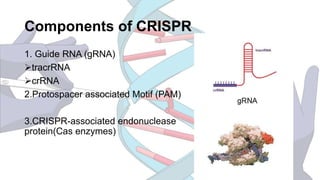
Components of CRISPR
1. Guide RNA (gRNA)
tracrRNA
crRNA
2.Protospacer associated Motif (PAM)
3.CRISPR-associated endonuclease
protein(Cas enzymes)
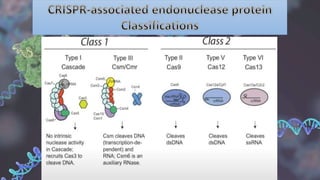
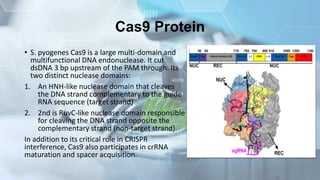
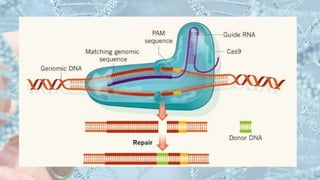
Cas9 Protein
• S. pyogenes Cas9 is a large multi-domain and
multifunctional DNA endonuclease. It cut
dsDNA 3 bp upstream of the PAM through. Its
two distinct nuclease domains:
1. An HNH-like nuclease domain that cleaves
the DNA strand complementary to the guide
RNA sequence (target strand)
2. 2nd is RuvC-like nuclease domain responsible
for cleaving the DNA strand opposite the
complementary strand (non-target strand).
In addition to its critical role in CRISPR
interference, Cas9 also participates in crRNA
maturation and spacer acquisition.
Guide RNA Variants
•Truncated Guide RNAs
(truRNA)
•Ribozyme-gRNA-Ribozyme
(RGR)
•Polycistronic tRNA-gRNA
(PTG/Cas9)
The Cas9 Nuclease Variants
•The Native Cas9
•The Cas9 Nickase
•The Inactive dCas9
•Dimeric RNA-Guided
FokI Nucleases
(RFNs)
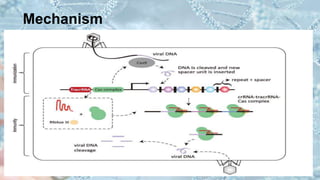
The CRISPR immune response three steps:
1. Adaptation: When DNA from a virus invades the bacteria, the viral DNA
is processed into short segments and is made into a new spacer between
the repeats. These will serve as genetic memory of previous infections.
2. Production of CRISPR RNA: The CRISPR sequence undergoes
transcription, including spacers and Cas genes, creating a single-stranded
RNA. The resulting single-stranded RNA is called CRISPR RNA, which
contains copies of the invading viral DNA sequence in its spacers.
3. Targeting : The CRISPR RNAs will identify viral DNA and guide the CRISPR-
associated proteins to them. The protein then cleaves and destroys the
targeted viral material.
Mechanism
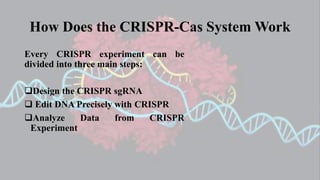
How Does the CRISPR-Cas System Work
Every CRISPR experiment can be
divided into three main steps:
Design the CRISPR sgRNA
 Edit DNA Precisely with CRISPR
Analyze Data from CRISPR
Experiment
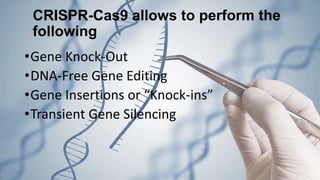
CRISPR-Cas9 allows to perform the
following
•Gene Knock-Out
•DNA-Free Gene Editing
•Gene Insertions or “Knock-ins”
•Transient Gene Silencing
Applications and Future perspectives
Edit crops to be more
nutritious
Tools to stop genetic
diseases
Genome screening
Gene drives
Future perspectives
Pros
• Reverse respectively all the
mutations
• Fast then others
• Utilize in many different
species
• Greater precision
• Excellent ability to target
any genomic region
Cons
•Off target effects like
Secondary unwanted
mutation
• Mosaic effects
• Ethical
•Social effects on the
society
•It Is Not Always
Efficient
The End

CRISPR A Genome Editing Tool

  • 1.
  • 3.
    INTRODUCTION: Clustered Regularly InterspacedShort Palindromic Repeats” New gene editing technology with the potential to revolutionize genetic engineering and the biotechnology industry. Use to understanding, characterizing, and controlling DNA.  Based on bacterial immune system.  Single solution to many problems CRISPR are found in approximately 50% of sequenced bacterial genome and nearly 90% of sequenced Archaea.
  • 4.
    HISTORY:  1987 Researcheryoushizmi Ishano find CRISPR sequence in E.coli but they don’t characterized their functions.  2000 CRISPR sequence were found by moica to be common in other microbes. 2002 Mr. Jansen Coined CRISPR name, defined, signature cas gene. 2007 First experimental evidence for CRISPR adaptive immunity. 2008 Spacer sequences are transcribed into guide RNAs 2010 Discovered that Cas9 can cleaves target DNA 2011 Discovery of tracrRNA for Cas9 system 2011 Discovered that CRISPR systems can function heterologously in other species 2012 Idea of using CRISPR- Cas9 as a genomic engineering tool, was published by Jennifer and Emmanuelle.  2013 First demonstration of Cas9 genome engineering in Eukaryotic cell. 2014 First CRISPR patent was granted to Feng Zheng.
  • 5.
    Components of CRISPR 1.Guide RNA (gRNA) tracrRNA crRNA 2.Protospacer associated Motif (PAM) 3.CRISPR-associated endonuclease protein(Cas enzymes)
  • 7.
    Cas9 Protein • S.pyogenes Cas9 is a large multi-domain and multifunctional DNA endonuclease. It cut dsDNA 3 bp upstream of the PAM through. Its two distinct nuclease domains: 1. An HNH-like nuclease domain that cleaves the DNA strand complementary to the guide RNA sequence (target strand) 2. 2nd is RuvC-like nuclease domain responsible for cleaving the DNA strand opposite the complementary strand (non-target strand). In addition to its critical role in CRISPR interference, Cas9 also participates in crRNA maturation and spacer acquisition.
  • 8.
    Guide RNA Variants •TruncatedGuide RNAs (truRNA) •Ribozyme-gRNA-Ribozyme (RGR) •Polycistronic tRNA-gRNA (PTG/Cas9)
  • 9.
    The Cas9 NucleaseVariants •The Native Cas9 •The Cas9 Nickase •The Inactive dCas9 •Dimeric RNA-Guided FokI Nucleases (RFNs)
  • 10.
    The CRISPR immuneresponse three steps: 1. Adaptation: When DNA from a virus invades the bacteria, the viral DNA is processed into short segments and is made into a new spacer between the repeats. These will serve as genetic memory of previous infections. 2. Production of CRISPR RNA: The CRISPR sequence undergoes transcription, including spacers and Cas genes, creating a single-stranded RNA. The resulting single-stranded RNA is called CRISPR RNA, which contains copies of the invading viral DNA sequence in its spacers. 3. Targeting : The CRISPR RNAs will identify viral DNA and guide the CRISPR- associated proteins to them. The protein then cleaves and destroys the targeted viral material.
  • 11.
  • 12.
    How Does theCRISPR-Cas System Work Every CRISPR experiment can be divided into three main steps: Design the CRISPR sgRNA  Edit DNA Precisely with CRISPR Analyze Data from CRISPR Experiment
  • 14.
    CRISPR-Cas9 allows toperform the following •Gene Knock-Out •DNA-Free Gene Editing •Gene Insertions or “Knock-ins” •Transient Gene Silencing
  • 15.
    Applications and Futureperspectives Edit crops to be more nutritious Tools to stop genetic diseases Genome screening Gene drives Future perspectives
  • 16.
    Pros • Reverse respectivelyall the mutations • Fast then others • Utilize in many different species • Greater precision • Excellent ability to target any genomic region Cons •Off target effects like Secondary unwanted mutation • Mosaic effects • Ethical •Social effects on the society •It Is Not Always Efficient
  • 17.