CRISPR CAS 9 TECHNOLOGY
Definition, Technology, Applications & Limitations
Madiha Asad (0110)
Sameera Jameel (0089)
SoniaAmjad (0099)
CONTENT:
Introduction
History
Mechanism & Technology
Types
Applications
Limitations
Future of CRISPR
INTRODUCTION:
Genome Editing:
Genome editing with site-specific nucleases is a type of genetic engineering
in which DNA is inserted, replaced, or removed from a genome using
artificially engineered nucleases.
Process:
The nucleases create a specific DSBs at desired locations in the genome and
harness the cell’s endogenous mechanism to repair the induced break by
natural processes of HDR and NHEJ.
This allows reverse genetics, genome engineering and targeted transgene
integration experiments to be carried out in an efficient way.
Until 2013, the dominant genome editing tools were:
• ZFNs (Zinc finger nucleases, engineered DNA-binding proteins)
• TALENs (Transcription activator-like effector nucleases, restriction
enzymes).
The Cluster Regularly Interspaced Short Palindromic Repeats
(CRISPR)/CRISPR-associated (Cas) 9 protein system from
Streptococcus pyogenes is the latest ground-breaking technology for
genome editing.
HISTORY OF CRISPR/CAS 9:
1987
• Researches find CRISPR sequences in Escherichia coli, but do not
characterize its functions.
2000 • CRISPR sequence are found to be common in other microbes
2002 • Coined CRISPR name, defined signature Cas genes
2007 • First experimental evidence for CRISPR adaptive immunity
2013
• First demonstration of Cas 9 genome engineering in eukaryotic cell
CRISPR CAS 9:
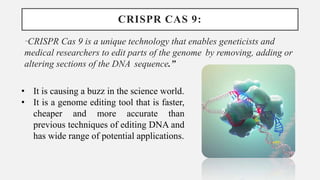
“CRISPR Cas 9 is a unique technology that enables geneticists and
medical researchers to edit parts of the genome by removing, adding or
altering sections of the DNA sequence.”
• It is causing a buzz in the science world.
• It is a genome editing tool that is faster,
cheaper and more accurate than
previous techniques of editing DNA and
has wide range of potential applications.
CRISPR CAS 9 SYSTEM IN BACTERIA
CRISPR/Cas 9 systems are
part of the adaptive immune
system of bacteria and
archaea, protecting them
against invading viruses by
cleaving the foreign DNA in a
sequence-dependent manner.
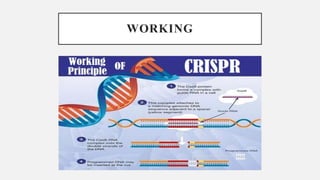
WORKING
CRISPR CAS 9 SYSTEMS ARE THE PART OF
ADAPTIVE IMMUNE SYSTEM OF BACTERIA.
TYPES OF CRISPR CAS 9:
There are three types of CRISPR Cas 9:
• Type I
• Type II
• Type III
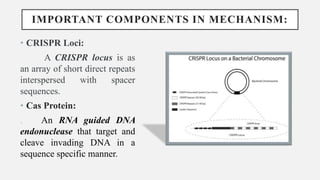
IMPORTANT COMPONENTS IN MECHANISM:
• CRISPR Loci:
A CRISPR locus is as
an array of short direct repeats
interspersed with spacer
sequences.
• Cas Protein:
. An RNA guided DNA
endonuclease that target and
cleave invading DNA in a
sequence specific manner.
MECHANISM:
It consist of three main
steps:
• Spacer acquisition.
• crRNA Processing.
• Interference.
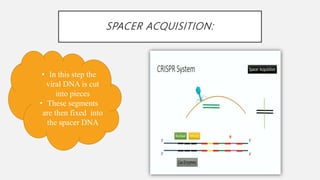
SPACER ACQUISITION:
• In this step the
viral DNA is cut
into pieces
• These segments
are then fixed into
the spacer DNA
crRNA Processing: crRNA Processing in type I:
IN TYPE II: IN TYPE III:
CRRNA PROCESSING:
INTERFERENCE PHASE:
crRNAs which are
formed in the
previous step are
then combine with
cas protein and form
a complex.
INTERFERENCE IN TYPE I AND II:
INTERFERENCE IN TYPE III:
TECHNIQUES:
• Gene knocking expression.
• Genome engineering tool.
• Transporter of enzyme to specific DNA sequence.
• Beyond genome editing .
1. Regulate gene expression.
2. Visualize selective loci in living cell.
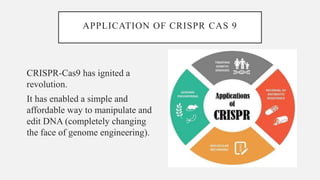
APPLICATION OF CRISPR CAS 9
CRISPR-Cas9 has ignited a
revolution.
It has enabled a simple and
affordable way to manipulate and
edit DNA (completely changing
the face of genome engineering).
Applications
CRISPR in Agriculture
CRISPR in Gene Therapy & Medicine
Live Imaging of DNA/mRNA with CRISPR/Cas9
CRISPR/Cas9-mediated Chromatin
Immunoprecipitation
Epigenetic Editing with CRISPR/Cas9
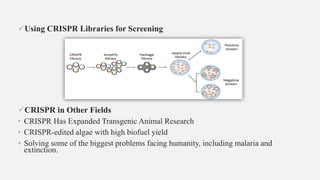
Using CRISPR Libraries for Screening
CRISPR in Other Fields
• CRISPR Has Expanded Transgenic Animal Research
• CRISPR-edited algae with high biofuel yield
• Solving some of the biggest problems facing humanity, including malaria and
extinction.
LIMITATIONS OF THE CRISPR/CAS9 SYSTEM
CRISPR/Cas is an extremely powerful tool, but it has important
limitations. It is:
• Difficult to deliver the CRISPR/Cas material to mature cells in large
numbers, which remains a problem for many clinical applications. Viral
vectors are the most common delivery method.
• Not 100% efficient, so even the cells that take in CRISPR/Cas may not
have genome editing activity.
• Not 100% accurate, and “off-target” edits, while rare, may have severe
consequences, particularly in clinical applications.
ETHICAL ISSUES:
• In addition to editing somatic cells.
• It’s possible to edit the genomes of gametes and early
embryos, called germline editing. Any such edits in humans
would not only affect an individual but also his or her
progeny.
• They could also theoretically be used to enhance desirable
traits instead of curing disease.
• Scientists have therefore called for a moratorium on human
germline editing until the serious ethical and societal
implications are more fully understood.
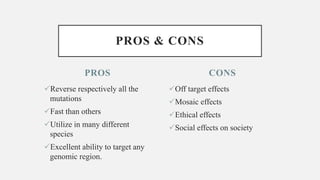
PROS
Reverse respectively all the
mutations
Fast than others
Utilize in many different
species
Excellent ability to target any
genomic region.
Off target effects
Mosaic effects
Ethical effects
Social effects on society
CONS
PROS & CONS
DRAWBACKS, PROBLEMS & SOLUTIONS:
Mosaic problem
• Safety
• Efficiency
In this unwanted gene sequence form during embryonic stage
and causes cancer.
Its solution is adding new CRISPR machinery in the cell and
double stranded DNA.
• Wrong attachment (Double stranded DNA in Solution).
• Ethical Barriers
• Bio-Weapons
CRISPR CAS 9 CURRENT USE:
• The current treatment options merely address symptoms of
sickle cell disease, but CRISPR-Cas9 has demonstrated the
potential to cure the underlying genetic cause of the disease
• Scientists have also used CRISPR to detect specific targets,
such as DNA from cancer-causing viruses and RNA from
cancer cells.
• Most recently, CRISPR has been put to use as an
experimental test to detect the novel coronavirus.
FUTURE ADVANCES:
CRISPR-edited cells could also be used to test new therapies
and discover which work at the molecular level. Researchers
are also now modeling patient cancers more efficiently by
editing specific genes using CRISPR-Cas9 in vitro, providing
large-scale biomass whereby functional and drug studies can
be performed.
CONCLUSION:
 So, CRISPR has its advantages and disadvantages ranging from ethical
concerns.
It is fastest, cheapest and most precise way of editing genes.
By this, the scientists are able to eliminate diseases, reduce
poverty, provide unlimited clean energy but at the same time get
out of hand easily.
CRISPR has potentially given us direct access to source code of
life and at the same time gives a great amount of hope to millions
of people.
CRISPR Cas 9 TECHNOLOGY

CRISPR Cas 9 TECHNOLOGY

  • 1.
    CRISPR CAS 9TECHNOLOGY Definition, Technology, Applications & Limitations Madiha Asad (0110) Sameera Jameel (0089) SoniaAmjad (0099)
  • 2.
  • 3.
    INTRODUCTION: Genome Editing: Genome editingwith site-specific nucleases is a type of genetic engineering in which DNA is inserted, replaced, or removed from a genome using artificially engineered nucleases. Process: The nucleases create a specific DSBs at desired locations in the genome and harness the cell’s endogenous mechanism to repair the induced break by natural processes of HDR and NHEJ. This allows reverse genetics, genome engineering and targeted transgene integration experiments to be carried out in an efficient way.
  • 5.
    Until 2013, thedominant genome editing tools were: • ZFNs (Zinc finger nucleases, engineered DNA-binding proteins) • TALENs (Transcription activator-like effector nucleases, restriction enzymes). The Cluster Regularly Interspaced Short Palindromic Repeats (CRISPR)/CRISPR-associated (Cas) 9 protein system from Streptococcus pyogenes is the latest ground-breaking technology for genome editing.
  • 6.
    HISTORY OF CRISPR/CAS9: 1987 • Researches find CRISPR sequences in Escherichia coli, but do not characterize its functions. 2000 • CRISPR sequence are found to be common in other microbes 2002 • Coined CRISPR name, defined signature Cas genes 2007 • First experimental evidence for CRISPR adaptive immunity 2013 • First demonstration of Cas 9 genome engineering in eukaryotic cell
  • 7.
    CRISPR CAS 9: “CRISPRCas 9 is a unique technology that enables geneticists and medical researchers to edit parts of the genome by removing, adding or altering sections of the DNA sequence.” • It is causing a buzz in the science world. • It is a genome editing tool that is faster, cheaper and more accurate than previous techniques of editing DNA and has wide range of potential applications.
  • 8.
    CRISPR CAS 9SYSTEM IN BACTERIA CRISPR/Cas 9 systems are part of the adaptive immune system of bacteria and archaea, protecting them against invading viruses by cleaving the foreign DNA in a sequence-dependent manner.
  • 9.
  • 10.
    CRISPR CAS 9SYSTEMS ARE THE PART OF ADAPTIVE IMMUNE SYSTEM OF BACTERIA. TYPES OF CRISPR CAS 9: There are three types of CRISPR Cas 9: • Type I • Type II • Type III
  • 11.
    IMPORTANT COMPONENTS INMECHANISM: • CRISPR Loci: A CRISPR locus is as an array of short direct repeats interspersed with spacer sequences. • Cas Protein: . An RNA guided DNA endonuclease that target and cleave invading DNA in a sequence specific manner.
  • 12.
    MECHANISM: It consist ofthree main steps: • Spacer acquisition. • crRNA Processing. • Interference.
  • 13.
    SPACER ACQUISITION: • Inthis step the viral DNA is cut into pieces • These segments are then fixed into the spacer DNA
  • 14.
    crRNA Processing: crRNAProcessing in type I:
  • 15.
    IN TYPE II:IN TYPE III: CRRNA PROCESSING:
  • 16.
    INTERFERENCE PHASE: crRNAs whichare formed in the previous step are then combine with cas protein and form a complex.
  • 17.
  • 18.
  • 19.
    TECHNIQUES: • Gene knockingexpression. • Genome engineering tool. • Transporter of enzyme to specific DNA sequence. • Beyond genome editing . 1. Regulate gene expression. 2. Visualize selective loci in living cell.
  • 20.
    APPLICATION OF CRISPRCAS 9 CRISPR-Cas9 has ignited a revolution. It has enabled a simple and affordable way to manipulate and edit DNA (completely changing the face of genome engineering).
  • 21.
    Applications CRISPR in Agriculture CRISPRin Gene Therapy & Medicine Live Imaging of DNA/mRNA with CRISPR/Cas9 CRISPR/Cas9-mediated Chromatin Immunoprecipitation Epigenetic Editing with CRISPR/Cas9
  • 22.
    Using CRISPR Librariesfor Screening CRISPR in Other Fields • CRISPR Has Expanded Transgenic Animal Research • CRISPR-edited algae with high biofuel yield • Solving some of the biggest problems facing humanity, including malaria and extinction.
  • 23.
    LIMITATIONS OF THECRISPR/CAS9 SYSTEM CRISPR/Cas is an extremely powerful tool, but it has important limitations. It is: • Difficult to deliver the CRISPR/Cas material to mature cells in large numbers, which remains a problem for many clinical applications. Viral vectors are the most common delivery method. • Not 100% efficient, so even the cells that take in CRISPR/Cas may not have genome editing activity. • Not 100% accurate, and “off-target” edits, while rare, may have severe consequences, particularly in clinical applications.
  • 24.
    ETHICAL ISSUES: • Inaddition to editing somatic cells. • It’s possible to edit the genomes of gametes and early embryos, called germline editing. Any such edits in humans would not only affect an individual but also his or her progeny. • They could also theoretically be used to enhance desirable traits instead of curing disease. • Scientists have therefore called for a moratorium on human germline editing until the serious ethical and societal implications are more fully understood.
  • 25.
    PROS Reverse respectively allthe mutations Fast than others Utilize in many different species Excellent ability to target any genomic region. Off target effects Mosaic effects Ethical effects Social effects on society CONS PROS & CONS
  • 26.
    DRAWBACKS, PROBLEMS &SOLUTIONS: Mosaic problem • Safety • Efficiency In this unwanted gene sequence form during embryonic stage and causes cancer. Its solution is adding new CRISPR machinery in the cell and double stranded DNA. • Wrong attachment (Double stranded DNA in Solution). • Ethical Barriers • Bio-Weapons
  • 27.
    CRISPR CAS 9CURRENT USE: • The current treatment options merely address symptoms of sickle cell disease, but CRISPR-Cas9 has demonstrated the potential to cure the underlying genetic cause of the disease • Scientists have also used CRISPR to detect specific targets, such as DNA from cancer-causing viruses and RNA from cancer cells. • Most recently, CRISPR has been put to use as an experimental test to detect the novel coronavirus.
  • 28.
    FUTURE ADVANCES: CRISPR-edited cellscould also be used to test new therapies and discover which work at the molecular level. Researchers are also now modeling patient cancers more efficiently by editing specific genes using CRISPR-Cas9 in vitro, providing large-scale biomass whereby functional and drug studies can be performed.
  • 29.
    CONCLUSION:  So, CRISPRhas its advantages and disadvantages ranging from ethical concerns. It is fastest, cheapest and most precise way of editing genes. By this, the scientists are able to eliminate diseases, reduce poverty, provide unlimited clean energy but at the same time get out of hand easily. CRISPR has potentially given us direct access to source code of life and at the same time gives a great amount of hope to millions of people.