IN THE NAME GOD
 Dr. Abolmaali
 Morteza Miri
Master of Microbial Biotechnology
10 December2016
What is CRISPR-Cas9?
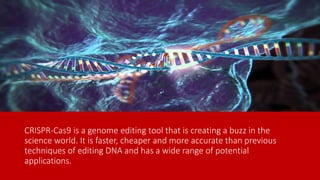
CRISPR-Cas9 is a genome editing tool that is creating a buzz in the
science world. It is faster, cheaper and more accurate than previous
techniques of editing DNA and has a wide range of potential
applications.
CRISPR-Cas9 is a unique technology that enables geneticists
and medical researchers to edit parts of the genome by cutting
out, replacing or adding parts to the DNA sequence.
How does it work?
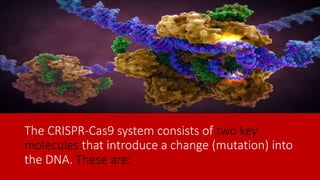
The CRISPR-Cas9 system consists of two key
molecules that introduce a change (mutation) into
the DNA. These are:
Cas9 gRNA
an enzyme called Cas9. This acts as a pair of ‘molecular
scissors’ that can cut the two strands of DNA at a specific
location in the genome so that bits of DNA can then be added
or removed
a piece of RNA called guide RNA (gRNA). This consists of a small piece of pre-
designed RNA sequence (about 20 bases long) located within a longer RNA scaffold.
The scaffold part binds to DNA and the pre-designed sequence ‘guides’ Cas9 to the
right part of the genome. This makes sure that the Cas9 enzyme cuts at the right
point in the genome.
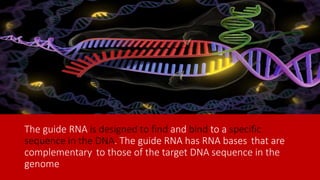
The guide RNA is designed to find and bind to a specific
sequence in the DNA. The guide RNA has RNA bases that are
complementary to those of the target DNA sequence in the
genome
This means that, at least in theory, the guide RNA will only bind
to the target sequence and no other regions of the genome.
The Cas9 follows the guide RNA to the same location in the
DNA sequence and makes a cut across both strands of the
DNA.
Cas9 nuclease
sgRNA
(single guide RNA)
Cas9 complex
14
Gene of Interest
Protospacer
Adjacent Motif
(PAM) Target Sequence
15
Stop Codon
Non-Homologous End
Joining (NHEJ) DNA
repair pathway
16
At this stage the cell recognises that the DNA is damaged and
tries to repair it.
Scientists can use CRISPR-Cas9 to target and mutate one or
more genes in the genome of a cell of interest.
Where do CRISPRs come from?
Some bacteria have a similar, built-in, gene editing system to
the CRISPR-Cas9 system that they use to respond to invading
pathogens like viruses, much like an immune system
Using CRISPR the bacteria snip out parts of the virus DNA and
keep a bit of it behind to help them recognise and defend
against the virus next time it attacks
C
R
I
S
P
R
clustered
regularly
interspaced
short
palindromic
repeats
Phase1: immunization STORAGE
Adaptation
Phase 2: immunity RECOGNITION CUTTING EDITING
CRISPR Processing Interference
Cas9 is the nuclease guided by the crRNA and tracrRNA (or
trans-activating crRNA) to cleave specific DNA sequences
(Deltcheva et al. 2011). A guide RNA (gRNA) can be designed to
include a hairpin that mimics the tracrRNA-crRNA complex
(Jinek et al. 2012). Binding specificity is based on the gRNA and
a three nucleotide NGG sequence called the protospacer
adjacent motif (PAM) sequence (Marraffini and Sontheimer,
2010). For site-specific genome editing, the CRISPR/Cas9
system minimally requires the Cas 9 nuclease and the gRNA.
Cas9, Csn1 = a CRISPR-associated protein containing two
nuclease domains, that is programmed by small RNAs to cleave
DNA
Cas = CRISPR-associated genes
crRNA = CRISPR RNA
gRNA = guide RNA
HDR = Homology-Directed Repair
HNH = an endonuclease domain named for characteristic
histidine and asparagine residues
NHEJ = Non-Homologous End Joining
PAM = Protospacer-Adjacent Motif
RuvC = an endonuclease domain named for an E. coli protein
involved in DNA repair
sgRNA = single guide RNA tracrRNA = trans-activating crRNA
GLOSSARY
Over the years scientists have learned about genetics and gene
function by studying the effects of changes in DNA.
Scientists adapted this system so that it could be used in other
cells from animals, including mice and humans
Why is CRISPR/Cas9 better?
•The system is simple, as it only requires a Cas nuclease and a gRNA
against the target sequence to function as a site-specific
nuclease. Also, despite the bacterial evolutionary origins of the
system, data demonstrates high levels of cutting activity in
mammalian cells, particularly at numerous simultaneous targets, In
addition, the requirement for an NGG sequence makes target design
simple and straightforward in genomic regions where off-targeting is
not an issue. Finally, CRISPR provides researchers a fast and cost-
effective genome editing tool to use for modifying the genomes of
various organisms.
What are the applications?
The CRISPR-Cas9 system
currently stands out as the
fastest, cheapest and most
reliable method for
‘editing’ genes.
What are the implications?
ethical legal
Because any changes made in germline cells will be passed on
from generation to generation it has important ethical
implications.
Carrying out gene editing in germline cells is currently illegal in
the UK and most other countries.
•David Baltimore of the California Institute of Technology read a
statement summarizing the committee's position on the use of gene
editing in humans, which said the following:
1-Basic and preclinical research should proceed. But if human
embryos are edited, they should not be used to establish a
pregnancy.
2-Gene editing of somatic cells, whose DNA is not passed on to the
next generation, falls under existing regulations for gene therapy, an
experimental treatment for genetic diseases that involves transplanting
normal genes into cells with defective ones.
3-It would be "irresponsible" to edit the human germline,
which is passed on to future generations, unless 1) the relevant
safety and efficacy issues have been resolved and 2) there is
"broad societal consensus" about a use of the technology
4-We need an ongoing international forum to discuss potential
medical uses of gene editing, help steer policymakers,
make recommendations and guidelines, and encourage
coordination between countries.
The future of CRISPR/Cas9
How was it developed?
TIMELINE
1987 Yoshizumi Ishino
In 1987, Yoshizumi Ishino at Osaka University was studying the
E. coli gene iap. During their sequencing efforts (remember,
this was 1987), they found this odd 29 nucleotide repeat
sequence with a 32 nucleotide spacing.
The final sentence of the paper:
So far, no sequence homologous to these have been found
elsewhere in procaryote, and the biological significance of
these sequences is not known
Francisco Mojica
identified a series of Short Regularly Spaced Repeats
(SRSRs) that were common among multiple species
Francisco Mojica was the first researcher to
characterize what is now called a CRISPR locus
2002 — Ruud Jansen
found a 21-37 bp repeat and citing the Ishino and
Mojica work, recognized that these interspaced
short sequence repeats have a distinct spacing
which varies by organism
Salmonella typhimurium was 21 bp where as
Streptococcus pyogenes was 37 bp
Alexander Bolotin
Bolotin was studying the bacteria Streptococcus thermophilus
Discoveryof
Cas9 PAM
March, 2006 — Eugene Koonin
Hypothetical scheme of adaptive immunity
abandoning previous
hypothesis that the Cas
proteins might comprise a
novel DNA repair system
Koonin proposed that CRISPR was a defense
mechanism that enabled immunological memory.
bioinformatics searches
2007 — Philippe Horvath2007 — Rodolphe Barrangou
Experimental demonstration of adaptive immunity
wanted to explore how it responds to phage attack Horvath and colleagues showed experimentally that CRISPR
systems are indeed an adaptive immune system
2008 — John van der Oost
Spacer sequences are transcribed into guide RNAs
showed that in E-scherichia coli, spacer sequences, which are
derived from phage, are transcribed into small RNAs
termed CRISPR RNAs
guide Cas proteins to the target DNA
that
2008 — Luciano Marraffini and Erik Sontheimer
CRISPR acts on DNA targets
elegantly demonstrated that the target molecule is DNA, not RNA
2010 — Sylvain Moineau
Cas9 cleaves target DNA
demonstrated that CRISPR-Cas9 creates double-stranded
breaks in target DNA at precise positions
3 nucleotides upstream of the PAM
also confirmed that Cas9 is the only protein
required for cleavage in the CRISPR-Cas9 system
2011 — Emmanuelle Charpentier
Discovery of tracrRNA for Cas9 system
discovered that in addition to the crRNA, a second small
RNA exists, which they called trans-activating CRISPR RNA
(tracrRNA)
showed that tracrRNA forms a duplex with crRNA, and that it is
this duplex that guides Cas9 to its targets
2011 — Virginijus Siksnys
CRISPR systems can function
heterologously in other species
Biochemical characterization of
Cas9-mediated cleavage
cloned the entire CRISPR-Cas locus from
S. thermophilus (a Type II system) and
expressed it in E. coli
where they demonstrated that it was capable of
providing plasmid resistance
This suggested that CRISPR systems are self-contained units
and verified that all of the required components of the Type II
system were known
Jennifer Doudna
Biochemical characterization of Cas9-mediated cleavage
Jennifer Doudna was famous not for CRISPR, but for solving
one of the most challenging crystal structures
she has largely specialized on solving RNA structures
Dr. Doudna was trying to figure out exactly how this happened.
figured out how two pieces of RNA join up with a protein made
by the bacteria called Cas9 to cut DNA at a specific spot
The researchers also found that the two RNA pieces could be
combined into one and still function
CRISPR-Cas9 harnessed for genome editing
was first to successfully adapt CRISPR-Cas9 for genome editing
in eukaryotic cells
They also showed that the system could be programmed to
target multiple genomic loci
Thank you all for your presence

Crispr

  • 1.
  • 2.
     Dr. Abolmaali Morteza Miri Master of Microbial Biotechnology 10 December2016
  • 3.
  • 4.
    CRISPR-Cas9 is agenome editing tool that is creating a buzz in the science world. It is faster, cheaper and more accurate than previous techniques of editing DNA and has a wide range of potential applications.
  • 5.
    CRISPR-Cas9 is aunique technology that enables geneticists and medical researchers to edit parts of the genome by cutting out, replacing or adding parts to the DNA sequence.
  • 6.
  • 7.
    The CRISPR-Cas9 systemconsists of two key molecules that introduce a change (mutation) into the DNA. These are:
  • 8.
  • 9.
    an enzyme calledCas9. This acts as a pair of ‘molecular scissors’ that can cut the two strands of DNA at a specific location in the genome so that bits of DNA can then be added or removed
  • 10.
    a piece ofRNA called guide RNA (gRNA). This consists of a small piece of pre- designed RNA sequence (about 20 bases long) located within a longer RNA scaffold. The scaffold part binds to DNA and the pre-designed sequence ‘guides’ Cas9 to the right part of the genome. This makes sure that the Cas9 enzyme cuts at the right point in the genome.
  • 11.
    The guide RNAis designed to find and bind to a specific sequence in the DNA. The guide RNA has RNA bases that are complementary to those of the target DNA sequence in the genome
  • 12.
    This means that,at least in theory, the guide RNA will only bind to the target sequence and no other regions of the genome.
  • 13.
    The Cas9 followsthe guide RNA to the same location in the DNA sequence and makes a cut across both strands of the DNA.
  • 14.
  • 15.
    Gene of Interest Protospacer AdjacentMotif (PAM) Target Sequence 15
  • 16.
    Stop Codon Non-Homologous End Joining(NHEJ) DNA repair pathway 16
  • 17.
    At this stagethe cell recognises that the DNA is damaged and tries to repair it.
  • 18.
    Scientists can useCRISPR-Cas9 to target and mutate one or more genes in the genome of a cell of interest.
  • 19.
    Where do CRISPRscome from?
  • 20.
    Some bacteria havea similar, built-in, gene editing system to the CRISPR-Cas9 system that they use to respond to invading pathogens like viruses, much like an immune system
  • 21.
    Using CRISPR thebacteria snip out parts of the virus DNA and keep a bit of it behind to help them recognise and defend against the virus next time it attacks
  • 22.
  • 23.
  • 24.
    Phase 2: immunityRECOGNITION CUTTING EDITING CRISPR Processing Interference
  • 26.
    Cas9 is thenuclease guided by the crRNA and tracrRNA (or trans-activating crRNA) to cleave specific DNA sequences (Deltcheva et al. 2011). A guide RNA (gRNA) can be designed to include a hairpin that mimics the tracrRNA-crRNA complex (Jinek et al. 2012). Binding specificity is based on the gRNA and a three nucleotide NGG sequence called the protospacer adjacent motif (PAM) sequence (Marraffini and Sontheimer, 2010). For site-specific genome editing, the CRISPR/Cas9 system minimally requires the Cas 9 nuclease and the gRNA.
  • 27.
    Cas9, Csn1 =a CRISPR-associated protein containing two nuclease domains, that is programmed by small RNAs to cleave DNA Cas = CRISPR-associated genes crRNA = CRISPR RNA gRNA = guide RNA HDR = Homology-Directed Repair HNH = an endonuclease domain named for characteristic histidine and asparagine residues NHEJ = Non-Homologous End Joining PAM = Protospacer-Adjacent Motif RuvC = an endonuclease domain named for an E. coli protein involved in DNA repair sgRNA = single guide RNA tracrRNA = trans-activating crRNA GLOSSARY
  • 28.
    Over the yearsscientists have learned about genetics and gene function by studying the effects of changes in DNA.
  • 29.
    Scientists adapted thissystem so that it could be used in other cells from animals, including mice and humans
  • 30.
  • 31.
    •The system issimple, as it only requires a Cas nuclease and a gRNA against the target sequence to function as a site-specific nuclease. Also, despite the bacterial evolutionary origins of the system, data demonstrates high levels of cutting activity in mammalian cells, particularly at numerous simultaneous targets, In addition, the requirement for an NGG sequence makes target design simple and straightforward in genomic regions where off-targeting is not an issue. Finally, CRISPR provides researchers a fast and cost- effective genome editing tool to use for modifying the genomes of various organisms.
  • 32.
    What are theapplications?
  • 34.
    The CRISPR-Cas9 system currentlystands out as the fastest, cheapest and most reliable method for ‘editing’ genes.
  • 35.
    What are theimplications? ethical legal
  • 36.
    Because any changesmade in germline cells will be passed on from generation to generation it has important ethical implications.
  • 37.
    Carrying out geneediting in germline cells is currently illegal in the UK and most other countries.
  • 38.
    •David Baltimore ofthe California Institute of Technology read a statement summarizing the committee's position on the use of gene editing in humans, which said the following:
  • 39.
    1-Basic and preclinicalresearch should proceed. But if human embryos are edited, they should not be used to establish a pregnancy. 2-Gene editing of somatic cells, whose DNA is not passed on to the next generation, falls under existing regulations for gene therapy, an experimental treatment for genetic diseases that involves transplanting normal genes into cells with defective ones. 3-It would be "irresponsible" to edit the human germline, which is passed on to future generations, unless 1) the relevant safety and efficacy issues have been resolved and 2) there is "broad societal consensus" about a use of the technology 4-We need an ongoing international forum to discuss potential medical uses of gene editing, help steer policymakers, make recommendations and guidelines, and encourage coordination between countries.
  • 40.
    The future ofCRISPR/Cas9
  • 41.
    How was itdeveloped? TIMELINE
  • 42.
  • 43.
    In 1987, YoshizumiIshino at Osaka University was studying the E. coli gene iap. During their sequencing efforts (remember, this was 1987), they found this odd 29 nucleotide repeat sequence with a 32 nucleotide spacing. The final sentence of the paper: So far, no sequence homologous to these have been found elsewhere in procaryote, and the biological significance of these sequences is not known
  • 44.
    Francisco Mojica identified aseries of Short Regularly Spaced Repeats (SRSRs) that were common among multiple species Francisco Mojica was the first researcher to characterize what is now called a CRISPR locus
  • 45.
    2002 — RuudJansen found a 21-37 bp repeat and citing the Ishino and Mojica work, recognized that these interspaced short sequence repeats have a distinct spacing which varies by organism Salmonella typhimurium was 21 bp where as Streptococcus pyogenes was 37 bp
  • 46.
    Alexander Bolotin Bolotin wasstudying the bacteria Streptococcus thermophilus Discoveryof Cas9 PAM
  • 47.
    March, 2006 —Eugene Koonin Hypothetical scheme of adaptive immunity abandoning previous hypothesis that the Cas proteins might comprise a novel DNA repair system Koonin proposed that CRISPR was a defense mechanism that enabled immunological memory. bioinformatics searches
  • 48.
    2007 — PhilippeHorvath2007 — Rodolphe Barrangou Experimental demonstration of adaptive immunity wanted to explore how it responds to phage attack Horvath and colleagues showed experimentally that CRISPR systems are indeed an adaptive immune system
  • 49.
    2008 — Johnvan der Oost Spacer sequences are transcribed into guide RNAs showed that in E-scherichia coli, spacer sequences, which are derived from phage, are transcribed into small RNAs termed CRISPR RNAs guide Cas proteins to the target DNA that
  • 50.
    2008 — LucianoMarraffini and Erik Sontheimer CRISPR acts on DNA targets elegantly demonstrated that the target molecule is DNA, not RNA
  • 51.
    2010 — SylvainMoineau Cas9 cleaves target DNA demonstrated that CRISPR-Cas9 creates double-stranded breaks in target DNA at precise positions 3 nucleotides upstream of the PAM also confirmed that Cas9 is the only protein required for cleavage in the CRISPR-Cas9 system
  • 52.
    2011 — EmmanuelleCharpentier Discovery of tracrRNA for Cas9 system discovered that in addition to the crRNA, a second small RNA exists, which they called trans-activating CRISPR RNA (tracrRNA) showed that tracrRNA forms a duplex with crRNA, and that it is this duplex that guides Cas9 to its targets
  • 53.
    2011 — VirginijusSiksnys CRISPR systems can function heterologously in other species Biochemical characterization of Cas9-mediated cleavage cloned the entire CRISPR-Cas locus from S. thermophilus (a Type II system) and expressed it in E. coli where they demonstrated that it was capable of providing plasmid resistance This suggested that CRISPR systems are self-contained units and verified that all of the required components of the Type II system were known
  • 54.
    Jennifer Doudna Biochemical characterizationof Cas9-mediated cleavage Jennifer Doudna was famous not for CRISPR, but for solving one of the most challenging crystal structures she has largely specialized on solving RNA structures Dr. Doudna was trying to figure out exactly how this happened. figured out how two pieces of RNA join up with a protein made by the bacteria called Cas9 to cut DNA at a specific spot The researchers also found that the two RNA pieces could be combined into one and still function
  • 55.
    CRISPR-Cas9 harnessed forgenome editing was first to successfully adapt CRISPR-Cas9 for genome editing in eukaryotic cells They also showed that the system could be programmed to target multiple genomic loci
  • 56.
    Thank you allfor your presence