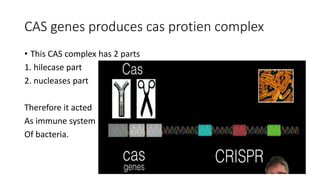
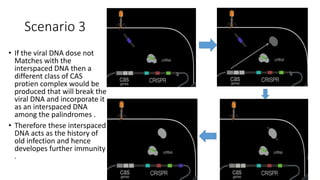
CRISPR-Cas9 is a bacterial defense mechanism that has been adapted for gene editing, allowing scientists to modify genomes with high efficiency and simplicity. It uses a cas protein complex to identify and cut specific DNA sequences, facilitating gene knockouts and the introduction of new genes. While CRISPR-Cas9 offers advantages such as ease of design and the ability to introduce multiple mutations, it also presents challenges like off-site effects and mosaicism in modified organisms.








![crispr-cas9ppt1-180304014050 [Autosaved].pptx](https://cdn.slidesharecdn.com/ss_thumbnails/crispr-cas9ppt1-180304014050autosaved-251206022530-6effc713-thumbnail.jpg?width=640&height=640&fit=bounds)


