Presented by
SUNIL KUMAR PATI
Sambalpur University
CRISPR CAS-9 TECHNOLOGY
CONTENTS
• INTRODUCTION
• CRISPR
• CAS-9
• HOW CRISPR CAS PROTEIN WORKS IN BACTERIA ?
• MECHANISM OF CRISPR CAS9 TECHNOLOGY
• IMPLICATIONS
• APPLICATIONS
INTRODUCTION
• CRISPR/Cas9 is a latest gene
editing tool that can manipulate
gene expression in plants,
humans and animals.
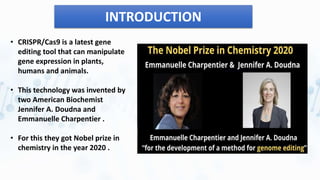
• This technology was invented by
two American Biochemist
Jennifer A. Doudna and
Emmanuelle Charpentier .
• For this they got Nobel prize in
chemistry in the year 2020 .
CRISPR
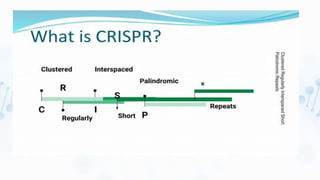
• CRISPR stands for clustered regularly interspaced short palindromic repeats .
• It is a family of DNA sequences in bacteria .
• The sequences contain snippets of DNA from viruses that have attacked the bacterium .
• These snippets are used by the bacterium to detect and destroy DNA from further attacks by similar viruses .
• A palindromic repeat , the sequence of nucleotides is the same in both directions .
• Each repetition is followed by short segment of spacer DNA from previous exposures to foreign DNA ( e.g., a
virus or plasmid ) .
• Small clusters of CAS (CRISPR associated system ) genes are located next to CRISPR sequences .
• The CRISPR /Cas system is a prokaryotic immune system that confers resistance to foreign genetic elements
such as those present within plasmids and phages that provides a form of acquired immunity .
CAS-9
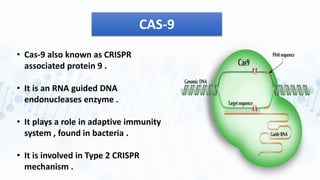
• Cas-9 also known as CRISPR
associated protein 9 .
• It is an RNA guided DNA
endonucleases enzyme .
• It plays a role in adaptive immunity
system , found in bacteria .
• It is involved in Type 2 CRISPR
mechanism .
How Crispr Cas protein works in bacteria ??
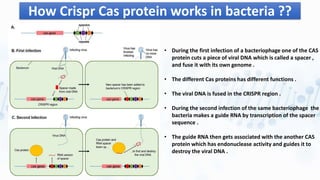
• During the first infection of a bacteriophage one of the CAS
protein cuts a piece of viral DNA which is called a spacer ,
and fuse it with its own genome .
• The different Cas proteins has different functions .
• The viral DNA is fused in the CRISPR region .
• During the second infection of the same bacteriophage the
bacteria makes a guide RNA by transcription of the spacer
sequence .
• The guide RNA then gets associated with the another CAS
protein which has endonuclease activity and guides it to
destroy the viral DNA .
Mechanism of Crispr Cas9 technology .
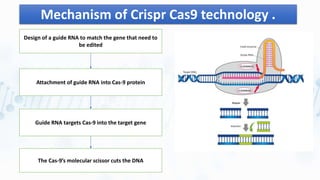
Design of a guide RNA to match the gene that need to
be edited
Attachment of guide RNA into Cas-9 protein
Guide RNA targets Cas-9 into the target gene
The Cas-9’s molecular scissor cuts the DNA
• The mechanism of CRISPR/Cas-9 genome editing can be generally divided into three
steps: recognition, cleavage, and repair.
• The designed sgRNA directs Cas-9 and recognizes the target sequence in the gene of
interest through its 5ʹcrRNA complementary base pair component.
• The Cas-9 nuclease makes double-stranded breaks (DSBs) at a site 3 base pair
upstream to PAM.
• PAM sequence is a short (2–5 base-pair length) conserved DNA sequence
downstream to the cut site and its size varies depending on the bacterial species.
• The most commonly used nuclease in the genome-editing tool, Cas-9 protein
recognizes the PAM sequence at 5ʹ-NGG-3ʹ (N can be any nucleotide base).
• Once Cas-9 has found a target site with the appropriate PAM, it triggers local DNA
melting followed by the formation of RNA-DNA hybrid, but the mechanism of how
Cas-9 enzyme melts target DNA sequence was not clearly understood yet.
• Finally, the DSB is repaired by the host cellular machinery .
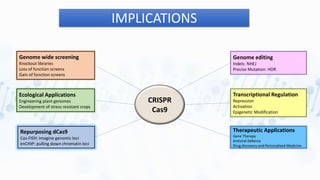
CRISPR
Cas9
Genome editing
Indels: NHEJ
Precise Mutation: HDR
Transcriptional Regulation
Repression
Activation
Epigenetic Modification
Therapeutic Applications
Gene Therapy
Antiviral Défense
Drug discovery and Personalized Medicine
Genome wide screening
Knockout libraries
Loss of function screens
Gain of function screens
Ecological Applications
Engineering plant genomes
Development of stress resistant crops
Repurposing dCas9
Cas-FISH: imagine genomic loci
enCHIP: pulling down chromatin loci
IMPLICATIONS
APPLICATIONS
• Gene silencing
• Producing transgenic animals
• Editing any gene in any plant species
• Editing genetic disease causing genes
• Due to its simplicity , efficiency , and low
cost and the possibility to target genes , it
allows faster genetic modification than
other technique .
CRISPR Cas9 technology.pptx

CRISPR Cas9 technology.pptx

  • 1.
    Presented by SUNIL KUMARPATI Sambalpur University CRISPR CAS-9 TECHNOLOGY
  • 2.
    CONTENTS • INTRODUCTION • CRISPR •CAS-9 • HOW CRISPR CAS PROTEIN WORKS IN BACTERIA ? • MECHANISM OF CRISPR CAS9 TECHNOLOGY • IMPLICATIONS • APPLICATIONS
  • 3.
    INTRODUCTION • CRISPR/Cas9 isa latest gene editing tool that can manipulate gene expression in plants, humans and animals. • This technology was invented by two American Biochemist Jennifer A. Doudna and Emmanuelle Charpentier . • For this they got Nobel prize in chemistry in the year 2020 .
  • 4.
    CRISPR • CRISPR standsfor clustered regularly interspaced short palindromic repeats . • It is a family of DNA sequences in bacteria . • The sequences contain snippets of DNA from viruses that have attacked the bacterium . • These snippets are used by the bacterium to detect and destroy DNA from further attacks by similar viruses . • A palindromic repeat , the sequence of nucleotides is the same in both directions . • Each repetition is followed by short segment of spacer DNA from previous exposures to foreign DNA ( e.g., a virus or plasmid ) . • Small clusters of CAS (CRISPR associated system ) genes are located next to CRISPR sequences . • The CRISPR /Cas system is a prokaryotic immune system that confers resistance to foreign genetic elements such as those present within plasmids and phages that provides a form of acquired immunity .
  • 6.
    CAS-9 • Cas-9 alsoknown as CRISPR associated protein 9 . • It is an RNA guided DNA endonucleases enzyme . • It plays a role in adaptive immunity system , found in bacteria . • It is involved in Type 2 CRISPR mechanism .
  • 7.
    How Crispr Casprotein works in bacteria ?? • During the first infection of a bacteriophage one of the CAS protein cuts a piece of viral DNA which is called a spacer , and fuse it with its own genome . • The different Cas proteins has different functions . • The viral DNA is fused in the CRISPR region . • During the second infection of the same bacteriophage the bacteria makes a guide RNA by transcription of the spacer sequence . • The guide RNA then gets associated with the another CAS protein which has endonuclease activity and guides it to destroy the viral DNA .
  • 8.
    Mechanism of CrisprCas9 technology . Design of a guide RNA to match the gene that need to be edited Attachment of guide RNA into Cas-9 protein Guide RNA targets Cas-9 into the target gene The Cas-9’s molecular scissor cuts the DNA
  • 9.
    • The mechanismof CRISPR/Cas-9 genome editing can be generally divided into three steps: recognition, cleavage, and repair. • The designed sgRNA directs Cas-9 and recognizes the target sequence in the gene of interest through its 5ʹcrRNA complementary base pair component. • The Cas-9 nuclease makes double-stranded breaks (DSBs) at a site 3 base pair upstream to PAM. • PAM sequence is a short (2–5 base-pair length) conserved DNA sequence downstream to the cut site and its size varies depending on the bacterial species. • The most commonly used nuclease in the genome-editing tool, Cas-9 protein recognizes the PAM sequence at 5ʹ-NGG-3ʹ (N can be any nucleotide base). • Once Cas-9 has found a target site with the appropriate PAM, it triggers local DNA melting followed by the formation of RNA-DNA hybrid, but the mechanism of how Cas-9 enzyme melts target DNA sequence was not clearly understood yet. • Finally, the DSB is repaired by the host cellular machinery .
  • 10.
    CRISPR Cas9 Genome editing Indels: NHEJ PreciseMutation: HDR Transcriptional Regulation Repression Activation Epigenetic Modification Therapeutic Applications Gene Therapy Antiviral Défense Drug discovery and Personalized Medicine Genome wide screening Knockout libraries Loss of function screens Gain of function screens Ecological Applications Engineering plant genomes Development of stress resistant crops Repurposing dCas9 Cas-FISH: imagine genomic loci enCHIP: pulling down chromatin loci IMPLICATIONS
  • 11.
    APPLICATIONS • Gene silencing •Producing transgenic animals • Editing any gene in any plant species • Editing genetic disease causing genes • Due to its simplicity , efficiency , and low cost and the possibility to target genes , it allows faster genetic modification than other technique .