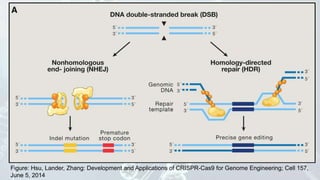
CRISPR-Cas9 is a revolutionary genome editing tool that allows targeted modifications to DNA. It utilizes the Cas9 endonuclease enzyme, which is guided to a specific location in the genome by a short RNA molecule. When the Cas9 enzyme cuts the DNA, it triggers the cell's repair mechanisms which can introduce changes to the genome at that location. CRISPR-Cas9 has significant advantages over previous genome editing techniques in terms of efficiency and ease of use. It holds promise for curing genetic diseases, advancing biomedical research, and improving crops and livestock. Future directions include optimizing delivery methods and enhancing the precision and control of genome alterations.




![Crispr guides the_future_of_genetic_engineering[1]](https://cdn.slidesharecdn.com/ss_thumbnails/crisprguidesthefutureofgeneticengineering1-200412214344-thumbnail.jpg?width=640&height=640&fit=bounds)


