1
.
DEPARTMENT OF MOLECULAR BIOLOGY
THE SCINCE AND TECHNIQUES OF GENOME EDITING USING CRISPR/CAS 9 SYSTEM
MULUKEN BEZABIH
BEZAWIT DOCTER
FERHAN HUSEN
MULUKEN AYCHILUHM
ELIAS BEKELE
HELINA SEYOUM
2
contents
• Introduction
• Components of CRISPR
• CRISPR MECHANISM IN BACTERIA
• Double-Stranded Break Repair Mechanisms
• Applications of CRISPR/CAS-9
• Challenges for CRISPR/Cas-9 Application
3
Introduction
• Genome editing is a type of genetic engineering in which DNA is
deliberately inserted, removed, or modified in living cells.
• The name CRISPR (Clustered Regularly Interspaced Short
Palindromic Repeat) refers to the unique organization of short,
partially repeated DNA sequences found in the genomes of
prokaryotes.
• CRISPR and its associated protein (Cas-9) is a method of adaptive
immunity in prokaryotes to defend themselves against viruses or
bacteriophages.
4
Cont…
 CRISPR first discovered in 1987 by Japanese scientist Ishino in Escherichia coli
while analyzing a gene for alkaline phosphatase .However, they did not ascertain
its biological function.
 Later on in 2007, a CRISPR was experimentally conferred as a key element in
the adaptive immune system of prokaryotes against viruses.
5
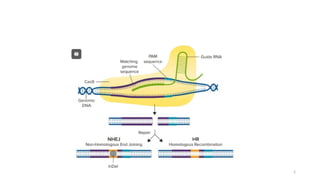
6
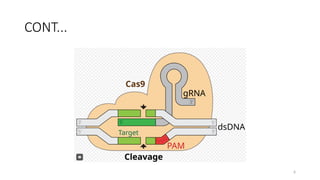
CONT...
7
Components of CRISPR
• crRNA/CRISPR RNA : Guide RNA present in host DNA that bind
with tracerRNA and form hairpin complex.
• tracrRNA : Trans active RNA that bind with crRNA from active
coplex.
• sgRNA : Single guide RNA (crRNA + tracrRNA)
• Cas9:protein/nuclease that can modify DNA
8
 The Cas-9 protein, the first Cas protein used in genome editing was extracted
from Streptococcus pyogenes (SpCas-9).
 It is a large (1368 amino acids) multi-domain DNA endonuclease responsible
for cleaving the target DNA to form a double stranded break and is called a
genetic scissor.
 Cas-9 consists of two regions, called the recognition (REC) lobe and the
nuclease (NUC) lobe.
9
 The REC lobe consists of REC1 and REC2 domains responsible for binding guide
RNA, whereas the NUC lobe is composed of RuvC, HNH, and Protospacer Adjacent
Motif (PAM) interacting domains.
 The crRNA is an 18–20 base pair in length that specifies the target DNA by pairing
with the target sequence,
 whereas tracrRNA is a long stretch of loops that serve as a binding scaffold for Cas-9
nuclease.
10
 In prokaryotes, the guide RNA is used to target viral DNA, but in the gene-
editing tool, it can be synthetically designed by combining crRNA and tracrRNA
to form a single guide RNA (sgRNA) in order to target almost any gene sequence
supposed to be edited.
11
CRISPR MECHANISM IN BACTERIA
• The CRISPR defense mechanism protects bacteria from repeated viral attacks via
three basic stages.
• A . Adaption( spacer acquisition):Acquisition of spacer DNA with the insertion of
viral pieces of viral genome in between CRISPR repeats.
• B . Expression :transcription into mRNA that is complementary to template
tracrRNA bind to CRISPR repeats and crRNA synthesis
.C. Interference : crRNA get integrated with a cas9 protein to form effector
complex. CRISPR repeats take hairpin looped form.
• cas9 induce a double strand cut in the viral DNA
12
Cont …
• It was in 2012 that Doudna, J, and Charpentier, E discovered CRISPR/Cas-9 could
be used to edit any desired DNA by just providing the right template.
• Since then, CRISPR/Cas-9 becomes the most effective, efficient, and accurate
method of genome editing tool in all living cells and utilized in many applied
disciplines.
13
Cont…
 The designed sgRNA directs Cas-9 and recognizes the target sequence in the
gene of interest through its 5 crRNA complementary base pair component.
ʹ
 The Cas-9 protein remains inactive in the absence of sgRNA.
 The Cas-9 nuclease makes double-stranded breaks (DSBs) at a site 3 base pair
upstream to PAM.
 PAM sequence is a short (2–5 base-pair length) conserved DNA sequence
downstream to the cut site and its size varies depending on the bacterial species.
14
Cont…
• The most commonly used nuclease in the genome-editing tool, Cas-9 protein
recognizes the PAM sequence at 5 -NGG-3 (N can be any nucleotide base)
ʹ ʹ
• Once Cas-9 has found a target site with the appropriate PAM, it triggers local
DNA melting followed by the formation of RNA-DNA hybrid,
• but the mechanism of how Cas-9 enzyme melts target DNA sequence was not
clearly understood yet.
15
Cont…
• Then, the Cas-9 protein is activated for DNA cleavage.
• HNH domain cleaves the complementary strand,
• while the RuvC domain cleaves the non-complementary strand of target DNA to
produce predominantly blunt-ended DSBs.
• Finally, the DSB is repaired by the host cellular machinery.
16
Double-Stranded Break Repair Mechanisms
The two mechanisms to repair DSBs created by Cas-9 protein in CRISPR/Cas-9
mechanism are Non-homologous end joining (NHEJ), and homology directed
repair (HDR) pathway.
NHEJ facilitates the repair of DSBs by:
• joining DNA fragments through an enzymatic process in the absence of
exogenous homologous DNA
• And is active in all phases of the cell cycle.
17
Cont…
• It is the predominant and efficient cellular repair mechanism that is
most active in the cells,
• But it is an error-prone mechanism that may result in small random
insertion or deletion (indels) at the cleavage site leading to the
generation of frameshift mutation or premature stop codon.
18
Cont…
HDR is :
• highly precise and requires the use of a homologous DNA template.
• It is most active in the late S and G2 phases of the cell cycle.
• In CRISPR-gene editing, HDR requires a large amount of donor (exogenous)
DNA templates containing a sequence of interest.
• HDR executes the precise gene insertion or replacement by adding a donor DNA
template with sequence homology at the predicted DSB site.
19
Applications of CRISPR/CAS-9
Role in Gene Therapy
•Gene therapy is the process of replacing the defective gene with exogenous DNA
and editing the mutated gene at its native location.
•Since its discovery in 2012, CRISPR/Cas-9 gene editing has held the promise of
curing most of the known genetic diseases such as sickle cell disease, β-thalassemia,
cystic fibrosis, and muscular dystrophy.
20
Cont..
•CRISPR/Cas9 for targeted sickle cell disease (SCD) therapy and
βthalassemia have been also applied in clinical trials.
•Scientists have been also investigating CRISPR/Cas-9 for the treatment
of cystic fibrosis.
•The genetic mutation of the cystic fibrosis transmembrane conductance
regulator (CFTR) gene decreases the structural stability and function of
CFTR protein leading to cystic fibrosis.
21
Therapeutic Role of CRISPR/Cas-9
•The first CRISPR-based therapy in the human trial was conducted to treat patients
with refractory lung cancer.
•Researchers first extract T-cells from three patient’s blood and they engineered
them in the lab through CRISPR/Cas-9 to delete genes (TRAC, TRBC, and PD-1)
that would interfere to fight cancer cells.
• Then, they infused the modified T-cells back into the patients. The modified T-
cells can target specific antigens and kill cancer cells.
22
Cont..
•Finally, no side effects were observed and engineered T-cells can be detected up to
9 months of post infusion.
• CRISPR/Cas-9 gene-editing technology could also be used to treat infectious
diseases caused by microorganisms.
23
• One focus area for the researchers is treating HIV, the virus that leads
to AIDS. In May 2017, a team of researchers from Temple University
demonstrated that HIV-1 replication can be completely shut down and
the virus eliminated from infected cells through excision of HIV-1
genome using CRISPR/Cas-9 in animal models.
•In addition to the approach of targeting the HIVgenome, CRISPR/Cas-
9 technology can also be used to block HIV entry into host cells by
editing chemokine coreceptor type-5 (CCR5) genes in the host cells
24
Role in Agriculture
•As the world population continues to grow, the risk of shortage in agricultural
resources is real.
• Hence, there is a need for new technologies for increasing and improving natural
food production.
•CRISPR/Cas-9 is an existing addition to the field since it has been used to
genetically modify foods to improve their nutritional value, increase their shelf life,
make them drought-tolerant, and enhance disease resistance.
25
Cont..
• There are generally three ways that CRISPR is solving the world’s
food crisis.
1.It can restore food supplies,
2.Help plants to survive in hostile conditions, and
3.Could improve the overall health of the plants.
26
Role in Gene Activation and Silencing
• Beyond genome editing activity, CRISPR/Cas-9 can be used to artificially
regulate (activate or repress) a certain target of a gene through advanced
modification of Cas-9 protein.
• Researchers had performed an advanced modified Cas-9 endonuclease called
dCas-9 nuclease by inactivating its HNH and RuvC domains.
• The dCas-9 nuclease lacks DNA cleavage activity, but its DNA binding activity is
not affected.
27
CONT…
• Then, transcriptional activators or inhibitors can be fused with dCas-9
to form the CRISPR/dCas-9 complex.
• Therefore, catalytically inactive dCas-9 can be used to activate
(CRISPRa) or silence (CRISPRi) the expression of a specific gene of
interest.
28
CONT…
• Moreover, the CRISPR/dCas-9 can be also used to visualize and
pinpoint where specifically the gene of interest is located inside the
cell (subcellular localization) by fusing a marker such as Green
Fluorescent Proteins (GFP) with dCas-9 enzyme.
• This enables site-specific labeling and imaging of endogenous loci in
living cells for further utilization.
29
Challenges for CRISPR/Cas-9 Application
•Despite its great promise as a genome-editing system CRISPR/Cas-9 technology
had hampered by several challenges that should be addressed during the process of
application.
•Immunogenicity, lack of a safe and efficient delivery system to the target, off-
target effect, and ethical issues have been the major barriers to extend the
technology in clinical applications.
30
CONT…
• Since the components of the CRISPR/Cas-9 system are derived from
bacteria, host immunity can elicit an immune response against these
components.
• Researchers also found that there were both pre-existing humoral
(anti-Cas-9 antibody) and cellular (anti-Cas-9 T cells) immune
responses to Cas-9 protein in healthy humans.
• Therefore, how to detect and reduce the immunogenicity of Cas-9
protein is still one of the most important challenges in the clinical trial
of the system.
31
Conclusions
• CRISPR/Cas-9 system in nature is used to protect prokaryotes from invading
viruses by recognizing and degrading exogenous genetic elements.
•CRISPR/Cas-9 gene editing is adopted from acquired immunity in prokaryotes and
consists of two elements: guide RNA used to locate (bind) the target DNA to be
edited and Cas-9, a protein that essentially cuts the DNA at the location identified
by guide RNA.
32
CONT…
•The fundamental part of the CRISPR/Cas-9 gene-editing process is the
identification of the target gene that determines the phenotype of
interest and designing the guide RNA.
•Now it becomes a new era in molecular biology and has countless roles
ranging from basic molecular researches to clinical applications.
33
CONT…
• Although tremendous efforts have been made, there are still some
challenges to rub in the practical applications and various
improvements are needed to overcome obstacles in order to assure its
maximum benefit while minimizing the risk.
34
References
1. Porteus M. Genome editing: a new approach to human therapeutics. Annu Rev
Pharmacol Toxicol. 2016;56:163–190. doi:10.1146/annurevpharmtox-010814-
124454
2. Hille F, Charpentier E. CRISPR-cas: biology, mechanisms, and relevance. Philos
Trans R Soc B Biol Sci. 2016;371(170):54–77. doi:10.1098/rstb.2015.0496
3. The AM. CRISPR tool kit for genome editing and beyond. Nat Commun.
2018;9(1):1911. doi:10.1038/s41467-018-04252-2
4. Liu Z, Dong H, Cui Y, Cong L, Zhang D. Application of different types of
CRISPR/Cas-based systems in bacteria. Microb Cell Fact. 2020;19(1):1–14.
doi:10.1186/s12934-020-01431-z

BFM (7).pptx great documents to reach ideas

  • 1.
    1 . DEPARTMENT OF MOLECULARBIOLOGY THE SCINCE AND TECHNIQUES OF GENOME EDITING USING CRISPR/CAS 9 SYSTEM MULUKEN BEZABIH BEZAWIT DOCTER FERHAN HUSEN MULUKEN AYCHILUHM ELIAS BEKELE HELINA SEYOUM
  • 2.
    2 contents • Introduction • Componentsof CRISPR • CRISPR MECHANISM IN BACTERIA • Double-Stranded Break Repair Mechanisms • Applications of CRISPR/CAS-9 • Challenges for CRISPR/Cas-9 Application
  • 3.
    3 Introduction • Genome editingis a type of genetic engineering in which DNA is deliberately inserted, removed, or modified in living cells. • The name CRISPR (Clustered Regularly Interspaced Short Palindromic Repeat) refers to the unique organization of short, partially repeated DNA sequences found in the genomes of prokaryotes. • CRISPR and its associated protein (Cas-9) is a method of adaptive immunity in prokaryotes to defend themselves against viruses or bacteriophages.
  • 4.
    4 Cont…  CRISPR firstdiscovered in 1987 by Japanese scientist Ishino in Escherichia coli while analyzing a gene for alkaline phosphatase .However, they did not ascertain its biological function.  Later on in 2007, a CRISPR was experimentally conferred as a key element in the adaptive immune system of prokaryotes against viruses.
  • 5.
  • 6.
  • 7.
    7 Components of CRISPR •crRNA/CRISPR RNA : Guide RNA present in host DNA that bind with tracerRNA and form hairpin complex. • tracrRNA : Trans active RNA that bind with crRNA from active coplex. • sgRNA : Single guide RNA (crRNA + tracrRNA) • Cas9:protein/nuclease that can modify DNA
  • 8.
    8  The Cas-9protein, the first Cas protein used in genome editing was extracted from Streptococcus pyogenes (SpCas-9).  It is a large (1368 amino acids) multi-domain DNA endonuclease responsible for cleaving the target DNA to form a double stranded break and is called a genetic scissor.  Cas-9 consists of two regions, called the recognition (REC) lobe and the nuclease (NUC) lobe.
  • 9.
    9  The REClobe consists of REC1 and REC2 domains responsible for binding guide RNA, whereas the NUC lobe is composed of RuvC, HNH, and Protospacer Adjacent Motif (PAM) interacting domains.  The crRNA is an 18–20 base pair in length that specifies the target DNA by pairing with the target sequence,  whereas tracrRNA is a long stretch of loops that serve as a binding scaffold for Cas-9 nuclease.
  • 10.
    10  In prokaryotes,the guide RNA is used to target viral DNA, but in the gene- editing tool, it can be synthetically designed by combining crRNA and tracrRNA to form a single guide RNA (sgRNA) in order to target almost any gene sequence supposed to be edited.
  • 11.
    11 CRISPR MECHANISM INBACTERIA • The CRISPR defense mechanism protects bacteria from repeated viral attacks via three basic stages. • A . Adaption( spacer acquisition):Acquisition of spacer DNA with the insertion of viral pieces of viral genome in between CRISPR repeats. • B . Expression :transcription into mRNA that is complementary to template tracrRNA bind to CRISPR repeats and crRNA synthesis .C. Interference : crRNA get integrated with a cas9 protein to form effector complex. CRISPR repeats take hairpin looped form. • cas9 induce a double strand cut in the viral DNA
  • 12.
    12 Cont … • Itwas in 2012 that Doudna, J, and Charpentier, E discovered CRISPR/Cas-9 could be used to edit any desired DNA by just providing the right template. • Since then, CRISPR/Cas-9 becomes the most effective, efficient, and accurate method of genome editing tool in all living cells and utilized in many applied disciplines.
  • 13.
    13 Cont…  The designedsgRNA directs Cas-9 and recognizes the target sequence in the gene of interest through its 5 crRNA complementary base pair component. ʹ  The Cas-9 protein remains inactive in the absence of sgRNA.  The Cas-9 nuclease makes double-stranded breaks (DSBs) at a site 3 base pair upstream to PAM.  PAM sequence is a short (2–5 base-pair length) conserved DNA sequence downstream to the cut site and its size varies depending on the bacterial species.
  • 14.
    14 Cont… • The mostcommonly used nuclease in the genome-editing tool, Cas-9 protein recognizes the PAM sequence at 5 -NGG-3 (N can be any nucleotide base) ʹ ʹ • Once Cas-9 has found a target site with the appropriate PAM, it triggers local DNA melting followed by the formation of RNA-DNA hybrid, • but the mechanism of how Cas-9 enzyme melts target DNA sequence was not clearly understood yet.
  • 15.
    15 Cont… • Then, theCas-9 protein is activated for DNA cleavage. • HNH domain cleaves the complementary strand, • while the RuvC domain cleaves the non-complementary strand of target DNA to produce predominantly blunt-ended DSBs. • Finally, the DSB is repaired by the host cellular machinery.
  • 16.
    16 Double-Stranded Break RepairMechanisms The two mechanisms to repair DSBs created by Cas-9 protein in CRISPR/Cas-9 mechanism are Non-homologous end joining (NHEJ), and homology directed repair (HDR) pathway. NHEJ facilitates the repair of DSBs by: • joining DNA fragments through an enzymatic process in the absence of exogenous homologous DNA • And is active in all phases of the cell cycle.
  • 17.
    17 Cont… • It isthe predominant and efficient cellular repair mechanism that is most active in the cells, • But it is an error-prone mechanism that may result in small random insertion or deletion (indels) at the cleavage site leading to the generation of frameshift mutation or premature stop codon.
  • 18.
    18 Cont… HDR is : •highly precise and requires the use of a homologous DNA template. • It is most active in the late S and G2 phases of the cell cycle. • In CRISPR-gene editing, HDR requires a large amount of donor (exogenous) DNA templates containing a sequence of interest. • HDR executes the precise gene insertion or replacement by adding a donor DNA template with sequence homology at the predicted DSB site.
  • 19.
    19 Applications of CRISPR/CAS-9 Rolein Gene Therapy •Gene therapy is the process of replacing the defective gene with exogenous DNA and editing the mutated gene at its native location. •Since its discovery in 2012, CRISPR/Cas-9 gene editing has held the promise of curing most of the known genetic diseases such as sickle cell disease, β-thalassemia, cystic fibrosis, and muscular dystrophy.
  • 20.
    20 Cont.. •CRISPR/Cas9 for targetedsickle cell disease (SCD) therapy and βthalassemia have been also applied in clinical trials. •Scientists have been also investigating CRISPR/Cas-9 for the treatment of cystic fibrosis. •The genetic mutation of the cystic fibrosis transmembrane conductance regulator (CFTR) gene decreases the structural stability and function of CFTR protein leading to cystic fibrosis.
  • 21.
    21 Therapeutic Role ofCRISPR/Cas-9 •The first CRISPR-based therapy in the human trial was conducted to treat patients with refractory lung cancer. •Researchers first extract T-cells from three patient’s blood and they engineered them in the lab through CRISPR/Cas-9 to delete genes (TRAC, TRBC, and PD-1) that would interfere to fight cancer cells. • Then, they infused the modified T-cells back into the patients. The modified T- cells can target specific antigens and kill cancer cells.
  • 22.
    22 Cont.. •Finally, no sideeffects were observed and engineered T-cells can be detected up to 9 months of post infusion. • CRISPR/Cas-9 gene-editing technology could also be used to treat infectious diseases caused by microorganisms.
  • 23.
    23 • One focusarea for the researchers is treating HIV, the virus that leads to AIDS. In May 2017, a team of researchers from Temple University demonstrated that HIV-1 replication can be completely shut down and the virus eliminated from infected cells through excision of HIV-1 genome using CRISPR/Cas-9 in animal models. •In addition to the approach of targeting the HIVgenome, CRISPR/Cas- 9 technology can also be used to block HIV entry into host cells by editing chemokine coreceptor type-5 (CCR5) genes in the host cells
  • 24.
    24 Role in Agriculture •Asthe world population continues to grow, the risk of shortage in agricultural resources is real. • Hence, there is a need for new technologies for increasing and improving natural food production. •CRISPR/Cas-9 is an existing addition to the field since it has been used to genetically modify foods to improve their nutritional value, increase their shelf life, make them drought-tolerant, and enhance disease resistance.
  • 25.
    25 Cont.. • There aregenerally three ways that CRISPR is solving the world’s food crisis. 1.It can restore food supplies, 2.Help plants to survive in hostile conditions, and 3.Could improve the overall health of the plants.
  • 26.
    26 Role in GeneActivation and Silencing • Beyond genome editing activity, CRISPR/Cas-9 can be used to artificially regulate (activate or repress) a certain target of a gene through advanced modification of Cas-9 protein. • Researchers had performed an advanced modified Cas-9 endonuclease called dCas-9 nuclease by inactivating its HNH and RuvC domains. • The dCas-9 nuclease lacks DNA cleavage activity, but its DNA binding activity is not affected.
  • 27.
    27 CONT… • Then, transcriptionalactivators or inhibitors can be fused with dCas-9 to form the CRISPR/dCas-9 complex. • Therefore, catalytically inactive dCas-9 can be used to activate (CRISPRa) or silence (CRISPRi) the expression of a specific gene of interest.
  • 28.
    28 CONT… • Moreover, theCRISPR/dCas-9 can be also used to visualize and pinpoint where specifically the gene of interest is located inside the cell (subcellular localization) by fusing a marker such as Green Fluorescent Proteins (GFP) with dCas-9 enzyme. • This enables site-specific labeling and imaging of endogenous loci in living cells for further utilization.
  • 29.
    29 Challenges for CRISPR/Cas-9Application •Despite its great promise as a genome-editing system CRISPR/Cas-9 technology had hampered by several challenges that should be addressed during the process of application. •Immunogenicity, lack of a safe and efficient delivery system to the target, off- target effect, and ethical issues have been the major barriers to extend the technology in clinical applications.
  • 30.
    30 CONT… • Since thecomponents of the CRISPR/Cas-9 system are derived from bacteria, host immunity can elicit an immune response against these components. • Researchers also found that there were both pre-existing humoral (anti-Cas-9 antibody) and cellular (anti-Cas-9 T cells) immune responses to Cas-9 protein in healthy humans. • Therefore, how to detect and reduce the immunogenicity of Cas-9 protein is still one of the most important challenges in the clinical trial of the system.
  • 31.
    31 Conclusions • CRISPR/Cas-9 systemin nature is used to protect prokaryotes from invading viruses by recognizing and degrading exogenous genetic elements. •CRISPR/Cas-9 gene editing is adopted from acquired immunity in prokaryotes and consists of two elements: guide RNA used to locate (bind) the target DNA to be edited and Cas-9, a protein that essentially cuts the DNA at the location identified by guide RNA.
  • 32.
    32 CONT… •The fundamental partof the CRISPR/Cas-9 gene-editing process is the identification of the target gene that determines the phenotype of interest and designing the guide RNA. •Now it becomes a new era in molecular biology and has countless roles ranging from basic molecular researches to clinical applications.
  • 33.
    33 CONT… • Although tremendousefforts have been made, there are still some challenges to rub in the practical applications and various improvements are needed to overcome obstacles in order to assure its maximum benefit while minimizing the risk.
  • 34.
    34 References 1. Porteus M.Genome editing: a new approach to human therapeutics. Annu Rev Pharmacol Toxicol. 2016;56:163–190. doi:10.1146/annurevpharmtox-010814- 124454 2. Hille F, Charpentier E. CRISPR-cas: biology, mechanisms, and relevance. Philos Trans R Soc B Biol Sci. 2016;371(170):54–77. doi:10.1098/rstb.2015.0496 3. The AM. CRISPR tool kit for genome editing and beyond. Nat Commun. 2018;9(1):1911. doi:10.1038/s41467-018-04252-2 4. Liu Z, Dong H, Cui Y, Cong L, Zhang D. Application of different types of CRISPR/Cas-based systems in bacteria. Microb Cell Fact. 2020;19(1):1–14. doi:10.1186/s12934-020-01431-z