Creative Problem Solving
Module One:
Getting Started
In the past few decades,
psychologists and business people
alike have discovered that successful
problem solvers tend to use the same
type of process to identify and
implement the solutions to their
problems. This process works for any
kind of problem, large or small.
No problem
can withstand
the assault
of sustained
thinking.
Voltaire
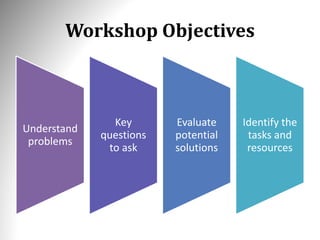
Workshop Objectives
Understand
problems
Key
questions
to ask
Evaluate
potential
solutions
Identify the
tasks and
resources
Module Two: The
Problem Solving Method
To begin, let’s look at the creative
problem solving process. In this
module, we will define “problem”
and other situations that lend
themselves to the creative problem
solving process. We will introduce
the concept of solving problems
using a creative process.
Every problem
has in it the
seeds of its own
solution. If you
don’t have any
problems, you
don’t get any
seeds.
Norman
Vincent Peale
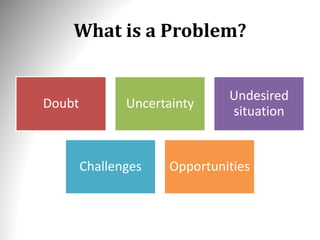
What is a Problem?
Doubt Uncertainty
Undesired
situation
Challenges Opportunities
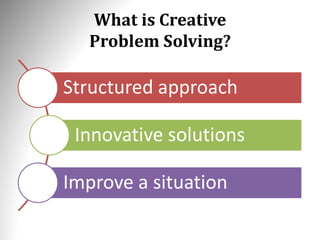
What is Creative
Problem Solving?
Structured approach
Innovative solutions
Improve a situation
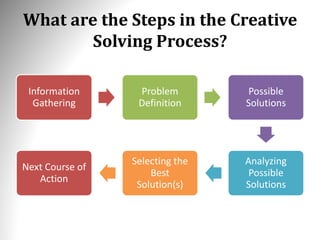
What are the Steps in the Creative
Solving Process?
Information
Gathering
Problem
Definition
Possible
Solutions
Analyzing
Possible
Solutions
Selecting the
Best
Solution(s)
Next Course of
Action
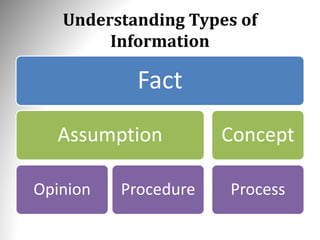
Understanding Types of
Information
Fact
Assumption
Opinion Procedure
Concept
Process
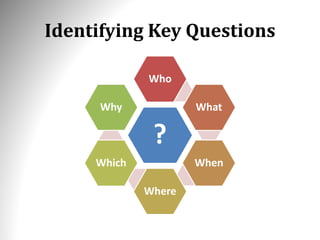
Identifying Key Questions
?
Who
What
When
Where
Which
Why
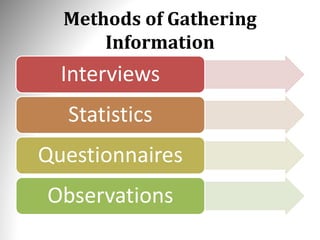
Methods of Gathering
Information
Interviews
Statistics
Questionnaires
Observations
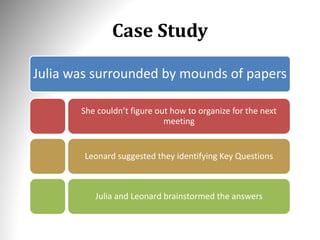
Case Study
Julia was surrounded by mounds of papers
She couldn’t figure out how to organize for the next
meeting
Leonard suggested they identifying Key Questions
Julia and Leonard brainstormed the answers
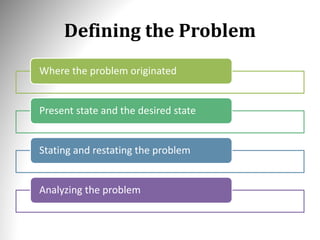
Defining the Problem
Where the problem originated
Present state and the desired state
Stating and restating the problem
Analyzing the problem
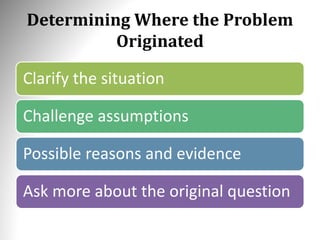
Determining Where the Problem
Originated
Clarify the situation
Challenge assumptions
Possible reasons and evidence
Ask more about the original question
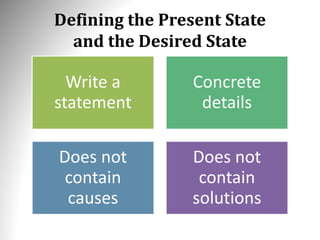
Defining the Present State
and the Desired State
Write a
statement
Concrete
details
Does not
contain
causes
Does not
contain
solutions
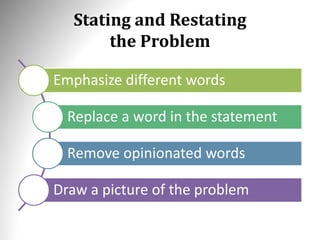
Stating and Restating
the Problem
Emphasize different words
Replace a word in the statement
Remove opinionated words
Draw a picture of the problem
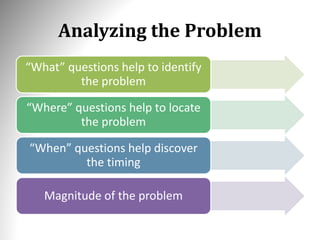
Analyzing the Problem
“What” questions help to identify
the problem
“Where” questions help to locate
the problem
“When” questions help discover
the timing
Magnitude of the problem
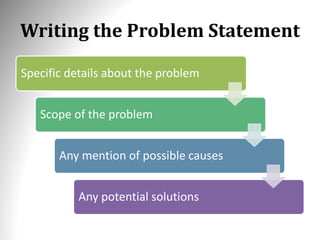
Writing the Problem Statement
Specific details about the problem
Scope of the problem
Any mention of possible causes
Any potential solutions
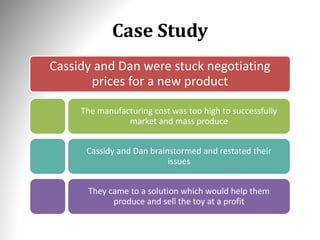
Case Study
Cassidy and Dan were stuck negotiating
prices for a new product
The manufacturing cost was too high to successfully
market and mass produce
Cassidy and Dan brainstormed and restated their
issues
They came to a solution which would help them
produce and sell the toy at a profit
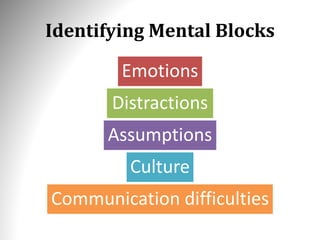
Identifying Mental Blocks
Emotions
Distractions
Assumptions
Culture
Communication difficulties
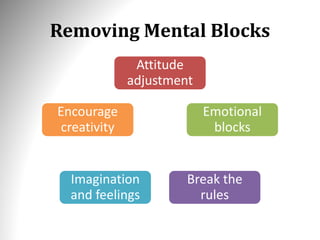
Removing Mental Blocks
Attitude
adjustment
Emotional
blocks
Break the
rules
Imagination
and feelings
Encourage
creativity
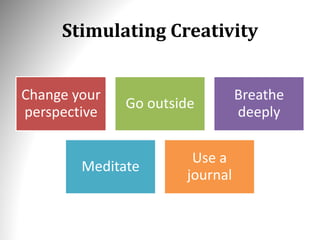
Stimulating Creativity
Change your
perspective
Go outside
Breathe
deeply
Meditate
Use a
journal
Case Study
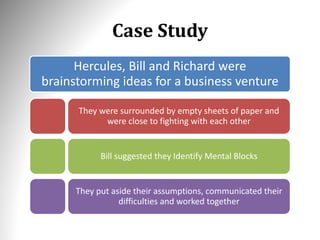
Hercules, Bill and Richard were
brainstorming ideas for a business venture
They were surrounded by empty sheets of paper and
were close to fighting with each other
Bill suggested they Identify Mental Blocks
They put aside their assumptions, communicated their
difficulties and worked together
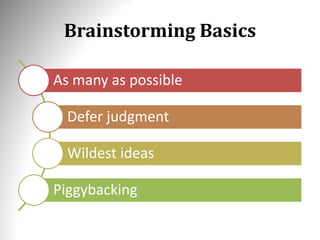
Brainstorming Basics
As many as possible
Defer judgment
Wildest ideas
Piggybacking
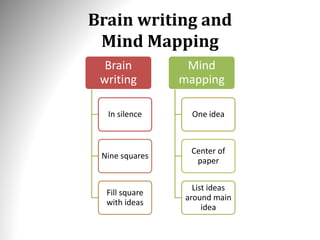
Brain writing and
Mind Mapping
Brain
writing
In silence
Nine squares
Fill square
with ideas
Mind
mapping
One idea
Center of
paper
List ideas
around main
idea
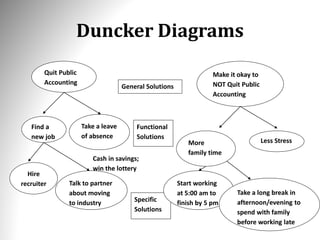
Duncker Diagrams
Quit Public
Accounting
Make it okay to
NOT Quit Public
Accounting
General Solutions
Find a
new job
Take a leave
of absence
More
family time
Less Stress
Functional
Solutions
Hire
recruiter
Specific
Solutions
Start working
at 5:00 am to
finish by 5 pm
Cash in savings;
win the lottery
Talk to partner
about moving
to industry
Take a long break in
afternoon/evening to
spend with family
before working late
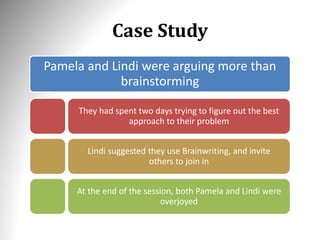
Case Study
Pamela and Lindi were arguing more than
brainstorming
They had spent two days trying to figure out the best
approach to their problem
Lindi suggested they use Brainwriting, and invite
others to join in
At the end of the session, both Pamela and Lindi were
overjoyed
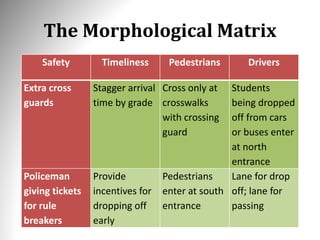
The Morphological Matrix
Safety Timeliness Pedestrians Drivers
Extra cross
guards
Stagger arrival
time by grade
Cross only at
crosswalks
with crossing
guard
Students
being dropped
off from cars
or buses enter
at north
entrance
Policeman
giving tickets
for rule
breakers
Provide
incentives for
dropping off
early
Pedestrians
enter at south
entrance
Lane for drop
off; lane for
passing
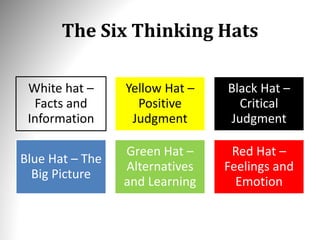
The Six Thinking Hats
White hat –
Facts and
Information
Yellow Hat –
Positive
Judgment
Black Hat –
Critical
Judgment
Blue Hat – The
Big Picture
Green Hat –
Alternatives
and Learning
Red Hat –
Feelings and
Emotion
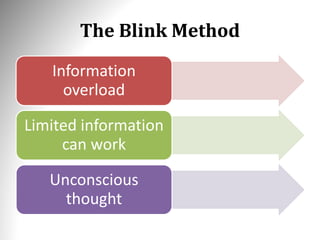
The Blink Method
Information
overload
Limited information
can work
Unconscious
thought
Case Study
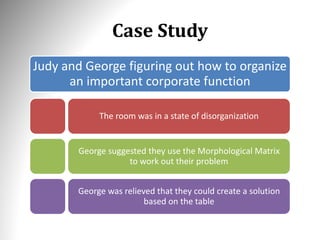
Judy and George figuring out how to organize
an important corporate function
The room was in a state of disorganization
George suggested they use the Morphological Matrix
to work out their problem
George was relieved that they could create a solution
based on the table
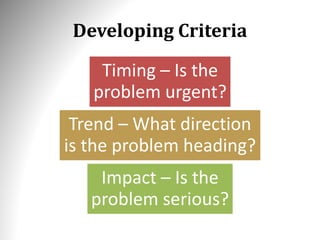
Developing Criteria
Timing – Is the
problem urgent?
Trend – What direction
is the problem heading?
Impact – Is the
problem serious?
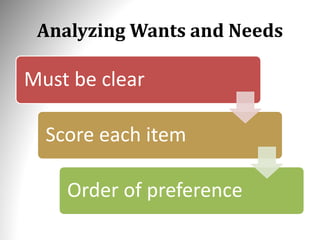
Analyzing Wants and Needs
Must be clear
Score each item
Order of preference
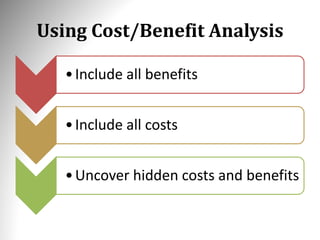
Using Cost/Benefit Analysis
•Include all benefits
•Include all costs
•Uncover hidden costs and benefits
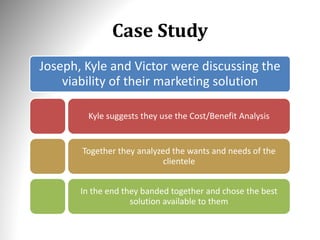
Case Study
Joseph, Kyle and Victor were discussing the
viability of their marketing solution
Kyle suggests they use the Cost/Benefit Analysis
Together they analyzed the wants and needs of the
clientele
In the end they banded together and chose the best
solution available to them
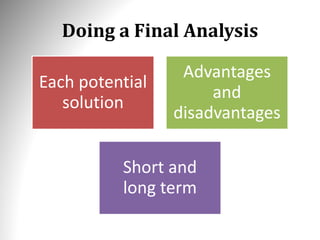
Doing a Final Analysis
Each potential
solution
Advantages
and
disadvantages
Short and
long term
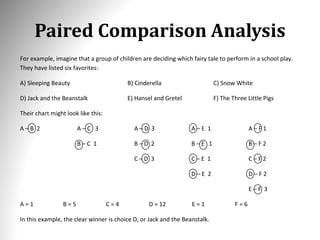
Paired Comparison Analysis
For example, imagine that a group of children are deciding which fairy tale to perform in a school play.
They have listed six favorites:
A) Sleeping Beauty B) Cinderella C) Snow White
D) Jack and the Beanstalk E) Hansel and Gretel F) The Three Little Pigs
Their chart might look like this:
A – B 2 A – C 3
B – C 1
A – D 3
B – D 2
C – D 3
A – E 1
B – E 1
C – E 1
D – E 2
A – F 1
B – F 2
C – F 2
D – F 2
E – F 3
A = 1 B = 5 C = 4 D = 12 E = 1 F = 6
In this example, the clear winner is choice D, or Jack and the Beanstalk.
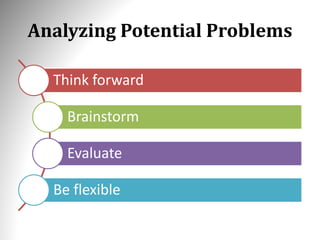
Analyzing Potential Problems
Think forward
Brainstorm
Evaluate
Be flexible
Case Study
Gregory and Henry were working over solutions
to prevent loss of cash flow in their small business
They were frustrated by their inability to choose the
best solution
Henry suggested they use the Paired Comparison
Analysis
They found the best solution to save their business
money, using a final analysis
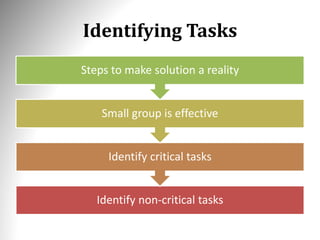
Identifying Tasks
Identify non-critical tasks
Identify critical tasks
Small group is effective
Steps to make solution a reality
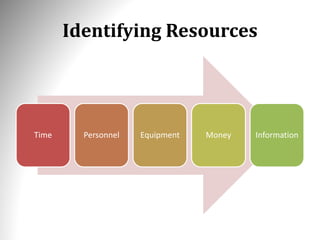
Identifying Resources
Time Personnel Equipment Money Information
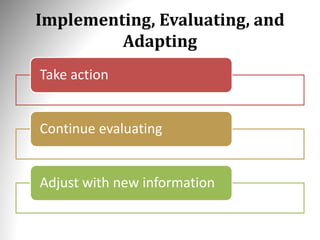
Implementing, Evaluating, and
Adapting
Take action
Continue evaluating
Adjust with new information
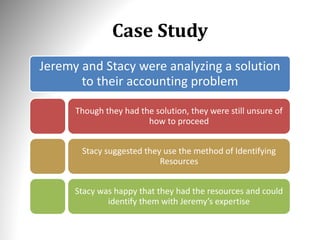
Case Study
Jeremy and Stacy were analyzing a solution
to their accounting problem
Though they had the solution, they were still unsure of
how to proceed
Stacy suggested they use the method of Identifying
Resources
Stacy was happy that they had the resources and could
identify them with Jeremy’s expertise
Planning the
Follow-Up Meeting
Have an
agenda
Invite all key
members
Meeting
arrangements
Location and
time
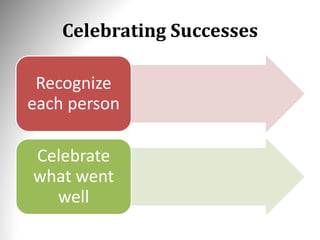
Celebrating Successes
Recognize
each person
Celebrate
what went
well
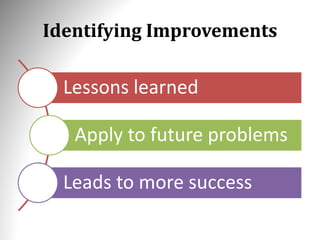
Identifying Improvements
Lessons learned
Apply to future problems
Leads to more success
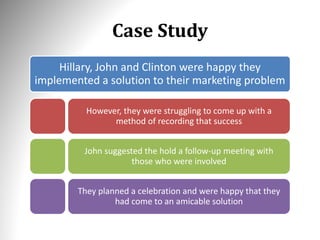
Case Study
Hillary, John and Clinton were happy they
implemented a solution to their marketing problem
However, they were struggling to come up with a
method of recording that success
John suggested the hold a follow-up meeting with
those who were involved
They planned a celebration and were happy that they
had come to an amicable solution
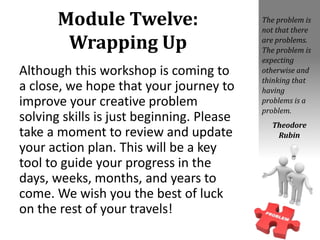
Module Twelve:
Wrapping Up
Although this workshop is coming to
a close, we hope that your journey to
improve your creative problem
solving skills is just beginning. Please
take a moment to review and update
your action plan. This will be a key
tool to guide your progress in the
days, weeks, months, and years to
come. We wish you the best of luck
on the rest of your travels!
The problem is
not that there
are problems.
The problem is
expecting
otherwise and
thinking that
having
problems is a
problem.
Theodore
Rubin
Words from the Wise
John Foster
Dulles
• The measure of success is not
whether you have a tough problem to
deal with, but whether it is the same
problem you had last year.
Henri Kaiser
• Problems are only opportunities in
work clothes.
Albert
Einstein
• The significant problems we face
cannot be solved at the same level of
thinking we were at when we created
them.

Creative problem solving

  • 1.
  • 2.
    Module One: Getting Started Inthe past few decades, psychologists and business people alike have discovered that successful problem solvers tend to use the same type of process to identify and implement the solutions to their problems. This process works for any kind of problem, large or small. No problem can withstand the assault of sustained thinking. Voltaire
  • 3.
  • 4.
    Module Two: The ProblemSolving Method To begin, let’s look at the creative problem solving process. In this module, we will define “problem” and other situations that lend themselves to the creative problem solving process. We will introduce the concept of solving problems using a creative process. Every problem has in it the seeds of its own solution. If you don’t have any problems, you don’t get any seeds. Norman Vincent Peale
  • 5.
    What is aProblem? Doubt Uncertainty Undesired situation Challenges Opportunities
  • 6.
    What is Creative ProblemSolving? Structured approach Innovative solutions Improve a situation
  • 7.
    What are theSteps in the Creative Solving Process? Information Gathering Problem Definition Possible Solutions Analyzing Possible Solutions Selecting the Best Solution(s) Next Course of Action
  • 8.
  • 9.
  • 10.
  • 11.
    Case Study Julia wassurrounded by mounds of papers She couldn’t figure out how to organize for the next meeting Leonard suggested they identifying Key Questions Julia and Leonard brainstormed the answers
  • 12.
    Defining the Problem Wherethe problem originated Present state and the desired state Stating and restating the problem Analyzing the problem
  • 13.
    Determining Where theProblem Originated Clarify the situation Challenge assumptions Possible reasons and evidence Ask more about the original question
  • 14.
    Defining the PresentState and the Desired State Write a statement Concrete details Does not contain causes Does not contain solutions
  • 15.
    Stating and Restating theProblem Emphasize different words Replace a word in the statement Remove opinionated words Draw a picture of the problem
  • 16.
    Analyzing the Problem “What”questions help to identify the problem “Where” questions help to locate the problem “When” questions help discover the timing Magnitude of the problem
  • 17.
    Writing the ProblemStatement Specific details about the problem Scope of the problem Any mention of possible causes Any potential solutions
  • 18.
    Case Study Cassidy andDan were stuck negotiating prices for a new product The manufacturing cost was too high to successfully market and mass produce Cassidy and Dan brainstormed and restated their issues They came to a solution which would help them produce and sell the toy at a profit
  • 19.
  • 20.
    Removing Mental Blocks Attitude adjustment Emotional blocks Breakthe rules Imagination and feelings Encourage creativity
  • 21.
    Stimulating Creativity Change your perspective Gooutside Breathe deeply Meditate Use a journal
  • 22.
    Case Study Hercules, Billand Richard were brainstorming ideas for a business venture They were surrounded by empty sheets of paper and were close to fighting with each other Bill suggested they Identify Mental Blocks They put aside their assumptions, communicated their difficulties and worked together
  • 23.
    Brainstorming Basics As manyas possible Defer judgment Wildest ideas Piggybacking
  • 24.
    Brain writing and MindMapping Brain writing In silence Nine squares Fill square with ideas Mind mapping One idea Center of paper List ideas around main idea
  • 25.
    Duncker Diagrams Quit Public Accounting Makeit okay to NOT Quit Public Accounting General Solutions Find a new job Take a leave of absence More family time Less Stress Functional Solutions Hire recruiter Specific Solutions Start working at 5:00 am to finish by 5 pm Cash in savings; win the lottery Talk to partner about moving to industry Take a long break in afternoon/evening to spend with family before working late
  • 26.
    Case Study Pamela andLindi were arguing more than brainstorming They had spent two days trying to figure out the best approach to their problem Lindi suggested they use Brainwriting, and invite others to join in At the end of the session, both Pamela and Lindi were overjoyed
  • 27.
    The Morphological Matrix SafetyTimeliness Pedestrians Drivers Extra cross guards Stagger arrival time by grade Cross only at crosswalks with crossing guard Students being dropped off from cars or buses enter at north entrance Policeman giving tickets for rule breakers Provide incentives for dropping off early Pedestrians enter at south entrance Lane for drop off; lane for passing
  • 28.
    The Six ThinkingHats White hat – Facts and Information Yellow Hat – Positive Judgment Black Hat – Critical Judgment Blue Hat – The Big Picture Green Hat – Alternatives and Learning Red Hat – Feelings and Emotion
  • 29.
    The Blink Method Information overload Limitedinformation can work Unconscious thought
  • 30.
    Case Study Judy andGeorge figuring out how to organize an important corporate function The room was in a state of disorganization George suggested they use the Morphological Matrix to work out their problem George was relieved that they could create a solution based on the table
  • 31.
    Developing Criteria Timing –Is the problem urgent? Trend – What direction is the problem heading? Impact – Is the problem serious?
  • 32.
    Analyzing Wants andNeeds Must be clear Score each item Order of preference
  • 33.
    Using Cost/Benefit Analysis •Includeall benefits •Include all costs •Uncover hidden costs and benefits
  • 34.
    Case Study Joseph, Kyleand Victor were discussing the viability of their marketing solution Kyle suggests they use the Cost/Benefit Analysis Together they analyzed the wants and needs of the clientele In the end they banded together and chose the best solution available to them
  • 35.
    Doing a FinalAnalysis Each potential solution Advantages and disadvantages Short and long term
  • 36.
    Paired Comparison Analysis Forexample, imagine that a group of children are deciding which fairy tale to perform in a school play. They have listed six favorites: A) Sleeping Beauty B) Cinderella C) Snow White D) Jack and the Beanstalk E) Hansel and Gretel F) The Three Little Pigs Their chart might look like this: A – B 2 A – C 3 B – C 1 A – D 3 B – D 2 C – D 3 A – E 1 B – E 1 C – E 1 D – E 2 A – F 1 B – F 2 C – F 2 D – F 2 E – F 3 A = 1 B = 5 C = 4 D = 12 E = 1 F = 6 In this example, the clear winner is choice D, or Jack and the Beanstalk.
  • 37.
    Analyzing Potential Problems Thinkforward Brainstorm Evaluate Be flexible
  • 38.
    Case Study Gregory andHenry were working over solutions to prevent loss of cash flow in their small business They were frustrated by their inability to choose the best solution Henry suggested they use the Paired Comparison Analysis They found the best solution to save their business money, using a final analysis
  • 39.
    Identifying Tasks Identify non-criticaltasks Identify critical tasks Small group is effective Steps to make solution a reality
  • 40.
    Identifying Resources Time PersonnelEquipment Money Information
  • 41.
    Implementing, Evaluating, and Adapting Takeaction Continue evaluating Adjust with new information
  • 42.
    Case Study Jeremy andStacy were analyzing a solution to their accounting problem Though they had the solution, they were still unsure of how to proceed Stacy suggested they use the method of Identifying Resources Stacy was happy that they had the resources and could identify them with Jeremy’s expertise
  • 43.
    Planning the Follow-Up Meeting Havean agenda Invite all key members Meeting arrangements Location and time
  • 44.
  • 45.
    Identifying Improvements Lessons learned Applyto future problems Leads to more success
  • 46.
    Case Study Hillary, Johnand Clinton were happy they implemented a solution to their marketing problem However, they were struggling to come up with a method of recording that success John suggested the hold a follow-up meeting with those who were involved They planned a celebration and were happy that they had come to an amicable solution
  • 47.
    Module Twelve: Wrapping Up Althoughthis workshop is coming to a close, we hope that your journey to improve your creative problem solving skills is just beginning. Please take a moment to review and update your action plan. This will be a key tool to guide your progress in the days, weeks, months, and years to come. We wish you the best of luck on the rest of your travels! The problem is not that there are problems. The problem is expecting otherwise and thinking that having problems is a problem. Theodore Rubin
  • 48.
    Words from theWise John Foster Dulles • The measure of success is not whether you have a tough problem to deal with, but whether it is the same problem you had last year. Henri Kaiser • Problems are only opportunities in work clothes. Albert Einstein • The significant problems we face cannot be solved at the same level of thinking we were at when we created them.