Personal Productivity
EVERYDAY DEVELOPMENT L.L.C
Module One:
Getting Started
Most people find that they wish they
had more time in a day. This
workshop will show participants how
to organize their lives and find those
hidden moments.
Part of being a
winner is
knowing when
enough is
enough.
Sometimes you
have to give up
the fight and
walk away, and
move on to
something that's
more productive.
Donald Trump
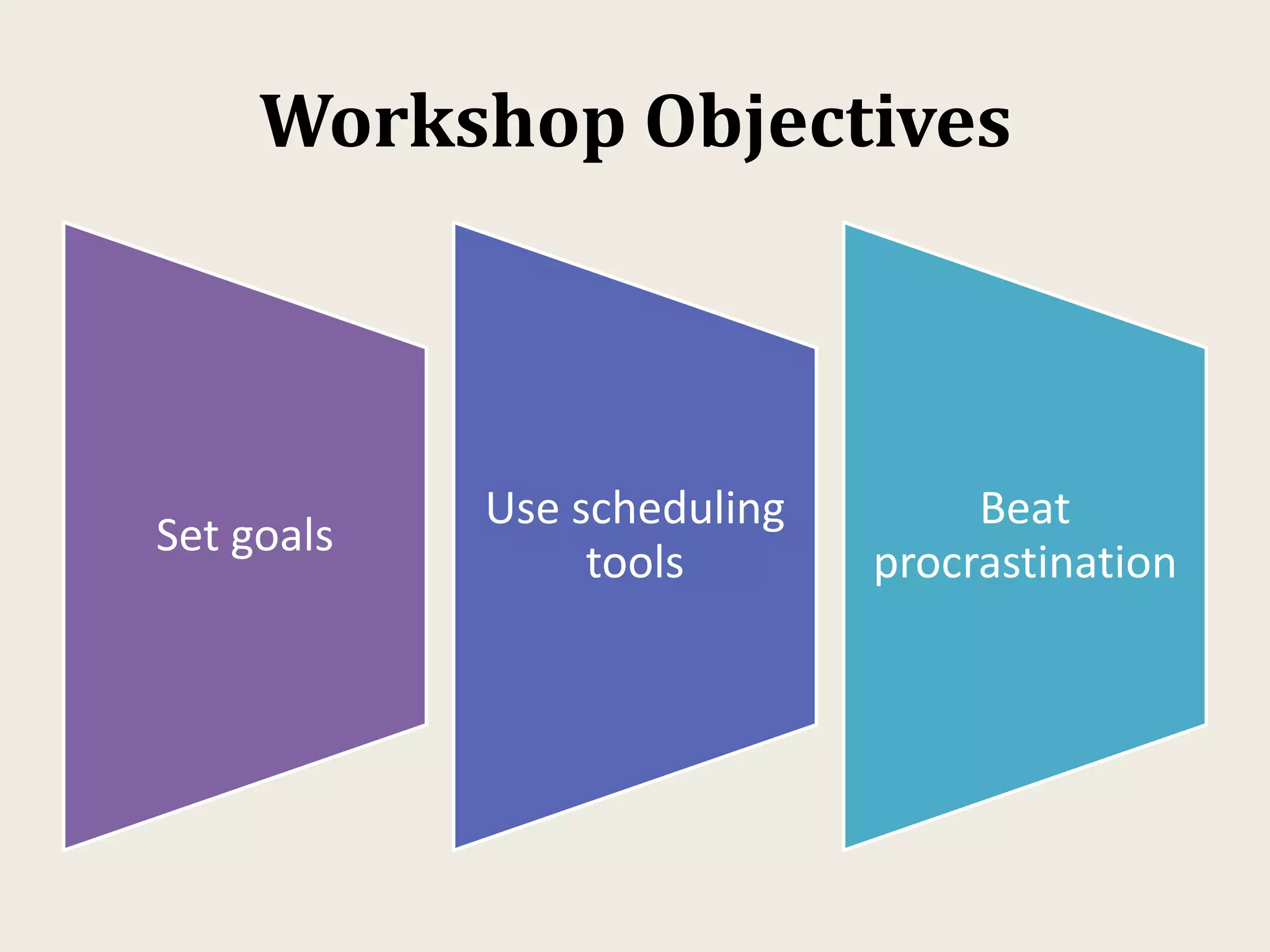
Workshop Objectives
Set goals
Use scheduling
tools
Beat
procrastination
Module Two: Setting
SMART Goals
Goal setting is critical to your
personal productivity. It can be used
in every single area of your life,
including financial, physical, personal
development, relationships, or even
spiritual.
Time is the
stuff that life is
made of.
Benjamin
Franklin
The Three P’s
Positive Personal
Possible
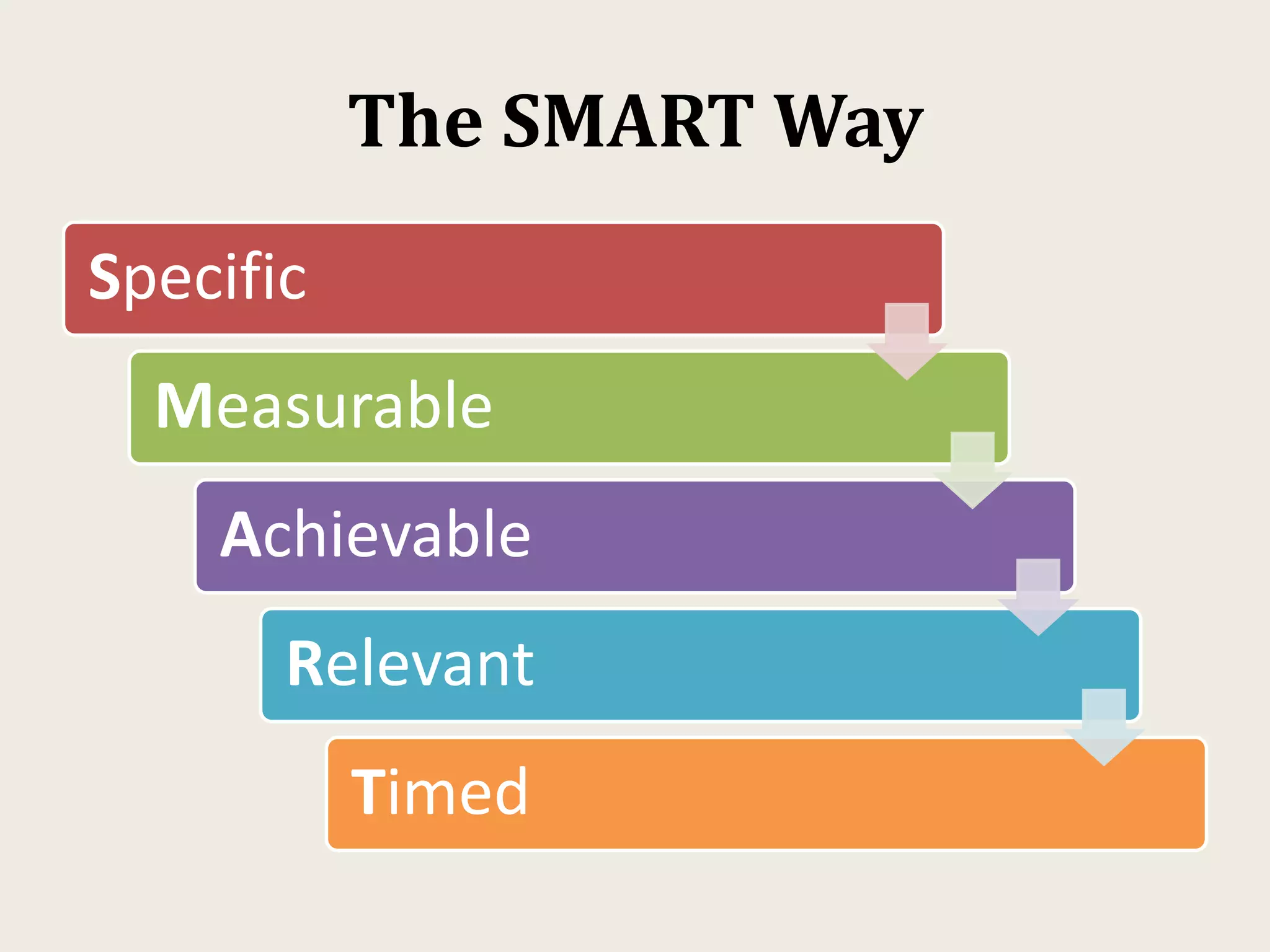
The SMART Way
Specific
Measurable
Achievable
Relevant
Timed
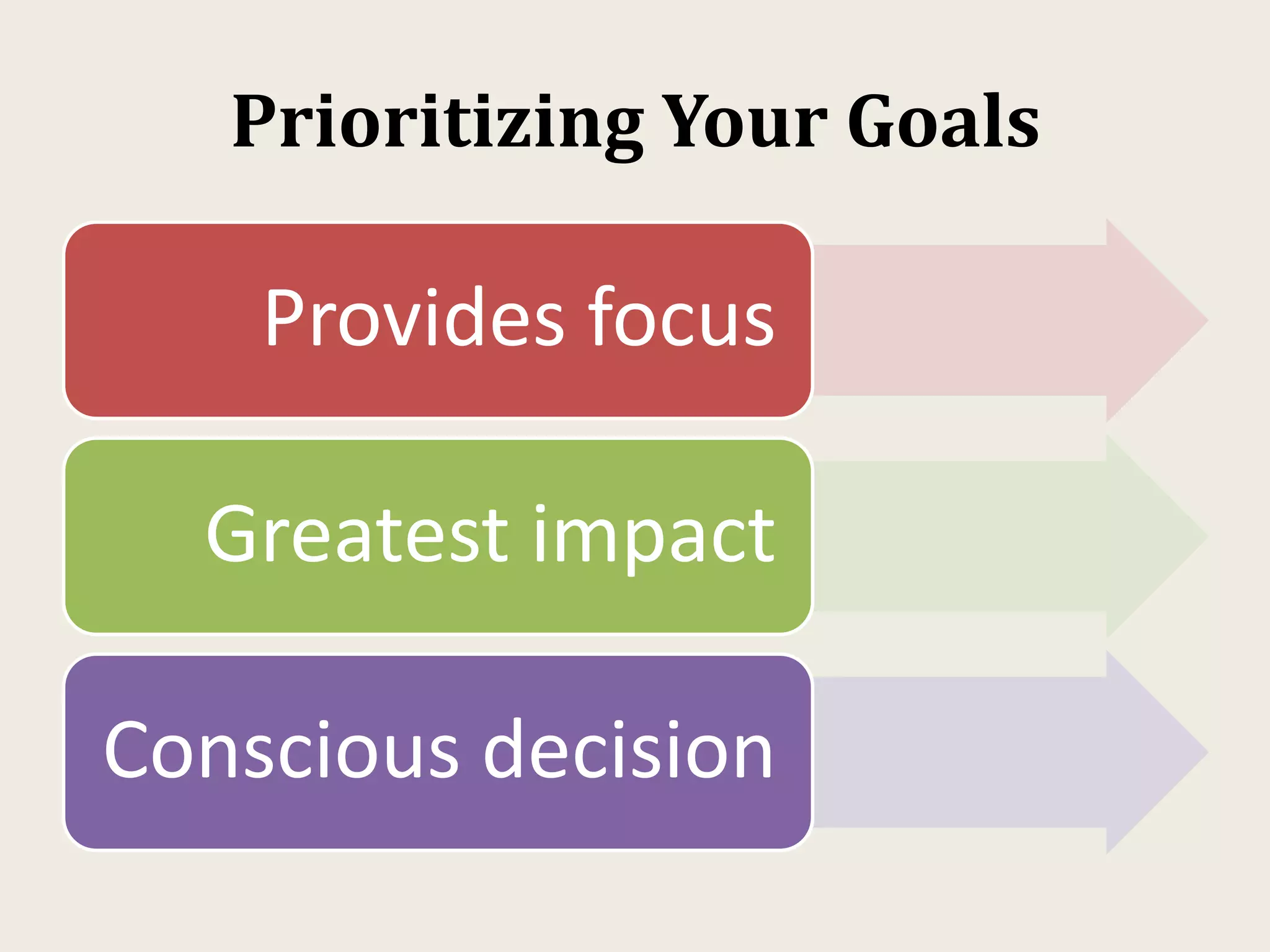
Prioritizing Your Goals
Provides focus
Greatest impact
Conscious decision
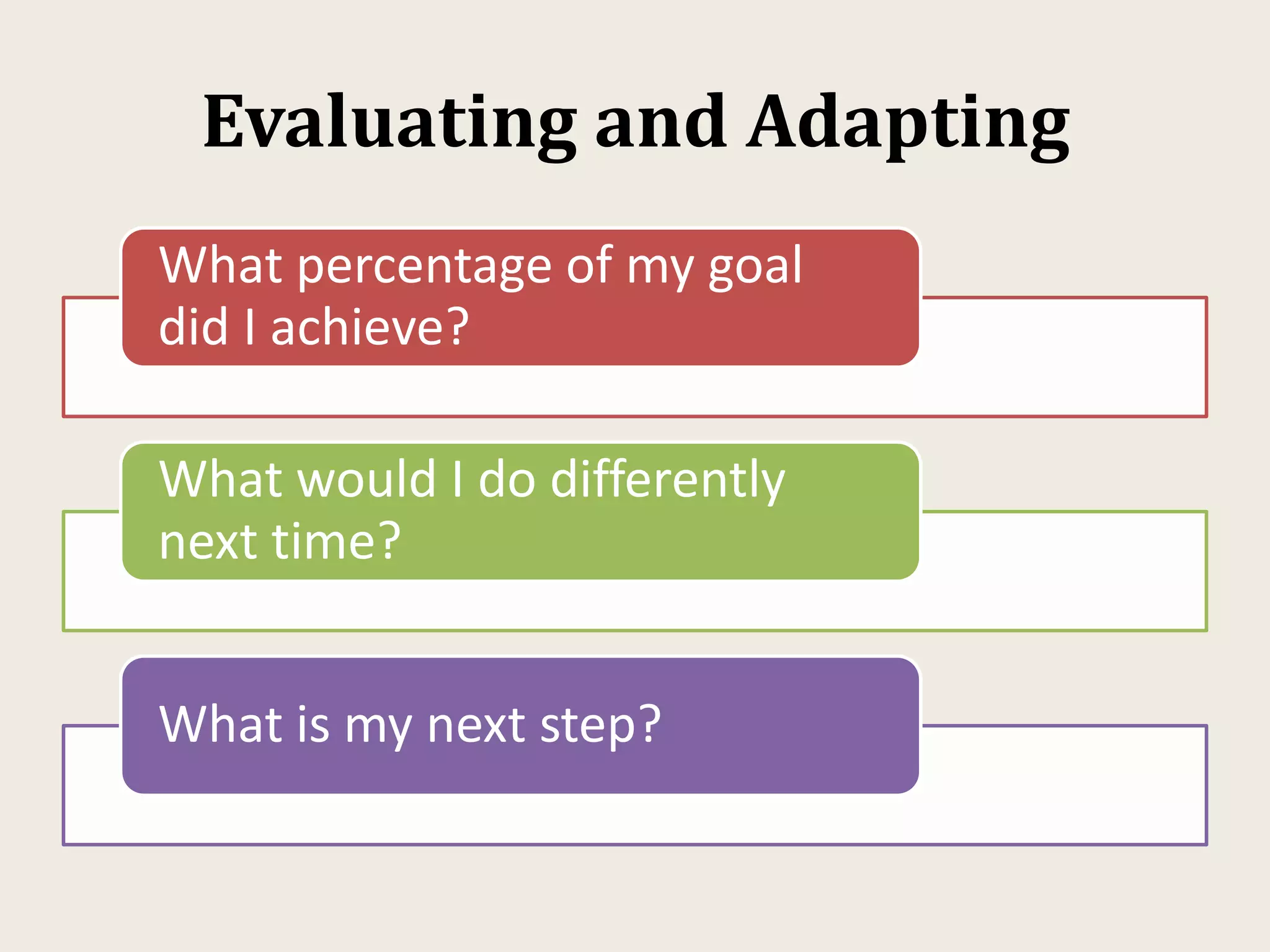
Evaluating and Adapting
What percentage of my goal
did I achieve?
What would I do differently
next time?
What is my next step?
Module Two: Review Questions
1. Complete this sentence. Goal setting is ____________ to
your personal productivity.
a) Critical
b) Useful
c) Meaningless
d) Soothing
2. What is the single most important life skill that most people
never learn to do properly?
a) Eat their vegetables
b) Run a marathon
c) Setting smart goals
d) Being on time
Module Two: Review Questions
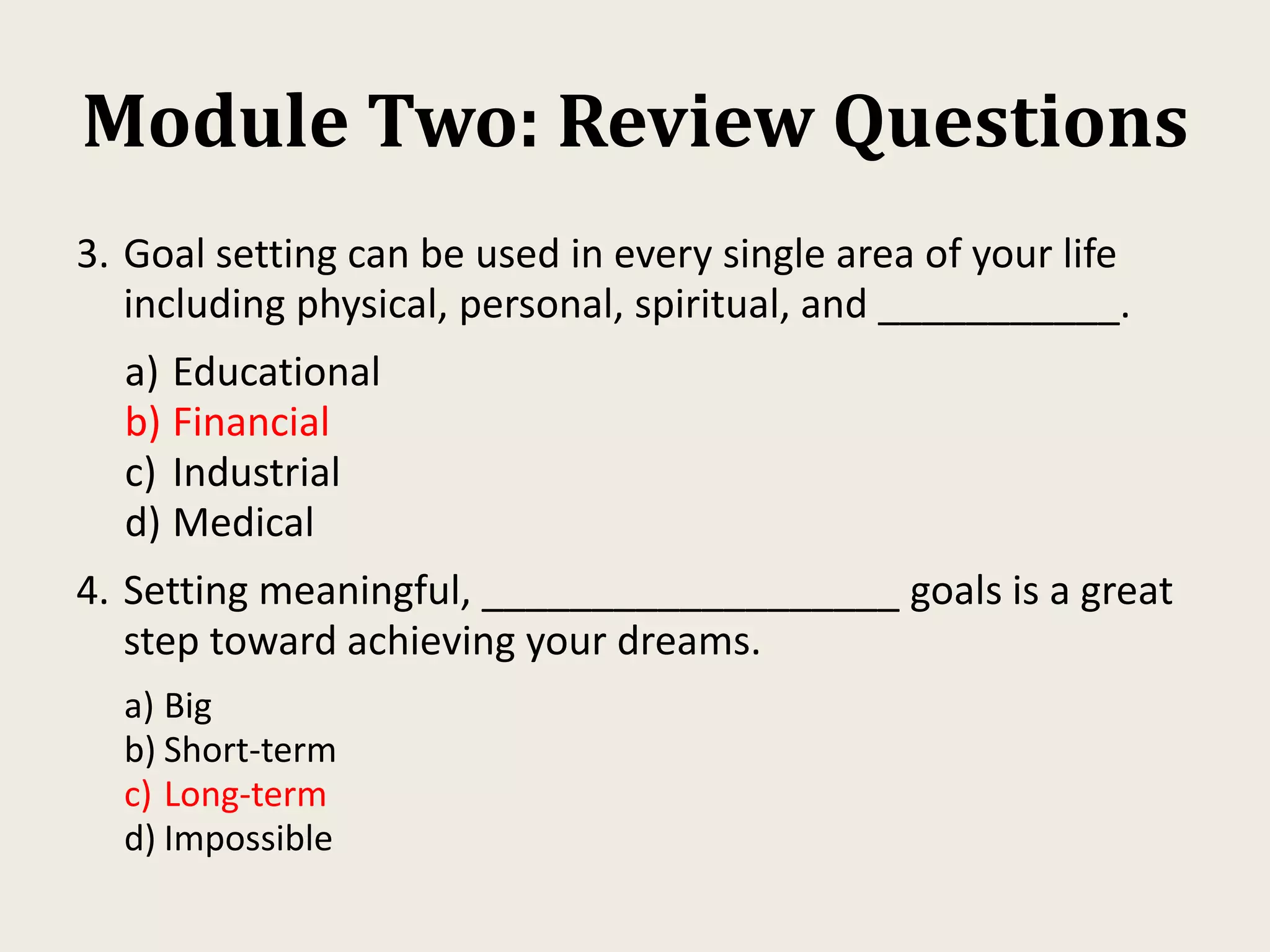
3. Goal setting can be used in every single area of your life
including physical, personal, spiritual, and ___________.
a) Educational
b) Financial
c) Industrial
d) Medical
4. Setting meaningful, ___________________ goals is a great
step toward achieving your dreams.
a) Big
b) Short-term
c) Long-term
d) Impossible
Module Two: Review Questions
5.Accomplishing short-term ________ can help you
accomplish tasks.
a)Goals
b)Dreams
c)Careers
d)Marriages
6.What are the three P's?
a)Peace, pensiveness, persistence
b)Priorities, purchases, personality
c)Pension, passiveness, purpose
d)Positive, personal, possible
Module Two: Review Questions
7.SMART is an acronym for what words?
a)Silly, maddening, artistic, realistic, trailblazer
b)Saturated, melodramatic, animal, redone, trouble
c)Simple, manageable, alert, reasonable, traceable
d)Specific, measurable, achievable, relevant, timed
8.Achieving challenging goals requires a lot of
__________ energy.
a)Magic
b)Kinetic
c)Exhausting
d)Mental
Module Two: Review Questions
9. When you are prioritizing, choose a goal that will have
the __________ impact on your life.
a) Least
b)Cheapest
c) Better
d)Greatest
10.As we grow and change, our goals should
___________ too.
a) Change
b)Disappear
c) Increase
d)Decrease
Module Two: Review Questions
1. Complete this sentence. Goal setting is ____________ to
your personal productivity.
a) Critical
b) Useful
c) Meaningless
d) Soothing
2. What is the single most important life skill that most people
never learn to do properly?
a) Eat their vegetables
b) Run a marathon
c) Setting smart goals
d) Being on time
Module Two: Review Questions
3. Goal setting can be used in every single area of your life
including physical, personal, spiritual, and ___________.
a) Educational
b) Financial
c) Industrial
d) Medical
4. Setting meaningful, ___________________ goals is a great
step toward achieving your dreams.
a) Big
b) Short-term
c) Long-term
d) Impossible
Module Two: Review Questions
5.Accomplishing short-term ________ can help you
accomplish tasks.
a)Goals
b)Dreams
c)Careers
d)Marriages
6.What are the three P's?
a)Peace, pensiveness, persistence
b)Priorities, purchases, personality
c)Pension, passiveness, purpose
d)Positive, personal, possible
Module Two: Review Questions
7.SMART is an acronym for what words?
a)Silly, maddening, artistic, realistic, trailblazer
b)Saturated, melodramatic, animal, redone, trouble
c)Simple, manageable, alert, reasonable, traceable
d)Specific, measurable, achievable, relevant, timed
8.Achieving challenging goals requires a lot of
__________ energy.
a)Magic
b)Kinetic
c)Exhausting
d)Mental
Module Two: Review Questions
9. When you are prioritizing, choose a goal that will have
the __________ impact on your life.
a) Least
b)Cheapest
c) Better
d)Greatest
10.As we grow and change, our goals should
___________ too.
a) Change
b)Disappear
c) Increase
d)Decrease
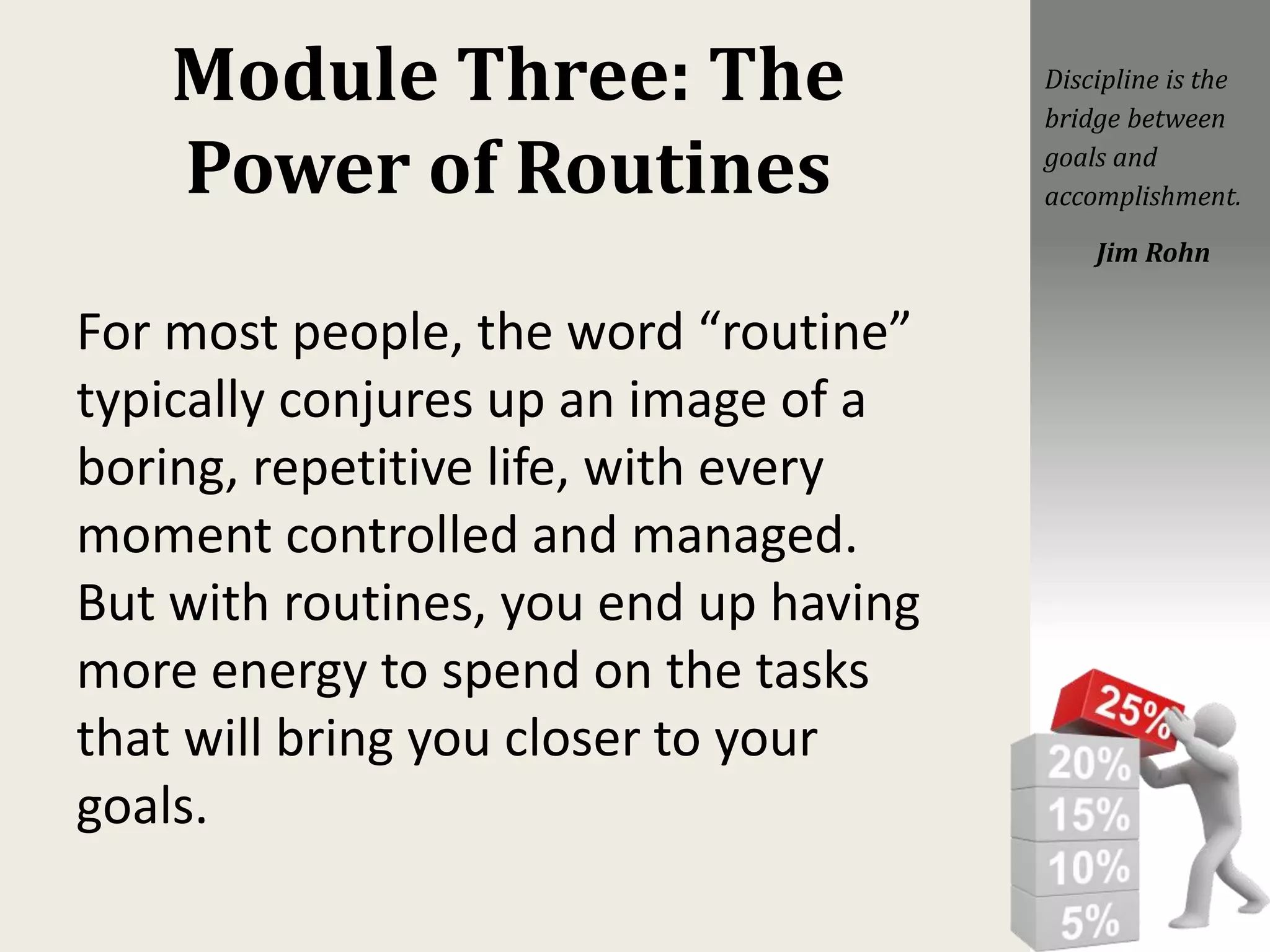
Module Three: The
Power of Routines
For most people, the word “routine”
typically conjures up an image of a
boring, repetitive life, with every
moment controlled and managed.
But with routines, you end up having
more energy to spend on the tasks
that will bring you closer to your
goals.
Discipline is the
bridge between
goals and
accomplishment.
Jim Rohn
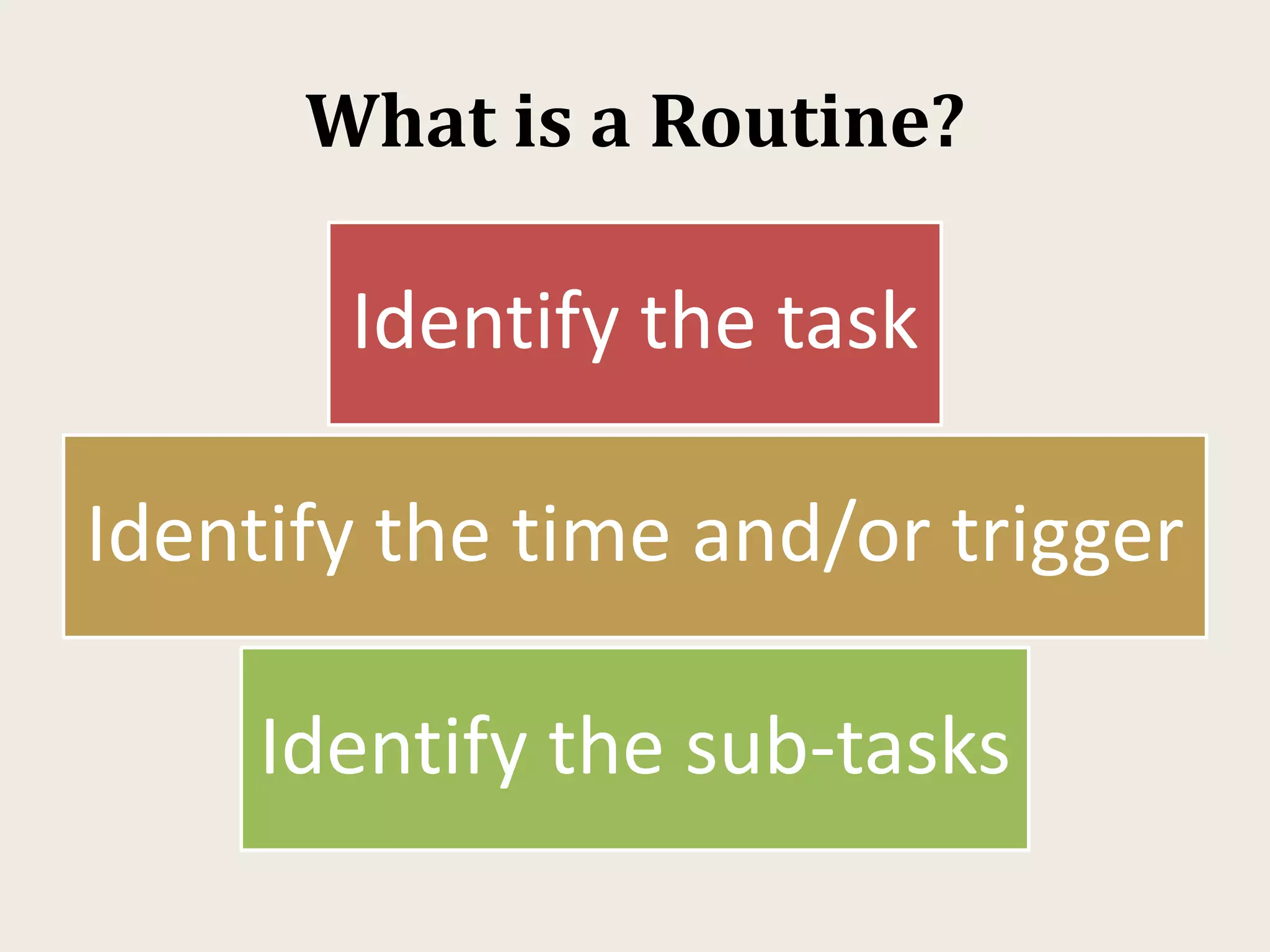
What is a Routine?
Identify the task
Identify the time and/or trigger
Identify the sub-tasks
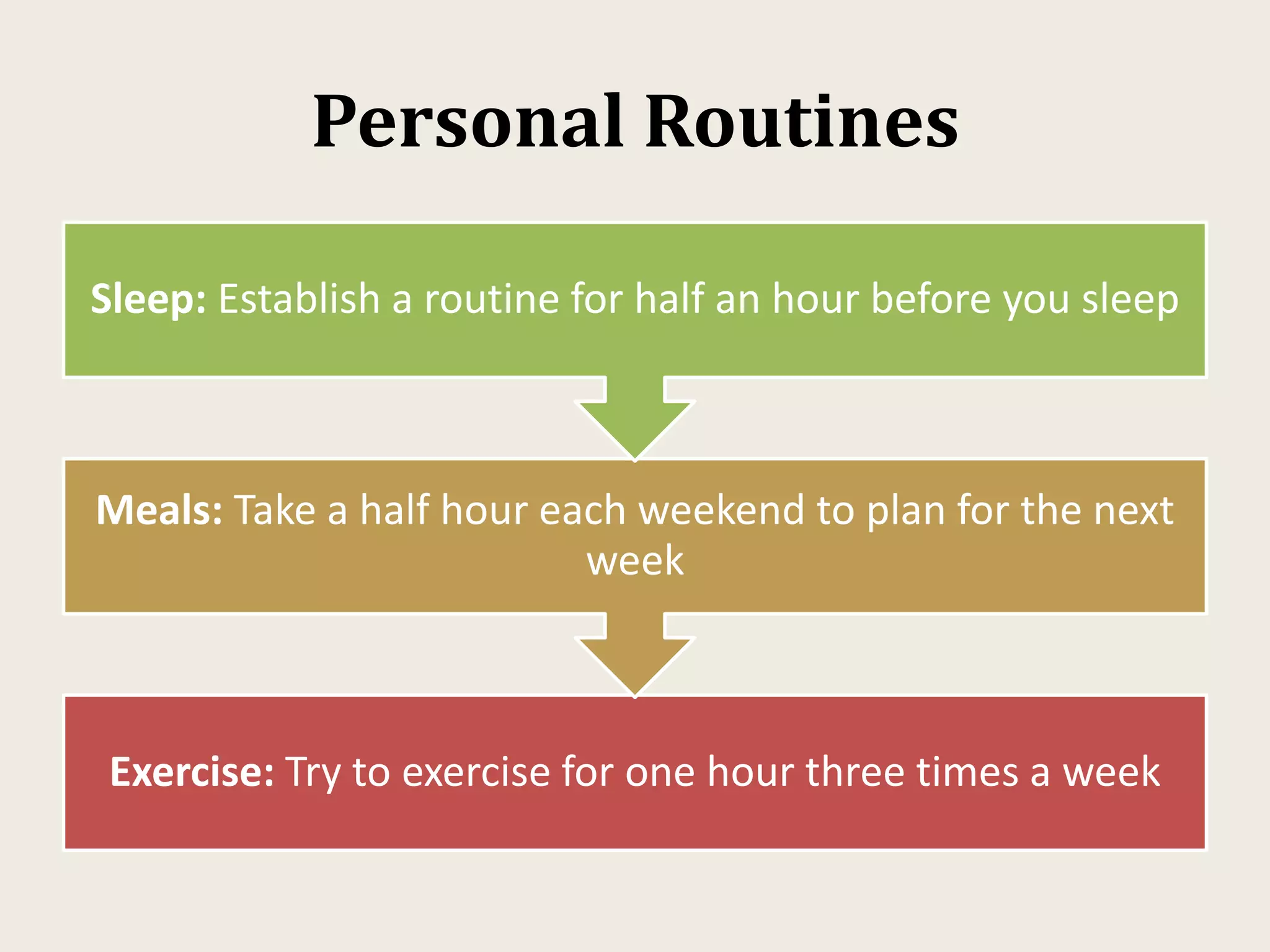
Personal Routines
Exercise: Try to exercise for one hour three times a week
Meals: Take a half hour each weekend to plan for the next
week
Sleep: Establish a routine for half an hour before you sleep
Professional Routines
Set aside a specific time to check email and
news
Set up a system for maintaining your task
tracking system
In the morning, perform your tasks in an
organized, routine manner
Six Easy Ways to
Simplify Your Life
Pay someone
else to do it
Use electronic
banking
Keep
everyone
organized
Plan your
meals
Take
advantage of
shortcuts
Save the
difference
Module Three: Review Questions
1. Routines and rituals can actually help _________ the
spontaneity and fun in your life.
a) Increase
b) Decrease
c) Sap
d) Eliminate
2. Routines allow you to have more __________ to spend on
tasks.
a) Room
b) Money
c) Energy
d) Fun
Module Three: Review Questions
3. “Any practice regularly performed in a set manner” is a
_________.
a) Accident
b) Coincidence
c) Downfall
d) Routine
4. Once you establish a routine it can ________________.
a) Be set in stone
b) Be difficult
c) Be modified
d) Be easy
Module Three: Review Questions
5. How many steps are there to building a routine?
a) Three
b) Five
c) Tons
d) One
6. Which is not one of the three easy steps to building a
routine?
a) Identifying the task
b) Identifying yourself
c) Identifying sub-tasks
d) Identifying time or trigger
Module Three: Review Questions
7. Sleep, meals, and _____________ form the building
blocks of our lives.
a) Exercise
b) Irritating
c) Noise
d) Distractions
8. Which can be considered a professional routine?
a) Do tasks as they come up
b) Don't worry about organization
c) Set aside time to check email
d) Have no plan
Module Three: Review Questions
9. Which of these is an easy way to simplify your life?
a) Pay someone to do it
b) Plan your meals
c) Use electronic banking
d) All of the above
10.Setting up a system for maintaining your task tracking
system is an example of what?
a) Too much work
b) Laziness
c) Professional routine
d) Procrastinating
Module Three: Review Questions
1. Routines and rituals can actually help _________ the
spontaneity and fun in your life.
a) Increase
b) Decrease
c) Sap
d) Eliminate
2. Routines allow you to have more __________ to spend on
tasks.
a) Room
b) Money
c) Energy
d) Fun
Module Three: Review Questions
3. “Any practice regularly performed in a set manner” is a
_________.
a) Accident
b) Coincidence
c) Downfall
d) Routine
4. Once you establish a routine it can ________________.
a) Be set in stone
b) Be difficult
c) Be modified
d) Be easy
Module Three: Review Questions
5. How many steps are there to building a routine?
a) Three
b) Five
c) Tons
d) One
6. Which is not one of the three easy steps to building a
routine?
a) Identifying the task
b) Identifying yourself
c) Identifying sub-tasks
d) Identifying time or trigger
Module Three: Review Questions
7. Sleep, meals, and _____________ form the building
blocks of our lives.
a) Exercise
b) Irritating
c) Noise
d) Distractions
8. Which can be considered a professional routine?
a) Do tasks as they come up
b) Don't worry about organization
c) Set aside time to check email
d) Have no plan
Module Three: Review Questions
9. Which of these is an easy way to simplify your life?
a) Pay someone to do it
b) Plan your meals
c) Use electronic banking
d) All of the above
10.Setting up a system for maintaining your task tracking
system is an example of what?
a) Too much work
b) Laziness
c) Professional routine
d) Procrastinating
Module Four:
Scheduling Yourself
Routines and rituals should form the
framework of your days at home and
in the office. This module will explore
how to schedule those tasks and
activities in the most efficient way
possible.
Time is
what we
want most,
but what we
use worst.
William
Penn
The Simple Secret of Successful
Time Management
No one-size-fits-all solution
Explore different methods
Find what works for you
Developing a Tracking System
Urgent and
Important
Important,
Not Urgent
Urgent,
Not
Important
Not
Urgent,
Not
Important
Scheduling Appointments
Block off quiet time to work
at your desk
Leave the best time for callers to call on
your voice mail
Strictly adhere to start and finish
times for meetings
Prepare a meeting agenda
in advance
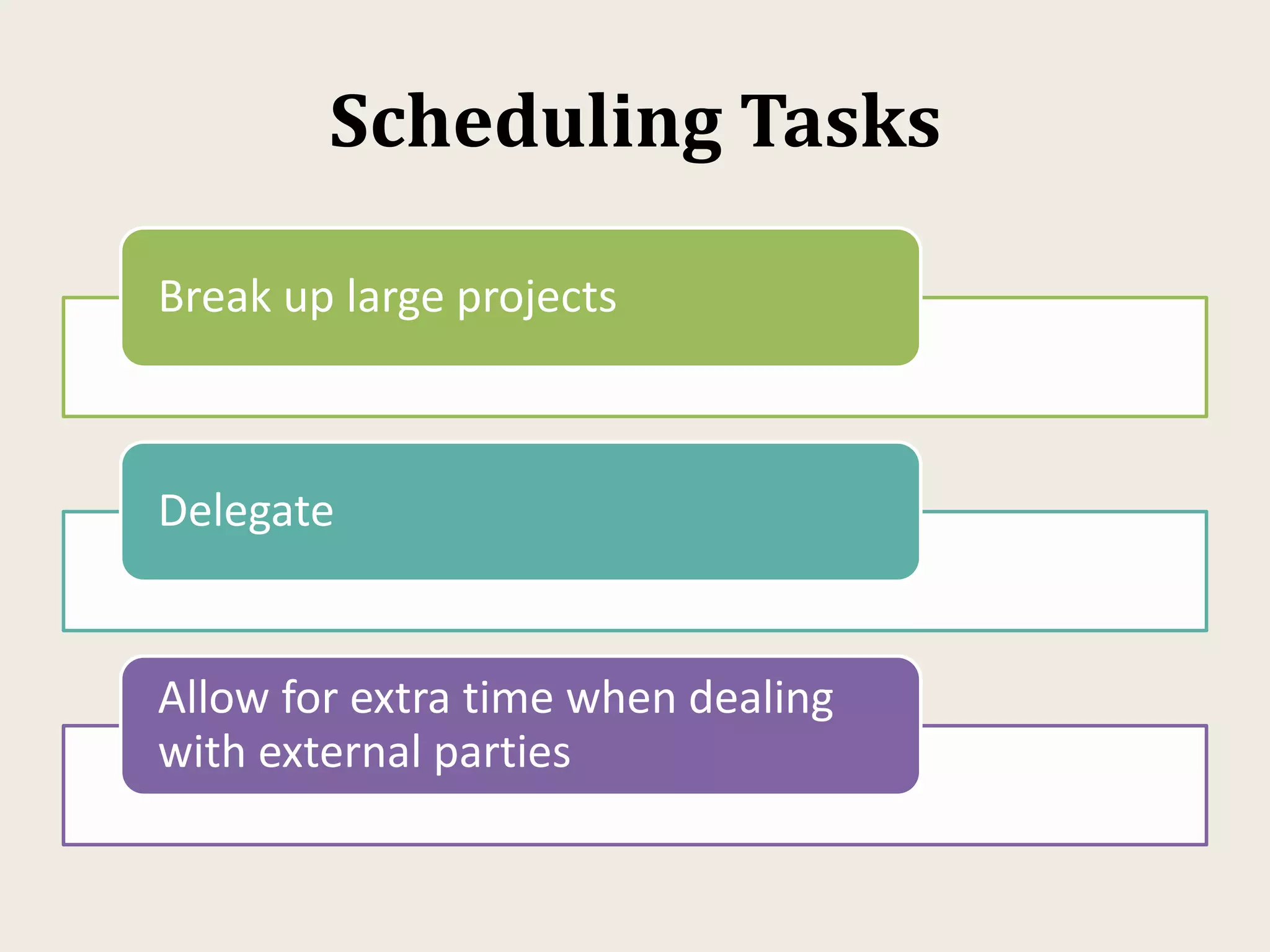
Scheduling Tasks
Break up large projects
Delegate
Allow for extra time when dealing
with external parties
Module Four: Review Questions
1. Routines and _________ should form the framework of
your days at home and in the office.
a) Procrastination
b) Difficult tasks
c) Rituals
d) Avoidance
2. There is no __________ to time management.
a) Answer
b) Path
c) End
d) Secret
Module Four: Review Questions
3. Electronic solutions are an example of a ___________ __________.
a) Long road
b) Difficult project
c) Tracking system
d) Sneaky tool
4. Which of these is not a step to making the most of your electronic
solution?
a) Taking time to learn about features of the application
b) Keep all your email accounts for home and office together
c) Adjust as much as you can
d) Keep personal and professional tasks separate
Module Four: Review Questions
5. People who are traditionalists should try using a
________________ journal.
a) Electronic files
b) Post-it
c) Productivity
d) Memory
6. You can keep a ____________ calendar in the back of the
journal.
a) Long-term
b) Short-term
c) Yearly
d) Activity
Module Four: Review Questions
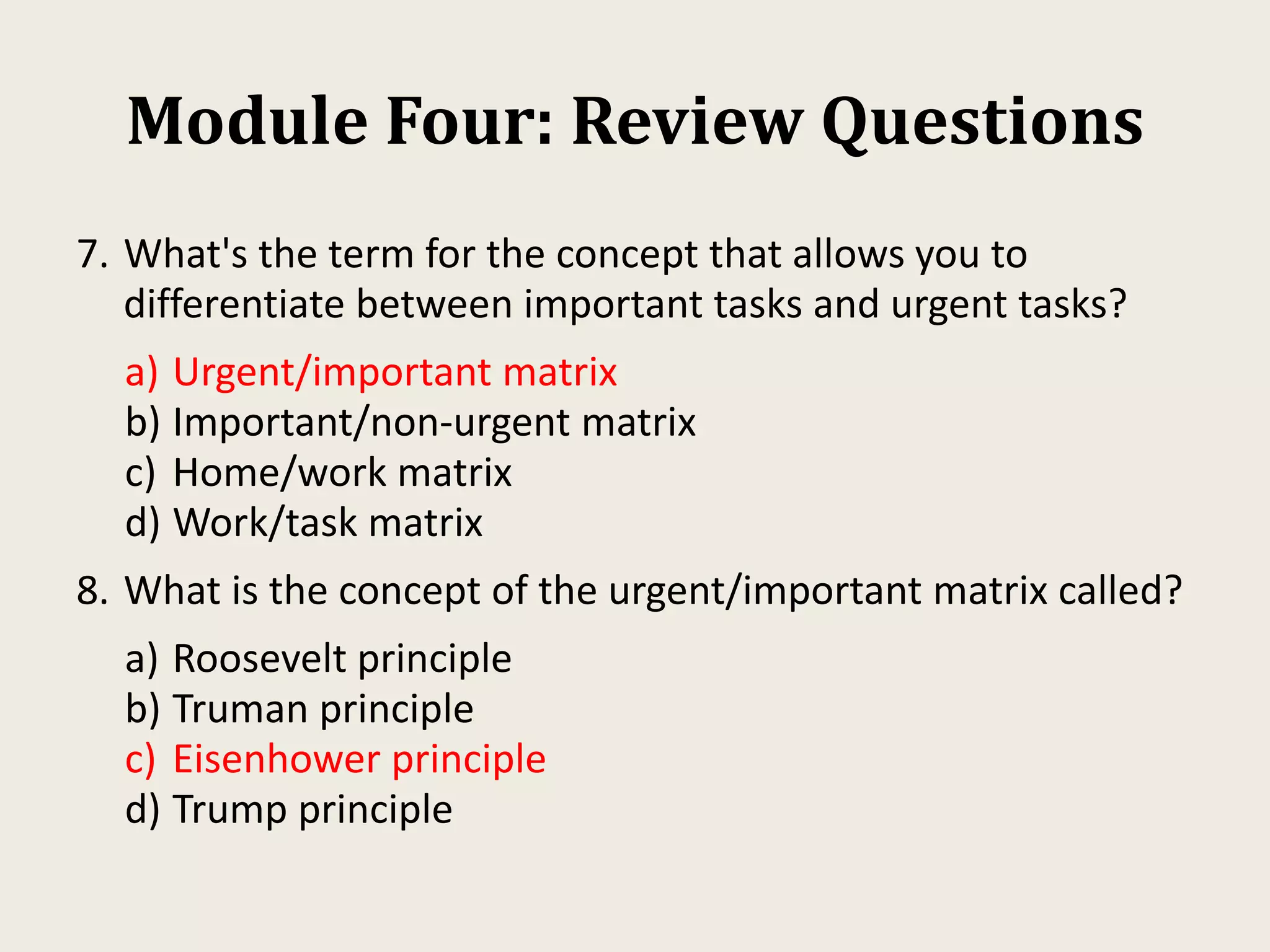
7. What's the term for the concept that allows you to
differentiate between important tasks and urgent tasks?
a) Urgent/important matrix
b) Important/non-urgent matrix
c) Home/work matrix
d) Work/task matrix
8. What is the concept of the urgent/important matrix called?
a) Roosevelt principle
b) Truman principle
c) Eisenhower principle
d) Trump principle
Module Four: Review Questions
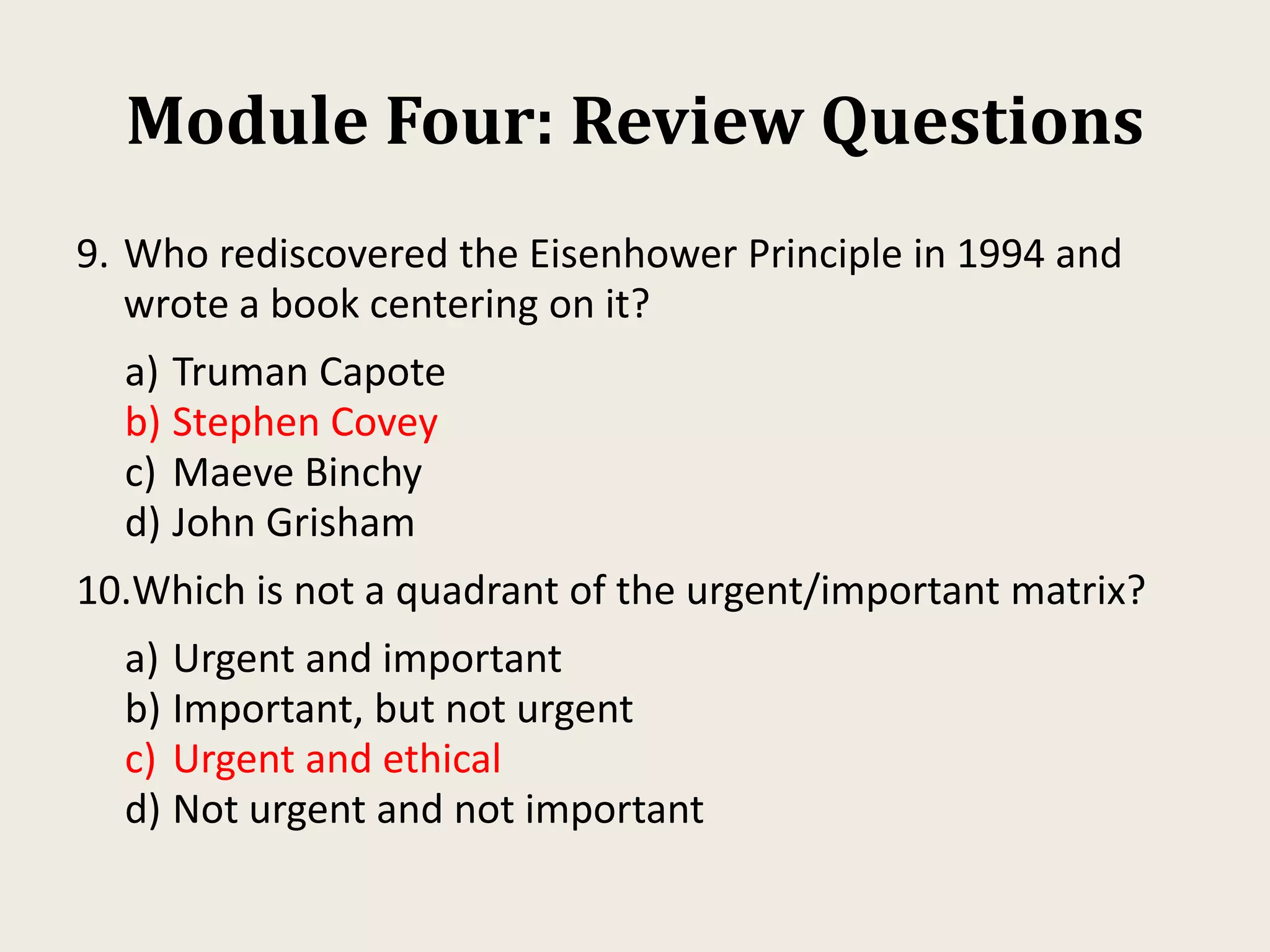
9. Who rediscovered the Eisenhower Principle in 1994 and
wrote a book centering on it?
a) Truman Capote
b) Stephen Covey
c) Maeve Binchy
d) John Grisham
10.Which is not a quadrant of the urgent/important matrix?
a) Urgent and important
b) Important, but not urgent
c) Urgent and ethical
d) Not urgent and not important
Module Four: Review Questions
1. Routines and _________ should form the framework of
your days at home and in the office.
a) Procrastination
b) Difficult tasks
c) Rituals
d) Avoidance
2. There is no __________ to time management.
a) Answer
b) Path
c) End
d) Secret
Module Four: Review Questions
3. Electronic solutions are an example of a ___________ __________.
a) Long road
b) Difficult project
c) Tracking system
d) Sneaky tool
4. Which of these is not a step to making the most of your electronic
solution?
a) Taking time to learn about features of the application
b) Keep all your email accounts for home and office together
c) Adjust as much as you can
d) Keep personal and professional tasks separate
Module Four: Review Questions
5. People who are traditionalists should try using a
________________ journal.
a) Electronic files
b) Post-it
c) Productivity
d) Memory
6. You can keep a ____________ calendar in the back of the
journal.
a) Long-term
b) Short-term
c) Yearly
d) Activity
Module Four: Review Questions
7. What's the term for the concept that allows you to
differentiate between important tasks and urgent tasks?
a) Urgent/important matrix
b) Important/non-urgent matrix
c) Home/work matrix
d) Work/task matrix
8. What is the concept of the urgent/important matrix called?
a) Roosevelt principle
b) Truman principle
c) Eisenhower principle
d) Trump principle
Module Four: Review Questions
9. Who rediscovered the Eisenhower Principle in 1994 and
wrote a book centering on it?
a) Truman Capote
b) Stephen Covey
c) Maeve Binchy
d) John Grisham
10.Which is not a quadrant of the urgent/important matrix?
a) Urgent and important
b) Important, but not urgent
c) Urgent and ethical
d) Not urgent and not important
Module Five: Keeping
Yourself on Top of Tasks
Even after you’ve got a plan in place,
it’s important to keep adjusting your
plan so that you can stay in control of
your time. This module will give you
some ways to help you stay on top of
your to-do list.
Ordinary people
think merely of
spending time.
Great people
think of using it.
Anonymous
The One-Minute Rule
Quick replies to e-mails
Accept a meeting invitation
Quick stretches
The Five-Minute Rule
Clean your
desk
Work on a
stuck
project
Clear out
your inbox
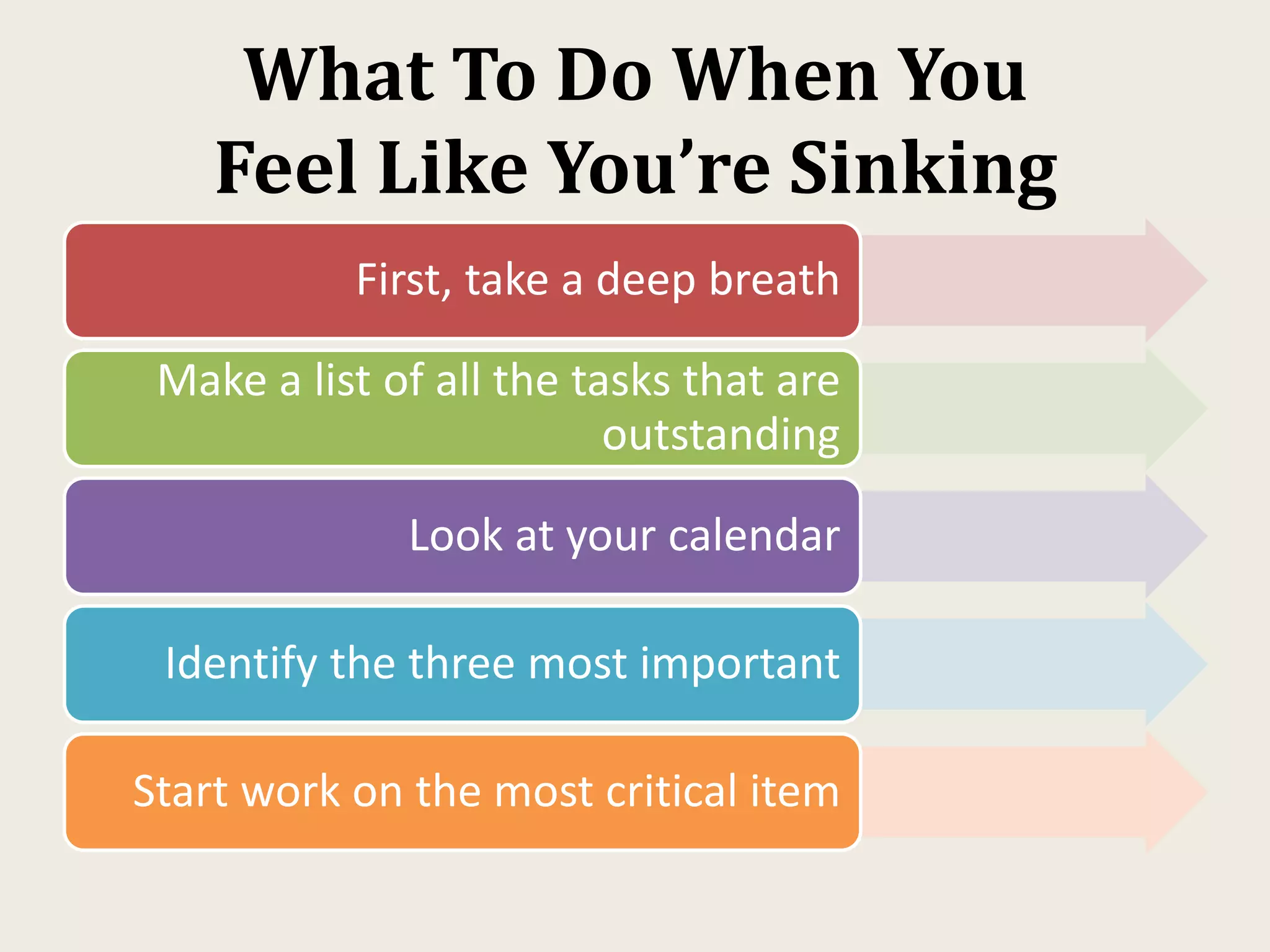
What To Do When You
Feel Like You’re Sinking
First, take a deep breath
Make a list of all the tasks that are
outstanding
Look at your calendar
Identify the three most important
Start work on the most critical item
Module Five: Review Questions
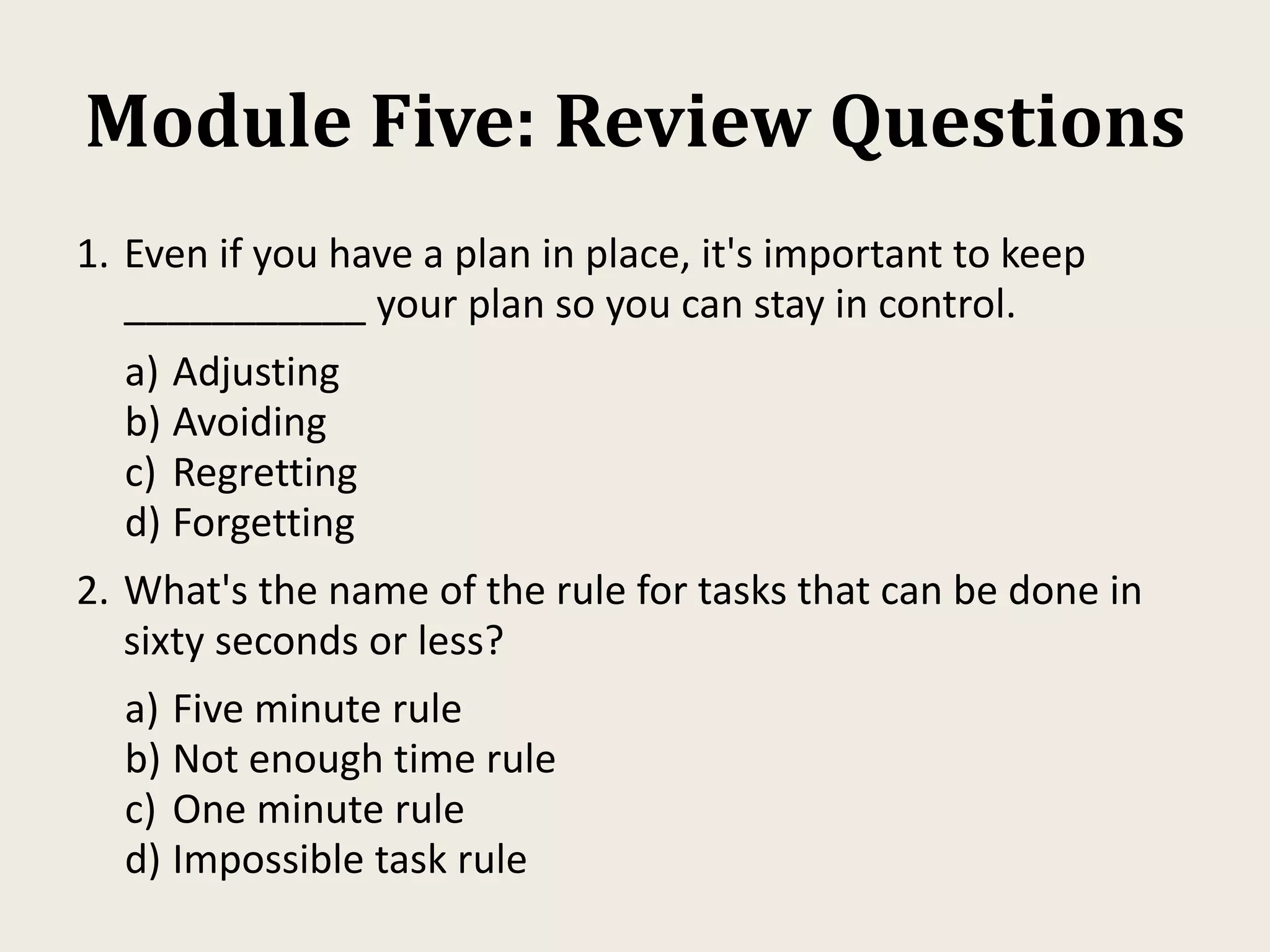
1. Even if you have a plan in place, it's important to keep
___________ your plan so you can stay in control.
a) Adjusting
b) Avoiding
c) Regretting
d) Forgetting
2. What's the name of the rule for tasks that can be done in
sixty seconds or less?
a) Five minute rule
b) Not enough time rule
c) One minute rule
d) Impossible task rule
Module Five: Review Questions
3. What can be accomplished utilizing the five-minute rule?
a) Writing a presentation
b) Creating an employee handbook
c) Cleaning off one part of your desk
d) Creating new files for all of your correspondence
4. Which of these can you do when you feel like you're
sinking?
a) Give up and find another line of work
b) Make a list of outstanding tasks and mark due dates on
them
c) Contemplate on them
d) Assign them to someone else
Module Five: Review Questions
5. Like all other plans, you'll probably need to ________ your to-do
items and priorities once you've completed a few tasks.
a) Revisit
b) Eliminate
c) Discard
d) Hide
6. After you've created a plan for the most important items you
should do what?
a) Celebrate with a night out
b) Transfer them to your tracking system
c) Take a break, you deserve it
d) Create more plans and weigh your options later
Module Five: Review Questions
7. When is a good time to clear you mind and take a deep
breath?
a) When you leave the office everyday
b) Before heading into the office
c) Every time you are called into a meeting
d) When you feel like you are sinking
8. If you're stuck on a task, set aside five _________ each
hour to work on it?
a) Seconds
b) Assignments
c) Tasks
d) Minutes
Module Five: Review Questions
9. Which of these can you do in 60 seconds or less?
a) Run around the block
b) Put together a presentation
c) Accept a meeting invitation
d) Complete all of your assigned tasks
10.Quick email replies, stretches, reviewing new RSS
feeds are examples of what?
a) Things you can do in less than a minute
b) Fun things that don't require any thought
c) Procrastination techniques
d) Stressful, meaningless tasks
Module Five: Review Questions
1. Even if you have a plan in place, it's important to keep
___________ your plan so you can stay in control.
a) Adjusting
b) Avoiding
c) Regretting
d) Forgetting
2. What's the name of the rule for tasks that can be done in
sixty seconds or less?
a) Five minute rule
b) Not enough time rule
c) One minute rule
d) Impossible task rule
Module Five: Review Questions
3. What can be accomplished utilizing the five-minute rule?
a) Writing a presentation
b) Creating an employee handbook
c) Cleaning off one part of your desk
d) Creating new files for all of your correspondence
4. Which of these can you do when you feel like you're
sinking?
a) Give up and find another line of work
b) Make a list of outstanding tasks and mark due dates on
them
c) Contemplate on them
d) Assign them to someone else
Module Five: Review Questions
5. Like all other plans, you'll probably need to ________ your to-do
items and priorities once you've completed a few tasks.
a) Revisit
b) Eliminate
c) Discard
d) Hide
6. After you've created a plan for the most important items you
should do what?
a) Celebrate with a night out
b) Transfer them to your tracking system
c) Take a break, you deserve it
d) Create more plans and weigh your options later
Module Five: Review Questions
7. When is a good time to clear you mind and take a deep
breath?
a) When you leave the office everyday
b) Before heading into the office
c) Every time you are called into a meeting
d) When you feel like you are sinking
8. If you're stuck on a task, set aside five _________ each
hour to work on it?
a) Seconds
b) Assignments
c) Tasks
d) Minutes
Module Five: Review Questions
9. Which of these can you do in 60 seconds or less?
a) Run around the block
b) Put together a presentation
c) Accept a meeting invitation
d) Complete all of your assigned tasks
10.Quick email replies, stretches, reviewing new RSS
feeds are examples of what?
a) Things you can do in less than a minute
b) Fun things that don't require any thought
c) Procrastination techniques
d) Stressful, meaningless tasks
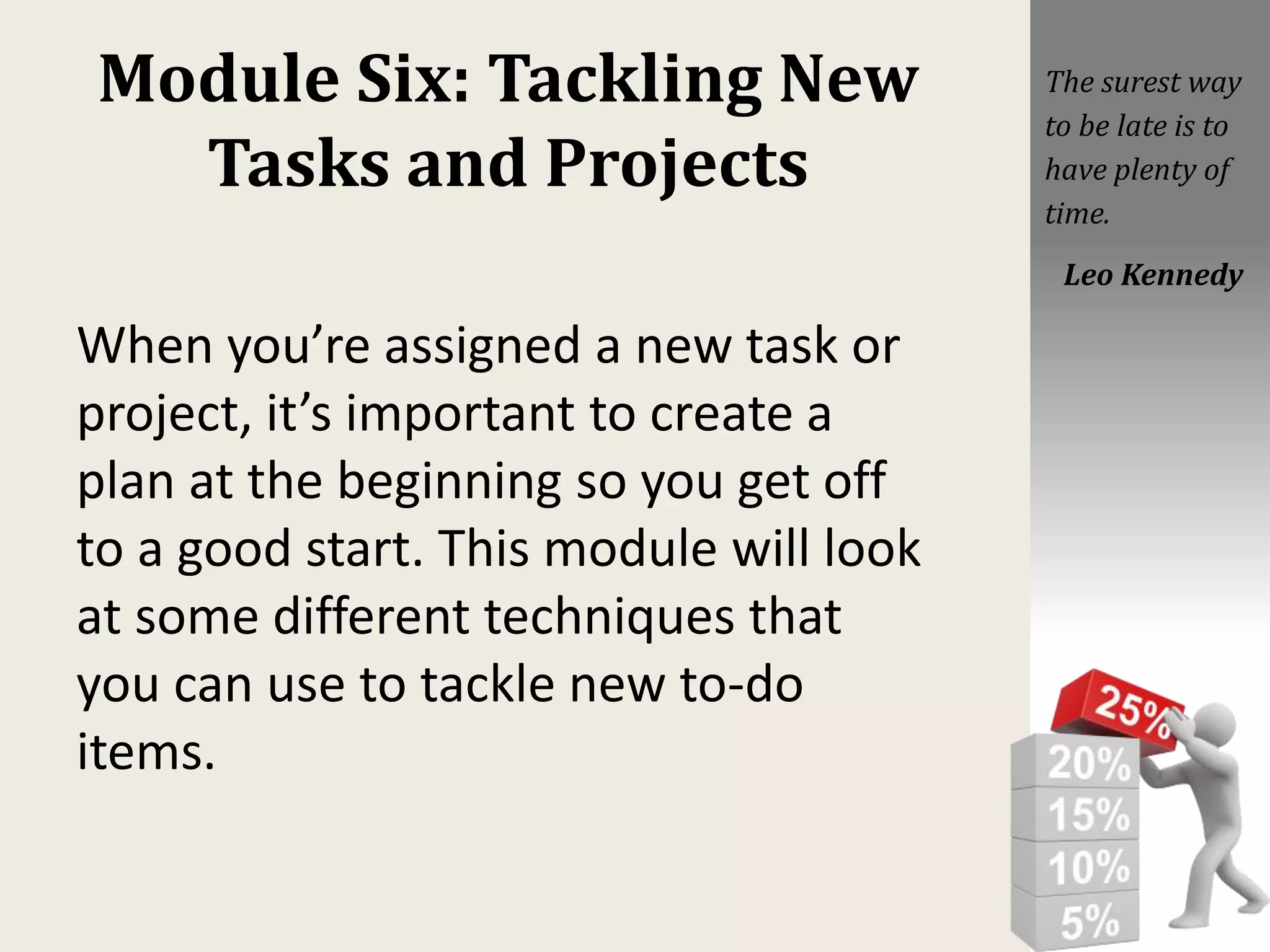
Module Six: Tackling New
Tasks and Projects
When you’re assigned a new task or
project, it’s important to create a
plan at the beginning so you get off
to a good start. This module will look
at some different techniques that
you can use to tackle new to-do
items.
The surest way
to be late is to
have plenty of
time.
Leo Kennedy
The Sliding Scale
Medium
projects
Visual
timeline
Storyboard
Large
projects
Gantt
chart
Tracking
dashboard
A Checklist for Getting Started
What is the date I will start this task?
What is the deadline?
What are the major things that need to be
completed?
What work has already been completed?
Evaluating and Adapting
Milestones
Review
your plan
Falling
behind?
Module Six: Review Questions
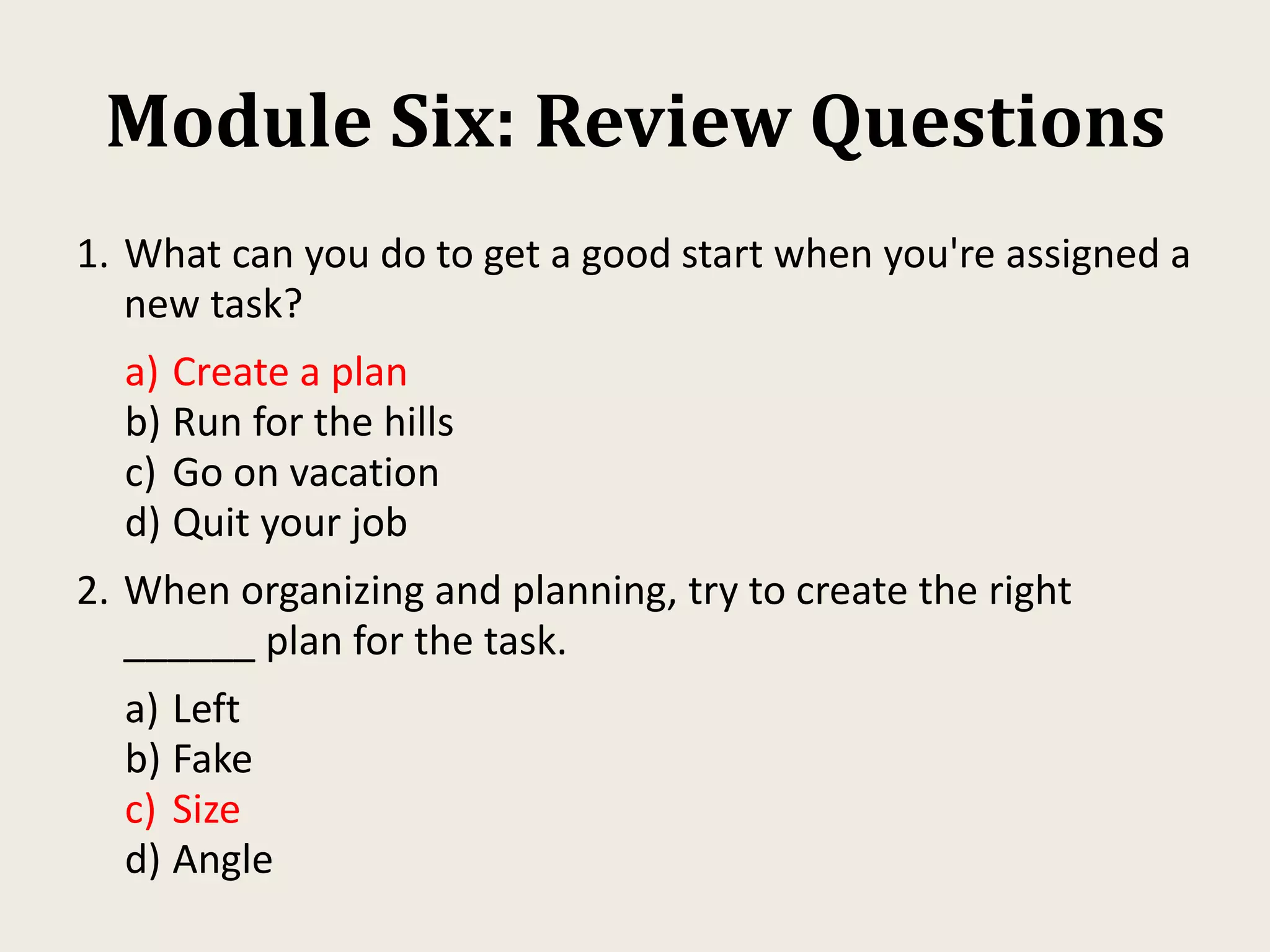
1. What can you do to get a good start when you're assigned a
new task?
a) Create a plan
b) Run for the hills
c) Go on vacation
d) Quit your job
2. When organizing and planning, try to create the right
______ plan for the task.
a) Left
b) Fake
c) Size
d) Angle
Module Six: Review Questions
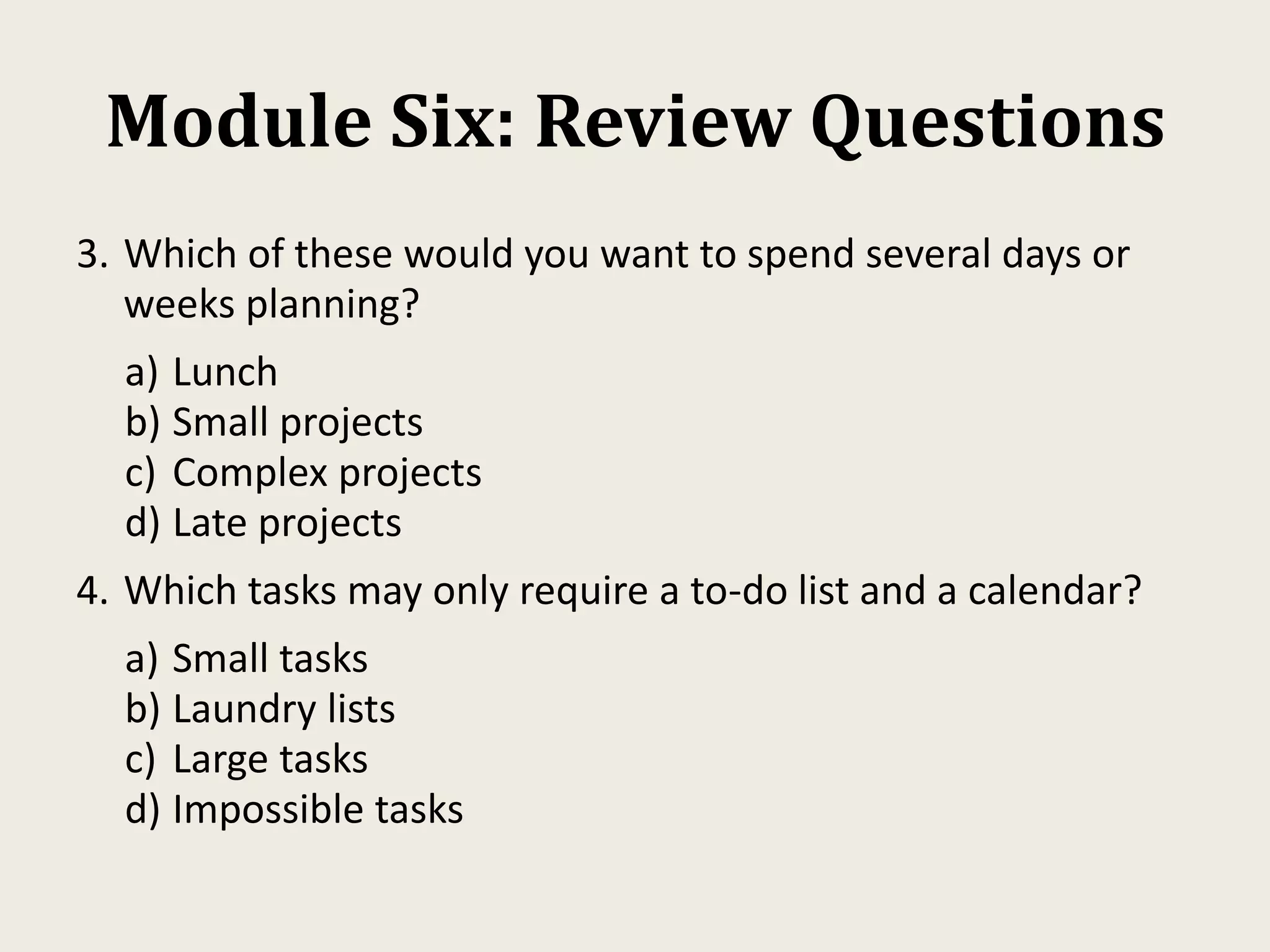
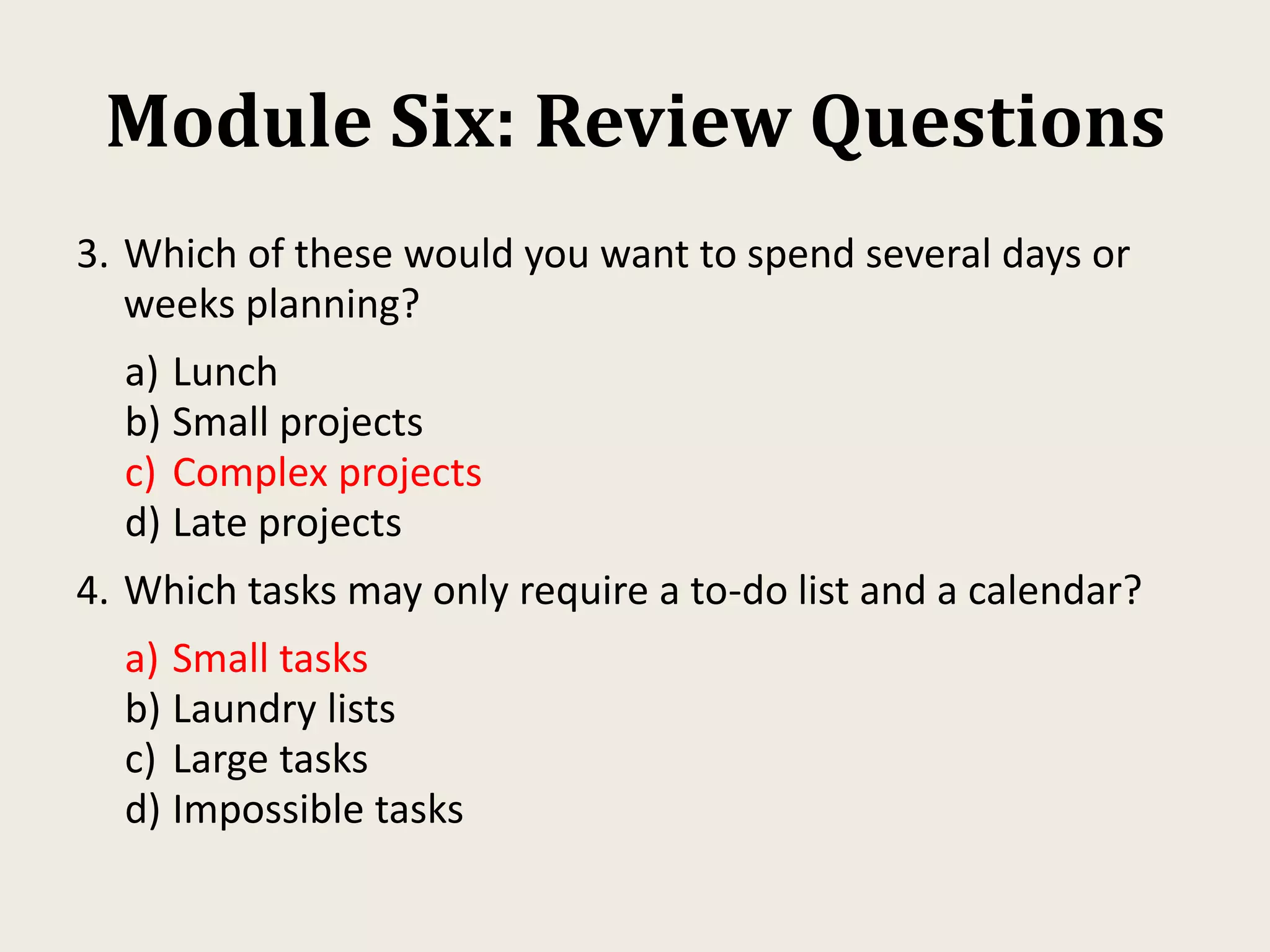
3. Which of these would you want to spend several days or
weeks planning?
a) Lunch
b) Small projects
c) Complex projects
d) Late projects
4. Which tasks may only require a to-do list and a calendar?
a) Small tasks
b) Laundry lists
c) Large tasks
d) Impossible tasks
Module Six: Review Questions
5. What kind of tasks would you use RACI charts or
storyboards for?
a) Large tasks
b) Homework assignments
c) Medium tasks
d) Small tasks
6. For large tasks consider using which of the following?
a) Grocery lists
b) Birthday gifts
c) Gantt charts
d) Medium tasks
Module Six: Review Questions
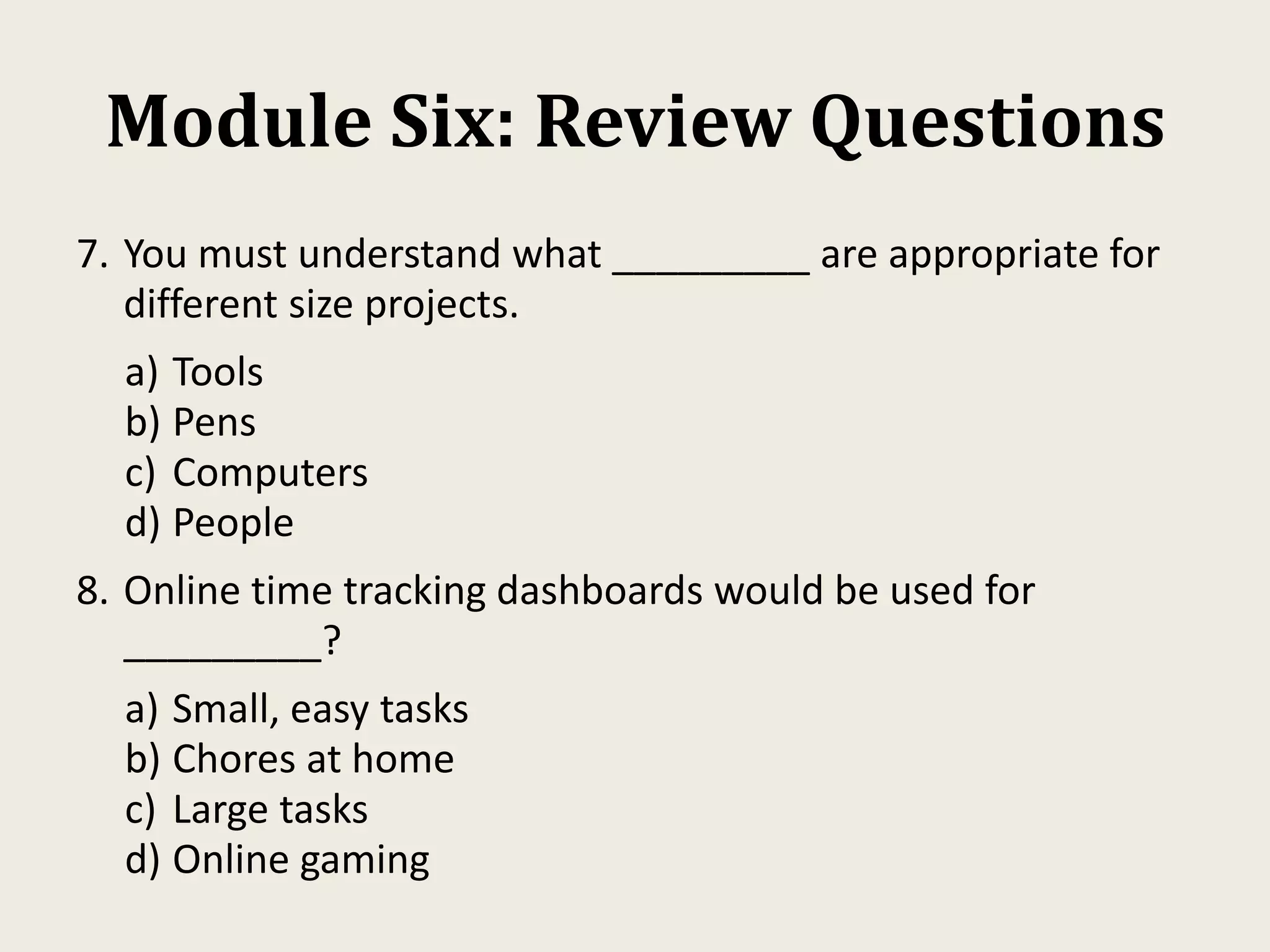
7. You must understand what _________ are appropriate for
different size projects.
a) Tools
b) Pens
c) Computers
d) People
8. Online time tracking dashboards would be used for
_________?
a) Small, easy tasks
b) Chores at home
c) Large tasks
d) Online gaming
Module Six: Review Questions
9. Visual time lines would be for:
a) Simple tasks
b) Large tasks
c) Medium tasks
d) Tasks with photos
10.Organizing your inbox is an example of what size task?
a) Large task
b) Small task
c) Mundane task
d) Medium task
Module Six: Review Questions
1. What can you do to get a good start when you're assigned a
new task?
a) Create a plan
b) Run for the hills
c) Go on vacation
d) Quit your job
2. When organizing and planning, try to create the right
______ plan for the task.
a) Left
b) Fake
c) Size
d) Angle
Module Six: Review Questions
3. Which of these would you want to spend several days or
weeks planning?
a) Lunch
b) Small projects
c) Complex projects
d) Late projects
4. Which tasks may only require a to-do list and a calendar?
a) Small tasks
b) Laundry lists
c) Large tasks
d) Impossible tasks
Module Six: Review Questions
5. What kind of tasks would you use RACI charts or
storyboards for?
a) Large tasks
b) Homework assignments
c) Medium tasks
d) Small tasks
6. For large tasks consider using which of the following?
a) Grocery lists
b) Birthday gifts
c) Gantt charts
d) Medium tasks
Module Six: Review Questions
7. You must understand what _________ are appropriate for
different size projects.
a) Tools
b) Pens
c) Computers
d) People
8. Online time tracking dashboards would be used for
_________?
a) Small, easy tasks
b) Chores at home
c) Large tasks
d) Online gaming
Module Six: Review Questions
9. Visual time lines would be for:
a) Simple tasks
b) Large tasks
c) Medium tasks
d) Tasks with photos
10.Organizing your inbox is an example of what size task?
a) Large task
b) Small task
c) Mundane task
d) Medium task
Module Seven: Using Project
Management Techniques
This module will give you an
introduction to key project
management techniques and ideas
and show you how to use them to
become more productive.
A project is
complete when
it starts
working for you,
rather than you
working for it.
Scott Allen
The Triple Constraint
Time
Scope
Quality
Cost
Creating the Schedule
Resources can perform activities
simultaneously
Indicate milestones in your schedule
Include deliverables with the
milestones
Include lag and lead time in your tasks
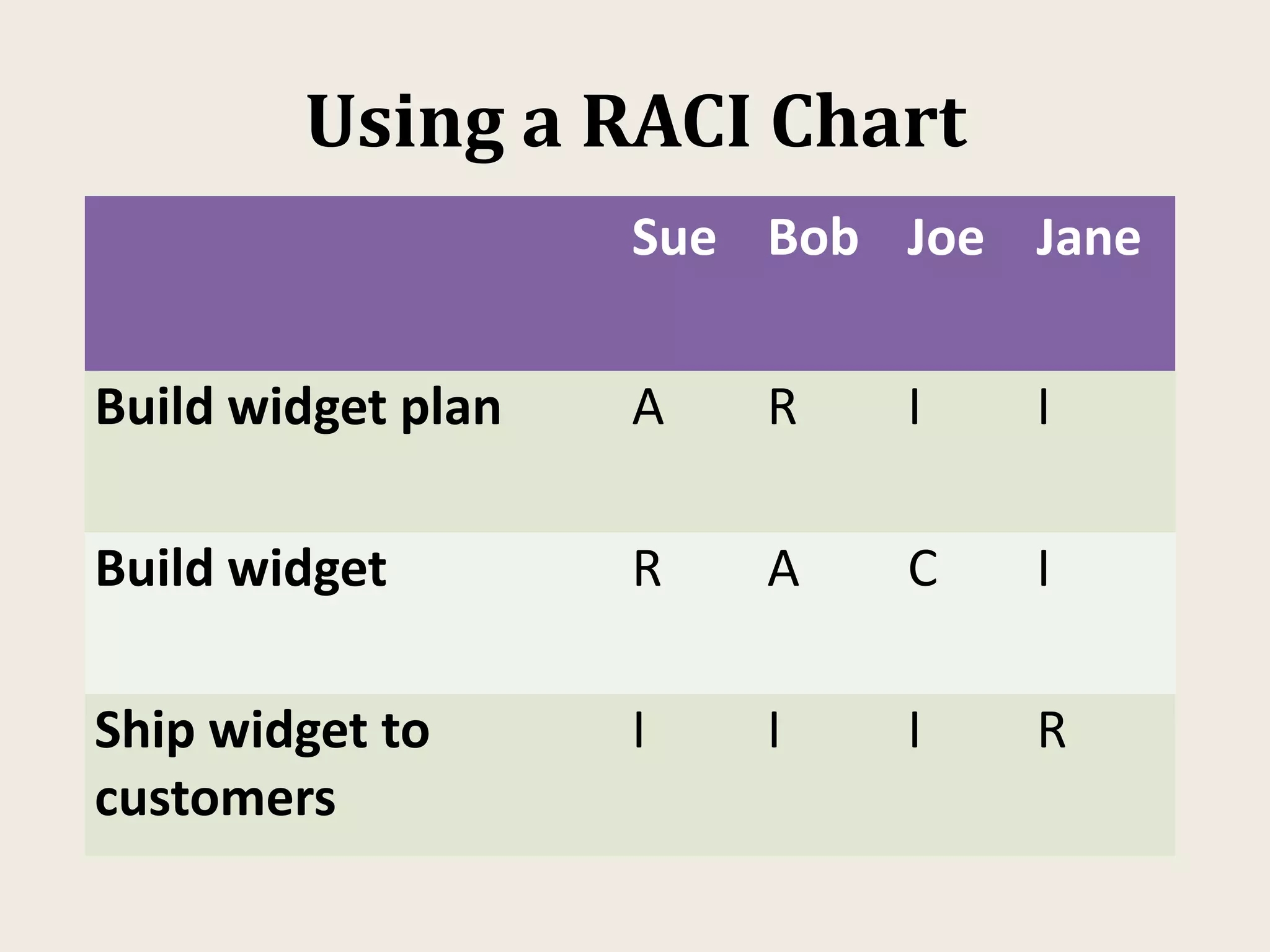
Using a RACI Chart
Sue Bob Joe Jane
Build widget plan A R I I
Build widget R A C I
Ship widget to
customers
I I I R
Module Seven: Review Questions
1. What is the art and science of planning, organizing, and managing
resources to ensure that a project is completed successfully?
a) Project management
b) Delegating appropriately
c) Placing blame
d) Avoiding all work
2. What does the Triple Constraint do?
a) Absolutely nothing worthwhile
b) Will do your projects for you
c) Illustrates the balance of the projects, scope, schedule, quality,
and cost
d) Wastes your time
Module Seven: Review Questions
3. During which phase does the project team define the
project scope, time, cost, and quality of the project?
a) Celebration phase
b) Last phase
c) Planning phase
d) Exercise phase
4. What will increase a cost increase?
a) New work clothes
b) Scope and time
c) Replacing upper management team
d) Everything
Module Seven: Review Questions
5. Whose job is it to identify how a change to a single element
will change the other elements?
a) The maintenance department
b) Project manager
c) New hire
d) Human resources
6. A good schedule will allow you to ______ and ___________
while you're working on a task.
a) Live, laugh
b) Sink, swim
c) Grow, change
d) Cry, shout
Module Seven: Review Questions
7. What's the preferred format for a personal task
management?
a) Simple, table-style format
b) Complex, matrix style format
c) Rubrics matrix
d) Reeves matrix
8. What should be in the first column?
a) Coworkers phone numbers
b) Names of team members
c) List of tasks to be performed
d) Due dates
Module Seven: Review Questions
9.What should be in the second column?
a)Specific duration of time for each task
b)Unrealistic time line
c) Delegated assignments
d)Cry for help
10.What does the letter I in RACI stand for?
a)Impossible
b)Irresponsible
c) Informed
d)Irreplaceable
Module Seven: Review Questions
1. What is the art and science of planning, organizing, and managing
resources to ensure that a project is completed successfully?
a) Project management
b) Delegating appropriately
c) Placing blame
d) Avoiding all work
2. What does the Triple Constraint do?
a) Absolutely nothing worthwhile
b) Will do your projects for you
c) Illustrates the balance of the projects, scope, schedule, quality,
and cost
d) Wastes your time
Module Seven: Review Questions
3. During which phase does the project team define the
project scope, time, cost, and quality of the project?
a) Celebration phase
b) Last phase
c) Planning phase
d) Exercise phase
4. What will increase a cost increase?
a) New work clothes
b) Scope and time
c) Replacing upper management team
d) Everything
Module Seven: Review Questions
5. Whose job is it to identify how a change to a single element
will change the other elements?
a) The maintenance department
b) Project manager
c) New hire
d) Human resources
6. A good schedule will allow you to ______ and ___________
while you're working on a task.
a) Live, laugh
b) Sink, swim
c) Grow, change
d) Cry, shout
Module Seven: Review Questions
7. What's the preferred format for a personal task
management?
a) Simple, table-style format
b) Complex, matrix style format
c) Rubrics matrix
d) Reeves matrix
8. What should be in the first column?
a) Coworkers phone numbers
b) Names of team members
c) List of tasks to be performed
d) Due dates
Module Seven: Review Questions
9.What should be in the second column?
a)Specific duration of time for each task
b)Unrealistic time line
c) Delegated assignments
d)Cry for help
10.What does the letter I in RACI stand for?
a)Impossible
b)Irresponsible
c) Informed
d)Irreplaceable
Module Eight:
Creating a Workspace
In order to be the most productive
that you can be, you must create the
appropriate environment. This
module will give you some ideas for
creating an effective, ergonomic
workspace in any office.
The journey of
a thousand
miles must
begin with a
single step.
Lao Tzu
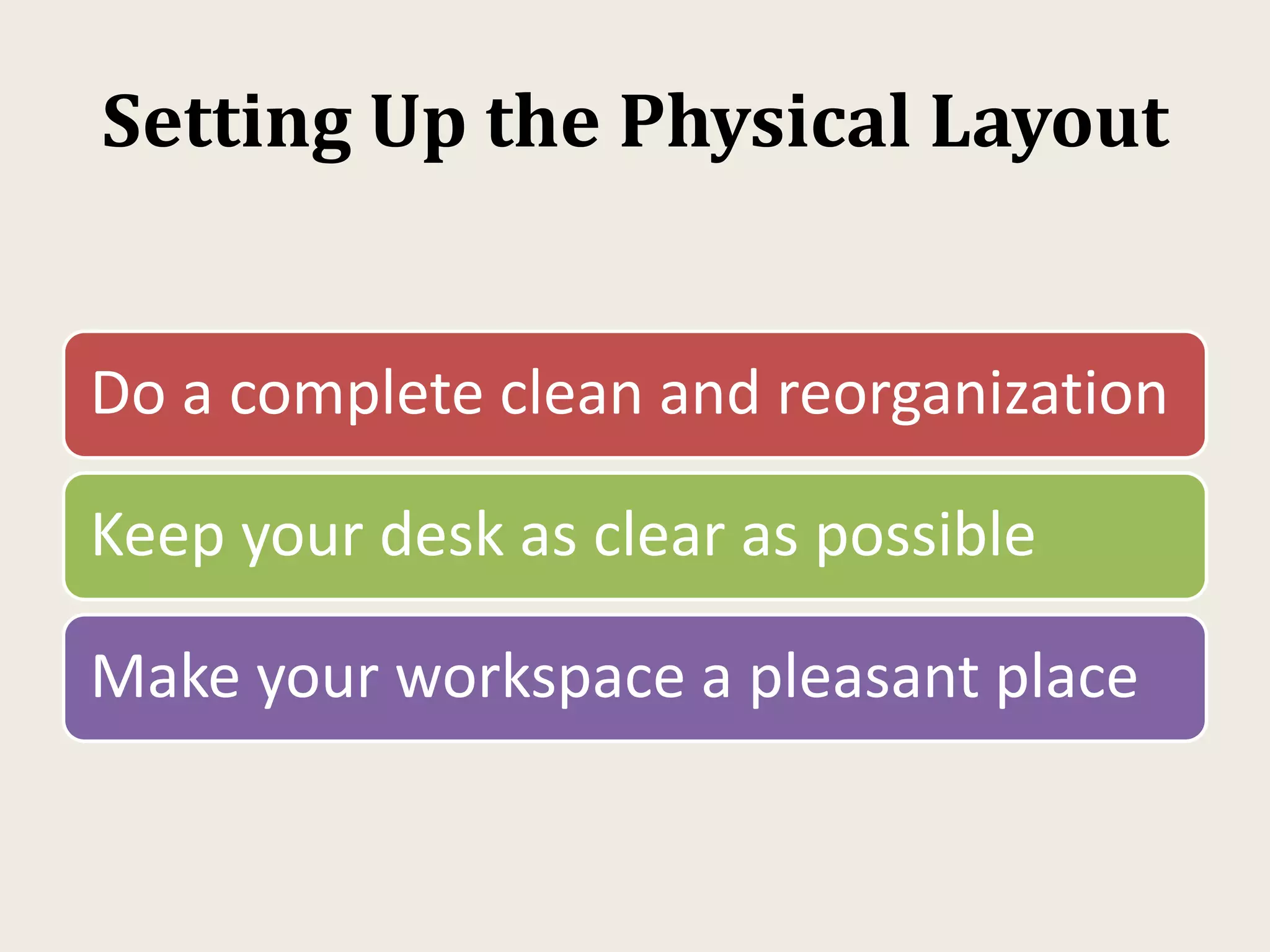
Setting Up the Physical Layout
Do a complete clean and reorganization
Keep your desk as clear as possible
Make your workspace a pleasant place
Ergonomics 101
Keep your back straight
Monitor viewing angle
Pay attention to your
body
Using Your Computer
Efficiently
Organize your Start
menu
Keep your virtual
desktop like your
real desk
Make use of
applications that
automate tasks for
you
Module Eight: Review Questions
1.What do you need to be the most productive?
a)To create the appropriate environment
b)A job and a paycheck
c) A willing partner
d)Someone to delegate to
2.What's one key aspect of an effective workspace?
a)Location of nearest coffee shop
b)Proximity to the bosses office
c) Physical layout
d)Team of people to do the work for you
Module Eight: Review Questions
3.How should you position the desk in your office?
a)As far away from the door as possible
b)In front of the door
c) Where it will receive maximum natural light
d)Closest to the restroom
4.Keep your desk as _________ as possible.
a)Clear
b)Littered
c) Disorganized
d)Animated
Module Eight: Review Questions
5. Do a complete clean and ___________ of your work
space once or twice a year?
a) Painting
b) Reorganization
c) Sanitizing
d) Designing
6. What should you focus on at work?
a) Changes you can make
b) Home
c) Late bills
d) Message boards
Module Eight: Review Questions
7. What is the term for how workers relate to their
environment?
a) Hostility
b) Passive-aggressive
c) Ergonomics
d) Devotion
8. It has been proven that particular __________ can increase
or decrease the risk of certain injuries and conditions.
a) Factors
b) People
c) Attitudes
d) Media outlets
Module Eight: Review Questions
9. What does RSI stand for?
a) Rarely simple information
b) Repetitive strain injuries
c) Really sad impact
d) Really steep incline
10.You want to make sure your monitor is __________ at
a comfortable viewing angle.
a) Low
b) High
c) Tilted
d) Comfortable
Module Eight: Review Questions
1.What do you need to be the most productive?
a)To create the appropriate environment
b)A job and a paycheck
c) A willing partner
d)Someone to delegate to
2.What's one key aspect of an effective workspace?
a)Location of nearest coffee shop
b)Proximity to the bosses office
c) Physical layout
d)Team of people to do the work for you
Module Eight: Review Questions
3.How should you position the desk in your office?
a)As far away from the door as possible
b)In front of the door
c) Where it will receive maximum natural light
d)Closest to the restroom
4.Keep your desk as _________ as possible.
a)Clear
b)Littered
c) Disorganized
d)Animated
Module Eight: Review Questions
5. Do a complete clean and ___________ of your work
space once or twice a year?
a) Painting
b) Reorganization
c) Sanitizing
d) Designing
6. What should you focus on at work?
a) Changes you can make
b) Home
c) Late bills
d) Message boards
Module Eight: Review Questions
7. What is the term for how workers relate to their
environment?
a) Hostility
b) Passive-aggressive
c) Ergonomics
d) Devotion
8. It has been proven that particular __________ can increase
or decrease the risk of certain injuries and conditions.
a) Factors
b) People
c) Attitudes
d) Media outlets
Module Eight: Review Questions
9. What does RSI stand for?
a) Rarely simple information
b) Repetitive strain injuries
c) Really sad impact
d) Really steep incline
10.You want to make sure your monitor is __________ at
a comfortable viewing angle.
a) Low
b) High
c) Tilted
d) Comfortable
Module Nine: Organizing
Files and Folders
Being able to find a particular piece
of information when you need it is
essential to being productive. This
module will give you some ways to
keep your files organized.
Out of clutter,
find Simplicity.
From discord,
find Harmony.
In the middle of
difficulty lies
Opportunity.
Albert Einstein
Organizing Paper Files
Archival files
Reference files
Working files
Organizing Electronic Files
Retrieve information quickly
A folder for each project
Appropriate sub-folders
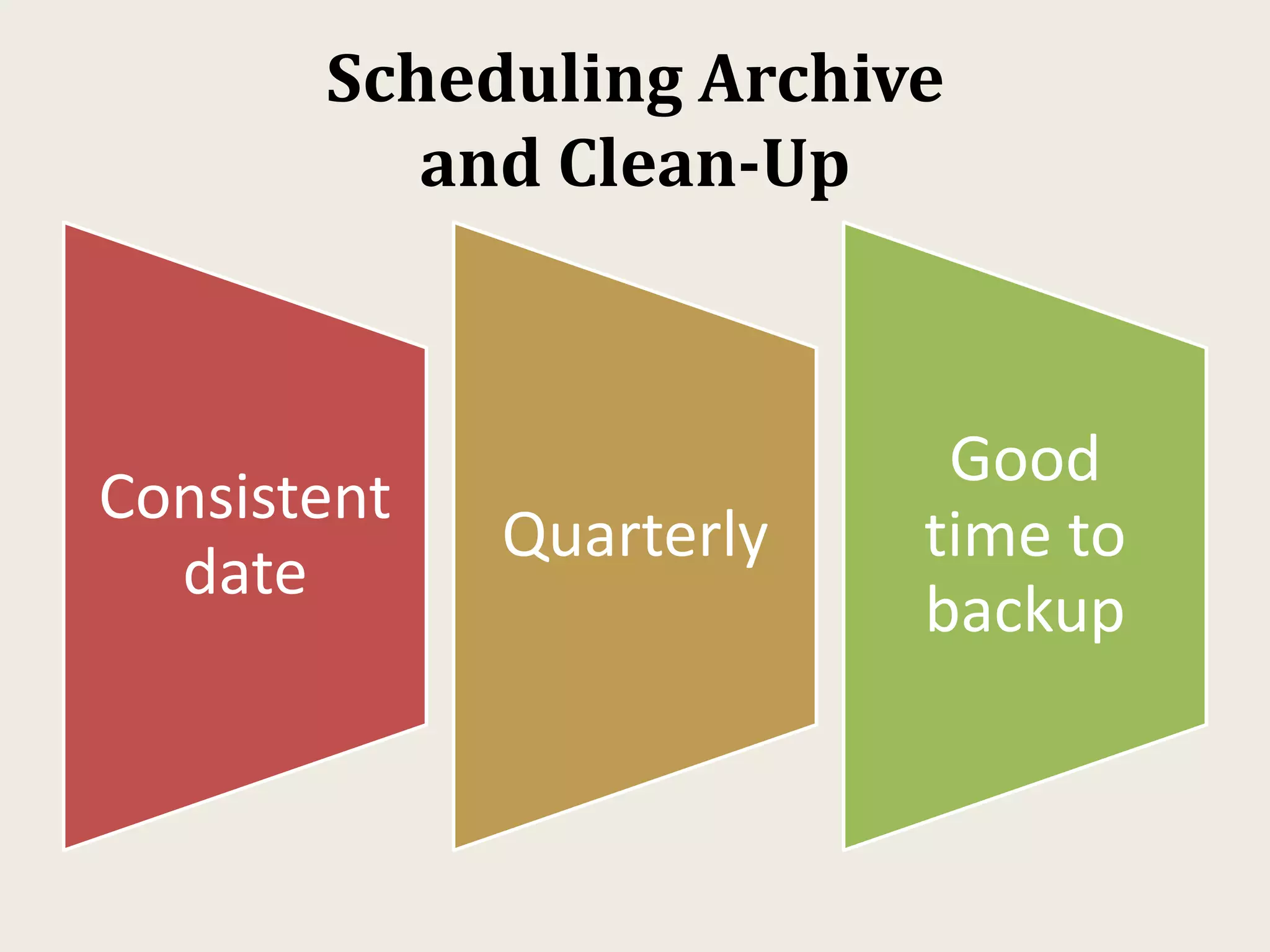
Scheduling Archive
and Clean-Up
Consistent
date
Quarterly
Good
time to
backup
Module Nine: Review Questions
1. Studies estimate that people spend how long looking for
things?
a) A lifetime
b) An hour and a half
c) Days
d) Weeks
2. What do you need in order to retrieve materials quickly?
a) An effective filing system
b) A maid
c) A spouse
d) A mess
Module Nine: Review Questions
3. Even with advanced search tools, it's important to
__________ your computer files.
a) Abandon
b) Neglect
c) Organize
d) Erase
4. Which is one of the most common ways of organizing files?
a) Dumping them in a drawer
b) Asking someone else to handle it
c) Creating a folder for each project
d) Avoiding the process altogether
Module Nine: Review Questions
5. Which of these are not operating system features?
a) Keywords
b) Flash drives
c) Tags
d) Jump lists
6. In order to keep your files organized you must clean up
and __________ your files.
a) Hide
b) Archive
c) Erase
d) Distribute
Module Nine: Review Questions
7. Which of these is not a system for archiving your data?
a) Back of drawer
b) Cd
c) External storage
d) DVD
8. After you've created folders, what else can you create?
a) A mess
b) Origami
c) Sub-folders
d) Hoopla
Module Nine: Review Questions
9. For email, you may want to create folders for
____________ with particular people.
a) Pictures
b) Correspondence
c) Jokes
d) Evidence
10.What are the three basic kinds of files?
a) Wood, rubber, air
b) Working, reference, archival
c) Waste, redundant, activity
d) Wrong, rare, absent
Module Nine: Review Questions
1. Studies estimate that people spend how long looking for
things?
a) A lifetime
b) An hour and a half
c) Days
d) Weeks
2. What do you need in order to retrieve materials quickly?
a) An effective filing system
b) A maid
c) A spouse
d) A mess
Module Nine: Review Questions
3. Even with advanced search tools, it's important to
__________ your computer files.
a) Abandon
b) Neglect
c) Organize
d) Erase
4. Which is one of the most common ways of organizing files?
a) Dumping them in a drawer
b) Asking someone else to handle it
c) Creating a folder for each project
d) Avoiding the process altogether
Module Nine: Review Questions
5. Which of these are not operating system features?
a) Keywords
b) Flash drives
c) Tags
d) Jump lists
6. In order to keep your files organized you must clean up
and __________ your files.
a) Hide
b) Archive
c) Erase
d) Distribute
Module Nine: Review Questions
7. Which of these is not a system for archiving your data?
a) Back of drawer
b) Cd
c) External storage
d) DVD
8. After you've created folders, what else can you create?
a) A mess
b) Origami
c) Sub-folders
d) Hoopla
Module Nine: Review Questions
9. For email, you may want to create folders for
____________ with particular people.
a) Pictures
b) Correspondence
c) Jokes
d) Evidence
10.What are the three basic kinds of files?
a) Wood, rubber, air
b) Working, reference, archival
c) Waste, redundant, activity
d) Wrong, rare, absent
Module Ten:
Managing E-Mail
E-mail can be a great time-saver, but
it can also be a great time waster,
too. This module will give you some
tools to manage your
e-mail time wisely.
To err is human,
but to really
foul things up
requires a
computer.
Anonymous
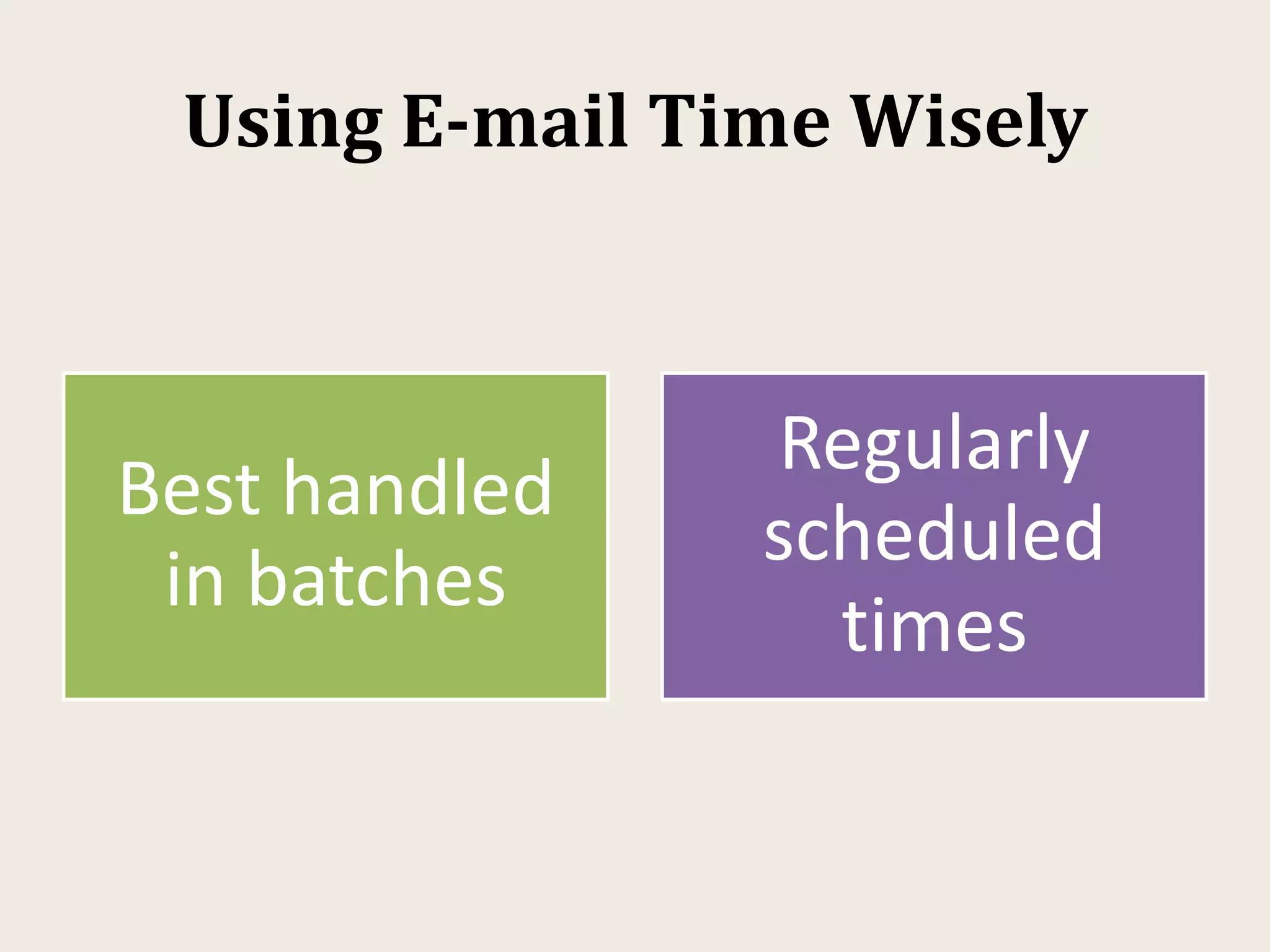
Using E-mail Time Wisely
Best handled
in batches
Regularly
scheduled
times
Taking Action!
Read it
File it
Delete it
Making the Most of
Your E-mail Program
Custom folders
Rules to move e-mails
Colored flags
Taking Time Back from
Handheld Devices
Turn off as many
notifications as possible
Give your number to
essential people only
Set your device to vibrate in
meetings, or turn it off if possible
Module Ten: Review Questions
1.Email can be a great ____________.
a)Nuisance
b)Joy
c) Time-saver
d)Headache
2.Email can also be a great ____________.
a)Disappointment
b)Time-waster
c) Distraction
d)Friend
Module Ten: Review Questions
3. Email is best handled in ____________.
a) The office
b) Batches
c) Private
d) Incognito
4. Set aside a period of time at the beginning of day,
before or after lunch, and at the ____ of your day.
a) Last
b) Best
c) End
d) Worst
Module Ten: Review Questions
5. Focus on getting your _________ cleaned out.
a) Locker
b) Purse
c) Inbox
d) Junk drawer
6. When reviewing your email, try to take ________ right
away.
a) A break
b) Action
c) Issue
d) Water
Module Ten: Review Questions
7. Which of these is not an example of taking action?
a) Read it, file or delete
b) Reply, file it
c) Reply, forward, reread
d) Forward it, file it
8. Most email programs include ___________ to save you
time.
a) Photos
b) Minions
c) Tools
d) Personal assistants
Module Ten: Review Questions
9. Which of these is not a favorite feature?
a) Attachments
b) Custom folders
c) Search tools
d) Junk mail filtering
10.______________ are the biggest obstacle toward
being more productive.
a) Coworkers
b) Emails
c) Disruptions
d) Bosses
Module Ten: Review Questions
1.Email can be a great ____________.
a)Nuisance
b)Joy
c) Time-saver
d)Headache
2.Email can also be a great ____________.
a)Disappointment
b)Time-waster
c) Distraction
d)Friend
Module Ten: Review Questions
3. Email is best handled in ____________.
a) The office
b) Batches
c) Private
d) Incognito
4. Set aside a period of time at the beginning of day,
before or after lunch, and at the ____ of your day.
a) Last
b) Best
c) End
d) Worst
Module Ten: Review Questions
5. Focus on getting your _________ cleaned out.
a) Locker
b) Purse
c) Inbox
d) Junk drawer
6. When reviewing your email, try to take ________ right
away.
a) A break
b) Action
c) Issue
d) Water
Module Ten: Review Questions
7. Which of these is not an example of taking action?
a) Read it, file or delete
b) Reply, file it
c) Reply, forward, reread
d) Forward it, file it
8. Most email programs include ___________ to save you
time.
a) Photos
b) Minions
c) Tools
d) Personal assistants
Module Ten: Review Questions
9. Which of these is not a favorite feature?
a) Attachments
b) Custom folders
c) Search tools
d) Junk mail filtering
10.______________ are the biggest obstacle toward
being more productive.
a) Coworkers
b) Emails
c) Disruptions
d) Bosses
Module Eleven: Tackling
Procrastination
Procrastination means delaying a
task that should be a priority. The
ability to overcome procrastination
and tackle the important actions that
have the biggest positive impact in
your life is a hallmark of the most
successful people out there.
How soon “not
now” becomes
“never.”
Martin Luther
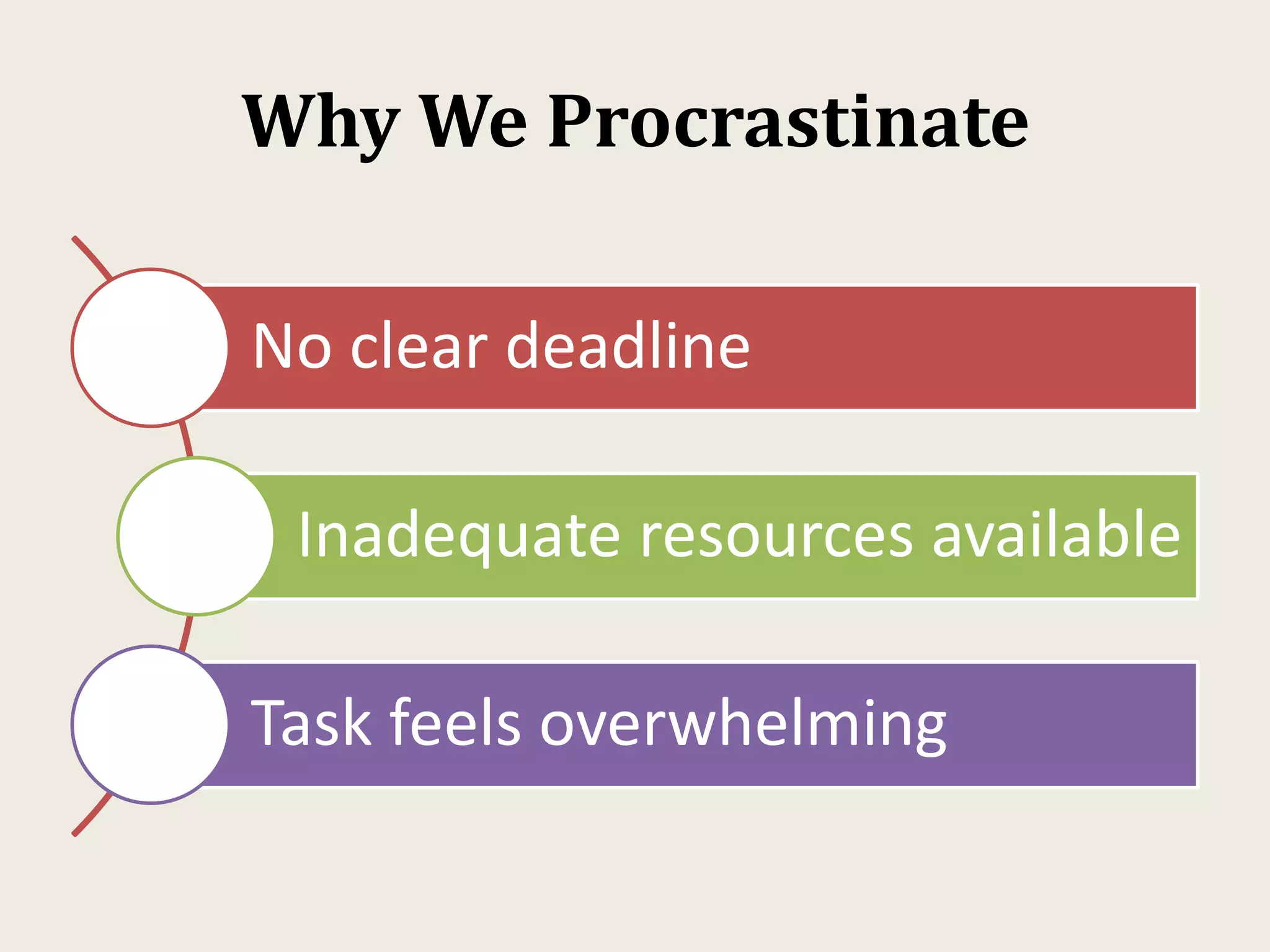
Why We Procrastinate
No clear deadline
Inadequate resources available
Task feels overwhelming
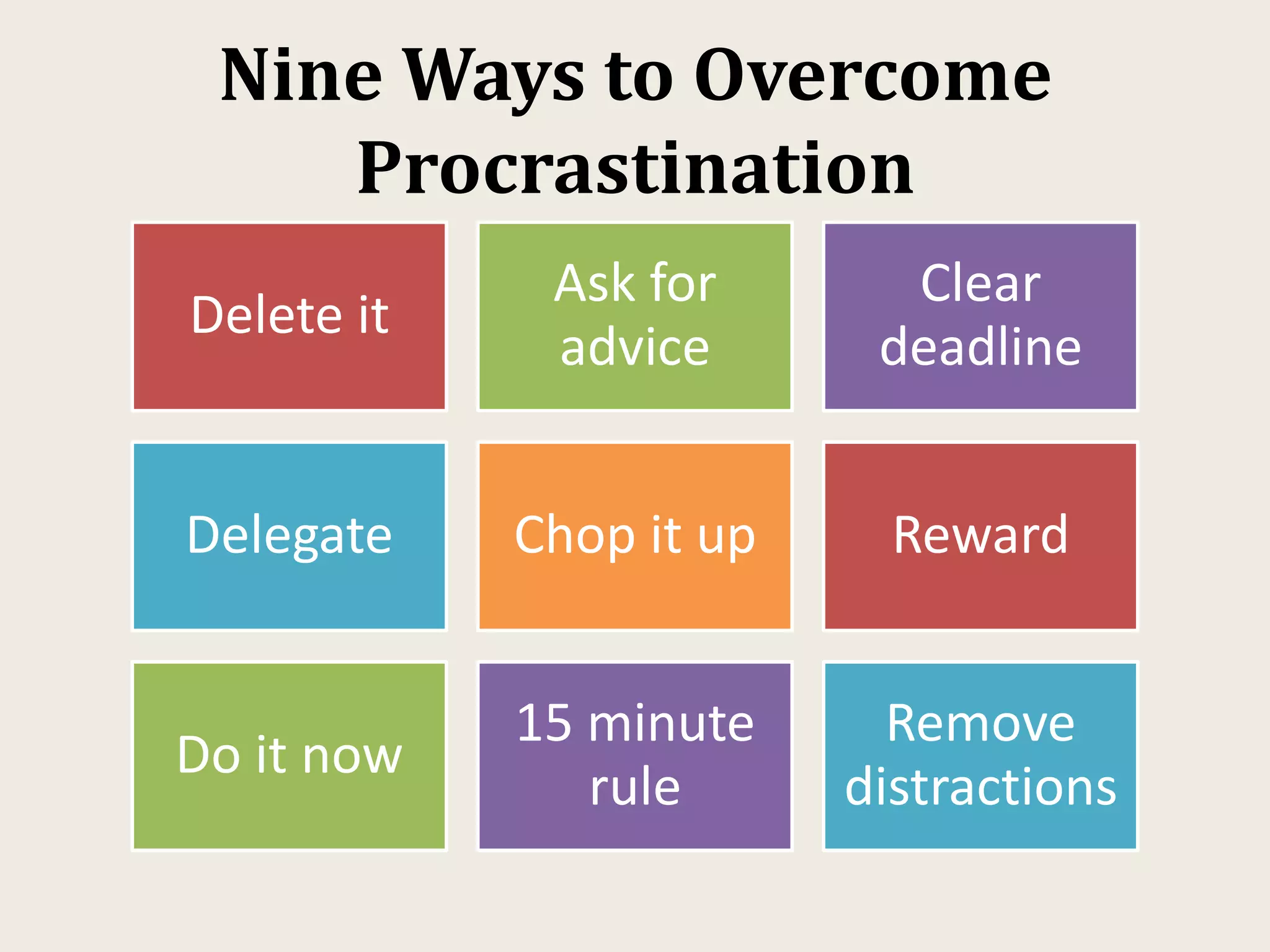
Nine Ways to Overcome
Procrastination
Delete it
Ask for
advice
Clear
deadline
Delegate Chop it up Reward
Do it now
15 minute
rule
Remove
distractions
Eat That Frog!
"If the first thing you have to do each morning is to
eat a live frog, you can go through the day with the
satisfaction of knowing that that is probably the worst
thing that is going to happen to you all day long!"
"If you have to eat two frogs, eat the ugliest one
first!"
Module Eleven: Review Questions
1. ______________ means delaying a task.
a) Spending
b) Celebrating
c) Procrastination
d) Moving
2. The ability to overcome procrastination in your life is a
__________ of the most successful people.
a) Pity
b) Hallmark
c) Waste
d) Curse
Module Eleven: Review Questions
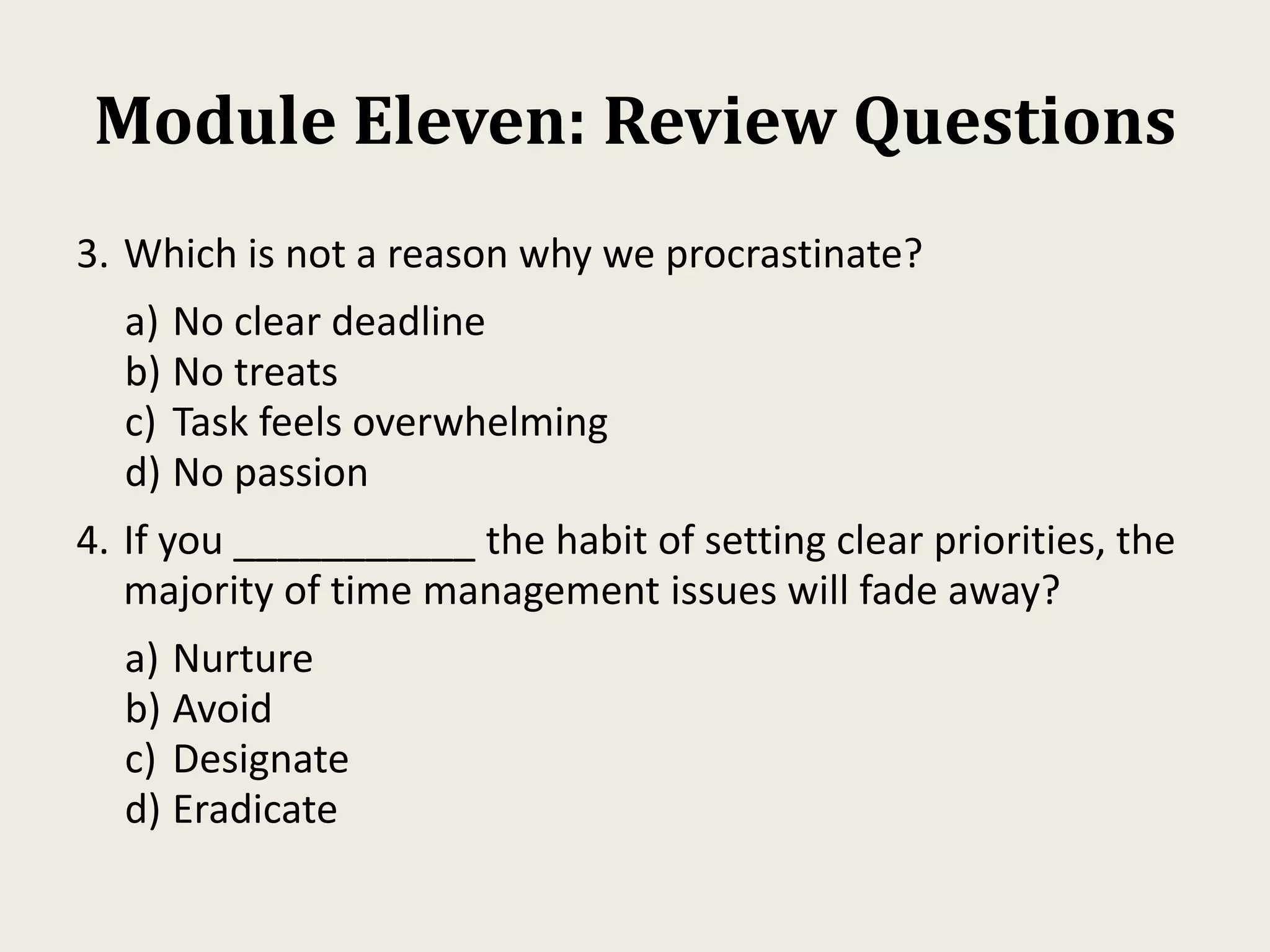
3. Which is not a reason why we procrastinate?
a) No clear deadline
b) No treats
c) Task feels overwhelming
d) No passion
4. If you ___________ the habit of setting clear priorities, the
majority of time management issues will fade away?
a) Nurture
b) Avoid
c) Designate
d) Eradicate
Module Eleven: Review Questions
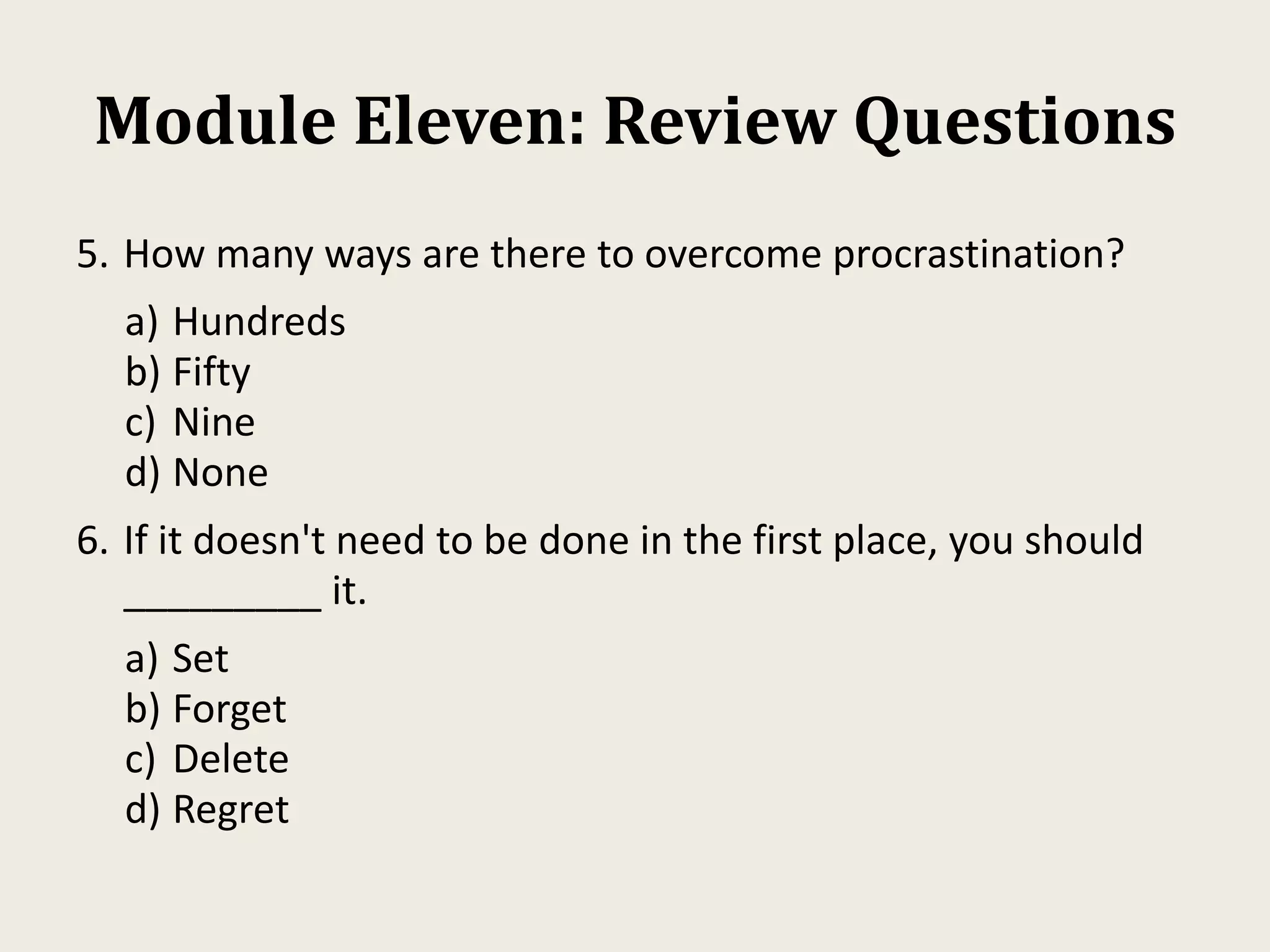
5. How many ways are there to overcome procrastination?
a) Hundreds
b) Fifty
c) Nine
d) None
6. If it doesn't need to be done in the first place, you should
_________ it.
a) Set
b) Forget
c) Delete
d) Regret
Module Eleven: Review Questions
7. Can the task be given to someone else is an example of
____________.
a) Laziness
b) Delegation
c) Interrogation
d) Intelligence
8. An example of seeking help from a trusted mentor would
be
a) Avoidance
b) Asking for advice
c) Making someone else do it
d) Filing it
Module Eleven: Review Questions
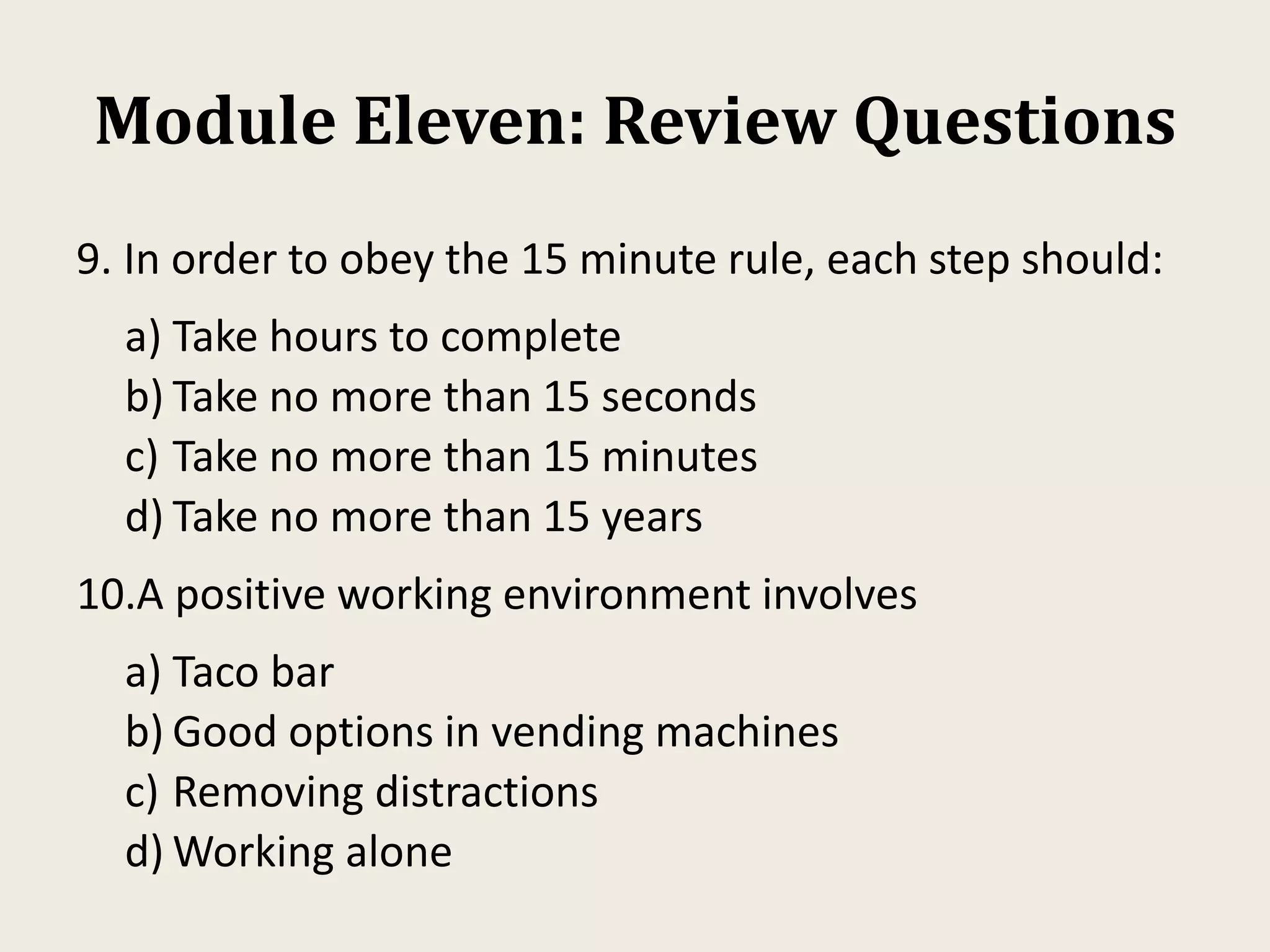
9. In order to obey the 15 minute rule, each step should:
a) Take hours to complete
b) Take no more than 15 seconds
c) Take no more than 15 minutes
d) Take no more than 15 years
10.A positive working environment involves
a) Taco bar
b) Good options in vending machines
c) Removing distractions
d) Working alone
Module Eleven: Review Questions
1. ______________ means delaying a task.
a) Spending
b) Celebrating
c) Procrastination
d) Moving
2. The ability to overcome procrastination in your life is a
__________ of the most successful people.
a) Pity
b) Hallmark
c) Waste
d) Curse
Module Eleven: Review Questions
3. Which is not a reason why we procrastinate?
a) No clear deadline
b) No treats
c) Task feels overwhelming
d) No passion
4. If you ___________ the habit of setting clear priorities, the
majority of time management issues will fade away?
a) Nurture
b) Avoid
c) Designate
d) Eradicate
Module Eleven: Review Questions
5. How many ways are there to overcome procrastination?
a) Hundreds
b) Fifty
c) Nine
d) None
6. If it doesn't need to be done in the first place, you should
_________ it.
a) Set
b) Forget
c) Delete
d) Regret
Module Eleven: Review Questions
7. Can the task be given to someone else is an example of
____________.
a) Laziness
b) Delegation
c) Interrogation
d) Intelligence
8. An example of seeking help from a trusted mentor would
be
a) Avoidance
b) Asking for advice
c) Making someone else do it
d) Filing it
Module Eleven: Review Questions
9. In order to obey the 15 minute rule, each step should:
a) Take hours to complete
b) Take no more than 15 seconds
c) Take no more than 15 minutes
d) Take no more than 15 years
10.A positive working environment involves
a) Taco bar
b) Good options in vending machines
c) Removing distractions
d) Working alone
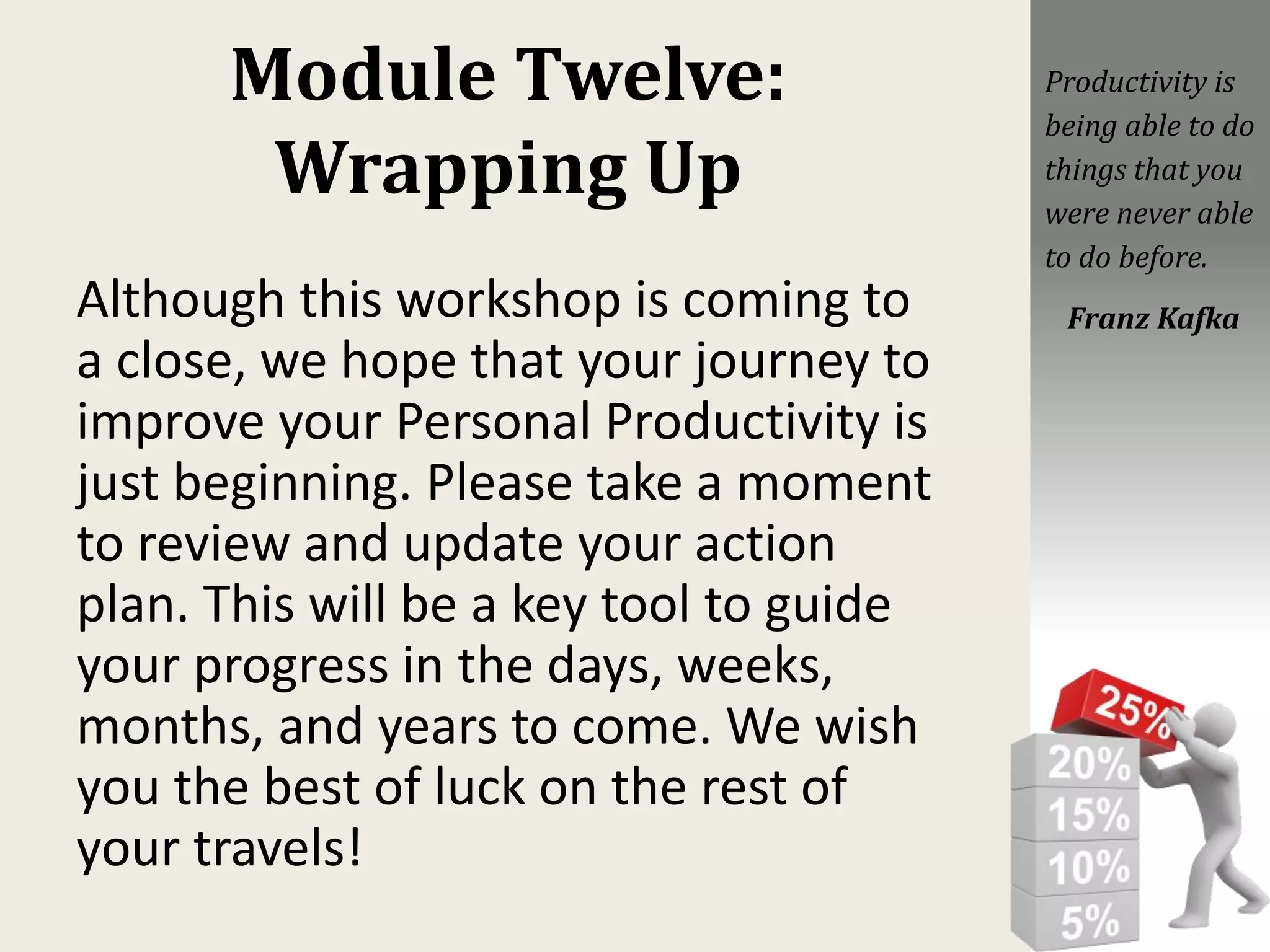
Module Twelve:
Wrapping Up
Although this workshop is coming to
a close, we hope that your journey to
improve your Personal Productivity is
just beginning. Please take a moment
to review and update your action
plan. This will be a key tool to guide
your progress in the days, weeks,
months, and years to come. We wish
you the best of luck on the rest of
your travels!
Productivity is
being able to do
things that you
were never able
to do before.
Franz Kafka
Words from the Wise
Will
Rogers
•Even if you are on the
right track, you'll get run
over if you just sit there.
Newell
D. Hillis
•Man must make his
choice between ease and
wealth; either may be
his, but not both.

Personal productivity ppt

  • 1.
  • 2.
    Module One: Getting Started Mostpeople find that they wish they had more time in a day. This workshop will show participants how to organize their lives and find those hidden moments. Part of being a winner is knowing when enough is enough. Sometimes you have to give up the fight and walk away, and move on to something that's more productive. Donald Trump
  • 3.
    Workshop Objectives Set goals Usescheduling tools Beat procrastination
  • 4.
    Module Two: Setting SMARTGoals Goal setting is critical to your personal productivity. It can be used in every single area of your life, including financial, physical, personal development, relationships, or even spiritual. Time is the stuff that life is made of. Benjamin Franklin
  • 5.
    The Three P’s PositivePersonal Possible
  • 6.
  • 7.
    Prioritizing Your Goals Providesfocus Greatest impact Conscious decision
  • 8.
    Evaluating and Adapting Whatpercentage of my goal did I achieve? What would I do differently next time? What is my next step?
  • 9.
    Module Two: ReviewQuestions 1. Complete this sentence. Goal setting is ____________ to your personal productivity. a) Critical b) Useful c) Meaningless d) Soothing 2. What is the single most important life skill that most people never learn to do properly? a) Eat their vegetables b) Run a marathon c) Setting smart goals d) Being on time
  • 10.
    Module Two: ReviewQuestions 3. Goal setting can be used in every single area of your life including physical, personal, spiritual, and ___________. a) Educational b) Financial c) Industrial d) Medical 4. Setting meaningful, ___________________ goals is a great step toward achieving your dreams. a) Big b) Short-term c) Long-term d) Impossible
  • 11.
    Module Two: ReviewQuestions 5.Accomplishing short-term ________ can help you accomplish tasks. a)Goals b)Dreams c)Careers d)Marriages 6.What are the three P's? a)Peace, pensiveness, persistence b)Priorities, purchases, personality c)Pension, passiveness, purpose d)Positive, personal, possible
  • 12.
    Module Two: ReviewQuestions 7.SMART is an acronym for what words? a)Silly, maddening, artistic, realistic, trailblazer b)Saturated, melodramatic, animal, redone, trouble c)Simple, manageable, alert, reasonable, traceable d)Specific, measurable, achievable, relevant, timed 8.Achieving challenging goals requires a lot of __________ energy. a)Magic b)Kinetic c)Exhausting d)Mental
  • 13.
    Module Two: ReviewQuestions 9. When you are prioritizing, choose a goal that will have the __________ impact on your life. a) Least b)Cheapest c) Better d)Greatest 10.As we grow and change, our goals should ___________ too. a) Change b)Disappear c) Increase d)Decrease
  • 14.
    Module Two: ReviewQuestions 1. Complete this sentence. Goal setting is ____________ to your personal productivity. a) Critical b) Useful c) Meaningless d) Soothing 2. What is the single most important life skill that most people never learn to do properly? a) Eat their vegetables b) Run a marathon c) Setting smart goals d) Being on time
  • 15.
    Module Two: ReviewQuestions 3. Goal setting can be used in every single area of your life including physical, personal, spiritual, and ___________. a) Educational b) Financial c) Industrial d) Medical 4. Setting meaningful, ___________________ goals is a great step toward achieving your dreams. a) Big b) Short-term c) Long-term d) Impossible
  • 16.
    Module Two: ReviewQuestions 5.Accomplishing short-term ________ can help you accomplish tasks. a)Goals b)Dreams c)Careers d)Marriages 6.What are the three P's? a)Peace, pensiveness, persistence b)Priorities, purchases, personality c)Pension, passiveness, purpose d)Positive, personal, possible
  • 17.
    Module Two: ReviewQuestions 7.SMART is an acronym for what words? a)Silly, maddening, artistic, realistic, trailblazer b)Saturated, melodramatic, animal, redone, trouble c)Simple, manageable, alert, reasonable, traceable d)Specific, measurable, achievable, relevant, timed 8.Achieving challenging goals requires a lot of __________ energy. a)Magic b)Kinetic c)Exhausting d)Mental
  • 18.
    Module Two: ReviewQuestions 9. When you are prioritizing, choose a goal that will have the __________ impact on your life. a) Least b)Cheapest c) Better d)Greatest 10.As we grow and change, our goals should ___________ too. a) Change b)Disappear c) Increase d)Decrease
  • 19.
    Module Three: The Powerof Routines For most people, the word “routine” typically conjures up an image of a boring, repetitive life, with every moment controlled and managed. But with routines, you end up having more energy to spend on the tasks that will bring you closer to your goals. Discipline is the bridge between goals and accomplishment. Jim Rohn
  • 20.
    What is aRoutine? Identify the task Identify the time and/or trigger Identify the sub-tasks
  • 21.
    Personal Routines Exercise: Tryto exercise for one hour three times a week Meals: Take a half hour each weekend to plan for the next week Sleep: Establish a routine for half an hour before you sleep
  • 22.
    Professional Routines Set asidea specific time to check email and news Set up a system for maintaining your task tracking system In the morning, perform your tasks in an organized, routine manner
  • 23.
    Six Easy Waysto Simplify Your Life Pay someone else to do it Use electronic banking Keep everyone organized Plan your meals Take advantage of shortcuts Save the difference
  • 24.
    Module Three: ReviewQuestions 1. Routines and rituals can actually help _________ the spontaneity and fun in your life. a) Increase b) Decrease c) Sap d) Eliminate 2. Routines allow you to have more __________ to spend on tasks. a) Room b) Money c) Energy d) Fun
  • 25.
    Module Three: ReviewQuestions 3. “Any practice regularly performed in a set manner” is a _________. a) Accident b) Coincidence c) Downfall d) Routine 4. Once you establish a routine it can ________________. a) Be set in stone b) Be difficult c) Be modified d) Be easy
  • 26.
    Module Three: ReviewQuestions 5. How many steps are there to building a routine? a) Three b) Five c) Tons d) One 6. Which is not one of the three easy steps to building a routine? a) Identifying the task b) Identifying yourself c) Identifying sub-tasks d) Identifying time or trigger
  • 27.
    Module Three: ReviewQuestions 7. Sleep, meals, and _____________ form the building blocks of our lives. a) Exercise b) Irritating c) Noise d) Distractions 8. Which can be considered a professional routine? a) Do tasks as they come up b) Don't worry about organization c) Set aside time to check email d) Have no plan
  • 28.
    Module Three: ReviewQuestions 9. Which of these is an easy way to simplify your life? a) Pay someone to do it b) Plan your meals c) Use electronic banking d) All of the above 10.Setting up a system for maintaining your task tracking system is an example of what? a) Too much work b) Laziness c) Professional routine d) Procrastinating
  • 29.
    Module Three: ReviewQuestions 1. Routines and rituals can actually help _________ the spontaneity and fun in your life. a) Increase b) Decrease c) Sap d) Eliminate 2. Routines allow you to have more __________ to spend on tasks. a) Room b) Money c) Energy d) Fun
  • 30.
    Module Three: ReviewQuestions 3. “Any practice regularly performed in a set manner” is a _________. a) Accident b) Coincidence c) Downfall d) Routine 4. Once you establish a routine it can ________________. a) Be set in stone b) Be difficult c) Be modified d) Be easy
  • 31.
    Module Three: ReviewQuestions 5. How many steps are there to building a routine? a) Three b) Five c) Tons d) One 6. Which is not one of the three easy steps to building a routine? a) Identifying the task b) Identifying yourself c) Identifying sub-tasks d) Identifying time or trigger
  • 32.
    Module Three: ReviewQuestions 7. Sleep, meals, and _____________ form the building blocks of our lives. a) Exercise b) Irritating c) Noise d) Distractions 8. Which can be considered a professional routine? a) Do tasks as they come up b) Don't worry about organization c) Set aside time to check email d) Have no plan
  • 33.
    Module Three: ReviewQuestions 9. Which of these is an easy way to simplify your life? a) Pay someone to do it b) Plan your meals c) Use electronic banking d) All of the above 10.Setting up a system for maintaining your task tracking system is an example of what? a) Too much work b) Laziness c) Professional routine d) Procrastinating
  • 34.
    Module Four: Scheduling Yourself Routinesand rituals should form the framework of your days at home and in the office. This module will explore how to schedule those tasks and activities in the most efficient way possible. Time is what we want most, but what we use worst. William Penn
  • 35.
    The Simple Secretof Successful Time Management No one-size-fits-all solution Explore different methods Find what works for you
  • 36.
    Developing a TrackingSystem Urgent and Important Important, Not Urgent Urgent, Not Important Not Urgent, Not Important
  • 37.
    Scheduling Appointments Block offquiet time to work at your desk Leave the best time for callers to call on your voice mail Strictly adhere to start and finish times for meetings Prepare a meeting agenda in advance
  • 38.
    Scheduling Tasks Break uplarge projects Delegate Allow for extra time when dealing with external parties
  • 39.
    Module Four: ReviewQuestions 1. Routines and _________ should form the framework of your days at home and in the office. a) Procrastination b) Difficult tasks c) Rituals d) Avoidance 2. There is no __________ to time management. a) Answer b) Path c) End d) Secret
  • 40.
    Module Four: ReviewQuestions 3. Electronic solutions are an example of a ___________ __________. a) Long road b) Difficult project c) Tracking system d) Sneaky tool 4. Which of these is not a step to making the most of your electronic solution? a) Taking time to learn about features of the application b) Keep all your email accounts for home and office together c) Adjust as much as you can d) Keep personal and professional tasks separate
  • 41.
    Module Four: ReviewQuestions 5. People who are traditionalists should try using a ________________ journal. a) Electronic files b) Post-it c) Productivity d) Memory 6. You can keep a ____________ calendar in the back of the journal. a) Long-term b) Short-term c) Yearly d) Activity
  • 42.
    Module Four: ReviewQuestions 7. What's the term for the concept that allows you to differentiate between important tasks and urgent tasks? a) Urgent/important matrix b) Important/non-urgent matrix c) Home/work matrix d) Work/task matrix 8. What is the concept of the urgent/important matrix called? a) Roosevelt principle b) Truman principle c) Eisenhower principle d) Trump principle
  • 43.
    Module Four: ReviewQuestions 9. Who rediscovered the Eisenhower Principle in 1994 and wrote a book centering on it? a) Truman Capote b) Stephen Covey c) Maeve Binchy d) John Grisham 10.Which is not a quadrant of the urgent/important matrix? a) Urgent and important b) Important, but not urgent c) Urgent and ethical d) Not urgent and not important
  • 44.
    Module Four: ReviewQuestions 1. Routines and _________ should form the framework of your days at home and in the office. a) Procrastination b) Difficult tasks c) Rituals d) Avoidance 2. There is no __________ to time management. a) Answer b) Path c) End d) Secret
  • 45.
    Module Four: ReviewQuestions 3. Electronic solutions are an example of a ___________ __________. a) Long road b) Difficult project c) Tracking system d) Sneaky tool 4. Which of these is not a step to making the most of your electronic solution? a) Taking time to learn about features of the application b) Keep all your email accounts for home and office together c) Adjust as much as you can d) Keep personal and professional tasks separate
  • 46.
    Module Four: ReviewQuestions 5. People who are traditionalists should try using a ________________ journal. a) Electronic files b) Post-it c) Productivity d) Memory 6. You can keep a ____________ calendar in the back of the journal. a) Long-term b) Short-term c) Yearly d) Activity
  • 47.
    Module Four: ReviewQuestions 7. What's the term for the concept that allows you to differentiate between important tasks and urgent tasks? a) Urgent/important matrix b) Important/non-urgent matrix c) Home/work matrix d) Work/task matrix 8. What is the concept of the urgent/important matrix called? a) Roosevelt principle b) Truman principle c) Eisenhower principle d) Trump principle
  • 48.
    Module Four: ReviewQuestions 9. Who rediscovered the Eisenhower Principle in 1994 and wrote a book centering on it? a) Truman Capote b) Stephen Covey c) Maeve Binchy d) John Grisham 10.Which is not a quadrant of the urgent/important matrix? a) Urgent and important b) Important, but not urgent c) Urgent and ethical d) Not urgent and not important
  • 49.
    Module Five: Keeping Yourselfon Top of Tasks Even after you’ve got a plan in place, it’s important to keep adjusting your plan so that you can stay in control of your time. This module will give you some ways to help you stay on top of your to-do list. Ordinary people think merely of spending time. Great people think of using it. Anonymous
  • 50.
    The One-Minute Rule Quickreplies to e-mails Accept a meeting invitation Quick stretches
  • 51.
    The Five-Minute Rule Cleanyour desk Work on a stuck project Clear out your inbox
  • 52.
    What To DoWhen You Feel Like You’re Sinking First, take a deep breath Make a list of all the tasks that are outstanding Look at your calendar Identify the three most important Start work on the most critical item
  • 53.
    Module Five: ReviewQuestions 1. Even if you have a plan in place, it's important to keep ___________ your plan so you can stay in control. a) Adjusting b) Avoiding c) Regretting d) Forgetting 2. What's the name of the rule for tasks that can be done in sixty seconds or less? a) Five minute rule b) Not enough time rule c) One minute rule d) Impossible task rule
  • 54.
    Module Five: ReviewQuestions 3. What can be accomplished utilizing the five-minute rule? a) Writing a presentation b) Creating an employee handbook c) Cleaning off one part of your desk d) Creating new files for all of your correspondence 4. Which of these can you do when you feel like you're sinking? a) Give up and find another line of work b) Make a list of outstanding tasks and mark due dates on them c) Contemplate on them d) Assign them to someone else
  • 55.
    Module Five: ReviewQuestions 5. Like all other plans, you'll probably need to ________ your to-do items and priorities once you've completed a few tasks. a) Revisit b) Eliminate c) Discard d) Hide 6. After you've created a plan for the most important items you should do what? a) Celebrate with a night out b) Transfer them to your tracking system c) Take a break, you deserve it d) Create more plans and weigh your options later
  • 56.
    Module Five: ReviewQuestions 7. When is a good time to clear you mind and take a deep breath? a) When you leave the office everyday b) Before heading into the office c) Every time you are called into a meeting d) When you feel like you are sinking 8. If you're stuck on a task, set aside five _________ each hour to work on it? a) Seconds b) Assignments c) Tasks d) Minutes
  • 57.
    Module Five: ReviewQuestions 9. Which of these can you do in 60 seconds or less? a) Run around the block b) Put together a presentation c) Accept a meeting invitation d) Complete all of your assigned tasks 10.Quick email replies, stretches, reviewing new RSS feeds are examples of what? a) Things you can do in less than a minute b) Fun things that don't require any thought c) Procrastination techniques d) Stressful, meaningless tasks
  • 58.
    Module Five: ReviewQuestions 1. Even if you have a plan in place, it's important to keep ___________ your plan so you can stay in control. a) Adjusting b) Avoiding c) Regretting d) Forgetting 2. What's the name of the rule for tasks that can be done in sixty seconds or less? a) Five minute rule b) Not enough time rule c) One minute rule d) Impossible task rule
  • 59.
    Module Five: ReviewQuestions 3. What can be accomplished utilizing the five-minute rule? a) Writing a presentation b) Creating an employee handbook c) Cleaning off one part of your desk d) Creating new files for all of your correspondence 4. Which of these can you do when you feel like you're sinking? a) Give up and find another line of work b) Make a list of outstanding tasks and mark due dates on them c) Contemplate on them d) Assign them to someone else
  • 60.
    Module Five: ReviewQuestions 5. Like all other plans, you'll probably need to ________ your to-do items and priorities once you've completed a few tasks. a) Revisit b) Eliminate c) Discard d) Hide 6. After you've created a plan for the most important items you should do what? a) Celebrate with a night out b) Transfer them to your tracking system c) Take a break, you deserve it d) Create more plans and weigh your options later
  • 61.
    Module Five: ReviewQuestions 7. When is a good time to clear you mind and take a deep breath? a) When you leave the office everyday b) Before heading into the office c) Every time you are called into a meeting d) When you feel like you are sinking 8. If you're stuck on a task, set aside five _________ each hour to work on it? a) Seconds b) Assignments c) Tasks d) Minutes
  • 62.
    Module Five: ReviewQuestions 9. Which of these can you do in 60 seconds or less? a) Run around the block b) Put together a presentation c) Accept a meeting invitation d) Complete all of your assigned tasks 10.Quick email replies, stretches, reviewing new RSS feeds are examples of what? a) Things you can do in less than a minute b) Fun things that don't require any thought c) Procrastination techniques d) Stressful, meaningless tasks
  • 63.
    Module Six: TacklingNew Tasks and Projects When you’re assigned a new task or project, it’s important to create a plan at the beginning so you get off to a good start. This module will look at some different techniques that you can use to tackle new to-do items. The surest way to be late is to have plenty of time. Leo Kennedy
  • 64.
  • 65.
    A Checklist forGetting Started What is the date I will start this task? What is the deadline? What are the major things that need to be completed? What work has already been completed?
  • 66.
  • 67.
    Module Six: ReviewQuestions 1. What can you do to get a good start when you're assigned a new task? a) Create a plan b) Run for the hills c) Go on vacation d) Quit your job 2. When organizing and planning, try to create the right ______ plan for the task. a) Left b) Fake c) Size d) Angle
  • 68.
    Module Six: ReviewQuestions 3. Which of these would you want to spend several days or weeks planning? a) Lunch b) Small projects c) Complex projects d) Late projects 4. Which tasks may only require a to-do list and a calendar? a) Small tasks b) Laundry lists c) Large tasks d) Impossible tasks
  • 69.
    Module Six: ReviewQuestions 5. What kind of tasks would you use RACI charts or storyboards for? a) Large tasks b) Homework assignments c) Medium tasks d) Small tasks 6. For large tasks consider using which of the following? a) Grocery lists b) Birthday gifts c) Gantt charts d) Medium tasks
  • 70.
    Module Six: ReviewQuestions 7. You must understand what _________ are appropriate for different size projects. a) Tools b) Pens c) Computers d) People 8. Online time tracking dashboards would be used for _________? a) Small, easy tasks b) Chores at home c) Large tasks d) Online gaming
  • 71.
    Module Six: ReviewQuestions 9. Visual time lines would be for: a) Simple tasks b) Large tasks c) Medium tasks d) Tasks with photos 10.Organizing your inbox is an example of what size task? a) Large task b) Small task c) Mundane task d) Medium task
  • 72.
    Module Six: ReviewQuestions 1. What can you do to get a good start when you're assigned a new task? a) Create a plan b) Run for the hills c) Go on vacation d) Quit your job 2. When organizing and planning, try to create the right ______ plan for the task. a) Left b) Fake c) Size d) Angle
  • 73.
    Module Six: ReviewQuestions 3. Which of these would you want to spend several days or weeks planning? a) Lunch b) Small projects c) Complex projects d) Late projects 4. Which tasks may only require a to-do list and a calendar? a) Small tasks b) Laundry lists c) Large tasks d) Impossible tasks
  • 74.
    Module Six: ReviewQuestions 5. What kind of tasks would you use RACI charts or storyboards for? a) Large tasks b) Homework assignments c) Medium tasks d) Small tasks 6. For large tasks consider using which of the following? a) Grocery lists b) Birthday gifts c) Gantt charts d) Medium tasks
  • 75.
    Module Six: ReviewQuestions 7. You must understand what _________ are appropriate for different size projects. a) Tools b) Pens c) Computers d) People 8. Online time tracking dashboards would be used for _________? a) Small, easy tasks b) Chores at home c) Large tasks d) Online gaming
  • 76.
    Module Six: ReviewQuestions 9. Visual time lines would be for: a) Simple tasks b) Large tasks c) Medium tasks d) Tasks with photos 10.Organizing your inbox is an example of what size task? a) Large task b) Small task c) Mundane task d) Medium task
  • 77.
    Module Seven: UsingProject Management Techniques This module will give you an introduction to key project management techniques and ideas and show you how to use them to become more productive. A project is complete when it starts working for you, rather than you working for it. Scott Allen
  • 78.
  • 79.
    Creating the Schedule Resourcescan perform activities simultaneously Indicate milestones in your schedule Include deliverables with the milestones Include lag and lead time in your tasks
  • 80.
    Using a RACIChart Sue Bob Joe Jane Build widget plan A R I I Build widget R A C I Ship widget to customers I I I R
  • 81.
    Module Seven: ReviewQuestions 1. What is the art and science of planning, organizing, and managing resources to ensure that a project is completed successfully? a) Project management b) Delegating appropriately c) Placing blame d) Avoiding all work 2. What does the Triple Constraint do? a) Absolutely nothing worthwhile b) Will do your projects for you c) Illustrates the balance of the projects, scope, schedule, quality, and cost d) Wastes your time
  • 82.
    Module Seven: ReviewQuestions 3. During which phase does the project team define the project scope, time, cost, and quality of the project? a) Celebration phase b) Last phase c) Planning phase d) Exercise phase 4. What will increase a cost increase? a) New work clothes b) Scope and time c) Replacing upper management team d) Everything
  • 83.
    Module Seven: ReviewQuestions 5. Whose job is it to identify how a change to a single element will change the other elements? a) The maintenance department b) Project manager c) New hire d) Human resources 6. A good schedule will allow you to ______ and ___________ while you're working on a task. a) Live, laugh b) Sink, swim c) Grow, change d) Cry, shout
  • 84.
    Module Seven: ReviewQuestions 7. What's the preferred format for a personal task management? a) Simple, table-style format b) Complex, matrix style format c) Rubrics matrix d) Reeves matrix 8. What should be in the first column? a) Coworkers phone numbers b) Names of team members c) List of tasks to be performed d) Due dates
  • 85.
    Module Seven: ReviewQuestions 9.What should be in the second column? a)Specific duration of time for each task b)Unrealistic time line c) Delegated assignments d)Cry for help 10.What does the letter I in RACI stand for? a)Impossible b)Irresponsible c) Informed d)Irreplaceable
  • 86.
    Module Seven: ReviewQuestions 1. What is the art and science of planning, organizing, and managing resources to ensure that a project is completed successfully? a) Project management b) Delegating appropriately c) Placing blame d) Avoiding all work 2. What does the Triple Constraint do? a) Absolutely nothing worthwhile b) Will do your projects for you c) Illustrates the balance of the projects, scope, schedule, quality, and cost d) Wastes your time
  • 87.
    Module Seven: ReviewQuestions 3. During which phase does the project team define the project scope, time, cost, and quality of the project? a) Celebration phase b) Last phase c) Planning phase d) Exercise phase 4. What will increase a cost increase? a) New work clothes b) Scope and time c) Replacing upper management team d) Everything
  • 88.
    Module Seven: ReviewQuestions 5. Whose job is it to identify how a change to a single element will change the other elements? a) The maintenance department b) Project manager c) New hire d) Human resources 6. A good schedule will allow you to ______ and ___________ while you're working on a task. a) Live, laugh b) Sink, swim c) Grow, change d) Cry, shout
  • 89.
    Module Seven: ReviewQuestions 7. What's the preferred format for a personal task management? a) Simple, table-style format b) Complex, matrix style format c) Rubrics matrix d) Reeves matrix 8. What should be in the first column? a) Coworkers phone numbers b) Names of team members c) List of tasks to be performed d) Due dates
  • 90.
    Module Seven: ReviewQuestions 9.What should be in the second column? a)Specific duration of time for each task b)Unrealistic time line c) Delegated assignments d)Cry for help 10.What does the letter I in RACI stand for? a)Impossible b)Irresponsible c) Informed d)Irreplaceable
  • 91.
    Module Eight: Creating aWorkspace In order to be the most productive that you can be, you must create the appropriate environment. This module will give you some ideas for creating an effective, ergonomic workspace in any office. The journey of a thousand miles must begin with a single step. Lao Tzu
  • 92.
    Setting Up thePhysical Layout Do a complete clean and reorganization Keep your desk as clear as possible Make your workspace a pleasant place
  • 93.
    Ergonomics 101 Keep yourback straight Monitor viewing angle Pay attention to your body
  • 94.
    Using Your Computer Efficiently Organizeyour Start menu Keep your virtual desktop like your real desk Make use of applications that automate tasks for you
  • 95.
    Module Eight: ReviewQuestions 1.What do you need to be the most productive? a)To create the appropriate environment b)A job and a paycheck c) A willing partner d)Someone to delegate to 2.What's one key aspect of an effective workspace? a)Location of nearest coffee shop b)Proximity to the bosses office c) Physical layout d)Team of people to do the work for you
  • 96.
    Module Eight: ReviewQuestions 3.How should you position the desk in your office? a)As far away from the door as possible b)In front of the door c) Where it will receive maximum natural light d)Closest to the restroom 4.Keep your desk as _________ as possible. a)Clear b)Littered c) Disorganized d)Animated
  • 97.
    Module Eight: ReviewQuestions 5. Do a complete clean and ___________ of your work space once or twice a year? a) Painting b) Reorganization c) Sanitizing d) Designing 6. What should you focus on at work? a) Changes you can make b) Home c) Late bills d) Message boards
  • 98.
    Module Eight: ReviewQuestions 7. What is the term for how workers relate to their environment? a) Hostility b) Passive-aggressive c) Ergonomics d) Devotion 8. It has been proven that particular __________ can increase or decrease the risk of certain injuries and conditions. a) Factors b) People c) Attitudes d) Media outlets
  • 99.
    Module Eight: ReviewQuestions 9. What does RSI stand for? a) Rarely simple information b) Repetitive strain injuries c) Really sad impact d) Really steep incline 10.You want to make sure your monitor is __________ at a comfortable viewing angle. a) Low b) High c) Tilted d) Comfortable
  • 100.
    Module Eight: ReviewQuestions 1.What do you need to be the most productive? a)To create the appropriate environment b)A job and a paycheck c) A willing partner d)Someone to delegate to 2.What's one key aspect of an effective workspace? a)Location of nearest coffee shop b)Proximity to the bosses office c) Physical layout d)Team of people to do the work for you
  • 101.
    Module Eight: ReviewQuestions 3.How should you position the desk in your office? a)As far away from the door as possible b)In front of the door c) Where it will receive maximum natural light d)Closest to the restroom 4.Keep your desk as _________ as possible. a)Clear b)Littered c) Disorganized d)Animated
  • 102.
    Module Eight: ReviewQuestions 5. Do a complete clean and ___________ of your work space once or twice a year? a) Painting b) Reorganization c) Sanitizing d) Designing 6. What should you focus on at work? a) Changes you can make b) Home c) Late bills d) Message boards
  • 103.
    Module Eight: ReviewQuestions 7. What is the term for how workers relate to their environment? a) Hostility b) Passive-aggressive c) Ergonomics d) Devotion 8. It has been proven that particular __________ can increase or decrease the risk of certain injuries and conditions. a) Factors b) People c) Attitudes d) Media outlets
  • 104.
    Module Eight: ReviewQuestions 9. What does RSI stand for? a) Rarely simple information b) Repetitive strain injuries c) Really sad impact d) Really steep incline 10.You want to make sure your monitor is __________ at a comfortable viewing angle. a) Low b) High c) Tilted d) Comfortable
  • 105.
    Module Nine: Organizing Filesand Folders Being able to find a particular piece of information when you need it is essential to being productive. This module will give you some ways to keep your files organized. Out of clutter, find Simplicity. From discord, find Harmony. In the middle of difficulty lies Opportunity. Albert Einstein
  • 106.
    Organizing Paper Files Archivalfiles Reference files Working files
  • 107.
    Organizing Electronic Files Retrieveinformation quickly A folder for each project Appropriate sub-folders
  • 108.
  • 109.
    Module Nine: ReviewQuestions 1. Studies estimate that people spend how long looking for things? a) A lifetime b) An hour and a half c) Days d) Weeks 2. What do you need in order to retrieve materials quickly? a) An effective filing system b) A maid c) A spouse d) A mess
  • 110.
    Module Nine: ReviewQuestions 3. Even with advanced search tools, it's important to __________ your computer files. a) Abandon b) Neglect c) Organize d) Erase 4. Which is one of the most common ways of organizing files? a) Dumping them in a drawer b) Asking someone else to handle it c) Creating a folder for each project d) Avoiding the process altogether
  • 111.
    Module Nine: ReviewQuestions 5. Which of these are not operating system features? a) Keywords b) Flash drives c) Tags d) Jump lists 6. In order to keep your files organized you must clean up and __________ your files. a) Hide b) Archive c) Erase d) Distribute
  • 112.
    Module Nine: ReviewQuestions 7. Which of these is not a system for archiving your data? a) Back of drawer b) Cd c) External storage d) DVD 8. After you've created folders, what else can you create? a) A mess b) Origami c) Sub-folders d) Hoopla
  • 113.
    Module Nine: ReviewQuestions 9. For email, you may want to create folders for ____________ with particular people. a) Pictures b) Correspondence c) Jokes d) Evidence 10.What are the three basic kinds of files? a) Wood, rubber, air b) Working, reference, archival c) Waste, redundant, activity d) Wrong, rare, absent
  • 114.
    Module Nine: ReviewQuestions 1. Studies estimate that people spend how long looking for things? a) A lifetime b) An hour and a half c) Days d) Weeks 2. What do you need in order to retrieve materials quickly? a) An effective filing system b) A maid c) A spouse d) A mess
  • 115.
    Module Nine: ReviewQuestions 3. Even with advanced search tools, it's important to __________ your computer files. a) Abandon b) Neglect c) Organize d) Erase 4. Which is one of the most common ways of organizing files? a) Dumping them in a drawer b) Asking someone else to handle it c) Creating a folder for each project d) Avoiding the process altogether
  • 116.
    Module Nine: ReviewQuestions 5. Which of these are not operating system features? a) Keywords b) Flash drives c) Tags d) Jump lists 6. In order to keep your files organized you must clean up and __________ your files. a) Hide b) Archive c) Erase d) Distribute
  • 117.
    Module Nine: ReviewQuestions 7. Which of these is not a system for archiving your data? a) Back of drawer b) Cd c) External storage d) DVD 8. After you've created folders, what else can you create? a) A mess b) Origami c) Sub-folders d) Hoopla
  • 118.
    Module Nine: ReviewQuestions 9. For email, you may want to create folders for ____________ with particular people. a) Pictures b) Correspondence c) Jokes d) Evidence 10.What are the three basic kinds of files? a) Wood, rubber, air b) Working, reference, archival c) Waste, redundant, activity d) Wrong, rare, absent
  • 119.
    Module Ten: Managing E-Mail E-mailcan be a great time-saver, but it can also be a great time waster, too. This module will give you some tools to manage your e-mail time wisely. To err is human, but to really foul things up requires a computer. Anonymous
  • 120.
    Using E-mail TimeWisely Best handled in batches Regularly scheduled times
  • 121.
  • 122.
    Making the Mostof Your E-mail Program Custom folders Rules to move e-mails Colored flags
  • 123.
    Taking Time Backfrom Handheld Devices Turn off as many notifications as possible Give your number to essential people only Set your device to vibrate in meetings, or turn it off if possible
  • 124.
    Module Ten: ReviewQuestions 1.Email can be a great ____________. a)Nuisance b)Joy c) Time-saver d)Headache 2.Email can also be a great ____________. a)Disappointment b)Time-waster c) Distraction d)Friend
  • 125.
    Module Ten: ReviewQuestions 3. Email is best handled in ____________. a) The office b) Batches c) Private d) Incognito 4. Set aside a period of time at the beginning of day, before or after lunch, and at the ____ of your day. a) Last b) Best c) End d) Worst
  • 126.
    Module Ten: ReviewQuestions 5. Focus on getting your _________ cleaned out. a) Locker b) Purse c) Inbox d) Junk drawer 6. When reviewing your email, try to take ________ right away. a) A break b) Action c) Issue d) Water
  • 127.
    Module Ten: ReviewQuestions 7. Which of these is not an example of taking action? a) Read it, file or delete b) Reply, file it c) Reply, forward, reread d) Forward it, file it 8. Most email programs include ___________ to save you time. a) Photos b) Minions c) Tools d) Personal assistants
  • 128.
    Module Ten: ReviewQuestions 9. Which of these is not a favorite feature? a) Attachments b) Custom folders c) Search tools d) Junk mail filtering 10.______________ are the biggest obstacle toward being more productive. a) Coworkers b) Emails c) Disruptions d) Bosses
  • 129.
    Module Ten: ReviewQuestions 1.Email can be a great ____________. a)Nuisance b)Joy c) Time-saver d)Headache 2.Email can also be a great ____________. a)Disappointment b)Time-waster c) Distraction d)Friend
  • 130.
    Module Ten: ReviewQuestions 3. Email is best handled in ____________. a) The office b) Batches c) Private d) Incognito 4. Set aside a period of time at the beginning of day, before or after lunch, and at the ____ of your day. a) Last b) Best c) End d) Worst
  • 131.
    Module Ten: ReviewQuestions 5. Focus on getting your _________ cleaned out. a) Locker b) Purse c) Inbox d) Junk drawer 6. When reviewing your email, try to take ________ right away. a) A break b) Action c) Issue d) Water
  • 132.
    Module Ten: ReviewQuestions 7. Which of these is not an example of taking action? a) Read it, file or delete b) Reply, file it c) Reply, forward, reread d) Forward it, file it 8. Most email programs include ___________ to save you time. a) Photos b) Minions c) Tools d) Personal assistants
  • 133.
    Module Ten: ReviewQuestions 9. Which of these is not a favorite feature? a) Attachments b) Custom folders c) Search tools d) Junk mail filtering 10.______________ are the biggest obstacle toward being more productive. a) Coworkers b) Emails c) Disruptions d) Bosses
  • 134.
    Module Eleven: Tackling Procrastination Procrastinationmeans delaying a task that should be a priority. The ability to overcome procrastination and tackle the important actions that have the biggest positive impact in your life is a hallmark of the most successful people out there. How soon “not now” becomes “never.” Martin Luther
  • 135.
    Why We Procrastinate Noclear deadline Inadequate resources available Task feels overwhelming
  • 136.
    Nine Ways toOvercome Procrastination Delete it Ask for advice Clear deadline Delegate Chop it up Reward Do it now 15 minute rule Remove distractions
  • 137.
    Eat That Frog! "Ifthe first thing you have to do each morning is to eat a live frog, you can go through the day with the satisfaction of knowing that that is probably the worst thing that is going to happen to you all day long!" "If you have to eat two frogs, eat the ugliest one first!"
  • 138.
    Module Eleven: ReviewQuestions 1. ______________ means delaying a task. a) Spending b) Celebrating c) Procrastination d) Moving 2. The ability to overcome procrastination in your life is a __________ of the most successful people. a) Pity b) Hallmark c) Waste d) Curse
  • 139.
    Module Eleven: ReviewQuestions 3. Which is not a reason why we procrastinate? a) No clear deadline b) No treats c) Task feels overwhelming d) No passion 4. If you ___________ the habit of setting clear priorities, the majority of time management issues will fade away? a) Nurture b) Avoid c) Designate d) Eradicate
  • 140.
    Module Eleven: ReviewQuestions 5. How many ways are there to overcome procrastination? a) Hundreds b) Fifty c) Nine d) None 6. If it doesn't need to be done in the first place, you should _________ it. a) Set b) Forget c) Delete d) Regret
  • 141.
    Module Eleven: ReviewQuestions 7. Can the task be given to someone else is an example of ____________. a) Laziness b) Delegation c) Interrogation d) Intelligence 8. An example of seeking help from a trusted mentor would be a) Avoidance b) Asking for advice c) Making someone else do it d) Filing it
  • 142.
    Module Eleven: ReviewQuestions 9. In order to obey the 15 minute rule, each step should: a) Take hours to complete b) Take no more than 15 seconds c) Take no more than 15 minutes d) Take no more than 15 years 10.A positive working environment involves a) Taco bar b) Good options in vending machines c) Removing distractions d) Working alone
  • 143.
    Module Eleven: ReviewQuestions 1. ______________ means delaying a task. a) Spending b) Celebrating c) Procrastination d) Moving 2. The ability to overcome procrastination in your life is a __________ of the most successful people. a) Pity b) Hallmark c) Waste d) Curse
  • 144.
    Module Eleven: ReviewQuestions 3. Which is not a reason why we procrastinate? a) No clear deadline b) No treats c) Task feels overwhelming d) No passion 4. If you ___________ the habit of setting clear priorities, the majority of time management issues will fade away? a) Nurture b) Avoid c) Designate d) Eradicate
  • 145.
    Module Eleven: ReviewQuestions 5. How many ways are there to overcome procrastination? a) Hundreds b) Fifty c) Nine d) None 6. If it doesn't need to be done in the first place, you should _________ it. a) Set b) Forget c) Delete d) Regret
  • 146.
    Module Eleven: ReviewQuestions 7. Can the task be given to someone else is an example of ____________. a) Laziness b) Delegation c) Interrogation d) Intelligence 8. An example of seeking help from a trusted mentor would be a) Avoidance b) Asking for advice c) Making someone else do it d) Filing it
  • 147.
    Module Eleven: ReviewQuestions 9. In order to obey the 15 minute rule, each step should: a) Take hours to complete b) Take no more than 15 seconds c) Take no more than 15 minutes d) Take no more than 15 years 10.A positive working environment involves a) Taco bar b) Good options in vending machines c) Removing distractions d) Working alone
  • 148.
    Module Twelve: Wrapping Up Althoughthis workshop is coming to a close, we hope that your journey to improve your Personal Productivity is just beginning. Please take a moment to review and update your action plan. This will be a key tool to guide your progress in the days, weeks, months, and years to come. We wish you the best of luck on the rest of your travels! Productivity is being able to do things that you were never able to do before. Franz Kafka
  • 149.
    Words from theWise Will Rogers •Even if you are on the right track, you'll get run over if you just sit there. Newell D. Hillis •Man must make his choice between ease and wealth; either may be his, but not both.