creative problem solving improving possibility
plan KM in PB Design PROCESS model
WARNING!
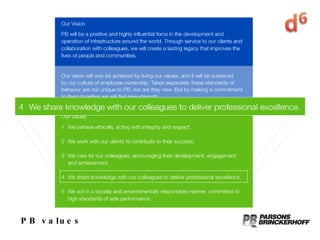
PB values
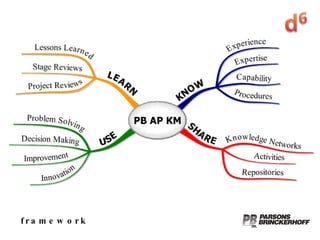
framework
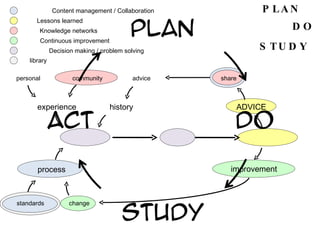
DO PLAN STUDY experience personal community history advice ADVICE share improvement process standards change Content management / Collaboration  Lessons learned Knowledge networks Continuous improvement Decision making / problem solving library
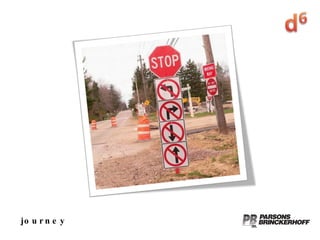
journey
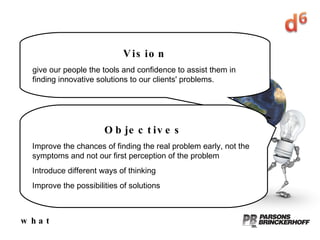
what Vision give our people the tools and confidence to assist them in finding innovative solutions to our clients' problems. Objectives Improve the chances of finding the real problem early, not the symptoms and not our first perception of the problem Introduce different ways of thinking Improve the possibilities of solutions
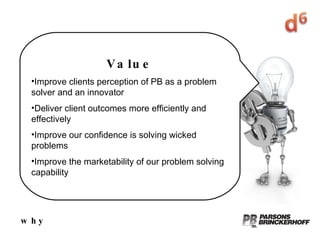
why Value Improve clients perception of PB as a problem solver and an innovator Deliver client outcomes more efficiently and effectively Improve our confidence is solving wicked problems Improve the marketability of our problem solving capability
 
initiative Creative Problem Solving Pilot Jun-Oct 2008 Problem Solving Model Nov 2008-Jan 2009
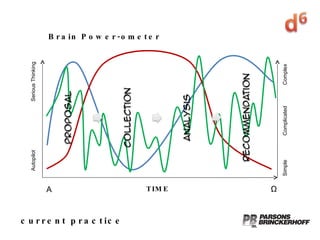
current practice Brain Power-ometer Autopilot Serious Thinking Simple Complicated Complex TIME Α Ω
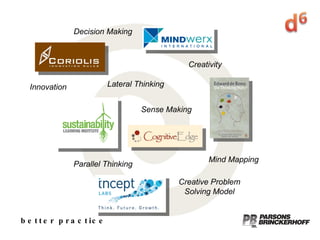
better practice Creative Problem Solving Model Sense Making Mind Mapping Decision Making Innovation Parallel Thinking Lateral Thinking Creativity
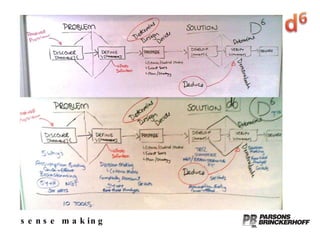
sense making
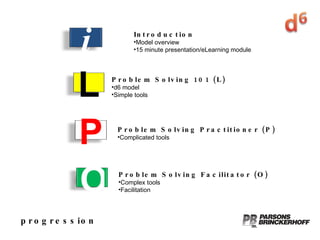
progression L Problem Solving 101 (L) d6 model Simple tools P Problem Solving Practitioner (P) Complicated tools O Problem Solving Facilitator (O) Complex tools Facilitation Introduction Model overview 15 minute presentation/eLearning module i
 
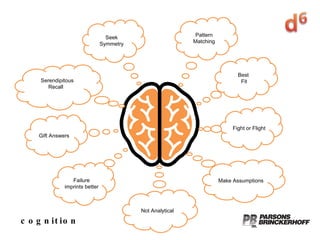
cognition Pattern Matching Gift Answers Failure imprints better Seek Symmetry Make Assumptions Best  Fit Fight or Flight Serendipitous Recall Not Analytical
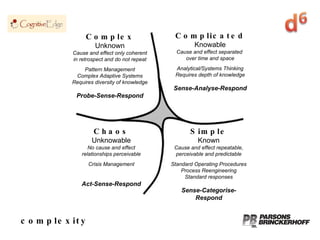
complexity Complicated Knowable Cause and effect separated  over time and space Analytical/Systems Thinking Requires depth of knowledge Sense-Analyse-Respond Simple Known Cause and effect repeatable, perceivable and predictable Standard Operating Procedures Process Reengineering Standard responses Sense-Categorise-Respond Complex Unknown Cause and effect only coherent in retrospect and do not repeat Pattern Management Complex Adaptive Systems Requires diversity of knowledge Probe-Sense-Respond Chaos Unknowable No cause and effect relationships perceivable Crisis Management Act-Sense-Respond
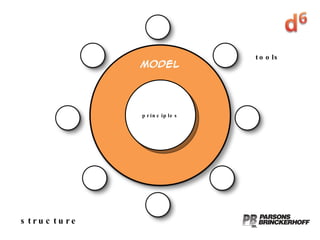
structure principles tools
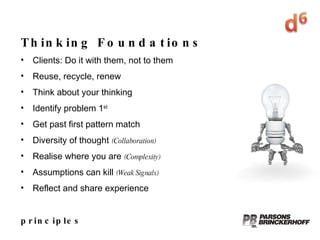
principles Thinking Foundations Clients: Do it with them, not to them Reuse, recycle, renew Think about your thinking Identify problem 1 st   Get past first pattern match Diversity of thought  (Collaboration) Realise where you are  (Complexity) Assumptions can kill  (Weak Signals) Reflect and share experience
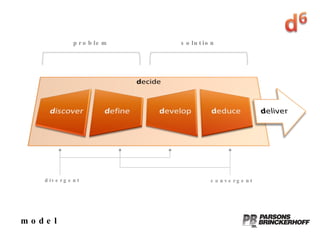
model problem solution divergent convergent
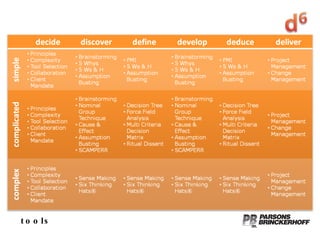
tools
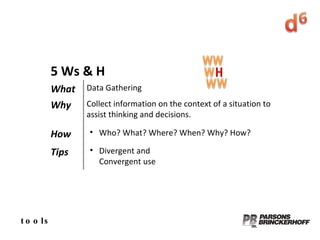
tools 5 Ws & H What Data Gathering Why Collect information on the context of a situation to assist thinking and decisions. How Who? What? Where? When? Why? How? Tips Divergent and  Convergent use
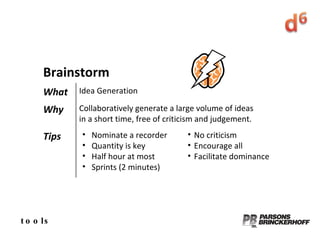
tools Brainstorm What Idea Generation Why Collaboratively generate a large volume of ideas  in a short time, free of criticism and judgement. Tips Nominate a recorder Quantity is key Half hour at most Sprints (2 minutes) No criticism Encourage all Facilitate dominance
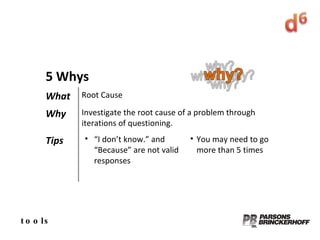
tools 5 Whys What Root Cause Why Investigate the root cause of a problem through iterations of questioning. Tips “ I don’t know.” and “Because” are not valid responses You may need to go more than 5 times
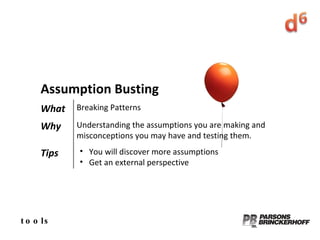
tools Assumption Busting What Breaking Patterns Why Understanding the assumptions you are making and misconceptions you may have and testing them. Tips You will discover more assumptions Get an external perspective
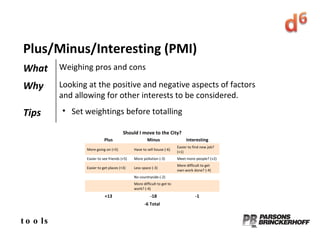
tools Should I move to the City? Plus Minus Interesting More going on (+5) Have to sell house (-6) Easier to find new job? (+1) Easier to see friends (+5) More pollution (-3) Meet more people? (+2) Easier to get places (+3) Less space (-3) More difficult to get own work done? (-4)   No countryside (-2)     More difficult to get to work? (-4)   +13 -18 -1 -6 Total Plus/Minus/Interesting (PMI) What Weighing pros and cons Why Looking at the positive and negative aspects of factors and allowing for other interests to be considered. Tips Set weightings before totalling
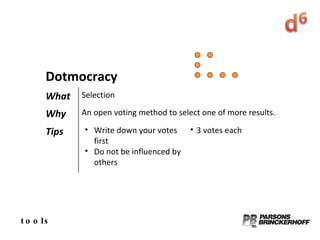
tools Dotmocracy What Selection Why An open voting method to select one of more results. Tips Write down your votes first Do not be influenced by others 3 votes each
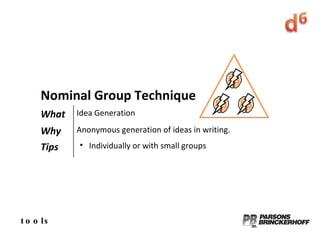
tools Nominal Group Technique What Idea Generation Why Anonymous generation of ideas in writing. Tips Individually or with small groups
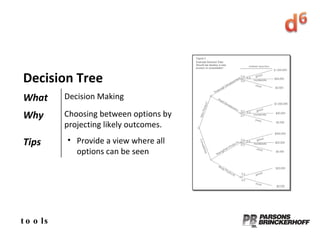
tools Decision Tree What Decision Making  Why Choosing between options by projecting likely outcomes. Tips Provide a view where all options can be seen
q&a
knowledgebucket.wik.is
thankyou Cory Banks Knowledge Manager [email_address] Twitter:  @corza Profile:  www.linkedin.com/in/corza Blog:  corzandeffect.wordpress.com Bookmarks:  delicious.com/corza

Creative Problem Solving

  • 1.
    creative problem solvingimproving possibility
  • 2.
    plan KM inPB Design PROCESS model
  • 3.
  • 4.
  • 5.
  • 6.
    DO PLAN STUDYexperience personal community history advice ADVICE share improvement process standards change Content management / Collaboration Lessons learned Knowledge networks Continuous improvement Decision making / problem solving library
  • 7.
  • 8.
    what Vision giveour people the tools and confidence to assist them in finding innovative solutions to our clients' problems. Objectives Improve the chances of finding the real problem early, not the symptoms and not our first perception of the problem Introduce different ways of thinking Improve the possibilities of solutions
  • 9.
    why Value Improveclients perception of PB as a problem solver and an innovator Deliver client outcomes more efficiently and effectively Improve our confidence is solving wicked problems Improve the marketability of our problem solving capability
  • 10.
  • 11.
    initiative Creative ProblemSolving Pilot Jun-Oct 2008 Problem Solving Model Nov 2008-Jan 2009
  • 12.
    current practice BrainPower-ometer Autopilot Serious Thinking Simple Complicated Complex TIME Α Ω
  • 13.
    better practice CreativeProblem Solving Model Sense Making Mind Mapping Decision Making Innovation Parallel Thinking Lateral Thinking Creativity
  • 14.
  • 15.
    progression L ProblemSolving 101 (L) d6 model Simple tools P Problem Solving Practitioner (P) Complicated tools O Problem Solving Facilitator (O) Complex tools Facilitation Introduction Model overview 15 minute presentation/eLearning module i
  • 16.
  • 17.
    cognition Pattern MatchingGift Answers Failure imprints better Seek Symmetry Make Assumptions Best Fit Fight or Flight Serendipitous Recall Not Analytical
  • 18.
    complexity Complicated KnowableCause and effect separated over time and space Analytical/Systems Thinking Requires depth of knowledge Sense-Analyse-Respond Simple Known Cause and effect repeatable, perceivable and predictable Standard Operating Procedures Process Reengineering Standard responses Sense-Categorise-Respond Complex Unknown Cause and effect only coherent in retrospect and do not repeat Pattern Management Complex Adaptive Systems Requires diversity of knowledge Probe-Sense-Respond Chaos Unknowable No cause and effect relationships perceivable Crisis Management Act-Sense-Respond
  • 19.
  • 20.
    principles Thinking FoundationsClients: Do it with them, not to them Reuse, recycle, renew Think about your thinking Identify problem 1 st Get past first pattern match Diversity of thought (Collaboration) Realise where you are (Complexity) Assumptions can kill (Weak Signals) Reflect and share experience
  • 21.
    model problem solutiondivergent convergent
  • 22.
  • 23.
    tools 5 Ws& H What Data Gathering Why Collect information on the context of a situation to assist thinking and decisions. How Who? What? Where? When? Why? How? Tips Divergent and Convergent use
  • 24.
    tools Brainstorm WhatIdea Generation Why Collaboratively generate a large volume of ideas in a short time, free of criticism and judgement. Tips Nominate a recorder Quantity is key Half hour at most Sprints (2 minutes) No criticism Encourage all Facilitate dominance
  • 25.
    tools 5 WhysWhat Root Cause Why Investigate the root cause of a problem through iterations of questioning. Tips “ I don’t know.” and “Because” are not valid responses You may need to go more than 5 times
  • 26.
    tools Assumption BustingWhat Breaking Patterns Why Understanding the assumptions you are making and misconceptions you may have and testing them. Tips You will discover more assumptions Get an external perspective
  • 27.
    tools Should Imove to the City? Plus Minus Interesting More going on (+5) Have to sell house (-6) Easier to find new job? (+1) Easier to see friends (+5) More pollution (-3) Meet more people? (+2) Easier to get places (+3) Less space (-3) More difficult to get own work done? (-4)   No countryside (-2)     More difficult to get to work? (-4)   +13 -18 -1 -6 Total Plus/Minus/Interesting (PMI) What Weighing pros and cons Why Looking at the positive and negative aspects of factors and allowing for other interests to be considered. Tips Set weightings before totalling
  • 28.
    tools Dotmocracy WhatSelection Why An open voting method to select one of more results. Tips Write down your votes first Do not be influenced by others 3 votes each
  • 29.
    tools Nominal GroupTechnique What Idea Generation Why Anonymous generation of ideas in writing. Tips Individually or with small groups
  • 30.
    tools Decision TreeWhat Decision Making Why Choosing between options by projecting likely outcomes. Tips Provide a view where all options can be seen
  • 31.
  • 32.
  • 33.
    thankyou Cory BanksKnowledge Manager [email_address] Twitter: @corza Profile: www.linkedin.com/in/corza Blog: corzandeffect.wordpress.com Bookmarks: delicious.com/corza

Editor's Notes

  • #5 www.pb.com.au / www.pbworld.com Our company PB is one of the world’s leading planning, environment and infrastructure firms. We employ over 10,000 people worldwide to work with our clients to reach their desired project and program outcomes. We are focused on delivering practical solutions, and our experience has allowed us to build lasting relationships with our clients. We are proud that the majority of our work comes from repeat purchase, and that our clients consistently rate us ‘best practice’ for both our technical delivery and our client service. We combine our core capabilities in design, planning and management with new approaches to project delivery. Our ability and experience in working with various financing arrangements — such as PPPs, alliances, design–bid–build, build–own–operate, and design–build–finance — mean that we can respond effectively to your project’s challenges. Our services Our services are comprehensive, and we can provide total project delivery on projects of any scale. We employ drafters, engineers from many disciplines (including civil, mechanical, structural, electrical, chemical, geotechnical and acoustic), economists, consultation experts, environmental scientists, planners, geospatial information system specialists, project and program managers, construction managers and management consultants. Principal services  Planning studies, feasibility analysis and investigation  Environmental studies and management  Design  Project and program management  Construction management  Strategic consulting Transport  Aviation  Ports and marine  Rail  Roads  Transit Resources and Industry  Mining  Industry  Oil and gas Water  Wastewater and water supply  Surface water and groundwater  Integrated water cycle Community Development  Land development  Building  Social infrastructure Defence  Defence estate  Defence infrastructure  Defence industry Power  Power generation  Transmission and distribution networks  Renewable energy Our markets We organise around market areas and local geographies to share methodologies, knowledge and technologies based on global best practice, and to apply these locally. Safety, community and the environment Our vision is to be a positive and highly influential force in the development and operation of infrastructure throughout the world. Our role in the delivery of infrastructure brings with it responsibility. We are committed to providing our consulting services to the highest safety, environmental, ethical and professional standards. We recognise the vital importance of sustainability, and provide the motivation and tools for our staff to incorporate this concept through excellence in planning, design and construction.
  • #11 _____________________________________________________________________ _____________________________________________________________________ _____________________________________________________________________ _____________________________________________________________________ _____________________________________________________________________ _____________________________________________________________________ _____________________________________________________________________ _____________________________________________________________________ _____________________________________________________________________ _____________________________________________________________________ _____________________________________________________________________
  • #12 _____________________________________________________________________ _____________________________________________________________________ _____________________________________________________________________ _____________________________________________________________________ _____________________________________________________________________ _____________________________________________________________________ _____________________________________________________________________ _____________________________________________________________________ _____________________________________________________________________ _____________________________________________________________________ _____________________________________________________________________
  • #17 Run you through an exercise. Welcome the d6 dancers facilitators. Sarah Crealy Lance Whitworth Darren Morgan Matt Moore Michelle Lambert Facilitators will distribute your safety packs whilst I brief you on the model and prepare you for the exercise.
  • #19 Another aspect we need to consider is a question of complexity In d6 we use the Cynefin complexity model to talk about levels of complexity. The lowest level we deal with is called the Simple space. In simple space we talk about cause and effect is obvious. A + B will always equal C. The approach is to sense the situation, categorise the condition and deliver the required response by using best practice. In complicated space the relationship between cause and effect requires analysis or some other form of investigation through the use of expert knowledge. A + B will equal C but we need to take some time to work out what C is. This is the space of the consultant. The approach is to sense the situation, analyse the condition and arrive at an appropriate good practice. In complex space the relationship between cause and effect can only be perceived in retrospect, not in advance. A + B will equal C today, but may equal Z tomorrow. The approach is to run probes to discover the situation, sense what emerges from those probes and respond with more probes to step further towards discovering an emergent practice. In the chaotic space there is no relationship between cause and effect. We don’t even know what A or B is. The approach is to act first, then sense if it worked and discover how to move forward. Once you have identified where your problem sits, you can begin selecting the right approach to solving your problem.