Problem Solving and Creativity Created by Felicia Oropeza
Ice Breaker Please write on a piece of paper your answers to the following questions: What is your favorite month, animal, food, TV show, hobby, and color? Each person is to sign his or her name, and to make certain no one else sees the answers. I will then read the answers to the whole group, and members try to guess  to whom each set of answers belongs. There will be one point for each answer. The person with the most points wins a goofy prize.
The Application of Creativity and Problem Solving to the Workplace Promotes team-building Increases motivation Generates novel ideas  Provides structure for arriving at creative solutions Cultivates open-mindedness  Fosters personal growth and the development of insight
Definition of Creativity Facilitates the process of forming mental associations derived from unconscious and conscious thought. There is no exact definition of creativity.  Also known as divergent thinking http://en.wikipedia.org/wiki/Creativity
Common Forms of Creativity Artificial Everyday Exceptional http://en.wikipedia.org/wiki/Creativity
Processes Possibly Engaged during Creative Activities Divine Intervention Social Environment Personality Traits Chance (Serendipity) http://en.wikipedia.org/wiki/Creativity
Wallas’ Five Stages of Creativity Published  Art of Thought  in 1926 Stages Preparation  Incubation Intimation Illumination Verification http://en.wikipedia.org/wiki/Creativity
Preparation Focusing the mind on a given problem http://en.wikipedia.org/wiki/Creativity
Incubation Incorporating details of problem into the unconscious http://en.wikipedia.org/wiki/Creativity
Intimation Realizing that one is close to finding a solution http://en.wikipedia.org/wiki/Creativity
Illumination Insight “bursts” from the creative seat of consciousness into awareness http://en.wikipedia.org/wiki/Creativity
Verification Prospective solution is subject to elaboration, verification, and application http://en.wikipedia.org/wiki/Creativity
Key Traits of a Creative Individual the ability to self-critique and to change one’s mind;  the ability to tell when a risk taken has succeeded or failed;  the ability to back away from an idea despite time invested.  http://www.cogsci.indiana.edu/Ambigrams.html
Difference between Vertical and Lateral Thinking Vertical Thinking Thought Processes based on Propositional Logic and Prior Knowledge Lateral Thinking  Thought Processes that increase one’s ability to accommodate changing trends and multiple dimensions of particular concepts. http://www.deakin.edu.au/~spalm/srp70733.html
Creativity and Affect At Work Positive affect in the workplace is directly related to creativity Creative acts are often followed by positive emotional experiences. Direct Immediate Fleeting http://en.wikipedia.org/wiki/Creativity
Measures of Creativity Independence of judgment Aesthetic Orientation Self-Confidence Attraction to Complexity Risk-Taking “ Openness to experience” may also be a creative trait-McCrae (1987)  Byrne, R.M.J. (2005). The Rational Imagination: How People Create Counterfactual Alternatives to Reality. Cambridge, MA: MIT Press.
Definition of Problem Solving A higher-order mental process that moderates the use of everyday skills to perform complex functions. Applies to both an artificial intelligence system and a living entity. The process of achieving a desired goal state http://en.wikipedia.org/wiki/Problem_solving
Five-Step Standard Method of Problem Solving: Stating the Problem Identifying the Cause(s) Choosing Solution(s) Applying Solution(s) Plan Next Step(s)
Stating the Problem What can you  see  that causes you to think there's a problem?  Where is it happening? How is it happening? When is it happening? With whom is it happening?
Identifying the Cause Write a complete description of cause based on own observations and others’ viewpoints. Why is this problem occurring? What are all the possible causes of this problem? Which causes are the most likely source of the problem? Which causes are easiest to fix (Prioritize)
Choosing a Solution Ask others for input  Brainstorm possible solutions What are the possible solutions to this problem? Which solutions are easiest to implement? How will this problem be fixed by the solution? What decision making method will be used?
Decision-Making Methods Majority Majority rules Consensus Everyone can live with the result Authority The senior person decides without consultation Consultative A person decides following consultation
Apply Solutions Apply the approved solution Complete an implementation plan Identify the risks involved Define criteria for success http://managementhelp.org/prsn_prd/prb_bsc.htm
Plan the Next Steps Following up with a review meeting What was the problem? What did we do well? What could we have done better? What did we learn? Are further actions required? Who needs to know the results of this meeting? How will we communicate the results?
Problem Solving Tools Imaging Fish-Bone Diagram Brainstorming Brain-writing Force-Field Analysis  Abstraction Means-Ends Analysis SWOT Analysis
Imaging Nontraditional Encourages “breakthrough thinking” Incorporates visual elements in the problem solution
Fish-Bone Diagram Ideal for studying Cause-Effect Relationships Effectively develops performance measures from results
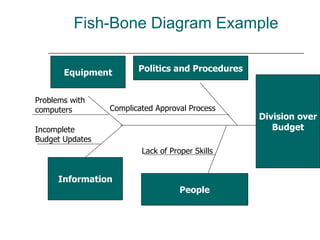
Fish-Bone Diagram Structure The outcome is usually on the right side of the diagram The four major categories are on the left. Potential causes are on each line of the diagram
Equipment Information Division over Budget Problems with computers Incomplete Budget Updates Politics and Procedures People Complicated Approval Process Lack of Proper Skills Fish-Bone Diagram Example
Brainstorming Similar to Free Association, a psychology concept Recommended guidelines are established at the beginning Not subject to evaluation or editing Inclusive of everyone’s contributions Subject to a time limit All ideas are fair game
How does brain-writing compare to brainstorming? A method of brainstorming that involves writing rather than speaking Necessitates the use of focusing techniques Use of Scales Rating Ranking
Force-Field Analysis State the objective  Prioritize the hindrances and barriers Show the importance of each of these aspects to the achievement of the goal. Assess the practical use of your action plan.
Abstraction Generalizing from the concrete details to basic attributes relevant to the concept’s purpose Mapping pieces of data based on similarities Carl Jung’s definition Sensing Feeling Thinking Intuition http://en.wikipedia.org/wiki/Abstraction
Means Ends Analysis (MEA) Finds the shortest route toward a desired goal state A controlled “search” Prodigy Automated planning project AI Knowledge operators  Table of connections Highlights correspondences between differences and actions http://en.wikipedia.org/wiki/Means-ends_analysis
SWOT Analysis Strengths Weaknesses Opportunities Threats
Strengths What are the advantages of the organization? What do they do well?
Example: DAU What does DAU do well? How does DAU benefit the EDD as a whole?
Weaknesses What are some improvements that could be made within the organization? What activity should be avoided by the organization?
Example: DAU  What improvements could be made to DAU? What activities should be avoided by this organization?
Opportunities What are some interesting trends for the organization? What are good chances facing you?
Example: DAU What does the economic, political, and social forecast look like for the DAU after 2010? Will there be opportunities available to the DAU staff in the near future?
Threats What obstacles does the organization face? What is their competition doing? How is changing technology affecting the organization at large? Does the organization have restricted cash flow?
Example: DAU What obstacles does DAU face on a daily/monthly basis? How is changing technology affecting the DAU’s productivity? Are the DAU’s processes limited by a restricted cash flow?
Summary Definitions of Creativity and Problem Solving Five Stages of Creativity Problem Solving Methods, Tools and Techniques Modern Day Example of SWOT Analysis
CREDITS Creator---------------Felicia Oropeza Special Thanks to Myron Kraus who helped me with the structure and implementation of this presentation.
Problem Solving And Creativity

  • 1.
    Problem Solving andCreativity Created by Felicia Oropeza
  • 2.
    Ice Breaker Pleasewrite on a piece of paper your answers to the following questions: What is your favorite month, animal, food, TV show, hobby, and color? Each person is to sign his or her name, and to make certain no one else sees the answers. I will then read the answers to the whole group, and members try to guess to whom each set of answers belongs. There will be one point for each answer. The person with the most points wins a goofy prize.
  • 3.
    The Application ofCreativity and Problem Solving to the Workplace Promotes team-building Increases motivation Generates novel ideas Provides structure for arriving at creative solutions Cultivates open-mindedness Fosters personal growth and the development of insight
  • 4.
    Definition of CreativityFacilitates the process of forming mental associations derived from unconscious and conscious thought. There is no exact definition of creativity. Also known as divergent thinking http://en.wikipedia.org/wiki/Creativity
  • 5.
    Common Forms ofCreativity Artificial Everyday Exceptional http://en.wikipedia.org/wiki/Creativity
  • 6.
    Processes Possibly Engagedduring Creative Activities Divine Intervention Social Environment Personality Traits Chance (Serendipity) http://en.wikipedia.org/wiki/Creativity
  • 7.
    Wallas’ Five Stagesof Creativity Published Art of Thought in 1926 Stages Preparation Incubation Intimation Illumination Verification http://en.wikipedia.org/wiki/Creativity
  • 8.
    Preparation Focusing themind on a given problem http://en.wikipedia.org/wiki/Creativity
  • 9.
    Incubation Incorporating detailsof problem into the unconscious http://en.wikipedia.org/wiki/Creativity
  • 10.
    Intimation Realizing thatone is close to finding a solution http://en.wikipedia.org/wiki/Creativity
  • 11.
    Illumination Insight “bursts”from the creative seat of consciousness into awareness http://en.wikipedia.org/wiki/Creativity
  • 12.
    Verification Prospective solutionis subject to elaboration, verification, and application http://en.wikipedia.org/wiki/Creativity
  • 13.
    Key Traits ofa Creative Individual the ability to self-critique and to change one’s mind; the ability to tell when a risk taken has succeeded or failed; the ability to back away from an idea despite time invested. http://www.cogsci.indiana.edu/Ambigrams.html
  • 14.
    Difference between Verticaland Lateral Thinking Vertical Thinking Thought Processes based on Propositional Logic and Prior Knowledge Lateral Thinking Thought Processes that increase one’s ability to accommodate changing trends and multiple dimensions of particular concepts. http://www.deakin.edu.au/~spalm/srp70733.html
  • 15.
    Creativity and AffectAt Work Positive affect in the workplace is directly related to creativity Creative acts are often followed by positive emotional experiences. Direct Immediate Fleeting http://en.wikipedia.org/wiki/Creativity
  • 16.
    Measures of CreativityIndependence of judgment Aesthetic Orientation Self-Confidence Attraction to Complexity Risk-Taking “ Openness to experience” may also be a creative trait-McCrae (1987) Byrne, R.M.J. (2005). The Rational Imagination: How People Create Counterfactual Alternatives to Reality. Cambridge, MA: MIT Press.
  • 17.
    Definition of ProblemSolving A higher-order mental process that moderates the use of everyday skills to perform complex functions. Applies to both an artificial intelligence system and a living entity. The process of achieving a desired goal state http://en.wikipedia.org/wiki/Problem_solving
  • 18.
    Five-Step Standard Methodof Problem Solving: Stating the Problem Identifying the Cause(s) Choosing Solution(s) Applying Solution(s) Plan Next Step(s)
  • 19.
    Stating the ProblemWhat can you see that causes you to think there's a problem? Where is it happening? How is it happening? When is it happening? With whom is it happening?
  • 20.
    Identifying the CauseWrite a complete description of cause based on own observations and others’ viewpoints. Why is this problem occurring? What are all the possible causes of this problem? Which causes are the most likely source of the problem? Which causes are easiest to fix (Prioritize)
  • 21.
    Choosing a SolutionAsk others for input Brainstorm possible solutions What are the possible solutions to this problem? Which solutions are easiest to implement? How will this problem be fixed by the solution? What decision making method will be used?
  • 22.
    Decision-Making Methods MajorityMajority rules Consensus Everyone can live with the result Authority The senior person decides without consultation Consultative A person decides following consultation
  • 23.
    Apply Solutions Applythe approved solution Complete an implementation plan Identify the risks involved Define criteria for success http://managementhelp.org/prsn_prd/prb_bsc.htm
  • 24.
    Plan the NextSteps Following up with a review meeting What was the problem? What did we do well? What could we have done better? What did we learn? Are further actions required? Who needs to know the results of this meeting? How will we communicate the results?
  • 25.
    Problem Solving ToolsImaging Fish-Bone Diagram Brainstorming Brain-writing Force-Field Analysis Abstraction Means-Ends Analysis SWOT Analysis
  • 26.
    Imaging Nontraditional Encourages“breakthrough thinking” Incorporates visual elements in the problem solution
  • 27.
    Fish-Bone Diagram Idealfor studying Cause-Effect Relationships Effectively develops performance measures from results
  • 28.
    Fish-Bone Diagram StructureThe outcome is usually on the right side of the diagram The four major categories are on the left. Potential causes are on each line of the diagram
  • 29.
    Equipment Information Divisionover Budget Problems with computers Incomplete Budget Updates Politics and Procedures People Complicated Approval Process Lack of Proper Skills Fish-Bone Diagram Example
  • 30.
    Brainstorming Similar toFree Association, a psychology concept Recommended guidelines are established at the beginning Not subject to evaluation or editing Inclusive of everyone’s contributions Subject to a time limit All ideas are fair game
  • 31.
    How does brain-writingcompare to brainstorming? A method of brainstorming that involves writing rather than speaking Necessitates the use of focusing techniques Use of Scales Rating Ranking
  • 32.
    Force-Field Analysis Statethe objective Prioritize the hindrances and barriers Show the importance of each of these aspects to the achievement of the goal. Assess the practical use of your action plan.
  • 33.
    Abstraction Generalizing fromthe concrete details to basic attributes relevant to the concept’s purpose Mapping pieces of data based on similarities Carl Jung’s definition Sensing Feeling Thinking Intuition http://en.wikipedia.org/wiki/Abstraction
  • 34.
    Means Ends Analysis(MEA) Finds the shortest route toward a desired goal state A controlled “search” Prodigy Automated planning project AI Knowledge operators Table of connections Highlights correspondences between differences and actions http://en.wikipedia.org/wiki/Means-ends_analysis
  • 35.
    SWOT Analysis StrengthsWeaknesses Opportunities Threats
  • 36.
    Strengths What arethe advantages of the organization? What do they do well?
  • 37.
    Example: DAU Whatdoes DAU do well? How does DAU benefit the EDD as a whole?
  • 38.
    Weaknesses What aresome improvements that could be made within the organization? What activity should be avoided by the organization?
  • 39.
    Example: DAU What improvements could be made to DAU? What activities should be avoided by this organization?
  • 40.
    Opportunities What aresome interesting trends for the organization? What are good chances facing you?
  • 41.
    Example: DAU Whatdoes the economic, political, and social forecast look like for the DAU after 2010? Will there be opportunities available to the DAU staff in the near future?
  • 42.
    Threats What obstaclesdoes the organization face? What is their competition doing? How is changing technology affecting the organization at large? Does the organization have restricted cash flow?
  • 43.
    Example: DAU Whatobstacles does DAU face on a daily/monthly basis? How is changing technology affecting the DAU’s productivity? Are the DAU’s processes limited by a restricted cash flow?
  • 44.
    Summary Definitions ofCreativity and Problem Solving Five Stages of Creativity Problem Solving Methods, Tools and Techniques Modern Day Example of SWOT Analysis
  • 45.
    CREDITS Creator---------------Felicia OropezaSpecial Thanks to Myron Kraus who helped me with the structure and implementation of this presentation.