CREATIVE
PROBLEM SOLVING
CREATIVE PROBLEM SOLVING
What is creative problem
solving?
• What is creative problem solving?
• Why don’t we think creatively more often?
• How can we be more creative?
• What is the creative problem solving process?
• What are some other specific creative problem solving
tools and techniques?
• Application of learning.
CREATIVE PROBLEM SOLVING
Workshop Outline
Areas which will cover during the
Training Session
• Introduction
• Purpose (Why do we need to learn)
• Learning Objectives
CREATIVE PROBLEM SOLVING
Introduction:
Creative problem-solving usually begins
with defining the problem. This may lead to
a simple non-creative solution, or to finding
a "textbook solution". The creative
problem-solving process may also lead to
the discovery of prior art and of creative
solutions by others.
CREATIVE PROBLEM SOLVING
• The creative person uses information to form new ideas.
• The real key to creative problem solving is what you do with the
knowledge.
• Creative problem solving requires an attitude that allows you to
search for new ideas and use your knowledge and experience.
• Change perspective and use knowledge to make the ordinary
extraordinary and the usual commonplace.
Some AdditionalThoughts
DEFINITION
CREATIVE PROBLEM SOLVING
How would you define “Creative problem solving”?
________________________________________________________
________________________________________________________
________________________________________________________
________________________________________________________
________________________________________________________
________________________________________________________
________________________________________________________
DEFINITION
CREATIVE PROBLEM SOLVING
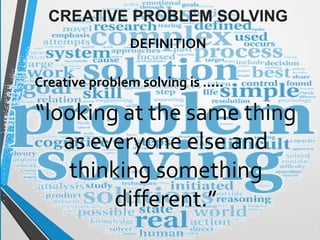
Creative problem solving is …..
“looking at the same thing
as everyone else and
thinking something
different.”
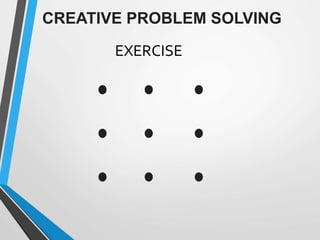
EXERCISE
CREATIVE PROBLEM SOLVING
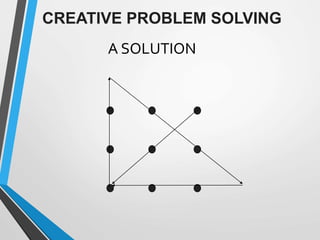
A SOLUTION
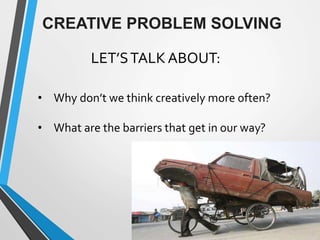
LET’STALK ABOUT:
• Why don’t we think creatively more often?
• What are the barriers that get in our way?
CREATIVE PROBLEM SOLVING
BARRIERSTHAT GET IN OUR WAY
• Time
• Why change?
• Usually don’t need to be creative
• Habit
• Routine
• Haven’t been taught to be creative
What are some other barriers that get in our way?
CREATIVE PROBLEM SOLVING
MENTAL BLOCKS
Mental blocks are
reasons (attitudes) why
we don’t “think
something different.”
CREATIVE PROBLEM SOLVING
1.The _______ answer.
2.That’s not _________.
3. __________ the rules.
4. Be ______________.
5. ________ is frivolous.
6.That’s not my _____.
7. ________ ambiguity.
8. Don’t be _________.
9. __________is wrong.
10. I’m not __________.
Questions we ask ourselves when solving
problems!
CREATIVE PROBLEM SOLVING
1.The right answer.
Only one?
MENTAL BLOCK # 1
CREATIVE PROBLEM SOLVING
MENTAL BLOCK # 2
1. The right answer.
2.That’s not logical.
CREATIVE PROBLEM SOLVING
MENTAL BLOCK # 3
1. The right answer.
2. That’s not logical.
3. Follow the rules.
Why rules should be
challenged:
1. We make rules based on
reasons that make a lot
of sense.
2. We follow these rules.
3. Time passes, and things
change.
4. The original reasons for
the generation of these
rules may no longer
exist, but because the
rules are still in place,
we continue to follow
them.
MENTAL BLOCK # 4
1. The right answer.
2. That’s not logical.
3. Follow the rules.
4.Be practical.
CREATIVE PROBLEM SOLVING
MENTAL BLOCK # 5
1. The right answer.
2. That’s not logical.
3. Follow the rules.
4. Be practical.
5. Play is frivolous.
“When do
you get
your best
ideas?”
CREATIVE PROBLEM SOLVING
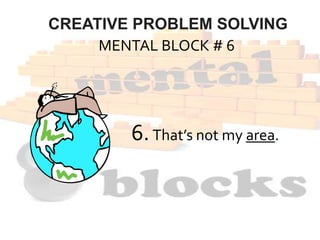
MENTAL BLOCK # 6
6.That’s not my area.
CREATIVE PROBLEM SOLVING
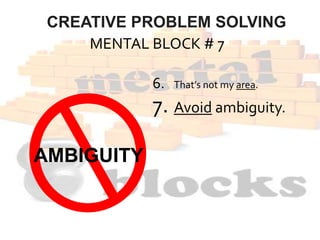
MENTAL BLOCK # 7
6. That’s not my area.
7. Avoid ambiguity.
AMBIGUITY
CREATIVE PROBLEM SOLVING
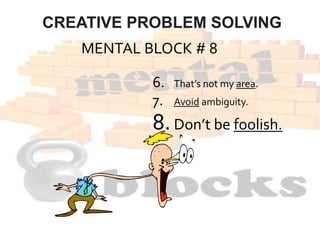
MENTAL BLOCK # 8
6. That’s not my area.
7. Avoid ambiguity.
8.Don’t be foolish.
CREATIVE PROBLEM SOLVING
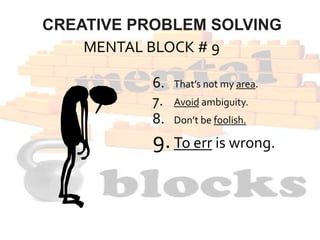
MENTAL BLOCK # 9
6. That’s not my area.
7. Avoid ambiguity.
8. Don’t be foolish.
9.To err is wrong.
CREATIVE PROBLEM SOLVING
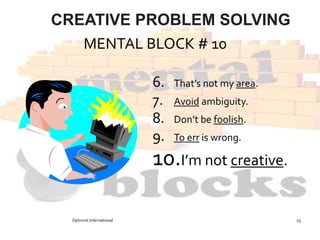
MENTAL BLOCK # 10
6. That’s not my area.
7. Avoid ambiguity.
8. Don’t be foolish.
9. To err is wrong.
10.I’m not creative.
Optimist International 25
CREATIVE PROBLEM SOLVING
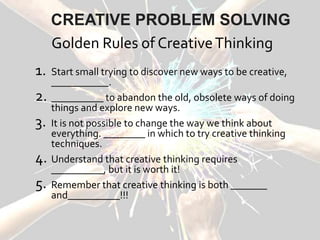
Golden Rules of CreativeThinking
1. Start small trying to discover new ways to be creative,
___________.
2. __________ to abandon the old, obsolete ways of doing
things and explore new ways.
3. It is not possible to change the way we think about
everything. ________ in which to try creative thinking
techniques.
4. Understand that creative thinking requires
__________, but it is worth it!
5. Remember that creative thinking is both _______
and__________!!!
CREATIVE PROBLEM SOLVING
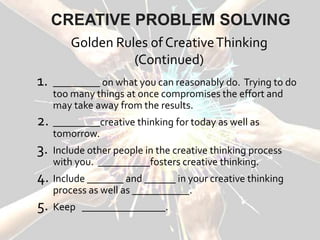
Golden Rules of CreativeThinking
(Continued)
1. _________ on what you can reasonably do. Trying to do
too many things at once compromises the effort and
may take away from the results.
2. _________creative thinking for today as well as
tomorrow.
3. Include other people in the creative thinking process
with you. __________fosters creative thinking.
4. Include _______ and ______ in your creative thinking
process as well as ___________.
5. Keep ________________.
CREATIVE PROBLEM SOLVING
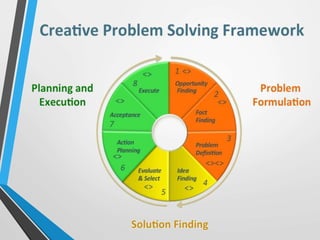
STEP 1. State what appears to be the problem.
The real problem may not surface until facts have been gathered
and analyzed. Therefore, start with what you assume to be the
problem, that can later be confirmed or corrected.
THE PROCESS
CREATIVE PROBLEM SOLVING
STEP 2. Gather facts, feelings and opinions.
• What happened?
• Where, when and how did it occur?
• What is it’s size, scope, and severity?
• Who and what is affected?
• Likely to happen again?
• Need to be corrected?
• May need to assign priorities to critical elements.
CREATIVE PROBLEM SOLVING
STEP 3. Restate the problem.
• The real facts help make this possible, and
provide supporting data.
• The actual problem may, or may not be the
same as stated in Step 1.
CREATIVE PROBLEM SOLVING
STEP 4. Identify alternative solutions.
• Generate ideas. Do not eliminate any
possible solutions until several have
been discussed.
CREATIVE PROBLEM SOLVING
STEP 5. Evaluate alternatives.
• Which will provide the optimum solution?
• What are the risks?
• Are costs in keeping with the benefits?
• Will the solution create new problems?
CREATIVE PROBLEM SOLVING
STEP 6. Implement the decision!
• Who must be involved?
• To what extent?
• How, when and where?
• Who will the decision impact?
• What might go wrong?
• How will the results be reported and verified?
CREATIVE PROBLEM SOLVING
STEP 7. Evaluate the results.
• Test the solution against the desired results.
• Make revisions if necessary.
CREATIVE PROBLEM SOLVING
ManagementTheorist have come up with tools/techniques
to tackle such situation:
1. Brain Storming
2. MULTIVOTING
3. MIND MAPPING
TOOLS &TECHNIQUES
CREATIVE PROBLEM SOLVING
Definition : A visual picture of a group of ideas, concepts or issues.
“Brain Storming”
Purpose :
• Unblock our thinking.
• See an entire idea or several ideas
on one sheet of paper.
• See how ideas relate to one
another.
• Look at things in a new and
different way.
• Look at an idea in depth.
Rules for Brainstorming:
• The more ideas the better!
• No discussion
• No idea is a bad idea
• Build on one another’s ideas
• Display all ideas
CREATIVE PROBLEM SOLVING
MULTI-VOTING
Purpose:
To help a group of people make a decision with which they are comfortable.
Definition: A way to vote to select the most important or popular items
(alternatives) from a list.
STEPS
1. Generate a list of items and number each item.
2. If two or more items seem similar, they may be combined.
3. If necessary, renumber the items.
4. Write down the numbers of the items you feel are the major cause of the
problem.
5. Share your votes by a show of hands.
6. Eliminate those items with the fewest votes.
7. Repeat steps 3 (renumber) through 6 on the list of remaining items.
Continue this process until only a few items remain. If a clear favorite
does not emerge, the group may discuss the items listed and make a
choice.
MIND MAPPING
Definition : A visual picture of a group of ideas, concepts or
issues.
Purpose :
• Unblock our thinking.
• See an entire idea or several ideas on one
sheet of paper.
• See how ideas relate to one another.
• Look at things in a new and different way.
• Look at an idea in depth.
CREATIVE PROBLEM SOLVING
MIND MAPPING
CREATIVE PROBLEM SOLVING
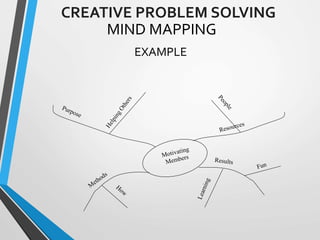
EXAMPLE
MIND MAPPING
CREATIVE PROBLEM SOLVING
Keep your printing large
and easy to read.
Feel free to use symbols
and or pictures.
Have some fun using
different colors.
A

Helpful Hints
APPLICATION OF LEARNING
What are “TheThree Greatest Problems / Opportunities
your “Team” faces when a problem arises?
i.e. “How do you motivate yourTeam members?”
1. _______________________________________
2. _______________________________________
3. _______________________________________
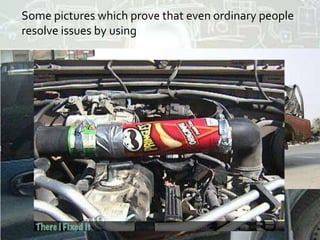
Some pictures which prove that even ordinary people
resolve issues by using
“Creative Problem Solving Skills”!
The Human Resource Department would like to thank you
for being a part of the learning culture….
We are now on facebook www.facebook.com/waterlinkpak

Creative Problem Solving

  • 2.
  • 3.
    CREATIVE PROBLEM SOLVING Whatis creative problem solving?
  • 4.
    • What iscreative problem solving? • Why don’t we think creatively more often? • How can we be more creative? • What is the creative problem solving process? • What are some other specific creative problem solving tools and techniques? • Application of learning. CREATIVE PROBLEM SOLVING Workshop Outline
  • 5.
    Areas which willcover during the Training Session • Introduction • Purpose (Why do we need to learn) • Learning Objectives CREATIVE PROBLEM SOLVING
  • 6.
    CREATIVE PROBLEM SOLVING Introduction: Creativeproblem-solving usually begins with defining the problem. This may lead to a simple non-creative solution, or to finding a "textbook solution". The creative problem-solving process may also lead to the discovery of prior art and of creative solutions by others.
  • 7.
    CREATIVE PROBLEM SOLVING •The creative person uses information to form new ideas. • The real key to creative problem solving is what you do with the knowledge. • Creative problem solving requires an attitude that allows you to search for new ideas and use your knowledge and experience. • Change perspective and use knowledge to make the ordinary extraordinary and the usual commonplace. Some AdditionalThoughts
  • 8.
    DEFINITION CREATIVE PROBLEM SOLVING Howwould you define “Creative problem solving”? ________________________________________________________ ________________________________________________________ ________________________________________________________ ________________________________________________________ ________________________________________________________ ________________________________________________________ ________________________________________________________
  • 9.
    DEFINITION CREATIVE PROBLEM SOLVING Creativeproblem solving is ….. “looking at the same thing as everyone else and thinking something different.”
  • 10.
  • 11.
  • 12.
    LET’STALK ABOUT: • Whydon’t we think creatively more often? • What are the barriers that get in our way? CREATIVE PROBLEM SOLVING
  • 13.
    CREATIVE PROBLEM SOLVING BARRIERSTHATGET IN OUR WAY • Time • Why change? • Usually don’t need to be creative • Habit • Routine • Haven’t been taught to be creative What are some other barriers that get in our way?
  • 14.
    CREATIVE PROBLEM SOLVING MENTALBLOCKS Mental blocks are reasons (attitudes) why we don’t “think something different.”
  • 15.
    CREATIVE PROBLEM SOLVING 1.The_______ answer. 2.That’s not _________. 3. __________ the rules. 4. Be ______________. 5. ________ is frivolous. 6.That’s not my _____. 7. ________ ambiguity. 8. Don’t be _________. 9. __________is wrong. 10. I’m not __________. Questions we ask ourselves when solving problems!
  • 16.
    CREATIVE PROBLEM SOLVING 1.Theright answer. Only one? MENTAL BLOCK # 1
  • 17.
    CREATIVE PROBLEM SOLVING MENTALBLOCK # 2 1. The right answer. 2.That’s not logical.
  • 18.
    CREATIVE PROBLEM SOLVING MENTALBLOCK # 3 1. The right answer. 2. That’s not logical. 3. Follow the rules. Why rules should be challenged: 1. We make rules based on reasons that make a lot of sense. 2. We follow these rules. 3. Time passes, and things change. 4. The original reasons for the generation of these rules may no longer exist, but because the rules are still in place, we continue to follow them.
  • 19.
    MENTAL BLOCK #4 1. The right answer. 2. That’s not logical. 3. Follow the rules. 4.Be practical. CREATIVE PROBLEM SOLVING
  • 20.
    MENTAL BLOCK #5 1. The right answer. 2. That’s not logical. 3. Follow the rules. 4. Be practical. 5. Play is frivolous. “When do you get your best ideas?” CREATIVE PROBLEM SOLVING
  • 21.
    MENTAL BLOCK #6 6.That’s not my area. CREATIVE PROBLEM SOLVING
  • 22.
    MENTAL BLOCK #7 6. That’s not my area. 7. Avoid ambiguity. AMBIGUITY CREATIVE PROBLEM SOLVING
  • 23.
    MENTAL BLOCK #8 6. That’s not my area. 7. Avoid ambiguity. 8.Don’t be foolish. CREATIVE PROBLEM SOLVING
  • 24.
    MENTAL BLOCK #9 6. That’s not my area. 7. Avoid ambiguity. 8. Don’t be foolish. 9.To err is wrong. CREATIVE PROBLEM SOLVING
  • 25.
    MENTAL BLOCK #10 6. That’s not my area. 7. Avoid ambiguity. 8. Don’t be foolish. 9. To err is wrong. 10.I’m not creative. Optimist International 25 CREATIVE PROBLEM SOLVING
  • 26.
    Golden Rules ofCreativeThinking 1. Start small trying to discover new ways to be creative, ___________. 2. __________ to abandon the old, obsolete ways of doing things and explore new ways. 3. It is not possible to change the way we think about everything. ________ in which to try creative thinking techniques. 4. Understand that creative thinking requires __________, but it is worth it! 5. Remember that creative thinking is both _______ and__________!!! CREATIVE PROBLEM SOLVING
  • 27.
    Golden Rules ofCreativeThinking (Continued) 1. _________ on what you can reasonably do. Trying to do too many things at once compromises the effort and may take away from the results. 2. _________creative thinking for today as well as tomorrow. 3. Include other people in the creative thinking process with you. __________fosters creative thinking. 4. Include _______ and ______ in your creative thinking process as well as ___________. 5. Keep ________________. CREATIVE PROBLEM SOLVING
  • 29.
    CREATIVE PROBLEM SOLVING STEP1. State what appears to be the problem. The real problem may not surface until facts have been gathered and analyzed. Therefore, start with what you assume to be the problem, that can later be confirmed or corrected. THE PROCESS
  • 30.
    CREATIVE PROBLEM SOLVING STEP2. Gather facts, feelings and opinions. • What happened? • Where, when and how did it occur? • What is it’s size, scope, and severity? • Who and what is affected? • Likely to happen again? • Need to be corrected? • May need to assign priorities to critical elements.
  • 31.
    CREATIVE PROBLEM SOLVING STEP3. Restate the problem. • The real facts help make this possible, and provide supporting data. • The actual problem may, or may not be the same as stated in Step 1.
  • 32.
    CREATIVE PROBLEM SOLVING STEP4. Identify alternative solutions. • Generate ideas. Do not eliminate any possible solutions until several have been discussed.
  • 33.
    CREATIVE PROBLEM SOLVING STEP5. Evaluate alternatives. • Which will provide the optimum solution? • What are the risks? • Are costs in keeping with the benefits? • Will the solution create new problems?
  • 34.
    CREATIVE PROBLEM SOLVING STEP6. Implement the decision! • Who must be involved? • To what extent? • How, when and where? • Who will the decision impact? • What might go wrong? • How will the results be reported and verified?
  • 35.
    CREATIVE PROBLEM SOLVING STEP7. Evaluate the results. • Test the solution against the desired results. • Make revisions if necessary.
  • 36.
    CREATIVE PROBLEM SOLVING ManagementTheoristhave come up with tools/techniques to tackle such situation: 1. Brain Storming 2. MULTIVOTING 3. MIND MAPPING TOOLS &TECHNIQUES
  • 37.
    CREATIVE PROBLEM SOLVING Definition: A visual picture of a group of ideas, concepts or issues. “Brain Storming” Purpose : • Unblock our thinking. • See an entire idea or several ideas on one sheet of paper. • See how ideas relate to one another. • Look at things in a new and different way. • Look at an idea in depth. Rules for Brainstorming: • The more ideas the better! • No discussion • No idea is a bad idea • Build on one another’s ideas • Display all ideas
  • 38.
    CREATIVE PROBLEM SOLVING MULTI-VOTING Purpose: Tohelp a group of people make a decision with which they are comfortable. Definition: A way to vote to select the most important or popular items (alternatives) from a list. STEPS 1. Generate a list of items and number each item. 2. If two or more items seem similar, they may be combined. 3. If necessary, renumber the items. 4. Write down the numbers of the items you feel are the major cause of the problem. 5. Share your votes by a show of hands. 6. Eliminate those items with the fewest votes. 7. Repeat steps 3 (renumber) through 6 on the list of remaining items. Continue this process until only a few items remain. If a clear favorite does not emerge, the group may discuss the items listed and make a choice.
  • 39.
    MIND MAPPING Definition :A visual picture of a group of ideas, concepts or issues. Purpose : • Unblock our thinking. • See an entire idea or several ideas on one sheet of paper. • See how ideas relate to one another. • Look at things in a new and different way. • Look at an idea in depth. CREATIVE PROBLEM SOLVING
  • 40.
  • 41.
    MIND MAPPING CREATIVE PROBLEMSOLVING Keep your printing large and easy to read. Feel free to use symbols and or pictures. Have some fun using different colors. A  Helpful Hints
  • 42.
    APPLICATION OF LEARNING Whatare “TheThree Greatest Problems / Opportunities your “Team” faces when a problem arises? i.e. “How do you motivate yourTeam members?” 1. _______________________________________ 2. _______________________________________ 3. _______________________________________
  • 43.
    Some pictures whichprove that even ordinary people resolve issues by using “Creative Problem Solving Skills”!
  • 45.
    The Human ResourceDepartment would like to thank you for being a part of the learning culture…. We are now on facebook www.facebook.com/waterlinkpak