CREATING A FEEDBACK
CULTURE
STOP	MANAGING	AND	START	COACHING
Hawley Kane
Head of Organizational
Talent & Leadership
Development, Saba Software TODAY’S
SPEAKER
S
Melany Gallant
Manager, Content Marketing,
Saba Software
© 2017 Saba Software, Inc.
AGENDA
What we’ll cover in today’s webinar:
1.  The Importance of Feedback
2.  The Role of Feedback in Modern Performance
3.  How to Give and Receive Feedback
4.  Building a Feedback Culture
POLL QUESTION
© 2017 Saba Software, Inc.
What is the feedback process like at your organization
today?
?
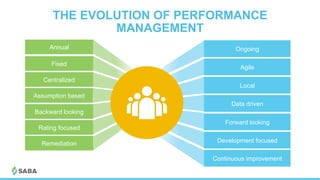
Annual
Fixed
Centralized
Assumption based
Backward looking
Rating focused
Remediation
THE EVOLUTION OF PERFORMANCE
MANAGEMENT
Ongoing
Agile
Local
Data driven
Forward looking
Development focused
Continuous improvement
5
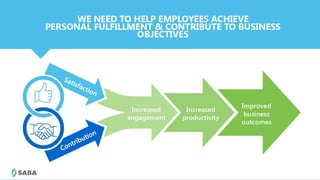
DRIVING BUSINESS OUTCOMES
INCREASED
ENGAGEMENT
INCREASED
PRODUCTIVITY
IMPROVED
BUSINESS
OUTCOMES
SATISFACTION
CONTRIBUTION
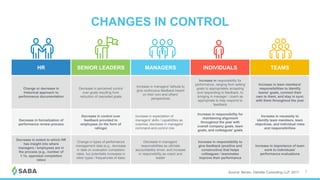
CHANGES IN CONTROL
HR SENIOR LEADERS MANAGERS INDIVIDUALS TEAMS
Change or decrease in
historical approach to
performance documentation
Decrease in perceived control
over goals resulting from
reduction of cascaded goals
Increase in managers' latitude to
give continuous feedback based
on their own and others'
perspectives
Increase in responsibility for
performance, ranging from setting
goals to appropriately accepting
and responding to feedback, to
bringing in manager / coach as
appropriate to help respond to
feedback
Increase in team members'
responsibilities to identify
teams' goals, connect their
own to them, and stay in sync
with them throughout the year
Decrease in formalization of
performance review process
Decrease in control over
feedback provided to
employees (in the form of
ratings)
Increase in expectation of
managers' skills / capabilities as
coaches; decrease in managers'
command-and-control role
Increase in responsibility for
maintaining alignment
throughout the year with
overall company goals, team
goals, and colleagues' goals
Increase in necessity to
identify team members, team
objectives, and individual roles
and responsibilities
Decrease in extent to which HR
has insight into where
managers / employees are in
the process (e.g., number of
1:1s, appraisal completion
rates)
Change in types of performance
management data (e.g., decrease
in data on evaluation completion
rates, but potentially increases in
other types / frequencies of data)
Decrease in managers'
responsibilities as ultimate
accountability driver, and increase
in responsibility as coach and
leader
Increase in responsibility to
give feedback (positive and
constructive) that helps
colleagues / teammates
improve their performance
Increase in importance of team
work to individuals'
performance evaluations
7Source: Bersin, Deloitte Consulting LLP, 2017.
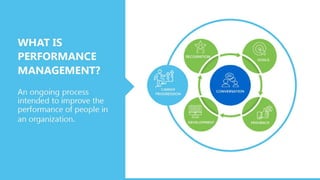
WHAT IS
PERFORMANCE
MANAGEMENT?
An ongoing process
intended to improve the
performance of people in
an organization.
Performance
Check-ins
4.
8
Feedback &
Recognition
2.
Managers5.
Development
3.
Goals1.
GOALS
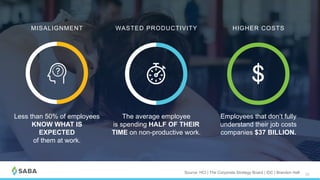
10Source: HCI | The Corporate Strategy Board | IDC | Brandon Hall
Less than 50% of employees
KNOW WHAT IS
EXPECTED
of them at work.
MISALIGNMENT
The average employee
is spending HALF OF THEIR
TIME on non-productive work.
WASTED PRODUCTIVITY
Employees that don’t fully
understand their job costs
companies $37 BILLION.
HIGHER COSTS
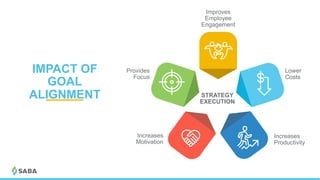
Provides
Focus
Increases
Motivation
Improves
Employee
Engagement
Increases
Productivity
Lower
Costs
STRATEGY
EXECUTION
IMPACT OF
GOAL
ALIGNMENT
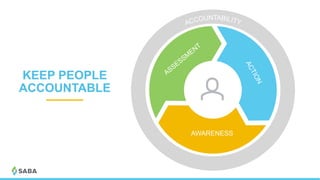
KEEP PEOPLE
ACCOUNTABLE
AWARENESS
DEVELOPMENT
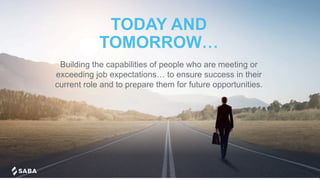
TODAY AND
TOMORROW…
Building the capabilities of people who are meeting or
exceeding job expectations… to ensure success in their
current role and to prepare them for future opportunities.
15
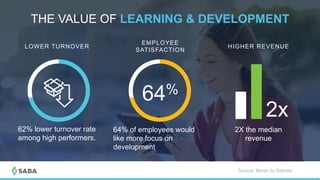
62% lower turnover rate
among high performers.
LOWER TURNOVER
64% of employees would
like more focus on
development
EMPLOYEE
SATISFACTION
2X the median
revenue
HIGHER REVENUE
2x
64%
Source: Bersin by Deloitte
THE VALUE OF LEARNING & DEVELOPMENT
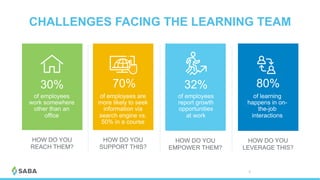
CHALLENGES FACING THE LEARNING TEAM
30% 70% 32% 80%
© 2017 Saba Software, Inc. 16
HOW DO YOU
REACH THEM?
HOW DO YOU
SUPPORT THIS?
of employees
work somewhere
other than an
office
of employees are
more likely to seek
information via
search engine vs.
50% in a course
HOW DO YOU
EMPOWER THEM?
of employees
report growth
opportunities
at work
HOW DO YOU
LEVERAGE THIS?
of learning
happens in on-
the-job
interactions
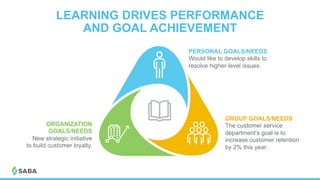
LEARNING DRIVES PERFORMANCE
AND GOAL ACHIEVEMENT
17
PERSONAL GOALS/NEEDS
Would like to develop skills to
resolve higher-level issues.
ORGANIZATION
GOALS/NEEDS
New strategic initiative
to build customer loyalty.
GROUP GOALS/NEEDS
The customer service
department’s goal is to
increase customer retention
by 2% this year.
POLL QUESTION
© 2017 Saba Software, Inc.
How often are your managers having performance
conversations with their employees?
?
PERFORMANCE
CHECK-INS
EMPLOYEES MANAGERS
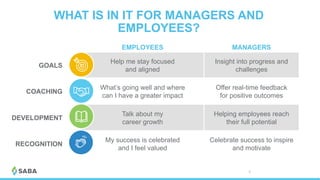
GOALS
Help me stay focused
and aligned
Insight into progress and
challenges
COACHING
What’s going well and where
can I have a greater impact
Offer real-time feedback
for positive outcomes
DEVELOPMENT
Talk about my
career growth
Helping employees reach
their full potential
RECOGNITION
My success is celebrated
and I feel valued
Celebrate success to inspire
and motivate
WHAT IS IN IT FOR MANAGERS AND
EMPLOYEES?
© 2017 Saba Software, Inc. 21
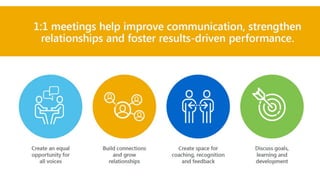
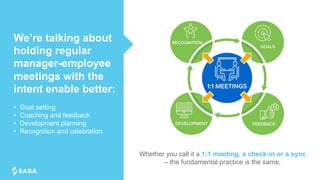
We’re talking about
holding regular
manager-employee
meetings with the
intent enable better:
•  Goal setting
•  Coaching and feedback
•  Development planning
•  Recognition and celebration
Whether you call it a 1:1 meeting, a check-in or a sync
– the fundamental practice is the same.
CASE EXAMPLE: DOGFISH HEAD CRAFT
BREWERY
© 2017 Saba Software, Inc. 23
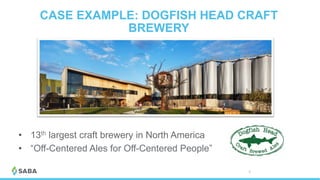
•  13th largest craft brewery in North America
•  “Off-Centered Ales for Off-Centered People”
CASE EXAMPLE: DOGFISH HEAD CRAFT
BREWERY
© 2017 Saba Software, Inc. 24
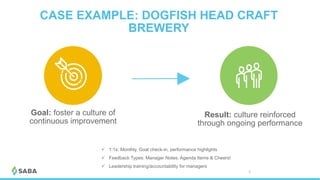
Result: culture reinforced
through ongoing performance
ü  1:1s: Monthly, Goal check-in, performance highlights
ü  Feedback Types: Manager Notes, Agenda Items & Cheers!
ü  Leadership training/accountability for managers
Goal: foster a culture of
continuous improvement
FEEDBACK &
RECONGITION
26
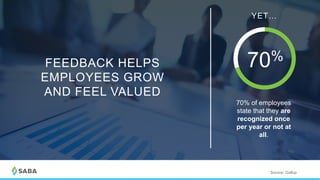
70% of employees
state that they are
recognized once
per year or not at
all.
70%
YET…
FEEDBACK HELPS
EMPLOYEES GROW
AND FEEL VALUED
Source: Gallup
27
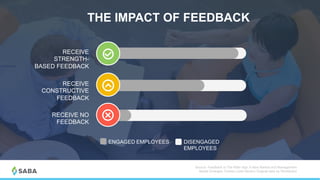
THE IMPACT OF FEEDBACK
Source: Feedback Is The Killer App: A New Market and Management
Model Emerges: Forbes (Josh Bersin) Original data by Workboard
ENGAGED	EMPLOYEES DISENGAGED
EMPLOYEES
RECEIVE NO
FEEDBACK
RECEIVE
STRENGTH-
BASED FEEDBACK
RECEIVE
CONSTRUCTIVE
FEEDBACK
The number one reason
feedback falls off the radar
– we’re too busy
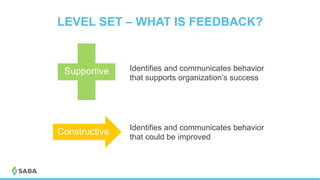
Identifies and communicates behavior
that could be improved
Identifies and communicates behavior
that supports organization’s success
Supportive
Constructive
LEVEL SET – WHAT IS FEEDBACK?
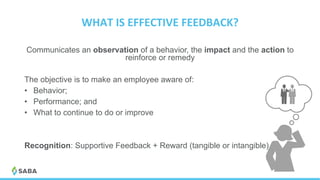
WHAT	IS	EFFECTIVE	FEEDBACK?	
Communicates an observation of a behavior, the impact and the action to
reinforce or remedy
The objective is to make an employee aware of:
•  Behavior;
•  Performance; and
•  What to continue to do or improve
Recognition: Supportive Feedback + Reward (tangible or intangible)
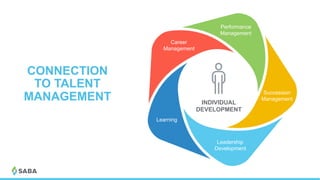
Performance
Management
Leadership
Development
Succession
Management
Career
Management
Learning
CONNECTION
TO TALENT
MANAGEMENT INDIVIDUAL
DEVELOPMENT
33© 2017 Saba Software, Inc.
#feedbackisagift
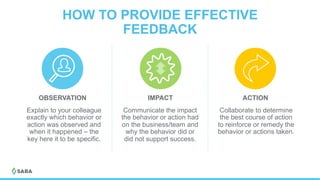
HOW TO PROVIDE EFFECTIVE
FEEDBACK
Explain to your colleague
exactly which behavior or
action was observed and
when it happened – the
key here it to be specific.
Communicate the impact
the behavior or action had
on the business/team and
why the behavior did or
did not support success.
Collaborate to determine
the best course of action
to reinforce or remedy the
behavior or actions taken.
OBSERVATION IMPACT ACTION
34© 2017 Saba Software, Inc.
#feedbackisagift
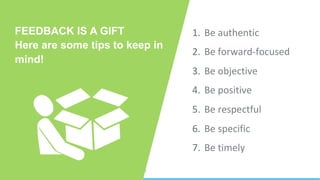
1.  Be	authentic	
2.  Be	forward-focused	
3.  Be	objective	
4.  Be	positive			
5.  Be	respectful	
6.  Be	specific	
7.  Be	timely	
FEEDBACK IS A GIFT
Here are some tips to keep in
mind!
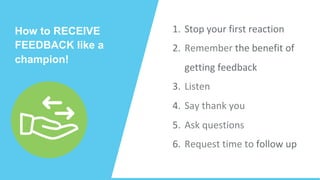
How to RECEIVE
FEEDBACK like a
champion!	
1.  Stop	your	first	reaction	
2.  Remember	the	benefit	of	
getting	feedback	
3.  Listen	
4.  Say	thank	you			
5.  Ask	questions	
6.  Request	time	to	follow	up
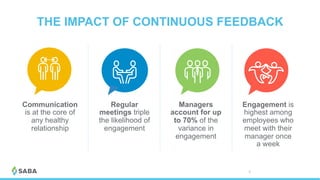
THE IMPACT OF CONTINUOUS FEEDBACK
Communication
is at the core of
any healthy
relationship
Regular
meetings triple
the likelihood of
engagement
Managers
account for up
to 70% of the
variance in
engagement
Engagement is
highest among
employees who
meet with their
manager once
a week
© 2017 Saba Software, Inc. 36
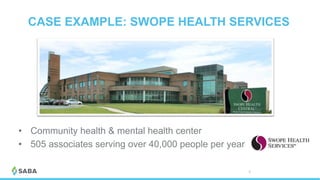
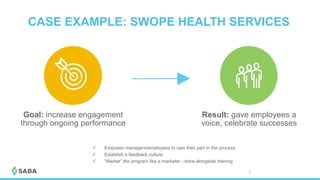
CASE EXAMPLE: SWOPE HEALTH SERVICES
© 2017 Saba Software, Inc. 37
•  Community health & mental health center
•  505 associates serving over 40,000 people per year
CASE EXAMPLE: SWOPE HEALTH SERVICES
© 2017 Saba Software, Inc. 38
Result: gave employees a
voice, celebrate successes
ü  Empower managers/employees to own their part in the process
ü  Establish a feedback culture
ü  “Market” the program like a marketer - done alongside training
Goal: increase engagement
through ongoing performance
HOW TO TRANSITION
YOUR CULTURE
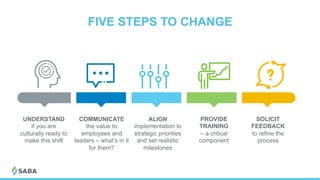
FIVE STEPS TO CHANGE
UNDERSTAND
if you are
culturally ready to
make this shift
COMMUNICATE
the value to
employees and
leaders – what’s in it
for them?
ALIGN
implementation to
strategic priorities
and set realistic
milestones
PROVIDE
TRAINING
– a critical
component
SOLICIT
FEEDBACK
to refine the
process
FEEDBACK needs to be “part of”
your unique business rhythm
and the heart of your talent
strategy!
POLL QUESTION
© 2017 Saba Software, Inc.
Are you interested in learning more about enabling
better feedback at your organization?
?
LEARN MORE
DOWNLOAD THE FEEDBACK TOOLKIT
bit.ly/feedback-toolkit
QUESTIONS?
THANK YOU

CREATING A FEEDBACK CULTURE

  • 1.
  • 2.
    Hawley Kane Head ofOrganizational Talent & Leadership Development, Saba Software TODAY’S SPEAKER S Melany Gallant Manager, Content Marketing, Saba Software © 2017 Saba Software, Inc.
  • 3.
    AGENDA What we’ll coverin today’s webinar: 1.  The Importance of Feedback 2.  The Role of Feedback in Modern Performance 3.  How to Give and Receive Feedback 4.  Building a Feedback Culture
  • 4.
    POLL QUESTION © 2017Saba Software, Inc. What is the feedback process like at your organization today? ?
  • 5.
    Annual Fixed Centralized Assumption based Backward looking Ratingfocused Remediation THE EVOLUTION OF PERFORMANCE MANAGEMENT Ongoing Agile Local Data driven Forward looking Development focused Continuous improvement 5
  • 6.
  • 7.
    CHANGES IN CONTROL HRSENIOR LEADERS MANAGERS INDIVIDUALS TEAMS Change or decrease in historical approach to performance documentation Decrease in perceived control over goals resulting from reduction of cascaded goals Increase in managers' latitude to give continuous feedback based on their own and others' perspectives Increase in responsibility for performance, ranging from setting goals to appropriately accepting and responding to feedback, to bringing in manager / coach as appropriate to help respond to feedback Increase in team members' responsibilities to identify teams' goals, connect their own to them, and stay in sync with them throughout the year Decrease in formalization of performance review process Decrease in control over feedback provided to employees (in the form of ratings) Increase in expectation of managers' skills / capabilities as coaches; decrease in managers' command-and-control role Increase in responsibility for maintaining alignment throughout the year with overall company goals, team goals, and colleagues' goals Increase in necessity to identify team members, team objectives, and individual roles and responsibilities Decrease in extent to which HR has insight into where managers / employees are in the process (e.g., number of 1:1s, appraisal completion rates) Change in types of performance management data (e.g., decrease in data on evaluation completion rates, but potentially increases in other types / frequencies of data) Decrease in managers' responsibilities as ultimate accountability driver, and increase in responsibility as coach and leader Increase in responsibility to give feedback (positive and constructive) that helps colleagues / teammates improve their performance Increase in importance of team work to individuals' performance evaluations 7Source: Bersin, Deloitte Consulting LLP, 2017.
  • 8.
    WHAT IS PERFORMANCE MANAGEMENT? An ongoingprocess intended to improve the performance of people in an organization. Performance Check-ins 4. 8 Feedback & Recognition 2. Managers5. Development 3. Goals1.
  • 9.
  • 10.
    10Source: HCI |The Corporate Strategy Board | IDC | Brandon Hall Less than 50% of employees KNOW WHAT IS EXPECTED of them at work. MISALIGNMENT The average employee is spending HALF OF THEIR TIME on non-productive work. WASTED PRODUCTIVITY Employees that don’t fully understand their job costs companies $37 BILLION. HIGHER COSTS
  • 11.
  • 12.
  • 13.
  • 14.
    TODAY AND TOMORROW… Building thecapabilities of people who are meeting or exceeding job expectations… to ensure success in their current role and to prepare them for future opportunities.
  • 15.
    15 62% lower turnoverrate among high performers. LOWER TURNOVER 64% of employees would like more focus on development EMPLOYEE SATISFACTION 2X the median revenue HIGHER REVENUE 2x 64% Source: Bersin by Deloitte THE VALUE OF LEARNING & DEVELOPMENT
  • 16.
    CHALLENGES FACING THELEARNING TEAM 30% 70% 32% 80% © 2017 Saba Software, Inc. 16 HOW DO YOU REACH THEM? HOW DO YOU SUPPORT THIS? of employees work somewhere other than an office of employees are more likely to seek information via search engine vs. 50% in a course HOW DO YOU EMPOWER THEM? of employees report growth opportunities at work HOW DO YOU LEVERAGE THIS? of learning happens in on- the-job interactions
  • 17.
    LEARNING DRIVES PERFORMANCE ANDGOAL ACHIEVEMENT 17 PERSONAL GOALS/NEEDS Would like to develop skills to resolve higher-level issues. ORGANIZATION GOALS/NEEDS New strategic initiative to build customer loyalty. GROUP GOALS/NEEDS The customer service department’s goal is to increase customer retention by 2% this year.
  • 18.
    POLL QUESTION © 2017Saba Software, Inc. How often are your managers having performance conversations with their employees? ?
  • 19.
  • 21.
    EMPLOYEES MANAGERS GOALS Help mestay focused and aligned Insight into progress and challenges COACHING What’s going well and where can I have a greater impact Offer real-time feedback for positive outcomes DEVELOPMENT Talk about my career growth Helping employees reach their full potential RECOGNITION My success is celebrated and I feel valued Celebrate success to inspire and motivate WHAT IS IN IT FOR MANAGERS AND EMPLOYEES? © 2017 Saba Software, Inc. 21
  • 22.
    We’re talking about holdingregular manager-employee meetings with the intent enable better: •  Goal setting •  Coaching and feedback •  Development planning •  Recognition and celebration Whether you call it a 1:1 meeting, a check-in or a sync – the fundamental practice is the same.
  • 23.
    CASE EXAMPLE: DOGFISHHEAD CRAFT BREWERY © 2017 Saba Software, Inc. 23 •  13th largest craft brewery in North America •  “Off-Centered Ales for Off-Centered People”
  • 24.
    CASE EXAMPLE: DOGFISHHEAD CRAFT BREWERY © 2017 Saba Software, Inc. 24 Result: culture reinforced through ongoing performance ü  1:1s: Monthly, Goal check-in, performance highlights ü  Feedback Types: Manager Notes, Agenda Items & Cheers! ü  Leadership training/accountability for managers Goal: foster a culture of continuous improvement
  • 25.
  • 26.
    26 70% of employees statethat they are recognized once per year or not at all. 70% YET… FEEDBACK HELPS EMPLOYEES GROW AND FEEL VALUED Source: Gallup
  • 27.
    27 THE IMPACT OFFEEDBACK Source: Feedback Is The Killer App: A New Market and Management Model Emerges: Forbes (Josh Bersin) Original data by Workboard ENGAGED EMPLOYEES DISENGAGED EMPLOYEES RECEIVE NO FEEDBACK RECEIVE STRENGTH- BASED FEEDBACK RECEIVE CONSTRUCTIVE FEEDBACK
  • 28.
    The number onereason feedback falls off the radar – we’re too busy
  • 29.
    Identifies and communicatesbehavior that could be improved Identifies and communicates behavior that supports organization’s success Supportive Constructive LEVEL SET – WHAT IS FEEDBACK?
  • 30.
    WHAT IS EFFECTIVE FEEDBACK? Communicates an observationof a behavior, the impact and the action to reinforce or remedy The objective is to make an employee aware of: •  Behavior; •  Performance; and •  What to continue to do or improve Recognition: Supportive Feedback + Reward (tangible or intangible)
  • 32.
  • 33.
    33© 2017 SabaSoftware, Inc. #feedbackisagift HOW TO PROVIDE EFFECTIVE FEEDBACK Explain to your colleague exactly which behavior or action was observed and when it happened – the key here it to be specific. Communicate the impact the behavior or action had on the business/team and why the behavior did or did not support success. Collaborate to determine the best course of action to reinforce or remedy the behavior or actions taken. OBSERVATION IMPACT ACTION
  • 34.
    34© 2017 SabaSoftware, Inc. #feedbackisagift 1.  Be authentic 2.  Be forward-focused 3.  Be objective 4.  Be positive 5.  Be respectful 6.  Be specific 7.  Be timely FEEDBACK IS A GIFT Here are some tips to keep in mind!
  • 35.
    How to RECEIVE FEEDBACKlike a champion! 1.  Stop your first reaction 2.  Remember the benefit of getting feedback 3.  Listen 4.  Say thank you 5.  Ask questions 6.  Request time to follow up
  • 36.
    THE IMPACT OFCONTINUOUS FEEDBACK Communication is at the core of any healthy relationship Regular meetings triple the likelihood of engagement Managers account for up to 70% of the variance in engagement Engagement is highest among employees who meet with their manager once a week © 2017 Saba Software, Inc. 36
  • 37.
    CASE EXAMPLE: SWOPEHEALTH SERVICES © 2017 Saba Software, Inc. 37 •  Community health & mental health center •  505 associates serving over 40,000 people per year
  • 38.
    CASE EXAMPLE: SWOPEHEALTH SERVICES © 2017 Saba Software, Inc. 38 Result: gave employees a voice, celebrate successes ü  Empower managers/employees to own their part in the process ü  Establish a feedback culture ü  “Market” the program like a marketer - done alongside training Goal: increase engagement through ongoing performance
  • 39.
  • 40.
    FIVE STEPS TOCHANGE UNDERSTAND if you are culturally ready to make this shift COMMUNICATE the value to employees and leaders – what’s in it for them? ALIGN implementation to strategic priorities and set realistic milestones PROVIDE TRAINING – a critical component SOLICIT FEEDBACK to refine the process
  • 41.
    FEEDBACK needs tobe “part of” your unique business rhythm and the heart of your talent strategy!
  • 42.
    POLL QUESTION © 2017Saba Software, Inc. Are you interested in learning more about enabling better feedback at your organization? ?
  • 43.
    LEARN MORE DOWNLOAD THEFEEDBACK TOOLKIT bit.ly/feedback-toolkit
  • 44.
  • 45.